ラミクタール錠小児用2mg
ラミクタール錠小児用5mg
ラミクタール錠25mg
ラミクタール錠100mg
に関する資料
本資料に記載された情報に係る権利及び内容の責任はグラクソ・スミ
スクライン株式会社に帰属するものであり、当該情報を適正使用以外
の営利目的に利用することはできません。
グラクソ・スミスクライン株式会社
ラミクタール錠25mg
ラミクタール錠100mg
ラミクタール錠小児用2mg
ラミクタール錠小児用5mg
製造販売承認事項一部変更承認申請書添付資料
第1部(モジュール1)
申請書等行政情報及び添付文書に関する情報
グラクソ・スミスクライン株式会社
1.5. 起原又は発見の経緯及び開発の経緯
ラモトリギンは、英国Wellcome Foundation 社(現 GlaxoSmithKline 社)が開発したトリア
ジン骨格を有する抗てんかん薬である。その作用は、電位依存性Na+チャネルの遅い不活性 化に作用して、不活性化からの回復を遅延させることによりNa+チャネルを抑制し、神経細 胞膜を安定化してグルタミン酸等の興奮性神経伝達物質遊離を抑制する結果、神経細胞のて んかん様バーストを抑制することによると考えられている。 ラモトリギンは、成人の部分発作に対するadd-on 療法薬として、1990 年にアイルランド で承認を取得して以来、100 ヵ国以上で承認されている(2014 年 9 月現在)。また、小児の 定型欠神発作に対する単剤療法として、欧州では2005 年にチェコ、ルーマニア、スロバキ
アで承認された。なお、欧州においてはその後Article 30 procedure による Summary of
Product Characteristics の改訂が 2008 年 7 月に CHMP により了承され、効能・効果、用法・ 用量が統一された。 本邦では、「他の抗てんかん薬で十分な効果が認められないてんかん患者の部分発作(二 次性全般化発作を含む)、強直間代発作及びLennox-Gastaut 症候群における全般発作に対す る抗てんかん薬との併用療法」の効能・効果で2008 年 10 月に承認を取得し、同年 12 月よ り市販されている。さらに、2011 年 7 月に「双極性障害における気分エピソードの再発・ 再燃抑制」、2014 年 8 月に「てんかん患者の部分発作(二次性全般化発作を含む)及び強 直間代発作に対する単剤療法」の追加効能に係る承認を取得している。 1.5.1. 申請に至った経緯 てんかん発作は、身体的な影響だけでなく、心理社会的、経済的側面からも日常生活に重 大な影響を及ぼす疾患である。てんかんは長期継続治療が必要であり、安全性、薬物相互作 用、経済的負担の軽減及びコンプライアンス向上の観点から、単剤療法の方が併用療法より も利点があると考えられている[Faught, 2007]。また、妊娠の可能性のある女性にとっては、 先天異常のリスクを最小限に留めるためにも、可能であれば単剤にすることが推奨されてい る[French , 2008; 日本神経学会, 2010]。新たに診断されたてんかん患者に対する治療は、第 1 薬目の抗てんかん薬を単剤療法で試し、効果が認められなかった場合は第 2 薬目の薬剤を 単剤療法で試し、それでも効果の発現が認められなかった場合には多剤併用療法を行う場合 が多い。実際に約60%が第 1 薬目あるいは第 2 薬目の薬剤の単剤療法にてコントロールされ ていることが報告されている[Karceski, 2005; Kwan, 2000]。 日本神経学会が監修している「てんかん治療ガイドライン2010」では、CQ6-2「小児欠神 てんかんに対する第一選択薬はなにか」に対し、「現時点ではバルプロ酸が推奨され、ラモ トリギンやエトスクシミドについては患児の状態や副作用などを確認しながら選択薬として 推奨される」と記載されており、CQ4-5「全般発作にバルプロ酸、部分発作にカルバマゼピ ンを十分量使用しても発作が再発した場合には、次に何を使用すべきか」に対し、欠神発作 の場合「エトスクシミドないしラモトリギンが推奨される」と記載されている[日本神経学 会, 2010]。つまり、これらの記載から、小児てんかんでの欠神発作に対して、バルプロ酸が 第一選択薬として推奨されていることがわかる。定型欠神発作の治療の選択肢は、バルプロ 1.5. 起原又は発見の経緯及び開発の経緯
酸、エトスクシミド又はラモトリギンの3 つのみであるが、日本では、ラモトリギンが承認
されていないため、バルプロ酸とエトスクシミドの2 つの選択肢のみであるのが現状である。
また、2012 年に発行された英国 National Institute for Health and Clinical Excellence (NICE)の ガイドライン[National Institute for Health and Clinical Excellence (NICE), 2012]には発作型別の
薬剤選択が示されており、欠神発作に対するFirst-line の抗てんかん薬として、エトスクシ ミド、ラモトリギン及びバルプロ酸の3 剤が示されているが、本文中には、欠神発作の第一 選択薬としてバルプロ酸やエトスクシミドがあるが、強直間代発作のリスクが高い患者には バルプロ酸を使用することとして推奨されている。バルプロ酸やエトスクシミドの効果がな く、忍容性に問題がある場合にはラモトリギンを使用するよう推奨されている。 さらに、2013 年に改訂された ILAE 治療ガイドライン[Glauser, 2013]では、有効性が確立 されている薬剤としてエトスクシミド及びバルプロ酸が示されているが、ラモトリギンは有 効である可能性が高い薬剤として示されている。 欧州におけるてんかん治療の専門家57 名(42 名回答、回答率 74%)に対し、抗てんかん
薬の使用について調査した「European expert opinion, 2007」[Wheless, 2007]では、欠神発作に 対する治療薬について、6 歳前後及び 12 歳前後に分けられて評価されている。エトスクシ ミドは強直間代発作に対して効果が低いことから、強直間代発作への発展が考えられる高年 齢の小児の欠神発作に対して、時々適切と評価されている。また、バルプロ酸は、妊婦又は 妊娠している可能性のある女性への投与について、原則禁忌となっていることからラモトリ ギンが適切であると述べられている。 このように、ラモトリギンのてんかん患者に対する単剤療法が世界的に推奨されているに もかかわらず、本邦においては、2008 年 10 月にラモトリギンの承認を取得したものの、そ の適応は「他の抗てんかん薬で十分な効果が認められないてんかん患者の部分発作(二次性 全般化発作を含む)、強直間代発作及びLennox-Gastaut 症候群における全般発作に対する抗 てんかん薬との併用療法」に限られていた。 このような状況の下、厚生労働省医政局研究開発振興課及び医薬食品局審査管理課が平成 21 年 6 月から 8 月に実施した「欧米では使用が認められているが、国内では承認されてい ない医療上必要な医薬品や適応(未承認薬・適応外薬)に係る要望の公募」に、日本てんか ん学会、日本脳神経外科学会及び日本小児神経学会より「成人における部分発作(二次性全 般化発作を含む)に対する単剤療法」等を目的とする本剤の開発に関して要望書が提出され た。「医療上の必要性の高い未承認薬・適応外薬検討会議」における検討の結果、「成人に おける部分発作(二次性全般化発作を含む)に対する単剤療法」「成人における強直間代発 作に対する単剤療法」「小児における定型欠神発作に対する単剤療法」については医療上の 必要性が高いという評価が得られたことから、厚生労働省医政局研究開発振興課長及び厚生 労働省医薬食品局審査管理課長より開発要請を受けた(平成22 年 12 月 13 日付医政研発 1213 第 1 号及び薬食審査発 1213 第 1 号「未承認薬・適応外薬の開発要請について」)。 グラクソ・スミスクライン株式会社は、この要請を受け、平成 年 月 日に実施した 医薬品医療機器総合機構との対面助言(医薬品 相談)の結果を踏まえ、成 人では新たに診断されたてんかん患者及び再発したてんかん患者(未治療)を対象とした単 1.5. 起原又は発見の経緯及び開発の経緯
剤療法試験(LAM115376 試験)を実施し、小児では新たに診断されたてんかん患者を対象 とした定型欠神発作に対する単剤療法試験(LAM115377 試験)を実施した。 今般、小児てんかん患者を対象とした臨床試験が終了し、日本人を含むてんかん患者にお ける本剤の有効性および安全性が確認されたことから、「てんかん患者の定型欠神発作に対 する単剤療法」の効能・効果を追加するための承認事項一部変更承認申請を行うものである。 なお、成人については、2014 年 8 月に「てんかん患者の部分発作(二次性全般化発作を 含む)及び強直間代発作に対する単剤療法」の効能・効果が追加で承認された。 1.5.2. 起原又は発見の経緯及び開発の経緯 起原又は発見の経緯及び開発の経緯については、平成13 年 6 月 21 日付医薬審発第 899 号 医薬局審査管理課長通知「新医薬品の製造又は輸入の承認申請に際し承認申請書に添付すべ き資料の作成要領について」の別紙2 の 5(1)に作成要領が示されているが、その中の「当該 内容が第2 部(5)に記載できる場合は、第一部において提出を省略することができる」との 記述をもとに、当該内容を第2 部(5)に記載した。 表 1.5.2-1 に、第 2 部(5)での当該内容の記載場所を示す。 また、開発の経緯図を図 1.5.2-1 に示す。 表 1.5.2-1 第 1 部(5)に関する内容の第 2 部(5)における記載場所 第1 部(5)に関する内容 第2 部(5)における記載場所 てんかんの病態及び治療 2.5.1.1.1. 2.5.1.1.2. てんかんの病態と疫学 日本のてんかん治療の現状及び Unmet medical needs
開発の経緯、治験相談 2.5.1.2. 2.5.1.3. ラモトリギンの開発 国内でのラモトリギン単剤療法の開 発に対する規制当局の助言 臨床試験データパッケージ 2.5.1.4. 承認申請に用いる定型欠神発作に対 するラモトリギン単剤療法の臨床デ ータパッケージ 有効性、安全性に基づく有用性に関する記載 2.5.6. ベネフィットとリスクに関する結論 なお、ラモトリギンの非臨床試験については、「他の抗てんかん薬で十分な効果が認めら れないてんかん患者の部分発作(二次性全般化発作を含む)、強直間代発作及び Lennox-Gastaut 症候群における全般発作に対する抗てんかん薬との併用療法」の効能取得時に既に 評価されていることから、新たな試験は実施しなかった。 1.5. 起原又は発見の経緯及び開発の経緯
図 1.5.2-1 国内外で実施された試験に関する開発の経緯図
1.5. 起原又は発見の経緯及び開発の経緯
参考文献
Faught E. Monotherapy in adults and elderly persons. Neurology. 2007;69(Suppl 3):S3-9. French JA, Pedley TA. Initial management of epilepsy. N Engl J Med. 2008;359:166-76.
Glauser T, Ben-Menachem E, Bourgeois B, et al. Updated ILAE evidence review of antiepileptic drug efficacy and effectiveness as initial monotherapy for epileptic seizures and syndromes. Epilepsia. 2013;54:551-63.
Karceski S, Morrell MJ, Carpenter D. Treatment of epilepsy in adults: expert opinion, 2005. Epilepsy
Behav. 2005;7 Suppl:S1-64.
Kwan P, Brodie MJ. Early identification of refractory epilepsy. N Engl J Med. 2000;342:314-9. National Institute for Health and Clinical Excellence (NICE). The epilepsies: the diagnosis and management of the epilepsies in adults and children in primary and secondary care. NICE clinical guideline 137. Available at URL (2014.9): http://www.nice.org.uk/cg137. 2012:.
Wheless JW, Clarke DF, Arzimanoglou A, et al. Treatment of pediatric epilepsy: European expert opinion, 2007. Epileptic Disord. 2007;9:353-412.
日本神経学会. てんかん治療ガイドライン 2010. Available at URL (2014.9):
http://www.neurology-jp.org/guidelinem/tenkan.html. 2010:.
1.6. 外国における使用状況等に関する資料
ラモトリギンは、成人の部分発作に対するadd-on 療法薬として、1990 年にアイルランド
で承認を取得して以来、100 ヵ国以上で承認されている(2014 年 9 月現在)。また、小児の
定型欠神発作に対する単剤療法として、欧州では2005 年にチェコ、ルーマニア、スロバキ
アで承認された。なお、欧州においてはその後Article 30 procedure による Summary of
Product Characteristics の改訂が 2008 年 7 月に CHMP により了承され、効能・効果、用法・ 用量が統一された。 主要国における承認状況を表 1.6-1 に示す。 表 1.6-1 主要国における承認状況及び承認取得年月(2014 年 9 月現在) 国名 販売名 剤型・含量 (mg) てんかん(成人) てんかん(小児) 双極性障害 add-on 療法 単剤療法 add-on 療法 定型欠神発 作単剤療法 英国 Lamictal 錠:25, 50, 100, 200 DC 錠1:2, 5, 25, 100, 200 1991 年 10 月 1995 年 2 月 1994 年 5 月 2009 年 10 月 2009 年 10 月 米国 Lamictal 錠:25, 100, 150, 200 CD 錠1:2, 5, 25 ODT2:25, 50, 100, 200 1994 年 12 月 1998 年 12 月3 2003 年 1 月 - 2003 年 6 月 ドイツ Lamictal DC 錠1:2, 5, 25, 50, 100, 200 1993 年 6 月 1996 年 12 月 1996 年 12 月 2008 年 11 月 2003 年 10 月 フランス Lamictal 錠:25, 50 DC 錠1:2, 5, 25, 50, 100, 200 1995 年 5 月 1999 年 12 月 1997 年 12 月 2009 年 1 月 2009 年 1 月
1. dispersible/chewable tablets(英国、ドイツ、フランス)又は chewable dispersible tablets(米国)
2. orally disintegrating tablets
3. 他の抗てんかん薬からの切り替えによる単剤療法
欧州のてんかんに関する効能・効果を以下に示す。また本項では、以下の資料を添付した。 1.6.1 欧州における添付文書の原文及び和訳
1.6.2 企業中核データシート(COMPANY CORE DATASHEET)の原文
なお、米国においては申請効能である「定型欠神発作に対する単剤療法」は承認されてい ない。 欧州における効能・効果(てんかん) 成人及び青年(13 歳以上) -部分発作及び強直間代発作を含む全般発作に対する併用療法又は単剤療法 -Lennox-Gastaut 症候群における発作。併用療法としてラミクタールを投与するが、 Lennox-Gastaut 症候群に対する初回治療としての抗てんかん薬となる可能性がある。 小児及び青年(2~12 歳) -部分発作及び強直間代発作を含む全般発作及びLennox-Gastaut 症候群における発作に対 する併用療法 -定型欠神発作に対する単剤療法 1.6. 外国における使用状況等に関する資料
v16 - Final
1. NAME OF THE MEDICINAL PRODUCT Lamictal and associated names (see Annex I) 25 mg tablets. Lamictal and associated names (see Annex I) 50 mg tablets. Lamictal and associated names (see Annex I) 100 mg tablets. Lamictal and associated names (see Annex I) 200 mg tablets.
Lamictal and associated names (see Annex I) 2 mg chewable/dispersible tablets. Lamictal and associated names (see Annex I) 5 mg chewable/dispersible tablets. Lamictal and associated names (see Annex I) 25 mg chewable/dispersible tablets. Lamictal and associated names (see Annex I) 50 mg chewable/dispersible tablets. Lamictal and associated names (see Annex I) 100 mg chewable/dispersible tablets. Lamictal and associated names (see Annex I) 200 mg chewable/dispersible tablets. [See Annex I - To be completed nationally]
2. QUALITATIVE AND QUANTITATIVE COMPOSITION Each Lamictal 25 mg tablet contains 25 mg lamotrigine.
Excipient: Each tablet contains 23.5 mg lactose. Each Lamictal 50 mg tablet contains 50 mg lamotrigine. Excipient: Each tablet contains 46.9 mg lactose.
Each Lamictal 100 mg tablet contains 100 mg lamotrigine. Excipient: Each tablet contains 93.9 mg lactose.
Each Lamictal 200 mg tablet contains 200 mg lamotrigine. Excipient: Each tablet contains 109.0 mg lactose.
Each Lamictal 2 mg chewable/dispersible tablet contains 2 mg lamotrigine. Each Lamictal 5 mg chewable/dispersible tablet contains 5 mg lamotrigine. Each Lamictal 25 mg chewable/dispersible tablet contains 25 mg lamotrigine. Each Lamictal 50 mg chewable/dispersible tablet contains 50 mg lamotrigine. Each Lamictal 100 mg chewable/dispersible tablet contains 100 mg lamotrigine. Each Lamictal 200 mg chewable/dispersible tablet contains 200 mg lamotrigine. For the full list of excipients, see section 6.1.
3. PHARMACEUTICAL FORM Tablet.
Chewable/dispersible tablet. 25 mg tablets:
Pale, yellowish-brown, multifaceted, super-elliptical tablets of 6.0 mm marked “GSEC7” on one side and “25” on the other.
50 mg tablets:
Pale, yellowish-brown, multifaceted, super-elliptical tablets of 7.4 mm marked “GSEE1” on one side and “50” on the other.
100 mg tablets:
Pale, yellowish-brown, multifaceted, super-elliptical tablets of 9.4 mm marked “GSEE5” on one side and “100” on the other.
v16 - Final 200 mg tablets:
Pale, yellowish-brown, multifaceted, super-elliptical tablets of 10.2 mm marked “GSEE7” on one side and “200” on the other.
2 mg chewable/dispersible tablets:
White to off-white round tablets of 4.8 mm with a blackcurrant odour. One side has a bevelled edge and is marked “LTG” above the number 2. The other side is marked with two overlapping super-ellipses at right angles. The tablets may be slightly mottled.
5 mg chewable/dispersible tablets:
White to off-white, elongated, biconvex tablets (major axis 8.0 mm; minor axis 4.0 mm) with a blackcurrant odour, marked “GS CL2” on one side and “5” on the other. The tablets may be slightly mottled.
25 mg chewable/dispersible tablets:
White to off-white multi-faceted, super-elliptical, tablets of 5.2 mm with a blackcurrant odour, marked “GSCL5” on one side “25” on the other. The tablets may be slightly mottled.
50 mg chewable/dispersible tablets:
White to off-white multi-faceted, super-elliptical, tablets of 6.6 mm with a blackcurrant odour, marked “GSCX7” on one side and “50” on the other. The tablets may be slightly mottled.
100 mg chewable/dispersible tablets:
White to off-white multi-faceted, super-elliptical, tablets of 8.3 mm with a blackcurrant odour, marked “GSCL7” on one side and “100” on the other. The tablets may be slightly mottled.
200 mg chewable/dispersible tablets:
White to off-white multi-faceted, super-elliptical, tablets of 10.4 mm with a blackcurrant odour, marked “GSEC5” on one side and “200” on the other. The tablets may be slightly mottled.
4. CLINICAL PARTICULARS 4.1 Therapeutic indications Epilepsy
Adults and adolescents aged 13 years and above
- Adjunctive or monotherapy treatment of partial seizures and generalised seizures, including tonic-clonic seizures.
- Seizures associated with Lennox-Gastaut syndrome. Lamictal is given as adjunctive therapy but may be the initial antiepileptic drug (AED) to start with in Lennox-Gastaut syndrome.
Children and adolescents aged 2 to 12 years
- Adjunctive treatment of partial seizures and generalised seizures, including tonic-clonic seizures and the seizures associated with Lennox-Gastaut syndrome.
- Monotherapy of typical absence seizures. Bipolar disorder
Adults aged 18 years and above
- Prevention of depressive episodes in patients with bipolar I disorder who experience predominantly depressive episodes (see section 5.1).
v16 - Final
4.2 Posology and method of administration
Lamictal tablets should be swallowed whole, and should not be chewed or crushed.
Lamictal chewable/dispersible tablets may be chewed, dispersed in a small volume of water (at least enough to cover the whole tablet) or swallowed whole with a little water.
If the calculated dose of lamotrigine (for example for treatment of children with epilepsy or patients with hepatic impairment) does not equate to whole tablets, the dose to be administered is that equal to the lower number of whole tablets.
Restarting therapy
Prescribers should assess the need for escalation to maintenance dose when restarting Lamictal in patients who have discontinued Lamictal for any reason, since the risk of serious rash is associated with high initial doses and exceeding the recommended dose escalation for lamotrigine (see section 4.4). The greater the interval of time since the previous dose, the more consideration should be given to escalation to the maintenance dose. When the interval since discontinuing lamotrigine exceeds five half-lives (see section 5.2), Lamictal should generally be escalated to the maintenance dose according to the appropriate schedule.
It is recommended that Lamictal not be restarted in patients who have discontinued due to rash associated with prior treatment with lamotrigine unless the potential benefit clearly outweighs the risk.
Epilepsy
The recommended dose escalation and maintenance doses for adults and adolescents aged 13 years and above (Table 1) and for children and adolescents aged 2 to 12 years (Table 2) are given below. Because of a risk of rash the initial dose and subsequent dose escalation should not be exceeded (see section 4.4). When concomitant AEDs are withdrawn or other AEDs/medicinal products are added on to treatment regimes containing lamotrigine, consideration should be given to the effect this may have on lamotrigine pharmacokinetics (see section 4.5).
v16 - Final Table 1: Adults and adolescents aged 13 years and above – recommended treatment regimen in epilepsy
Treatment regimen Weeks 1 + 2 Weeks 3 + 4 Usual maintenance dose Monotherapy: 25 mg/day
(once a day) 50 mg/day (once a day) 100 − 200 mg/day (once a day or two divided doses) To achieve maintenance, doses may be increased by maximum of 50 - 100 mg every one to two weeks until optimal response is achieved
500 mg/day has been required by some patients to achieve desired response Adjunctive therapy WITH valproate (inhibitor of lamotrigine glucuronidation – see section 4.5): This dosage regimen
should be used with valproate regardless of any concomitant medicinal products 12.5 mg/day (given as 25 mg on alternate days) 25 mg/day
(once a day) 100 − 200 mg/day (once a day or two divided doses) To achieve maintenance, doses may be increased by maximum of 25 - 50 mg every one to two weeks until optimal response is achieved
Adjunctive therapy WITHOUT valproate and WITH inducers of lamotrigine glucuronidation (see section 4.5):
This dosage regimen should be used without valproate but with: phenytoin carbamazepine phenobarbitone primidone rifampicin lopinavir/ritonavir 50 mg/day
(once a day) 100 mg/day (two divided doses)
200 − 400 mg/day (two divided doses)
To achieve maintenance, doses may be increased by maximum of 100 mg every one to two weeks until optimal response is achieved
700 mg/day has been required by some patients to achieve desired response Adjunctive therapy WITHOUT valproate and WITHOUT inducers of lamotrigine glucuronidation (see section 4.5):
This dosage regimen should be used with other medicinal products that do not significantly inhibit or induce lamotrigine glucuronidation
25 mg/day
(once a day) 50 mg/day (once a day) 100 − 200 mg/day (once a day or two divided doses) To achieve maintenance, doses may be increased by maximum of 50 - 100 mg every one to two weeks until optimal response is achieved
In patients taking medicinal products where the pharmacokinetic interaction with lamotrigine is currently not known (see section 4.5), the treatment regimen as recommended for lamotrigine with concurrent valproate should be used.
v16 - Final Table 2: Children and adolescents aged 2 to 12 years - recommended treatment regimen in epilepsy (total daily dose in mg/kg body weight/day)
Treatment regimen Weeks 1 + 2 Weeks 3 + 4 Usual maintenance dose Monotherapy of typical
absence seizures: 0.3 mg/kg/day (once a day or two divided doses) 0.6 mg/kg/day (once a day or two divided doses) 1 – 15 mg/kg/day
(once a day or two divided doses) To achieve maintenance, doses may be increased by maximum of 0.6 mg/kg/day every one to two weeks until optimal response is achieved, with a maximum maintenance dose of 200mg/day Adjunctive therapy WITH valproate (inhibitor of lamotrigine glucuronidation – see section 4.5): This dosage regimen
should be used with valproate regardless of any other concomitant
medicinal products
0.15 mg/kg/day*
(once a day) 0.3 mg/kg/day (once a day) 1 − 5 mg/kg/day (once a day or two divided doses) To achieve maintenance, doses may be increased by maximum of 0.3 mg/kg every one to two weeks until optimal response is achieved, with a maximum maintenance dose of 200 mg/day Adjunctive therapy WITHOUT valproate and WITH inducers of lamotrigine glucuronidation (see section 4.5):
This dosage regimen should be used without valproate but with: phenytoin carbamazepine phenobarbitone primidone rifampicin lopinavir/ritonavir 0.6 mg/kg/day (two divided doses) 1.2 mg/kg/day (two divided doses) 5 − 15 mg/kg/day
(once a day or two divided doses) To achieve maintenance, doses may be increased by maximum of 1.2 mg/kg every one to two weeks until optimal response is achieved, with a maximum maintenance dose of 400 mg/day
Adjunctive therapy WITHOUT valproate and WITHOUT inducers of lamotrigine glucuronidation (see section 4.5):
This dosage regimen should be used with other medicinal products that do not significantly inhibit or induce lamotrigine glucuronidation 0.3 mg/kg/day (once a day or two divided doses) 0.6 mg/kg/day (once a day or two divided doses) 1 − 10 mg/kg/day
(once a day or two divided doses) To achieve maintenance, doses may be increased by maximum of 0.6 mg/kg every one to two weeks until optimal response is achieved, with a maximum of maintenance dose of 200 mg/day In patients taking medicinal products where the pharmacokinetic interaction with lamotrigine is currently not known (see section 4.5), the treatment regimen as recommended for lamotrigine with concurrent valproate should be used.
* If the calculated daily dose in patients taking valproate is 1 mg or more but less than 2 mg, then Lamictal 2 mg chewable/dispersible tablets may be taken on alternate days for the first two weeks. If the calculated daily dose in patients taking valproate is less than 1 mg, then Lamictal should not be administered.
v16 - Final To ensure a therapeutic dose is maintained the weight of a child must be monitored and the dose reviewed as weight changes occur. It is likely that patients aged two to six years will require a maintenance dose at the higher end of the recommended range.
If epileptic control is achieved with adjunctive treatment, concomitant AEDs may be withdrawn and patients continued on Lamictal monotherapy.
Children below 2 years
There are limited data on the efficacy and safety of lamotrigine for adjunctive therapy of partial seizures in children aged 1 month to 2 years (see section 4.4). There are no data in children below 1 month of age. Thus Lamictal is not recommended for use in children below 2 years of age. If, based on clinical need, a decision to treat is nevertheless taken, see sections 4.4, 5.1 and 5.2.
Bipolar disorder
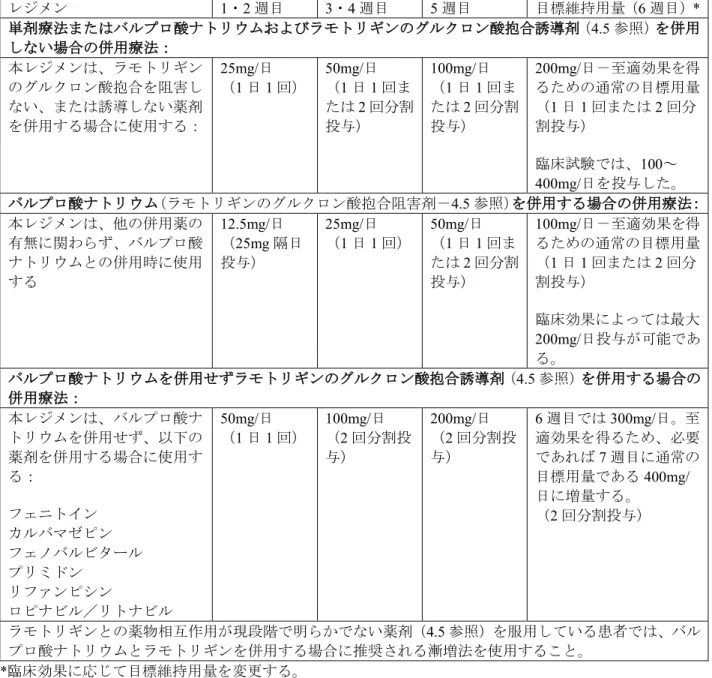
The recommended dose escalation and maintenance doses for adults of 18 years of age and above are given in the tables below. The transition regimen involves escalating the dose of lamotrigine to a maintenance stabilisation dose over six weeks (Table 3) after which other psychotropic medicinal products and/or AEDs can be withdrawn, if clinically indicated (Table 4). The dose adjustments following addition of other psychotropic medicinal products and/or AEDs are also provided below (Table 5). Because of the risk of rash the initial dose and subsequent dose escalation should not be exceeded (see section 4.4).
v16 - Final Table 3: Adults aged 18 years and above - recommended dose escalation to the maintenance total daily stabilisation dose in treatment of bipolar disorder
Treatment Regimen Weeks 1 + 2 Weeks 3 + 4 Week 5 Target Stabilisation Dose (Week 6)*
Monotherapy with lamotrigine OR adjunctive therapy WITHOUT valproate and WITHOUT inducers of lamotrigine glucuronidation (see section 4.5):
This dosage regimen should be used with other medicinal products that do not
significantly inhibit or induce lamotrigine glucuronidation
25 mg/day
(once a day) 50 mg/day (once a day or two divided doses) 100 mg/day (once a day or two divided doses)
200 mg/day - usual target dose for optimal response (once a day or two divided doses) Doses in the range 100 - 400 mg/day used in clinical trials
Adjunctive therapy WITH valproate (inhibitor of lamotrigine glucuronidation – see section 4.5): This dosage regimen should
be used with valproate regardless of any concomitant medicinal products 12.5 mg/day (given as 25 mg on alternate days) 25 mg/day
(once a day) 50 mg/day (once a day or two divided doses)
100 mg/day - usual target dose for optimal response (once a day or two divided doses) Maximum dose of 200 mg/day can be used depending on clinical response
Adjunctive therapy WITHOUT valproate and WITH inducers of lamotrigine glucuronidation (see section 4.5):
This dosage regimen should be used without valproate but with: phenytoin carbamazepine phenobarbitone primidone rifampicin lopinavir/ritonavir 50 mg/day
(once a day) 100 mg/day (two divided doses) 200 mg/day (two divided doses) 300 mg/day in week 6, if necessary increasing to usual target dose of 400 mg/day in week 7, to achieve optimal response (two divided doses)
In patients taking medicinal products where the pharmacokinetic interaction with lamotrigine is currently not known (see section 4.5), the dose escalation as recommended for lamotrigine with concurrent valproate, should be used.
v16 - Final Table 4: Adults aged 18 years and above - maintenance stabilisation total daily dose following withdrawal of concomitant medicinal products in treatment of bipolar disorder
Once the target daily maintenance stabilisation dose has been achieved, other medicinal products may be withdrawn as shown below.
Treatment Regimen Current lamotrigine stabilisation dose (prior to withdrawal) Week 1 (beginning with withdrawal) Week 2 Week 3 onwards * Withdrawal of valproate (inhibitor of lamotrigine glucuronidation – see section 4.5), depending on original dose of lamotrigine:
When valproate is withdrawn, double the stabilisation dose, not exceeding an increase of more than 100 mg/week
100 mg/day 200 mg/day Maintain this dose (200 mg/day) (two divided doses)
200 mg/day 300 mg/day 400 mg/day Maintain this dose
(400 mg/day) Withdrawal of inducers of lamotrigine glucuronidation (see section 4.5), depending on original dose of lamotrigine:
This dosage regimen should be used when the following are withdrawn: phenytoin carbamazepine phenobarbitone primidone rifampicin lopinavir/ritonavir
400 mg/day 400 mg/day 300 mg/day 200 mg/day 300 mg/day 300 mg/day 225 mg/day 150 mg/day 200 mg/day 200 mg/day 150 mg/day 100 mg/day
Withdrawal of medicinal products that do NOT significantly inhibit or induce lamotrigine glucuronidation (see section 4.5):
This dosage regimen should be used when other medicinal products that do not significantly inhibit or induce lamotrigine glucuronidation are withdrawn
Maintain target dose achieved in dose escalation (200 mg/day; two divided doses)
(dose range 100 - 400 mg/day)
In patients taking medicinal products where the pharmacokinetic interaction with lamotrigine is currently not known (see section 4.5), the treatment regimen recommended for lamotrigine is to initially maintain the current dose and adjust the lamotrigine treatment based on clinical response .
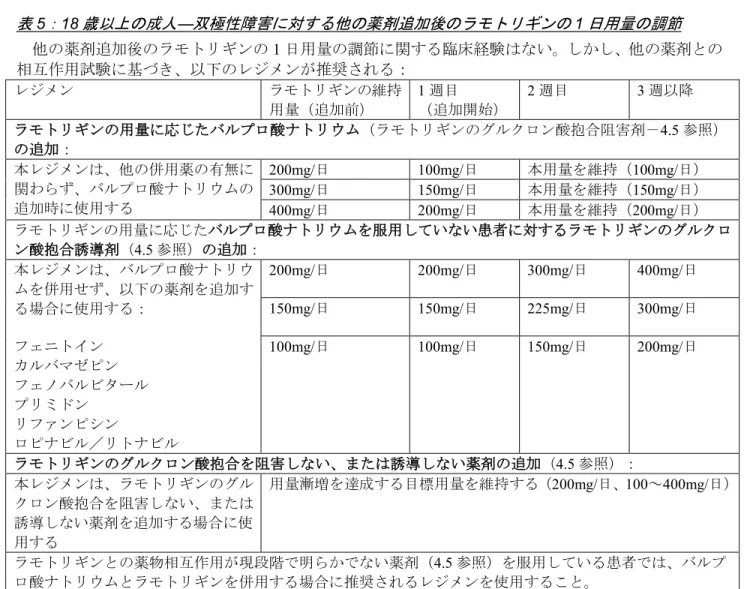
v16 - Final Table 5: Adults aged 18 years and above - adjustment of lamotrigine daily dosing following the addition of other medicinal products in treatment of bipolar disorder
There is no clinical experience in adjusting the lamotrigine daily dose following the addition of other medicinal products. However, based on interaction studies with other medicinal products, the following recommendations can be made:
Treatment Regimen Current lamotrigine stabilisation dose (prior to addition) Week 1 (beginning with addition)
Week 2 Week 3 onwards
Addition of valproate (inhibitor of lamotrigine glucuronidation – see section 4.5), depending on original dose of lamotrigine:
This dosage regimen should be used when valproate is added regardless of any concomitant medicinal products
200 mg/day 100 mg/day Maintain this dose (100 mg/day) 300 mg/day 150 mg/day Maintain this dose (150 mg/day) 400 mg/day 200 mg/day Maintain this dose (200 mg/day) Addition of inducers of lamotrigine glucuronidation in patients NOT taking valproate (see
section 4.5), depending on original dose of lamotrigine: This dosage regimen should be
used when the following are added without valproate: phenytoin carbamazepine phenobarbitone primidone rifampicin lopinavir/ritonavir
200 mg/day 200 mg/day 300 mg/day 400 mg/day 150 mg/day 150 mg/day 225 mg/day 300 mg/day 100 mg/day 100 mg/day 150 mg/day 200 mg/day
Addition of medicinal products that do NOT significantly inhibit or induce lamotrigine glucuronidation (see section 4.5):
This dosage regimen should be used when other medicinal products that do not significantly inhibit or induce lamotrigine glucuronidation are added
Maintain target dose achieved in dose escalation (200 mg/day; dose range 100-400 mg/day)
In patients taking medicinal products where the pharmacokinetic interaction with lamotrigine is currently not known (see section 4.5), the treatment regimen as recommended for lamotrigine with concurrent valproate, should be used.
Discontinuation of Lamictal in patients with bipolar disorder
In clinical trials, there was no increase in the incidence, severity or type of adverse reactions following abrupt termination of lamotrigine versus placebo. Therefore, patients may terminate Lamictal without a step-wise reduction of dose.
Children and adolescents below 18 years
Lamictal is not recommended for use in children below 18 years of age due to a lack of data on safety and efficacy (see section 4.4).
v16 - Final General dosing recommendations for Lamictal in special patient populations
Women taking hormonal contraceptives
The use of an ethinyloestradiol/levonorgestrel (30 μg/150 μg) combination increases the clearance of lamotrigine by approximately two-fold, resulting in decreased lamotrigine levels. Following titration, higher maintenance doses of lamotrigine (by as much as two-fold) may be needed to attain a maximal therapeutic response. During the pill-free week, a two-fold increase in lamotrigine levels has been observed.
Dose-related adverse events cannot be excluded. Therefore, consideration should be given to using contraception without a pill-free week, as first-line therapy (for example, continuous hormonal contraceptives or non-hormonal methods; see sections 4.4 and 4.5).
Starting hormonal contraceptives in patients already taking maintenance doses of lamotrigine and NOT taking inducers of lamotrigine glucuronidation
The maintenance dose of lamotrigine will in most cases need to be increased by as much as two-fold (see sections 4.4 and 4.5). It is recommended that from the time that the hormonal contraceptive is started, the lamotrigine dose is increased by 50 to 100 mg/day every week, according to the individual clinical response. Dose increases should not exceed this rate, unless the clinical response supports larger increases.
Measurement of serum lamotrigine concentrations before and after starting hormonal contraceptives may be considered, as confirmation that the baseline concentration of lamotrigine is being maintained. If necessary, the dose should be adapted. In women taking a hormonal contraceptive that includes one week of inactive treatment ("pill-free week"), serum lamotrigine level monitoring should be conducted during week 3 of active treatment, i.e. on days 15 to 21 of the pill cycle. Therefore, consideration should be given to using contraception without a pill-free week, as first-line therapy (for example, continuous hormonal
contraceptives or non-hormonal methods; see sections 4.4 and 4.5).
Stopping hormonal contraceptives in patients already taking maintenance doses of lamotrigine and NOT taking inducers of lamotrigine glucuronidation
The maintenance dose of lamotrigine will in most cases need to be decreased by as much as 50% (see sections 4.4 and 4.5). It is recommended to gradually decrease the daily dose of lamotrigine by 50-100 mg each week (at a rate not exceeding 25% of the total daily dose per week) over a period of 3 weeks, unless the clinical response indicates otherwise. Measurement of serum lamotrigine concentrations before and after stopping hormonal contraceptives may be considered, as confirmation that the baseline concentration of lamotrigine is being maintained. In women who wish to stop taking a hormonal contraceptive that includes one week of inactive treatment ("pill-free week"), serum lamotrigine level monitoring should be conducted during week 3 of active treatment, i.e. on days 15 to 21 of the pill cycle. Samples for assessment of lamotrigine levels after permanently stopping the contraceptive pill should not be collected during the first week after stopping the pill.
Starting lamotrigine in patients already taking hormonal contraceptives
Dose escalation should follow the normal dose recommendation described in the tables.
Starting and stopping hormonal contraceptives in patients already taking maintenance doses of lamotrigine and TAKING inducers of lamotrigine glucuronidation
Adjustment to the recommended maintenance dose of lamotrigine may not be required.
Use with atazanavir/ritonavir
No adjustments to the recommended dose escalation of lamotrigine should be necessary when lamotrigine is added to the existing atazanavir/ritonavir therapy.
In patients already taking maintenance doses of lamotrigine and not taking glucuronidation inducers, the lamotrigine dose may need to be increased if atazanavir/ritonavir is added, or decreased if
atazanavir/ritonavir is discontinued. Plasma lamotrigine monitoring should be conducted before and during 2 weeks after starting or stopping atazanavir/ritonavir, in order to see if lamotrigine dose adjustment is needed (see section 4.5).
v16 - Final Use with lopinavir/ritonavir
No adjustments to the recommended dose escalation of lamotrigine should be necessary when lamotrigine is added to the existing lopinavir/ritonavir therapy.
In patients already taking maintenance doses of lamotrigine and not taking glucuronidation inducers, the lamotrigine dose may need to be increased if lopinavir/ritonavir is added, or decreased if lopinavir/ritonavir is discontinued. Plasma lamotrigine monitoring should be conducted before and during 2 weeks after starting or stopping lopinavir/ritonavir, in order to see if lamotrigine dose adjustment is needed (see section 4.5).
Elderly (above 65 years)
No dosage adjustment from the recommended schedule is required. The pharmacokinetics of lamotrigine in this age group do not differ significantly from a non-elderly adult population (see section 5.2).
Renal impairment
Caution should be exercised when administering Lamictal to patients with renal failure. For patients with end-stage renal failure, initial doses of lamotrigine should be based on patients' concomitant medicinal products; reduced maintenance doses may be effective for patients with significant renal functional impairment (see sections 4.4 and 5.2).
Hepatic impairment
Initial, escalation and maintenance doses should generally be reduced by approximately 50% in patients with moderate (Child-Pugh grade B) and 75% in severe (Child-Pugh grade C) hepatic impairment. Escalation and maintenance doses should be adjusted according to clinical response (see section 5.2). 4.3 Contraindications
Hypersensitivity to the active substance or to any of the excipients listed in section 6.1. 4.4 Special warnings and precautions for use
Skin rash
There have been reports of adverse skin reactions, which have generally occurred within the first eight weeks after initiation of lamotrigine treatment. The majority of rashes are mild and self-limiting, however serious rashes requiring hospitalisation and discontinuation of lamotrigine have also been reported. These have included potentially life-threatening rashes such as Stevens–Johnson syndrome (SJS), toxic epidermal necrolysis (TEN) and Drug Reaction with Eosinophilia and Systemic Symptoms (DRESS); also known as hypersensitivity syndrome (HSS) (see section 4.8).
In adults enrolled in studies utilizing the current lamotrigine dosing recommendations the incidence of serious skin rashes is approximately 1 in 500 in epilepsy patients. Approximately half of these cases have been reported as Stevens–Johnson syndrome (1 in 1000). In clinical trials in patients with bipolar disorder, the incidence of serious rash is approximately 1 in 1000.
The risk of serious skin rashes in children is higher than in adults. Available data from a number of studies suggest the incidence of rashes associated with hospitalisation in epileptic children is from 1 in 300 to 1 in 100.
In children, the initial presentation of a rash can be mistaken for an infection, physicians should consider the possibility of a reaction to lamotrigine treatment in children that develop symptoms of rash and fever during the first eight weeks of therapy.
v16 - Final - high initial doses of lamotrigine and exceeding the recommended dose escalation of lamotrigine
therapy (see section 4.2)
- concomitant use of valproate (see section 4.2).
Caution is also required when treating patients with a history of allergy or rash to other AEDs as the
frequency of non-serious rash after treatment with lamotrigine was approximately three times higher in these patients than in those without such history.
All patients (adults and children) who develop a rash should be promptly evaluated and Lamictal withdrawn immediately unless the rash is clearly not related to lamotrigine treatment. It is recommended that Lamictal not be restarted in patients who have discontinued due to rash associated with prior treatment with
lamotrigine unless the potential benefit clearly outweighs the risk. If the patient has developed SJS, TEN or DRESS with the use of lamotrigine, treatment with lamotrigine must not be re-started in this patient at any time.
Rash has also been reported as part of a hypersensitivity syndrome associated with a variable pattern of systemic symptoms including fever, lymphadenopathy, facial oedema, abnormalities of the blood and liver and aseptic meningitis (see section 4.8). The syndrome shows a wide spectrum of clinical severity and may, rarely, lead to disseminated intravascular coagulation and multiorgan failure. It is important to note that early manifestations of hypersensitivity (for example fever, lymphadenopathy) may be present even though rash is not evident. If such signs and symptoms are present the patient should be evaluated immediately and Lamictal discontinued if an alternative aetiology cannot be established.
Aseptic meningitis was reversible on withdrawal of the drug in most cases, but recurred in a number of cases on re-exposure to lamotrigine. Re-exposure resulted in a rapid return of symptoms that were frequently more severe. Lamotrigine should not be restarted in patients who have discontinued due to aseptic meningitis associated with prior treatment of lamotrigine.
Clinical worsening and suicide risk
Suicidal ideation and behaviour have been reported in patients treated with AEDs in several indications. A meta-analysis of randomised placebo-controlled trials of AEDs has also shown a small increased risk of suicidal ideation and behaviour. The mechanism of this risk is not known and the available data do not exclude the possibility of an increased risk for lamotrigine.
Therefore patients should be monitored for signs of suicidal ideation and behaviours and appropriate treatment should be considered. Patients (and caregivers of patients) should be advised to seek medical advice should signs of suicidal ideation or behaviour emerge.
In patients with bipolar disorder, worsening of depressive symptoms and/or the emergence of suicidality may occur whether or not they are taking medications for bipolar disorder, including Lamictal. Therefore patients receiving Lamictal for bipolar disorder should be closely monitored for clinical worsening (including development of new symptoms) and suicidality, especially at the beginning of a course of treatment, or at the time of dose changes. Certain patients, such as those with a history of suicidal behaviour or thoughts, young adults, and those patients exhibiting a significant degree of suicidal ideation prior to commencement of treatment, may be at a greater risk of suicidal thoughts or suicide attempts, and should receive careful monitoring during treatment.
Consideration should be given to changing the therapeutic regimen, including possibly discontinuing the medication, in patients who experience clinical worsening (including development of new symptoms) and/or the emergence of suicidal ideation/behaviour, especially if these symptoms are severe, abrupt in onset, or were not part of the patient’s presenting symptoms.
v16 - Final Hormonal contraceptives
Effects of hormonal contraceptives on lamotrigine efficacy
The use of an ethinyloestradiol/levonorgestrel (30 μg/150 μg) combination increases the clearance of lamotrigine by approximately two-fold resulting in decreased lamotrigine levels (see section 4.5). A decrease in lamotrigine levels has been associated with loss of seizure control. Following titration, higher maintenance doses of lamotrigine (by as much as two-fold) will be needed in most cases to attain a maximal therapeutic response. When stopping hormonal contraceptives, the clearance of lamotrigine may be halved. Increases in lamotrigine concentrations may be associated with dose-related adverse events. Patients should be monitored with respect to this.
In women not already taking an inducer of lamotrigine glucuronidation and taking a hormonal contraceptive that includes one week of inactive treatment (for example "pill-free week"), gradual transient increases in lamotrigine levels will occur during the week of inactive treatment (see section 4.2). Variations in
lamotrigine levels of this order may be associated with adverse effects. Therefore, consideration should be given to using contraception without a pill-free week, as first-line therapy (for example, continuous hormonal contraceptives or non-hormonal methods).
The interaction between other oral contraceptive or HRT treatments and lamotrigine have not been studied, though they may similarly affect lamotrigine pharmacokinetic parameters.
Effects of lamotrigine on hormonal contraceptive efficacy
An interaction study in 16 healthy volunteers has shown that when lamotrigine and a hormonal
contraceptive (ethinyloestradiol/levonorgestrel combination) are administered in combination, there is a modest increase in levonorgestrel clearance and changes in serum FSH and LH (see section 4.5). The impact of these changes on ovarian ovulatory activity is unknown. However, the possibility of these changes resulting in decreased contraceptive efficacy in some patients taking hormonal preparations with lamotrigine cannot be excluded. Therefore patients should be instructed to promptly report changes in their menstrual pattern, i.e. breakthrough bleeding.
Dihydrofolate reductase
Lamotrigine has a slight inhibitory effect on dihydrofolic acid reductase, hence there is a possibility of interference with folate metabolism during long-term therapy (see section 4.6). However, during prolonged human dosing, lamotrigine did not induce significant changes in the haemoglobin concentration, mean corpuscular volume, or serum or red blood cell folate concentrations up to 1 year or red blood cell folate concentrations for up to 5 years.
Renal failure
In single dose studies in subjects with end stage renal failure, plasma concentrations of lamotrigine were not significantly altered. However, accumulation of the glucuronide metabolite is to be expected; caution should therefore be exercised in treating patients with renal failure.
Patients taking other preparations containing lamotrigine
Lamictal should not be administered to patients currently being treated with any other preparation containing lamotrigine without consulting a doctor.
25, 50, 100 and 200 mg tablets: Excipient of Lamictal tablets
Lamictal tablets contain lactose monohydrate. Patients with rare hereditary problems of galactose
v16 - Final Development in children
There are no data on the effect of lamotrigine on growth, sexual maturation and cognitive, emotional and behavioural developments in children.
Precautions relating to epilepsy
As with other AEDs, abrupt withdrawal of Lamictal may provoke rebound seizures. Unless safety concerns (for example rash) require an abrupt withdrawal, the dose of Lamictal should be gradually decreased over a period of two weeks.
There are reports in the literature that severe convulsive seizures including status epilepticus may lead to rhabdomyolysis, multiorgan dysfunction and disseminated intravascular coagulation, sometimes with fatal outcome. Similar cases have occurred in association with the use of lamotrigine.
A clinically significant worsening of seizure frequency instead of an improvement may be observed. In patients with more than one seizure type, the observed benefit of control for one seizure type should be weighed against any observed worsening in another seizure type.
Myoclonic seizures may be worsened by lamotrigine.
There is a suggestion in the data that responses in combination with enzyme inducers is less than in combination with non-enzyme inducing antiepileptic agents. The reason is unclear.
In children taking lamotrigine for the treament of typical absence seizures, efficacy may not be maintained in all patients.
Precautions relating to bipolar disorder
Children and adolescents below 18 years
Treatment with antidepressants is associated with an increased risk of suicidal thinking and behaviour in children and adolescents with major depressive disorder and other psychiatric disorders.
4.5 Interaction with other medicinal products and other forms of interaction Interaction studies have only been performed in adults.
UDP-glucuronyl transferases have been identified as the enzymes responsible for metabolism of lamotrigine. There is no evidence that lamotrigine causes clinically significant induction or inhibition of hepatic
oxidative drug-metabolising enzymes, and interactions between lamotrigine and medicinal products metabolised by cytochrome P450 enzymes are unlikely to occur. Lamotrigine may induce its own metabolism but the effect is modest and unlikely to have significant clinical consequences.
v16 - Final Table 6: Effects of other medicinal products on glucuronidation of lamotrigine
Medicinal products that significantly inhibit
glucuronidation of lamotrigine
Medicinal products that significantly induce
glucuronidation of lamotrigine
Medicinal products that do not significantly inhibit or induce glucuronidation of lamotrigine
Valproate Phenytoin Oxcarbazepine
Carbamazepine Felbamate Phenobarbitone Gabapentin Primidone Levetiracetam Rifampicin Pregabalin Lopinavir/ritonavir Topiramate Ethinyloestradiol/ levonorgestrel combination** Zonisamide Atazanavir/ritonavir* Lithium Buproprion Olanzapine Aripiprazole *For dosing guidance (see section 4.2)
**Other oral contraceptive and HRT treatments have not been studied, though they may similarly affect lamotrigine pharmacokinetic parameters (see sections 4.2 and 4.4).
Interactions involving antiepileptic drugs
Valproate, which inhibits the glucuronidation of lamotrigine, reduces the metabolism of lamotrigine and increases the mean half-life of lamotrigine nearly two-fold. In patients receiving concomitant therapy with valproate, the appropriate treatment regimen should be used (see section 4.2).
Certain AEDs (such as phenytoin, carbamazepine, phenobarbitone and primidone) which induce hepatic drug-metabolising enzymes induce the glucuronidation of lamotrigine and enhance the metabolism of lamotrigine. In patients receiving concomitant therapy with phenytoin, carbamazepine, pheonbarbitone or primidone, the appropriate treatment regimen should be used (see section 4.2).
There have been reports of central nervous system events including dizziness, ataxia, diplopia, blurred vision and nausea in patients taking carbamazepine following the introduction of lamotrigine. These events usually resolve when the dose of carbamazepine is reduced. A similar effect was seen during a study of lamotrigine and oxcarbazepine in healthy adult volunteers, but dose reduction was not investigated. There are reports in the literature of decreased lamotrigine levels when lamotrigine was given in
combination with oxcarbazepine. However, in a prospective study in healthy adult volunteers using doses of 200 mg lamotrigine and 1200 mg oxcarbazepine, oxcarbazepine did not alter the metabolism of lamotrigine and lamotrigine did not alter the metabolism of oxcarbazepine. Therefore in patients receiving concomitant therapy with oxcarbazepine, the treatment regimen for lamotrigine adjunctive therapy without valproate and without inducers of lamotrigine glucuronidation should be used (see section 4.2).
In a study of healthy volunteers, coadministration of felbamate (1200 mg twice daily) with lamotrigine (100 mg twice daily for 10 days) appeared to have no clinically relevant effects on the pharmacokinetics of lamotrigine.
Based on a retrospective analysis of plasma levels in patients who received lamotrigine both with and without gabapentin, gabapentin does not appear to change the apparent clearance of lamotrigine. Potential interactions between levetiracetam and lamotrigine were assessed by evaluating serum
v16 - Final does not influence the pharmacokinetics of levetiracetam and that levetiracetam does not influence the pharmacokinetics of lamotrigine.
Steady-state trough plasma concentrations of lamotrigine were not affected by concomitant pregabalin (200 mg, 3 times daily) administration. There are no pharmacokinetic interactions between lamotrigine and pregabalin.
Topiramate resulted in no change in plasma concentrations of lamotrigine. Administration of lamotrigine resulted in a 15% increase in topiramate concentrations.
In a study of patients with epilepsy, coadministration of zonisamide (200 to 400 mg/day) with lamotrigine (150 to 500 mg/day) for 35 days had no significant effect on the pharmacokinetics of lamotrigine.
Although changes in the plasma concentrations of other AEDs have been reported, controlled studies have shown no evidence that lamotrigine affects the plasma concentrations of concomitant AEDs. Evidence from
in vitro studies indicates that lamotrigine does not displace other AEDs from protein binding sites.
Interactions involving other psychoactive agents
The pharmacokinetics of lithium after 2 g of anhydrous lithium gluconate given twice daily for six days to 20 healthy subjects were not altered by co-administration of 100 mg/day lamotrigine.
Multiple oral doses of bupropion had no statistically significant effects on the single dose pharmacokinetics of lamotrigine in 12 subjects and had only a slight increase in the AUC of lamotrigine glucuronide.
In a study in healthy adult volunteers, 15 mg olanzapine reduced the AUC and Cmax of lamotrigine by an
average of 24% and 20%, respectively. An effect of this magnitude is not generally expected to be clinically relevant. Lamotrigine at 200 mg did not affect the pharmacokinetics of olanzapine.
Multiple oral doses of lamotrigine 400 mg daily had no clinically significant effect on the single dose pharmacokinetics of 2 mg risperidone in 14 healthy adult volunteers. Following the co-administration of risperidone 2 mg with lamotrigine, 12 out of the 14 volunteers reported somnolence compared to 1 out of 20 when risperidone was given alone, and none when lamotrigine was administered alone.
In a study of 18 adult patients with bipolar I disorder, receiving an established regimen of lamotrigine (100-400 mg/day), doses of aripiprazole were increased from 10 mg/day to a target of 30 mg/day over a 7 day period and continued once daily for a further 7 days. An average reduction of approximately 10% in Cmax
and AUC of lamotrigine was observed. An effect of this magnitude is not expected to be of clinical consequence.
In vitro experiments indicated that the formation of lamotrigine's primary metabolite, the 2-N-glucuronide,
was minimally inhibited by co-incubation with amitriptyline, bupropion, clonazepam, haloperidol or
lorazepam. These experiments also suggested that metabolism of lamotrigine was unlikely to be inhibited by clozapine, fluoxetine, phenelzine, risperidone, sertraline or trazodone. In addition, a study of bufuralol metabolism using human liver microsome preparations suggested that lamotrigine would not reduce the clearance of medicinal products metabolised predominantly by CYP2D6.
Interactions involving hormonal contraceptives
Effect of hormonal contraceptives on lamotrigine pharmacokinetics
In a study of 16 female volunteers, dosing with 30 μg ethinyloestradiol/150 μg levonorgestrel in a combined oral contraceptive pill caused an approximately two-fold increase in lamotrigine oral clearance, resulting in an average 52% and 39% reduction in lamotrigine AUC and Cmax, respectively. Serum lamotrigine
concentrations increased during the course of the week of inactive treatment (including the "pill-free" week), with pre-dose concentrations at the end of the week of inactive treatment being, on average, approximately
v16 - Final two-fold higher than during co-therapy (see section 4.4). No adjustments to the recommended dose
escalation guidelines for lamotrigine should be necessary solely based on the use of hormonal contraceptives, but the maintenance dose of lamotrigine will need to be increased or decreased in most cases when starting or stopping hormonal contraceptives (see section 4.2).
Effect of lamotrigine on hormonal contraceptive pharmacokinetics
In a study of 16 female volunteers, a steady state dose of 300 mg lamotrigine had no effect on the pharmacokinetics of the ethinyloestradiol component of a combined oral contraceptive pill. A modest increase in oral clearance of the levonorgestrel component was observed, resulting in an average 19% and 12% reduction in levonorgestrel AUC and Cmax, respectively. Measurement of serum FSH, LH and oestradiol during the study indicated some loss of suppression of ovarian hormonal activity in some women, although measurement of serum progesterone indicated that there was no hormonal evidence of ovulation in any of the 16 subjects. The impact of the modest increase in levonorgestrel clearance, and the changes in serum FSH and LH, on ovarian ovulatory activity is unknown (see section 4.4). The effects of doses of lamotrigine other than 300 mg/day have not been studied and studies with other female hormonal preparations have not been conducted.
Interactions involving other medicinal products
In a study in 10 male volunteers, rifampicin increased lamotrigine clearance and decreased lamotrigine half-life due to induction of the hepatic enzymes responsible for glucuronidation. In patients receiving concomitant therapy with rifampicin, the appropriate treatment regimen should be used (see section 4.2). In a study in healthy volunteers, lopinavir/ritonavir approximately halved the plasma concentrations of lamotrigine, probably by induction of glucuronidation. In patients receiving concomitant therapy with lopinavir/ritonavir, the appropriate treatment regimen should be used (see section 4.2).
In a study in healthy adult volunteers, atazanavir/ritonavir (300 mg/100 mg) administered for 9 days reduced the plasma AUC and Cmax of lamotrigine (single 100 mg dose) by an average of 32% and 6%, respectively. In patients receiving concomitant therapy with atazanavir/ritonavir, the appropriate treatment regimen should be used (see section 4.2).
Data from in vitro assessment demonstrate that lamotrigine, but not the N(2)-glucuronide metabolite, is an inhibitor of Organic Transporter 2 (OCT 2) at potentially clinically relevant concentrations. These data demonstrate that lamotrigine is a more potent in vitro inhibitor of OCT 2 than cimetidine, with IC50 values of 53.8 μM and 186 μM, respectively. Co-administration of lamotrigine with renally excreted medicinal products which are substrates of OCT2 (e.g. metformin, gabapentin and varenicline) may result in increased plasma levels of these medicinal products.
The clinical significance of this has not been clearly defined, however care should be taken in patients co administered with these medicinal products.
4.6 Pregnancy and lactation
Risk related to antiepileptic drugs in general
Specialist advice should be given to women who are of childbearing potential. The antiepileptic treatment should be reviewed when a woman is planning to become pregnant. In women being treated for epilepsy, sudden discontinuation of AED therapy should be avoided as this may lead to breakthrough seizures that could have serious consequences for the woman and the unborn child. Monotherapy should be preferred whenever possible because therapy with multiple AEDs could be associated with a higher risk of congenital malformations than monotherapy, depending on the associated antiepileptics.
v16 - Final Risk related to lamotrigine
Pregnancy
A large amount of data on pregnant women exposed to lamotrigine monotherapy during the first trimester of pregnancy (more than 8700) do not suggest a substantial increase in the risk for major congenital
malformations including oral clefts. Animal studies have shown developmental toxicity (see section 5.3). If therapy with Lamictal is considered necessary during pregnancy, the lowest possible therapeutic dose is recommended.
Lamotrigine has a slight inhibitory effect on dihydrofolic acid reductase and could therefore theoretically lead to an increased risk of embryofoetal damage by reducing folic acid levels (see section 4.4). Intake of folic acid when planning pregnancy and during early pregnancy may be considered.
Physiological changes during pregnancy may affect lamotrigine levels and/or therapeutic effect. There have been reports of decreased lamotrigine plasma levels during pregnancy with a potential risk of loss of seizure control. After birth lamotrigine levels may increase rapidly with a risk of dose-related adverse events. Therefore lamotrigine serum concentrations should be monitored before, during and after pregnancy, as well as shortly after birth. If necessary, the dose should be adapted to maintain the lamotrigine serum
concentration at the same level as before pregnancy, or adapted according to clinical response. In addition, dose-related undesirable effects should be monitored after birth.
Lactation
Lamotrigine has been reported to pass into breast milk in highly variable concentrations, resulting in total lamotrigine levels in infants of up to approximately 50% of the mother’s. Therefore, in some breast-fed infants, serum concentrations of lamotrigine may reach levels at which pharmacological effects occur. Among a limited group of exposed infants, no adverse effects were observed.
The potential benefits of breast-feeding should be weighed against the potential risk of adverse effects occurring in the infant. Should a woman decide to breast-feed while on therapy with lamotrigine, the infant should be monitored for adverse effects.
Fertility
Animal experiments did not reveal impairment of fertility by lamotrigine (see section 5.3). 4.7 Effects on ability to drive and use machines
As there is individual variation in response to all AED therapy, patients taking Lamictal to treat epilepsy should consult their physician on the specific issues of driving and epilepsy.
No studies on the effects on the ability to drive and use machines have been performed. Two volunteer studies have demonstrated that the effect of lamotrigine on fine visual motor co-ordination, eye movements, body sway and subjective sedative effects did not differ from placebo. In clinical trials with lamotrigine adverse reactions of a neurological character such as dizziness and diplopia have been reported. Therefore, patients should see how Lamictal therapy affects them before driving or operating machinery.
4.8 Undesirable effects
The undesirable effects for epilepsy and bipolar disorder indications are based on available data from controlled clinical studies and other clinical experience and are listed in the table below. Frequency categories are derived from controlled clinical studies (epilepsy monotherapy (identified by†) and bipolar disorder (identified by §)). Where frequency categories differ between clinical trial data from epilepsy and
bipolar disorder the most conservative frequency is shown. However, where no controlled clinical trial data are available, frequency categories have been obtained from other clinical experience.
v16 - Final The following convention has been utilised for the classification of undesirable effects:- Very common (>1/10); common (>1/100 to <1/10); uncommon (>1/1000 to <1/100); rare (>1/10,000 to <1/1000); very rare (<1/10,000), not known (cannot be estimated from the available data).
System Organ Class Adverse Event Frequency Blood and lymphatic
system disorders Haematological abnormalities
1 including neutropenia,
leucopenia, anaemia, thrombocytopenia, pancytopenia, aplastic anaemia, agranulocytosis Lymphadenopathy1
Very rare Not known Immune System
Disorders Hypersensitivity syndrome
2 (including such symptoms
as, fever, lymphadenopathy, facial oedema, abnormalities of the blood and liver, disseminated
intravascular coagulation, multi organ failure). Very Rare Psychiatric Disorders Aggression, irritability
Confusion, hallucinations, tics Nightmares Common Very rare Not known Nervous System Disorders Headache †§
Somnolence†§, dizziness†§, tremor†, insomnia† agitation§
Ataxia† Nystagmus†
Unsteadiness,movement disorders, worsening of Parkinson's disease 3, extrapyramidal effects,
choreoathetosis†, increase in seizure frequency Aseptic meningitis(see section 4.4)
Very Common Common Uncommon Rare Very Rare Rare Eye disorders Diplopia†, blurred vision†
Conjunctivitis
Uncommon Rare Gastrointestinal
disorders Nausea
†, vomiting†, diarrhoea†, dry mouth§ Common
Hepatobiliary
disorders Hepatic failure, hepatic dysfunction
4, increased liver
function tests Very rare
Skin and
subcutaneous tissue disorders
Skin rash5†§
Stevens–Johnson Syndrome §
Toxic epidermal necrolysis
Drug Reaction with Eosinophilia and Systemic Symptoms Very common Rare Very rare Very rare Musculoskeletal and connective tissue disorders Arthralgia§ Lupus-like reactions Common Very rare General disorders and
administration site conditions


![表 2 :小児および青年( 2 ~ 12 歳)-てんかんに対する推奨レジメン( 1 日総用量[ mg/kg/ 日]) レジメン 1・2 週目 3・4 週目 通常維持用量 定型欠神発作に対する単剤療 法: 0.3mg/kg/日 ( 1 日 1 回ま たは 2 回分割 投与) 0.6mg/kg/日( 1 日 1 回または 2 回分割投与) 1~15mg/kg/日 ( 1 日 1 回または 2 回分割投与) 維持用量に達するため、至適効果が得 られるまでは最大維持用量を 200mg/ 日として 1~2 週間](https://thumb-ap.123doks.com/thumbv2/123deta/6847135.738895/41.918.103.821.90.926/およびに対するレジメンレジメンに対する回また回また達する.webp)