A Report About English and Intercultural Activities in Public Schools
公立学校における英語活動と異文化交流の取り組み
OCHANTE, Carlos
Naragakuen University
Faculty of Education for Human Growth
奈良学園大学人間教育学部
オチャンテ・カルロス
WALSH, Anthony
Faculty of Education for Future Generations
Department of Early Childhood Development
次世代教育学部子ども発達学科
アンソニー・ウォルシュ
要旨 日本政府が 2008 年に「留学生 30 万人計画」を発表して以降,日本における留学生の増加が著しい。環太平洋大 学でも留学生数が近年増加し,アジア出身の学生がその中心を占める。留学生による地域貢献を目的に国際交流 活動と言語支援活動を実施した。具体的には,地域の小学校で留学生が国紹介などをする交流を重ね,異文化理 解・国際理解を育むための活動を行った。また、言語支援の一貫として中学校における英語学習を支援する活動 も実施した。英語が堪能な留学生が英語での文化紹介を行なったり、様々なゲームなどの英語活動をしたりする ことを通じて,生徒と英語でコミュニケーションを取り,国際交流を通した外国語学習支援がなされた。Keywords: English education, Language support, Intercultural understanding, EFL
1. Introduction
The platform to build an English environment in semi rural Japan is challenging and rewarding for all involved. This government supported study establishes three key areas to incorporate into a higher education program within the community it stands. This includes an International Exchange Project management team to coordinate the schedules, plans and affairs. Along with cultural activities based support contingent and finally a language group focusing on communication exchange. Collaborating between staff, students and members of the local community requires considerable forethought and general planning in order to provide clear direction for designed intentions to be achieved. Through providing Teacher Assistants (TAs)
with language practice techniques they can then communicate in a meaningful way with their peers as well as participants on the program.
2. Background of Support System for Exchange
In 2014, a group of university teachers got together to combine their knowledge, time and skills in order to commence an action research project. Undeterred by not having fundamentally clear goals established from the onset, the members predominantly from the Department of International Studies joined with fellow faculty members from the Department of Education Management. This combination of departments included Associate Teachers, Part Time Lecturers, Full Time Lecturers, Associate Professors and Professors who could with confidence coordinators leading systems of International exchange. On this paper we will focus mainly on the language assistance (English) to public schools in Okayama prefecture.
Bringing together a wealth of teaching experience in conjunction with volunteers from International Pacific University (IPU) undergraduate program provided the foundation of personnel. Naturally, when implementing an exchange programs then English as a medium for communication would be considered a prerequisite.
The data collected for this research has been gathered over the period of four years, with the interpretations, patterns and themes emerging as the project developed. Initial members of the research group changed employment or discontinued supporting the research, leaving holes to be replaced. According to Somekh (1993) interpretations and evidence is continual and therefore research programs like this one should be regularly evaluated. Despite the fact other researches in this group have performed critical analysis of the set up and plan, this paper is the first English edition to be written up.
Looking closer at the volunteers or Teachers Assistance (TAs), they consisted of native Japanese as well as the following various nationalities that include, China, Fiji, New Zealand, Thailand, Uzbekistan, Bangladesh, Nepal, Taiwan, Korea as well as Vietnam. The Vietnamese population at IPU far outweighs that of any other nationality. Details of why the TAs chose to come to Japan have not been assessed, yet in this study all members were part of a four-year degree course. Bolshier & Collins (1983) suggest reasons why undergrads would get involved are because it would be an enjoyable experience, a chance to be in the community, to build relationships or to just escape boredom. In this case, it would be assumed they would have extrinsic motivation to make their families proud. Furthermore, young foreigners would have intrinsic incentives to share their own culture to members of their new communities while learning unfamiliar things within the exchange. These extrinsic values may also lead to eventually finding a job in Japan.
3. Aims, Goals and Targets for the Exchange
Essentially, the main motivation for international students to want to be involved in an exchange program is to make friends. Nevertheless, as the members are all undergraduates, many of them are also in a position of transiting into higher education for the first time. Woodrow et al (2011) point out issues in academic communication as well as in their daily lives need to be factored. Therefore, students may have initially wanted to participate in a program like this to use English, but found as it is a Japanese community they are communicating in then it would be more beneficial to communicate using Japanese. As this study was to integrate foreign students into the community of local schools, the role of English as a medium became less and less important. It is also relevant to consider the international students are all looking to increase their Japanese communication ability. For the majority of first years, they are expected to get Level 3 in the Japanese Language Proficiency Test (JLPT). Additionally, those students had targets of reaching level 2 in the JLPT by the completion of their sophomore year.
For many of the international students, they had already studied English throughout their K-12 level of schooling and therefore were comfortable in using that lingua franca. Yet as mentioned, the aim of the research was to adapt to changes within the context of the academic goals of learning Japanese. Hence, the program was less focused on English as a medium and more
on cultural activities as a means of exchange. Despite this, there were cases of English used within kindergarten, elementary and junior high school visits, but they did not consist of language targets in either English or Japanese mediums. Ames (1992) affirms performance goals as an approach to being involved as a desire to get respect from teachers, which was a goal for students to want to participate. In addition, volunteers could feel self-satisfaction to participate in an activity that did not have performance evaluation that reflected on their academic grades. In research from Australia in this area of educational performance tasks indicate students can have numerous intentions and ambitions, which vary depending on the individual (Mindgley, 2002).
Looking at International students more broadly on a national level, the Department of Education publicize on their website that in 2003 the target of 100,000 foreign students in Japan was achieved. More recent figures show that sum has increased to 267,042 (Graph 1). An optimistic goal of 300,000 students will be expected by 2020 doubling the number of foreigner learners. At IPU, this figure has also shown to be reflected in the numbers of international student’s figures on campus. Those enrolling range from fully scholarship provided fees scheme to privately being financed themselves. Therein, throughout Japan demands for clear professional standards of practice with clear evaluation of academic experience needs to be justified. In addition, according to the same report there are approximately 5,000,000 students studying abroad around the globe and this will increase to 7,000,000 by 2025. Continuing with these statistics countries like Australia have inflated their numbers to 26% of their higher education. With this quota occupied by International communities then Tertiary in Japan will need to follow in a similar direction. Particularly considering the predicted population decrease (Ministry of Foreign Affairs, 2010).
Graph 1 Increase of foreign students in Japan, 1983-2017. Source: JASSO
4. From Institution to the Community Considerations
Forming network alliances requires researchers to take on the role of Associate Teachers (ATs) responsible for maintaining clear direction during exchange for the TA to conduct their activities. In a previous study, two of the researches had initiated TA roles that consisted of mentoring in the following tasks:
Roles and Responsibilities of the TA are as follows: a. Aide the teacher in classroom practice
b. Provide translation and interpret English into Japanese
c. Be punctual on time to class as well as attend at least 9 out of 15 classes d. Show initiative and ask students if they need help
e. Complete an evaluation sheet to the Associate Teacher on 3rd, 8th and 15th week f. Provide an opinions pre and post class in a debriefing session with the Associate Teacher g. Follow all the rules and regulations of the school's standards of classroom etiquette. h. Show high levels of enthusiasm and general interest in the activities and language drills.
Those professional practices, which had been established at IPU, then need to be shown in the following institutional settings:
a. Kindergartens b. Primary Schools c. Junior High Schools d. High Schools e. Colleges f. Universities g. Local business
h. Neighborhood residents
5-3 English education support
We created this activity in order to support local schools English education. This activity was held in 2 Junior high schools (A and B) and supported students from 1 to 3 year grade.
Foreign students participating in this activity count with high levels of English skills and were selected by our staff. In order to participate they attended numerous training sessions, which provided them with a better understanding of the Japanese English curriculum. This training was also used to prepare the materials for each class.
For each class students gave presentations in English about their native countries (Picture 1). English teaching methods included TPR (Total Physical Response) as well as ICT (Information and communication technologies) usage (Picture 1-2) About the participants (University foreign students)
All students belonged to the International Studies Department Japanese course.
Participants for Junior high school A were from New Zealand and Philippines (2 students). Participants for Junior high school B were from Vietnam (4 students).
Picture 2 Students using ICT for the English activities.
Picture 3 Students using TPR methods for their class games. Survey results
In each class, surveys were carried out in order to get feedback from the activities. We collected 96 responses from School A and 90 responses from School B. The questionnaire included questions about English usage and interest towards foreign countries and cultures.
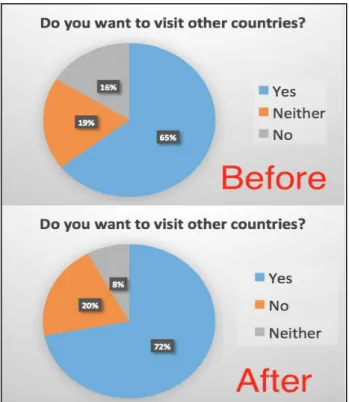
Figure 1 shows the results from School A, were we made a before and after survey. To the question “Do you want to visit other countries” students’ positive answer increased after our participation in their classes from 65% to 72%.
Figure 1 Comparison between before and after the class
For School B we added the question “Did your image of Vietnamese change after the classes?” We also asked “How did it change”. By formulating these questions we wanted to understand how the activities held contributed to the creation of positive images toward foreign students. A 30% of the students answered that their image of the Vietnamese students had changed after meeting them on class. Many of the students that answered yes quoted that they thought Vietnamese students were serious and quiet but after the class they discover that it was the other way and they happened to be very cheerful and friendly. A translation of the students comments were as follows: “They were really fun”, “they were different but fun”, “They really like to talk”, “They were very kind”, “they were really easy people to talk to”, “I was afraid at first but then they were always smiling”
Figure 2 Elementary Students First Impressions
6. The Future of International Support Systems
Without question, the focus on international exchange programs will involve deeper levels of cultural understanding. From this research, observations have shown that young Japanese students from kindergarten through to high school appreciate the uniqueness the TAs share with them. The school teachers are also supportive and facilitate activities by preparing their students for the TAs to come into their classrooms. Through continued cooperation and exchange programs such as the one mentioned here in Okayama and Akaiwa will become a natural part of K to 12 education. Accordingly, this should be seen as a strong presence within higher education curriculums across the whole of the nation. Cultural acceptance will unquestionably come from understanding and celebrating differences. Projects like this will play a vital part of Japanese society in this next generation with the MEXT reporting the increased number of two million more foreigners coming to study. Research in the future should address language both Japanese as well as English being the key feature for exchange. Additionally, how young people can communicate effectively should be given equal attention.
References
1) Ames, C. (1992). Classrooms: Goals and structures and student motivation. Journal of Educational Psychology, 84(3): 261 - 71. 2) Bolshier, R. And Collins, J.B. (1983). Education participation scale factor structure and correlates for twelve thousand learners.
International Journal of Lifelong Education, 2(2): 163-77.
3) Midgley, C. M. (2002). Goals, Goal Structures and Patterns of Adaptive Learning. Mahwah, NJ: Lawrence Erlbaum. 4) Somekh, B. (1993) Quality in educational research, the contribution of classroom teachers. In Edge and Richards (1993). 5) Woodrow, L. (2011). College English writing affect: self-efficacy and anxiety. System, 39(4): 510 - 22.
6) http://www.studyjapan.go.jp/en/toj/toj09e.html 7)
https://www.japantimes.co.jp/news/2017/06/13/national/number-foreign-students-public-schools-lack-japanese-language-skills-hit s-record-high/#.WgYmyxOCz64