
トップページ - 横浜国立大学学術情報リポジトリ
22
0
0
全文
(2) 78. (342). Yokohama Journal of Social Sciences, Vol. 24, No. 3. Table 3 Definitions of Innovation Ambidexterity Definition. Source. IA is a capability that can help an organization reconcile alignment and revolution by pursuing Tushman and OʼReilly Ⅲ, incremental and discontinuous innovations simultaneously under different contexts of “structures, 1996 processes, and cultures within the same firm” (p. 24). IA means the capability to keep a balance between exploitative innovation based on current knowledge He and Wong, 2004 of an organization and exploratory innovation based on the organizationʼs new knowledge. In the context of new product development, IA is defined as the capability that enables an organization Backman, Börjesson, to keep a balance between alignment and adaptability by exploiting existing process efficiently and and Setterberg, 2007 exploring radical innovation under changing market conditions. IA means an organization simultaneously pursues “exploiting existing products to enable incremental Andriopoulos and Lewis, innovation” and “exploring new opportunities to foster more radical innovation” (p. 696). 2009 IA means an organization simultaneously exploits incremental innovation for existing customers and Mirzataghi explores radical innovation for potential and new customers. Chaharmahali and Amir Siadat, 2010 IA refers to “organisational activities and strategies of exploiting existing knowledge in the producing Zang and Li, 2016 process to satisfy current demands while synchronously exploring unknown areas to adapt to environment changes that finally leads to both subsist at present and thrive in long-term” (p. 23). IA means an organization pursues both exploitative innovation and exploratory innovation Zhang, Wang, and Wei, simultaneously. 2019 (Source: the author). Special Introductory Note: This article is the second part of the paper, The Conceptual Development of Organizational Ambidexterity: From General Discussion to Innovation Management Application. Part Ⅰ introduced the resource-based view, reviewed and discussed the relevant studies of organizational ambidexterity (OA) and exploitation & exploration at general level. Part Ⅱ discusses the specific application of OA in the innovation management field in different parts: innovation ambidexterity, and incremental innovation & radical innovation, and indicates the core question needs to be addressed in future studies. At last, the author makes a summary of this research. 3.Specific Application 3. 1 Innovation Ambidexterity 3. 1. 1 Notions of Innovation Ambidexterity As the author has reviewed in the first part of this paper, the study on organizational ambidexterity has several different research streams. In the innovation management stream, many researchers studied the issue of innovation ambidexterity from different perspectives. Based on their specific studies, researchers defined innovation ambidexterity in different ways. Table 3 lists some typical definitions of innovation ambidexterity (IA) in the literature. From the definitions presented above, we can find that although scholars may define innovation ambidexterity from different perspectives, the essence of this term can be described as an organizational capability that enables an organization to pursue incremental innovation and radical innovation (exploitative innovation and exploratory innovation, alignment and adaptability, etc.) simultaneously by exploiting existing.
(3) The Conceptual Development of Organizational Ambidexterity(Huaxing Shang) (343). 79. knowledge or technologies and exploring new opportunities for developing radical changes to help the organization obtain a sustainable competitive advantage in a long period. According to the literature, when organizational ambidexterity is extended to innovation ambidexterity, there is a congruent relationship between exploitation & exploration and incremental innovation & radical innovation (Tushman and Smith, 2002). Furthermore, some scholars indicated that exploitation could lead to incremental innovation by improving existing capabilities, and exploration could generate radical innovation by developing new opportunities (Huang, 2008; Andriopoulos and Lewis, 2009; Brion, Mothe, and Sabatier, 2010; Lewis and Andriopoulos, 2013). Some researchers explained exploitation as exploitative innovation and exploration as exploratory innovation (He and Wong, 2004; Zhang, Wang, and Wei, 2019). Other scholars regarded exploitation and exploration as alignment and adaptability (Tushman and OʼReilly Ⅲ, 1996; Backman, Börjesson, and Setterberg, 2007). Since organizational ambidexterity study mainly discusses the issue of exploitation and exploration, the study on innovation ambidexterity should focus on the issue of incremental innovation and radical innovation. The author reviews the literature on this issue in the following parts of this section. 3. 1. 2 Relationships between Innovation Ambidexterity and Organizational Performance Recently, many researchers have studied the relationship between innovation ambidexterity and organizational performance from different perspectives. Since prior researches have suggested that organizational ambidexterity and organizational performance had a positive relationship (Auh and Menguc, 2005; Tushman et al., 2010; Wang and Li, 2008), some scholars extended this finding into innovation management stream and indicated that innovation ambidexterity and organizational performance also had a positive relationship. For example, Han, Kim, and Kim (2001) suggested that the organization pursued innovation ambidexterity had a higher market share and returns on investment than the organization pursued incremental innovation only. Katila and Ahuja (2002) indicated that the interaction of search depth (exploitative innovation) and search scope (exploratory innovation) had a positive relationship with the numbers of a firmʼs new products. From the study of Tushman et al. (2002), we can infer that the organization pursues innovation ambidexterity can facilitate radical innovation of existing products and services to improve its innovation performance in a long period dramatically. Colbert (2004) argued that the reconciliation of incremental innovation and radical innovation could help an organization obtain an irreducible capability to improve its performance because this capability existed and could be developed only within some specific relationships. He and Wong (2004, p. 492) found that “the interaction between explorative and exploitative innovation strategies is positively related to sales growth rate”, and “the relative imbalance (absolute difference) between explorative and exploitative innovation strategies is negatively related to sales growth rate”. Atuahene‒Gima (2005) indicated that exploring new opportunities with complementary exploitative activities could help an organization achieve radical innovation. Cao, Gedajlovic, and Zhang (2009) pointed out that incremental innovation could satisfy current customersʼ needs by continually improving the quality and values of existing products, and radical innovation could help an organization occupy a new market by exploring new opportunities so that both balance dimension and combined dimension could enhance organizational performance under specific conditions. Lin et al. (2013) indicated that the combination of incremental and radical innovations could lead to higher business performance. Other researchers discussed the relationship between innovation ambidexterity and organizational.
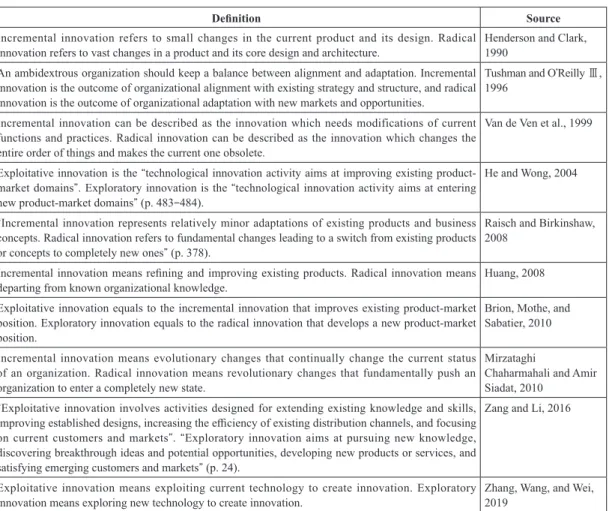
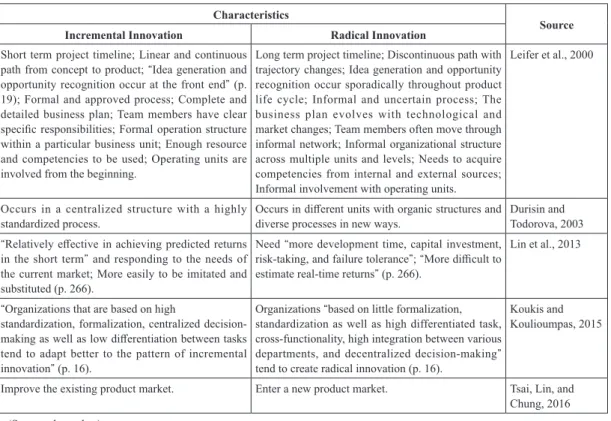
(4) 80. (344). Yokohama Journal of Social Sciences, Vol. 24, No. 3. performance by referring to some critical antecedents. They indicated that some antecedents could facilitate or hinder the achievement of innovation ambidexterity, which could improve organizational performance under specific conditions. For example, Lin et al. (2013) indicated that learning capability, which referred to the combination of “intra-organizational learning, inter-organizational partnering, and an open organization culture” (p. 267), enabled an organization to pursue exploitative and exploratory activities, that could create both incremental and radical innovations, and the innovation ambidexterity could facilitate higher organizational performance as the outcome of this process. By investing 190 hospitals in China, Zang and Li (2016, p. 1) found that “both technology capabilities and marketing capabilities have an inverse U-shape relationship with innovation ambidexterity”, the combination of these two capabilities could help an organization achieve innovation ambidexterity, which could further improve the organizational performance in the long term. Mohammadi, Broström, and Franzoni (2017) indicated that ethnic diversity of the workforce could facilitate radical innovation, and employeesʼ disciplinary background diversity could facilitate incremental and radical innovations. Both kinds of diversities could help an organization achieve innovation ambidexterity, which could increase the turnover of the firm as an outcome. Zhang, Wang, and Wei (2019, p. 11) pointed out that “intra-industry ties reduce, whereas extra-industry ties enhance the positive effects of innovation ambidexterity on firm growth”. By investigating 429 Spanish SMEs, Soto‒Acosta, Popa, and Martinez‒Conesa (2018) found that there was a positive relationship between information technology capability and innovation ambidexterity. Also, environmental dynamism could help a firm achieve innovation ambidexterity, which could improve the performance of the firm for a certain period. From all these studies, we can infer that innovation ambidexterity could be regarded as an intermediate variable between influential factors or antecedents and organizational performance. 3. 2 Incremental Innovation and Radical Innovation 3. 2. 1 Notions of Incremental Innovation and Radical Innovation Since a lot of definitions of incremental innovation and radical innovation have been put forward by scholars around the world, in the research field of innovation ambidexterity, researchers defined these two terms from some other perspectives. Table 4 lists some typical definitions of incremental innovation and radical innovation in the literature of innovation ambidexterity. Some scholars used different terms to express the same meaning of incremental and radical innovations in their definitions. In addition, some scholars indicated the characteristics of incremental innovation and radical innovation by making a comparison between these two innovation types. Table 5 lists several characteristics of both kinds of innovations in different aspects. From the literature, we can find that although scholars might use different terms to express incremental innovation and radical innovation, the underlying meaning of these two innovation types could be summarized as follows: incremental innovation means the evolutionary change that exploits existing knowledge, technologies and products (designs and functions) to meet the needs of the current market by adopting current organizational strategy and structure, in contrast, radical innovation means the revolutionary change that explores new knowledge, technologies and products (designs and functions) to meet the needs of emerging and potential markets by pursuing new organizational strategy and structure. In this research, incremental innovation can be defined as the continuous improvement of existing components, knowledge, technologies, experiences, skills, and know-how created by sub-units of an.
(5) The Conceptual Development of Organizational Ambidexterity(Huaxing Shang) (345). 81. Table 4 Definitions of Incremental Innovation and Radical Innovation in Innovation Ambidexterity Study Definition. Source. Incremental innovation refers to small changes in the current product and its design. Radical Henderson and Clark, innovation refers to vast changes in a product and its core design and architecture. 1990 An ambidextrous organization should keep a balance between alignment and adaptation. Incremental Tushman and OʼReilly Ⅲ, innovation is the outcome of organizational alignment with existing strategy and structure, and radical 1996 innovation is the outcome of organizational adaptation with new markets and opportunities. Incremental innovation can be described as the innovation which needs modifications of current Van de Ven et al., 1999 functions and practices. Radical innovation can be described as the innovation which changes the entire order of things and makes the current one obsolete. Exploitative innovation is the “technological innovation activity aims at improving existing product- He and Wong, 2004 market domains”. Exploratory innovation is the “technological innovation activity aims at entering new product-market domains” (p. 483‒484). “Incremental innovation represents relatively minor adaptations of existing products and business Raisch and Birkinshaw, concepts. Radical innovation refers to fundamental changes leading to a switch from existing products 2008 or concepts to completely new ones” (p. 378). Incremental innovation means refining and improving existing products. Radical innovation means Huang, 2008 departing from known organizational knowledge. Exploitative innovation equals to the incremental innovation that improves existing product-market Brion, Mothe, and position. Exploratory innovation equals to the radical innovation that develops a new product-market Sabatier, 2010 position. Incremental innovation means evolutionary changes that continually change the current status Mirzataghi of an organization. Radical innovation means revolutionary changes that fundamentally push an Chaharmahali and Amir organization to enter a completely new state. Siadat, 2010 “Exploitative innovation involves activities designed for extending existing knowledge and skills, Zang and Li, 2016 improving established designs, increasing the efficiency of existing distribution channels, and focusing on current customers and markets”. “Exploratory innovation aims at pursuing new knowledge, discovering breakthrough ideas and potential opportunities, developing new products or services, and satisfying emerging customers and markets” (p. 24). Exploitative innovation means exploiting current technology to create innovation. Exploratory Zhang, Wang, and Wei, innovation means exploring new technology to create innovation. 2019 (Source: the author). organization, in contrast, radical innovation can be defined as the revolutionary new product that has “either unprecedented performance features or familiar features that offer potential for significant improvements in performance or cost” that creates a new market or dramatically transform existing markets or industries (Leifer et al., 2000, p. 5). In addition, according to the study of Leifer et al. (2000, p. 6‒7), radical innovation can be categorized into three types: “innovation within the technology/market domains of existing business units”, “innovation in the ʻwhite spacesʼ between a firmʼs existing businesses”, and “innovation outside a firmʼs current strategic context”. 3. 2. 2 Relationships between Incremental Innovation and Radical Innovation From previous literature, we know that incremental innovation and radical innovation have different meanings and characteristics. However, these two innovation types also have a series of close relationships which have been indicated in the publications of innovation ambidexterity. Some scholars discussed the.
(6) 82. (346). Yokohama Journal of Social Sciences, Vol. 24, No. 3. Table 5 Characteristics Comparison between Incremental Innovation and Radical Innovation Characteristics Incremental Innovation Short term project timeline; Linear and continuous path from concept to product; “Idea generation and opportunity recognition occur at the front end” (p. 19); Formal and approved process; Complete and detailed business plan; Team members have clear specific responsibilities; Formal operation structure within a particular business unit; Enough resource and competencies to be used; Operating units are involved from the beginning.. Radical Innovation. Source. Long term project timeline; Discontinuous path with Leifer et al., 2000 trajectory changes; Idea generation and opportunity recognition occur sporadically throughout product life cycle; Informal and uncertain process; The business plan evolves with technological and market changes; Team members often move through informal network; Informal organizational structure across multiple units and levels; Needs to acquire competencies from internal and external sources; Informal involvement with operating units.. Occurs in a centralized structure with a highly Occurs in different units with organic structures and Durisin and standardized process. diverse processes in new ways. Todorova, 2003 “Relatively effective in achieving predicted returns Need “more development time, capital investment, Lin et al., 2013 in the short term” and responding to the needs of risk-taking, and failure tolerance”; “More difficult to the current market; More easily to be imitated and estimate real-time returns” (p. 266). substituted (p. 266). “Organizations that are based on high standardization, formalization, centralized decisionmaking as well as low differentiation between tasks tend to adapt better to the pattern of incremental innovation” (p. 16).. Organizations “based on little formalization, Koukis and standardization as well as high differentiated task, Koulioumpas, 2015 cross-functionality, high integration between various departments, and decentralized decision-making” tend to create radical innovation (p. 16).. Improve the existing product market.. Enter a new product market.. Tsai, Lin, and Chung, 2016. (Source: the author). relationships between incremental innovation and radical innovation by directly pointing out their findings or designing specific models to describe the relationships. Some researchers indirectly indicated the relationships but discussed this issue through mechanisms of managing the two innovation types from different perspectives. Other researchers noted that radical innovation could be created or transformed from incremental innovation. In this part, the author reviews the first group of scholarsʼ research outcomes. The studies of the scholars belonging to the other two groups will be discussed in the following parts. Since incremental innovation and radical innovation are inherently different, they have different strategystructure causal sequences (Ettlie, Bridges, and OʼKeefe, 1984), some scholars indicated that simultaneously pursuing both two innovation types within an organization could be difficult to some extent. For example, Leonard‒Barton (1992) pointed out that exploiting current product innovation capabilities (incremental innovation) might lead to tension and create limitations of exploring new product innovation capabilities (radical innovation). However, some scholars suggested organizations to pursue and reconcile these two innovation types to obtain a sustainable competitive advantage. Tushman and OʼReilly Ⅲ (1996, p. 24) indicated that innovation ambidexterity referred to the “ability to simultaneously pursue both incremental and discontinuous innovation”. From the study of Colbert (2004), we can find that reconciling exploitative innovation and exploratory innovation could be much better than pursuing each innovation type individually for the long-term.
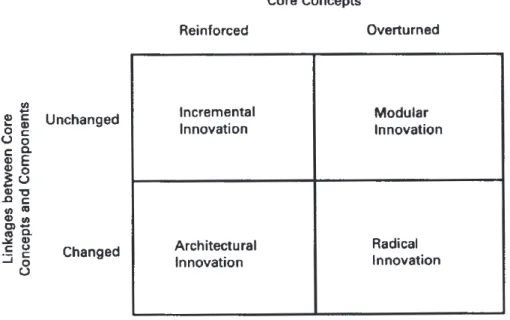
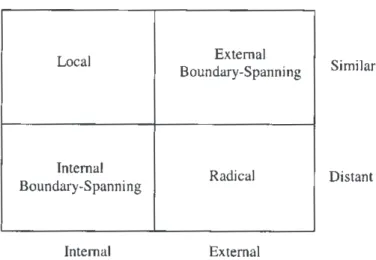
(7) Huaxing Shang PartⅡ Ambidexterity of Organizational Conceptual Development The Conceptual (Figures & Tables) The Development of Organizational Ambidexterity(Huaxing Shang) (347). 83. Figure 8 A Framework for Defining Innovation. andfor Clark, 1990, p.Innovation 12) (Source: Defining Framework 8 AHenderson Figure. (Source: Henderson and Clark, 1990, p. 12). development of organizations. However, by making a large-scale survey of high-technology SMEs, Randall, Edelman, and Galliers (2017) pointed out that the exploratory innovation activity could be compromised and undercut by exploitative innovation activities to some extent in an organization due to the influences of some specific factors. Some scholars explained the relationship between incremental innovation and radical innovation in innovation ambidexterity domain by putting forward various models. Henderson and Clark (1990) designed a model (Figure 8) to put four innovation types into different quadrants based on their impacts on components and linkages between these components. According to their model, incremental innovation could reinforce current core concepts and remain the “linkages between core concepts and components”, in contrast, radical innovation could fundamentally establish new core concepts and change the “linkages between core concepts and components” as well (p. 12). Rosenkopf and Nerkar (2001) classified local innovation and radical innovation based on two dimensions: technological boundary spanning and organizational boundary spanning. From their model (Figure 9), we can find that local innovation refers to the type that exploits existing technologies within an organization, and radical innovation refers to the type that explores new technologies beyond an organization. Incremental innovation and radical innovation also have an orthogonal relationship. Smith and Tushman (2005) put forward a model (Figure 10) to describe the scope of exploitative innovation and exploratory innovation by putting them in some specific locations according to their different characteristics Figure 9 Types of Exploration of target markets and technologies that compared with existing products of a firm. At the origin of the space (Source: Rosenkopf and Nerkar, 2001, p. 289) was the exploitative innovation, which focused on current customers by pursuing incremental technological innovation. Exploratory innovation happened in the area outside of the original space. Andriopoulos and.
(8) Figure 8. A Framework for Defining Innovation (Source: Henderson and Clark, 1990, p. 12). 84. (348). Yokohama Journal of Social Sciences, Vol. 24, No. 3. Figure 9 Types of Exploration. (Source: Rosenkopf and Nerkar, 2001, p. 289) (Figures & Tables). 9. Figure The Conceptual Development of Organizational Ambidexterity. Types of Exploration PartⅡ Huaxing Shang (Source: Rosenkopf and Nerkar, 2001, p. 289). Figure 10 Innovation Map. Figure 10and Tushman, Innovation Map Smith 2005, p. 524) (Source: (Source: Smith and Tushman, 2005, p. 524).
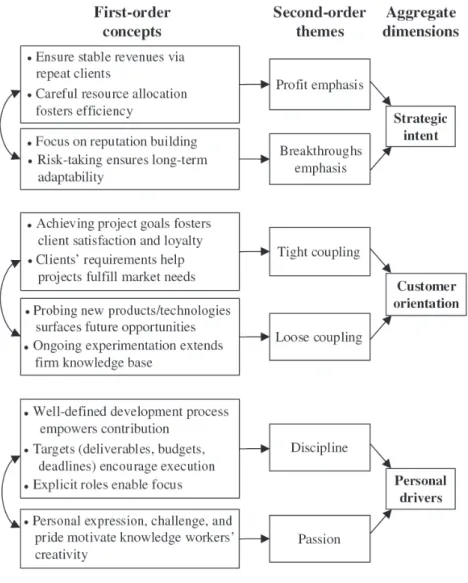
(9) (Figures & Tables) The TheConceptual Conceptual Development Development ofofOrganizational Ambidexterity PartⅡ Huaxing Shang (349) 85 Organizational Ambidexterity(Huaxing Shang). Figure 11 Data Structure: Paradoxes of Innovation. Figure (Source: 11 Data Structure:and Paradoxes of p.Innovation Andriopoulos Lewis, 2009, 701) (Source: Andriopoulos and Lewis, 2009, p. 701). Lewis (2009) built a theoretical framework (Figure 11) to package “first-order concepts, second-order themes and aggregate dimensions” of incremental innovation and radical innovation into a structure based on their case study (p. 701). From their framework, we can find that although the two innovation types have different strategic intents, customer orientations, and personal drivers, they are closely connected in each dimension, which indicates that the connection or interplay between incremental innovation and radical innovation is possible and reasonable..
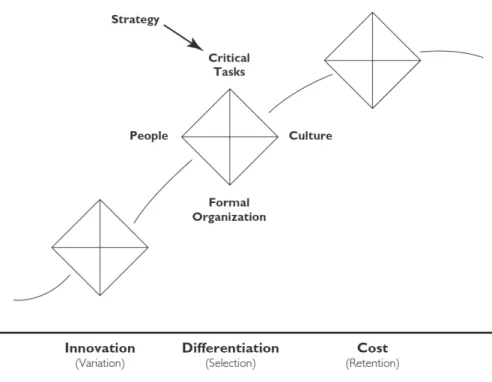
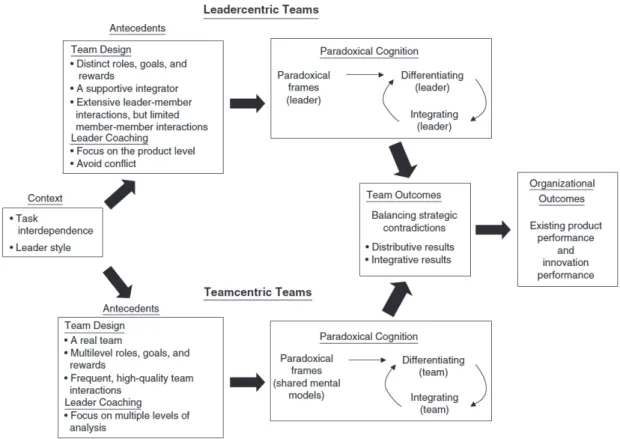
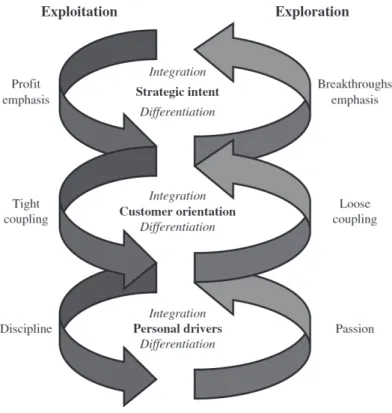
(10) 86. (350). Yokohama Journal of Social Sciences, Vol. 24, No. 3. 3. 2. 3 Mechanisms for Managing Incremental Innovation and Radical Innovation In order to achieve innovation ambidexterity, an organization needs to reconcile incremental innovation and radical innovation through some specific management mechanisms. Some scholars put forward the mechanisms along with the general mechanisms for managing exploitation and exploration. Some scholars specifically designed mechanisms for managing incremental and radical innovations under different conditions and contexts. Followed the discussion of general management mechanisms for managing exploitation and exploration, some scholars transformed the general mechanisms into innovation ambidexterity study so that the structural, contextual, and temporal mechanisms could also be used to coordinate incremental innovation and radical innovation under specific conditions. The structural mechanism means an ambidextrous organization can pursue incremental innovation and radical innovation separately in different subunits (Tushman and OʼReilly Ⅲ, 1996; Corso and Pellegrini, 2007; Lin et al., 2013). The contextual mechanism means a top management team or a manager can coordinate departments, and create an organizational context so that the members of the organization can pursue incremental innovation and radical innovation by dividing their time and workloads based on specific requirements (Corso and Pellegrini, 2007). The context may include four elements: “performance management, formalization, creativity and risk-taking” (Brion, Mothe, and Sabatier, 2010, p. 7). The temporal mechanism means an ambidextrous organization can pursue incremental and radical innovations in different periods. For example, Duncan (1976) indicated that an innovation process could be divided into initiation and implementation stages so that the extents of complexity, formalization, and centralization in each stage should be treated differently. Tushman and OʼReilly Ⅲ (1996) put forward a model (Figure 12) based on punctuated equilibrium, and they indicated that an ambidextrous organization could evolve and develop through a long period of incremental innovation, which was punctuated by several radical innovations at some moments. When a certain market or technology changes, the managers or the top management team of an organization should realign their business units with their strategies, structures, skills, and cultures to meet new conditions. Some scholars also put forward some specific mechanisms for managing incremental innovation and radical innovation based on different aspects of innovation ambidexterity. By doing a case study of IBM, Durisin and Todorova (2003) indicated that the radical innovation subunit could interact closely with incremental innovation subunit to foster innovation ambidexterity. Smith and Tushman (2005) put forward a model (Figure 13) to explain the mechanism for managing strategic contradiction between exploitative innovation and exploratory innovation. Their model included context, antecedents, paradoxical cognition, team outcomes, and organizational outcomes of the whole process, and the applicability of this model needed to be further developed in the future. Andriopoulos and Lewis (2009) designed a model (Figure 14) to describe how an organization could coordinate the relationship between exploitative innovation and exploratory innovation based on “varied mixes of integration and differentiation” approaches across multiple levels (p. 703). The interaction among different levels could reinforce the innovation ambidexterity to some extent. Lin et al. (2013) suggested that an organization could achieve innovation ambidexterity by developing its learning capability which relied on the combination of intra-organizational learning among employees, inter-organizational learning with other organizations, and an open organizational culture that facilitated knowledge sharing within the ambidextrous organization. Dunlap et al. (2016) underlined that an organization might achieve innovation.
(11) The Conceptual Development of Organizational Ambidexterity(Huaxing Shang) (351). (Figures & Tables). The Conceptual Development of Organizational Ambidexterity. PartⅡ. 87. Huaxing Shang. Figure 12 Punctuated Equilibrium and Organizational Evolution. Figure 12. Punctuated Equilibrium andⅢ, Organizational Evolution (Source: Tushman and O’Reilly 1996, p. 14) (Source: Tushman and O’Reilly Ⅲ, 1996, p. 14). ambidexterity by keeping a balance between incremental innovation and radical innovation, promoting the interaction between these two innovation activities, and combining all these management mechanisms. 3. 2. 4 Influence Factors of Managing Incremental Innovation and Radical Innovation From the literature of innovation ambidexterity, we can find that many scholars have put forward some influence factors for managing incremental innovation and radical innovation simultaneously. These factors could be classified into three categories: environmental, organizational, and managerial factors. In addition, some researchers emphasized several factors across different categories in their studies. 1) Environmental Factors An ambidextrous organization could pursue and achieve innovation ambidexterity under specific environmental conditions. Jansen, van den Bosch, and Volberda (2006) indicated that it was suitable for an organization to pursue exploitative innovation in a more competitive environment, and pursue exploratory innovation in a more dynamic environment. Lin, Yang, and Demirkan (2007) believed that the uncertain and unstable environment was suitable for an organization to keep a balance between exploitative innovation and exploratory innovation. Dunlap et al. (2016) argued that an ambidextrous organization could obtain excellent performance by supporting greater supplier involvement when it pursued innovation ambidexterity through a combined mechanism..
(12) (Figures & Tables) The Conceptual Development of Organizational Ambidexterity PartⅡ 88 (352) Yokohama Journal of Social Sciences, Vol. 24, No. 3. Figure 13. Huaxing Shang. A Model of Managing Strategic Contradiction by Team Type (Source: Smith 2005, p. 530) (Source: Smithand and Tushman, Tushman, 2005, p. 530). Figure 13 A Model of Managing Strategic Contradiction by Team Type. 2) Organizational Factors Although external environmental factors could influence the management of incremental innovation and radical innovation, several attributes of the organization itself are also important for achieving innovation ambidexterity. For example, Ettlie, Bridges, and OʼKeefe (1984) made a survey of several firms in the food processing industry and indicated that pursuing incremental innovation and radical innovation needed different organizational strategies and structures. Specifically, incremental innovation could be supported by a market dominated growth strategy and traditional structure arrangement (complexity, decentralization, and formalization), in contrast, radical innovation could be supported by an aggressive strategy and unique structure arrangement (centralization and informal type). From the study of He and Wong (2004), we can infer that knowledge transferability is necessary when an organization intends to pursue exploitative and exploratory innovations simultaneously. McCarthy et al. (2006) suggested that an ambidextrous organization should effectively “govern the process ability to switch or toggle between behaviors that range from linear to chaotic to produce corresponding innovations that range from incremental to radical” (p. 441). Menguc and Auh (2010) indicated that formal organizational structure could support incremental innovation, and the informal one could support radical innovation. Grover, Purvis, and Segars (2007) argued that both mechanistic and organic.
(13) (Figures & Tables). The Conceptual Development of Organizational Ambidexterity PartⅡ Huaxing Shang The Conceptual Development of Organizational Ambidexterity(Huaxing Shang) (353). 89. Figure 14 Virtuous Cycles of Ambidexterity Figure 14 Virtuous Cycles of Ambidexterity (Source: Andriopoulos and Lewis, 2009, p. 707). (Source: Andriopoulos and Lewis, 2009, p. 707). structures could coexist to support innovation ambidexterity. From the study of Sheng and Chien (2016), we can find that incremental innovation could be benefitted from organizational learning orientation, and radical innovation could be benefitted from organizational absorptive capacity. Forés and Camisón (2016) indicated that incremental innovation could be supported by internal knowledge creation capability and absorptive capability of an organization, in contrast, radical innovation could be supported by the combination of internal knowledge and external knowledge. Followed Audia and Goncaloʼs research (2007), Brion and Mothe (2016) suggested that an organization could achieve innovation ambidexterity by creating a context that supported creativity: the convergent creativity could facilitate exploitative innovation, and the divergent creativity could facilitate exploratory innovation. By surveying 190 Chinese hospitals, Zang and Li (2016, p. 1) found that “both technology capabilities and marketing capabilities have an inverse U-shape relationship with innovation ambidexterity”, and the combination of these two capabilities had a positive relationship with innovation ambidexterity. 3) Managerial Factors Innovation ambidexterity is not only affected by environmental and organizational factors, some managerial factors derived from management activities also have significant influences on the management of.
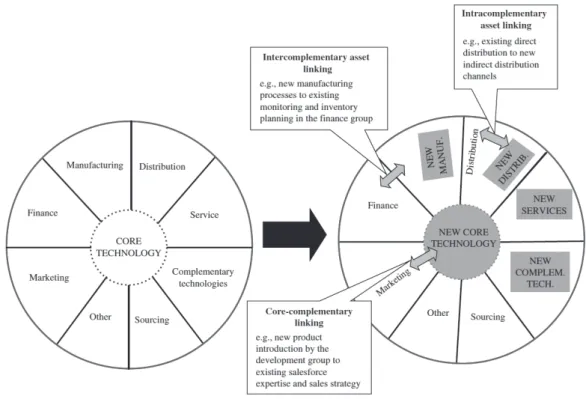
(14) (Figures Tables) 90 & (354). The Conceptual Development of Organizational PartⅡ Yokohama Journal of SocialAmbidexterity Sciences, Vol. 24, No. 3. Huaxing Shang. Figure 15 Influence Model of Managerial Linking Activities During Technological Transitions Figure 15 Influence Model of Managerial Linking Activities During Technological Transitions (Source: Taylor and Helfat, 2009, p. 723). (Source: Taylor and Helfat, 2009, p. 723). incremental innovation and radical innovation under specific conditions. For example, Duncan (1976) divided an innovation process into initiation (radical) and implementation (incremental) stages, and he indicated that an organization designer needed to consider four variables when an organization changed its structure, the variables included: “dealing with conflict, effective interpersonal relations, switching rules for differentiating organization structures, and institutionalizing the dual structures for innovation” (p. 185). Taylor and Helfat (2009) designed a model (Figure 15) to present several managerial factors (economic incentives, structural influences, social context, and organizational cognition), which influenced the technology transition through a series of organizational linking activities across new technology and existing complementary assets. Brunner et al. (2010) underlined the importance of deliberate perturbation in facilitating exploration from intense exploitative activities. Mohammadi, Broström, and Franzoni (2017) indicated that the workforce that had diverse ethnic and educational disciplinary backgrounds had a positive influence on a firmʼs turnover, which was generated by radical innovation. Also, the external resource could replace the workforceʼs disciplinary diversity to some extent but could not replace the ethnic diversity..
(15) The Conceptual Development of Organizational Ambidexterity(Huaxing Shang) (355). 91. 4) Combination of Multiple Factors Based on the three basic categories of influence factors, some scholars underlined the importance of several factors across different categories. For example, Tushman and OʼReilly Ⅲ (1996) indicated that a series of structural, cultural, and managerial factors could support an organization in pursuing incremental innovation and discontinuous innovation simultaneously. However, structural inertia and cultural inertia might impede innovation ambidexterity. By doing a survey to firms of the aerospace, electronic components, and telecommunication industries, Koberg, Detienne, and Heppard (2003, p. 39) argued that incremental innovation could be supported by “environmental dynamic, age, and size of the firm, intrafirm structural linkages and the age of CEO”, in contrast, radical innovation could be supported by “environmental dynamic, intrafirm linkages, experimentation, and transition or sequencing from project or product to another”. From Pohlʼs study (2012), we can find that social policy and organizational strategy could influence the decision making of radical innovation. Technology ability, supplier participation, and information sharing could favor the development of radical innovation. Randall, Edelman, and Galliers (2017, p. 6‒7) indicated that attracting prestigious customers, “goal incongruence between the agent and the firm on development priority”, and “asymmetric information between the agent and the principle” might lead to “change in development plans away from exploration during the development phase”, which could finally weaken the innovation ambidexterity performance. Soto-Acosta, Popa, and Martinez-Conesa (2018) argued that “information technology capability, knowledge management capability and environmental dynamism are positively associated with innovation ambidexterity”, and “environmental dynamism is found to strengthen the positive effect of innovation ambidexterity on firm performance” (p. 824). 3. 2. 5 Radical Innovation Builds on Incremental Innovation Since exploitation and exploration could interplay under specific conditions, incremental innovation (exploitative innovation) and radical innovation (exploratory innovation) could also interact with each other. Based on this, we can infer that radical innovation could be built or created from incremental innovation (exploitative innovation). Some scholars discussed this issue from different perspectives. For example, based on the analysis of cases in various industries, Hargadon (2003, p. 205) indicated that “breakthrough innovation come by recombining the people, ideas, and objects of past technologies”, firms that adopted technology brokering strategy could achieve breakthrough innovation by “bridging distant worlds in order to see new ways of combining existing but previously distant people, ideas, and objects, and building new networks between and around these new combinations” (p. 65) under specific conditions. By deeply exploring how and why “a decision of offering breakfast to homeless people can lead to radical change of a church and its environment”, Plowman et al. (2007, p. 515) found that radical change could be spontaneously created by the dynamic interaction of small changes, amplifying actions and destabilizing conditions. Taylor and Helfat (2009) put forward a theoretical framework (Figure 16) to explain the mechanism of technology transition, and they found that exploiting “existing complementary assets” could “support the new ʻexploratoryʼ core technology” by utilizing some organizational linkages (“core-complementary linkage, intra-complementary linkage, and inter-complementary asset linkage”), which could be influenced by several “economic, structural, social, and cognitive” factors (p. 721‒722). Practically, middle managers should take responsibility for creating and managing this mechanism. Brunner et al. (2010) argued that a mature organization which pursued exploitation could stimulate exploration (radical innovation) by deliberately inducing perturbation in its process. Zang and Li (2016) indicated that exploitative.
(16) (Figures & Tables) 92 (356). The ConceptualYokohama DevelopmentJournal of Organizational of SocialAmbidexterity Sciences, Vol.PartⅡ 24, No. 3 Huaxing Shang. Figure Figure16 Organizational 16 OrganizationalLinkages LinkagesRequired Requiredfor forTechnology Technology Transitions Transitions (Source: Taylor and Helfat, 2009, p. 721). (Source: Taylor and Helfat, 2009, p. 721). innovation could help an organization understand existing knowledge, and reconfigure the knowledge to explore new opportunities in new markets to improve the effectiveness of exploratory innovation as a result. On the other hand, exploratory innovation could help an organization improve exploitative innovation through several means under specific conditions. From the studies mentioned above, we can infer that radical innovation (exploratory innovation) could be supported, created, or built on incremental innovation (exploitative innovation). The interplay between these two innovation types is beneficial for both sides and could help an organization achieve innovation ambidexterity under specific conditions. 3. 3 Research Question By reviewing the studies of innovation ambidexterity, we can find that, as an organizational capability, innovation ambidexterity means an organization simultaneously pursues incremental innovation and radical innovation (exploitative innovation and exploratory innovation) by exploiting existing knowledge or technologies, and exploring new opportunities for developing radical changes, in order to help the organization achieve good performance, and obtain a sustainable competitive advantage in the long run. As two basic elements of innovation ambidexterity, incremental innovation and radical innovation have different meanings.
(17) The Conceptual Development of Organizational Ambidexterity(Huaxing Shang) (357). 93. and characteristics but a very close relationship so that they can interplay together through several mechanisms under specific conditions and contexts. Furthermore, radical innovation can be built on incremental innovation, and it can also give incremental innovation more opportunities to be improved and developed gradually. In addition, environmental, organizational, managerial factors, and the combination of them have significant influences on managing the relationship between incremental innovation and radical innovation. Based on these studies, the critical question, how to develop radical innovation from incremental innovation(s) across multiple levels in an ambidextrous organization, needs to be explored in future studies. 4.Conclusion From the perspective of the resource-based view, an organization usually has many kinds of resources and capabilities, which could be used and developed when necessary. This paper discusses the conceptual development of organizational ambidexterity from general discussion to innovation management application. Scholars have discussed the issue of organizational ambidexterity (OA) at the general level for more than forty years. Although many researchers have put forward some definitions of OA, in this research, OA is defined as an organizational capability to reconcile exploitation and exploration across multiple levels within a system under certain conditions to help an organization obtain a sustainable competitive advantage. Basically, the study of OA has six research streams; they are organizational learning, organizational adaptation, organizational design, innovation management, strategic management, and resource management. Also, some scholars pointed out that OA and organizational performance could be positively related. At the general level, the study on exploitation and exploration (Ei and Er) is the primary focus of OA research. Many researchers have made several definitions of Ei and Er, indicated the relationships between Ei and Er, studied the management mechanisms (ten types), and influence factors (environmental, organizational, managerial) of Ei and Er based on different industrial contexts. In addition, some scholars indicated that Ei and Er could be managed and reconciled across different organizational levels, and exploration could be built on exploitation under specific conditions. In the research stream of innovation management, many researchers discussed the issue of innovation ambidexterity (IA) at a specific level. Some scholars have made several definitions of IA from different perspectives, and some researchers pointed out IA and organizational performance could positively related though these organizations might have different industrial contexts. Although various definitions of IA have been put forward, the essence of IA could be summarized as the capability that enables an organization simultaneously pursue incremental innovation and radical innovation by exploiting existing knowledge or technologies and exploring new opportunities for developing radical changes to help the organization obtain a sustainable competitive advantage. The study on incremental innovation and radical innovation (II & RI) has become the primary focus of innovation ambidexterity study. Some scholars defined each term and compared their characteristics from different perspectives. Some researchers studied the relationships, management mechanisms, and influence factors of II & RI. In addition, some scholars indicated that radical innovation could be created from incremental innovation through specific mechanisms. Figure 17 summaries the research route and basic contents of this paper. From the previous literature, we can find that although incremental innovation and radical innovation have different meanings and characteristics, they can interplay together through several mechanisms under.
(18) 94. Figure 17. Yokohama Journal of of Literature Social Sciences, 24, No. Theoretical Framework ReviewVol. (Source: the3author). (358). RBV General Discussion Organizational Ambidexterity (OA) Origin & Evolution. Research Streams. Notions. OA & Org. Performance. Organizational Learning Organizational Adaptation Organizational Design Innovation Management Strategic Management Resource Management Exploitation & Exploration (Ei & Er) Notions. Relationships of Ei & Er. Two Ends of a Continuum; Orthogonal Relationship; Traps of Excessive Ei or Er. Primary Focus of OA Ei & Er Across Different Levels. Management Mechanisms. Influence Factors. 10 Types. Environmental; Organizational; Managerial. Er Builds on Ei. Specific Application Innovation Ambidexterity (IA) Notions (Ei & Er≈II & RI). IA & Org. Performance Incremental Innovation and Radical Innovation (II&RI). Notions. Note:. Relationships of II&RI. Management Mechanisms. Primary Focus of IA. Influence Factors Environmental; Organizational; Managerial; Combination. : Logical Influence : Inclusion Relation : Indicator Research Question. Figure 17 Summary of Research Route and Basic Contents (Source: the author). RI Builds on II.
(19) The Conceptual Development of Organizational Ambidexterity(Huaxing Shang) (359). 95. specific conditions and contexts. Furthermore, it has been shown that radical innovation can be created from incremental innovation. Since Pohl (2012) indicated that some companies were not only good at pursuing incremental innovations but also had the capabilities to create “more-than-incremental” innovations, an important question that needs to be answered in future studies is how to develop radical innovation from incremental innovation(s) across multiple levels in an ambidextrous organization? Going forward, we propose that qualitative study into this research question is an important area of inquiry.. Acknowledgment. This research has benefited from the advice and support of many people and organizations. First, I need to thank my three academic advisors of Yokohama National University, Daniel A. Heller, Seiji Manabe, and Kodo Yokozawa, for their guidance in leading me to the right direction of this research, and providing necessary and invaluable advice and support. Special thanks to Toka‒Donghua Educational and Cultural Exchange Foundation for its generous financial support, which helped me relieve the financial burden when I lived in Japan during the whole research process. Finally, I wish to thank the authors of all cited literature in this paper for helping me explore and understand organizational ambidexterity from general discussion to innovation management application.. References Andriopoulos, C. and Lewis, M. W., “Exploitation-Exploration Tensions and Organizational Ambidexterity: Managing Paradoxes of Innovation”, Organization Science, Vol. 20, No. 4, 2009, pp. 696‒717. Atuahene-Gima, K., “Resolving the Capability-Rigidity Paradox in New Product Innovation”, Journal of Marketing, Vol. 69, Issue 4, 2005, pp. 61‒83. Audia, P. G. and Goncalo, J. A., “Past Success and Creativity over Time: A Study of Inventors in the Hard Disk Drive Industry”, Management Science, Vol. 53, Issue 1, 2007, pp. 1‒15. Auh, S. and Menguc, B., “Balancing Exploration and Exploitation: The Moderating Role of Competitive Intensity”, Journal of Business Research, Vol. 58, Issue 12, 2005, pp. 1652‒1661. Backman, M., Börjesson, S. and Setterberg, S., “Working with Concepts in the Fuzzy Front End: Exploring the Context for Innovation for Different Types of Concepts at Volvo Cars”, R&D Management, Vol. 37, Issue 1, 2007, pp. 17‒28. Brion, S. and Mothe, C., “Organizational Context and Innovation Ambidexterity: Is Creativity the Missing Link?”, XXVe conférence de l’AIMS, Tunis, Tunisia, May 2016, pp. 1‒21. Brion, S., Mothe, C. and Sabatier, M., “The Impact of Organisational Context and Competences on Innovation Ambidexterity”, International Journal of Innovation Management, Vol. 14, No. 2, 2010, pp. 151‒178. Brunner, D. J., Staats, B. R., Tushman, M. and Upton, D. M., “Wellsprings of Creation: How Perturbation Sustains Exploration in Mature Organizations”, Harvard Business School, Working Paper 09‒011, 2010, pp. 1‒35. Cao, Q., Gedajlovic, E. and Zhang, H., “Unpacking Organizational Ambidexterity: Dimensions, Contingencies, and Synergistic Effects”, Organization Science, Vol. 20, Issue 4, 2009, pp. 781‒796. Colbert, B. A., “The Complex Resource-Based View: Implications for Theory and Practice of Strategic Human Resource Management”, Academy of Management Review, Vol. 29, No. 3, 2004, pp. 341‒358. Corso, M. and Pellegrini, L., “Continuous and Discontinuous Innovation: Overcoming the Innovator Dilemma”, Creativity and Innovation Management, Vol. 16, Issue 4, 2007, pp. 333‒347. Duncan, R. B., “The Ambidextrous Organization: Designing Dual Structures for Innovation”, In Kilmann, R. H.,.
(20) 96. (360). Yokohama Journal of Social Sciences, Vol. 24, No. 3. Pondy, L. R. and Slevin, D. (eds.), The Management of Organization Design: Strategies and Implementation, New York: North-Holland, 1976, pp. 167‒188. Dunlap, D., Parente, R., Geleilate, J. M. and Marion, T. J., “Organizing for Innovation Ambidexterity in Emerging Markets: Taking Advantage of Supplier Involvement and Foreignness”, Journal of Leadership & Organizational Studies, Vol. 23, Issue 2, 2016, pp. 175‒190. Durisin, B. and Todorova, G., “The Ambidextrous Organization: Managing Simultaneously Incremental and Radical Innovation?”, SDA Bocconi-Research Division, Working Paper N. 96/03, 2003, pp. 1‒30. Ettlie, J. E., Bridges, W. P. and OʼKeefe, R. D., “Organization Strategy and Structural Differences for Radical versus Incremental Innovation”, Management Science, Vol. 30, Issue 6, 1984, pp. 682‒695. Forés, B. and Camisón, C., “Does Incremental and Radical Innovation Performance Depend on Different Types of Knowledge Accumulation Capabilities and Organizational Size?”, Journal of Business Research, Vol. 69, Issue 2, 2016, pp. 831‒848. Grover, V., Purvis, R. L. and Segars, A. H., “Exploring Ambidextrous Innovation Tendencies in the Adoption of Telecommunications Technologies”, IEEE Transactions on Engineering Management, Vol. 54, Issue 2, 2007, pp. 268‒285. Han, J. K., Kim, N. and Kim, H. B., “Entry Barriers: A Dull-, One-, or Two-Edged Sword for Incumbents? Unraveling the Paradox from A Contingency Perspective”, Journal of Marketing, Vol. 65, Issue 1, 2001, pp. 1‒14. Hargadon, A., How Breakthroughs Happen: The Surprising Truth about How Companies Innovate, Cambridge, MA: Harvard Business School Press, 2003. He, Z. L. and Wong, P. K., “Exploration vs. Exploitation: An Empirical Test of the Ambidexterity Hypothesis”, Organization Science, Vol. 15, Issue 4, 2004, pp. 481‒494. Henderson, R. M. and Clark, K. B., “Architectural Innovation: The Reconfiguration of Existing Product Technologies and the Failure of Established Firms”, Administrative Science Quarterly, Vol. 35, No. 1, 1990, pp. 9‒30. Huang, P., “Why and How to be Ambidextrous? The Relationship between Environmental Factors, Innovation Strategy and Organizational Capabilities”, Working Paper, Cheng-Shiu University, Taiwan, 2008, pp. 1‒39. Jansen, J. J., van den Bosch, F. A. and Volberda, H. W., “Exploratory Innovation, Exploitative Innovation, and Performance: Effects of Organizational Antecedents and Environmental Moderators”, Management Science, Vol. 52, Issue 11, 2006, pp. 1661‒1674. Katila, R. and Ahuja, G., “Something Old, Something New: A Longitudinal Study of Search Behavior and New Product Introduction”, Academy of Management Journal, Vol. 45, No. 6, 2002, pp. 1183‒1194. Koberg, C. S., Detienne, D. R. and Heppard, K. A., “An Empirical Test of Environmental, Organizational, and Process Factors Affecting Incremental and Radical Innovation”, The Journal of High Technology Management Research, Vol. 14, Issue 1, 2003, pp. 21‒45. Koukis, S. and Koulioumpas, I., “Innovation Strategies and Ambidexterity within Flat Organizations: The Case Study of Alfa Laval”, KTH Industrial Engineering and Management, Master of Science Thesis, 2015. Leifer, R., McDermott, C. M., OʼConnor, G. C., Peters, L. S., Rice, M. P. and Veryzer, R. W., Radical Innovation: How Mature Companies Can Outsmart Upstarts, Cambridge, MA: Harvard Business School Press, 2000. Leonard‒Barton, D., “Core Capabilities and Core Rigidities: A Paradox in Managing New Product Development”, Strategic Management Journal, Vol. 13, Issue S1, 1992, pp. 111‒125. Lewis, M. W. and Andriopoulos, C., “Managing Innovation Paradoxes for Organizational Ambidexterity”, In Kahn, K. B. (ed.), The PDMA Handbook of New Product Development, New Jersey: John Wiley & Sons, Inc., 2013, pp. 356‒367. Lin, H. E., McDonough III, E. F., Lin, S. J. and Lin, C. Y. Y., “Managing the Exploitation/Exploration Paradox: The Role of a Learning Capability and Innovation Ambidexterity”, Journal of Product Innovation Management, Vol. 30, Issue 2, 2013, pp. 262‒278. Lin, Z., Yang, H. and Demirkan, I., “The Performance Consequences of Ambidexterity in Strategic Alliance Formations: Empirical Investigation and Computational Theorizing”, Management Science, Vol. 53, Issue 10, 2007, pp. 1645‒1658. McCarthy, I. P., Tsinopoulos, C., Allen, P. and Rose-Anderssen, C., “New Product Development as a Complex.
(21) The Conceptual Development of Organizational Ambidexterity(Huaxing Shang) (361). 97. Adaptive System of Decisions”, Journal of Product Innovation Management, Vol. 23, Issue 5, 2006, pp. 437‒456. Menguc, B. and Auh, S., “Development and Return on Execution of Product Innovation Capabilities: The Role of Organizational Structure”, Industrial Marketing Management, Vol. 39, Issue 5, 2010, pp. 820‒831. Mirzataghi Chaharmahali, S. and Amir Siadat, S., “Achieving Organizational Ambidexterity: Understanding and Explaining Ambidextrous Organizations”, Linköping University, Master Thesis, 2010. Mohammadi, A., Broström, A. and Franzoni, C., “Workforce Composition and Innovation: How Diversity in Employeesʼ Ethnic and Educational Backgrounds Facilitates Firm―Level Innovativeness”, Journal of Product Innovation Management, Vol. 34, Issue 4, 2017, pp. 406‒426. Plowman, D. A., Baker, L. T., Beck, T. E., Kulkarni, M., Solansky, S. T. and Travis, D. V., “Radical Change Accidentally: The Emergence and Amplification of Small Change”, Academy of Management Journal, Vol. 50, No. 3, 2007, pp. 515‒543. Pohl, H., “Japanese Automakersʼ Approach to Electric and Hybrid Electric Vehicles: From Incremental to Radical Innovation”, International Journal of Technology Management, Vol. 57, Issue 4, 2012, pp. 266‒288. Raisch, S. and Birkinshaw, J., “Organizational Ambidexterity: Antecedents, Outcomes, and Moderators”, Journal of Management, Vol. 34, Issue 3, 2008, pp. 375‒409. Randall, C., Edelman, L. and Galliers, R., “Ambidexterity Lost? Compromising Innovation and the Exploration/ Exploitation Plan”, The Journal of High Technology Management Research, Vol. 28, Issue 1, 2017, pp. 1‒16. Rosenkopf, L. and Nerkar, A., “Beyond Local Search: Boundary-Spanning, Exploration, and Impact in the Optical Disk Industry”, Strategic Management Journal, Vol. 22, Issue 4, 2001, pp. 287‒306. Sheng, M. L. and Chien, I., “Rethinking Organizational Learning Orientation on Radical and Incremental Innovation in High-Tech Firms”, Journal of Business Research, Vol. 69, Issue 6, 2016, pp. 2302‒2308. Smith, W. K. and Tushman, M. L., “Managing Strategic Contradictions: A Top Management Model for Managing Innovation Streams”, Organization Science, Vol. 16, Issue 5, 2005, pp. 522‒536. Soto-Acosta, P., Popa, S. and Martinez-Conesa, I., “Information Technology, Knowledge Management and Environmental Dynamism as Drivers of Innovation Ambidexterity: A Study in SMEs”, Journal of Knowledge Management, Vol. 22, Issue 4, 2018, pp. 824‒849. Taylor, A. and Helfat C. E., “Organizational Linkages for Surviving Technological Change: Complementary Assets, Middle Management and Ambidexterity”, Organization Science, Vol. 20, Issue 4, 2009, pp. 718‒739. Tsai, F., Lin, C. and Chung, K., “Resource Slack, Innovation Ambidexterity, and Quality Performance: Knowledge Heterogeneity Perspective”, Journal of Social and Administrative Sciences, Vol. 3, Issue 4, 2016, pp. 268‒281. Tushman, M. L. and OʼReilly Ⅲ, C. A., “Ambidextrous Organizations: Managing Evolutionary and Revolutionary Change”, California Management Review, Vol. 38, No. 4, 1996, pp. 8‒30. Tushman, M. L. and Smith, W. K., “Organizational Technology”, In Baum, J. (ed.), Companion to Organization, Malden, MA: Blackwell, 2002, pp. 386‒414. Tushman, M. L., Smith, W. K., Wood, R. C., Westerman, G. and OʼReilly Ⅲ, C. A., “Innovation Streams and Ambidextrous Organizational Designs: On Building Dynamic Capabilities”, Division of Research, Harvard Business School, 2002, pp.1‒55. Tushman, M. L., Smith, W. K., Wood, R. C., Westerman, G. and OʼReilly Ⅲ, C. A., “Organizational Designs and Innovation Streams”, Industrial and Corporate Change, Vol. 19, Issue 5, 2010, pp. 1331‒1366. Van de Ven, A. H., Polley, D. E., Garud, R. and Venkataraman, S., The Innovation Journey, New York: Oxford University Press, 1999. Wang, H. and Li, J., “Untangling the Effects of Overexploration and Overexploitation on Organizational Performance: The Moderating Role of Organizational Dynamism”, Journal of Management, Vol. 34, No. 5, 2008, pp. 925‒951. Zang, J. and Li, Y., “Technology Capabilities, Marketing Capabilities and Innovation Ambidexterity”, Technology Analysis & Strategic Management, Vol. 29, Issue 1, 2016, pp. 23‒37. Zhang, L., Wang, Y. and Wei, Z., “How Do Managerial Ties Leverage Innovation Ambidexterity for Firm Growth?”, Emerging Markets Finance and Trade, Vol. 55, Issue 4, 2019, pp. 902‒914. [ホアシュン シャン 横浜国立大学大学院国際社会科学府博士課程後期].
(22)
(23)
図
+7

関連したドキュメント
Keywords: homology representation, permutation module, Andre permutations, simsun permutation, tangent and Genocchi
Habiro con- siders an abelian group A k (H) dened by unitrivalent graphs with k trivalent vertices and with univalent vertices labelled by elements of H , subject to anti- symmetry,
Applications of msets in Logic Programming languages is found to over- come “computational inefficiency” inherent in otherwise situation, especially in solving a sweep of
Shi, “The essential norm of a composition operator on the Bloch space in polydiscs,” Chinese Journal of Contemporary Mathematics, vol. Chen, “Weighted composition operators from Fp,
[2])) and will not be repeated here. As had been mentioned there, the only feasible way in which the problem of a system of charged particles and, in particular, of ionic solutions
This paper presents an investigation into the mechanics of this specific problem and develops an analytical approach that accounts for the effects of geometrical and material data on
(4) It is immediate from the definition (2) that our sequence A is equal to its curling number transform, and in fact is the unique sequence with this property!. 2 The
静岡大学 静岡キャンパス 静岡大学 浜松キャンパス 静岡県立大学 静岡県立大学短期大学部 東海大学 清水キャンパス
