Sustaining Circulation:Operations of Long
Standing Japanese Local Currencies
著者
SEPTEMBER JEREMY RYAN
学位授与機関
Tohoku University
学位授与番号
11301
1
Sustaining Circulation:
Operations of Long Standing Japanese Local
Currencies
30 June 2020
Tohoku University Graduate School of
Economics and Management
Global Program in Economics and Management
Doctoral Thesis
Jeremy September
2
Table of Contents
ACKNOWLEDGEMENTS 4LIST OF TABLES 5
LIST OF FIGURES 5
ABBREVIATIONS 6
DEFINITIONS 7
ABSTRACT 9
CHAPTER 1 – INTRODUCTION 10
1.1 OUTLINE OF PAPER 11
1.2 LOCAL CURRENCY DEFINITION 13
1.3 HISTORY OF LCS 13
1.4 PURPOSE OF LCS 14
1.5 TERMS GOING FORWARD 18
CHAPTER 2: JAPANESE LCS 19
2.1 JAPANESE LC CIRCULATION MECHANISM 19
2.2 THE EVOLUTION OF JAPANESE LOCAL CURRENCIES 21
2.3 JAPANESE LCS AND THE NONPROFIT SECTOR: INTRODUCTION 22
2.4 THE THEORETICAL ROLE OF JAPANESE LOCAL CURRENCIES IN SOCIETY 27
2.5 CHAPTER SUMMARY 32
CHAPTER 3 LITERATURE REVIEW 33
3.1 THE BENEFITS OF LOCAL CURRENCIES 33
3.2 LOCAL CURRENCIES: AN OVERLY COMPLEX FIELD 41
3.3 LONGEVITY AND LOCAL CURRENCIES 43
3.4 RELEVANCE OF JAPAN WITH THE INTERNATIONAL LC FIELD 45
3.5 CHAPTER SUMMARY 50
CHAPTER 4 - RESEARCH PURPOSE 51
4.1 RESEARCH GOAL 51
4.2 RESEARCH SITES 51
4.3 RESEARCH SIGNIFICANCE 63
4.4 RESEARCH QUESTIONS 64
CHAPTER 5 - RESEARCH METHODOLOGY 65
5.1 INTRODUCTION 65
5.2 GTA’S HISTORY AND DEVELOPMENT 65
5.3 GTA IMPLEMENTATION 69
5.4 GTA RESEARCH SUMMARY 76
5.5 RESEARCH QUESTIONS 79
6. RESULTS 80
6.1 LEADERSHIP CONTINUITY: INTRODUCTION 80
6.2 ANALYSIS OF LONG-TERM LEADERSHIP 80
6.3 ANALYSIS OF SECURE FUNDING MECHANISMS 102
6.4 MIGRANT CENTERED RURAL NETWORKS 112
6.5 CONCLUSION 113
7. CONCLUSION 116
7.1 LONG-TERM LEADERSHIP DISCUSSION 117
7.2 SECURE FUNDING PRACTICAL IMPLICATIONS 122
3
7.4 THEORETICAL IMPLICATIONS 123
7.5 COMPARISON BETWEEN JAPANESE AND THE WESTERN LC LONGEVITY FINDINGS 125
7.6 PRACTICAL IMPLICATIONS 132
7.7 ORIGINALITY 142
7.8 FAILED JAPANESE LOCAL CURRENCIES 144
7.9 LIMITATIONS 145
7.10 FINAL REMARKS 146
REFERENCES 150
PERSONAL INTERVIEWS 156
APPENDIX 2 159
APPENDIX 3 160
APPENDIX 4 161
4
Acknowledgements
I would like to offer my gratitude to all the representatives of the local currency organizations interviewed during the course of this study. Without the generous contribution of their time and knowledge this paper would not have been possible. They are listed below: • Atom Currency’s central executive committee members • Mr. Saga and Mr. Hatta from Earthday Money • Mrs. Yasui from Santo Club Maayu • Mr. Hayashi from Awa Money • Mr. Takahashi from Yorozu Ya • Mr. Yuki Saito and Toda Oar’s executive committee • Mr. Oikawa from Sarari • Mr. Horii from Beach Money • Mrs. Eda from Tama, • Mr. Goto from Hirari • Mr. Nitanda from Genki • Mr. Yoshida from Omusubi Currency.
Furthermore I’d like to thank my research partner, associate professor Shigeto Kobayashi of Sapporo City University for his invaluable advice and guidance.
Special thanks also go to assistant professor Miyazaki Yoshihisa of the National Institute of Technology and associate professor Masayuki Yoshida of Joetsu University of Education for their roles in reviewing early drafts and giving their feedback.
Finally, I’d like to thank my supervisor professor Yuko Nishide for her advice and support throughout my 5 years as a graduate student at Tohoku University.
5
List of Tables
Table 1: Multiplier Effect of Genki Currency 17 Table 2: Japanese LC Issuing Purpose Classification 1999 – 2016 22 Table 3: Categorization of Organizations Issuing LC from 1999 – 2016 27 Table 4: Research Sites Grouped According To Type 52 Table5: Number of Participating Businesses for each Research Site 60 Table 6: Research Sites divided according developmental phase 62 Table 7: Data Gathering Summary 70 Table 8: Characteristics of Long-Term Leaders 80 Table 9: Local Currency Funding Needs 82 Table 10: LC Maintenance Factors 83 Table 11: LC Maintenance Factors 87 Table 12: Long-term Leadership Time Investment 88 Table 13: Description of LC Long-Term Leadership Categories 90 Table 14: Leadership Type, Maintenance Factors & Time Invested Comparison 92 Table 15: Shared Categories among Passbook Community Type LCs (Model 1) 96 Table 16: Organizational and Institutional Support for Development LCs 98 Table 17: Shared categories among model 2 LC Organizations 99 Table 18: Shared categories of Model 3 LCs 101 Table 19: LCs with Secure Funding Mechanisms 109 Table 20: LCs That Have Received Short Term Grants And Subsidies 110 Table 21: Circulation Funding Mechanisms Among the Research Sites 112 Table 22: Methods to Enable LC purchase 137 Table 23: Comparison between LCs with business evangelists and those with none 138 Table 24: Atom currency branch data from 2013 – 2017. 140 Table 25: Summary of Key Elements and Stakeholders of Cross-Sector LCs 1416
List Of Figures
Figure 1: Basic typology representation of LCs. 16 Figure 2: Depiction of the LC multiplier effect 18 Figure 3: Simplified version of a DTS Circulation System 21 Figure 4: The roles of NPOs in society 27 Figure 5: Local currency systems operational in Japan by type. 46 Figure 6: Actual transition of local currencies in Japan. 49 Figure 7: Example of a well-used Yorozu Ya Passbook with several transactions 53 Figure 8: Caring Ticket Circulation Path 54 Figure 9: Non-Exchangeable Volunteer Ticket Circulation Path 56 Figure 10: Exchangeable Volunteer Ticket Circulation Path 57 Figure 11: Photographs from Kids Dream Market Events that took place in 20191 59 Figure 12: Coding Process Example 73 Figure 13: Summary of GTA Research Methodology 77 Figure 14: Relationships between the top 7 categories 78 Figure 15: Long-Term Leadership Categories 91 Figure 16: Long-Term Leadership vs. Maintenance Requirements 93 Figure 17: Hirari, Sarari and Toda Oar Development comparison 104 Figure 18: Key Elements of Cross-Sector Based LCs 1411 https://www.f-money.com/
7
Abbreviations
LC - Local Currency CC - Community Currency CSR - Corporate Social Responsibility NPO - Nonprofit Organization DTS - Double Triangle System STS - Single Triangle systemDefinitions
Local Currency - An agreement within a community to accept something other than legal tender as a means of payment. (Lietaer, 2004, p.3)Community Currency - A subcategory of local currency. A community currency is earned through community involvement and circulates with the intention of developing social capital and building community bonds. Complementary Currency - A subcategory of local currency. A complementary currency circulates with the aim of developing the local economy through credit creation or through encouraging the production or consumption of local goods or services.
Corporate Social Responsibility – “A management concept whereby companies integrate social and environmental concerns in their business operations and interactions with their stakeholders. CSR is generally understood as being the way through which a company achieves a balance of economic, environmental and social imperatives”2 2 http://www.unido.org/csr/o72054.html - United Nations Industrial Development organization: CSR definition. Accessed June 2017
8 Nonprofit Organization – The Japanese NPO center defines a nonprofit organization according to 3 requirements: 3 Firstly, it is an organization that performs services that the government is unable to
or that private companies will only do for a profit. Secondly, any profits that are created are not distributed to members, but used to cover the costs of achieving the organization's goals. Thirdly, it consists of a continually present group of people in an organization that has assumed a responsibility towards society. Double Triangle System – A currency circulation system where a LC mediates commercial transactions of goods and services offered by businesses, civil groups, and NPOs in order to forge a complementary relationship between commercial and non-commercial transactions (Kichiji and Nishibe, 2008, p.269). Single Triangle System - A currency circulation system where a LC acts as a platform for mediating non-commercial transactions between individual members of a community with minimal to no links to the business community.
Mutual Credit Currency: In a mutual credit system, units of currency are issued when a participant extends credit to another user in a standard spending transaction. Picture a new mutual credit currency with all accounts having a zero balance. The first transaction could look like this: Alice pays Bob 20 credits for a haircut. Alice’s account now has -20, and Bob’s has +20.4 3 https://www.jnpoc.ne.jp/?page_id=134#a01 4 http://ceptr.org/whitepapers/mutual-credit
9
ABSTRACT
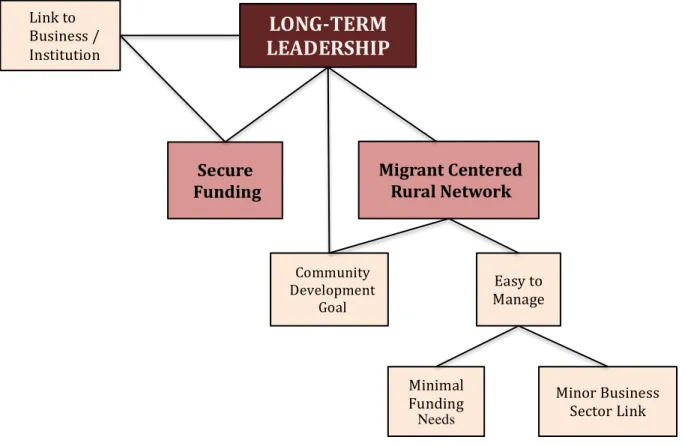
This paper uncovers key theoretical concepts regarding the longevity of Japanese Local Currencies (LCs). In order to accomplish this goal, 12 Japanese LC organizations that have operated for more than a decade are investigated using a Grounded Theory Approach (GTA). GTA is a largely qualitative research methodology used to develop theories or theoretical concepts in new or under-researched fields of study. Due to the lack of available quantitative data among LC organizations as well as the relative novelty of the LC field it was felt that GTA was an appropriate methodology. The GTA methodology was applied to the primary data set, which consisted of 8 hours and 8 minutes of transcribed interviews and 17 typed interviews. This was supplemented by 6 quantitative currency circulation reports, 4 surveys among LC users and observation of the activities of 5 LCs. Long-Term Leadership emerged as the core concept underlying the longevity of all 12 research sites. This was supported by two other key concepts Secure Funding and Migrant Centered Rural Networks. An examination of the core concept revealed 3 distinct models of long-term LC management. The 1st model (Passbook Communities) are social networks facilitated by an easy to administer passbook LC mechanism. LCs that fit into the 2nd model (Cross-sector Tools) are built on cross sector partnerships strongly supported by the local business sector. LCs that match the 3rd Model (Aspiring LCs) are independent organizations led by motivated mission-based
leaders. An examination of the Secure Funding concept uncovered 4 effective long-term funding mechanisms and an analysis of the concept of Migrant Centered Rural Networks revealed the utility of passbook LCs as a gateway for urban migrants settling in the countryside. In addition to the key concepts and the management models that emerged, 6 impact factors were identified that enhance the effectiveness of LC organizations. Key words: Local currency, Theoretical concepts, Longevity, Grounded Theory, Long-Term Leadership
10
Chapter 1 – Introduction
The purpose of this paper is the formulation of theoretical concepts that describe the phenomenon of long-lived Japanese local currencies (LCs) for the understanding of researchers and social entrepreneurs. To accomplish this, 12 LC organizations that have operated for more than a decade are investigated using a Grounded Theory Approach (GTA) in order to uncover these concepts. Within the last 30 years LC development has steadily picked up in pace, aided in part by the development cryptocurrency and the accompanying growth in awareness of unconventional monetary instruments. This development of LCs is visible in the increased number of experiments worldwide as well as their growing complexity. Japanese LCs in particular have been a source of curiosity among LC researchers since the country experienced a LC boom in the early 2000s (1999 – 2005) with hundreds of LC organizations launching each year. Since the boom period the number of new Japanese LCs founded each year has dropped significantly. However, Japan still has an appreciable number of LCs currently circulating (around 2005), the vast majority of which operate
as nonprofit organizations (NPOs).
Now, in their 4th decade as a recognized social phenomenon, LCs and have demonstrated the
capability to encourage local economic development (Nishibe, 2018) as well as local social development (Richey, 2007). This has attracted the attention of researchers seeking alternative solutions to some modern issues. Consequently, the development of LCs, their circulation instruments and the rapidly shifting environments in which they operate has resulted in the creation of complex theoretical frameworks as researchers aim to comprehend a research field rich in variety. This has meant that research focused on the operational and managerial aspects has been left behind to some extent. Consequently the author’s aim is to uncover management related concepts that can summarize the key lessons learned by social entrepreneurs in the field to contribute towards an understanding of LCs rooted in observed findings. Therefore it is the author’s intention to make an empirical contribution to the understanding of LCs for interested researchers. A secondary aim is that this paper synthesizes useful insights for interested social entrepreneurs.
11
1.1 Outline of Paper
What follows next is summary of the chapters in this paper. 1.1.1 Introduction LCs are a unique concept and not widely known. For this reason the introduction chapter focuses on providing readers with a description of the history and nature of LCs to provide a framework for understanding this unique tool that is used for economic and social development. 1.1.2 Chapter 2: Japanese Local Currencies Chapter 2 goes into further detail on the background and context of Japanese LCs and lays much of the groundwork for grasping the substance of this paper. The chapter begins by providing an overview of Japanese LCs through a discussion of their circulation mechanisms, their purposes and a summary of their evolution. The chapter then establishes the status of LCs as NPOs by examining the history of Japanese LCs in terms of NPO definitional terms. The chapter concludes with a theoretical elaboration on the roles that Japanese LCs fulfill within society as NPOs. In essence this chapter will cover how and why LCs function in Japan as well as assigning a theoretical framework that describes their role within Japanese society. 1.1.3 Chapter 3: Literature Review Having discussed the roles played by LCs in Japan in chapter 2, chapter 3 looks at the broader field of LCs. It highlights several aspects of LC research relevant to the purpose of this research paper, which is to uncover theoretical concepts that can shed light on the longevity of Japanese LCs. It starts by addressing the value of LCs as tools for social and economic development. This is done by showing examples from the literature that empirically establish the benefits of LCs starting with the social benefits and then moving onto to economic benefits. Next, through an examination of the literature the author puts forward an argument for why a focus on long-term management is important for the continued development of LCs. Finally, the chapter looks at the significance of Japanese LCs within the overall field and why an examination of long-lived Japanese LCs will make a useful contribution towards establishing long-term management framework.12 1.1.4 Chapter 4: Research Purpose The 4th chapter reiterates the research goal mentioned previously in more detail by expanding on the research sites, their selection criteria and the significance of this paper. The significance of this paper is discussed in terms of its value to the field of LCs and the NPO sector. 1.1.5 Chapter 5: Methodology
The chosen methodology for this research paper is the Grounded Theory Approach (GTA). This chapter discusses the data collection and analysis using GTA principles as well as the research questions that emerged from the process. The chapter firstly discusses the history and development of GTA, as this understanding is necessary in order to accurately contextualize the methodology’s implementation. Next, the chapter discusses the data collection process in detail. Finally, the chapter describes how the GTA principles were applied to the collected data in order to realize the emergent themes, which produced the research questions for the paper. 1.1.6 Chapter 6: Findings Chapter 6 is the final phase of the GTA analysis process. The research questions are answered and the main categories are filled in with descriptive detail to uncover the 3 key concepts (1 core and 2 supporting concepts) governing the longevity of Japanese LC organizations as well as 3 management models.
1.1.7 Chapter 7: Conclusion
This final chapter begins with a discussion on the core emerging concept and its theoretical and practical implications. Next, the implications of the supporting concepts are discussed. The overall academic implications of this paper are then elaborated on. Towards the end of the chapter the practical implications of the 3 uncovered management models are discussed and these take the form of 6 impact factors. The paper concludes with a discussion of the originality and limitations of this paper and lastly the concluding remarks are made
13
1.2 Local Currency Definition
Community currencies (LCs) have been in existence since the beginning of the modern economy and are known by various names such as community currencies, alternative currencies and complementary currencies. They are not legal tender and circulate alongside national currencies to accomplish their goals. According to Lietaer (2004, p.3) a LC is an agreement within a community to accept something other than legal tender as a means of payment. Therefore, any medium of exchange for goods and services outside of the legal tender system and within a limited community can be described as a LC. LCs can generally be divided between those that promote social development (community currencies) and those that promote economic development (complementary currencies). These terms are not mutually exclusive and many LCs bridge the divide between social and economic development.
1.3 History Of LCs
As mentioned above LCs have been around since the advent of the modern economy. The scope and utility of LCs span more than a century of experimentation around the world and include thousands of examples. According to Gatch (2012, p.23): “Between 1931 and 1935 hundreds of experiments in local currency or ‘scrip’ flourished in the United States as attempts to grapple with various aspects of the economic crisis”. During the same period LCs also flourished in Europe. The most famous of these European LCs is the Worgl experiment which has been favorably discussed by several researchers including Irving Fisher (1933), Onken (1983) and Lietaer (2001). After existing on the fringes of the early modern economy LCs, with a few exceptions, faded out of public consciousness as the great depression subsided.
Over the last 30 years there has been resurgence in LCs and the number LC organizations around the world have steadily grown in number. According to Lietaer (2001. p.339), in 1995 there were around 1000 LC systems worldwide. Current estimates of LC systems indicate steady growth. Seyfang & Longhurst (2012) put the recent number at around 3500 systems worldwide while Lietaer & Dunne (2013, p.73) estimate there are 4000 systems worldwide.
14 Much of LC development and growth has taken place in Europe, North America and Japan. At the turn of the millennium Japan experienced a boom in LC organizations with hundreds being launched in a short space of years. This includes over 120 created in 2002 and around 90 created in 2005 (Kobayashi, Miyazaki and Yoshida, 2017, p.4). Since then there has been a sharp decline in the number of new LCs created each year however, Izumi and Nakazato (2017, p.42) estimate that there are currently around 204 actively operating CCs in Japan. Regarding American LCs, Krohn and Snyder (2008, p.54) write that between 1991 and 2008 “over 80 communities in the United States introduced printed local currencies.” Over in Europe the advantages of LCs are well recognized and some LC organizations benefit from local government or European Union funding. The Do it Together (DiT) currency which is active in two municipalities in the Netherlands is subsidized by the European Union (Batterink, Kampers & Van De Veer, 2017, p.31) while the SOL Violette currency in France was launched in 2011 thanks to financial support from the city of Toulouse 6.
As seen above, LCs have always been a part of the monetary or economic landscape. As the modern economy evolves and technology provides more opportunity and scope for development, it is increasingly becoming a more vibrant area of research. Given the long history of LCs and their current development, there is every indication that they will continue to exist in one form or another.
1.4 Purpose Of LCs
As mentioned above LCs can be divided into two types depending on their purpose and always work with the national currency to achieve these goals. The first category of LCs are essentially economic projects aimed at revitalizing the local economy. These will be referred to as complementary currencies for the remainder of this paper as their primary goal is to complement the national currency in local economic development. The second kind of LC is created to strengthen community bonds and develop civil participation amongst local populations. These will be known as community currencies (LCs) for the remainder of this paper. These two categories are discussed in greater detail below. 6 http://www.sol-violette.fr/sol-violette/le-projet/historique- The history of The Sol Violette LC. Accessed March 2018.
15 1.4.1 Complementary Currencies
Complementary Currencies are created to survive a harsh economic climate or to promote the circulation of local goods and services. As such they are more focused on local economic development. Perfect examples of complementary currencies are the scrip currencies used during the Great Depression in America (Gatch, 2012) and the Worgl currency utilized in Austria (Muralt, 1934). These serve as perfect examples of LCs created out of dire necessity to revitalize the local economy. More recently Banco Palmas, a complementary currency in Brazil, encourages local spending and liquidity in combination with micro lending (Nishibe, 2018). Finally in Japan Omusubi Currency, which circulates in Toyota City, was created for the purpose of revitalizing the local economy by circulating among local small to medium sized businesses (Toyota, 2014) 1.4.2 Community Currencies Community currencies (CCs), as the name suggests, are created to strengthen community bonds. In contrast to many LCs created at the beginning of the 20th century out of economic necessity, a large swath of modern LCs are created with the specific purpose of strengthening community bonds or have strong socializing aspects to them. One example is the Do It Together (DiT) currency scheme in the municipalities of Tholen and Bergen op Zoom in the Netherlands. According to Batterink, Kampers and Van der Veer (2017, p.4), “The main objectives behind DiT are social. DiT is an experiment that seeks to shape social support through a shared feeling of responsibility between institutions such as the municipality, housing associations and care providers, non-profit organizations, local retailers and citizens.” CCs are also the most prevalent type of LC in Japan. When describing typical Japanese LC programs Richey (2007, pp.1) states that, “These programs are specifically designed to stimulate generalized trust by rewarding civic engagement and encouraging social interaction.”
16 Figure 1: Basic typology representation of LCs. (Created by Author) 1.4.3 Not Mutually Exclusive These categories of LC are not mutually exclusive and many modern LCs combine the social and economic benefits of LCs. For example Calgary Dollars (a Canadian LC), is defined as “a complementary currency program that seeks to improve economic stability, enhance social inclusion, and increase bridging social capital.” (Wheatley, Younie, Alajlan, & McFarlane, 2011, p.85). Thus LCs in general have socializing aspects to them but a complementary currency puts more emphasis on economic development while a community currency puts more emphasis community development.
1.4.4 Importance of the Multiplier Function
The primary benefit that a LC has over other propositions for local social or economic development is the potential of the multiplier effect. The multiplier effect is defined as, “an economic factor that, when applied, amplifies the effect of some other outcome.”7 Another way of putting it is to say that
a change in a particular input can cause a larger change in an output. This is a commonly understood aspect of currency in general and an oft-mentioned example in economic theory is that changes in government spending can cause a greater change in gross domestic product. The key characteristic of a local currency is that the change in output is contained within the local community thus revitalizing it socially or economically, depending on the aims of the LC. Thus an 7 https://www.investopedia.com/terms/m/multiplier.asp § To survive a harsh economic crisis § To promote local goods and services
COMPLEMENTARY
CURRENCIES
COMMUNITY
CURRENCIES (CCs)
§ Develop social capital § Strengthen community bonds § Environmental preservation etc. MOST JAPANESE LCS
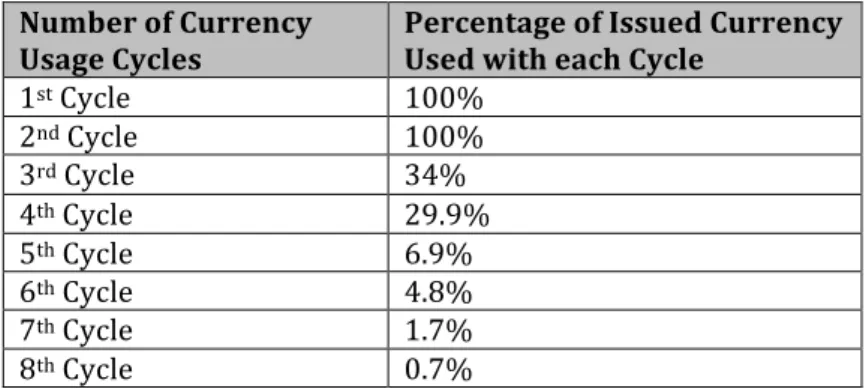
17 increase in LC issuance in a local community can result in larger outputs in the form of greater exchanges in mutual care or more transactions at local businesses. Number of Currency Usage Cycles Percentage of Issued Currency Used with each Cycle 1st Cycle 100% 2nd Cycle 100% 3rd Cycle 34% 4th Cycle 29.9% 5th Cycle 6.9% 6th Cycle 4.8% 7th Cycle 1.7% 8th Cycle 0.7% Table 1: Multiplier Effect of Genki Currency. Adapted from Yamazaki (2009, p.73)
Two examples from the literature (Kurita, Miyazaki, & Nishibe, 2012; Yamazaki, 2009) show examples of LCs where a multiplier effect was recorded and measured. Yamazaki (2009, p.72) describes an experiment where the usage cycles of a sample of 1370 LC paper notes (¥137,000 in value) was recorded. The results can be seen in table 1. Each additional use of the LC was either a transaction of volunteer reward or a transaction at a local business. As can be seen in the table all the LC notes were used at least twice and tiny fraction of the issued sample managed 8 cycles. A key point is that all of these cycles occurred within the community whereas with the national currency, any further cycles of the currency could easily take place outside the local area and often do. Thus the goal of a LC is to encourage as many cycles of the LC as possible, thus increasing the circulation of value within the local area.
18 Figure 2: Illustrative Example of How the LC Multiplier Effect Could Function (Created By Author)
1.5 Terms Going Forward
Due to the variety of systems in existence an overarching typology of LCs is yet to be firmly established. In this paper the term LC is used to describe currency systems limited to a local area irrespective of whether they are used for economic or social development. In other publications that are quoted here, the terms sometimes used are complementary currency, community currency or CC. It should be borne in mind that for the purposes of this paper these have the same meaning as LC.
LC Organization
100,000 LC
( ¥100,000)
LOCAL COMMUNITY
X
5
19
Chapter 2: Japanese LCs
Chapter 2 goes into further detail on the background and context of Japanese LCs and lays much of the groundwork for grasping the substance of this paper. The chapter begins by providing an overview of Japanese LCs by discussing their circulation mechanisms, their purposes and a summary of their evolution. The chapter then establishes the status of LCs as NPOs by examining the history of Japanese LCs in terms of NPO definitional terms. The chapter concludes with a theoretical elaboration on the roles that Japanese LCs fulfill within society as NPOs. In essence this chapter will cover how and why LCs function in Japan as well as assigning a theoretical framework that describes their role within Japanese society.
2.1 Japanese LC Circulation Mechanism
In order to provide context for the examination of the Japanese LCs in this paper it is essential to describe the basic circulation of a Japanese LC. As will be become evident in this chapter, Japanese LCs are quite diverse and thus it is not easy to provide a baseline description that covers all Japanese LC circulation systems, however the descriptions below should suffice to accurately portray the basic circulation mechanism for the vast majority of Japanese LCs.
2.1.1 Single Triangle System
The circulation mechanisms of Japanese LCs have undergone two fundamental phases of development. The first phase which involved all Japanese LCs from the 1973 to around 2000, did not involve commercial transactions with local businesses, only exchanges of mutual care between individual participants. This was a form of time banking, which can be described as “a bartering system for services, where people exchange services for labor-time based credits, rather than money.”8 This is the single triangle system part of figure 3 where the LC organization acts as a
platform for mediating transactions between individual members of a community. While the majority of these single triangle system LCs were created before the year 2000, there are still several LC organizations that successfully utilize this model to build connections between people in the community including 3 of the LC organizations under investigation in this paper. Kichiji and
8 https://www.investopedia.com/terms/t/time-banking.asp
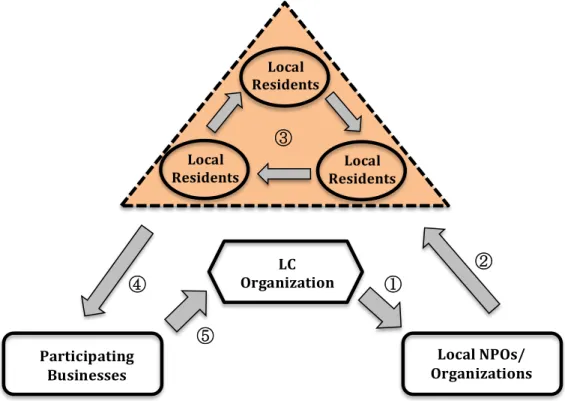
20 Nishibe (2008, p.269) explain that the primary issue with this first phase system was that more active users accumulated the currency and could not find services to spend it on. This led several LC organizations to develop the double triangle mechanism described below and depicted in figure 3. 2.1.2 Double Triangle System The second phase of LC circulation, known as the Double Triangle System (DTS), developed as a means to encourage greater LC circulation. Kichiji and Nishibe write that in order to overcome the shortcomings of a single triangle system, “it is necessary to introduce the major cycle (a large triangle) as a driving force where LC mediates commercial transactions of goods and services offered by businesses and industries, the municipality, civil groups, and NPOs…to forge a complementary relationship between commercial and non-commercial transactions in an integrated cycle of LC” (Kichiji and Nishibe, 2008, p.269). Therefore, by including businesses, NPOs and other local groups in the circulation, there are more places to earn and spend the currency.
In a typical DTS, point ① in figure 3 is the origin point of the LC. From this point the LC is issued (or sold) to NPOs or participating organizations who distribute it further. Point ② in figure 3 represents a NPO, a volunteering opportunity or a local event where individuals who offer their time and effort can earn the LC. Point ③ represents the single triangle where individuals can use the LC to exchange goods and services with one another and point ④ represents the ability to use the LC at participating businesses. Finally, the LC returns to point ① where it can be redeemed at the issuing organization (by businesses only) for Japanese yen after it has hopefully been used several times in the community and encouraged greater social or economic interaction through the multiplier effect. The majority of Japanese LCs, in spite of their diverse issuance purposes, follow this circulation pattern or variations of it. For the purposes of this paper LC networks who have stakeholders in both the business and voluntary sector will be called DTS LCs, while LC networks that consist only of groups of individual who transact with one another will be called STS. Of the LCs investigated in this paper, 7 have a DTS, 3 have a STS and 2 have a unique mechanism that fits neither category.
21 Figure 3: Simplified version of a DTS Circulation System (Kichiji & Nishibe, 2008, p.270)
2.2 The Evolution of Japanese Local Currencies
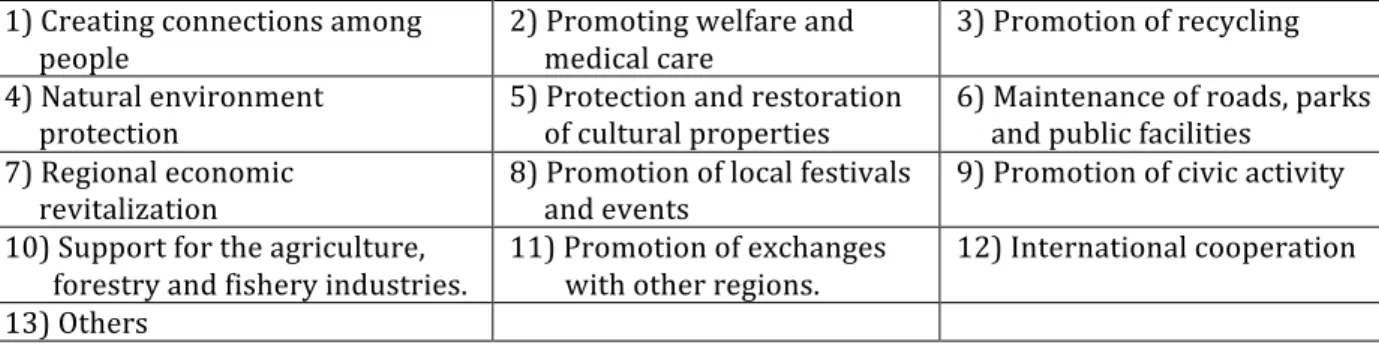
Having discussed the basic mechanism of Japanese LCs, the focus now shifts to the evolution of issuance purposes. Thus the question is why are LCs issued? What purpose are they trying to serve? Over the years Japanese LCs have evolved and diversified to a fair degree as shown by Kobayashi, Miyazaki and Yoshida (2017, p.3) who identified 12 different issuance purposes for Japanese LCs created between 1999 and 2016. These 12 purposes can be seen in Table 2. Their study reveals that the most common issuance purposes over the 17-year period were the formation of connections between people and regional economic revitalization. However between 2012 and 2016, the revitalization of forestry and regional economies became the most common issuance purposes. Single Triangle System (STS) Double Triangle System (DTS) LC Organization NPOs, Civic Events Volunteering, Commerce and Industry Government Grants (optional) Local Residents Local Residents Local Residents
②
③
①
④
Potential Flow of LC
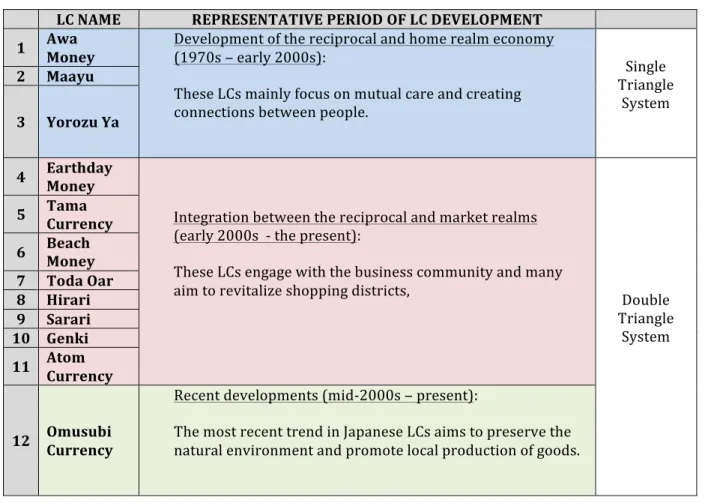
22 The diversity of Japanese LCs is a consequence of their evolution within the changing Japanese socio-economic environment. Miyazaki and Kurita have divided the development of Japan’s wide variety of LCs into 3 phases of evolution from the 1970s to the present day (Kurita & Miyazaki, 2018): 1. Development of the reciprocal and home realm economy (1970s ‒ early 2000s): These LCs mainly focused on mutual care and creating connections between people. 2. Integration between the reciprocal and market realms (early 2000s - the present): These LCs engage with the business community and many aim to revitalize shopping districts, 3. Recent developments (mid-2000s ‒ present): The most recent trend in Japanese LCs aims to preserve the natural environment and promote local production of goods. Thus the early Japanese LCs of the 1970s, 1980s and 1990s, using a STS, focused almost exclusively on community development and mutual care. At the turn of the millennium they started branching out to fulfill other purposes such as economic development and environmental preservation. Below follows a more detailed explanation of the above mentioned 3 phases with regards to Japanese LCs and their link to the nonprofit sector. 1) Creating connections among people 2) Promoting welfare and medical care 3) Promotion of recycling 4) Natural environment
protection 5) Protection and restoration of cultural properties 6) Maintenance of roads, parks and public facilities 7) Regional economic
revitalization 8) Promotion of local festivals and events 9) Promotion of civic activity 10) Support for the agriculture, forestry and fishery industries. 11) Promotion of exchanges with other regions. 12) International cooperation 13) Others Table 2: Japanese LC Issuing Purpose Classification 1999 – 2016 (Kobayashi, Miyazaki and Yoshida 2017 p.3)
2.3 Japanese LCs and the Nonprofit Sector: Introduction
LCs have been a feature of the nonprofit sector in Japan since the first time bank experiment was launched in the 1970s. The reformulation of Japanese NPO laws in the late 1990s were a key factor in LCs spreading throughout Japan as it provided Eco-money, a popular LC at the time, with
23 appropriate and beneficial legal structures for conducting activities (Yamazaki and Akai, 2010, p54) At present the majority of modern Japanese LCs are firmly situated within the nonprofit sector with regards to the aims of their activities (table 2), their organizational structure and their relationship to government. This section aims to clarify the status of LCs within the nonprofit sector. The discussion begins with a conceptual definition of what a Japanese NPO is and how this definition is applicable to Japanese LCs throughout their historical evolution.
2.3.1 Japanese NPOs: A Conceptual Definition
While there are clear legal parameters for what constitutes a NPO, the conceptual or functional definition of what an NPO is, is not immediately discernible. Anheier writes that, “Although we speak of the nonprofit “sector,” which suggests clearly defined borders with the public sector and the for-profit sector, such sector distinctions are in reality quite blurred and fluid.” (Anheier, 2005, p.4) Japanese NPOs are no different in this respect. Okada, Ishida, Nakajima & Kotagiri (2017, p.7) state that the Japanese NPO sector can be roughly divided into two groups. They assert that, “The sector consists of legally well-defined, well recognized nonprofit corporations and grassroots groups.” They further add that these grassroots organizations that operate without legal status are an important part of Japanese civil society (Okada et. al., 2017, p.7). From this explanation we can surmise that to have an accurate understanding of what a Japanese NPO is, we cannot simply rely on the legal definition, as this would exclude a significant and important part of the Japanese NPO sector. The Japanese NPO center defines a nonprofit organization according to 3 requirements9: 1. Not Being Under Government Control: Essentially this means that NPOs perform services that the government is unable to or that private companies will only do for a profit.
2. Not For Profit: Any profits that are created are not distributed to members, but used to cover the costs of achieving the organization's goals.
3. Assuming Responsibility Towards Society: A continually present group of people in an organization that has assumed a responsibility towards society. 10
9 https://www.jnpoc.ne.jp/?page_id=134#a01
24 The history and development of LCs in Japan will now be analyzed according to these 3 requirements to clarify the status of LCs as NPOs.
2.3.2 Early Japanese LCs (1973 – 1999)
The two most widespread and influential Japanese LC networks leading up to the turn of the millennium, were the Volunteer Labor Bank and the Fureai Kippu system. Both of these emerged as not-for-profit grassroots time-banking movements that assumed responsibility for issues that were emerging within Japanese society related to supporting women and taking care of the elderly. They are discussed below.
2.3.2.1 The Volunteer Labor Bank (VLB)
In 1973, Teruko Mizushima, a social benefactor, formally established the Volunteer Labor Bank (VLB) as the first LC in Japan and possibly the first time-bank in the world11. The purpose of the
VLB was to support career women and full-time homemakers alike, aid childcare, and support those dealing with sudden illness (Kobayashi, Miyazaki and Yoshida, 2017). According to Hayashi the “VLB is a membership voluntary group whose activities included labor exchanges between the members through a time-based complementary currency - Love Currency.” (Hayashi, 2012, p.4) Thus, the VLB was a grassroots volunteer movement of women taking responsibility for caring for themselves and others with no government links, placing it firmly underneath the NPO conceptual umbrella. 2.3.2.2 The Fureai Kippu System The Fureai Kippu system evolved out of grass roots volunteer groups that emerged in the 1980s to tackle Japan’s rising social challenge of caring for the elderly. By the 1990s the Fureai Kippu model consisted of many groups spread across the country with variations in their operations. It was around this time that Mr. Tsutomu Hotta, the founder and chair of the Sawayaka Welfare foundation coined the term Fureai Kippu in the hopes of promoting collaboration between individual schemes (Hayashi, 2012, p.36). In the 6 years between 1992 and 2001, the number of Fureai Kippu branches went from 113 to 361 (Lietaer, 2004). Tanaka reports that of the 243 branches in 1996, 119 (49%) were run by some sort of government agency and 124 (51%) were
11 http://www.transitsocialinnovation.eu/sii/timebanks-3
25 run by grassroots or voluntary self-help groups (Tanaka, 1996, p.107). Thus various forms of government control appeared to play an important role in expanding the Fureai Kippu model. Thus looking at Japan’s early pioneer LCs we see that the VLB falls firmly within the NPO definition while around half of the Fureai Kippu systems fall within the NPO definition due to the other half being subject to government control. 2.3.2.3 Eco-Money Eco-Money was a LC system proposed by Toshiharu Kato in 1997 for the purposes of encouraging the reciprocal exchange of services among people in a community. The founder of Eco-Money, Toshiharu Kato, describes Eco-Money in the following way: "Eco-money is the ‘new money’ of the 21st century that mediates value related to the environment, welfare, local communities, education, culture and so on. Eco-Money acknowledges and distributes value that cannot be measured by the conventional measures of the market economy.” (Kato, 2001, p.20) Lietaer (2004, p.6) describes Eco- Money as a non-profit organization that provides local regions with the support needed to introduce community currencies. Thus, the purpose of Eco-money was to propagate a particular kind of LC mechanism for social development throughout Japan. By 2003 around 35 models were being experimented with in parallel (Lietaer, 2004, p.7). Each Eco-money experiment or project was the result of a cross sector partnership between local stakeholders such as local municipalities, chambers of commerce, NPOs etc. Despite involvement from various sectors, the Eco-Money organization, as well as the Eco-Money issuing organizations active on the local level are uniformly referred to as NPOs throughout the literature (Lietaer, 2004; Yamazaki and Akai, 2010; Yamazaki, 2013) Two of the organizations investigated here were launched as Eco-Money projects (Genki Currency & Toda Oar) and both are firmly situated underneath the NPO umbrella.
The goals of Eco-money were to analyze the needs of the community, design a currency to fulfill those needs and strategize a practical implementation plan for the currency and observe the results. Eco-money projects were launched in partnership with local governments, however
26 they were not government run. Overall Eco-Money fulfills all 3 aspects of what defines a Japanese NPO.
2.3.3 Japanese LCs at the turn of the Millennium
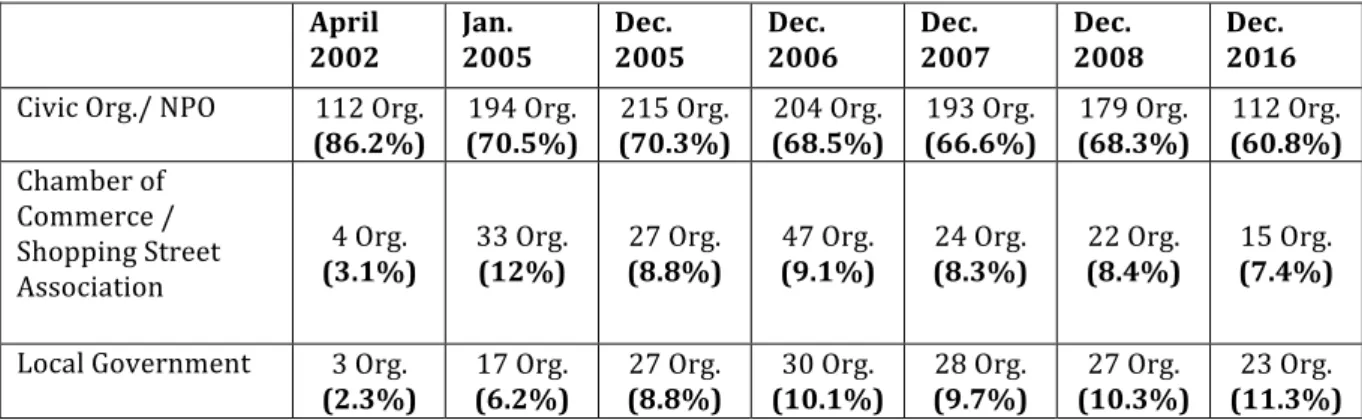
The LC boom at the turn of the millennium sparked much interest among researchers and practitioners and as a result there is ample data that describes the evolution and development of Japanese CCs after 2000. According to data supplied by Izumi and Nakazato (2016, p.43) the majority of LCs since 2002 have been NPOs and civic groups. In 2002 86% of Japanese LCs were comprised of civic organizations and NPOs. In 2016 this figure had dropped to 60.8%, while over the same period the percentage of LCs issued by the local government has increased from 2.3% to 11.3%. Thus, over the last 16 years the share of CCs adopted by local government has increased but it is still in the minority. This data is clear evidence that since the early 2000s the vast majority of Japanese LCs were of a non-profit nature and not being under government control. Regarding the aspect of adopting responsibility towards society, the data from Kobayashi, Miyazaki and Yoshida (2017) regarding the aims of Japanese CCs since 2000 show overwhelmingly that they were created to help to deal with issues arising within Japanese society from creating connections between people to local economic revitalization and recycling. Therefore based on the data of Izumi and Nakazato (2016) and Kobayashi, Miyazaki and Yoshida (2017), we can see that particularly since the turn of the millennium the majority of LCs have been firmly operating within the NPO sector.
Having examined the characteristics of Japanese LCs since the 1970s it is clear that the vast majority of LCs have operated as agents of the non-profit sector despite not always being legally described as such. The following section looks at the specific role LCs fulfill as NPOs in Japanese society.
27 Table 3: Categorization of LC Organizations from 1999 – 2016 (Izumi & Nakazoto, 2017)
2.4 The Theoretical Role of Japanese Local Currencies in Society
The section reflects on the roles LCs fulfill in Japanese society as NPOs. Given the diverse issuance purposes seen in table 2 it is not easy to identify the exact roles that LCs play in society. However, a close examination will reveal that LCs largely fulfill 2 of the 4 roles traditionally played by NPOs and put forward by Kramer (1981). These are the Value Guardian Role and the Vanguard Role. Figure 4: The roles of NPOs in society (Kramer, 1981) 2.4.1 Value Guardian Role The Value Guardian role is so named because it refers to “a set of individual and social values that voluntary organizations are expected to ‘guard’ – i.e., to protect and promote by offering opportunities for their active expression. These include: altruism, social integration, democratic collective action, self-help, pluralism, and the humanizing or personalizing of the provision of a social service” (Kramer, 1981, p.193). The social values that LCs typically guard are: A. Altruism: This is done through the promotion of volunteer activities B. Social integration: This is done through the encouragement of civic participation April 2002 Jan. 2005 Dec. 2005 Dec. 2006 Dec. 2007 Dec. 2008 Dec. 2016 Civic Org./ NPO 112 Org.(86.2%) (70.5%) 194 Org. (70.3%) 215 Org. (68.5%) 204 Org. (66.6%) 193 Org. (68.3%) 179 Org. (60.8%) 112 Org. Chamber of
Commerce / Shopping Street Association
4 Org.
(3.1%) 33 Org. (12%) (8.8%) 27 Org. (9.1%) 47 Org. (8.3%) 24 Org. (8.4%) 22 Org. (7.4%) 15 Org.
Local Government 3 Org.
(2.3%) (6.2%) 17 Org. (8.8%) 27 Org. (10.1%) 30 Org. (9.7%) 28 Org. (10.3%) 27 Org. (11.3%) 23 Org.
Service Provider Role Value Guardian Role Advocacy Role The Vanguard Role
28 C. The humanizing or personalizing of the provision of a social service: This is done through creating networks for mutual care and by resolving the ‘paid volunteer’ paradox. 2.4.1.1 Altruism and Social Integration The promotion of volunteer activities and civic participation is at the heart of many Japanese LCs. 8 of the 12 research sites under investigation in this paper are actively used as tools to foster greater citizen participation and volunteer participation. Richey (2007) gives the following description of a typical Japanese LC: “In a typical program, a town gives credits to those who attend a town meeting or volunteer for a town project. Volunteers can use their credits to pay for government services normally requiring real money, barter them with other citizens, or use them at participating stores.” (Richey, 2007, p.3) Thus, the goal of a typical Japanese LC, as indicated by the example mentioned above, is to motivate citizens to take part in community or volunteer events.
There is some evidence from the literature that LCs do indeed increase the motivation of volunteers. Kurita, Miyazaki and Yoshida (2012) concluded that even people with a no-reward orientation (most volunteers) are likely to have their motivation raised by LCs, rather than diminished. They further found that volunteers’ perception towards LCs and cash is dramatically different despite LCs having the same monetary value as cash. This differentiation between the value of LCs and the Japanese Yen emerged from interviews with 3 of the research sites (Genki, Tama Currency and Sarari). Mr. Nitanda of Genki stated that LC is “Money that contains the emotions of the recipient or patient”12. Mrs. Eda of Tama Currency stated that when they started a
LC they “wanted a way to reward volunteers that couldn’t be measured in yen”13. Mr. Oikawa of
Sarari described paying someone with LC as “trying to capture the feeling of reward.”14 Thus, the
consensus from the background literature and from interviews conducted for this paper, are that LCs are a medium of exchange that convey more emotion and gratitude than Japanese yen. It is because of this capacity for capturing gratitude that LCs possess, that make them useful instruments for humanizing social service provision. This is discussed next. 12 (Nitanda, S. personal communication, October, 2019) 13 (Eda, M, personal communication, July, 2018) 14 (Oikawa, Y. personal communication, December, 2018)
29 2.4.1.2 Humanizing Social Service Provision: Solving the ‘Paid Volunteering’ Paradox
The humanizing of social service provision with LCs is typically done through the creation of mutual care networks and an important aspect of these LC mutual care networks is the manner in which they resolve the ‘paid volunteering’ paradox, which is explained below.
The Fureai Kippu grassroots groups of the early 1980s worked strictly on a volunteer basis, receiving no remuneration. However, Hayashi (2012, pp.34 – 35,) summarizes 3 reasons why these initial volunteer groups broke with volunteering tradition and charged users of the services a small fee.
1. Due to the importance of reciprocity within Japanese culture, elderly people were embarrassed to be receiving these services for free.
2. Elderly people receiving these services inaccurately associated them with state sponsored charity, which added to shame of accepting the services.
3. In order for the services to be sustainable some kind of funding source was needed.
In order to overcome these issues users were charged small fees and volunteers received small remuneration for the services they provided resulting in the ambiguous term ‘paid volunteering’ (Yamashita, 2011, p.434) The user fees reduced the feeling of shame felt by older people in receiving the services (Hayashi, 2012, p.35) and made the volunteer groups more financially feasible (Tanaka, 1996). However, for the volunteers it generated a new problem. Volunteers felt that their interactions with service users were now more transactional and distant. Volunteers further felt that their genuine efforts were not being recognized or were even exploited and their personal relationships with users were damaged (Kobayashi, 1994) In order to deal with these concerns the new Fureai Kippu model was created whereby volunteers could receive LC as part of or instead of a cash payment, thereby harmonizing volunteer-user relationships. (Hayashi, 2012, p.35). This was the start of the link between LCs and ‘paid’ volunteering in Japan and this convention of LC ‘paid volunteering’ continues to this day. In fact the promotion of ‘paid volunteering’ through the medium of a LC is the central focus of Genki Currency, one of the LC under investigation in this paper. Other LCs among the research sites that make use of this ‘paid
30 volunteering’ concept are Hirari and Sarari. In summary LCs, in their role as value guardians, provide a platform for the expression of altruism, social integration and humanized social service provision through the issuance of currency that is more effective at capturing gratitude and sentiment than Japanese yen. 2.4.2 Vanguard Role Anheier provides the following summary of the Vanguard role:
“Vanguard role: nonprofits innovate by experimenting with and pioneering new approaches, processes, or programs in service delivery. Less beholden than business firms to the expectations of stakeholders demanding some return on their investment, and not subject to the electoral process as are government entities, nonprofit organizations can, in their fields, serve as change agents. If innovations prove successful after being developed and tested by nonprofits, other service providers, particularly government agencies with a broader reach, may adopt them, or businesses might turn them into marketable products.” (Anheier, 2005, p.174)
Key words in relation to the Vanguard Role are innovative, experimental and pioneering. These 3 words are accurate description of LCs around the world. As mentioned in chapter 1 there has been resurgence in LC projects and experiments around the world within the last 30 years. This resurgence has been accompanied by constant change in the implementation of LCs as social entrepreneurs and researchers discover more effective ways for LCs to fulfill their respective purposes. This process of constant change and adjustment can be seen in the evolution of Japanese LCs as with each of the above mentioned 3 phases they continued to adapt to new methodologies and societal needs. Currently there are new digital LCs that are quite promising such as Sarubobo Coin in Takayama15 and it is quite clear that the LC field will continue to grow and innovate into the foreseeable future. 15 https://www.hidashin.co.jp/coin/
31 This worldwide development of LCs has not been an isolated form of innovation. Within the last 20 years there has been incredible growth in the area of currencies and payment systems. Within the digital payment sphere many payment applications such as Origami Pay, Rakuten Pay, PayPay, LINE pay and many others have arisen. Within the last 10 years, the number of cryptocurrencies has grown from a single cryptocurrency (Bitcoin) to thousands. In this area of payments and currencies so dominated by private enterprise and government, it is only natural that as with other sectors of society nonprofits also have a role to fulfill. The usual role of fulfilling societal needs that neither the government nor private sector can adequately do.
The nonprofit sector is not a sector known for being at the forefront of technological development. However, in recent years the advent of the Internet, social media and the fast development of technology in general has provided NPOs with more tools than ever before in terms of fund raising, service provision and marketing. With reference to LCs, the advent of block chain technology has provided NPOs with limited means, a possible tool for fundraising, receiving charitable donations and facilitating cross border transactions to communities in need. This increased accessibility to cutting edge technology has meant that the Vanguard Role played by NPOs is no longer limited to taking the initiative in caring for overlooked populations as stated by Kramer (1981) but being truly innovative in other aspects too.
Another reason why the Vanguard Role is most appropriate for Japanese LCs is that their innovation arc is still ongoing. Japanese LCs for example, as discussed above, are in their 3rd phase
of evolution and will no doubt have more. While technological innovation will naturally cause advancement in all industries, the advancement of LCs is not only rooted in technology. Innovations in LC systems is also related to changes in societal needs. This can be seen in the changes from the original Volunteer Labor Bank and the Fureai Kippu systems, which focused on mutual care for vulnerable members of the population (women and the elderly) to the development of the Eco-Money system, which sought a broader application of mutual care and community building. Then the post-2000 LCs started focusing on revitalizing shopping streets and connecting with the business sector. The current third phase of Japanese LC evolution, in
32 addition to advances in digital currency, is also placing a greater focus on environmental preservation and the promotion of local production (Miyazaki and Kurita, 2018, p.126).
Thus it is clear that LCs are organizations looking for innovative ways to guard and promote society’s values. One aspect of the goals of this paper is reviewing the innovation process of Japanese LCs within the last 2 decades and identifying aspects that aid long-term operability.
2.5 Chapter Summary
This chapter began with a description of the practical workings of Japanese LC circulation mechanisms. This involved a description of the STS and the DTS. These circulation mechanisms describe the majority of Japanese LC systems and these terms will be in repeated use throughout the rest of this paper. Next the chapter summarized the 3 phases of Japanese LC evolution, showing how the general issuance purposes of LCs changed over the years. In general terms this shed light on the key questions of how Japanese LCs operate and why they operate. This sets the stage for chapter 3, when the author will go into more detail regarding the benefits of LCs as well as chapter 4 when the details of the research sites are discussed.
A detailed examination of each phase of LC evolution in Japan also established that the vast majority of Japanese LCs have been consistently operating within the parameters of a nonprofit structure. With their status as NPOs established, this chapter then provided a detailed examination of the roles that Japanese LCs play in society as NPOs, namely the Vanguard Role and the Value Guardian Role. Finally, taking into consideration the continuing evolution of Japanese LCs and aspects of the above-mentioned roles, the author concluded that the developmental arc of Japanese LCs is still ongoing and set to continue for the foreseeable future. The central purpose of this paper then is to contribute to this ongoing evolution by reviewing the key LC managerial innovations of the past 20 years, and identifying the key concepts that contribute to the long-term operability of LCs.
33
Chapter 3 Literature review
Chapter 2 spoke about Japanese LCs fulfilling a role in society as innovative tools for guarding values. Having discussed the roles played by LCs in Japan, this chapter looks at the broader field of LCs. It highlights several aspects of LC research relevant to the purpose of this research paper, which is to uncover theoretical concepts that can shed light on the longevity of Japanese LCs. It starts by addressing the value of LCs as tools for social and economic development. This is done by showing examples from the literature that empirically establish the benefits of LCs starting with the social benefits and then moving onto to economic benefits. Next, through an examination of the literature the author puts forward an argument for why a focus on long-term management is important for the continued development of LCs. Finally, the chapter looks at the significance of Japanese LCs within the overall field and why an examination of long-lived Japanese LCs will make a useful contribution towards establishing a long-term management framework.
3.1 The Benefits of Local Currencies
As previously stated LCs are a unique and little known phenomenon. This also means that the benefits and advantages of a well-managed LC organization are perhaps not well understood. The aim of this section is to highlight the potential of LCs to bring about beneficial social and economic development. An understanding of the value of LCs as tools of development will underscore the importance of the LC field as a whole and validate the aims of this paper.
As mentioned in chapter 1 LCs are issued for the purposes of social or economic development or sometimes both. This section describes the findings of research papers that detail the benefits of LCs. The first half first focuses the social benefits of LCs and the second half on the economic benefits. 3.1.1 Social Benefits of Local Currencies According to September (2019, p.19), the link between LCs and the development of social capital is a key point regarding the utility and significance of LCs. For this reason this section first expounds on the term social capital before describing the positive link that exists between its development and LCs.
34 3.1.1.1 Social Capital
Nishide (2009, p.1) describes social capital as “social relationships such as trust, norms and networks that facilitate cooperation among members of a community.” In a World Bank paper on the measurement of social capital it is stated that, “A range of social problems –crime, health, poverty, unemployment-have been linked empirically to a community’s endowment of social capital (or lack thereof)” (Grootaert, Narayan, Woolcock & Nyhan-Jones, 2003, p.3). As mentioned in chapter 2, the goal of many Japanese LCs is to strengthen these networks of cooperation in society. The literature, as will be seen below, draws a positive link between social capital development and the use of LCs.
3.1.1.2 The Tekona Local Currency (Japan)
In 2007 Richey published the results of a quasi-experiment that measured social capital among members of the Tekona LC circulating in the Ichikawa suburb of Tokyo, Japan. The Tekona was a typical DTS LC that was paid out to individuals who participated in local volunteer activities. The currency was distributed to volunteers on an IC card and once volunteers received the currency there were a wide variety of places to spend it. Participants could use the Tekona currency at city-owned venues such as the zoo, community centers or the town’s three museums. Alternatively they could use the currency at a wide variety of stores including all the stores in Ichikawa’s large shopping mall, the movie theatre as well as smaller mom-and-pop stores (Richey, 2007, p.6). The currency was very well supported by the local government as the city created a website to explain the system and an office to assist users. Furthermore, each store or governmental agency needed a magnetic scanner to read the IC card and adjust the balance. When the store signed-up to be a member of the system, the city installed this machine without charge. (Richey, 2007, pp.6-7)
The main research instrument for Richey’s study was a 12-page questionnaire developed from various reports on how to measure social capital in general and how to adapt the instrumentation to the cultural context in Japan (Richey, 2007, p.10). The questionnaire was mailed to members of the Tekona LC network and there were 117 responses. A control group of randomly selected residents were given the same questionnaire. When analyzing the results Richey concluded that, “The Tekona project created trust through shared experiences and social activities. The reform creates a new style of participation that is engaging by its structure, and the results suggest that it successfully develops social capital (Richey, 2007, p.16). The findings of this paper are particularly convincing
35 due to the use of a control group and the creation of a comprehensive social capital questionnaire.
3.1.1.3 Calgary Dollars (Canada)
A 2011 research report on a Canadian LC (Calgary Dollars) provides further evidence of the social capital benefits of LCs. Calgary Dollars has circulated in Calgary City in Canada since 1996. Calgary Dollars is a LC that aims for both social and economic development. The currency is primarily earned by members of the network who advertise goods and services they have for sale on an online listing. Calgary Dollars can also be earned through reward points when shopping at certain local stores, posting your first five ads on the listing or referring new users16 The currency is available in paper and digital format. The Calgary City council unanimously endorsed the currency in 2000 and from 2003 the City of Calgary provided funding for the LC project. The funders of Calgary Dollars required “data collection, outcomes measurement and annual reporting.” (Wheatley, Younie, Alajlan, McFarlane, 2011, p.86). For this reason Calgary Dollars is a well examined LC with 3 studies taking place between 2002 – 2010. The 2011 report concluded that, “Using various methods and measuring over time, Calgary Dollars has shown that participants benefit deeply both socially and economically as a result of their participation.... Participants also build durable social relationships and broaden their community participation.” Therefore, the findings on Calgary Dollars finds evidence not only of social capital development but also of economic support too. 3.1.1.4 Ichi-Muraoka and Bytesring (Japan and Sweden) In 2012 Nakazoto and Hiramoto conducted an empirical comparative analysis of two LC organizations in Stockholm, Sweden (Bytesring) and Muraoka, Japan (Ichi-Muraoka). Both these LCs are mutual credit STS that focus on transactions between members of the network and have no links to local businesses. In this case the goal was to assess the social support provided by a LC system. The main research instruments used were a 6-page questionnaire survey and a network analysis of recorded transactions. The researchers received 119 responses (54%) from 220 members of Ichi-Muraoka and 65 responses (80.2%) from 81 members of Bytesring. For Ichi-Muraoka transactional records were recorded from December 2002 to March 2006. For Bytesring the transactional records were collected from January 2002 to December 2005 (Nakazoto and Hiramoto, 2012, pp.126 – 127)
16 http://www.calgarydollars.ca/