126
On planar portraits of manifolds associated with graphs of
block decompositions of manifolds
Mahito Kobayashi
Graduate School of Engineering Science, Akita University, Akita 010‐8502, Japan; E‐‐mail : [email protected]‐u.ac.jp
Abstract
For a smooth closed manifold Mand its stable map finto the plane, the pair \mathcal{P}_{f}
of the image f(M) and the discriminant set of f is called the planar portrait of M
through f . In this article, we note an association of \mathcal{P}_{f} with a graph representing adjacency of building blocks of M, through examples.
1 Introdution
For a smooth closed n‐manifold Mof n=\dim M\geq 1 , the discriminant set D_{f}of its
stable map f:Marrow \mathbb{R}^{2}, or the set of singular values of f , is a collection of smooth loops which may have cusped points and normal crossings. It can be regarded a pictorial representation of Mthrough f, as one may imagine from the shape detection
of surfaces embedded in \mathbb{R}^{3} by their apparent contours produced by the projections
into \mathbb{R}^{2}. In this context, the pair
\mathcal{P}_{f}=(f(M), D_{f})
up to diffeomorphism of \mathbb{R}^{2} isreferred to as the planar portrait of Mthrough f ([K1]). However, the precise relation
between \mathcal{P}_{f} and M is yet to be cleared and we will expose an idea that may help us
toward the appreciation of the relation. Henceforth manifolds and maps are assumed
to be smooth.
First we consider a block decomposition of a manifoıd as follows. By D^{n} we
denote the closed n‐disc, and for an array of a finite number of positive integers
L= (a_{1}, a_{2}, \cdots , a_{k}) of a_{1}+a_{2}+ +a_{k}=n, we use the notations D^{L} and \partial_{i}D^{L}
(i=1,2, \cdots , k) as
D^{L}=D^{a_{1}}\cross \cross D^{a_{k}}
\partialı D^{L}=\partial D^{a_{l}}\cross \cross D^{a_{k}}
\partial_{2}D^{L}=D^{a_{1}}\cross\partial D^{a_{2}}\cross \cross D^{a_{k}}
\partial_{k}D^{L}=D^{a_{1}}\cross \cross\partial D^{a_{k}},
A block decomposition of a closed n‐manifold Mof type L, or into copies of D^{L}, is
a finite decomposition
M= \bigcup_{r=1}^{l}H_{r}
of Minto blocks H_{r} such that1. Each H_{r} is diffeomorphic to D^{L}.
2. For distinct rand s, H_{r}\cap H_{s}\subset\partial H_{r}\cap\partial H_{s}.
3. Under the identification of H_{r} with D^{L} , the above intersection is the union of the i‐th boundary \partial_{i}D^{L} for some i.
A simple example of a block decomposition is the one for the sphere S^{n}into two copies of D^{n}. The sphere also enjoys another one into two copies of D^{L}for an arbitrary
L of a_{1}+a_{2}+\cdots+a_{k}=n, since each hemisphere is diffeomorphic to D^{L} . One more
example is the following decomposition of the total space M of an S^{a}‐bundle over
S^{b}(a, b\geq 1)
with a cross‐section. In actual, M is decomposed into two copies ofS^{a}\cross D^{b} by local triviality so that a tubular neighbourhood of the cross‐section is
decomposed into two copies of D^{a}\cross D^{b}. The rest of the tubular neighbourhood is
also decomposed into two copies of D^{a}\cross D^{b} , and these four pieces become the blocks
of a block decomposition of M.
For a block decomposition of a manifold M=\cup H_{r} of type L= (a_{1}, a_{2}, \cdots , a_{k}),
an adjacency graph can be considered, where each node represents a block H_{r} and each link represents an i‐th part \partial_{i}D^{L} of the intersection H_{r}\cap H_{s} of an adjacent pair of blocks. Since each block has k parts \partial_{1}D^{L}, \partial_{2}D^{L}, \partial_{k}D^{L} in its boundary, the
degree of a node of this graph is the constant k, or it is a k‐valency graph. It may
enjoy multi‐links. This graph is referred to as the network of blocks.
For the previous block decomposition of S^{n} into two copies of D^{n}, the network of
blocks is the two nodes linked by a single edge, or it is represented by a line segment (Throughout we denote this network by I, after the unit interval). The network of
blocks of the second decomposition of S^{n} into two copies of D^{a}\cross D^{n-a} is the facet
of a 2‐gon, or the two nodes multi‐linked by two arcs. The network for the finally
mentioned decomposition of an S^{a}‐bundle over S^{b} of a certain kind is the facet of a
rectangle.
In the following part, we consider block decompositions of types L=(a), (a, b),
or (a, b, c), and make observations on the association of a planar portrait with the network of blocks.
2 Association of
\mathcal{P}_{f}
with a network of blocksLet Nbe the network of blocks in a block decomposition of a manifold M. We limit
our attention to the case where the valency kof N, or the degree of each node, is at
most three, as mentioned. For simplicity we consider N represented by a single line
segment I(k=1), or by the facet of a convex polygon, including the 2‐gon (k=2), if
kis 1 or 2. For k=3, we assume that Nis represented by a set of distinct points and
embedded arcs connecting them so that no arc contains the nodes except its boundary points and that any pair of arcs are either disjoint or have a finite number of normal crossings. A representation of Nof k\geq 2has the compact side, which is the closure of the union of the bounded components of its compliment in the plane.
We say that a discriminant set D_{f}of a stable map f:Marrow \mathbb{R}^{2}is associated with a
128
by the following process, up to diffeomorphism.
1. Take small 2‐disc neighbourhood U_{i} of each node v_{i} of N so that links abuting v_{i}is transverse to \partial U_{i}.
2. Outside
\bigcup_{i=1}^{l}U_{i}
, duplicate each link l_{j} of Nso that the result is two disjoint arcsin a thin tubular neighbourhood of l_{j}.
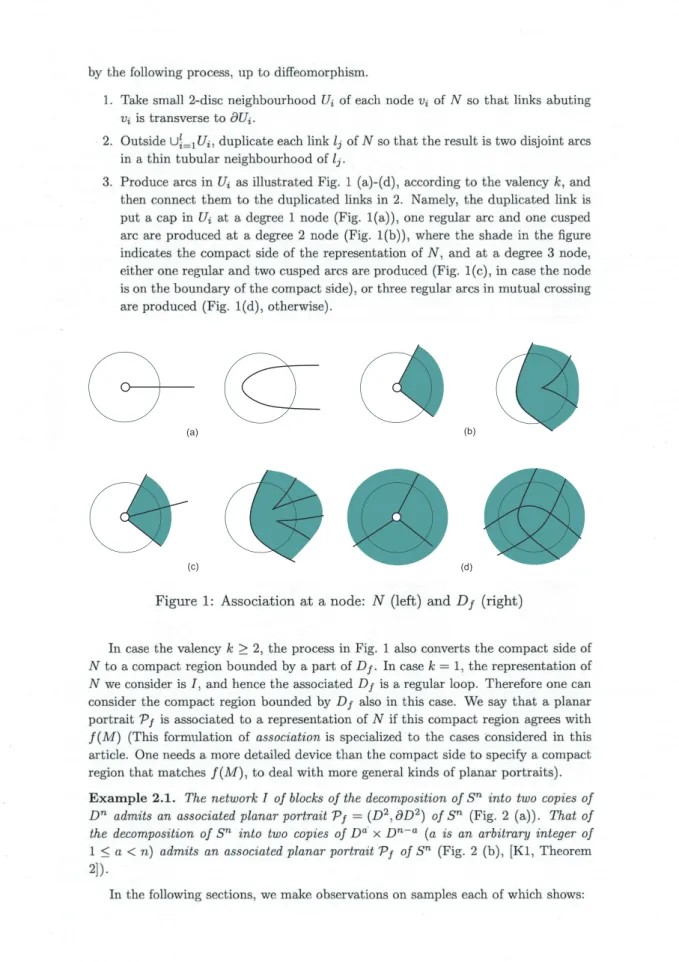
3. Produce arcs in U_{i} as illustrated Fig. ı (a)-(d), according to the valency k, and
then connect them to the duplicated links in 2. Namely, the duplicated link is put a cap in U_{i} at a degree 1 node (Fig. 1(a) ), one regular arc and one cusped arc are produced at a degree 2 node (Fig. 1(b) ), where the shade in the figure indicates the compact side of the representation of N, and at a degree 3 node,
either one regular and two cusped arcs are produced (Fig. ı(c), in case the node is on the boundary of the compact side), or three regular arcs in mutual crossing are produced (Fig. 1(d), otherwise).
(a) (b)
(c) (d)
Figure 1: Association at a node:
N(left) and D_{f} (right)
In case the valency k\geq 2, the process in Fig. 1 also converts the compact side of
Nto a compact region bounded by a part of D_{f}. In case k=1, the representation of Nwe consider is I, and hence the associated D_{f} is a regular loop. Therefore one can
consider the compact region bounded by D_{f} also in this case. We say that a planar portrait \mathcal{P}_{f} is associated to a representation of Nif this compact region agrees with
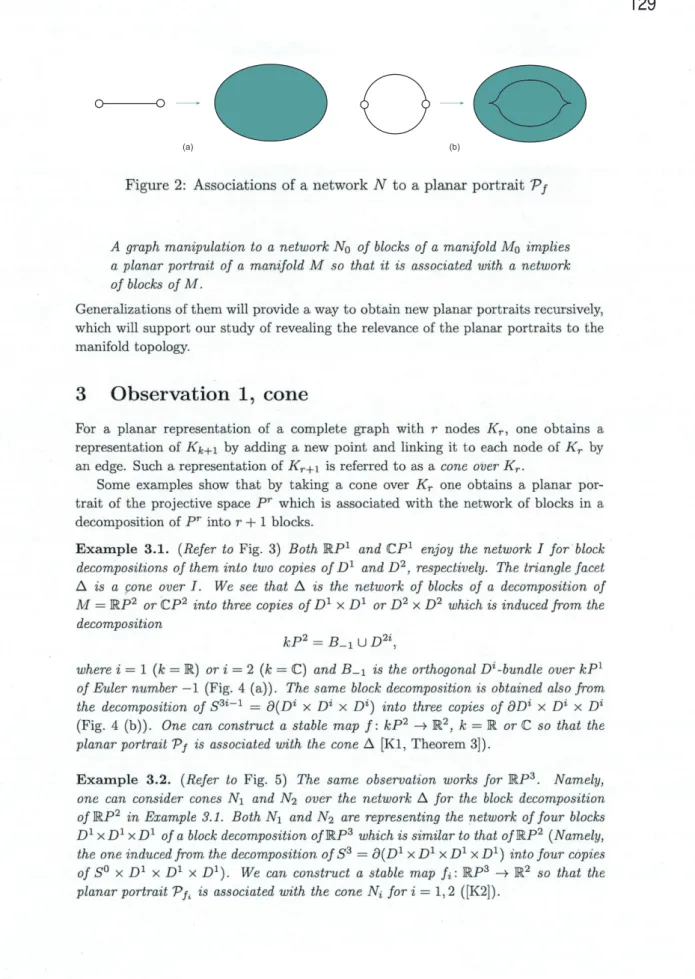
f(M) (This formulation of association is specialized to the cases considered in this article. One needs a more detailed device than the compact side to specify a compact region that matches f(M) , to deal with more general kinds of planar portraits). Example 2.1. The network l of blocks of the decomposition of S^{n} into two copies of D^{n} admits an associated planar portrait
\mathcal{P}_{f}=(D^{2}, \partial D^{2})
of S^{n} (Fig. 2 (a) ). That ofthe decomposition of S^{n} into two copies of D^{a}\cross D^{n-a} (a is an arbitrary integer of
1\leq a<n) admits an associated planar portrait \mathcal{P}_{f} of S^{n} (Fig. 2 (b), [Kı, Theorem
2] ) .
In the following sections, we make observations on samples each of which shows:
(a) (b)
Figure 2: Associations of a network
Nto a planar portrait
\mathcal{P}_{f}
A graph manipulation to a network N_{0} of blocks of a manifold M_{0} implies a planar portrait of a manifold M so that it is associated with a network
of blocks of M.
Generalizations of them will provide a way to obtain new planar portraits recursively, which will support our study of revealing the relevance of the planar portraits to the manifold topology.
3
Observation 1, cone
For a planar representation of a complete graph with r nodes K_{r}, one obtains a
representation of K_{k+1} by adding a new point and linking it to each node of K_{r} by an edge. Such a representation of K_{r+1} is referred to as a cone over K_{r}.
Some examples show that by taking a cone over K_{r} one obtamins a planar por‐ trait of the projective space P^{r} which is associated with the network of blocks in a
decomposition of P^{r} into r+1 blocks.
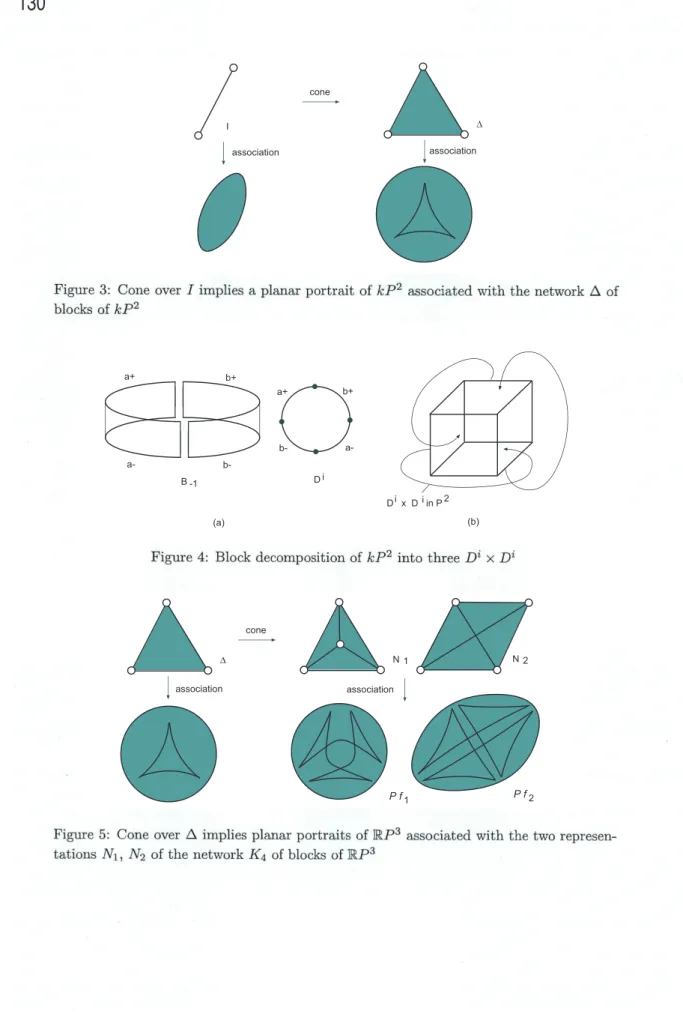
Example 3.1. (Refer to Fig. 3) Both RPı and
\mathbb{C}P^{1}enjoy the network I for block
decompositions of them into two copies of D^{1} and D^{2}, respectively. The triangle facet
\triangle is a gone over I. We see that \Delta is the network of blocks of a decomposition of
M=\mathbb{R}P^{2} or \mathbb{C}P^{2} into three copies of D^{1}\cross D^{1} or D^{2}\cross D^{2} which is induced from the decomposition
kP^{2}=B_{-1}\cup D^{2i},
where i=1(k=\mathbb{R}) or i=2(k=\mathbb{C}) and
B_{-1}is the orthogonal
D^{i}‐bundle over kPı
of Euler number
-1(Fig. 4 (a) ). The same block decomposition is obtained also from
the decomposition of S3i‐ı =\partial(D^{i}\cross D^{i}\cross D^{i}) into three copies of
\partial D^{i}\cross D^{i}\cross D^{i}(Fig. 4 (b)). One can construct a stable map f:kP^{2}arrow \mathbb{R}^{2},
k=\mathbb{R}or
\mathbb{C}so that the
planar portrait \mathcal{P}_{f} is associated with the cone
\Delta[Kı, Theorem 3]).
Example 3.2. (Refer to Fig. 5) The same observation works for
\mathbb{R}P^{3}. Namely,
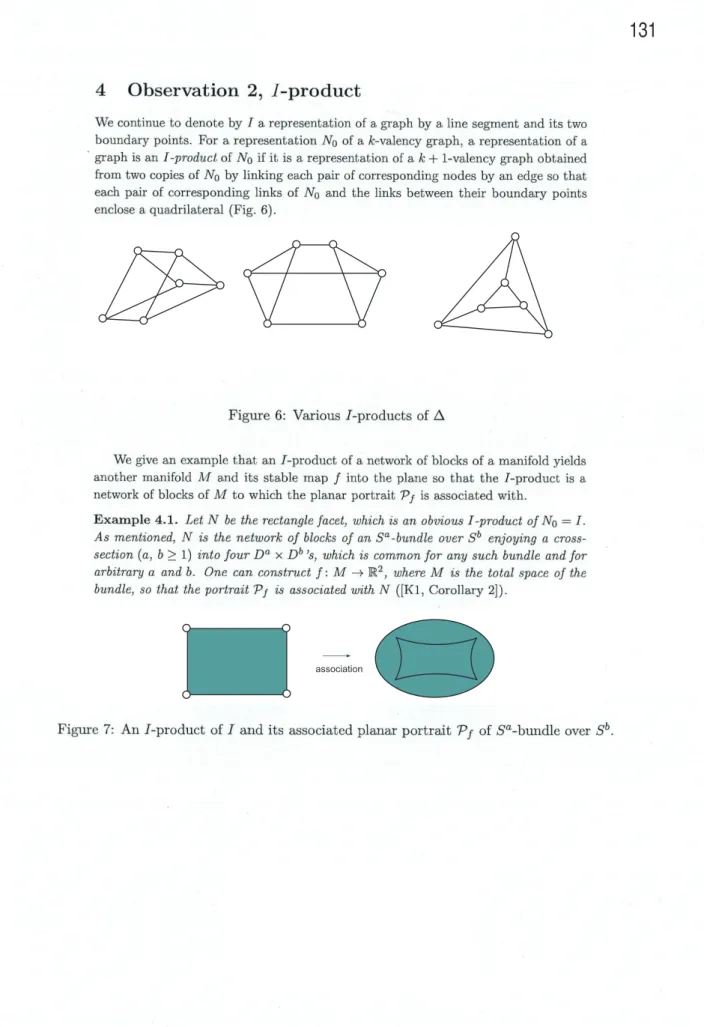
one can consider cones Nı and N_{2} over the network \Delta for the block decomposition
of \mathbb{R}P^{2} in Example 3.1. Both N_{1} and N_{2} are representing the network of four blocks
D^{1}\cross D^{1}\cross D^{1}
of a block decomposition of
\mathbb{R}P^{3}which is similar to that of
\mathbb{R}P^{2}(Namely,
the one induced from the decomposition ofS^{3}=\partial(D^{1}\cross D^{1}\cross D^{1}\cross D^{{\imath}})
into four copies ofS^{0}xD^{1}\cross D^{1}\cross D^{1})
. We can construct a stable mapf_{i}:\mathbb{R}P^{3}arrow \mathbb{R}^{2}
so that the130
\underline{cone}
\downarrow
association\downarrow
associationFigure 3: Cone over Iimplies a planar portrait of kP^{2} associated with the network \triangle of blocks of kP^{2}
B_{-1} D^{i}
D^{i}xu\ln r
(a) (b)
Figure 4: Block decomposition of kP^{2} into three D^{i}\cross D^{i}
\underline{cone}
1
\downarrow
association association\downarrow
f_{1}
Figure 5: Cone over
\triangleimplies planar portraits of
\mathbb{R}P^{3}associated with the two represen‐
tations N_{1}, N_{2} of the network K_{4} of blocks of \mathbb{R}P^{3}
We continue to denote by Ia representation of a graph by a line segment and its two
boundary points. For a representation N_{0} of a k‐valency graph, a representation of a
graph is an I‐product of N_{0}if it is a representation of a k+1‐valency graph obtained
from two copies of N_{0} by linking each pair of corresponding nodes by an edge so that each pair of corresponding links of N_{0} and the links between their boundary points enclose a quadrilateral (Fig. 6).
Figure 6: Various I‐products of \triangle
We give an example that an I‐product of a network of blocks of a manifold yields
another manifold M and its stable map f into the plane so that the I‐product is a
network of blocks of M to which the planar portrait \mathcal{P}_{f} is associated with.
Example 4.1. Let N be the rectangle facet, which is an obvious I‐product of N_{0}=I.
As mentioned, N is the network of blocks of an S^{a}‐bundle over S^{b} enjoying a cross‐
section (a, b\geq 1) into four D^{a}\cross D^{b}s, which is common for any such bundle and for
arbitrary a and b. One can construct f:Marrow \mathbb{R}^{2} , where M is the total space of the
bundle, so that the portrait \mathcal{P}_{f} is associated with N ([Kl, Corollary 2]).
association
132
5
Observation 3,
I‐slide
For a representation N_{0} of a k‐valency graph, a representation N of a graph is an I‐slide of N_{0} if it is obtained from an I‐product of N_{0} and a fixed link Ain N_{0} by
collapsing the quadrilateral enclosed by two copies of A and two links between copies
of \partial Ato the single link A (Fig. 8).
Figure 8: Various
I‐moves of a pentagon facet (bold)
We give two examples that I‐slides of a network of blocks of a manifold yields
another manifold M and its stable map f into the plane so that the I‐slide is a
network of blocks of Mto which the planar portrait \mathcal{P}_{f} is associated with.
Example 5.1. The treangle facet \Delta iS the network of the three blocks of \mathbb{R}P^{2} as
mentioned. The two representations of graphs N_{1} and N_{2} of K_{4} in Example 3.2 are both I‐slides of \Delta (Fig. 9). They are both representations of the network K_{4} of the
four blocks of \mathbb{R}P^{3} and there exist stable maps f_{i}:\mathbb{R}P^{3}arrow \mathbb{R}^{2}, i=1,2 such that the planar portraits \mathcal{P}_{f_{x}} are associated with N_{i}, as mentioned.
N1 N2 N2
Figure 9: I‐moves of \triangle
References
[K1] M. Kobayashi, On the cusped fan in a planar portrait of a manifold, Geom. Dedicata 162 (2013), 25‐43.
[K2] M. Kobayashi and M. Yamamoto, Views of real projective 3 space by stable maps into the plane, Experim. Math. 26 (2017) Issue 2, 138‐152.