氷の内部融解\cdot 凍結による六角板状の真空泡形成のモデリングに向けて
Towards
modelling the
formation
of
negative
ice
crystalsor
vapor figures
produced
by freezing
of
internal
melt figures*1
岐阜大学・教育学部 石渡哲哉 (TetsuyaIshiwata)
Faculty of Education, Gifu University*2
and
宮崎大学\cdot 工学部 矢崎成俊 (Shigetoshi Yazaki)
Faculty ofEngineering, Universityof Miyazaki*3
Abstract
When so-called Tyndall figure in asingle icecrystal is refrozen, avapor bubble
in the figure remains in ice, and it is transformed to a hexagonal disk which is
called negativecrystalorvaporfigure. Undersomeassumptions, thistransformation
process willbe simulated by aPplication ofan $area_{r}\cdot preserving$crystallinecurvature
flow, i.e., an area-preserving gradientflow oftotal interfacialenergy.
Key Words: single ice crystal, internal melting, Tyndall figure, negative crystal,
vaporfigure, interfacialenergy, area-preserving crystalline curvature flow
1
Introduction
When a block of ice is exposed to solar beams of other radiation, internal melting of ice
occurs.
That is, internal melting starts fromsome
interior points of ice without meltingthe exterior portions, and each water region forms a flower of six petals, which is called
“Tyndall figure” (Figure 1 (left)). And Figure 1 (right) indicatesthat Tyndall figures are
alInost two dimensional figures.
The figure is filled with water excePt for
a
vapor bubble. This phenomenonwas
firstobserved
by Tyndall (1858). When Tyndall figure is refrozen, the vapor bubble remainsin the ice
as
a
hexagonal disk (see Figure 2). This hexagonal disk is filled with watervapor saturated at that temperatureand surrounded by ice. McConnel foundthese disks
in the ice of Davos lake [9]. Nakaya called this hexagonal disk “vapor figure (空像)” and
investigated its Properties precisely[10]. Adams and Lewis (1934) called it “negative
$*lManuscript$ for “現象fiのO[)数理pa解ne析s+ と発展方程式 (Symposium on Mathematical Models of
Phenom-ena and Evolution Equations)”, October 18 –20, 2006 at RIMS Kyoto, University. The authors are
Partially $suPported$ by Grant-in-Aid for Encouragement of Young Scientists (T.I.: No.18740048, S.Y.: No.17740063). This visit wassPonsoredby RIMS (S.Y.).
t21-1
Yanagido, Gifu501-1193, JAPAN. E-mail: [email protected]Figure 1: (Left) Tyndall figures
seen
from the direction of45’ to c-axis [10, No.17]; (right)Tyndall figures
seen
from the direction of90’ to c-axis [10, No.18].Figure
2:
Natural vapor figures in anice single crystal [10, No.1].crystal (負結晶).” (Although Nakaya said “this term does not
seem
adequate” with acertainreason, hereafter
we
use
the term negative crystal for avoiding confusion.)Negative crystal is useful to determine the structure and orientation of ice
or
solids.Because, within
a
single ice crystal, all negative crystalsare
similarly oriented, that is,corresponding edges of hexagon
are
parallel each other (see Figure 3). lturukawa andFigure 3: A cluster of minute vapor figures [10, No.53 (magnified)].
Kohata made hexagonal prisms experimentally in a single ice crystal, and investigated
the habit change ofnegative crystals with respecttothetemperatures andtheevaporation
mechanisms of ice surfaces [3].
To the best of author’s knowledge, after the Furukawa and Kohata’s
experimental
dynamical model equations describing the process of formation of negative crystals. In
this paper, we will focus on the process of formation of negative crystals after Tyndall
figures are refrozen, and propose a model equation of interfacial motion which tracks the
deformation ofnegative crystals in time.
2
Formation
of
negative
crystals
Figure4 indicates aftereffect of freezing of Tyndall figuresfrom the initialstageof refrozen
process to the final stage of the formation of negative crystals. The aim of this talk i8 to
Figure 4: From left to right, upper to lower: (a) Start of freezing, $t=Omin$
.
$(b)$ Freezingproceeds, $t=3 \min$
.
$(c)$ Freezingproceedsfurther, $t=1lmin$.
$(d)$ Thebubble isseparated,$t=17 \min$
.
$(e)$ The separated liquid film migrates, $t=28 \min$.
$(f)$ After freezing, cloudylayers and avapor figure are left, $t=1 hr21\min$
.
[$10$, No. $52a-52f$].propose a model equation, revealed the process in Figure 4 from (d) to (f). This process
may be described as the following:
Negative crystal changes the shape from
an
oval to the hexagon.Thus,
our
modelwill be assumed the followings.(A1) water vapor region is simply connected and bounded region in the plane $\mathbb{R}^{2}$ (we
denote it by $\Omega$);
(A2) $\Omega$ is surroundedby
a
single icecrystal (i.e.,
a
single ice region is includedin $R^{2}\backslash \Omega$);(A4) the crystallographic c-axis (main axis) of the single ice crystal is perpendicular to
the plane;
(A5) $\Omega$ is filled with
water vapor saturated at that temperature, and the temperature is
a constant (i.e., there is
no
thermalgradient);(A6) the initIal figure ofnegative crystal (we denote it by $\Omega_{0}$) is strictly
convex
set witha
smooth boundary.Remark: Under (A5), the thickness of negative crystal is regarded
as
constant in deformation process. In this sense, (A1) is a natural assumption. Meaning of (A2) and
(A3) is that after the bubble in Tyndall flgure is captured in ice phase, there is
no
waterregion between the bubble and the ice, and they
are
separated each other bya
sharpboundary interface
curve.
(A4)means
thatwe
observe figures from the direction of mainaxis in structure of single ice crystal. To observe effect of interfacial energy,
we
assume
(A5). Shape of the bubble in Tyndall figure is circle by virtue ofsurface tension. Hence
immediately after the bubble is captured in ice phase, the shape
can
be regardedas
a
circle
or a
convex
set, and this follows (A6). Theprimary idea ofour
assumptionscan
befound in [8].
The evolution law of moving interface is similar to the growth of
snow
crystal, sincedeformation ofnegative crystalisregarded
as
crystal growth intheair. Asa
model ofsnow
crystal,
we
referthe Yokoyama-Kuroda model [15], which is basedon
thediffusion processandthe surfacekinetic process byBurton-Cabrera-Rank(BCF) theory[2]. Meanwhile,
we
assume
the existence of interfacial energy (density)on
the boundary $\partial\Omega$.
Theequilibriumshapeofnegative crystalis
a
regular hexagon, andiftheregion$\Omega$is veryclosetoaregularhexagon, thentheevolutionprocess may be described
as a
gradientflow oftotalinterfacialenergy
subject toa
fixed enclosedarea.
Under (A5), thediffusion process and thesurface
kinetic process will not give
so
much effecton
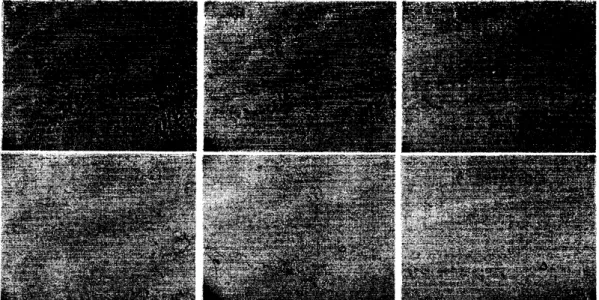
deformation of negative crystal. Nakayaexplained the transformation of
an
apparently circular form intoa
hexagon (Figure 4(d)(e)(f)
or
Figure 5) by “the principle of minimum surface – to find the shape whichhas the minimum circumference for the given area” [10, section 24].
In this paper,
we
win explain the deformation process by usingan
are&pr\infty ervinggradient flow of total interfacial energy. Figure 6 is a numerical example by an area.
preserving crystalline curvature flow. We
can
observe that the initial shape converges toa
regular hexagon.In the next section,
we
will introducean
area-preserving crystalline curvature flow,andshow known mathematicalresults. Inthe lastsection,
we
will summarizeanddiscuss
Figure 5: Transformation of acircular figure intoahexagon [10, No.93]; from left to right: a) $t=0,$ $b$) $t=2.5,$ $c$) $t=5,$ $d$) $t=39 \min$. Although Nakayadid not mention onthermal
gradient in this process, it
seems
that (A5) is not satisfied.Figure
6:
Transformationofacircular figure (theinitial36-sidedregularpolygon(farleft))into
a
hexagon (far right). Numerical computation is basedon
the scheme in Ushijimaand Yazaki [14].
3
Area-preserving
crystalline
curvature
flow
$\bm{t}$ this aection, crystalllne curvature flow and its are&pr\’eerving version will be $intrc\succ$
duoed, and known mathematical results $wiU$ be shown. Crystallinecurvature flow is very
singular weighted curvature flow, and it wa6 proposed by J. E. Taylor, and S. Angenent
$\bm{t}d$ M. E.
Gurtin
at the end of $1980’ s$.
We refer the reader to the pioneer works Taylor$[11, 12]$ and Angenent and Gurtin [1], and the
surveys
by Taylor,CAn
and Handwerker[13] and Giga [5], $\bm{t}d$ the books by Gurtin [6] for agmmetric and physical background.
In what $foUows$,
we
will introduceanarea-preservingcrystallinecurvatureflow forconvex
polygon in the plte.
Polygons. Let$\mathcal{P}$bean $N$-sided
convex
polygon inthe plane$\mathbb{R}^{2}$,andlabeltheposition
vector of vertic\’e $p_{i}(i=1,2, \ldots, N)$ in
an
anticlockwise order: $P= \bigcup_{i=1}^{N}$Si, where$S_{1}=[p_{i},p_{i+1}]$ is the i-th edge $(p_{N+1}=p_{1})$
.
The length of $S_{i}$ is $d_{i}=|p_{i+1}-p_{i}|$, andthen the $i$-th unit tangent vector is $t_{i}=(p_{i+1}-p_{i})/d_{i}$ and the i-th unit outward normal
vector is $n_{i}=-t_{1}^{\perp}$, where $(a, b)^{\perp}=(-b, a)$. We define aset of normal vectors of $\mathcal{P}$ by
$N=\{n_{1}, n_{2}, \ldots, n_{N}\}$. Let $\theta_{i}$ be the exterior normal angle of$S_{*}$ such as $n_{i}=\mathfrak{n}(\theta_{i})$ and $t_{t}=t(\theta_{i})$
,
where $n(\theta)=(\cos\theta,\sin\theta)$ and $t(\theta)=(-\sin\theta,\cos\theta)$.
We define the i-th hightfunction $h_{i}=p_{1}\cdot n_{i}=p_{i+1}\cdot n_{i}$
.
By using $N$-tuple $h=(h_{1}, h_{2}, \ldots, h_{N}),$ $d_{1}$ isdaecribedas
fofows:
$d_{i}[h]=-(\cot\theta_{i}+\cot\theta:+1)h_{\iota}+k_{-1}$
cosec
$\theta_{:}+h_{1+1}$cosec$\theta_{:+1}$, (3.1)where $\theta_{:}=\theta_{i}-\theta_{i-1}$ for $i=1,2,$
$\ldots,$$N$. Note that $0<\theta_{:}<\pi$ holds for all
Interfacial
energy.
In the field of material sciences and crystagography, we $need$ toexplain the anisotropy: phenomenon of interface motion which depends
on
the normaldirection
$n$.
To explain the anisotropy, it is convenient to definean
interfacialenery
on
theinterface
or thecurve
which has line density $\gamma(n)>0$.
The function $\gamma(n)$ ctbe extended to the function $x\in \mathbb{R}^{2}$ by putting
$\gamma(x)=|x|\gamma(x/|x|)$ if $x\neq 0$, otherwise $\gamma(0)=0$
.
This extension is caUed the extension of positively $homogen\infty us$ of degree 1,since $\gamma(\lambda x)=\lambda\gamma(x)$ holds for $\lambda\geq 0$ and $x\in \mathbb{R}^{2}.$ We $wi\mathbb{I}$
use
thesame
notation $\gamma$ for
the extended function. To observe the
characteristic
of$\gamma$, the following Frank diagram isuseful: $\mathcal{F}_{\gamma}=\{n(\theta)/\gamma(n(\theta));\theta\in S^{1}\}=\{x\in \mathbb{R}^{2};\gamma(x)=1\}.$ If the Rank$diagram\mathcal{F}_{\gamma}$ is
aconvex
polygon, $\gamma$ is called crystalline energy. When $\mathcal{F}_{\gamma}$ isa
$J$-sidedconvex
polygon,there exists aset $of_{\bm{t}}gles\{\phi_{i}|\phi_{1}<\phi_{2}<\cdots<\phi_{J}<\phi_{1}+2\pi\}$ such that the position
vectorsof vertices
are
labeled$n(\phi_{i})/\gamma(n(\phi_{i}))$ inan
rticlockwise order $(\phi_{J+1}=\phi_{1}):\mathcal{F}_{\gamma}=$$\bigcup_{i=1}^{J}[\xi:,\xi_{i+1}],$ $\xi_{i}=\nu_{i}/\gamma(\nu_{1})$
.
Here $\bm{t}d$ hereafter,we denote $\nu_{i}=n(\phi_{i})$ for$i=1,2,$
$\ldots,$$J$
$(\nu_{J+1}=\nu_{1})$
.
Inthis
$ca\epsilon e$, theWulff
shape$\mathcal{W}_{\gamma}=\bigcap_{\theta\in S^{1}}\{x\in \mathbb{R}^{2};x\cdot n(\theta)\leq\gamma(n(\theta))\}$
is $ako$ aJ-sided
convex
Polygon with the outward normal vector of the i-th edge being$\nu::\mathcal{W}_{\gamma}=\bigcap_{1=1}^{J}\{x\in \mathbb{R}^{2};x\cdot\nu_{i}\leq\gamma(\nu_{i})\}$
.
We define asetof normal vectors of $\mathcal{W}_{\gamma}$ by
$\mathcal{N}_{\gamma}=\{\nu_{1}, \nu_{2}, \ldots, \nu_{J}\}$
.
Admissibility. Following [7], we call $\mathcal{P}\mathcal{W}_{\gamma}$-essentially admissible if $\bm{t}d$ only if the
cooecutive outward unit normal vectors $n_{i},$ $n_{i+1}\in \mathcal{N}(n_{N+1}=n_{1})satis\infty\eta/|\eta|\not\in \mathcal{N}_{\gamma}$,
where $\eta=(1-\lambda)n_{i}+\lambda n_{i+1}$ for $\lambda\in(0,1)$ and $i=1,2,$$\ldots$ , N. Note that $\mathcal{P}$ i8a
$\mathcal{W}_{\gamma^{-}}essentially$ admissible
convex
polygon if $\bm{t}d$ only if$N\supseteq \mathcal{N}_{\gamma}$ holds. We $caU\mathcal{P}\mathcal{W}_{\gamma^{-}}$admissible
if $\bm{t}d$ only if $\mathcal{P}$ isa
$\mathcal{W}_{\gamma}$-essentially admissible polygon and
$N=\mathcal{N}_{\gamma}$ holds.
In
other words, $\mathcal{P}$ isa
$\mathcal{W}_{\gamma}$-admissible
convex
polygon if$\bm{t}d$ only if$n_{i}=\nu_{1}$ holds for all
$i=1,2,$$\ldots,$$N=J$.
Gradient of the total interfacial
energy.
Let $\mathcal{P}$ bea
$\mathcal{W}_{\gamma^{-}}\text{\’{e}} sentiaUy$ admissible
N-sided
convex
polygm with the $N$-tuple of hight functions $h=(h_{1}, h_{2}, \ldots, h_{N})$.
Thenthe totalinterfacial$(crystm_{ne})e$nergy
on
$\mathcal{P}$is$\mathcal{E}_{\gamma}[h]=\sum_{i=1}^{N}\gamma(n_{i})d_{i}[h]$.
For twoN-tupl\’e
$\varphi=$ $(\varphi_{1}, \varphi_{2}, \ldots, \varphi_{N}),$$\psi=(\psi_{1}, \psi_{2}, \ldots, \psi_{N})\in \mathbb{R}^{N}$, let
us
define theinner product
on
$\mathcal{P}$as
$( \varphi, \psi)_{2}=\sum_{i=1}^{N}\varphi_{i}\psi_{i}\phi[h].$ ffirthermore, we define the rate ofvariation of$\mathcal{E}_{\gamma}[h]$ in the
direction $\varphi$ and the first variation $\delta \mathcal{E}_{\gamma}[h]/\delta h$ as follows:
$\frac{\delta \mathcal{E}_{\gamma}[h]}{\delta\varphi}=\frac{d}{d\epsilon}\mathcal{E}_{\gamma}[h+\varphi]|_{\epsilon=0}=grad\mathcal{E}_{\gamma}[h]\bullet\varphi=(\frac{\delta \mathcal{E}_{\gamma}[h]}{\delta h},$$\varphi)_{2}$
.
Crystalline curvature. The first
variation
of$\mathcal{E}_{\gamma}[h]$ of$\mathcal{P}$ at $S_{1}$ is$\frac{\delta \mathcal{E}_{\gamma}[h]}{\delta\varphi}=\sum_{i=1}^{N}\gamma_{i}d_{i}[\varphi]=\sum_{1=1}^{N}d_{i}[\gamma]\varphi_{1}=\sum_{i\approx 1}^{N}\frac{d_{i}[\gamma]}{d_{i}[h]}\varphi_{i}d:[h]$,
$\gamma=(\gamma_{1},\gamma_{2}, \ldots,\gamma_{N})$,
where $\gamma_{1}=\gamma(n_{i})$ for all $i$
.
Hencewe
have $(\delta \mathcal{E}_{\gamma}[h]/\delta h)_{i}=d_{1}[\gamma]/d_{i}[h]$for all$i$ in this metric
$(\cdot, \cdot)_{2}$
.
This quantity is called crystallineby $\Lambda_{\gamma}(n_{i})=d_{i}[\gamma]/d_{i}[h]$
.
The numerator $d_{i}[\gamma]$ is described as $d_{i}[\gamma]=l_{\gamma}(n_{i})$, where $l_{\gamma}(n)$is the length ofthej-th edge of$\mathcal{W}_{\gamma}$ if
$n=\nu_{j}$ for
some
$j$, otherwise $l_{\gamma}(n)=0$. Thereforeif$\mathcal{P}=\mathcal{W}_{\gamma}$, then the crystalline curvature is 1.
An area-preserving motion by crystalline curvature. Theenclosed
area
$\mathcal{A}$of$\mathcal{P}$is given by$\mathcal{A}[h]=\sum_{i=1}^{N}h_{i}d_{i}[h]/2$
.
Then therate of variation of$A[h]$ in the direction$\varphi$ is
$\frac{\delta \mathcal{A}[h]}{\delta\varphi}=\frac{d}{d\epsilon}\mathcal{A}[h+\varphi]|_{\epsilon=0}=\sum_{i=1}^{N}\varphi_{i}d_{i}[h]$
.
By taking $\varphi_{i}=-(\delta \mathcal{E}_{\gamma}[h]/\delta h)_{i}=-\Lambda_{\gamma}(n_{i})$,
we
have $\delta \mathcal{A}[h]/\delta\varphi=-\sum_{:=1}^{N}\Lambda_{\gamma}(n_{i})d_{i}[h]$.
Hence
by taking$\varphi_{i}=\overline{\Lambda}_{\gamma}-\Lambda_{\gamma}(n_{i})$,we
have $\delta \mathcal{A}[h]/\delta\varphi=0$.
Here
$\overline{\Lambda}_{\gamma}=\frac{\sum_{i=1}^{N}\Lambda_{\gamma}(n_{1})d_{i}[h]}{\sum_{k=1}^{N}d_{k}}=\frac{\sum_{1=1}^{N}l_{\gamma}(n_{1})}{\mathcal{L}}$
is the
average
ofthecrystallinecurvature, and$\mathcal{L}$ isthetotal length of$\mathcal{P}$,i.e., $\mathcal{L}=\sum_{1=1}^{N}4$.
Thus we have the gradient flow of$\mathcal{E}_{\gamma}$ along $\mathcal{P}$ which encloses
a
fixedarea:
$V_{1}=\overline{\Lambda}_{\gamma}-\Lambda_{\gamma}(n_{i})$, $i=1,2,$
$\ldots,$$N$, (3.2)
where $V_{1}(t)=\dot{h}_{:}(t)$ is the normal velocity on $S_{i}$ in the direction $n_{i}$ at the time $t$
.
Hereand hereafter,
we
denote $\dot{u}$ by $du/dt$.
From (3.1), the time derivative of$d_{1}(t)=d_{i}[h]$ is
given by
$\dot{\phi}=-(\cot\theta_{i}+\cot\theta_{i+1})V_{1}+V_{i-1}$
cosec
$\theta_{:}+V_{1+1}$cosec
$\theta_{i+1}$ (3.3)for $i=1,2,$$\ldots$ ,$N$
.
Note that (3.2) and (3.3)are
equivalenteach other.Negative polygons. Applying the arebpreserving crystalline curvature flow to de
formation of negative crystals,
we
will introduce the concept of negative polygons.En-closed region of $\mathcal{W}_{\gamma}$-admissible
convex
polygon $\mathcal{P}$ is crystal, and then normal vector$n$
is direction from ice to gas, i.e., $\mathcal{P}$ is
convex
to$-n$ direction and crystailline curvature
$\Lambda_{\gamma}(n)$ is positive everywhere. We define negative polygon of $\mathcal{P}$ by $-\mathcal{P}$, and
we
denoteit by $\overline{\mathcal{P}}$
Then vertices of negative polygon フヲ
are
labeled clockwise, フシ isconcave
to$-n$ direction, and crystalline curvature $\Lambda_{\gamma}(n)$ is negative everywhere. If$\mathcal{P}$ is
a
regularpolygon, then $\mathcal{P}=$フヲ. In this sense, the negative Wulff shape $\overline{\mathcal{W}}_{\gamma}=-\mathcal{W}_{\gamma}$ is defined
as
$\overline{\mathcal{W}}_{\gamma}=\bigcap_{j\approx 1}^{J}\{x\in \mathbb{R}^{2};x\cdot(-\nu_{j})\leq\gamma(\nu_{j})\}$
.
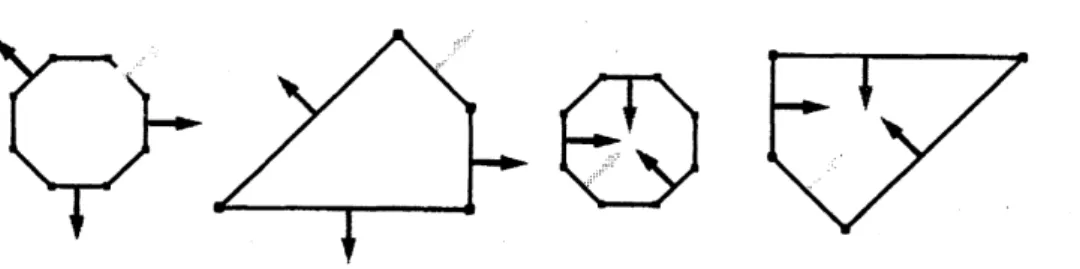
See Figure 7.Known results. The problem is stated
as
follows.Problem 1 For
a
given $\mathcal{W}_{\gamma}$-essentially admissible closedcurve
$\mathcal{P}_{0}$, finda
family of$\mathcal{W}_{\gamma^{-}}$essentiallyadmissible
curves
$\{P(t)\}_{0\leq t<T}$satisfying (3.2) (or (3.3)) with $\mathcal{P}(0)=\mathcal{P}_{0}$.
Since(3.3)
are
the syst$em$ of ordinary differential equations, the maximal existence time isFigure
7:
From left to right: $\mathcal{W}_{\gamma}$-essentially admissible polygon, the Wulff shape $\mathcal{W}_{\gamma}$,$\overline{\mathcal{W}}_{\gamma}$-essentially admissible negative polygon,
and the negativeWulffshape $\overline{\mathcal{W}}_{\gamma}$
What might happen to $\mathcal{P}(t)$
as
$t$ tendsto
$T\leq\infty$?For this question,we
have thefollowing three results. The first
result
isthe
case
wheremotion
is isotropic and polygonis admissible.
Theorem A Let theinterfacialenergy be isotropic$\gamma\equiv 1$
.
Assume the initial polygon$\mathcal{P}_{0}$is
an
N-sided$\mathcal{W}_{\gamma}$-admissibleconvex
polygon. Thena
solution$\mathcal{W}_{\gamma}$-admissiblepolygon$\mathcal{P}(t)$
of Problem 1 exists globally in time keeping the
area
enclosed by the polygon constant$\mathcal{A}$, and
$\mathcal{P}(t)$ converges to the shape of the boundary of the Wulff shape
$\partial \mathcal{W}_{\gamma}$
.
in theHausdorff metric
as
$t$ tends to infinity, where $\gamma_{r}(n_{i})\equiv\sqrt{2\mathcal{A}/\sum_{k=1}^{N}l_{1}(n_{k})}$is constant.In particular, if $\mathcal{P}_{0}$ is centrally symmetric with respect to the origin, then
we
have
an
exponentialrate of
convergence.
This
theorem isproved byYazaki [16] by using theisoperimetricinequality and the$th\infty ry$ofdynamical systems. We note that $\partial \mathcal{W}_{\gamma}$
.
is the circumscribed polygon ofa
circle withradius $\gamma.$, and then this result is a semidiscrete version of Gage [4].
The second result is the
case
where motion is anisotropic and polygon is admissible.Theorem B Let the crystalline
energy
be $\gamma>0$.
Assume the initial polygon $\mathcal{P}_{0}$ is anN-sided $\mathcal{W}_{\gamma}$-admissible
convex
polygon. Thena
solution$\mathcal{W}_{\gamma}$-admissible polygon $\mathcal{P}(t)$
of Problem 1 exists globally in time keeping the
area
enclosed by the polygon constant$\mathcal{A}$
,
and$\mathcal{P}(t)$ converges to the shape of the boundary of the Wulff shape $\partial \mathcal{W}_{\gamma}$
.
in theHausdorffmetric
as
$t$ tends to infinity, where $\gamma_{*}(n_{i})=\gamma(n_{i})/W,$ $W=\sqrt{|\mathcal{W}_{\gamma}|}/\mathcal{A}$ for all$i=1,2,$ $\ldots,$$N$ and $| \mathcal{W}_{\gamma}|=\sum_{k=1}^{N}\gamma(n_{k})l_{\gamma}(n_{k})/2$ is enclosed
area
of$\mathcal{W}_{\gamma}$.
This theorem is proved in Yazaki [17, Part I] by using the anisoperimetric inequality $or$
Br\"unn andMinkowski’sinequality and the theory of dynamical systems whichis
a
similartechnique
as
in Yazaki [16].The last result is the
case
where motion is anisotropic and polygon is $\mathcal{W}_{\gamma}$-essentiallyadmissible. Thenext theorem is proved inYazaki [19].
Theorem C Let the crystalline energy be $\gamma>0$
.
Assume the initial polygon $\mathcal{P}_{0}$ is ansolution $\mathcal{W}_{\gamma}$-essentially admissible polygon $\mathcal{P}(t)$ of Problem 1 is finite $T<\infty$, then there
exists the i-th edge $S_{i}$ such that $\lim_{tarrow T}d_{i}(t)=0$ and $l_{\gamma}(n_{i})=0$ hold. That is, the
normal vector of vanishing edge does not belong to $\mathcal{N}_{\gamma}$, and $\inf_{0<t<T}d_{k}(t)>0$ holds for
all $n_{k}\in \mathcal{N}_{\gamma}$
.
4
Conclusion
We will show
our
main results $\bm{t}d$ discuss future works.Main results. By Theorem $B,$ any $\overline{\mathcal{W}}_{\gamma}$-admissible negative polygon
converg\’e to
the
negat.ive
WulffshaPe
$\overline{\mathcal{W}}_{\gamma}$as
time tends to infinity. Figure 6shows convergence of$\overline{\mathcal{W}}_{\gamma^{-}}aesentiafy$ admissible negative Polygon (36-sided regular polygon) to the negative
Wulff
shaPe
$\overline{\mathcal{W}}_{\gamma}$ in thecase
where $\overline{\mathcal{W}}_{\Gamma}$ isa
$re_{1^{1ar}}$ hexagon. However, this numerical
r\’eult is
an
open problem: For any $\mathcal{W}_{\gamma}$-essentially admissibleconvex
polygon $\mathcal{P}_{0}$, is $T$a
finite value? If the
answer
of this question is yes, then we have the finite time sequence$T_{1}<T_{2}<\cdots<T_{M}$ such that $\mathcal{P}(T_{i})$ is $\mathcal{W}_{\gamma^{-}}essent;_{a}g_{y}$ admissible for $i=1,2,$
$\ldots,$$M-1$
and $\mathcal{P}(T_{M})$ is $\mathcal{W}_{\gamma}$-admissible. In the generalcasewhere $V_{1}=g(n_{i}, \Lambda_{\gamma}(n_{i}))$ for all $i$ under
certain
conditions
of $g$, theanswer
of the above question is yae.Sae
Yazaki [18]. Notethat $g$ doe8not include $\overline{\Lambda}_{\gamma}$
.
Discussion. The initial shape of negative crystal is $\bm{t}$ apparently circular form.
Nahya $a\epsilon serted$ that the boundary is stepped structure rather than asmooth
curve
[10,Figure 26]. Thiscorrespondstothe
cave
where the initial$\mathcal{P}_{0}$is$\mathcal{W}_{\gamma}$-admissiblenon-strictly-convex
polygon, when $\mathcal{W}_{\gamma}$ is aregular hexagon. Althoughwe
ct compute evolution of $\mathcal{W}_{\gamma^{-}}essen.tiaUy$ admissiblepolygonalcurves, the mathematicaljustification isour on-goingraeearch. Rrthermore, in ourfuture research, the assumptions (A1) and (A5) wigbe
re-moved, $i.e.$, Wewill consider influence of temperature indeformation of thrae dimensional
negative crystak. Then they will be filled with super- or sub-saturated water vapor, $d\triangleright$
pending
on
the
position, $\bm{t}d$we
will$n\infty d$evolutionequationswhichd\’ecribethediffision
procaes and the surface kinetic process.
References
[1] S. Angenent and M. E. Gurtin, Multiphase thermomechanics with interfacial
struc-$t$ure, 2. Evolutionofan isothermalinterface, Arch. RationalMech. Anal. 108 (1989)
323-391.
[2] W. K. Burton, N. Cabrera and F. C. Frank, Thegrowth of crystals and the
equilib-rium $s$
tructure
of their $s$urfaces, Philos. $R\bm{t}S$.
R. Soc. London, Ser.A 243
(1951)[3] Y. Furukawa andS. Kohata, Temperature dependence of the growthformofnegative
crystal in an ice single crystal and evaporation kinetics for its $s$urfaces, J. Crystal
Growth 129 (1993)
571-581.
[4] M. Gage, On anarea-preservingevol$u$tionequationsforplanecurves, Contemporary
Math. 51 (1986) 51-62.
[5] Y. Giga, Anisotropic $c$urvat
ure
effects in interface dynamics, Sugaku 52 (2000)113-127; English transl., Sugaku Expositions 16 (2003)
135-152.
[6] M. E. Gurtin, Thermomechanicsof evolvingphaseboundariesin th$e$plane, Oxford,
Clarendon
Press (1993).[7] H. Hontani, M.-H. Giga, Y. Giga and K. Deguchi, Expanding $se\Re imilar$solutions
ofa crystauine flow $wi$th applications to contour figure analysis, Discrete Applied
Mathematics 147 (2005) 265-285.
[8] T. Ishiwata, Towards mathematical understanding the formation of vapor figures
(in Japanese), Proceedings ofSugadaira ski-science seminar 9 (2005)
30-37.
[9] J.
C.
McConnel, The crystallization oflake ice, Nature 39 (1889)367.
[10] U. Nayaka, Properties of single crystaisofice, revealed byinternal melting,
SIPRE
(Snow, Ice and Permafrost Reseach Establishment) Research Paper
13
(1956).[11] J. E. Rylor, Constructions and conject
ures
in crystallinenondifferentialgeometry,Proceedings of the Conference
on
Differential Geometry, Rio de Janeiro, PitmanMonograpbs Surve$ys$ Pure Appl. Math. 52 (1991) 321-336, Pitman London.
[12] J. E. Taylor, Motion of$c$
urves
by crystalline $cu$rvature, including triple$j$unctionsand boundarypoints, Diff.
Geom.:
partial diff. eqs.on
manifolds (Los Angeles, CA,1990), Proc. Sympos.
Pure
Math., 54 (1993), Part I, 417-438, AMS, Providencd,RI.
[13] J. E. Taylor, J. Cahnand C. Handwerker, Geometricmodels ofcrystalgrovvth,Acta
Metall., 40 (1992)
1443-1474.
[14] T. K. Ushijima and S. Yazaki, Convergence of
a
crystalline approximation foran
area-preserving motion, Journal of Computational and Applied Mathematics 166
(2004)
427-452.
[15] E. Yokoyama andT. Kuroda,Patternformationingrovvthofsnow ciystalsoccurring
in the surface kinetic process
an
$d$ the diffusion process, PhysicalReview A
41(4)[16] S. Yazaki, On an area-preserving crystalline motion, Calc. Var. 14 (2002) 85-105.
[17] S. Yazaki, $On$
an
anisotropic area-preserving crystalline $mo$tion and motion ofnonadmissible polygons by crystalline curvature, Surikaisekikenkyusho Kokyuroku
1356
(2004)44-58.
[18] S. Yazaki, Motion of nonadmissible
convex
polygons by crystalline curvature,Pub-lications ofResearch Institute for Mathematical ScIences (to appear).
[19] S. Yazaki, Asymptotic behavior of solutions to
![Figure 2: Natural vapor figures in an ice single crystal [10, No.1].](https://thumb-ap.123doks.com/thumbv2/123deta/6000032.1062138/2.892.321.582.400.584/figure-natural-vapor-figures-ice-single-crystal.webp)
![Figure 5: Transformation of a circular figure into a hexagon [10, No.93]; from left to right:](https://thumb-ap.123doks.com/thumbv2/123deta/6000032.1062138/5.892.177.749.150.259/figure-transformation-circular-figure-hexagon-left-right.webp)