A
cute kidney injury (AKI) induced by contrast following percutaneous coronary intervention (PCI) is associated with increased short- and long-term mortality in patients with coronary artery disease [1]. To prevent contrast-induced AKI, infusion of saline has been used in clinical practice since 1980 [2]. Infusion of sodium bicarbonate was expected to be a replacement therapy to prevent contrast-induced AKI. However,multicenter, randomized trials have shown no advan-tage of this method compared with infusion of saline [3,4]. A variety of pharmacotherapies have been evalu-ated for prevention of contrast-induced AKI. Infusion or oral administration of nicorandil, which has dual properties of a nitrate and an ATP-sensitive K+ channel agonist with vasodilatory effects, decreases the inci-dence of contrast-induced AKI [5,6]. However, the benefit of these therapies remains unclear.
CopyrightⒸ 2021 by Okayama University Medical School.
http ://escholarship.lib.okayama-u.ac.jp/amo/
Original Article
Possible Protective Effect of Remote Ischemic Preconditioning on Acute
Kidney Injury Following Elective Percutaneous Coronary Intervention:
Secondary Analysis of a Multicenter, Randomized Study
Hiroaki Otsuka
a, Toru Miyoshi
a*, Kentaro Ejiri
a, Kunihisa Kohno
a,
Makoto Nakahama
b, Masayuki Doi
c, Mitsuru Munemasa
d, Masaaki Murakami
e,
Kazufumi Nakamura
a, and Hiroshi Ito
aaDepartment of Cardiovascular Medicine, Okayama University Graduate School of Medicine,
Density and Pharmaceutical Sciences, Okayama 700-8558, Japan,
bDepartment of Cardiology, Fukuyama City Hospital, Fukuyama, Hiroshima 721-8511, Japan, cDepartment of Cardiology, Kagawa Prefectural Central Hospital, Takamatsu 760-8557, Japan,
dDepartment of Cardiology, Okayama Medical Center, Okayama 701-1192, Japan, eDepartment of Cardiology, Okayama Heart Clinic, Okayama 703-8251, Japan
Remote ischemic preconditioning (RIPC) is a promising strategy for protecting against ischemic reperfusion injury. This study is a secondary analysis of a randomized study that aimed to evaluate the effect of RIPC on the early increase in serum creatinine (SCr) following percutaneous coronary intervention (PCI), which is associ-ated with contrast-induced acute kidney injury. Patients with stable angina undergoing elective PCI were assigned to control, RIPC, and continuous infusion of nicorandil (nicorandil) groups. The endpoint of this study was the incidence of the early increase in SCr, a predictor of contrast-induced acute kidney injury, which was defined as either a >20% or absolute increase by 0.3 mg/dl of SCr levels after 24 h of PCI. This study included 220 patients for whom a dataset of SCr values was available. The incidence of the early increase in SCr was significantly lower in the RIPC than in the control (1.3% vs 10.8%, p=0.03) group, but was not significantly different between the nicorandil and control groups. In multivariate analysis, RIPC remained a significant fac-tor associated with a reduction in the incidence of early increase in SCr. RIPC reduces the incidence of early increase in SCr in patients with stable angina following elective PCI.
Key words: remote ischemic preconditioning, stable angina, serum creatinine, acute kidney injury
Received May 18, 2020 ; accepted October 5, 2020.
*Corresponding author. Phone : +81-86-235-7351; Fax : +81-86-235-7353
Contrast-induced AKI is usually defined as an increase in in the serum creatinine (SCr) level from baseline 48 to 72 h after contrast exposure [7-10]. However, with the development of new technology, most patients are discharged in 1 or 2 days after PCI, without the measurement of SCr at 48-72 h after PCI. To stratify patients’ risks of contrast-induced AKI prior to PCI, a scoring system is useful. Inohara et al. reported that the AKI prediction model derived from the National Cardiovascular Data Registry (NCDR) was well-fitted to analysis of a Japanese PCI cohort [11]. Meanwhile, Ribichini et al. evaluated predictors of con-trast-induced AKI after angiography and PCI, and found that an increase in SCr of 5% to 10% above base-line at 12 h predicted the development of contrast- induced AKI [12]. Liu et al. reported that long-term mortality in patients after coronary angiography was similar for patients with early (within 24 h) and late (24-48 h) increases in SCr ≥0.3 mg/dL or ≥50% [13]. Thus, the early increase in SCr after contrast exposure may be a useful predictor for contrast-induced AKI and its associated long-term mortality.
Remote ischemic preconditioning (RIPC) is defined as transient brief episodes of ischemia at a remote site before a subsequent prolonged ischemia/reperfusion injury of the target organ. RIPC is an adaptational response that protects against an ischemic and reperfu-sion insult [14]. Several studies have shown the tissue- protective effects of RIPC in various target organs, including the kidneys [8,15-20]. Therefore, RIPC may offer a novel noninvasive treatment strategy for decreasing the incidence of AKI.
We recently reported a multicenter, randomized trial that examined whether pre-procedural RIPC or intravenous nicorandil reduces periprocedural myocar-dial injury in patients who undergo elective PCI for stable coronary artery disease. This study showed that RIPC or intravenous nicorandil moderately reduced biomarker release and periprocedural myocardial injury, but these results were not significant [21]. Therefore, an exploratory analysis to identify a popula-tion in whom RIPC or intravenous nicorandil is effec-tive was planned. Considering the tissue-proteceffec-tive effects of RIPC in various organs, RIPC could have a protective effect on contrast-induced AKI. In our pre-vious randomized study [21], we collected serum creat-inine value at baseline and 24 h after PCI. We hypothe-sized that RIPC reduced the incidence of the early
increase in creatinine, which is associated with the development of contrast-induced AKI. Thus, this study aimed to evaluate the effect of RIPC or nicorandil on the early increase in SCr as a substudy of our previous mul-ticenter, randomized study.
Materials and Methods
The main study (Cardiac Preconditioning Effect of Remote Ischemia and Nicorandil in Patients Undergoing Elective Percutaneous Coronary Intervention: RINC) was a prospective, open-label, multicenter, random-ized, controlled trial, which was conducted between February 2011 and January 2013 [21]. The current study was a post-hoc analysis of the RINC study. The study was approved by the ethics committees of all par-ticipating hospitals. All participants provided written informed consent before enrolling. This study was con-ducted in accordance with the principles expressed in the Declaration of Helsinki. The study is registered at the UMIN Clinical Trials Registry (UMIN000005607).
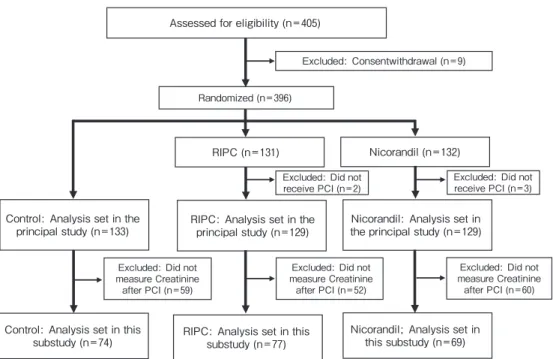
Patient population. Figure 1 shows a flow dia-gram of the study. Eligible patients were adults (>20 years old) who were diagnosed with silent myocardial ischemia or stable angina and planned to have elective PCI. Patients were excluded for the following reasons: they had acute coronary syndrome, they had contrain-dications for intravenous nicorandil administration, they planned elective PCI for a chronic total occlusion lesion or PCI with a rotablator, they were using sulfo-nylurea drugs, they had an aorta-venous shunt in one or both arms, and their prognosis was regarded as <12 months [21,22]. In the main study, 396 patients underwent randomization. In this post-hoc analysis, patients were included if blood samples for measuring SCr levels before PCI and 24 h after PCI were available. Finally, 220 patients were included in this post-hoc analysis (n=74 in the control group, n=77 in the RIPC group, and n=69 in the nicorandil group).
Study protocol. The intervention protocol and PCI procedure have been described previously [21]. Patients were randomly assigned to control, RIPC, or 6 mg/h intravenous nicorandil (nicorandil) groups. In patients who were assigned to the RIPC group, 5-min inflation of a blood pressure cuff to 200 mmHg around the upper arm, followed by 5-min deflation of a cuff to 0 mmHg was performed three times for at least 1 h each time before PCI. This procedure was automatically
per-formed by a newly developed automated continuous blood pressure device (FB-270; Fukuda Denshi, Tokyo). In patients who were assigned to the nicorandil group, 4 mg of nicorandil was intravenously adminis-tered for 5 min at least 1 h before PCI, followed by continuous infusion of nicorandil (6 mg/h) for at least 8 h during PCI. The infusion was stopped at the direc-tion of the attending doctor. Patients in the control group did not receive any additional pre-treatment before PCI. Blood samples were collected before PCI (until 2 days before the planned PCI) and at 24 h after PCI. The total volume of drip infusion associated with PCI (>1,500 ml or <1,500 ml) was collected.
End points. The primary end point of this sub-analysis was the incidence of the early increase in SCr following PCI.
Early increase in SCr was defined as either a >20% increase or an absolute increase by 0.3 mg/dl of SCr 24 h after PCI. The definition of early increase in SCr was based on a previous study of the definition of AKI following angiography with use of contrast [23,10].
The incidence of early increase in SCr was also eval-uated according to the Mehran Score and the tertile of contrast medium (first: 9-80 ml; second: 83-118 ml; third: 120-232 ml). The Mehran score is used to
pre-dict the risk of developing contrast-induced AKI [24], and accounts for such factors as hypotension, use of an intra-aortic balloon pump, congestive heart failure, age, anemia, diabetes mellitus, contrast media volume, and estimated glomerular filtration rate (eGFR). Mehran scores of <5,6-10,11-15, and >15 were cate-gorized as low, moderate, high, and very high risk.
Statistical analysis. Continuous variables are presented as the mean±standard deviation or as the median (25-75 th percentile), as appropriate. Categorical variables are presented as numbers and ratios (%). Continuous variables were compared using analysis of variance or the Kruskal-Wallis test, as appropriate. Categorical variables were compared using Pearson’s chi-square test. For multiple comparison, the Bonferroni post-hoc test was applied.
We assumed that occurrence of renal failure event would be 20% in the control group, and 4% in the RIPC group or nicorandil group as in previous studies [5,6,8,18,25,26]. To ensure that the two-sided signif-icance level was 5% and the power was 90%, 77 patients in each group were required.
Odds ratios (ORs) between groups and their 95% exact confidence intervals (CIs) were calculated. In addition, a multivariate logistic regression model was
Assessed for eligibility (n=405)
Excluded: Consentwithdrawal (n=9)
RIPC: Analysis set in the
principal study (n=129) the principal study (n=129)Nicorandil: Analysis set in Nicorandil (n=132) RIPC (n=131)
Control: Analysis set in this
substudy (n=74) RIPC: Analysis set in thissubstudy (n=77)
Nicorandil; Analysis set in this substudy (n=69)
Excluded: Did not measure Creatinine after PCI (n=60) Excluded: Did not
receive PCI (n=2)
Control: Analysis set in the principal study (n=133)
Randomized (n=396)
Excluded: Did not receive PCI (n=3)
Excluded: Did not measure Creatinine after PCI (n=52) Excluded: Did not
measure Creatinine after PCI (n=59)
Fig. 1 Flow diagram of the study. A total of 405 patients were enrolled in this study. Among them, 396 patients underwent randomiza-tion, and 220 were included in the per-protocol set as the complete study population.
used to calculate the OR between study groups with adjustment for factors having p values <0.10 in univar-iate analysis (i.e., smoking), as well as duration of blood sampling and total fluid volume. All analyses were per-formed with IBM SPSS version 25. A p value <0.05 was considered statistically significant.
Results
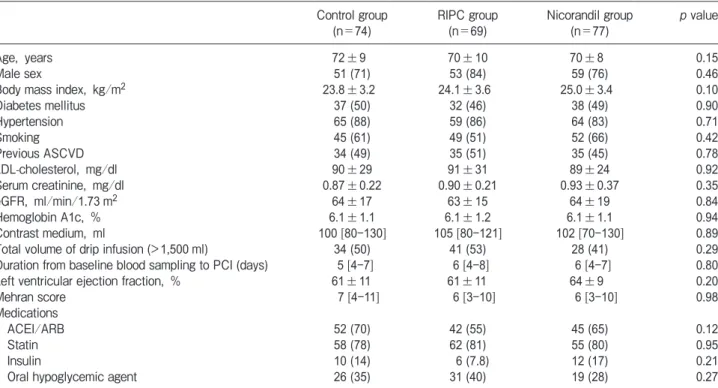
Study population. Table 1 shows the baseline patient characteristics in the control, RIPC, and nicorandil groups. Among all patients, the mean age, eGFR at baseline, and volume of contrast medium used for PCI were 70.7±8.8 years, 64.3±16.5 ml/min/1.73 m2, and 103.2±39.5 ml, respectively. These parameters were not significantly different among the three groups. Other baseline patient characteristics and medications were also not significantly different among the groups.
Primary end point. Of the 220 patients, the early increase in SCr occurred in 11 patients. First, the inci-dence of early increase in SCr was evaluated according to the Mehran score. The incidence of the early increase
in SCr in the low risk (n=92), moderate risk (n=74), and high and very high risk (n=54) groups was 1.1%, 8.1%, and 7.4%, respectively (p=0.08). In addition, the incidence of early increase in SCr was evaluated accord-ing to the tertile of contrast medium. The incidence of AKI in the first (n=78), second (n=73), and third (n=68) tertiles was 3.9%, 4.1%, and 0%, respectively.
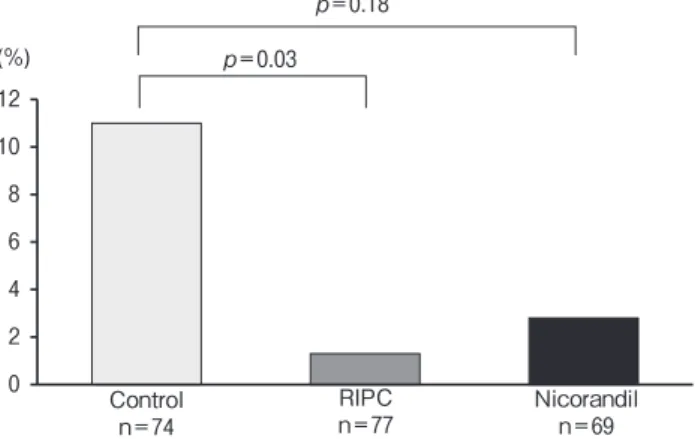
The incidence of the early increase in SCr (primary endpoint) was significantly lower in the RIPC group than in the control group (1 [1.3%] vs 8 [10.8%] patients, p=0.03), but it was not significantly different between the nicorandil (2 [2.8%] patients) and control groups (p=0.18) (Fig.2). A further analysis in patients with eGFR <60 mL/min per 1.73 m2 was performed (control: n =34; nicorandil: n =28; RIPC: n =34). The incidence of early increase in SCr was 9% (n=3) in the control, 2% (n=2) in the nicorandil, and 0% in the RIPC group, respectively, and there was no significant difference between the control and nicorandil (p=0.81) or between the control and the RIPC (p=0.08) groups.
Independent association between the early increase in SCr and RIPC. To examine the association between
Table 1 Patientsʼ characteristics among the control, RIPC, and nicorandil groups Control group
(n=74) RIPC group (n=69) Nicorandil group (n=77) p value
Age, years 72±9 70±10 70±8 0.15
Male sex 51 (71) 53 (84) 59 (76) 0.46
Body mass index, kg/m2 23.8±3.2 24.1±3.6 25.0±3.4 0.10
Diabetes mellitus 37 (50) 32 (46) 38 (49) 0.90 Hypertension 65 (88) 59 (86) 64 (83) 0.71 Smoking 45 (61) 49 (51) 52 (66) 0.42 Previous ASCVD 34 (49) 35 (51) 35 (45) 0.78 LDL-cholesterol, mg/dl 90±29 91±31 89±24 0.92 Serum creatinine, mg/dl 0.87±0.22 0.90±0.21 0.93±0.37 0.35 eGFR, ml/min/1.73 m2 64±17 63±15 64±19 0.84 Hemoglobin A1c, % 6.1±1.1 6.1±1.2 6.1±1.1 0.94 Contrast medium, ml 100 [80-130] 105 [80-121] 102 [70-130] 0.89
Total volume of drip infusion (>1,500 ml) 34 (50) 41 (53) 28 (41) 0.29
Duration from baseline blood sampling to PCI (days) 5 [4-7] 6 [4-8] 6 [4-7] 0.80
Left ventricular ejection fraction, % 61±11 61±11 64±9 0.20
Mehran score 7 [4-11] 6 [3-10] 6 [3-10] 0.98
Medications
ACEI/ARB 52 (70) 42 (55) 45 (65) 0.12
Statin 58 (78) 62 (81) 55 (80) 0.95
Insulin 10 (14) 6 (7.8) 12 (17) 0.21
Oral hypoglycemic agent 26 (35) 31 (40) 19 (28) 0.27
Data are presented as mean±standard deviation, n (%), or median [25-75 th percentile].
ACEI, angiotensin-converting enzyme inhibitor; ARB, angiotensin II receptor blocker; ASCVD, atherosclerotic cardiovascular disease; eGFR, estimated glomerular filtration rate; LDL, low-density lipoprotein; RIPC, remote ischemic preconditioning.
the early increase in SCr and RIPC, 151 patients in the control (n=74) and the RIPC (n=77) groups were ana-lyzed. Table 2 compares the patient characteristics between patients with and without the early increase in SCr. There were no significant differences in character-istics between the 2 groups. Finally, logistic regression analysis was performed (Table 3). Multivariate analysis
using factors that showed p values <0.10 in univariate analysis, the total volume of drip infusion, and the duration from baseline blood sampling to PCI showed that RIPC remained a significant factor associated with a reduction in the early increase in SCr (odds ratio, 0.12; 95% confidence interval, 0.01-0.96; p=0.04).
Discussion
In this post-hoc analysis of a multicenter, random-ized, controlled trial, we showed that the incidence of the early increase in SCr in the RIPC group was signifi-cantly lower than that in the control group. However, the nicorandil group did not show a significantly lower incidence of the early increase in SCr compared with the control group. This is the first multicenter trial to show the potential benefit of RIPC for preventing contrast- induced AKI following elective PCI in patients with stable coronary artery disease.
Several clinical studies have reported the effect of RIPC on renal outcomes [8,18-20]. A randomized trial by Zarbock et al. reported that performing RIPC before open thoracic cardiac surgery prevented patients from having renal failure 72 h after surgery [20]. Similar studies have reported the protective effect of RIPC in the perioperative period, which suggests that there is a renal protective effect of RIPC in highly invasive sur-0 2 4 6 8 10 12 p=0.18 p=0.03 (%) Control n=74 RIPCn=77 Nicorandiln=69
Fig. 2 Incidence of the early increase in serum creatinine post-PCI. The incidence of the early increase in serum creatinine follow-ing PCI in the control, RIPC, and nicorandil groups is shown. Fisherʼs exact test was applied to compare the incidence of the early increase in serum creatinine following PCI between the RIPC and control groups or the nicorandil and control groups.
RIPC, remote ischemic preconditioning.
Table 2 Characteristics of patients with and without the early increase in serum creatinine in the control and RIPC groups Early increase in serum creatinine
Presence (n=9) Absence (n=142) p value
Male 5 (55) 105 (74) 0.25 Age, years 71±9 76±5 0.08 Diabetes mellitus 6 (66) 69 (49) 0.33 Hypertension 8 (88) 121 (85) 1.00 Dyslipidemia 7 (77) 116 (82) 0.67 eGFR <60 ml/min/1.73 m2 2 (22) 65 (46) 0.30 Previous ASCVD 5 (55) 64 (45) 0.73 Smoking 3 (33) 94 (66) 0.07 Contrast medium (ml) 100 [80-121] 100 [75-131] 0.82 ACEI/ARB 8 (89) 86 (61) 0.15 Statin 6 (66) 114 (80) 0.39
Oral hypoglycemic agent 3 (33) 54 (35) 1.00
RIPC 1 (11) 76 (54) 0.01
Total volume of drip infusion (>1,500 ml) 4 (44) 74 (52) 0.66
Duration from baseline blood sampling to PCI (days) 7 [4-9] 6 [4-8] 0.28
Data are presented as mean±standard deviation, n (%), or median [25-75th percentile].
RIPC, remote ischemic preconditioning; eGFR, estimated glomerular filtration rate; ASCVD, atherosclerotic cardiovascular disease; ACEI, angiotensin-converting enzyme inhibitor; ARB, angiotensin II receptor blocker; PCI, percutaneous coronary intervention.
gery. However, there are a limited number of studies in patients after angiography or PCI. In a previous, sin-gle-center randomized trial, the incidence of AKI in the control group was 40% [8], higher than that in our RINC study (11%) in patients after elective angiogra-phy. Another multicenter randomized trial reported that the incidence of contrast-induced nephropathy in the RIPC group was not significantly lower than that in the control group (3.8% and 5.1%, p=0.74) [27]. There are some differences between these previous trials and our RINC study. First, patients in the previous trials had an eGFR <60 ml/min/1.73 m2, while patients in our RINC study had a mean eGFR of 64 ml/min/ 1.73 m2. Therefore, the RINC study included patients with mild renal insufficiency. Second, in the previous trial, measurement of SCr levels was performed until 48 h after the procedure to define contrast-induced AKI. However, in our study, SCr levels were checked once in 24 h after PCI. The incidence of the early increase in SCr is associated with contrast-induced AKI, but is not generally used to define contrast-induced AKI. Thus, this study did not evaluate the incidence of contrast-induced AKI directly. Third, the use of con-trast, the PCI procedures and the prior infusion of saline or other fluids were controlled according to the patient’s baseline kidney function by physicians within
the protocol of the main study to prevent large myocar-dial injury, which may be associated with AKI. However, there are also several strengths of our study. First, this study is the first multicenter trial to show the potential benefit of RIPC on contrast-induced renal injury in patients after PCI. Second, the occurrence of early increase in SCr has clinical relevance and impor-tance for the development of contrast-induced AKI [12,13]. Therefore, any reduction in the incidence of the early increase in SCr would provide practical benefit for patients following PCI.
The actual mechanism of RIPC remains controver-sial, but neuronal and hormonal pathways have been proposed to account for the protection against ischemic reperfusion injury. [14,28]. We previously reported that three cycles of ischemia-reperfusion in an upper limb enhanced parasympathetic nerve activity in healthy subjects, which might induce vasodilation [29]. RIPC induces nitric oxide synthase, which produces nitric oxide, which is a humoral factor that exhibits vasodilatory activity in the manner of adenosine and bradykinin [30]. A clinical randomized trial showed that the significantly higher circulating nitric oxide level in an RIPC group compared to the control group was maintained until 24 h after cardiac surgery [31]. Another study showed that RIPC induced a significant
Table 3 Odds ratios for the early increase in serum creatinine
Univariate analysis Multivariate analysis Odds ratio 95% CI p value Odds ratio 95% CI p value
RIPC 0.11 0.01-0.89 0.04 0.12 0.01-0.96 0.04 Male sex 0.44 0.11-1.73 0.23 Age 1.08 0.98-1.19 0.11 Diabetes mellitus 2.11 0.51-8.79 0.30 Dyslipidemia 0.78 0.15-3.99 0.78 Hypertension 1.39 0.17-11.68 0.76 eGFR <60 ml/min/1.73 m2 0.34 0.07-1.69 0.19 Previous ASCVD 1.52 0.39-5.91 0.54 Smoking 0.26 0.06-1.07 0.06 0.24 0.05-1.09 0.07 Contrast medium 0.98 0.96-1.01 0.19 ACEI/ARB 5.21 0.63-42.79 0.13 Statin 0.49 0.12-2.09 0.34
Oral hypoglycemic agent 0.82 0.19-3.39 0.78
Total volume of drip infusion (>1,500 ml) 0.66 0.16-2.76 0.57 0.75 0.18-3.10 0.69 Duration from baseline blood sampling to PCI (days) 1.06 0.87-1.30 0.57 1.09 0.88-1.34 0.44 Multivariate analysis included factors with p<0.1 in univariate analysis.
CI, confidence interval; RIPC, remote ischemic preconditioning; eGFR, estimated glomerular filtration rate; ASCVD, atherosclerotic car-diovascular disease; ACEI, angiotensin-converting enzyme inhibitor; ARB, angiotensin II receptor blocker; PCI, percutaneous coronary intervention.
decrease in the renal resistivity index through increased intra-renal perfusion in healthy volunteers [32]. In the target organ, RIPC activates the phosphoinositide 3 kinase/Akt/cyclic guanosine monophosphate/protein kinase G pathway, which modulates mitochondrial ATP-sensitive K+ channels [28]. This pathway may pre-vent cell damage. With regard to the mechanism of RIPC in renal protection, the following possibility should be considered. Nephrons with a microvascular network are vulnerable to injury. When contrast medium is used, there is sustained (hours to days) intrarenal vasoconstriction and ischemic injury [33]. This ischemic disorder triggers a cascade of oxidative injury causing death of renal tubular cells. RIPC might provide the kidney with resistance to ischemic injury by reducing vessel resistance and increasing renal perfu-sion. Because the main study of this subanalysis was not designed to investigate the mechanisms of RIPC, change in neuronal and hormonal factors was not examined. Further studies will be needed to elucidate the underlying mechanisms of RIPC.
Our study showed that nicorandil moderately reduced the incidence of the early increase in SCr, but this effect was not statistically significant. This finding is in line with previous studies showing the efficacy of nicorandil for avoiding AKI [6]. In that protocol, nicorandil was administered by injection of 4 mg fol-lowed by infusion at 6 mg/h for 24 h and by oral administration, based on our previous study showing that intravenous nicorandil in conjunction with coro-nary angioplasty is associated with better functional and clinical outcomes in patients with an anterior acute myocardial infarction [34]. Therefore, in this study, 4 mg of nicorandil was intravenously administered for 5 min at least 1 h before PCI, followed by continuous infusion of nicorandil (6 mg/h) for at least 8 h [21]. Nawa et al. reported that creatinine values at 24 h after PCI in the continuous nicorandil infusion group were significantly lower than those in the control group [5]. However, our study failed to show significant reduction of the incidence of the early increase in SCr, despite a longer duration of nicorandil administration than that in our study. To achieve the maximum effect of nicorandil for preventing AKI, the optimal dose and administration duration need to be clarified.
In this study, we evaluated the effects of RIPC and nicorandil on renal function. RIPC is probably medi-ated by neural and hormonal factors [14,28] and can be
applied to all patients with renal dysfunction undergo-ing PCI. Meanwhile, nicorandil is a synthetic K-ATP channel activator and increases vascular nitric oxide content by activating endothelial nitric oxide synthase [35]. Nicorandil is also used widely in patients with renal dysfunction. The combination of RIPC and nicorandil might have additive effects on renal function, although further studies will be needed to confirm this.
Limitations. This study had several limitations. First, this study was a post-hoc analysis of a random-ized, controlled trial. A small number of early increases in SCr occurred after PCI in the RIPC group and the nicorandil group. Second, the infusion volume, such as for saline around PCI, was not available in this sub-analysis. We cannot deny the possibility that some patients received additional infusion or other protective pretreatments for kidney function because the renal function of patients before PCI was not blind. Third, almost half of the patients were excluded due to the lack of SCr after PCI, although the number of patients satis-fied our sample-size calculation. When we examined the homogeneity of patient characteristics between this study and the main study in each group, no significant differences were found (data not shown). Fourth, the early increase in SCr used in our study was different from the definition commonly used for contrast-induced AKI [24]. Contrast-induced AKI is usually defined as an increase in the SCr level from baseline at 48 to 72 h after contrast exposure [7-10]. In this study, blood sampling was performed only once, at 24 h after PCI. However, early increases in SCr have been associated with the development of contrast-induced AKI and prognosis [12,13], and are thus of clinical importance. Fifth, a sham RIPC group was not set in this study. Therefore, we cannot completely rule out that this non-blinded intervention affected the outcomes.
In conclusion this secondary analysis of the RINC study shows that RIPC significantly reduces the inci-dence of the early increase in SCr following elective PCI in patients with stable angina. Our study suggests that RIPC was beneficial for renal protection in these patients. Further investigation using a multicenter, prospective study is required to evaluate the effect of RIPC on contrast-induced AKI following PCI in patients with stable angina.
Acknowledgments. In addition to the authors named above, the RINC study collaborators were as follows: Atsushi Takaishi, MD, PhD;
Yusuke Kawai, MD, PhD; Tetsuya Satoh, MD, PhD; Katsumasa Satoh, MD, PhD; Takefumi Oka, MD, PhD; Natsuki Takahashi, MD, PhD; Satoru Sakuragi, MD, PhD; Atsushi Mima, MD, PhD; Kenki Enko, MD, PhD; Shingo Hosogi, MD, PhD; Seiji Nanba, MD, PhD; Ryoichi Hirami, MD, PhD; Yasukazu Fujiwara, MD; Yoshimasa Morimoto, MD; Shunji Suemaru, MD; and Toshiaki Yamanaka, MD.
Funding. This research was supported by a grant from the Okayama Medical Foundation.
Referenes
1. Rihal CS, Textor SC, Grill DE, Berger PB, Ting HH, Best PJ, Singh M, Bell MR, Barsness GW, Mathew V, Garratt KN and Holmes DR, Jr.: Incidence and prognostic importance of acute renal failure after percutaneous coronary intervention. Circulation (2002) 105: 2259-2264.
2. Eisenberg RL, Bank WO and Hedgock MW: Renal failure after major angiography can be avoided with hydration. AJR Am J Roentgenol (1981) 136: 859-861.
3. Klima T, Christ A, Marana I, Kalbermatter S, Uthoff H, Burri E, Hartwiger S, Schindler C, Breidthardt T, Marenzi G and Mueller C: Sodium chloride vs. sodium bicarbonate for the prevention of con-trast medium-induced nephropathy: a randomized controlled trial. Eur Heart J (2012) 33: 2071-2079.
4. Solomon R, Gordon P, Manoukian SV, Abbott JD, Kereiakes DJ, Jeremias A, Kim M, Dauerman HL and Investigators BT: Randomized Trial of Bicarbonate or Saline Study for the Prevention of Contrast-Induced Nephropathy in Patients with CKD. Clin J Am Soc Nephrol (2015) 10: 1519-1524.
5. Nawa T, Nishigaki K, Kinomura Y, Tanaka T, Yamada Y, Kawasaki M and Minatoguchi S: Continuous intravenous infusion of nicorandil for 4 hours before and 24 hours after percutaneous coronary intervention protects against contrast-induced nephropa-thy in patients with poor renal function. Int J Cardiol (2015) 195: 228-234.
6. Fan Y, Wei Q, Cai J, Shi Y, Zhang Y, Yao L, Wang X, Lin S, Li Y, Lv J, Zhou B and Du R: Preventive effect of oral nicorandil on contrast-induced nephropathy in patients with renal insufficiency undergoing elective cardiac catheterization. Heart Vessels (2016) 31: 1776-1782.
7. Budano C, Levis M, DʼAmico M, Usmiani T, Fava A, Sbarra P, Burdese M, Segoloni GP, Colombo A and Marra S: Impact of contrast-induced acute kidney injury definition on clinical outcomes. Am Heart J (2011) 161: 963-971.
8. Er F, Nia AM, Dopp H, Hellmich M, Dahlem KM, Caglayan E, Kubacki T, Benzing T, Erdmann E, Burst V and Gassanov N: Ischemic preconditioning for prevention of contrast medium- induced nephropathy: randomized pilot RenPro Trial (Renal Protection Trial). Circulation (2012) 126: 296-303.
9. Rezaei Y, Khademvatani K, Rahimi B, Khoshfetrat M, Arjmand N and Seyyed-Mohammadzad MH: Short-Term High-Dose Vitamin E to Prevent Contrast Medium-Induced Acute Kidney Injury in Patients With Chronic Kidney Disease Undergoing Elective Coronary Angiography: A Randomized Placebo-Controlled Trial. J Am Heart Assoc (2016) 5: e002919.
10. KDIGO working Group: Section 4: Contrast-induced AKI. Kidney Int Suppl (2011) (2012) 2: 69-88.
11. Inohara T, Kohsaka S, Miyata H, Ueda I, Maekawa Y, Fukuda K, Cohen DJ, Kennedy KF, Rumsfeld JS and Spertus JA:
Performance and Validation of the U.S. NCDR Acute Kidney Injury Prediction Model in Japan. J Am Coll Cardiol (2016) 67: 1715-1722.
12. Ribichini F, Graziani M, Gambaro G, Pasoli P, Pighi M, Pesarini G, Abaterusso C, Yabarek T, Brunelleschi S, Rizzotti P, Lupo A and Vassanelli C: Early creatinine shifts predict contrast-induced nephropathy and persistent renal damage after angiography. Am J Med (2010) 123: 755-763.
13. Liu Y, Duan CY, Wang K, Bei WJ, Guo XS, Li HL, Wang Y, Chen SQ, Xian Y, Chen PY, Geng QS, Tan N and Chen JY: Could late measurement of serum creatinine be missed for patients without early increase in serum creatinine following coronary angi-ography? Medicine (Baltimore) (2017) 96: e8460.
14. Heusch G, Botker HE, Przyklenk K, Redington A and Yellon D: Remote ischemic conditioning. J Am Coll Cardiol (2015) 65: 177-195.
15. Kanoria S, Jalan R, Seifalian AM, Williams R and Davidson BR: Protocols and mechanisms for remote ischemic preconditioning: a novel method for reducing ischemia reperfusion injury. Transplantation (2007) 84: 445-458.
16. Rentoukas I, Giannopoulos G, Kaoukis A, Kossyvakis C, Raisakis K, Driva M, Panagopoulou V, Tsarouchas K, Vavetsi S, Pyrgakis V and Deftereos S: Cardioprotective role of remote ischemic peri-conditioning in primary percutaneous coronary intervention: enhancement by opioid action. JACC Cardiovasc Interv (2010) 3: 49-55.
17. Cao B, Wang H, Zhang C, Xia M and Yang X: Remote Ischemic Postconditioning (RIPC) of the Upper Arm Results in Protection from Cardiac Ischemia-Reperfusion Injury Following Primary Percutaneous Coronary Intervention (PCI) for Acute ST-Segment Elevation Myocardial Infarction (STEMI). Med Sci Monit (2018) 24: 1017-1026.
18. Ali ZA, Callaghan CJ, Lim E, Ali AA, Nouraei SA, Akthar AM, Boyle JR, Varty K, Kharbanda RK, Dutka DP and Gaunt ME: Remote ischemic preconditioning reduces myocardial and renal injury after elective abdominal aortic aneurysm repair: a random-ized controlled trial. Circulation (2007) 116: I98-105.
19. Xie J, Zhang X, Xu J, Zhang Z, Klingensmith NJ, Liu S, Pan C, Yang Y and Qiu H: Effect of Remote Ischemic Preconditioning on Outcomes in Adult Cardiac Surgery: A Systematic Review and Meta-analysis of Randomized Controlled Studies. Anesth Analg (2018) 127: 30-38.
20. Zarbock A, Schmidt C, Van Aken H, Wempe C, Martens S, Zahn PK, Wolf B, Goebel U, Schwer CI, Rosenberger P, Haeberle H, Gorlich D, Kellum JA, Meersch M and Renal RI: Effect of remote ischemic preconditioning on kidney injury among high-risk patients undergoing cardiac surgery: a randomized clinical trial. JAMA (2015) 313: 2133-2141.
21. Miyoshi T, Ejiri K, Kohno K, Nakahama M, Doi M, Munemasa M, Murakami M, Takaishi A, Kawai Y, Sato T, Sato K, Oka T, Takahashi N, Sakuragi S, Mima A, Enko K, Hosogi S, Nanba S, Hirami R, Nakamura K, Ito H and Collaborators RS: Effect of remote ischemia or nicorandil on myocardial injury following percu-taneous coronary intervention in patients with stable coronary artery disease: A randomized controlled trial. Int J Cardiol (2017) 236: 36-42.
22. Ejiri K, Miyoshi T, Kohno K, Nakahama M, Doi M, Munemasa M, Murakami M, Takaishi A, Nakamura K, Ito H and Collaborators RS: Protective Effect of Remote Ischemic Preconditioning on Myocardial Damage After Percutaneous Coronary Intervention in Stable Angina Patients With Complex Coronary Lesions-
Subanalysis of a Randomized Controlled Trial. Circ J (2018) 82: 1788-1796.
23. Lautin EM, Freeman NJ, Schoenfeld AH, Bakal CW, Haramati N, Friedman AC, Lautin JL, Braha S, Kadish EG and Sprayregen S et al.: Radiocontrast-associated renal dysfunction: incidence and risk factors. AJR Am J Roentgenol (1991) 157: 49-58.
24. Mehran R, Aymong ED, Nikolsky E, Lasic Z, Iakovou I, Fahy M, Mintz GS, Lansky AJ, Moses JW, Stone GW, Leon MB and Dangas G: A simple risk score for prediction of contrast-induced nephropathy after percutaneous coronary intervention: develop-ment and initial validation. J Am Coll Cardiol (2004) 44: 1393-1399.
25. McCullough PA, Choi JP, Feghali GA, Schussler JM, Stoler RM, Vallabahn RC and Mehta A: Contrast-Induced Acute Kidney Injury. J Am Coll Cardiol (2016) 68: 1465-1473.
26. Ghaemian A, Yazdani J, Azizi S, Farsavian AA, Nabati M, Malekrah A, Dabirian M, Espahbodi F, Mirjani B, Mohsenipouya H and Heshmatian J: Remote ischemic preconditioning to reduce contrast-induced acute kidney injury in chronic kidney disease: a randomized controlled trial. BMC Nephrol (2018) 19: 373. 27. Roubille F, Macia JC, Ivanes F, Angoulvant D, Mateus V, Belle L,
Elbaz M, Morel O, Furber A, Biere L and Prunier F: Effects of remote ischemic conditioning on kidney injury in at-risk patients undergoing elective coronary angiography (PREPARE study): a multicenter, randomized clinical trial. Sci Rep (2019) 9: 11985. 28. Heusch G: Molecular basis of cardioprotection: signal
transduc-tion in ischemic pre-, post-, and remote conditransduc-tioning. Circ Res
(2015) 116: 674-699.
29. Enko K, Nakamura K, Yunoki K, Miyoshi T, Akagi S, Yoshida M, Toh N, Sangawa M, Nishii N, Nagase S, Kohno K, Morita H, Kusano KF and Ito H: Intermittent arm ischemia induces vasodila-tation of the contralateral upper limb. J Physiol Sci (2011) 61: 507-513.
30. Aggarwal S, Randhawa PK, Singh N and Jaggi AS: Precondi-tioning at a distance: Involvement of endothelial vasoactive sub-stances in cardioprotection against ischemia-reperfusion injury. Life Sci (2016) 151: 250-258.
31. Jin X, Wang L, Li L and Zhao X: Protective effect of remote isch-emic pre-conditioning on patients undergoing cardiac bypass valve replacement surgery: A randomized controlled trial. Exp Ther Med (2019) 17: 2099-2106.
32. Robert R, Vinet M, Jamet A and Coudroy R: Effect of non-inva-sive remote ischemic preconditioning on intra-renal perfusion in volunteers. J Nephrol (2017) 30: 393-395.
33. McCullough PA: Contrast-induced acute kidney injury. J Am Coll Cardiol (2008) 51: 1419-1428.
34. Ito H, Taniyama Y, Iwakura K, Nishikawa N, Masuyama T, Kuzuya T, Hori M, Higashino Y, Fujii K and Minamino T: Intravenous nicorandil can preserve microvascular integrity and myocardial viability in patients with reperfused anterior wall myo-cardial infarction. J Am Coll Cardiol (1999) 33: 654-660. 35. Ahmed LA: Nicorandil: A drug with ongoing benefits and different
mechanisms in various diseased conditions. Indian J Pharmacol (2019) 51: 296-301.