高橋里美 TAKAHASHI Satomi
Effects of Individual Differences on Web-Based Language Learning:
An Exploration with Structural Equation Modeling
TAKAHASHI Satomi
Key words:
個人差、インターネットを基盤とした言語学習、
リーディング・ストラテジー、外国語としての英語
individual differences, Web-based language learning, reading strategy, English as a foreign language
Abstract
Previous research has revealed that computer-assisted language learning (CALL) enhances L2 learners’ motivation to learn their target languages and enables them to utilize various forms of learning strategies. Yet, the effects of individual difference (ID) variables on the development of L2 proficiency through CALL have not been substantially explored. In the framework of structural equation modeling, this study investigated the effects of four ID variables—motivation, learning strategies, instructional preferences, and attitude toward Web-based learning—on the improvement in learners’ L2 reading proficiency in technology- enhanced environments.
Online materials for a chunked reading strategy were developed for 135 Japanese college students. The participants were instructed to read the materials outside class throughout the semester. Toward the end of the semester, they filled out questionnaires on the four ID variables and the perceived improvement that using the Web-based materials brought about in L2 reading proficiency. The exploratory and confirmatory factor analyses for the four ID variables provided 10 learner dispositions, which were hypothesized to affect the criterion measure “improvement in L2 reading.” This hypothesized structural model was tested using AMOS 7.0.
The final model showed a moderately good fit to the data, with two data-driven paths emerging between the latent ID variables. Of the 10 latent ID variables, “Course Orientation,”
one of the four motivation variables, was found to significantly affect learners’ improvement in L2 reading. This suggests that learners who prioritize L2 learning by relying on course materials and expect to employ the skills learnt in this course in other English courses are most likely to be able to improve their L2 reading proficiency through specific Web-based materials.
1. Introduction
Research on computer-assisted language learning (CALL) has long been centered on the effectiveness of computers or multimedia in the development of target language skills or linguistic features (see Felix, 2005 for a comprehensive review). The concrete instances of the effectiveness of CALL found in the past research include the enhancement of learners’ motivation in learning their target languages (e.g., Chang, 2005; Coniam & Wong, 2004; Fotos, 2004) and the development in strategy use through effective CALL activities (e.g., Vinther, 2005). Some studies indicated learners’ positive attitude toward effective CALL (e.g., Gettys et al., 2001; Son, 2003). Although these findings encourage us to rely on CALL in improving learners’ second language (L2) proficiency, it is possible that learners with certain characteristics may not sufficiently benefit from CALL. In other words, certain individual difference (ID) variables may not be closely associated with the development of L2 skills through specific CALL activities.
Some previous studies suggested that it is essential to investigate the effect of ID variables on the development of L2 proficiency through CALL (e.g., Chapelle, 2004; Davis
& Lyman-Hager, 1997; Gettys et al., 2001). However, the role of ID variables in technology- enhanced environments has not been substantially explored under a rigorous research design. Exceptions include a series of studies conducted by Chun and her associates (e.g., Chun & Payne, 2004; Chun & Plass, 1997; Plass et al., 1998). These studies revealed significant effects of the target ID variables on L2 vocabulary learning through multimedia, thus providing an empirical base in explaining that CALL is not effective for all learners.
Similar to the studies conducted by Chun and her associates, the present study aims to investigate the effects of Japanese English as a foreign language (EFL) learners’
individual disposition on the improvement of their L2 reading proficiency through Web- based materials for a chunked reading strategy. Unlike as in the research by Chun and her associates, however, efforts are invested in exploring the impact of multiple ID variables on the development of skills through online materials; for this purpose, motivation, learning strategies, instructional preferences, and attitude toward Web-based learning are included as the target ID variables in this study.
2. Background
2. 1. Effects of individual differences on CALL
Within the framework of attribute-by-treatment interactions (ATI), Chun and her
高橋里美 TAKAHASHI Satomi
associates have concentrated on investigating the “effectiveness of specific features of multimedia materials for specific types of learners, for specific learning tasks, and for specific cognitive processes” (Chun & Plass, 1997, p. 72). Their research focuses on the effectiveness of annotations in L2 text/reading comprehension by learners with different learning preferences and cognitive abilities. Plass, Chun, Mayer, and Leutner (1998), for instance, investigated the interaction between visualizer-verbalizer learning preferences and annotation types included in their multimedia materials. They observed that visualizers exhibited a better performance on words that reminded them of visual annotations rather than verbal annotations, whereas this was not the case with verbalizers. Plass et al. (2003) also examined the effectiveness of visual and verbal annotations in multimedia text comprehension, albeit through a more complex research design. Learners with low verbal and spatial abilities revealed a lesser degree of text comprehension than those with high verbal and spatial abilities when receiving visual annotations; however, their performance was similar when receiving verbal annotations.
Overall, however, all the learners exhibited a poor performance when they received visual annotations as high cognitive load was required to process visual annotations. This indicates that the degree of learners’ cognitive load constrained by their working memory while performing tasks influenced text comprehension in multimedia materials (see Chun
& Payne, 2004 for the effect of learners’ working memory on vocabulary learning through multimedia).
A few previous studies also identified some effects of ID variables on L2 achievements through CALL. Zapata and Sagarra (2007) suggested that learners with a positive attitude toward online workbooks held significant achievements. Shimoyama, Isoda, and Yamamori (2002) reported that CALL was appropriate for learners with high anxiety and low confidence levels in language learning. Takahashi (2002) demonstrated that intrinsically motivated learners actively participated in L2 online chat sessions. However, in order to conclusively claim that ID variables influence the development of L2 in multimedia learning environments, more empirical studies should be undertaken by relying on more rigorous analytical procedures that can prove causal relationships, such as the structural equation modeling (SEM).
2. 2. Individual differences in L2 Learning
With respect to second language acquisition (SLA), ID variables that have substantially been investigated are motivation (see Dörnyei, 2001, 2003, 2005 for an overview) and learning strategies (see Ehrman et al., 2003; Macaro, 2006; Oxford, 1996 for an overview).
In particular, in the early 1990s, the theoretical base for L2 motivation research was shifted from the social-psychological and macro perspectives, as represented by Gardner’s
(1985) socio-educational model, to cognitive and micro perspectives, as represented by the cognitive theories of motivation such as expectancy-value theories and self- determination theory (e.g., Crookes & Schmidt, 1991; Dörnyei, 1990, 1994; Gardner &
Tremblay, 1994; Noels, 2001; Oxford & Shearin, 1994). Within the framework of the latter, classroom-oriented motivation research has been undertaken significantly. Of them, Schmidt, Boraie, and Kassabgy (1996) and Schmidt and Watanabe (2001) are noteworthy as they focus on the association of motivational factors with the factors of learning strategies and preferred classroom learning activities, which is an attempt to clarify the interaction of multiple ID variables in language learning.
Specifically, both Schmidt et al. (1996) and Schmidt and Watanabe (2001) revealed that three components of motivation—value, motivational strength, and cooperativeness—had the strongest influence on learning strategies and instructional preferences, replicating the findings of the previous studies with respect to the influence of motivation on learning strategies (e.g., Ehrman & Oxford, 1995; Garcia & Pintrich, 1994;
Oxford & Nyikos, 1989; see Manolopoulou-Sergi, 2004 for a more recent study on the same issue) and on instructional preferences (e.g., Julkunen, 1989). However, Schmidt and his associates failed not only in examining the relationship between learning strategies and instructional preferences but also in exploring the effects of these three ID variables on the development of learners’ L2 proficiency. In view of this, it would be imperative to examine the causal relationships among all these ID variables and their influence on learners’ L2 proficiency. Moreover, this should be done preferably by including attitudes toward language learning or a specific type of language learning, since learners’ attitudes were claimed to be closely related to L2 motivation (Tremblay & Gardner, 1995). Such research endeavors will definitely provide a more comprehensive picture with respect to the role of ID variables in SLA.
2. 3. Chunked reading strategy
L2 learners aim to develop their reading skills by enhancing comprehension and ensuring adequate reading speed. For this purpose, a number of researchers have explored the types of reading strategies to be taught and the manner of teaching them, with or without relying on computer technology (e.g., Dreyer & Nel, 2003; Ikeda &
Takeuchi, 2006; see also Bell, 2001). Of the several reading strategies, a chunked reading strategy that requires learners to read phrase by phrase (with a phrase as a sense unit) is probably one of the most effective strategies for learners whose native language has a different word order from that of their target language, as seen in the case where Japanese learners of English read English passages.1) Specifically, while reading an English passage, Japanese learners of English are likely to mentally translate the English sentence
高橋里美 TAKAHASHI Satomi
into Japanese by converting the original English word order with the verb following the subject (e.g., SVO) into the Japanese word order with the verb in sentence-final position (e.g., SOV).2) This practice of backward reading is considered to be one of the sources of their relatively slow reading speed and the delay in comprehension of the whole sentence. The chunked reading strategy enables them to eliminate this poor reading practice by encouraging them to process English sentences phrase by phrase, one after another, without disrupting the original word order for instant comprehension of the meaning of each phrase (see Just et al., 1982 for the immediacy of comprehension as one of the features of normal reading in L1).
Previously, the effectiveness of the chunked reading strategy was confirmed for both L1 and L2 reading. The L1 literature specifically demonstrated that the chunked reading strategy was effective in improving comprehension (Casteel, 1989; 1990; O’Shea &
Sindelar, 1983; cf. Gerrell & Mason, 1983). With regard to L2 reading, Kameyama (1993) and Komaba et al. (1992) reported an improvement in both learners’ comprehension and their reading speed. Moreover, it is noteworthy that Komaba et al. demonstrated the effectiveness of a computer-based training for acquiring this particular reading strategy.
However, despite the potential effectiveness of the chunked reading strategy through CALL, recent reading research on CALL concentrates on vocabulary learning by using various forms of multimedia annotations (e.g., Chun & Plass, 1996; Davis & Lyman-Hager, 1997; Gettys et al., 2001; Tozcu & Coady, 2004). In view of this trend, it would be worthwhile to examine chunked reading strategy as a means of improving learners’ L2 reading proficiency in technology-enhanced environments.
3. The present study
This study addresses the following research question: Do the four ID variables— motivation, learning strategies, instructional preferences, and attitude toward Web-based learning—directly or indirectly influence Japanese EFL learners’ improvement in L2 reading proficiency through Web-based chunked reading exercises and to what extent?
This research question will be pursued within the framework of SEM. Furthermore, the point to be noted here is that although Web-based chunked reading exercises developed for this study primarily aim at improving learners’ reading comprehension and their reading speed, the materials are assumed to be closely related to the improvement in the following three areas as well: (1) learners’ ability in sentence structure or their grammatical competence (Rifkin, 2005); (2) their listening comprehension, which also requires instant comprehension of the meaning of words and phrases in a linear manner;
and (3) their overall English proficiency as a result of the improvement in all areas of skill
mentioned above. Accordingly, it is reasonable to assume that the “improvement in learners’ L2 reading skills through Web-based materials” (hereafter, “improvement in L2 reading”) is a composite construct that can be measured by the degree of improvement in learners’ reading comprehension, reading speed, sentence structure ability, listening comprehension, and overall L2 proficiency.
4. Method
4. 1. Participants
The study involved 135 Japanese college students (91 females and 44 males) who were enrolled in the “Reading & Listening (R&L)” classes conducted by this author. All of them were freshmen with the mean age of 18.4 (SD = .062). They exhibited high- intermediate to advanced levels of English proficiency in the placement test administered by the university’s English language program. The participants had received formal English education in Japan for seven to eight years; none of them had experienced any form of Web-based English learning.
4. 2. Instruments
4. 2. 1. Web-based materials for a chunked reading strategy
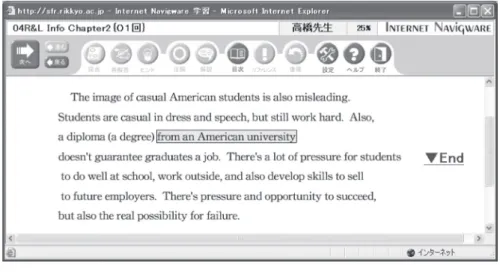
In the process of developing Web-based chunked reading exercises, Fujitsu Internet Navigware Version 7.0 was adopted as a learning management system. FLASH MX 2004 was used in order to highlight each phrase in sequence (see Figure 1). All the reading passages for the Web materials were obtained from the reading section of the required textbook for the R&L course.3) The Web-based materials consisted of the following five components: (1) first timed reading; (2) comprehension questions; (3) explanation; (4) chunked reading practice based on the learners’ most pertinent reading speed (from 80 wpm to 160 wpm, depending on the passages) by following the highlighted phrases one after another; and (5) second timed reading. Learners’ reading speeds were measured based on the number of words read per minute by using a JavaScript timer. During the chunked reading exercises, learners were encouraged to read the materials with a speed higher than their current level of reading speed.4) All the learning logs were stored on the server.
高橋里美 TAKAHASHI Satomi
4. 2. 2. Assessment questionnaires
Based on Schmidt et al. (1996) and Schmidt and Watanabe (2001), a questionnaire was developed to assess learners’ motivation, learning strategies, and instructional preferences, with an independent section established for each. The items included were modified for the EFL context of Japan. New items were added to examine learners’
dispositions to deal with Web-based materials (although they were eventually excluded in the process of factor analysis). There were 47 items in the motivation section; 35 items in the learning strategies section; and 28 items in the instructional preferences section. By preparing three forms of the questionnaire, the presentation order of these three sections in the questionnaire was counter-balanced across the participants. Each questionnaire item was assessed by a five-point rating scale (1 = strongly disagree; 5 = strongly agree).
Furthermore, a questionnaire on Web-based language learning was prepared. This questionnaire aimed to obtain information on the extent to which learners could improve their L2 reading proficiency through the particular Web-based chunked reading exercises (as a self-evaluation). For this purpose, five question items—improvement in learners’
reading comprehension, reading speed, sentence structure ability, listening comprehension, and overall English proficiency—were included. They were considered to be possibly influenced by the development of reading skills in the framework of the current study.5) It should be noted here that learners’ self-evaluation of their L2 improvement is crucial (cf. Brantmeier, 2006; Davis & Lyman-Hager, 1997; Salaberry, 2001).
This is because we can ascertain the effect of our Web materials only through these items on their perceived improvement. One might argue that standardized reading tests should be used in a pretest-posttest design; however, the scores obtained may reflect the
Fig. 1 Excerpt of the chunked reading exercises on the Web.
improvement in reading proficiency as a result of taking up other English courses offered at the university. In fact, other required English courses also provide students with various reading activities throughout the semester.6) Furthermore, this questionnaire was intended to elicit additional information on learners’ attitude toward Web-based learning (eight items).7) A five-point rating scale was provided for the quantitative assessment of each questionnaire item (for the items on improvement in L2 reading: 1 = did not improve at all; 5 = highly improved; for the items on learners’ attitude toward Web-based learning: 1
= strongly disagree; 5 = strongly agree).
4. 3. Procedures
Data were collected during the spring semester of 2004 and 2005. At the beginning of the semester, an orientation was provided to the participants with the aim of the chunked reading practice and the manner of utilizing our Web-based materials. During the course of 12−13 weeks, we met twice a week with 90 minutes for each: one for reading skills and the other for listening skills. The participants were instructed to complete the Web-based chunked-reading exercises as homework assignments outside the class. In addition to the comprehension questions included in our Web materials, additional comprehension questions were provided to the participants in the subsequent reading class, followed by a more detailed explanation by the author and speaking/
writing activities related to the topic of the reading passage. The participants were requested to report their reading time (for first and second timed-reading) via Internet Navigware. In case of some possible technical problems, they were requested to record their reading time on a recording sheet as well. This sheet was to be submitted to the author at the end of the semester.
Toward the end of the semester, the questionnaires on motivation, learning strategies, and instructional preferences were administered to the participants. In the last class, they filled out the questionnaires on Web-based language learning.
4. 4. Data analysis
By employing AMOS 7.0, a confirmatory factor analysis (CFA) using the maximum likelihood method was performed to examine the relationship between the latent variable
“improvement in L2 reading” and its observed indicator variables—improvement in learners’ reading comprehension, reading speed, sentence structure ability, listening comprehension, and overall English proficiency (= the validation of the measurement model for “improvement in L2 reading”) (α = .05). With regard to the four ID variables, following the elimination of outliers from the raw data, exploratory factor analyses (EFAs) were applied to the raw scores for motivation, learning strategies, instructional
高橋里美 TAKAHASHI Satomi
preferences, and attitude toward Web-based learning by using SPSS 14.0J. Specifically, a principal factor analysis with promax oblique rotation was employed to extract the underlying factors. The number of factors was initially determined by examining the scree plot for each ID variable. The minimum loading was set at .40. The validity of the obtained factorial structures was subsequently checked through the CFAs by using AMOS 7.0 (= the validation of the measurement models for the four ID variables) (α = .05).
A hypothesized structural model was constructed within the framework of SEM by using the latent variables obtained from the factor analyses. Based on previous ID research, motivation was treated as an exogenous latent variable and the remaining three ID variables, as endogenous latent variables. All of them were hypothesized to be linked to the criterion variable “improvement in L2 reading.” Path analyses were repeated until the final structural model was obtained by using AMOS 7.0 (α = .05).
5. Results
5. 1. Improvement in L2 reading through Web-based chunked reading exercises
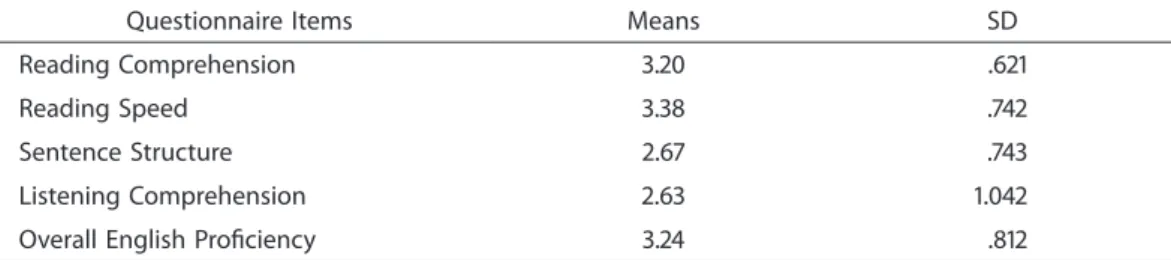
Table 1 indicates the means and standard deviations for the perceived improvement in reading comprehension, reading speed, sentence structure ability, listening comprehension, and overall English proficiency through the Web-based chunked reading exercises. In view of the means of 3.20 or beyond for reading comprehension and reading speed, our Web-based materials were judged as being able to contribute to the development of learners’ reading-specific skills, as originally planned.8) In contrast, learners observed that the improvement with respect to their sentence structure ability and listening comprehension was not significant; however, their overall English proficiency was perceived to be improved to the same extent as their reading comprehension and
Table 1 Means and standard deviations for the questionnaire items for improvement in L2 reading
Questionnaire Items Means SD
Reading Comprehension 3.20 .621
Reading Speed 3.38 .742
Sentence Structure 2.67 .743
Listening Comprehension 2.63 1.042
Overall English Proficiency 3.24 .812
Note: SD = standard deviation
reading speed. Based on these observations, we could overall claim that the Web-based chunked exercises developed for this study were moderately effective.
The CFA was performed in order to validate the relationship between the latent variable “improvement in L2 reading” and the observed variables—improvement in reading comprehension, reading speed, sentence structure ability, listening comprehension, and overall English proficiency. It was found that a relatively low (but significant) path coefficient was obtained for listening comprehension (β = .275, p < .01).
In fact, listening comprehension exhibited a significant (but weak) correlation with reading comprehension only (r = .277, p < .01). Therefore, it was decided to eliminate the path for listening comprehension, and the second CFA was applied to the data for the remaining four observed variables. The results revealed high path coefficients for all the four variables and a relatively good fitness to the data (χ2 (2) = 1.857, n.s.; Goodness of Fit Index (GFI) = .993, Adjusted Goodness of Fit Index (AGFI) = .965) (see Table 2). It should also be noted that the latent variable “improvement in L2 reading” predicted 73% of the variance associated with reading comprehension, 45% of the variance associated with reading speed, 29% of the variance associated with sentence structure ability, and 57% of the variance associated with overall English proficiency. Furthermore, the correlation between the four observed variables was relatively high, as shown in Table 3. Considering
Table 2 Results of the second confirmatory factor analysis for improvement in L2 reading (standardized estimates)
Questionnaire Items (α = .785) Improvement
in L2 Reading 1. I could improve my reading comprehension through the Web-based chunked
reading exercises. (Reading Comprehension) .863
2. I could improve my reading speed through the Web-based chunked reading
exercises. (Reading Speed) .673
3. I could improve my sentence structure ability through the Web-based chunked
reading exercises. (Sentence Structure) .534
4. I could improve my overall English proficiency through the Web-based chunked
reading exercises. (Overall Proficiency) .743
Table 3 Correlation between the observed variables for improvement in L2 reading
1 2 3 4
1. Reading Comprehension 1.000 .594*** .456*** .634***
2. Reading Speed 1.000 .311*** .494***
3. Sentence Structure 1.000 .441***
4. Overall Proficiency 1.000
Note: *** p < .001
高橋里美 TAKAHASHI Satomi
the above, it was concluded that these four variables jointly served as measurement instruments for the latent variable “improvement in L2 reading.”
5. 2. Extraction of underlying factors for ID variables
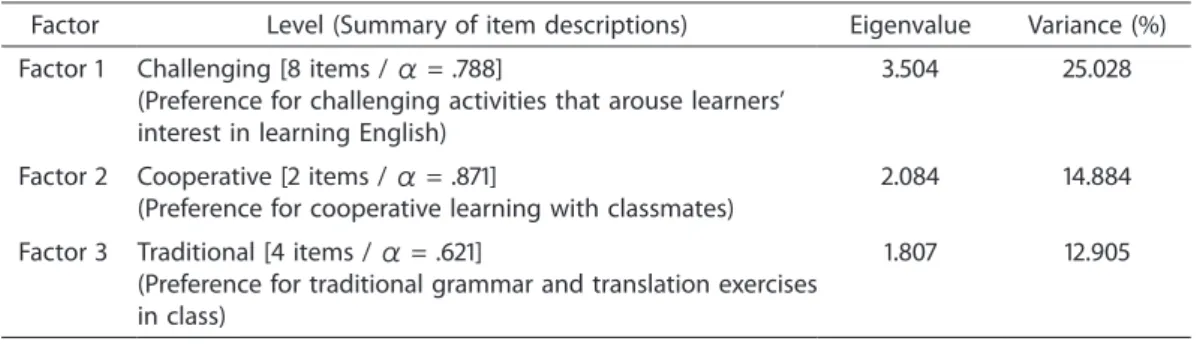
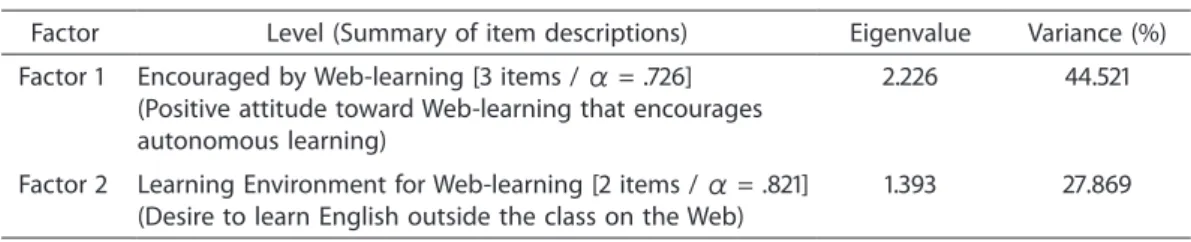
As shown in Tables 4, 5, 6, and 7, the EFAs yielded four factors for motivation (interaction orientation, course orientation, anxiety, competitiveness), three factors for learning strategies (autonomous learning, organized learning, cognitive and metacognitive strategies), three factors for instructional preferences (challenging, cooperative, traditional), and two factors for attitude toward Web-based learning (encouraged by Web-learning,
Table 4 Results of exploratory factor analysis for motivation
Factor Level (Summary of item descriptions) Eigenvalue Variance (%)
Factor 1 Interaction Orientation [13 items / α = .878]
(Active participation in communicative activities in English) 7.650 23.905 Factor 2 Course Orientation [8 items / α = .851]
(Reliance on the course to improve the target skills) 2.890 9.030 Factor 3 Anxiety [6 items / α = .718]
(Anxiety in learning English) 2.641 8.252
Factor 4 Competitiveness [5 items / α = .665]
(Learning English through competition with other students in the course)
2.421 7.565
Table 5 Results of exploratory factor analysis for learning strategies
Factor Level (Summary of item descriptions) Eigenvalue Variance (%)
Factor 1 Autonomous Learning [6 items / α = .805]
(Active search for opportunities to use English) 3.935 32.795 Factor 2 Organized Learning [3 items / α = .751]
(Arrangement of time for learning English) 1.663 13.855
Factor 3 Cognitive and Metacognitive Strategies [3 items / α = .604]
(Cognitive and/or metacognitive ways of learning English) 1.330 11.082
Table 6 Results of exploratory factor analysis for instructional preferences
Factor Level (Summary of item descriptions) Eigenvalue Variance (%)
Factor 1 Challenging [8 items / α = .788]
(Preference for challenging activities that arouse learners’
interest in learning English)
3.504 25.028
Factor 2 Cooperative [2 items / α = .871]
(Preference for cooperative learning with classmates) 2.084 14.884 Factor 3 Traditional [4 items / α = .621]
(Preference for traditional grammar and translation exercises in class)
1.807 12.905
learning environment for Web-learning) (see Appendices A to D for the factor loadings for the questionnaire items, which are available on the website: www.rikkyo.ac.jp/web/
satomit/research2.html).
The subsequent CFAs conducted to examine the validity of the measurement models for the ID variables successfully validated the factorial structures for all the variables, except instructional preferences, by showing a relatively good fitness to the data for each of them. Specifically, the four-factor structure for motivation, the three-factor structure for learning strategies, and the two-factor structure for attitude toward Web-based learning were confirmed with the following goodness-of-fit indices: GFI = .719, AGFI = .677, Comparative Fit Index (CFI) = .721 for motivation; GFI = .908, AGFI = .859, CFI = .933 for learning strategies; and GFI = .988, AGFI = .954, CFI = .999 for attitude toward Web-based learning.
With regard to instructional preferences, the subsequent CFA failed to validate this three-factor structure; the path coefficient for item 22 of the factor “cooperative” was not significant (β = .233, p = .887). Therefore, a further CFA was performed after eliminating this particular factor, and a successful validation was obtained for a two-factor structure (GFI = .910, AGFI = .867, CFI = .907). It was thus concluded that only two factors— challenging and traditional—should be included in the subsequent statistical analysis for this ID variable.
5. 3. Hypothesized structural model
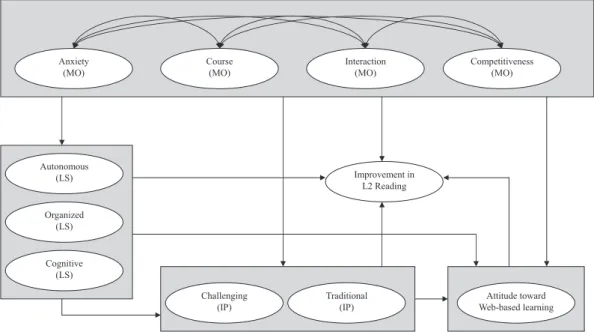
The criterion measure “improvement in L2 reading” and a total of 11 underlying factors identified for the four ID variables were included in the initial hypothesized structural model. The hypothetical causal relationships among the four ID variables were established based on the previous ID research (e.g., Schmidt et al., 1996; Schmidt &
Watanabe, 2001) in the following manner: (1) motivation (four latent variables) has an impact on learning strategies (three latent variables), instructional preferences (two latent variables), and attitude toward Web-based learning (two latent variables); (2) learning strategies influence instructional preferences and attitude toward Web-based learning; and (3) instructional preferences affect attitude toward Web-based learning. These 11 latent
Table 7 Results of exploratory factor analysis for attitude toward Web-based learning
Factor Level (Summary of item descriptions) Eigenvalue Variance (%)
Factor 1 Encouraged by Web-learning [3 items / α = .726]
(Positive attitude toward Web-learning that encourages autonomous learning)
2.226 44.521
Factor 2 Learning Environment for Web-learning [2 items / α = .821]
(Desire to learn English outside the class on the Web) 1.393 27.869
高橋里美 TAKAHASHI Satomi
variables were hypothesized to be linked to the criterion measure “improvement in L2 reading.” Covariance was established between the four latent variables for motivation, as this ID variable was considered as the exogenous latent variable in this study.
This hypothesized model was tested by using AMOS 7.0; however, an inadmissible solution was obtained, which was attributed to item 20 of Factor 2 for attitude toward Web-based learning. Therefore, this particular item was deleted and the remaining item for Factor 2 (item 19) was moved to Factor 1, resulting in the formation of a one-factor structure for this ID variable.9) Factor 1 was then renamed as “attitude toward Web-based learning” based on the name of the ID variable itself. The subsequent CFA validated the relationship between the observed variables and the latent variable “attitude toward Web- based learning,” supporting the one-factor structure for this ID variable (GFI = .989, AGFI = .944, CFI = .988). All the paths for this revised hypothesized model are indicated in Figure 2.
5. 4. Final structural model
The revised hypothesized model, which consisted of 10 latent variables for the four ID variables and the criterion measure “improvement in L2 reading,” was submitted for the hypothesis testing by using AMOS 7.0. A series of path deletions and additions (based on
Anxiety
(MO) Course
(MO) Interaction
(MO) Competitiveness
(MO)
Autonomous (LS)
Organized (LS)
Cognitive (LS)
Traditional (IP) Challenging
(IP) Attitude toward
Web-based learning Improvement in
L2 Reading
Note: MO = motivation; LS = learning strategies; IP = instructional preferences; Course = course orientation;
Interaction = interaction orientation; Autonomous = autonomous learning; Organized = organized learning;
Cognitive = cognitive and metacognitive strategies
Fig. 2 Revised hypothesized model (simplified version).
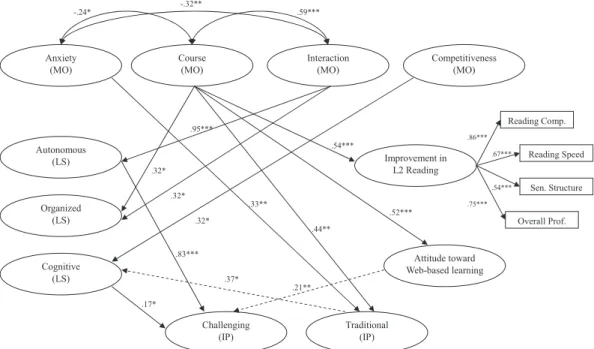
the modification indices) yielded the final structural model as shown in Figure 3. In view of a large number of observed variables (64 in total) involved in this model, a decision was made to rely on the goodness-of-fit statistics of the root mean square error of approximation (RMSEA) alone, which is not influenced by the number of observed variables.10) Based on the RMSEA value of .069, which was well within the recommended range of acceptability (< .05 to .08) (Byrne, 2001), it was concluded that the model indicated a moderately good fit to the data. In this final structural model, 12 paths were found to be significant. They included two data-driven paths drawn from the factor
“attitude toward Web-based learning” to the factor “challenging” (instructional preferences) and from the factor “traditional” (instructional preferences) to the factor “cognitive and metacognitive strategies” (learning strategies).
Four remarkable findings emerged from this final structural model. First, of the 10 latent ID variables, only the motivation factor “course orientation” directly influenced learners’ improvement in L2 reading proficiency by using our Web materials (β = .542, p <
.001). Second, this particular motivation factor also affected learners’ attitude toward Web-
Anxiety
(MO) Course
(MO) Interaction
(MO) Competitiveness
(MO)
Autonomous (LS)
Organized (LS)
Cognitive (LS)
Traditional (IP) Challenging
(IP)
Attitude toward Web-based learning Improvement in
L2 Reading
Reading Comp.
Reading Speed
Sen. Structure
Overall Prof.
.54***
.52***
.44**
.32*
.95***
.32* .33**
.32*
.83***
.17*
.37* .21**
.86***
.67***
.54***
.75***
.59***
-.24* -.32**
Note: *p < .05; **p < .01; ***p < .001. MO = motivation; LS = learning strategies; IP = instructional preferences;
Course = course orientation; Interaction = interaction orientation; Autonomous = autonomous learning;
Organized = organized learning; Cognitive = cognitive and metacognitive strategies
Fig. 3 Final structural model with standardized estimates. The error variances and the observed variables, except the ones for the criterion measure, are not indicated. The data-driven paths are indicated by the dashed arrows.
高橋里美 TAKAHASHI Satomi
based learning (β = .524, p < .001). Third, learners’ attitude toward Web-based learning did not have any impact on the improvement in L2 reading on the Web. Fourth, learners’
attitude toward Web-based learning was directly associated with the instructional preferences factor “challenging” (β = .205, p < .01).
6. Discussion
The significant contribution of the motivational disposition “course orientation”
indicates the possibility that learners who are satisfied with the content of the course and recognize the importance of learning the course materials, irrespective of the formats, are able to improve their reading (and other related) skills using our Web-based materials.
Further, learners who tend to believe that what they learn in this course would help them in other English courses and would take this course even if it were not required can improve their reading proficiency (and overall proficiency) through our Web materials. In fact, in the first meeting of the course, I emphasized that this course aims to improve reading and listening skills that would enable learners to obtain good learning outcomes in the other courses included in our English curriculum. This might particularly arouse the curiosity of learners with the course orientation disposition to intensively learn the course materials, leading them to improve their reading proficiency through our Web materials.
Overall, learners with this motivational disposition appear to prioritize L2 learning with the course materials, and this tendency is contradictory to Warden and Lin’s (2000) argument that required motivation—a motivation to study because the class was required—is necessary for Asian students to yield positive learning outcomes. All of these suggest the following two points: (1) we should clarify the objectives of a course and its significance in relation to the other courses in the curriculum in the first or earlier classes of the course and (2) CALL materials used in a particular course need to be linked with the development of skills in other courses. It should further be noted that the item obtaining the highest loading for this motivational disposition—“It is important to me to learn the course material in this course” (see Appendix A available on the website: www.
rikkyo.ac.jp/web/satomit/research2.html)—may be interpreted in the following manner:
Learners are eager to learn English by using the Web materials because they believe that the course materials decided for use by trusted authorities, i.e., teachers, are effective (Bernaus et al., 2007; Huang, 2006; Iyengar & Lepper, 1999; Littlewood, 1999). This suggests considerable influences of teachers on the development of learners’ attributions (Williams & Burdern, 1999), while this could also be interpreted as a type of halo effect, resulting from teacher authority, which is operative in such a reaction.
Moreover, it is plausible that learners with the course orientation disposition exhibit
positive attitude toward the Web-based learning system. Such learners are more likely to be encouraged by the merits of Web-based materials in that they can learn at their own pace, at any time, and at any place. This attitudinal factor, however, failed to indicate a significant path leading to the criterion measure “improvement in L2 reading.” This suggests that mere encouragement through a novel form of learning may not be sufficient to lead learners to higher learning outcomes (see Davis & Lyman-Hager, 1997 for a similar observation). Needless to say, if we had included other question items in the attitude questionnaires, different results would have been obtained.
One of the data-driven paths in the current structural model also indicates that learners with a more positive attitude toward Web-based learning tend to engage in more challenging activities in and outside the class. It should be noted that the factor “course orientation” is indirectly linked to this “challenging” factor by way of the factor “attitude toward Web-based learning.” Since the course orientation directly influences learners’
reading skill development, there might be a possibility that learners’ preferences for challenging activities directly affect the improvement of their L2 reading proficiency if the current design is applied to a different population.
7. Conclusion
The findings of this study lend support to the claim that CALL activities are not effective for all learners; and the effects of learner characteristics existed in L2 learning through multimedia. Specifically, in the context of this study that employed the moderately effective Web-based materials for the chunked reading strategy, learners who recognized the importance of learning the course materials and those who believed that they can transfer what they learned in this course to other L2 learning contexts were most likely to be able to improve their L2 reading proficiency. In fact, among the 10 ID factors submitted for hypothesis testing in the final structural model, the course orientation alone was directly linked to the criterion measure. Furthermore, in terms of the interaction among the ID factors, the course orientation was found to affect as many as five ID factors: Its direct influence on three ID factors—organized learning (learning strategies), traditional (instructional preferences), and attitude toward Web-based learning;
and its indirect impact on two ID factors—cognitive and metacognitive strategies (learning strategies) by way of traditional, and challenging (instructional preferences) by way of attitude toward Web-based learning and by way of traditional plus cognitive and metacognitive strategies, respectively.
This suggests that the course orientation factor plays a relatively significant and central role not only in L2 CALL but also in ID research in SLA, as a whole. In order to
高橋里美 TAKAHASHI Satomi
conclusively claim that this motivation factor has a significant impact on L2 learning, further studies should be conducted by using a larger sample size and more effective Web-based materials intended for other reading strategies. Inclusion of other ID variables would also be in order. These constant research endeavors alone enable us to obtain a more precise picture of the relationship between ID variables and L2 achievements in technology-enhanced environments.
Acknowledgements
This research was funded by Rikkyo University Special Fund for Research Project, “Development and Use of Collaborative E-Learning Systems to Support Teaching and Learning” (2003−2004), coordinated by Professor Etsuo Kobayashi. I would like to particularly thank Professor Kobayashi, who kindly invited me to participate in this project and provided me with an opportunity to conduct my research reported here.
Notes
1) This strategy is also termed a “chunking/word-combining strategy” (Kern, 1989) or “phrase reading” (Kameyama, 1993) or “parsing sentences into phrasal groups” (Ikeda & Takeuchi, 2006).
2) By using this description, I do not intend to claim that mental translation should be avoided (see Kern, 1994).
3) The required textbook for this course was “Information, Please!” that was developed by the English Language Program of Rikkyo University (2000, Shohakusha, Tokyo).
4) The reading speed of the passages gradually increased with the progress of the course (from Chapter 1 to Chapter 10): the reading speed for Chapters 1− 3 ranged from 80 wpm to 130 wpm and that for Chapters 9 − 10 ranged from 110 wpm to 160 wpm, depending on the learners’ reading ability.
5) An additional item was included, asking which was more effective in improving learners’
reading comprehension, in-class reading activities (using other reading materials) or Web-based chunked reading exercises. However, this item was eliminated from the anal- ysis due to the use of a rating scale with different rating values.
6) The Secondary Level English Proficiency (SLEP) test developed by the Educational Testing Service was administered both at the beginning and at the end of the semester. How- ever, no significant correlation was identified between the significant gains obtained in the test scores and learners’ self-evaluation of the development of their reading skills through the Web-based materials.
7) This questionnaire also included the items for eliciting information on learners’ evalua- tion of the format of the Web-based materials (eight items). They exclusively aimed to improve the materials, and thus data from these items were not analyzed in this study.
8) With regard to reading speed, we compared learners’ reading speed (wpm) for the pas-
sage in Chapter 1 at the beginning of the semester and that for the passage in Chapter 10 at the end of the semester (N = 109). Note that these two passages manifested the same degree of readability (according to Flesch Reading Ease). The results indicated that learners’ reading speed at the end of the semester significantly surpassed that at the beginning of the semester (t(108) = −9.088, p < .001).
9) This procedure was relevant since the correlation between item 22 (Factor 1) and item 19 (Factor 2) was found to be significant (r = .242, p < .001).
10) The goodness-of-fit statistics GFI and AGFI were not employed here as they are influ- enced by the number of observed variables. They do not yield the value .90 when there are more than 30 observed variables.
References
Bell, T. (2001). Extensive reading: Speed and comprehension. The Reading Matrix, 1(1). Available:
http://www.readingmatrix.com/articles/bell/article.pdf.
Bernaus, M., Moore, E., & Azevedo, A. C. (2007). Affective factors influencing plurilingual stu- dents’ acquisition of Catalan in a Catalan-Spanish bilingual context. The Modern Language Journal, 91, 235–246.
Brantmeier, C. (2006). Advanced L2 learners and reading placement: Self-assessment, CBT, and subsequent performance. System, 34, 15–35.
Byrne, B. M. (2001). Structural equation modeling with AMOS. London: Lawrence Erlbaum.
Casteel, C. A. (1989). Effects of chunked reading among learning disabled students: An experi- mental comparison of computer and traditional chunked passages. Journal of Educational Technology Systems, 17(2), 115–121.
Casteel, C. A. (1990). Effects of chunked text-material on reading comprehension of high and low ability readers. Reading Improvement, 27(4), 269–275.
Chang, M-M. (2005). Applying self-regulated learning strategies in a Web-based instruction: An investigation of motivation perception. Computer Assisted Language Learning, 18(3), 217–230.
Chapelle, C. A. (2004). Technology and second language learning: Expanding methods and agendas. System, 32, 593–601.
Chun, D. M., & Payne, J. S. (2004). What makes student click: Working memory and look-up behavior. System, 32, 481–503.
Chun, D. M., & Plass, J. L. (1996). Facilitating reading comprehension with multimedia. System, 24(4), 503–519.
Chun, D. M., & Plass, J. L. (1997). Research on text comprehension in multimedia environments.
Language Learning & Technology, 1(1), 60–81.
Coniam, D., & Wong, R. (2004). Internet relay chat as a tool in the autonomous development of ESL learners’ English language ability: An exploratory study. System, 32, 321–335.
Crooks, G., & Schmidt, R. (1991). Motivation: Reopening the research agenda. Language Learn- ing, 41, 469–512.
高橋里美 TAKAHASHI Satomi Davis, J. N., & Lyman-Hager, M. A. (1997). Computers and L2 reading: Student performance,
student attitudes. Foreign Language Annals, 30(1), 58–72.
Dörnyei, Z. (1990). Conceptualizing motivation in foreign language learning. Language Learn- ing, 40, 46–78.
Dörnyei, Z. (1994). Motivation and motivating in the foreign language classroom. The Modern Language Journal, 78, 273–284.
Dörnyei, Z. (2001). Teaching and researching motivation. Harlow, England: Longman.
Dörnyei, Z. (2003). Attitudes, orientations, and motivations in language learning: Advances in theory, research, and applications. Language Learning, 53, 3–32.
Dörnyei, Z. (2005). The psychology of the language learner: Individual differences in second lan- guage acquisition. London: Lawrence Erlbaum.
Dreyer, C., & Nel, C. (2003). Teaching reading strategies and reading comprehension within a technology-enhanced learning environment. System, 31, 349–365.
Ehrman, M. E., & Oxford, R. L. (1995). Cognition plus: Correlates of language learning success.
The Modern Language Journal, 79, 67–89.
Ehrman, M. E., Leaver, B. L., & Oxford R. L. (2003). A brief overview of individual differences in second language learning. System, 31, 313–330.
Felix, U. (2005). Analysing recent CALL effectiveness research—Towards a common agenda.
Computer Assisted Language Learning, 18(1/2), 1–32.
Fotos, S. (2004). Writing as talking: E-mail exchange for promoting proficiency and motivation in the foreign language classroom. In S. Fotos & C. M. Browne (Eds.), New perspectives on CALL for second language classrooms (pp. 109–129). Mahwah, NJ: Lawrence Erlbaum.
Garcia, T., & Pintrich, P. R. (1994). Regulating motivation and cognition in the classroom: The role of self-schemas and self-regulatory strategies. In D. H. Schunk & B. J. Zimmerman (Eds.), Self-regulation of learning and performance: Issues and educational applications (pp.
127–153). Hillsdale, NJ: Lawrence Erlbaum.
Gardner, R. C. (1985). Social psychology and second language learning: The role of attitudes and motivation. London: Edward Arnold.
Gerrell, H. R., & Mason, G. E. (1983). Computer-chunked and traditional text. Reading World, 22(3), 241–246.
Gettys, S., Imhof, L. A., & Kautz, J. O. (2001). Computer-assisted reading: The effect of glossing format on comprehension and vocabulary retention. Foreign Language Annals, 34(2), 91–106.
Huang, S. (2006). Reading English for academic purposes: What situational factors may moti- vate learners to read? System, 34, 371–383.
Ikeda, M., & Takeuchi, O. (2006). Clarifying the differences in learning EFL reading strategies:
An analysis of portfolios. System, 34, 384–398.
Iyengar, S. S., & Lepper, M. R. (1999). Rethinking the value of choice: A cultural perspective on intrinsic motivation. Journal of Personality and Social Psychology, 76(3), 349–366.
Just, M. A., Carpenter, P. A., & Woolley J. (1982). Paradigms and processes in reading compre-
hension. Journal of Educational Psychology: General, 3(2), 228–238.
Kameyama, T. (1993). Sensu-group ni yoru rikai-kunren wo dankaitekini dounyu shita jugyou no kokoromi: Read-and-Look-up kara Listen-and-Look-up e [A step-by-step introduction of training for comprehending a phrase as a sense unit: From Read-and-Look-up to Lis- ten-and-Look-up]. STEP Bulletin, 5, 51–64.
Kern, R. G. (1989). Second language reading strategy instruction: Its effects on comprehension and word inference ability. The Modern Language Journal, 73, 135–149.
Kern, R. G. (1994). The role of mental translation in second language reading. Studies in Second Language Acquisition, 16(4), 441–461.
Komaba, T., Kawasaki, H., Masubuchi, T., Tsubuki, F., Aizawa, K., Fukuda, T., Iwahara, N., Tezuka, T. (1992). Pasokon ni yoru komyunikeishon no tame no riidingu shido [Computer-based reading lessons to improve learners’ communication abilities]. STEP Bulletin, 4, 88–107.
Littlewood, W. (1999). Defining and developing autonomy in East Asian contexts. Applied Lin- guistics, 20(1), 71–94.
Macaro, E. (2006). Strategies for language learning and for language use: Revising the theo- retical framework. The Modern Language Journal, 90, 320–337.
Manolopoulou-Sergi, E. (2004). Motivation within the information processing model of foreign language learning. System, 32, 427–441.
Noels, K. A. (2001). New orientations in language learning motivation: Toward a contextual model of intrinsic, extrinsic, and integrative orientations and motivation. In Z. Dörnyei &
R. Schmidt (Eds.), Motivation and second language acquisition (Technical Report #23, pp.
43–68). Honolulu, HI: University of Hawai’i, Second Language Teaching and Curriculum Center.
O’Shea, L. J., & Sindelar, P. T. (1983). The effects of segmenting written discourse on the reading comprehension of low- and high-performance readers. Reading Research Quarterly, 18(4), 458–465.
Oxford, R. L. (1996). What have we learned about language learning strategies around the world? In R. L. Oxford (Ed.), Language learning strategies around the world: Cross-cultural perspectives (Technical Report #13, pp. 247–249). Honolulu, HI: University of Hawai’i, Sec- ond Language Teaching and Curriculum Center.
Oxford, R. L., & Nyikos, M. (1989). Variables affecting choice of language learning strategies by university students. The Modern Language Journal, 73, 291–300.
Oxford, R. L., & Shearin, J. (1994). Language learning motivation: Expanding the theoretical framework. The Modern Language Journal, 78, 12–28.
Plass, J. L., Chun, D. M., Mayer, R. E., & Leutner, D. (1998). Supporting visual and verbal learning preferences in a second-language multimedia learning environment. Journal of Educa- tional Psychology, 90(1), 25–36.
Plass, J. L., Chun, D. M., Mayer, R. E., & Leutner, D. (2003). Cognitive load in reading a foreign language text with multimedia aids and the influence of verbal and spatial abilities. Com- puters in Human Behavior, 19, 221–243.
高橋里美 TAKAHASHI Satomi Rifkin, B. (2005). A ceiling effect in traditional classroom foreign language instruction: Data
from Russian. The Modern Language Journal, 89, 3–18.
Salaberry, M. R. (2001). The use of technology for second language learning and teaching: A retrospective. The Modern Language Journal, 85, 39–55.
Schmidt, R., & Watanabe, Y. (2001). Motivation, strategy use, and pedagogical preferences in foreign language learning. In Z. Dörnyei & R. Schmidt (Eds.), Motivation and second lan- guage acquisition (Technical Report #23, pp. 313–359). Honolulu, HI: University of Hawai’i, Second Language Teaching and Curriculum Center.
Schmidt, R., Boraie, D., & Kassabgy, O. (1996). Foreign language motivation: Internal structure and external connections. In R. Oxford (Ed.), Language learning motivation: Pathways to the new century (Technical Report #11, pp. 9–70). Honolulu, HI: University of Hawai’i, Sec- ond Language Teaching and Curriculum Center.
Shimoyama, Y., Isoda, T., & Yamamori, K. (2002). Learner beliefs in language learning in the CALL environment. JALT Journal, 24(2), 155–166.
Son, J-B. (2003). A hypertext approach to foreign language reading: Student attitudes and perceptions. Australian Review of Applied Linguistics, Series S. No. 17: Asian languages and computers, 91–110.
Takahashi, S. (2002). The effects of individual differences on L2 Web-based chat. Rikkyo Univer- sity Journal of Language and the Humanities, 4, 53–90.
Tremblay, P. F., & Gardner, R. C. (1995). Expanding the motivation construct in language learn- ing. The Modern Language Journal, 79, 505–520.
Tozcu, A., & Coady, J. (2004). Successful learning of frequent vocabulary through CALL also benefits reading comprehension and speed. Computer Assisted Language Learning, 17(5), 473–495.
Vinther, J. (2005). Cognitive processes at work in CALL. Computer Assisted Language Learning, 18(4), 251–271.
Warden, C. A., & Lin, H. J. (2000). Existence of integrative motivation in an Asian EFL setting.
Foreign Language Annals, 33(5), 535–547.
Williams, M., & Burden, R. (1999). Students’ developing conceptions of themselves as language learners. The Modern Language Journal, 83, 193–201.
Zapata, G., & Sagarra, N. (2007). CALL on hold: The delayed benefits of an online workbook on L2 vocabulary learning. Computer Assisted Language Learning, 20(2), 153–171.