Fukushima Medical University
福島県立医科大学 学術機関リポジトリ
This document is downloaded at: 2021-11-08T00:24:32Z
Title Roles of RAS and BRAF mutations in thyroid carcinogenesis
Author(s) Fukushima, Toshihiko; Takenoshita, Seiichi
Citation Fukushima Journal of Medical Science. 51(2): 67-75
Issue Date 2005-12
URL http://ir.fmu.ac.jp/dspace/handle/123456789/172
Rights © 2005 The Fukushima Society of Medical Science
DOI
Text Version publisher
Fukushima J. Med. Sci., Vol. 51, No.2, 2005
[Review Article]
ROLES OF RAS AND BRAF MUTATIONS IN THYROID CARCINOGENESIS
TOSHIHIKO FUKUSHIMA and SEIICHI T AKENOSHIT A
Department of Surgery II, Fukushima Medical University School of Medicine,Fukushima, 960-1295, Japan
(Received April 25, 2005, accepted July 6, 2005)
Abstract: Papillary carcinoma and follicular carcinoma are types of differentiated thyroid carcinomas, develop from the same thyroid follicular epithelial cells and show distinct biological behavior. Although several studies have demonstrated differences in the biological characteristics of these carcinomas, little is known about the genetic backgrounds that underlie these differences. The clarification of the genetic background can lead to the understanding of thyroid carcinogenesis, proper therapeutic strategies, and development of the molecular targeting drugs.
Recently, aberrant activation of RAS-RAF - MEK - MAP kinase signaling pathway is frequently found in thyroid carcinoma. The pathway transmits a mitogenic signal to the nucleus, and constitutive activation of the pathway is thought to promote uncontrolled cell division. In our series, BRAF mutation was detected exclusively in papillary carcinoma (54%), and was exclusively V599E (a single nucleotide change of A - T at nucleotide 1796). NRAS mutation was observed in follicular carcinoma (50%) and in anaplastic carcinoma (28%), and was exclusively Q61R (a single nucleotide change of A -G at nucleotide 182). No mutations were found in KRAS or HRAS.
In this chapter, we explain the role of RAS-RAF-MEK-MAP kinase pathway in carcinogenesis of the thyroid and its clinical implication based on our study. In addition, we review the current knowledge in this field.
Key words: BRAF, RAS, papillary thyroid cancer, follicular thyroid cancer, MAP kinase pathway
:ffliJiM~i!it, t'r~r~-
Correspondence to: Toshihiko Fukushima, Department of Surgery II, Fukushima Medical University School of Medicine, Fukushima City 960-1295, Japan.
Dr. Toshihiko Fukushima received the 2004 Fukushima Society of Medical Science Young Researcher A ward.
67
68
T. FUKUSHIMA et al.INTRODUCTION
Papillary carcinoma and follicular carcinoma are types of differentiated thyroid cancers that are thought to arise from thyroid follicular epithelial cells. They account for 95% of all thyroid cancers and are classified into papillary and follicular cancers. In Japan, 80 and 20% of differentiated thyroid cancers are papillary and follicular cancers, respectively. They are known to differ biologically as follows:
papillary cancers metastasize
frequen~lyto regional lymph nodes but rarely to distant sites, whereas follicular cancers metastasize rarely to regional lymph nodes but relatively frequently to distant sites such as the lungs and bones. However, knowledge on the molecular biological mechanisms in these differences and causing transformation of thyrocytes into papillary or follicular phenotypes is scarce!).
The RAS and RAF proteins are components of RAS-RAF-MEK-Mitogen- activated protein kinase (MAPK) pathway. The pathway transmits an extracel- lular mitogenic signal to the nucleus. Aberrant activation of this pathway is frequently found in human cancers, particularly in adenocarcinomas, and is thought to promote uncontrolled cell division. The RAS mutations found in tumors produce constitutively active RAS proteins. Papillary carcinoma and follicular carcinoma of the thyroid, both of which are adenocarcinomas, exhibit RAS mutations at a rate of 5 to 30%2l. RAF proteins are serine/threonine kinases that are located down- stream of RAS in the signaling pathway. Recently, point mutations of the BRAF gene were reported in 60% of melanomas and at lower rates in lung, colon, and ovarian cancers
3 -sl. BRAF abnormalities in papillary thyroid cancers were report-·
ed with frequencies as high as 30-60%, having a great impact on investigations of thyroid cancers
6 -10l.
In this review, we discuss the role of RAS and BRAF mutations in the thyroid carcinogenesis.
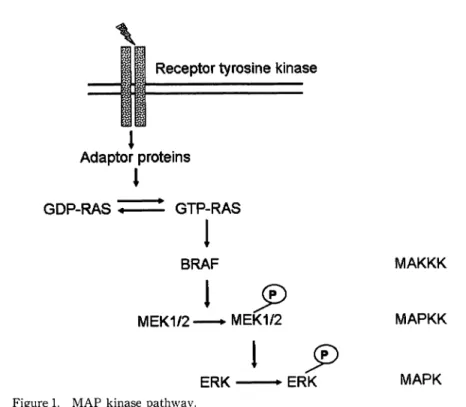
ROLES OF RAS AND BRAF PROTEIN IN THE INTRACELLULAR SIGNAL TRANSDUCTION (FIGUREl)
The extracellualr signals bind first to receptors on the cell surface. These receptors, such as the platelet-derived growth factor receptor, the epidermal growh- th factor receptor, and the fibroblast growth factor receptor, are the receptor-type tyrosine kinase with an intracellular tyrosine kinase domain, which bind to the ligand to form a dimer resulting in phosphorylation of tyrosine residues each other.
The self-phosphorylated receptors bind to various adaptor molecules to activate the
small G protein RAS by catalyzing replacement of GDP with GTplll. When RAS
is activated, RAF translocates from the cytosol to the cell membrane. The active
GTP-bound RAS binds to the RAS-binding domain of RAF protein, resulting in
activation of RAF protein by changing its conformation12l. Activated RAF proteins
BRAF MUTATIONS IN THYROID CANCER
Receptor tyrosine kinase
Adaptor proteins 1 1
GDP-RAS ;:. =~ GTP-RAS
1
BRAF MAKKK
1!fJ
MEK1/2 - MEK1/2 MAPKK
1 !fJ
ERK
IERK MAPK
Figure 1. MAP kinase pathway.
Growth factor binds to receptor. These signals transduce through the activation of RAS protein, which leads to activation BRAF, and then to activation MAPK kinase. Then MAPKK phosphorylates MAPK. It is this sequential phosphor- ylation of BRAF, MEK and ERK that is called the MAP kinase cascade.
69
phosphorylate serine and/or threonine residues in the kinase domain of MAP kinase kinase, such as MEKI/2. Activated MEKs phosphorylate tyrosine and threonine residue in the kinase domain of MAP kinase, known as extracelluar signal regulated kinase (ERK). Activated MAPK is known to ultimately promote progression of the cell cycle from the Gl to S phase by regulating transcription of immediate early genes such as c-fos, promoting cyclin Dl transcription and activating the cyclin- dependent kinase CDK4/6. In this way, growth stimuli are transmitted from the cell membrane to the cytosol, and this cascade controls cell growth, differentiation and survival.
RAS AND BRAF MUTATIONS IN THYROID CARCINOGENESIS
Mammals have three kinds of RAS genes, HRAS, KRAS, and NRAS, each of
which codes a 21-kD GTP-binding protein (small G protein). RAS is localized in
the cell membrane, functioning as a switch protein that controls the transduction of
signals from growth factor receptors. Like other G proteins, the small G protein
exists as an active GTP-binding form or inactive GDP-binding form, and has
GTPase activity. In normal cells, upstream signals convert RAS from the inactive
70 T. FUKUSHIMA et at.
GDP-binding form to the active GTP-binding form
II).This reaction is promoted by guanine nucleotide exchange factor (GEF). Binding of GTPase-activating protein (GAP) to active GTP-RAS enhances GTPase activity, and GTP-RAS undergoes hydrolysis to become inactivatedli). Many of the RAS point mutations found in cancers are miss-sense mutations at codons 12, 13, and 61
13).Since these mutations reduce the GTPase activity of RAS, levels of GTP-RAS form becomes predominant, activating the downstream MAPK cascade.
The frequencies of RAS mutations in thyroid cancer greatly vary according to reports and have been suggested as being 0-50% in papillary cancers, 14-62% in follicular cancers, 0-60% in undifferentiated cancers, and 0-85% in follicular adenomas. Many studies on the spectrum of mutations have reported that muta- tions are common in codon 61 of HRAS and NRAS, being rare in other codons
I4 •15).PCR-direct sequencing of our series showed mutation rates of 0 in 80 papillary cancers, 4 (50%) in 8 follicular cancers, and 2 (33%) in 6 undifferentiated cancers; all were NRAS Q61R mutations.
The Raf gene was first identified as a murine protooncogene. RAF genes are found in various eukaryotes including Caenorhabditis elegans, Drosophila melanogaster, Xenopus laevis, chickens, mice, rats and humans_ Its human homologs ARAF, BRAF, and RAF -1 (CRAF) have been cloned. The BRAF gene is located on chromosome 7q34, and has a genomic DNA size of about 190 kb, consist- ing of 18 exons
I6 ).These three RAFs contain three conserved regions, CRl, CR2, and CR3l7). CRI contains a GTP-RAS binding domain and cysteine-rich domain that form a zinc finger structure, and is considered important for activation of RAF by RAS binding. CR2 is rich in serine/threonine residues, of which S364 is a regulatory phosphorylation site and CR3 is a kinase domain with the highest homology. S445, D448, T598, and S601 are regulatory phosphorylation sites; the former two correspond to exon 11, and the latter two are present in the region called the activation segment, corresponding to exon 15. The phosphorylation of T598 and S60l plays a central role in the activation of BRAf1
8 ).In 2002, BRAF mutations were reported in 66% of malignant melanomas
3 ).Later, BRAF mutations were also confirmed in 1-3% of lung cancers and 5% of
5601
- - CR3 -
RAS binding domain G-Ioop Activation segment
Kinase domain Figure 2. Domain structure of the BRAF.
Phosphorylation of S364, S445. D448, T598 and S601 are important for the regula- tion of activation.
BRAF MUTATIONS IN THYROID CANCER TACAGTGAAATI
80 90
1\
J V I \
Corresponding normal tissue Figure 3. Mutations in the BRAF gene.
TACAGHGAAAT 80
Papillary thyroid cancer Sequence electropherogram from tumor DNA shows a heterozygous missense mutation (T1796A/V599E). Nucleotide sequence in the corresponding normal tissue shows a wild type.
71
colorectal cancers
3 - S).Eighty-nine percent of the BRAF mutations detected in these cases were present in the activation segment, and 90% were V599E mutations.
In addition, V599D, L596V, L596R, and F594L mutations were observed, although at low frequencies
3 ).Eleven percent of BRAF mutations are found in glycine residues (G463, G465, and G468) in the G-loop of the N-terminallobe of the kinase domain;
therefore, exons 11 and 15 are hot spots for BRAF mutations.
Many studies, including ours, have reported BRAF mutations in thyroid can-
cers
6 - 1O).We analyzed 114 thyroid tumors (80 papillary carcinomas, 8 follicular
carcinomas, 7 undifferentiated carcinomas, 9 medullary carcinomas, and 10 follicular adenomas) for BRAF mutations in exons 11 and 15 using peR-sequencing. Of 80 papillary carcinoma, 43 (54%) had heterozygous mutations gene at codon 599 (V599E) resulting from a T to A change at nucleotide 1796 (T1796A) (Figure 3).
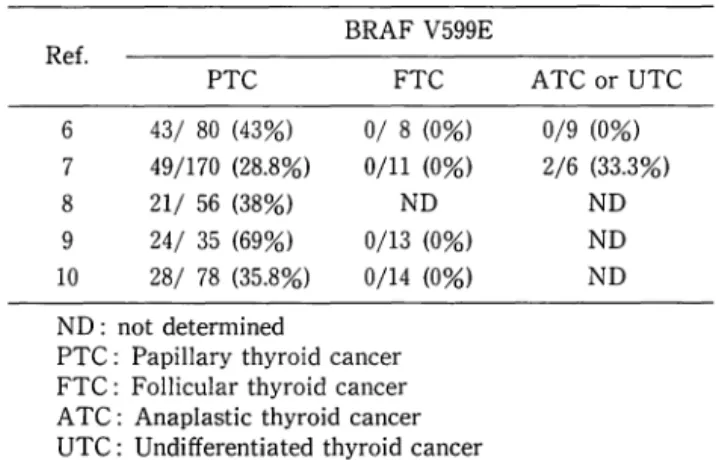
BRAF mutations were not observed in other types of thyroid carcinoma. Other studies have also reported BRAF mutations, exclusively V599E, in 29-69% of papillary carcinomas, but not in follicular carcinomas or adenomas (Table 1).
The valine at codon 599 of the BRAF gene is located in the evolutionarily
conserved activation segment of the kinase domain. An amino acid change from
valine to glutamic acid (V599E) is thought to produce a negative charge, which
mimics phosphorylation of the regulatory phosphorylation sites T588 and S60l,
resulting in elevated kinase activity
3.18).Indeed, the basal kinase activity of the
V599E mutant of BRAF has been shown to be elevated in cos cells that can trans-
form NIH3T3 cells
3 ).These findings suggest that BRAF V599E mutations activate
72 T. FUKUSHIMA et al.
Table l. Prevalence of BRAF mutation in thyroid cancer BRAF V599E
Ref.
PTC FTC
6 43/ 80 (43%) 0/ 8 (0%) 7 49/170 (28.8%) 0/11 (0%)
8 21/ 56 (38%) ND
9 24/ 35 (69%) 0/13 (0%) 10 28/ 78 (35.8%) 0/14 (0%) ND: not determined
PTC: Papillary thyroid cancer FTC: Follicular thyroid cancer A TC: Anaplastic thyroid cancer UTC: Undifferentiated thyroid cancer
ATC or UTC 0/9 (0%) 2/6 (33.3%)
ND ND ND
the MAP kinase cascade, thereby playing an important role in the carcinogenesis of papillary thyroid carcinomas.
In our series and other studies, no cases of simultaneous BRAF and RAS mutations were found. In addition, it has been reported that the microinjection of RAS-neutralizing antibody does not inhibit the proliferation of cells with the V599E BRAF mutation
3 ).These results suggest that activation of the MAP kinase path- way does not depend on RAS mutations; this is even the case in thyroid cancer cells with BRAF mutations.
Thyroid stimulating hormone (TSH) stimulates the proliferation of thyroid follicular epithelial cells and differentiated thyroid cancer cells. TSH receptors are G-protein-coupled receptors, and binding of TSH to the receptors elevates intracel- lular cAMP levels to promote proliferation
I9 ).This cAMP-dependent mitogenic pathway is known to activate BRAp
O).The same scheme applies to melanocyte- stimulating hormone and the melanocortin receptor
21),where binding increases the intracellular cAMP level and activates BRAF. In both melanoma and papillary carcinoma of the thyroid, increased BRAF activity due to the V599E mutation may simulate the mitogenic signal transmitted from the receptors, and thus may explain why BRAF mutations occur at higher rates in these cancers than in other cancers.
RET
jPTCrearrangement is a genetic abnormality that is known to occur in 5- 30% of papillary thyroid carcinomas
22 ).Since there have been no reported cases of simultaneous RET
jPTCrearrangement and BRAF mutation, these two genetic abnormalities are considered to be abnormalities with independent pathways
23).The detection rate of RET
jPTCrearrangement was higher (40%) and the preva-
lence of BRAF mutations was lower (12%) in papillary thyroid carcinomas after the
Chernobyl nuclear plant accident than in sporadic counterparts
24 ).A recent study
reported that 11% of patients who developed radiation-induced thyroid cancer soon
(5-6 years) after radiation, had BRAF rearrangement involving para centric inver-
sion of chromosome 7q.
Ithas been shown that BRAF rearrangement results from
BRAF MUTATIONS IN THYROID CANCER 73
in-frame fusion between exons 1-8 of the A-kinase protein 9 (AKAP9) gene and exons 9-18 of the BRAF gene, and that the fusion protein increases kinase activity
25).These findings suggest that BRAF is the target of genetic abnormalities in both radiation-induced and sporadic cases, and that activation of the MAPK cascade plays an extremely important role in the carcinogenesis of papillary thyroid car- cinoma.
THE APPLICATION FOR THE THYROID CANCER THERAPY
BRAF mutations are found at high frequency in papillary thyroid carcinomas, and appear to be involved in carcinogenesis; therefore, BRAF is a promising target for molecular targeted drugs. Bis-aryl urea has been confirmed to inhibit Raf activity in vitro and in mouse xenografts, and clinical trials using melanomas are in progress
26 ).Triarylimidazole has also been confirmed to inhibit Raf activity in hematopoietic celllines27). The therapeutic effects of these compounds on papillary thyroid carcinoma are awaited with interest.
CONCLUSION
In our study, BRAF mutations were detected exclusively in papillary cancers (43 in 80 cases: 54%), and were exclusively V599E. Our results suggest that BRAF mutation may play a critical role in carcinogenesis of papillary carcinoma of thyroid. However, how BRAF mutations induce changes in downstream signal transduction and expression of target genes, and how these changes are ultimately involved in carcinogenesis remain unknown. Similarly, the mechanism by which papillary cancers develop without BRAF mutations requires clarification. Clues to the answers to these questions might be found in the profile provided by mutational analysis of other factors involved in the MAPK cascade and by comprehensive analysis of the transcriptome and proteotome; however, the details need clarified in further studies.
REFERENCES
1. Pierotti MA, Bongarzone I, Borello MG, Greco A, Pilotti S, Sozzi G. Cytogenetics and molecular genetics of carcinomas arising from thyroid epithelial follicular cells. Genes Chromosomes Cancer, 16: 1-14, 1996.
2. Sugg SL, Ezzat S, Zheng L, Freeman JL, Rosen lB, Asa SL. Oncogene profile of papillary thyroid carcinoma. Surgery, 125: 46-52, 1999.
3. Davies H, Bignell GR, Cox C, Stephens P, Edkins S, Clegg S, Teague J, Woffendin H, Garnett MJ, Bottomley W, Davis N, Dicks E, Ewing R, Floyd Y, Gray K, Hall S, Hawes R, Hughes J, Kosmidou V, Menzies A, Mould C, Parker A, Stevens C, Watt S, Hooper S, Wilson R, Jayatilake H, Gusterson BA, Cooper C, Shipley J, Hargrave D, Pritchard- Jones, Maitland N, Chenevix-Trench G, Riggins GJ, Bigner DD, Palmieri G, Cossu A.
Flanagan A, Nicholson A, Ho JW, Leung SY, Yuen ST, Weber BL, Seigler HF, Darrow
74 T. FUKUSHIMA et al.
TL, Paterson H, Marais R, Marshall CJ, Wooster R, Stratton MR, Futreal PA.
Mutations of the BRAF gene in human cancer. Nature (Lond.), 417: 949-954, 2002.
4. Naoki K, Chen TH, Richards WG, Sugarbaker DJ, Meyerson M. Missense mutations of the BRAF gene in human lung adenocarcinoma. Cancer Res, 62: 7001-7003, 2002.
5. Yuen ST, Davies H, Chan TL, Ho JW, Bignell GR, Cox C, Stephens P, Edkins S, Tsui WW, Chan AS, Futreal PA, Stratton MR, Wooster R, Leung SY. Similarity of the phenotypic patterns associated with BRAF and KRAS mutations in colorectal neoplasia.
Cancer Res, 62: 6451-6455, 2002.
6. Fukushima T, Suzuki S, Mashiko M, Ohtake T, Endo Y, Takebayashi Y, Sekikawa K, Hagiwara K, Takenoshita S. BRAF mutations in papillary carcinomas of the thyroid.
Oncogene, 22: 6455-6457, 2003.
7. Namba H, Nakashima M, Hayashi T, Hayashida N, Maeda S, Rogounovitch TI, Ohtsuru A, Saenko VA, Kanematsu T, Yamashita S. Clinical implication of hot spot BRAF mutation, V599E, in papillary thyroid cancers. J Clin Endocrinol Metab, 88: 4393-4397, 2003.
8. Xu X, Quiros RM, Gattuso P, Ain KB, Prinz RA. High prevalence of BRAF gene mutation in papillary thyroid carcinomas and thyroid tumor cell lines. Cancer Res, 63 : 4561-4567, 2003.
9. Cohen Y, Xing M, Mambo E, Guo Z, Wu G, Trink B, Beller U, Westra WH, Ladenson PW, Sidransky D. BRAF mutation in papillary thyroid carcinoma. J Natl Cancer Inst, 95: 625-627, 2003.
10. Kimura ET, Nikiforova MN, Zhu Z, Knauf JA, Nikiforov YE, Fagin JA. High preva·
lence of BRAF mutations in thyroid cancer: genetic evidence for constitutive activation of the RET/PTC-RAS-BRAF signaling pathway in papillary thyroid carcinoma.
Cancer Res, 63: 1454-1457, 2003.
11. Robinson MJ. Cobb MH. Mitogen-activated protein kinase pathways. Curr Opin Cell Bioi, 9: 180-186, 1997.
12. Marshall M. Interactions between Ras and Raf: key regulatory proteins in cellular transformation. Mol Reprod Dev, 42: 493-499, 1995.
13. Bos JL. Ras oncogenes in human cancer: a review. Cancer Res, 1989, 49: 4682-4689, (Review). Erratum in: Cancer Res, 50: 1352, 1990.
14. Zhang BH, Guan KL. Activation of B-Raf kinase requires phosphorylation of the conserved residues Thr598 and Ser601. EMBO J. 19: 5429-5439, 2000.
15. Learoyd DL, Messina M, Zedenius J, Robinson BG. Molecular genetics of thyroid tumors and surgical decision-making. World J Surg, 24: 923-933, 2000.
16. Sithanandam G, Druck T, Cannizzaro LA, Leuzzi G, Huebner K, Rapp UR. B-raf and a B-raf pseudogene are located on 7q in man. Oncogene, 7: 795-759, 1992.
17. Stephens RM, Sithanandam G, Copeland TD, Kaplan DR, Rapp UR, Morrison DK. 95- kilodalton B-Raf serine/threonine kinase: identification of the protein and its major autophosphorylation site. Mol Cell Bio, 12: 3733-3742, 1992.
18. Zhang BH, Guan KL. Activation of B-Raf kinase requires phosphorylation of the conserved residues Thr598 and Ser601. EMBO J, 19: 5429-5439, 2000.
19. Ledent C, Parmentier M, Maenhaut C, Taton M, Pirson I, Lamy F, Roger P, Dumont JE.
The TSH cyclic AMP cascade in the control of thyroid cell proliferation: the story of a concept. Thyroido!ogy, 3: 97-101, 1991.
20. Busca R, Abbe P, Mantoux F, Aberdam E, Peyssonnaux C, Eychene A, Ortonne JP, Ballotti R. Ras mediates the cAMP-dependent activation of extracellular signal- regulated kinases (ERKs) in melanocytes. EMBO J, 19: 2900-2910, 2000.
21. Halaban R. The regulation of normal melanocyte proliferation. Pigment Cell Res, 13 : 4-14, 2000.
22. Viglietto G, Chiappetta G, Martinez-Tello FJ, Fukunaga FH, Tallini G, Rigopoulou D, Visconti R, Mastro A, Santoro M, Fusco A. RET /PTC oncogene activation is an early event in thyroid carcinogenesis. Oncogene, 11: 1207-1210, 1995.
BRAF MUTATIONS IN THYROID CANCER 75 23. Soares P, Trovisco V, Rocha AS, Lima J, Castro P, Preto A, Maximo V, Botelho T, Seruca R, Sobrinho-Simoes M. BRAF mutations and RET /PTC rearrangements are alternative events in the etiopathogenesis of PTe. Oncogene, 22: 4578-4580, 2003.
24. Lima J, Trovisco V, Soares P, Maximo V, Magalhaes
J.
Salvatore G, Santoro M, Bogdanova T, Tronko M, Abrosimov A, Jeremiah S, Thomas G, Williams D, Sobrinho- Simoes M. BRAF mutations are not a major event in post-Chernobyl childhood thyroid carcinomas. J Clin Endocrinol Metab, 89: 4267-4671, 2004.25. Ciampi R, Knauf JA, Kerler R, Gandhi M, Zhu Z, Nikiforova MN, Rabes HM, Fagin JA, Nikiforov YEo Oncogenic AKAP9-BRAF fusion is a novel mechanism of MAPK pathway activation in thyroid cancer. J Clin Invest, 115: 94-101, 2005.
26. Lyons JF, Wilhelm S, Hibner B, Bollag G. Discovery of a novel Raf kinase inhibitor.
Endocr Relat Cancer, 8: 219-225, 2001.
27. Shelton JG, Moye PW, Steelman LS, Blalock WL, Lee JT, Franklin RA, McMahon M, McCubrey JA. Differential effects of kinase cascade inhibitors on neoplastic and cyto- kine-mediated cell proliferation. Leukemia, 17: 1765-1782,2003.