• 検索結果がありません。

Study of a constrained hyperbolic free boundary problem involving fluid motion based on variational approach and particle method

N/A
N/A
Protected

Academic year: 2021

シェア "Study of a constrained hyperbolic free boundary problem involving fluid motion based on variational approach and particle method"

Copied!
9
0
0

読み込み中.... (全文を見る)

全文

(1)

Study of a constrained hyperbolic free

boundary problem involving fluid motion based on variational approach and particle method

著者 グエン トリ コン

著者別表示 Nguyen Tri Cong journal or

publication title

博士論文要旨Abstract 学位授与番号 13301甲第3950号

学位名 博士(理学)

学位授与年月日 2013‑09‑26

URL http://hdl.handle.net/2297/37355

(2)

Abstract

In this thesis, we study hyperbolic problem with volume preservation, where a free

boundary appears. This problem can be obtained by examining the motion of a

droplet on plane. In this phenomenon, the drop is divided into two interacting

parts: a film representing the surface of the drop, and the fluid inside. The motion

of the liquid is described by equation of fluid dynamics (Euler equations). The film,

which determines a (moving) boundary for the liquid inside, is considered to be the

graph of a scalar function. Free boundary, volume constraint and contact angle are

three main features of the model of the film. The underlying surface, on which

the droplet rests, plays the role of an obstacle to the motion and gives rise to free

boundary. Moreover, the volume preservation constraint is obtained from assump-

tion that the volume of the drop does not change. Finally, there is a positive contact

angle on the boundary of the region where the drop touches the surface. The hy-

perbolic free boundary problem with volume conservation constraint is solved by

discrete Morse flow method. Moreover, a model taking into account both the sur-

face and the liquid body is solved by combining discrete Morse flow and smoothed

particle hydrodynamics method.

(3)

1 Introduction

In this work, the content follows: in Section 2, we derive governing equation of motion of film representing the surface of the droplet. In the next section, we use discrete Morse flow to construct an approximation solution to the governing equation (hyperbolic free boundary problem with volume conservation constraint).

Then, we introduce the couple model which combines the above governing equa- tion with Euler equations for the fluid inside film as shown in Section 4. Section 5 presents some numerical results for the moving of a droplet on the plane and inclined plane.

2 The model of film

In this work, θ ≤ 90 0 is our consistent consideration. Then we can describe the surface as a scalar function u : (0, T ) × Ω → R, where (0, T ) is the time interval and Ω is the domain where the motion is considered. The surface, on which the drop rests, plays the role of an obstacle. The boundary of the set {u > 0} is the free boundary.

The film model equation is derived based on Hamilton’s principle. Adopting a basic form of surface energy, the action of the film is written as

J(u) = Z T

0

Z

σ

2 u 2 t χ u>0 − γ g

2 |∇u| 2 − R 2 χ ε (u) − 1

2 ρgu 2 χ u>0 dxdt,

Here σ is area density of the surface, γ g and R 2 describe the surface tension prop- erties of the material, ρ is the fluid density, χ u>0 is the characteristic function of the set {u > 0}, and χ ε (u) ∈ C 2 (R) is a smoothing of χ u>0 .

Searching for its stationary points, first variation gives

χ u>0 σu tt = γ g ∆ u − ρguχ u>0 − R 2 χ 0 ε (u) + λ. (1) where

λ = 1 V

Z

γ g |∇u| 2 + ρgu 2 χ u>0 + R 20 ε (u) + σu tt uχ u>0

dx.

In the case of a droplet on inclined plane with angle α, above equation becomes χ u>0 σu tt = γ g ∆ u − f χ u>0 − R 2 χ 0 ε (u) + λ, (2) where f = ρg(u cos θ − x 1 sin θ), here x 1 is the horizontal axis, and

λ = 1 V

Z

γ g |∇u| 2 + ρg(u 2 cos α − ux 1 sin α)χ u>0 + R 20 ε (u) + σu tt uχ u>0

dx.

(4)

3 Numerical method

In this content, we use discrete Morse flow method to construct an approximation solution to equation of film motion.

First, we fix a large number N > 0, determine the time step h = T/N and consider the approximate shapes of the film u n at time levels t n = nh, n = 0, 1, 2, .., N. The shape u 0 is given as the initial condition u(0, x) and u 1 can be approximated using u 0 and initial velocity as u 1 = u 0 + v 0 h, here v 0 = u t (0, x). The approximate solution u n on further time levels t = nh for n = 2, 3, .., N, to be the minimizer of the following functional

J n (u) = Z

Ω σ |u − 2u n−1 + u n−2 | 2

2h 2 χ u>0 + γ g

2 |∇u| 2 + R 2 χ ε (u) + ρgu 2 χ u>0

!

dx. (3) in the admissible set

K : = n

u ∈ H 0 1 ( Ω );

Z

Ω uχ u>0 = V o

Calculating the first variation of J n under volume conservation condition, we find that minimizers of the functional J n construct an approximation solution to (1).

In order to obtain a minimizer u n , n = 2, 3, .., N of functional J n (u) we use mini- mizing algorithm following:

1. Set up initial condition u 0 , v 0 , and we have u 1 = u 0 + hv 0 , 2. For n = 1, 2, .., N, determine u n +1 using the following procedure:

(a) a 1 = u n

(b) For k = 1, 2, .., K n

i. compute the gradient p k = 5 u J n (a k ),

ii. search for minimizer (using the steepest descent method and bi- section method) e a k + 1 of J n in the direction − p k ,

iii. e a k +1 = max( e a k +1 , 0)

iv. project a k + 1 on the volume-constraint hyperplane: a k + 1 = P( e a k + 1 ), v. if |J n (a k ) − J n (a k + 1 )| < ξ then K n = k + 1 else k = k + 1

(c) u n + 1 = a K

n

In this algorithm, the J n (a k ) is calculated by using finite element method for space

discretization. Furthermore, minimizers are determined by the steepest descent

method combined with bisection method (step ii).

(5)

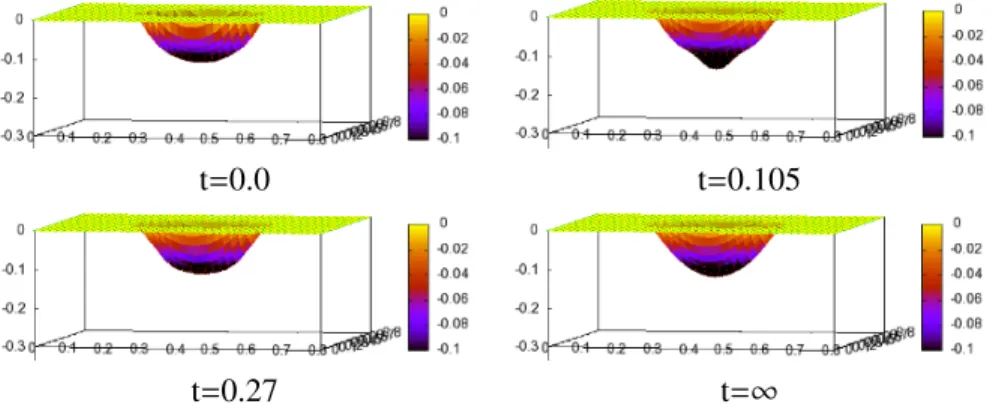
Taking as an example, we consider the behaviour of the film of a droplet pinned by the solid surface (Figure.1). We use equation (1) with the parameter as

σ = 1, γ g = 1, ρ = 1, R 2 = 1.2, ε = 0.03, h = 7.5 × 10 −4 and this example is calculated under Dirichlet boundary condition.

t=0.0 t=0.105

t = 0.27 t = ∞

Figure 1: A droplet hanging on the plane.

4 Couple model

In this part, we consider a couple model which combines the motion of film with fluid motion inside film.

From the assumption, the domain of fluid flow is given as:

Ω f (t) = {( x 1 , x 2 , z) ∈ R 3 ; z ∈ (0, u( x 1 , x 2 ))} (4) In this domain, we propose the motion of fluid following the equations:

Conservation of mass Dρ

Dt + ρ∇.v = 0, in ∪ t∈(0,T) Ω f (t) × {t}, (5)

Conservation of momentum Dv

Dt = − 1

ρ ∇P + g, in ∪ t∈(0,T) Ω f (t) × {t}, (6)

where v is the velocity, P is the pressure and g is the gravitation force.

The pressure is determined by

P = c 2 (ρ − ρ 0 )

(6)

where c is the artificial sound speed and ρ 0 is the reference density.

In order to achieve the model of the droplet motion, we consider one more outer force against the surface - the pressure force pushing the film from the inside.

The pressure force per unit area is written as Pn, where

n = 1

p 1 + |∇u| 2

(−u x

1

, −u x

2

, 1)

is the unit outer normal vector of the surface. Therefore, P(x, u, t) is the net force which is applied to the film. Thus, the equation (2) becomes

χ u>0 σu tt = γ g ∆ u − f χ u>0 − R 2 χ 0 ε (u) + λ, (7) where f = ρg(u cos θ − x 1 sin θ) − P| z = u , and

λ = 1 V

Z

γ g |∇u| 2 + ρg(u 2 cos α−ux 1 sin α)χ u>0 −uP| z = u + R 20 ε (u)+ σu tt uχ u>0 dx.

For the fluid flow, we impose v = 0 on the plane z = 0, v(x, u, t) = (0, 0, u t ) on the film z = u(x 1 , x 2 ).

In summary, a model of the droplet motion is given as

χ u>0 σu tt = γ g ∆ u − f χ u>0 − R 2 χ 0 ε (u) + λ, in Ω × (0, T ), (8) Dρ

Dt = −ρ∇.v, in ∪ t∈(0,T) Ω f (t) × {t}, (9) Dv

Dt = − 1

ρ ∇P + g, in ∪ t∈(0,T) Ω f (t) × {t}, (10)

P = c 2 (ρ − ρ 0 ), in ∪ t∈(0,T) Ω f (t) × {t}, (11)

v| z = 0 = 0, v| z = u (x, u, t) = (0, 0, u t ). (12) The whole system is solved by combining discrete Morse flow with smooth particle hydrodynamic method. At each time level t = nh, we have u n , x n , and v n , from which we can find the new shape u n +1 of the film and the new position x n +1 of the fluid as follows:

1. Predict the shape of film u using the discrete Morse flow method without pressure force.

2. Determine position x n + 1 and pressure P n + 1 under region below u , using smoothed particle hydrodynamics method.

3. Determine the new shape u n + 1 of the film, using the discrete Morse flow

method with pressure force.

(7)

5 Numerical result

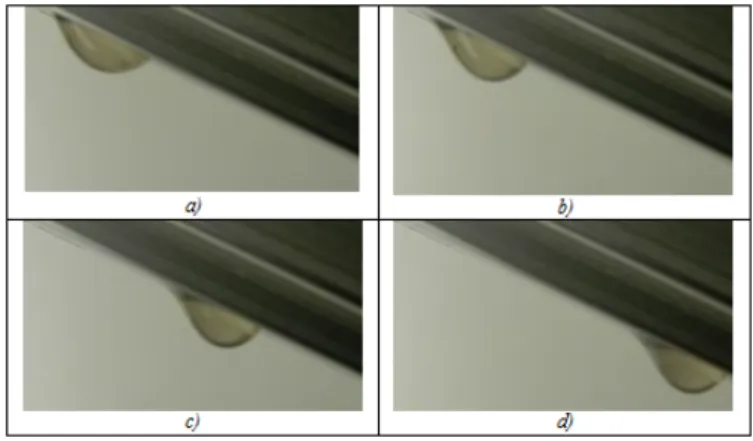
Figure 2: A droplet lying under inclined plane (experiment).

We use above procedure to simulate the motion of a droplet under inclined plane with angle α = 20 0 (Figure. 2). The fluid inside the drop is represented by 1451 particles. The parameters of the equation (8) are given as

σ = 1, γ g = 1., ρ = 3, R 2 = 1.65, ε = 0.04, h = 4 × 10 −4 .

By observing the numerical results (Figure 3), it can be seen that the shape of droplet oscillates and the volume of the droplet is precisely preserved while the droplet moves. In addition, all of particles representing the fluid are controlled well by the film of the droplet during the motion. This results show qualitative agrees with observations from the real experiments.

6 Conclusions

We have derived the hyperbolic free boundary problem with volume conservation

constraint based on examining the motion of the surface of a droplet on plane or

inclined plane. An approximation solution of this problem has been designed using

the discrete Morse flow method. This method induced good numerical results, the

droplet oscillates and its volume is precisely preserved. We have also presented a

couple model for the moving droplet by combining the above hyperbolic problem

for the film with the Euler equations for fluid filling film. In this case, the film plays

as the moving boundary of the fluid and it always fills on role. Numerical result

shows qualitative agreement with observed fact. Our future goal is quantitative

comparison for this model.

(8)

t = 0. t = 0.28

t = 0.56 t = 1.12

Figure 3: A droplet lying under inclined plane (simulation), blue dots represent the

film, green points represent the fluid inside the film and black dots represent the

inclined plane.

(9)

Figure 1: A droplet hanging on the plane.
Figure 2: A droplet lying under inclined plane (experiment).
Figure 3: A droplet lying under inclined plane (simulation), blue dots represent the film, green points represent the fluid inside the film and black dots represent the inclined plane.

参照

関連したドキュメント

Let X be a smooth projective variety defined over an algebraically closed field k of positive characteristic.. By our assumption the image of f contains

By an inverse problem we mean the problem of parameter identification, that means we try to determine some of the unknown values of the model parameters according to measurements in

In this paper, we study the generalized Keldys- Fichera boundary value problem which is a kind of new boundary conditions for a class of higher-order equations with

[7] , On initial boundary value problem with Dirichlet integral conditions for a hyperbolic equation with the Bessel operator, J.. Bouziani

By considering the p-laplacian operator, we show the existence of a solution to the exterior (resp interior) free boundary problem with non constant Bernoulli free boundary

In this article we study a free boundary problem modeling the tumor growth with drug application, the mathematical model which neglect the drug application was proposed by A..

For arbitrary 1 &lt; p &lt; ∞ , but again in the starlike case, we obtain a global convergence proof for a particular analytical trial free boundary method for the

Solov’ev, On an integral equation for the Dirichlet problem in a plane domain with cusps on the boundary..