726 日 本 化 学 療 法 学 会 雑 誌 S E P T. 2 0 1 6
【総 説】
糖尿病患者の尿糖排泄増加と尿中微生物の増殖
桧山 佳樹1)・市原 浩司1)・髙橋 聡2)・舛森 直哉1)
1)札幌医科大学医学部泌尿器科学講座*
2)同 感染制御・臨床検査医学講座
(平成28年2月24日受付・平成28年3月8日受理)
Renal sodium-glucose co-transporter 2
(SGLT2)阻害薬の問題点として,尿路・性器感染症の増加が 懸念されている。上市後の調査では,SGLT2
阻害薬による治療で尿路・性器感染症が増加したとの報告 もあるが,尿路感染症の定義が曖昧であるため,薬剤が原因で罹患率が上昇するかどうかの結論はでて いない。糖尿病患者に尿路感染症が発症する機序としては,尿中糖濃度上昇による細菌・真菌の増殖,尿路上皮への接着の促進,宿主の免疫力低下などが推測されている。
細菌の糖利用法は菌種によりさまざまであるが,細菌内に取り込まれた糖は,好気・嫌気的呼吸,発 酵という過程を経て
ATP
を産生する。したがって,糖が豊富に存在する状況では細菌の増殖が促進され るとの報告もある。一方,糖濃度が高すぎると発育は促進されず,尿pH
などを含めた他の因子にも影響 されるのではないかとの考えもある。SGLT2
阻害薬の登場によって,尿糖と微生物の増殖に関する情報はさらに重要性を増すと考える。しかし,この領域においては臨床データを裏付ける基礎研究データは示されていないことから,今後は積 極的に臨床と基礎実験をつなぐ橋渡し研究が必要である。
Key words: bacterial growth,fungal growth,urine glucose,urinary tract infection,genital
infection
新規糖尿病(diabetes mellitus:DM)治療薬としてRenal sodium-glucose co-transporter 2(SGLT2)阻害薬が世界的に 普及し始めている。しかし,SGLT2阻害薬の有害事象として 尿路・性器感染症の増加が指摘されており,その機序として
SGLT2阻害薬による尿の高糖濃度が細菌や真菌の増殖を促
進させると推測されている。そこで,本稿では,尿糖が微生物 の増殖に与える影響について,基礎・臨床的な面から概説す る。
I. SGLT2阻害薬と尿路・性器感染症の関連性
DM
の新規治療薬として期待されるSGLT2
阻害薬 は,その使用に際して適時問診・検査を行い,尿路感染 症(urinary tract infection:UTI)・性器感染症(geni-tal infection:GI)の発見に努めることが推奨されてい
る1)。これは,尿の高糖濃度が細菌増殖を促す可能性が指 摘されているからである2)。SGLT2阻害剤であるダパグ リフロジンとUTI
発症との関連に言及した総説には,UTI
の発生が増加傾向にあると記載されている3)が,有 意差は認めていない。また,わが国の報告ではSGLT2
が投与された患者におけるUTI・GI
の発症頻度は1〜
2%
であり,プラセボ群と同等であった4)。報告によって患者背景,特に排尿障害の有無,DMの程度や
UTI・GI
の定義も異なるため,SGLT2阻害薬とUTI・GI
の発症 の関連性についての評価は定まっていない。II. 糖が細菌増殖に及ぼす影響
上述のとおり,SGLT2阻害薬と
UTI・GI
発生の関連 性については,未だ結論が得られていないが,DMは,UTI
のリスク因子であると報告されている2)。その根拠 として,尿糖濃度の上昇に伴う細菌増殖の促進,宿主の 免疫力低下および尿路上皮への細菌接着促進などがあげ られている2)。UTI
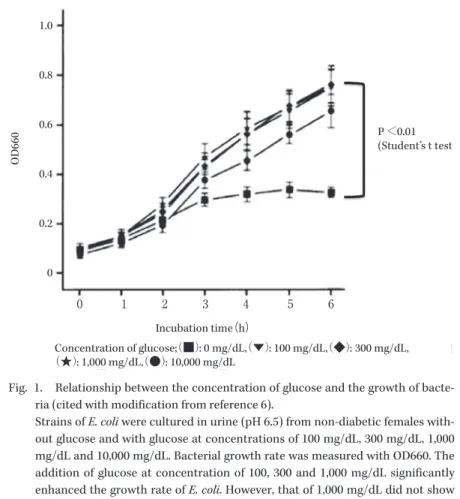
の主要な原因菌である大腸菌(Escherichia coli:E.coli)は,グルコースをリン酸化して細胞内へ取りこむこ とでエネルギー源としている5)。Geerlingsらは,UTI 患者の血液および尿,または糞便から分離されたE. coli を材料とし,成人尿を培地として糖を数段階の濃度で付 加した後に培養し,細菌数をモニターする目的で培養液 の濁度(optical density:OD)を連続的に測定した。結 果として,尿に
100 mg/dL,300 mg/dL,1,000 mg/dL
の糖を添加した群は,糖無添加群と比較して,6
時間後に はOD
値が有意に増加した(Fig. 1)6)。しかし,最大濃度*北海道札幌市中央区南1条西16丁目
VOL. 64 NO. 5 尿糖と細菌および真菌感染 727
Fig. 1. Relationship between the concentration of glucose and the growth of bacte- ria (cited with modification from reference 6).
Strains of E. coli were cultured in urine (pH 6.5) from non-diabetic females with- out glucose and with glucose at concentrations of 100 mg/dL, 300 mg/dL, 1,000 mg/dL and 10,000 mg/dL. Bacterial growth rate was measured with OD660. The addition of glucose at concentration of 100, 300 and 1,000 mg/dL significantly enhanced the growth rate of E. coli. However, that of 1,000 mg/dL did not show any increase in OD660.
P <0.01 (Student’s t test
Concentration of glucose;(■): 0 mg/dL,(▼): 100 mg/dL,(◆): 300 mg/dL,
(★): 1,000 mg/dL,(●): 10,000 mg/dL Incubation time(h)
0 1 2 3 4 5 6
OD660
1.0
0.8
0.6
0.4
0.2
0
である糖濃度
10,000 mg/dL
添加群は,非添加群と比較してE. coliの増殖に有意差を認めなかった。このある一
定以上の糖濃度環境下で細菌増殖が抑制されるという現 象は真菌選択培地であるサブロー培地に応用されてい る7)。サブロー培地の糖濃度は
4,000 mg/dL
である。2.5mg,5 mg
および10 mg
のダパグリフロジンを24
週間 投与し,投与前・後の尿中糖濃度の平均増加量を比較し たところ,それぞれ1,480.5 mg, 2,149.9 mg,および 2,592.3 mg
であったと報告されている3)。高糖濃度で細菌が増殖 しにくいことに関しては,環境中の糖濃度が必要以上に 高いと,酢酸,乳酸などの有機酸が生産され,増殖阻害 や代謝活性が低下するKrabtree
効果が指摘されてい る8)。ただし,細菌増殖を促進もしくは抑制させる尿中糖 濃度の基準範囲は明確ではない。また,この実験ではOD
値のみで細菌増殖を評価していることや,培養開始時点 での菌量が1.0×10
8cfu/mL
と比較的高いため,SGLT2 阻害薬投与下における患者の尿中糖濃度上昇が細菌増殖 に与える影響についてどの程度反映しているのかも明ら かではない。糖濃度と細菌尿の関連を調査した報告では,DM患者 の尿の糖濃度は,
10
5cfu/mL
以上の細菌尿を認めない群 で62.4 mg/dL,認める群で 352.2 mg/dL
と,細菌尿を認 める群で有意に高い濃度であった9)。一方,2
型DM
女性においては,尿糖陽性の割合は無症候性細菌尿(105
cfu/
mL
以上)を認める群で38%,細菌尿を認めない群で 42%
と,尿糖と無症候性細菌尿において関連性は認めないと する報告もある10)。臨床的に,症状の有無を問わず細菌尿 と尿糖との関連性についても明確な結論は示されていな い。
E. coliの尿路上皮接着能促進に関する基礎的研究か
ら,DM患者におけるE. coliの尿路上皮への接着は,非
DM
患者由来のものと比較して顕著に高かったと報告さ れている11)。その接着促進はタイプ1
線毛によるもので あり,HbA1cが高値な患者由来の尿路上皮に対するE.coliの接着が促進された。しかし,同一の尿路上皮に対す る接着は糖濃度を変化させても有意差を認めなかった。
このことから,DM患者の尿路上皮におけるタイプ
1
線 毛の受容体の変化が,E. coliの尿路上皮への接着促進の 要因ではないかと推察されている。ただし,この尿路上 皮の変化の理由がDM
による高血糖や血管障害に起因 するのか,高濃度の尿糖にさらされた結果に起因するの かは明らかにされていない。宿主の免疫能低下については
DM
患者の白血球遊走 能,貪食能力,接着力が低下するとの報告がある12)。この ことは,高糖濃度自体が白血球機能の低下を引き起こす 可能性を示している。728 日 本 化 学 療 法 学 会 雑 誌 S E P T. 2 0 1 6
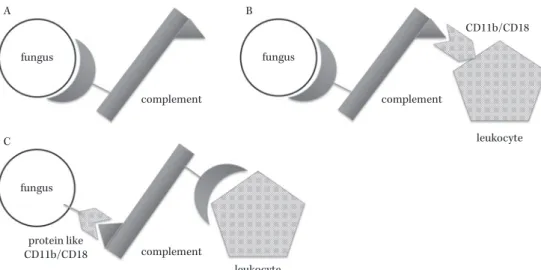
Fig. 2. The mechanism of fungal avoidance of recognition by leukocytes (cited with modification from reference 14).
(A) The binding of a fungus and a complement results in opsonization. (B) The opsonized fungus is likely to be recognized by leukocytes with membrane protein, CD11b/CD18. (C) In fungi with a pro- tein like CD11b/CD18, the recognition by leukocytes is inhibited because of different complement binding.
A
fungus fungus
fungus
complement
complement complement
leukocyte
leukocyte protein like
CD11b/CD18
CD11b/CD18 B
C
以上から,
SGLT2
阻害薬によって引き起こされる尿の 高糖濃度が細菌の増殖を促進させるだけではなく,膀胱 尿路上皮の変化や宿主の好中球機能の低下を惹起するこ とにより,UTI・GI
を増加させる可能性があると考えら れる。III. 糖が真菌増殖に及ぼす影響
SGLT2
阻害薬の投与によって,GIの発生増加も危惧されているが,原因微生物の一つは真菌である1)。
18
歳以 上のDM
患者を対象としたイギリスの報告では,女性DM
患者(年齢中央値65
歳)は非DM
患者に対して真菌 性腟炎の相対危険度が1.81
倍,男性のDM
患者(年齢中 央値61.4
歳)は非DM
患者に対して亀頭包皮炎の相対危 険度が2.85
倍であると報告されており13),DMは真菌に よるGI
のリスク因子の一つであると考えられている。DM
による真菌感染症の病態生理については,好中球機 能の低下やCD11b/CD18
類似蛋白の過剰発現などが指 摘されている14)。CD11b/CD18
蛋白は好中球表面に発現する蛋白であり,補体を認識し,腟粘膜などの上皮へ好中球の接着を 促進する働きを有している。一方で,真菌も
CD11b/
CD18
類似の蛋白を細胞表層に有しており,上皮接着因 子の一つとなっている。この蛋白は,グルコース濃度を5 mM
から50 mM
に上昇させるとその発現量は4〜6
倍増加するという報告がある14)。補体によりオプソニン化 された真菌は,好中球に認識されやすくなるが,CD11
b/CD18
類似蛋白を過剰発現した真菌は,補体と優先的に結合し,好中球から認識されにくくなる(Fig. 2)14)。
SGLT2
阻害薬の投与により, 尿の高糖濃度が惹起され,真菌の
CD11b/CD18
類似タンパク発現が促進されることで,腟や亀頭包皮への接着促進や好中球からの認識回 避機構が働き,結果的に真菌感染を容易にしている可能 性がある。しかしながら,尿の高糖濃度環境下での真菌 増殖促進に否定的な報告もあり14),最終的な結論を得る にいたっていない。
IV. ま と め
尿の高糖濃度の環境では,細菌増殖が促進され,微生 物が宿主に感染しやすくなる可能性がある。しかし,基 礎的研究と臨床的研究とを関連付ける十分なデータがな いのが現状である。
DM
の病態生理を考慮すれば,高イン スリン血症を招きにくいSGLT2
阻害薬は,優れたDM
治療薬であり,さらに使用量が増加すると考えられる。したがって,実臨床にもつながるような,この領域にお ける基礎研究データの蓄積が求められている。
利益相反自己申告:申告すべきものなし。
文 献
1) SGLT2阻 害 薬 の 適 正 使 用 に 関 す るRecommenda-
tion。日本糖尿病協会SGLT2阻害薬の適正使用に関
する委員会,2014
2) Geerlings S, Fonseca V, Castro-Diaz D, List J, Parikh S: Genital and urinary tract infections in diabetes:
impact of pharmacologically-induced glucosuria.
Diabetes Res Clin Pract 2014; 103: 373-81
3) Johnsson K M, Ptaszynska A, Schmitz B, Sugg J, Parikh S J, List J F: Urinary tract infections in pa- tients with diabetes treated with dapagliflozin. J Diabetes Complications 2013; 27: 473-8
4) Kaku K, Kiyosue A, Inoue S, Ueda N, Tokudome T, Yang J, et al: Efficacy and safety of dapagliflozin monotherapy in Japanese patients with type 2 diabe- tes inadequately controlled by diet and exercise.
Diabetes Obes Metab 2014; 16: 1102-10
VOL. 64 NO. 5 尿糖と細菌および真菌感染 729
5) 森田鉄兵,饗場弘二:グルコース応答と代謝制御ネッ トワークの新しい世界。化と生2005; 43: 222-8 6) Geerlings S E, Brouwer E C, Gaastra W, Verhoef J,
Hoepelman A I: Effect of glucose and pH on uropa- thogenic and non-uropathogenicEscherichia coli: stud- ies with urine from diabetic and non-diabetic indi- viduals. J Med Microbiol 1999; 48: 535-9
7) Sandven P, Lassen J: Importance of selective media for recovery of yeasts from clinical specimens. J Clin Microbiol 1999; 37: 3731-2
8) Mustea I, Muresian T: Crabtree effect in some bacte- rial cultures. Cancer 1967; 20: 1499-501
9) Turan H, Serefhanoglu K, Torun A N, Kulaksizoglu S, Kulaksizoglu M, Pamuk B, et al: Frequency, risk factors, and responsible pathogenic microorganisms of asymptomatic bacteriuria in patients with type 2 diabetes mellitus. Jpn J Infect Dis 2008; 61: 236-8 10) Geerlings S E, Stolk R P, Camps M J, Netten P M,
Hoekstra J B, Bouter K P, et al: Asymptomatic bacte- riuria may be considered a complication in women
with diabetes. Diabetes Mellitus Women Asympto- matic Bacteriuria Utrecht Study Group. Diabetes Care 2000; 23: 744-9
11) Geerlings S E, Meiland R, van Lith E C, Brouwer E C, Gaastra W, Hoepelman A I : Adherence of type 1- fimbriatedEscherichia colito uroepithelial cells: more in diabetic women than in control subjects. Diabetes Care 2002; 25: 1405-9
12) Delamaire M, Maugendre D, Moreno M, Le Goff M C, Allannic H, Genetet B: Impaired leucocyte functions in diabetic patients. Diabet Med 1997; 14: 29-34 13) Hirji I, Andersson S W, Guo Z, Hammar N, Gomez-
Caminero A : Incidence of genital infection among patients with type 2 diabetes in the UK General Practice Research Database. J Diabetes Complica- tions 2012; 26: 501-5
14) Hostetter M K: Handicaps to host defense. Effects of hyperglycemia on C3 andCandida albicans. Diabetes 1990; 39: 271-5
Association between urine glucose and a growth of bacterium and fungi Yoshiki Hiyama1), Koji Ichihara
1), Satoshi Takahashi
2)and Naoya Masumori
1)
1)Department of Urology, Sapporo Medical University School of Medicine, S1, W16, Chuo-ku, Sapporo, Hokkaido, Japan
2)Department of Infection Control and Laboratory Medicine, Sapporo Medical University School of Medicine