- 84 -
平成 28 年度 厚生労働科学研究費補助金
(政策科学総合研究事業(臨床研究等 ICT 基盤構築研究事業))
分担研究報告書
全国老人福祉施設における要介護度悪化に関連する利用者及び施設特徴に関する研究
(Resident and facility characteristics associated with care-need level deterioration in long-term care welfare facilities in Japan)
研究代表者 田宮菜奈子 筑波大学医学医療系ヘルスサービスリサーチ分野 教授 研究協力者 金雪瑩 筑波大学医学医療系ヘルスサービスリサーチ分野 研究員 研究協力者 Jeon Boyoung 筑波大学医学医療系ヘルスサービスリサーチ分野 研究員 研究分担者 高橋秀人 福島県立医科大学医学部 教授
研究分担者 野口晴子 早稲田大学 政治経済学術院 教授 研究分担者 川村顕 早稲田大学 政治経済学術院 准教授
研究要旨
本研究の目的は、日本老人福祉施設(特養)における要介護度悪化に関連する利用者特徴 と施設特徴を明らかにすることである。
本研究は、審査年月2012年10月から2013年10月の全国介護レセプトデータを用いて、
3774個特養に入所していた358,886人の利用者を対象とした。施設特徴の情報は、2012年の 介護サービス施設・事業所調査をマージして得た。本研究では、マルチレベルロジスティク ス回帰分析を用いて、追跡不可能であった利用者を入れたモデルと入れないモデルに分けて 分析を行った。(追跡不可能であった利用者はほとんど死亡もしくは入院であったため、要 介護度悪化群に見なした)。
共変量を調整した結果、利用者レベルにおいては、高年齢、ベースラインに要介護度が低 いほど要介護度悪化が有意に多かった。施設レベルにおいては、都市に位置している、新し い施設、ユニット型施設であるほど要介護度悪化が有意に少ない傾向が見られた。追跡不可 能利用者を入れたモデルのみでは、正看護師の看護師に占める割合が高いほど要介護度悪化 が有意に少なかった。追跡不可能利用者を除外したモデルのみでは、管理栄養士の割合が栄 養士に占める割合が高いほど要介護度悪化が有意に少なかった。
本研究は、個人特性を考慮した上で施設特性とアウトカムの関係を示した。施設のケアの 質を改善することとケア市場での競争を高めることにもつながると考えられる。
A.研究目的
Older populations have a higher rate of disabilities and increased requirements for health care needs. Japan has been particularly affected by increased health care needs because it has the highest
proportion of older adults worldwide. To solve this problem, the Japanese government introduced a long-term care insurance (LTCI) system in April of 2000 (Ministry of Health, Labour and Welfare 2002).
- 85 - Since the implementation of the LTCI system, there has been a dramatic increase in the number of long-term care facilities (Ministry of Health, Labour and Welfare 2015). Because the elderly or their families can freely choose the types of services and facilities, the competition among the facilities has increased. However, there has been a lack of quality control in long-term care services. Therefore, the necessity to improve the quality of care has become a critical issue in Japan. In 2015, the Ministry of Health, Labour and Welfare (MHLW) made recommendations for the implementation of assessment indicators to measure the quality of care. One of the key quality indicators as an assessment measure is the change of health status (Ministry of Health, Labour and Welfare, 2015). The care-need level could be a possible indicator of functional status because activities of daily living (ADL) is an important factor in qualifying the care- need level. In addition, a previous study has shown that the care-need level strongly reflected the ADL (Hannda, & Imai, 2016).
To date, studies have attempted to investigate the factors that are related to deteriorations in the care-need level (Kato, Tamiya, Kashiwagi, Sato, & Takahashi, 2009; Koike & Furui, 2013; Kono, Izumi, Yoshiyuki, Kanaya, & Rubenstein, 2016;
Olivares-Tirado, Tamiya, & Kashiwagi, 2012), but most studies focused on community-based services or home care services. However, previous studies have shown that facility service users were more likely to experience a deterioration in the care-need level than community-based service and home care service users ( Lin, Otsubo, & Imanaka, 2015). To the best of
our knowledge, only one study has analysed the facility characteristics that are associated with the outcome indicators (Sandoval Garrido et al., 2014), but no study has investigated the facility characteristics that are associated with care-need level deterioration.
In Japan, there are three types of long- term care facilities for the elderly as follows: long-term care welfare facilities (LTCWF), long-term care health facilities, and long-term care medical facilities. In this study, we focused on LTCWF because among the three types of facilities, LTCWF have the highest number of users and the longest mean length of stay (Japan association of Geriatric Health Services Facilities, 2014).
This study aims to address these limitations by investigating both resident- and facility-level characteristics and identify factors that are related to deteriorations in the care-need level in LTCWF for the elderly in Japan.
B.研究方法
1. 使用データ
This study combined resident-level national LTCI claims data from October 2012 to October 2013 and facility-level data from a survey of institutions and establishments of long-term care in 2012.
The LTCI claims data contain information
regarding user sex, age, care-need level, and
types of service received. The long-term
care facility characteristics were obtained
from the facility survey, which is conducted
by MHLW every year. In Japan, the LTCI
claims data are not available to all
- 86 -
researchers, and only researchers who receive permission from the MHLW are allowed to use these data.
(倫理面への配慮)
2. 対象者
Inclusion criteria require that residents are aged 65 years or older and have been discharged multiple times from a facility during the follow-up period. Approximately 24.4% of all residents were loss to follow- up because they left the facilities.
According to MHLW, the main reasons for leaving a facility were death, which accounted for 63.7%, and hospitalization, which accounted for 28.9% (Ministry of Health, Labour and Welfare 2012).
Therefore, we first analysed all residents and defined loss to follow-up residents as the “deterioration group” because of the consideration that 92.6% of the residents might be hospitalized or dead. Then, an analysis was conducted after excluding the loss to follow-up group. The residents who were care-need level 5 at baseline could not deteriorate further; thus, these residents were excluded to prevent a ceiling effect
3. 従属変数
The care-need level deterioration is the dependent variable in this study. First, we calculated the change in the care-need level by subtracting the care-need level in October 2012 from the care-need level in October 2013. If the residents’ care-need level changes were equal to or less than 0, they were defined as “not deteriorated”. If the residents’ care-need level changes were greater than 0, they were defined as
“deteriorated”.
4. 説明変数
Resident-level characteristics
The age (65-74, 75-84, greater than 85
years) at baseline and sex were collected (Giuliani et al., 2008; Phillips, Chen, &
Sherman, 2008; Phillips, Shen, Chen, &
Sherman, 2007). This study used the care- need level at baseline to adjust the residents’ health status (Kato, Tamiya, Kashiwagi, Sato, & Takahashi, 2009; Koike
& Furui, 2013; Kono, Izumi, Yoshiyuki, Kanaya, & Rubenstein, 2016; Olivares- Tirado et al., 2012; Lin, Otsubo, & Imanaka, 2015).
Facility-level characteristics
We included years in business, facility size as measured by the number of beds (less than 100 beds, 100 beds or more than 100 beds), location (metropolitan, nonmetropolitan), the availability of 24- hour nursing staff and the number of staff in different specialties allocated per 100 users, the proportion of register nurses (RN) among nurses (Bellows & Halpin, 2008; Giuliani et al., 2008; Sandoval Garrido et al., 2014; Zimmerman et al., 2005; Statistics Bureau, Ministry of Internal Affairs and Communications 2012), and the proportion of registered dietitians among all dietitians. We also included an independent variable that indicated the facility model in terms of traditional, unit, or mixed. Traditional model facilities are staff-centric and mainly have shared room settings. In contrast, unit model facilities are person-centred and care for a small number of residents (less than 10) as one living unit, and all are private room settings. Mixed facilities are those with both the unit model and the traditional model.
5. 統計手法
The descriptive analysis was conducted first to review the distribution of the
- 87 - dependent variable and the independent variables. Then, a univariate logistic regression was carried out to identify the variables that are significantly associated with the outcome for inclusion in the multivariate model.
We used a multilevel logistic regression because of the nested nature of our data set (residents nested within facilities). Because residents in the same facility could be more homogeneous than those across different facilities, the assumption of independence was violated in the single level logistic regression. Additionally, the multilevel model accounts for the hierarchical structure to produce better inferences (Raudenbush & Bryk, 2002). The STATA procedure “melogit” was used to fit this multilevel model (Rabe-Hesketh &
Skrondal, 2008; Liu,2016).
C.研究結果
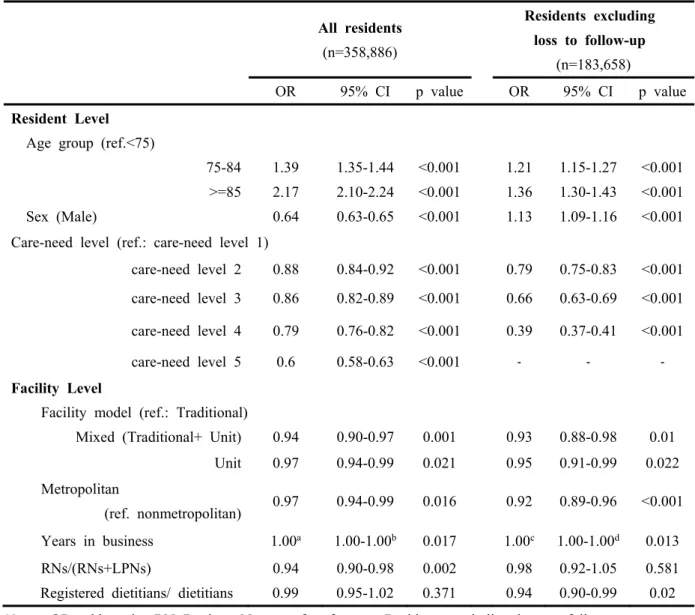
Table 1 presents the results of the
multivariate models predicting care-need level deteriorations. At the resident level, residents who were in the higher age group, male and at a lower care-need level at baseline were significantly more
deteriorated in the care-need level in the all residents model. However, after excluding the loss to follow-up group, females were more likely to experience care-need level deterioration.
Several facility variables were consistently associated with care-need level
deterioration regardless of whether the loss to follow-up group was excluded.
Compared to the traditional model facility, the unit and mixed-model facilities were less likely to experience care-need level deterioration. In addition, facilities that were located in metropolitan areas and
were in business for fewer years were less likely to experience a deterioration in the care-need level.
The results showed that a lower
proportion of registered nurses among all nurses was associated with care-need level deterioration only in the all resident model. After excluding those who were loss to follow-up, a re-analysis of the data showed that a lower proportion of
registered dietitians among all dietitians was associated with care-need level deterioration。
D.考察
This study is the first to analyze
nationally representative data to identify the characteristics that are associated with care-need level deterioration in LTCWF in Japan. Three resident-level variables and five facility-level variables were significantly associated with care- need level deterioration.
At the resident level, older age and a lower care-need level at baseline were significantly associated with care-need level deterioration as documented in earlier studies (Burdick et al., 2005;
Giuliani et al., 2008; Phillips et al., 2007;
Lin, Otsubo, & Imanaka, 2015).
However, we found contradictory
associations with sex in terms of care-need level deterioration when including and excluding those residents who were loss to follow-up. The results show that male residents contribute more to
hospitalization or death than female residents. In contrast, women have a higher risk of care-need level deterioration only when excluding the loss to follow-up group. Previous studies have shown that women have a higher risk of surviving
- 88 - with deteriorating trajectories in health
limitations (Doblhammer & Hoffmann, 2010).
The most important objective of this work was to investigate the facility
characteristics that are related to care- need level deterioration. First, this study found three variables that are consistently associated with our outcomes.
Unit model and mixed model facilities were less likely to be deteriorated in care- need level than traditional model facilities.
To date, although many unit facilities have been established, doubts regarding their performance remain. This study was the first to investigate whether there are different effects on the care-need level deterioration based on the facility model.
Second, facilities located in metropolitan areas performed better. Studies have shown that rurality was often associated with a poorer quality of care. (Kang, Meng,
& Miller, 2011; Phillips, Holan, Sherman, Williams, & Hawes, 2004). A previous study argued that rural facilities were less likely to provide mental health services (Li, 2010) and lacked accreditations or special care programmes (Kang et al., 2011).
Third, fewer years in business contributed to a reduced care-need deterioration in our results, but a non-significant relationship between ADL change and facility age was shown in a previous study (Zimmerman et al., 2005). In Japan, the proportion of unit facilities increased dramatically from 1.5%
to 31.7% between 2003 and 2014 (Ministry of Health, Labour and Welfare 2014). The increase in new facilities with the unit facility model may have influenced the
effect of the business year variable on the outcome.
In addition to the three facility variables, two staffing level variables were
associated with our outcomes. A lower proportion of RNs on the nursing staff was significantly associated with care-need level deterioration when analysed in the all residents model. Earlier studies have demonstrated that RNs serve as leaders and role models in the supervision of LPNs and may improve resident outcomes (Linn, Gurel, & Linn, 1977; Anderson, Hsieh, & Su, 1998).
E.結論
Our results indicate the following potential implications for the LTCI system. First, the results showed that approximately one-fourth of the residents experience care-need level deterioration and that patients with a lower care-need level at baseline experience a greater care- need deterioration. Additionally, previous studies have shown that a greater care- need deterioration occurs in facility service users than in home care service users.
Therefore, preventing the care-need deterioration in the early stages during the lower care-need levels in facilities may be more effective. Second, in Japan, all service prices are determined according to the care-need level, and a higher care-need level warrants a greater amount of
benefits regardless of the efforts to prevent the deterioration. Currently, this payment system provides disincentives to protect the residents from care-need level deterioration. This study suggests increasing the pay for performance systems that consider deterioration in the care-need level of residents. Third, we also
- 89 - suggest that reimbursing providers for
good performance against care-need deterioration to provide essential
information for residents in the choice of facilities. Additionally, enhance the competitiveness in the market among providers will be effective and improve the quality of care by the intensive system.
F.研究発表
1.論文発表 投稿予定
論文投稿および査読後の修正により結果 が変わる可能性がある
2.学会発表
第75回公衆衛生学会
(発表誌名巻号・頁・発行年等も記入)
G.知的財産権の出願・登録状況(予定を 含む)
1.特許取得 なし
2.実用新案登録 なし
3.その他 なし
References
Anderson, R. A., Hsieh, P.-C., & Su, H.-F.
(1998). Resource allocation and resident outcomes in nursing homes: Comparisons between the best and worst. Research in Nursing
& Health, 21(4), 297.
Bellows, N. M., & Halpin, H. A. (2008).
MDS-based state Medicaid reimbursement and the ADL- decline quality indicator.
Gerontologist, 48(3), 324-329.
Bravo, G., De Wals, P., Dubois, M. F., &
Charpentier, M. (1999). Correlates of care quality in long-term care facilities: a multilevel analysis. J Gerontol B Psychol Sci Soc Sci, 54(3), P180-188.
Burdick, D. J., Rosenblatt, A., Samus, Q.
M., Steele, C., Baker, A., Harper, M., Lyketsos, C. G. (2005). Predictors of functional impairment in residents of assisted-living facilities: the Maryland Assisted Living study. J Gerontol A Biol Sci Med Sci, 60(2), 258-264.
Burge, E., von Gunten, A., & Berchtold, A.
(2013). Factors favoring a degradation or an improvement in activities of daily living (ADL) performance among nursing home (NH) residents: a survival analysis.
Arch Gerontol Geriatr, 56(1), 250-
257. doi:
10.1016/j.archger.2012.09.001 Campbell, J. C., & Ikegami, N. (2000).
Long-term care insurance comes to Japan. Health Aff (Millwood), 19(3), 26-39.
Chen, L. Y., Liu, L. K., Liu, C. L., Peng, L.
N., Lin, M. H., Chen, L. K., . . . Chang, P. L. (2013). Predicting functional decline of older men living in veteran homes by minimum data set: implications for disability prevention programs in long term care settings. J Am Med Dir Assoc, 14(4), 309.e309-313.
doi: 10.1016/j.jamda.2013.01.017 Dettori, J. R. (2011). Loss to follow-up.
Evidence-Based Spine-Care
Journal, 2(1), 7–10.
- 90 -
http://doi.org/10.1055/s-0030- 1267080
Doblhammer, G., & Hoffmann, R. (2010).
Gender differences in trajectories of health limitations and subsequent mortality. A study based on the German Socioeconomic Panel 1995-2001 with a mortality follow- up 2002-2005. J Gerontol B Psychol Sci Soc Sci, 65(4), 482-491. doi:
10.1093/geronb/gbp051
Glymour, M. M., Avendano, M., &
Kawachi, I. (2014). Socioeconomic status and health. Social epidemiology, 2, 17-63.
Giuliani, C. A., Gruber-Baldini, A. L., Park, N. S., Schrodt, L. A., Rokoske, F., Sloane, P. D., & Zimmerman, S.
(2008). Physical performance characteristics of assisted living residents and risk for adverse health outcomes. Gerontologist, 48(2), 203-212.
Hannda Sachiko, Imai, Y. (2016).
Relationship between nursing care levels and ADL, BPSD as well as independence degree in daily living for elderly with dementia. Japanese journal of geriatric psychiatry, 27(6), 667-674. (In Japanese) Horn, S. D., Sharkey, S. S., Hudak, S.,
Smout, R. J., Quinn, C. C., Yody, B.,
& Fleshner, I. (2010). Beyond CMS quality measure adjustments:
identifying key resident and nursing home facility factors associated with quality measures. J Am Med Dir Assoc, 11(7), 500-505. doi:
10.1016/j.jamda.2009.10.008.
Japan Association of Geriatric Health Services Facilities:. Geriatric Health
Services Facility in Japan 2014.
[Cited 2017 Jan 10]. Available form:
http://www.roken.or.jp/wp/wp- content/uploads/2012/07/english_2 014.pdf
Kang, Y., Meng, H., & Miller, N. A. (2011).
Rurality and nursing home quality:
evidence from the 2004 National
Nursing Home Survey.
Gerontologist, 51(6), 761-773. doi:
10.1093/geront/gnr065
Kato, G., Tamiya, N., Kashiwagi, M., Sato, M., & Takahashi, H. (2009).
Relationship between home care service use and changes in the care needs level of Japanese elderly.
BMC Geriatr, 9, 58. doi:
10.1186/1471-2318-9-58
Koike, S., & Furui, Y. (2013). Long-term care-service use and increases in care-need level among home-based elderly people in a Japanese urban area. Health Policy, 110(1), 94-100.
doi:
10.1016/j.healthpol.2012.12.011 Kono, A., Izumi, K., Yoshiyuki, N., Kanaya,
Y., & Rubenstein, L. Z. (2016).
Effects of an Updated Preventive Home Visit Program Based on a Systematic Structured Assessment of Care Needs for Ambulatory Frail Older Adults in Japan: A Randomized Controlled Trial. J Gerontol A Biol Sci Med Sci, 71(12),
1631-1637. doi:
10.1093/gerona/glw068
Lin, H. R., Otsubo, T., & Imanaka, Y.
(2015). The effects of dementia and
long-term care services on the
deterioration of care-needs levels of
the elderly in Japan. Medicine
- 91 -
(Baltimore), 94(7), e525. doi:
10.1097/md.0000000000000525 Linn, M. W., Gurel, L., & Linn, B. S. (1977).
Patient outcome as a measure of quality of nursing home care. Am J Public Health, 67(4), 337-344.
Li, Y. (2010). Provision of mental health services in U.S. nursing homes, 1995-2004. Psychiatr Serv, 61(4),
349-355. doi:
10.1176/ps.2010.61.4.349
Mukamel, D. B. (1997). Risk-adjusted outcome measures and quality of care in nursing homes. Med Care, 35(4), 367-385.
Ministry of Health, Labour and
Welfare:Implemention of assing quality of service in Long-term care payment system. 2015. (In Japanese) [Cited 2017 Jan 10].
Available form:
http://www.mhlw.go.jp/file/05- Shingikai-12601000-
Seisakutoukatsukan-
Sanjikanshitsu_Shakaihoshoutantou /0000089752.pdf
Ministry of Health, Labour and Welfare:
Laws and ordinances on care-need level authorization. 2000. (In Japanese) [Cited 2017 Jan 10].
Available form:
http://www.mhlw.go.jp/topics/kaig o/nintei/gaiyo4.html
Ministry of Health, Labour and Welfare:
Long-term care facility service.
2012. (in Japanese) [Cited 2017 Jan 10]. Available form:
http://www.mhlw.go.jp/file.jsp?id=
146267&name=2r98520
Ministry of Health, Labour and Welfare:
Long-term care, Health and Welfare
Services for the Elderly. 2015.
[Cited 2017 Jan 10]. Available form:
http://www.mhlw.go.jp/english/wp/
wp-hw9/dl/10e.pdf
Ministry of Health, Labour and Welfare:
Long-term care Insurance in Japan, Implementation of the long-term care insurance system. 2002.
[Cited 2017 Jan 10]. Available form:
http://www.mhlw.go.jp/english/topi cs/elderly/care/4.html
Ministry of Health, Labour and Welfare:
Survey of institutions and
establishments for long-term care.
2014. (in Japanese) [Cited 2017 Jan 10]. Available form:
http://www.mhlw.go.jp/toukei/saiki n/hw/kaigo/service14/dl/kekka- gaiyou_03.pdf
Olivares-Tirado, P., Tamiya, N., &
Kashiwagi, M. (2012). Effect of in- home and community-based services on the functional status of elderly in the long-term care insurance system in Japan. BMC Health Serv Res, 12(1), 239. doi:
10.1186/1472-6963-12-239
Phillips, C. D., Chen, M., & Sherman, M.
(2008). To what degree does provider performance affect a quality indicator? The case of nursing homes and ADL change.
Gerontologist, 48(3), 330-337.
Phillips, C. D., Holan, S., Sherman, M., Williams, M. L., & Hawes, C.
(2004). Rurality and nursing home quality: results from a national sample of nursing home admissions.
Am J Public Health, 94(10), 1717-
1722.
- 92 -
Phillips, C. D., Shen, R., Chen, M., &
Sherman, M. (2007). Evaluating nursing home performance indicators: an illustration exploring the impact of facilities on ADL change. Gerontologist, 47(5), 683- 689.
Sandoval Garrido, F. A., Tamiya, N., Kashiwagi, M., Miyata, S., Okochi, J., Moriyama, Y., . . . Takamuku, K.
(2014). Relationship between structural characteristics and outcome quality indicators at health care facilities for the elderly requiring long-term care in Japan from a nationwide survey. Geriatr Gerontol Int, 14(2), 301-308. doi:
10.1111/ggi.12098
Spector, W. D., & Takada, H. A. (1991).
Characteristics of nursing homes that affect resident outcomes. J Aging Health, 3(4), 427-454.
Statistics Bureau, Ministry of Internal Affairs and Communications. 2012.
About regional division. In Japanese.
[Cited 2017 Jan 10]. Available form:
http://www.stat.go.jp/data/kokusei/
2010/users-g/word7.htm
The Japan Dietetic Association: Resistered dietitians and Dietitians.2015.
[Cited 2017 Jan 10]. Available form:
http://www.dietitian.or.jp/english/di etitians/.
Tsutsui, T. & N. Muramatsu (2005) Care- needs certification in the long-term care insurance system of Japan. J Am Geriatr Soc, 53, 522-7.
Tsutsui, T., & Muramatsu, N. (2007).
Japan's universal long-term care system reform of 2005: containing costs and realizing a vision. J Am Geriatr Soc, 55(9), 1458-1463. doi:
10.1111/j.1532-5415.2007.01281.x Wang, J., Kane, R. L., Eberly, L. E., Virnig,
B. A., & Chang, L. H. (2009). The effects of resident and nursing home characteristics on activities of daily living. J Gerontol A Biol Sci Med Sci, 64(4), 473-480. doi:
10.1093/gerona/gln040
Zimmerman, S., Gruber-Baldini, A. L., Sloane, P. D., Eckert, J. K., Hebel, J.
R., Morgan, L. A., . . . Konrad, T. R.
(2003). Assisted living and nursing homes: apples and oranges?
Gerontologist, 43 Spec No 2, 107- 117.
Zimmerman, S., Sloane, P. D., Eckert, J. K., Gruber-Baldini, A. L., Morgan, L.
A., Hebel, J. R., . . . Chen, C. K.
(2005). How good is assisted living?
Findings and implications from an outcomes study. J Gerontol B Psychol Sci Soc Sci, 60(4), S195- 204.
Raudenbush, S. W., & Bryk, A. S. (2002).
Hierarchical linear models:
Applications and data analysis methods (Vol. 1): Sage.
Rabe-Hesketh, S., & Skrondal, A. (2008).
Multilevel and longitudinal modeling using Stata: STATA press.
Xing Liu (2016). Applied Ordinal Logistic
Regression Using Stata:Sage.
- 93 -
Table 1. Facility and resident characteristics associated with the care-need level deterioration: results of the multilevel logistic regression analysis
All residents (n=358,886)
Residents excluding loss to follow-up
(n=183,658)
OR 95% CI p value OR 95% CI p value
Resident Level Age group (ref.<75)
75-84 1.39 1.35-1.44 <0.001 1.21 1.15-1.27 <0.001
>=85 2.17 2.10-2.24 <0.001 1.36 1.30-1.43 <0.001
Sex (Male) 0.64 0.63-0.65 <0.001 1.13 1.09-1.16 <0.001
Care-need level (ref.: care-need level 1)
care-need level 2 0.88 0.84-0.92 <0.001 0.79 0.75-0.83 <0.001 care-need level 3 0.86 0.82-0.89 <0.001 0.66 0.63-0.69 <0.001 care-need level 4 0.79 0.76-0.82 <0.001 0.39 0.37-0.41 <0.001
care-need level 5 0.6 0.58-0.63 <0.001 - - -
Facility Level
Facility model (ref.: Traditional)
Mixed (Traditional+ Unit) 0.94 0.90-0.97 0.001 0.93 0.88-0.98 0.01
Unit 0.97 0.94-0.99 0.021 0.95 0.91-0.99 0.022
Metropolitan
(ref. nonmetropolitan) 0.97 0.94-0.99 0.016 0.92 0.89-0.96 <0.001
Years in business 1.00a 1.00-1.00b 0.017 1.00c 1.00-1.00d 0.013
RNs/(RNs+LPNs) 0.94 0.90-0.98 0.002 0.98 0.92-1.05 0.581
Registered dietitians/ dietitians 0.99 0.95-1.02 0.371 0.94 0.90-0.99 0.02 Notes: OR=odds ratio; RN=Register Nurse; ref.=reference; Residents excluding loss to follow-up group:
Residents who stayed at facility, excluding the cases loss to follow-up due to death or hospitalization i n the majority; Traditional=traditional staff-centric model and mainly with shared room setting; Unit=A small number of residents (smaller than 10) as one living unit, and all are private room settings; Mixe d=both the unit model and the traditional model exist; a 1.001; b 1.000-1.002; c 1.002; d 1.000-1.003.