• 検索結果がありません。

Optimal Control Analysis in Heat Transfer Field Using Fictitious Domain FEM and Adjoint Equation Method

N/A
N/A
Protected

Academic year: 2021

シェア "Optimal Control Analysis in Heat Transfer Field Using Fictitious Domain FEM and Adjoint Equation Method"

Copied!
2
0
0

読み込み中.... (全文を見る)

全文

(1)

JSME-CMD International Computational Mechanics Symposium 2012 in Kobe (JSME-CMD ICMS2012)

1

Optimal Control Analysis in Heat Transfer Field Using Fictitious Domain FEM and Adjoint Equation Method

Takahiko Kurahashi**

**Department of Mechanical Engineering, Nagaoka National College of Technology, 888 Nishikatakai, Nagaoka, Niigata 940-8532, Japan

E-mail:[email protected]

In this study, a numerical study for boundary control problem in heat transfer field based on fictitious domain, finite element and adjoint equation methods is shown. If this kind of control compuation is carried out, it can be said that control problem with moving boundary can be easily solved without using remeshing technique. In this study, some results for a fundamental study are shown and discussions for the numerical results are carried out.

Key words: Optimal Control, Adjoint Equation Method, Fictitious Domain Method

1. Introduction

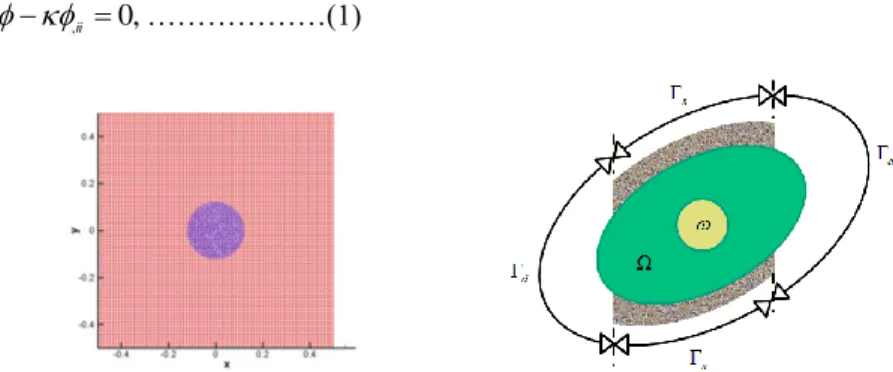
In this study, numerical example for temperature control problem based on finite element analysis using the fictitious domain method [1]. In the fictitious domain method, two types of region, whole domain Ω and sub domain ω, are employed, and physical information in sub domain is affected to whole domain by interpolation method. If this method is used to moving domain problem, it isn’t necessary to apply re-meshing technique. Therefore, this method is frequently employed for particle flow problem [1].

This method is mainly applied to direct problems, it is difficult to see studies that the fictitious domain method is applied to inverse problems. Hence, this method is employed in inverse problem, applicability of this method to inverse problem is confirmed. In this study, this method is applied to a temperature control problem [2].

2. Formulation by Fictitious Domain Method and Optimal Control Problem Domain and boundary definition is shown in Fig.2. Ω and ω indicate whole and sub domains, and Γ d and Γ n denote Dirichlet and Neumann boundary conditions. In this paper, heat transfer equation is introduced for temperature control problem (Eq.(1)).

  , ii  0 , ………(1)

Fig. 1 Image diagram of overlapped mesh Fig. 2 Domain and boundary definitions

(2)

JSME-CMD International

Computational Mechanics Symposium 2012 in Kobe (JSME-CMD ICMS2012)

2 where φ, κ indicate temperature and thermal diffusion coefficient. In addition, initial and boundary conditions are defied as shown in Eq.(2).

       

t  ˆ in  ,  ˆ on  , b   i n ib ˆ on  ,  g in

2 ,

1

0 ……(2)

The Lagrange multiplier method is introduced to solve Eq.(1) considering constraint condition for temperature φ in sub domain ω. Appling the finite element method to Eq.(1) and constraint condition in sub domain, weighted residual equations are obtained as Eqs.(3) and (4).

   ,   ,

 

d w d w d

wii

 

………(3)

  w   gd  0 , ………(4)

whereλindicates Lagrange multiplier, and wφand wλdenote weighting functions for temperature and Lagrange multiplier. Applying the Green theorem to Eq.(3), Eq.(5) is obtained.

      

 

d w d w n d w d

w

n

i i i

i  

, , , ………(5)

In this study, shape function for linear triangle element is applied to interpolate temperature and weighting function for temperature, and the Dirac’s delta function is employed for interpolation for Lagrange multiplier and weighting function for Lagrange multiplier (Eqs.(6),(7)).

  N 11N 22N 33 , w N 1 w 1N 2 w 2N 3 w 3 , ………(6)

     

d

N

d i

i N

i

i w w

1 1

, i

i x x

x

x

………(7)

where N and δ indicate shape function and dirac’s delta function. Finally, finite element equations are obtained as shown in Eqs. (8) and (9).

  M         H xx    H yy        T    B T    in  ………(8)   B       G in  ………(9)

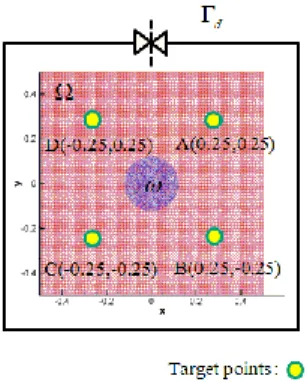
In this study, computational model shown in Fig.3 is employed, and a boundary control problem is solved. In this computational model, there are two kind of computational domain, i.e., whole domain Ω and sub domain ω, and some target points are prepared in the whole domain. The purpose of this study is to find optimal control temperature in sub domain ω such that temperature at target points is close to the target temperature. In the formulation of this problem, the adjoit equation method is employed.

Fig. 3 Computational model References

[1] R. Glowinski et. al., Contemporary Mathematics, 218, pp.121-137,1998.

[2] T.Kurahashi and M.Kawahara, Int. J. Numeri.Meth. Eng., 73, pp.982-1009, 2008.

Fig. 1 Image diagram of overlapped mesh    Fig. 2 Domain and boundary definitions
Fig. 3 Computational model  References

参照

関連したドキュメント

Furthermore, the upper semicontinuity of the global attractor for a singularly perturbed phase-field model is proved in [12] (see also [11] for a logarithmic nonlinearity) for two

In particular, we show that the q-heat polynomials and the q-associated functions are closely related to the discrete q-Hermite I polynomials and the discrete q-Hermite II

A new method is suggested for obtaining the exact and numerical solutions of the initial-boundary value problem for a nonlinear parabolic type equation in the domain with the

We study the stabilization problem by interior damping of the wave equation with boundary or internal time-varying delay feedback in a bounded and smooth domain.. By

Solov’ev, On an integral equation for the Dirichlet problem in a plane domain with cusps on the boundary..

Using the fact that there is no degeneracy on (α, 1) and using the classical result known for linear nondegenerate parabolic equations in bounded domain (see for example [16, 18]),

Girault; The Stokes problem and vector potential operator in three-dimensional exterior domains: An approach in weighted Sobolev spaces. Sequeira; A

It is known that if the Dirichlet problem for the Laplace equation is considered in a 2D domain bounded by sufficiently smooth closed curves, and if the function specified in the