修士 論文
水中における人体の熱的応答に関する研究
Study of Human Thermal Reaction in Water Immersion
1−75ページ 完
平成 14年 2月 15日 提出
指導教官 : 庄司 正弘 教授
CONTENTS
ACKNOWLEDGEMENT ... 4INTRODUCTION ... 5
1.1 BACKGROUND ... 5 1.2 OBJECTIVE ... 6MATHMATICAL MODELING ... 7
2.1 BODY HEAT BANLANCE EQUATION ... 7
2.2 METABOLIC HEAT PRODUCTION ... 10
2.3 EVAPORATIVE HEAT EXCHANGE ... 10
2.4 HEAT EXCHANGE WITH ATMOSPHERE BY SENISIBLE HEAT... 13
2.5 HEAT EXCHANGE WITH WATER ENVIRONMENT ... 13
NUMERICAL SIMULATION ... 15
3.1 CONTROL SYSTEM ... 15 3.2 CONTROLLING SYSTEM ... 20EXPERIMENTS... 28
4.1 INTRODUCTION ... 28 4.2 METHOD ... 28RESULTS AND DISCUSSIONS... 32
5.1 EXPERIMENTAL RESULTS ... 32
5.2 EXPERIMENTS VS SIMULATIONS ... 38
5.3 SIMULATIONS... 45
APPENDIX ... 50
APPENDIX A – TABLES ... 51
Table 1: Surface Area, Weight and Heat Capacity of the Four Compartment in each Segment. ... 51
Table 2: Thermal Conductance between Compartments, Basal Metabolic Heat Production and Basal Blood Flow for Each Compartment. ... 52
Table 3: Values of Heat Transfer Coefficient for Each Segment ... 53
Table 4: Estimation of Distribution of Skin Receptors, Sweating, Vasodilatation and Vasoconstriction Command over the different Skin Areas... 53
Table 5: Estimates of Distribution of Heat Production in Muscle Compartment. .... 53
Table 6: Temperature Set Point for initial condition... 54
APPENDIX B... 55
Programming 1: Simulation of Physiology Reaction in water immersion ... 55
Programming 2: Conversion Volt to Celsius ... 70
ACKNOWLEDGEMENT
I would like to acknowledge with sincere appreciation the facilities made available and the generous help given my supervisor, Prof. Masahiro Shoji during the whole period of study. My deep gratitude is due to his continuous guidance and encouragement which were really invaluable and fruitful.
I would like to thanks Associate Prof. Shigeo Maruyama, for his careful help and valuable opinion in performing my study. Thanks are extended to Mr. Makoto Watanabe how provided sincere help during the experimental work.
Finally, I am grateful to my parents who dedicated their lives full of sacrifices to provide me with all means of the success.
CHAPTER 1
INTRODUCTION
1.1 BACKGROUND
Even though we spend most of our time in land, more and more people involve in water activities for the purpose of such as doing daily activities (taking hot bath, shower etc) and recreational activities (swimming, scuba diving, snorkeling etc). In addition, for occupational reason, some people need to work in a deep sea water and for the purpose of survival, for instance accidental cold water immersion, a proper understand of human thermal or physiological response while they immerse into water is very important. The physical properties of water are very different from those in air. Accordingly, the environmental stress easily become severe and may even threaten life. On immersion heat exchange between the body and its environment is enhanced. Water has a volumetric specific heat 4000 times greater than that of air, and a conductivity 25 times that of air. Water therefore serves as a gigantic heat sink around the body. As the results, it is equally important to study the human thermal response in aquatic environment.
Various human body models have been developed to simulate human thermoregulation. In a simple model, the human body may be considered as only two concentric cylinders, while in some complex models, the body can be divided into more than 50 major elements and body temperatures are computed at tens of thousands of nodal points on a supercomputer. In most cases, human body models are used to predict physiological responses to thermal condition. However, almost all of those model were done in air environment, there is none developed for water environment.
In this study, a numerical modeling has been developed to simulate the human thermal responses in water immersion. The model is then validated with experimental data of taking a
bath only. In general, the model is a basic whole body water immersion for taking a bath, further development can be continue to include other water activities as well.
1.2 OBJECTIVE
Since the understanding of human thermal reaction in aquatic environment is so important, the purpose of this study is to
1. To develop numerical model that simulates the human thermal response in water immersion such as mean skin temperature, core temperature, metabolic heat production and evaporative heat loss. This model to be developed in such a format that this can be used to simulate human thermal response in different environment conditions (such as water temperature, air and humidity temperature etc), and also different part of body immersion (i.e. either whole body immersion with only head out or half body immersion)
2. Carry out experiments that measure skin and oral temperature of human in water immersion. The purpose of doing experiment is to validate the simulation result. The experiment is done in three cases that to validate the simulation results in various criteria for instance, different water temperature conditions, two types of body part of immersion and different subjects.
CHAPTER 2
MATHMATICAL MODELING
2.1 BODY HEAT BANLANCE EQUATION
Since the purpose of the thermoregulatory system of the body is to maintain an essentially constant internal body temperature, it can be assumes that for long exposures to a constant (moderate) thermal environment with a constant metabolic rate a heat balance will exist for the human body, i.e., the heat production will the heat dissipation, and there will be no significant heat storage within the body. The heat balance equation [8] describing the thermal exchange between the body and its environment is
[
2]
. ) (± − − ± ± − =M E R C W W m H (2.1)where H = rate of storage of body heat (+ for net gain)
M = rate of metabolic energy production (always +) E = rate evaporative heat loss
R = rate of radiant heat exchange (+ for gain) C = rate of convective heat transfer (+ for gain)
W = rate of work (+ for work against external force)
2.11 Body Temperature – Mean Skin Temperature and Core Temperature
Skin temperature may be measured experimentally by appropriately designed thermocouples. Mean skin temperature Tsk, is an average of local values of skin temperature over the body surface. Each weighted by the fraction of the total body surface represented. A useful weighting scale is head (7%), chest (17.5%), back (17.5%), upper arms (7%), forearms (7%), hands (5%), thighs (19%), and legs (20%). In the cold, wide differences in skin temperatureover the body surface can be expected, which hinder proper interpretation of Tsk.
However, in the water immersion, the skin surface temperature tends to be fairly uniform and thus the weighting factors are less significant in determining Tsk.
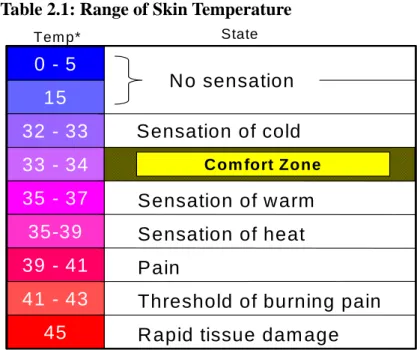
Skin temperature serve as an significant index of the mode of regulation of body temperature. Values of Tsk may also serve as indices of our sensory judgment of heat, cold and pain as well as of the thermal comfort the environment. Table 2.1 outlines the general relationships that may be expected between skin temperature and various physiological and sensory states. It shows that the comfort range skin temperature for human is quite limited i.e. 34-36°C. Human will be in critical condition with small increase (about 6°C) and decrease (18°C) in mean skin temperature.
Table 2.1: Range of Skin Temperature
0 - 5 15 32 - 33 33 - 34 35 - 37 35-39 39 - 41 41 - 43 45 0 - 5 15 32 - 33 33 - 34 35 - 37 35-39 39 - 41 41 - 43 45 Sensation of cold Sensation of w arm Sensation of heat Pain
Threshold of burning pain R apid tissue dam age
Tem p*
* in degrees Celcius
N o sensation
C om fort Zone
State
The temperature of blood reaching the hypothalamus (Tcore) is regarded as a major afferent stimulus for the intensity of the effector response of sweating, vasomotor activity and shivering. To estimate Tcore in humans, measurement sites other than the hypothalamus have
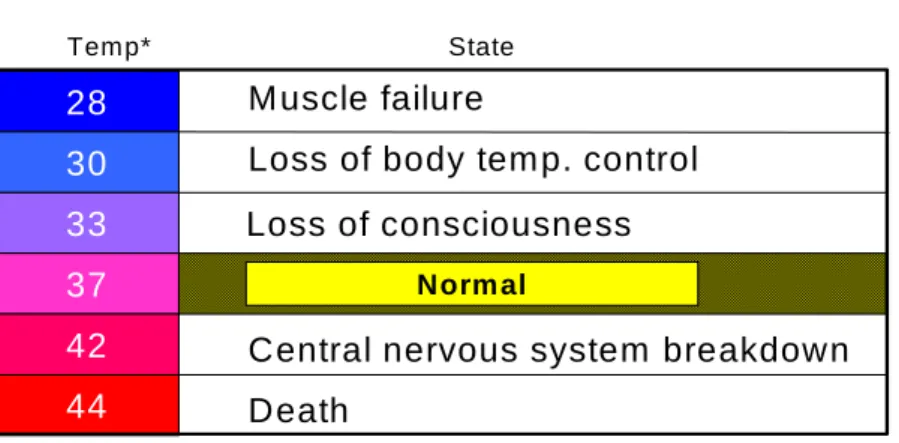
frequently been utilized, including the oral cavity, tympanice membrane, pulmonary artery (PA) and right heart (RH), rectum and esophagus. Measurement of Tcore is important both as an estimate of afferent input in the temperature-control system and as an estimate of the temperature of the blood going to the brain. Table 2.2 outlines the general relationships that may be expected between core temperature and various physiological and sensory states.
Table 2.2: Range of Core Temperature
Loss of consciousness
Central nervous system breakdown Death
Temp*
* in degrees Celcius
Norm al
Muscle failure
Loss of body temp. control 28 30 33 37 42 44 State
In contrast to the situation in air, water exposure of a nude person will bring the temperature of the skin close to that of water within minutes. The skin-to-water temperature gradient is affected by water temperature, water movement and people` movements. The core temperature is affected little during the first 5 minutes of immersion, irrespective of water temperature and metabolic rate. A longer exposure will, except in a rather narrow `thermoneutral` range of water temperature, induce a change in core temperature. The rate of this change is dependent on factors including water temperature, and the subject metabolic rate and skinfold thickness. Thus the temperature zone in which man can stay in water without excessive heating or cooling is very narrow compared to air.
2.12 Skin Wettedness
Skin wettedness (w) is defined as the ratio of an equivalent akin area (Awet), which, if covered with water, would produce the observed skin evaporative heat loss (Esk) to the total skin surface area (Atotal). Evaluating of w will be discussed in the section 3.23.
2.2 METABOLIC HEAT PRODUCTION
The metabolic energy term M in the basic heat balance Equation 1 represents the free energy produced by the transformation of chemical energy during aerobic and anaerobic metabolic activities within an organism.
2.3 EVAPORATIVE HEAT EXCHANGE
Evaporative heat loss in man occurred through respiratory system and skin. Evaporation heat loss through skin can then be further divided into skin diffusion and sweat secretion.
2.31 Evaporation Heat Loss by Skin Diffusion
Water vapor diffusion through the skin is one part of the insensible perspiration, a process not subject to thermoregulatory control. The magnitude of the diffusion per unit area is assumed to be proportional to the difference between the saturated water vapor pressure ps at
skin temperature and the partial vapor pressure of water vapor pa in the ambient air. The
equation [3] for the heat loss by water vapor through skin diffusion is ) ( s a total fg diff h mA p p E = − (kJ/hr) (2.2)
where Ediff = heat loss by vapor diffusion through the skin (Watt)
m = permeation coefficient of skin, (6.1×10⁻⁴kg/hr m2 mm Hg, from analysis data of Inouye et al)
ps = saturated vapor pressure at skin temperature (mmHg)
pa = vapor pressure in ambient air (mmHg)
By substitute the permeation coefficient of skin into eq.2.2 and convert the unit of kJ/hr into Watt, the evaporative heat loss through skin diffusion can be rewritten as:
) ( 10 6944 . 1 4 fg total s a diff h A p p E = × − − (W) (2.2a)
2.32 Evaporation Heat Loss by Sweat Secretion
The heat loss by the evaporation of sweat secretion on the skin surface is humans` most effective means of survival in the heat. The magnitude of the sweat secretion is a function of the activity level. The amount of heat removed by evaporation of sweat is given by
) / ( total o total sw A M A q E =λ − (2.3)
According to Eq. (2.3) sweating will not occur for metabolic rates (M) lower than qo (a typical
value for humans is 58 W/m2), Above this value, which corresponds to average sedentary conditions in humans, sweating is an increasing function of thermal exposure. λ is an experimental coefficient relating the amount of heat exchange by sweating to physiological parameters. A typical value of isλfor human is 0.32.
2.33 Evaporation Heat Loss by Latent Respiration
Heat and water vapor are transferred to inspired air by convection and evaporation from the mucosal lining of the respiratory tract. On reaching the alveoli the air is at deep body temperature and saturated with water vapor. As the air moves outward through the respiratory tract some heat is transferred back to the body and water is condensed but the expired air
emerging from the nose still contain more heat and water than the inspired air in comfortable environments. Breathing therefore results in a latent heat loss and a dry heat loss from body.
The latent respiration heat loss is a function of the pulmonary ventilation and the difference in water content between expired and inspired air:
(
ex a)
λres V W W
E = −
•
(kcal/hr) (2.4)
where Eres = latent respiration heat loss (kcal/hr) •
V = pulmonary ventilation
Wex = humidity ratio of the expiration air (kg water/ kg dry air)
Wa = humidity ratio of the inspiration air (kg water/ kg dry air) λ = heat of vaporization of water (value from steam table)
Pulmonary ventilation is mainly a function of the metabolic rate, through minor differences have been observed between working tasks where arm and leg movements respectively are dominant. The following linear expression has been found as a practical approximation for the mean pulmonary for different type of work:
M V =0.0060
•
(2.5)
Although the function of the respiratory tract is quite effective, the condition of the expired air will still depend to a certain degree upon the condition of inspired are. The difference between expired and inspired air can be expressed by the following equation:
Wex- Wa = 0.0277 + 0.000065ta - 0.80Wa (2.6) ≅ 0.029 - 0.80Wa (kg water/kg dry air)
Substituting a a a a p p P p W 0.622 ≅0.00083 − = in Eq. (6) gives
Wex- Wa = 0.029 - 0.00066pa (kg water/kg dry air) (2.6a) Where pa = the partial pressure if water vapor in inspired air (ambient air) (mmHg)
P = 760 mmHg (sea level barometric pressure)
Substituting the expression for •
V and Wex - Wa in Eq. (4), one obtains the following formula for the latent respiration heat loss:
(
a)
res M p
E =0.0023 44− (kcal/hr) (2.4a)
2.4 HEAT EXCHANGE WITH ATMOSPHERE BY SENISIBLE HEAT
The exchange of sensible heat from skin surface at average temperature Tsk is usually
accomplished by radiation and convection from the skin surface to the surrounding medium. The heat exchange from the body surface without cloth, at skin temperature is given by
(
sk a)
sen hT T
Q = − (Wm-2) (2.7)
where h is the combined coefficient for heat transfer by radiation and convection in W.m-2C-1 and Ta is the ambient air temperature.
2.5 HEAT EXCHANGE WITH WATER ENVIRONMENT
Heat will either transfer from the human body to water or on the other way round is depend upon the temperature difference between the skin and water temperature. In cold water immersion, heat produced in the body core and the limbs is transport by blood convection and tissue conduction to the skin surface for dissipation. Heat arriving at the skin surface will be dissipated to the colder water by convection at a rate determined by the skin to water temperature (Tw) gradient (Tsk- Tw) and the heat transfer coefficient for external convection hw(Wm-2C-1).
(
sk w)
w
water h T T
Q = − (Wm-2) (2.8)
This is the only important heat transfer at the skin because in water evaporation of sweat cannot be used as a heat dissipating mechanism and heat loss hue to radiation is negligible.
On the other hand, warm water immersion will result in a negative Qwater showing that the heat is transferred from the water environment to human body.
Values for the convective heat transfer coefficient hw have been derived analytically, measured on a heated copper manikin placed in water or determined from experimental data on human. RAPP [6] presented values for hw of 105 Wm-2C-1 in still water, increasing nearly linearly to 411 Wm-2C-1 at 0.5 ms-1.
CHAPTER 3
NUMERICAL SIMULATION
The mathematical model for human thermoregulation involves both a passive system and a controlling system. Commonly, the geometrical and anatomical representations of the body and mathematical expressions of the heat transfer within the body and between the body and its environment are referred to as the passive system. The mathematical representation of the regulatory mechanisms by which the body regulates its heat exchanges to control the body temperature is referred to as the controlling system. The model is expressed in a form of computer simulation, which is written in FORTRAN programming language.
For the present study, a 29-node model is used. The development of this model is derived from the Stolwijk and Hardy model [1], particularly in aspects of body heat flow analysis and mechanisms for thermal regulation. However, Stolwijk and Hardy model is only modeling of temperature control of human in air environment, whereas, the developed model has included the air environment as well as water environment. In addition, the six-element body representation by Stolwijk and Hardy is replaced by seven-element representation, which the “trunk” part has been divided into “thorax” and “abdomen”. The purpose is to allow simulation for half body water immersion.
3.1 CONTROL SYSTEM
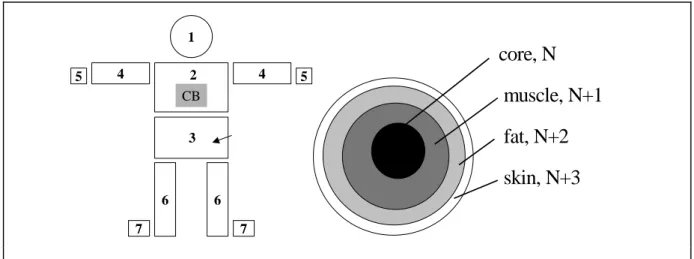
Figure 3.1 shows the anatomical representation of the human body. As shown in the figure, the body is divided into seven segments (I), i.e. head, thorax, abdomen, arm (included arm and forearm), hand, leg (included thigh and calves) and feet. Each of the body segments is further divided into four compartments (N): core, muscle, fat and skin. An additional central blood compartment, representing large arteries and veins, exchange heat with all the other compartment through the convective heat transfer occurring with the blood flow to each
compartment. To simplify the model, each compartment is assumed to have direct blood convective heat transfer with the central blood compartment rather than the adjacent body compartments. The total compartments are 29 compartments. For each of the 29 compartments complete heat balance equation must be developed to account for heat flow into and out of the compartments, through conduction, convection, and the metabolism heat production within the compartment. For those compartments in contact with outside environment, equations will be derived to express the heat exchange by evaporation, radiation, and convection. Chapter 2, Mathematical Modeling, has details discussion about general Heat Balance Equation of human being.
The dimensions and thermal properties of each compartment are derived from Handbook
of Physiology ~ Reaction to Environmental Agents [1]. The average The “Standard man” in
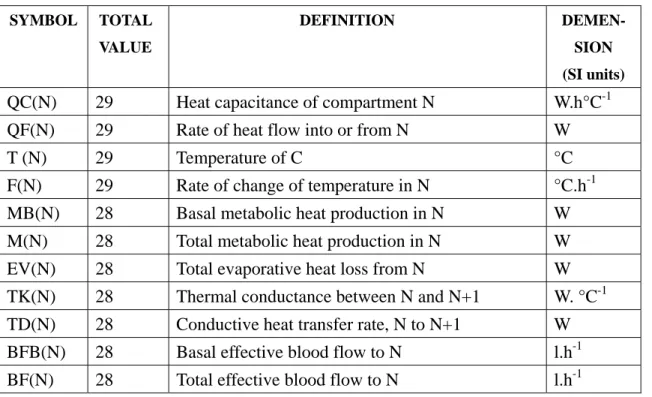
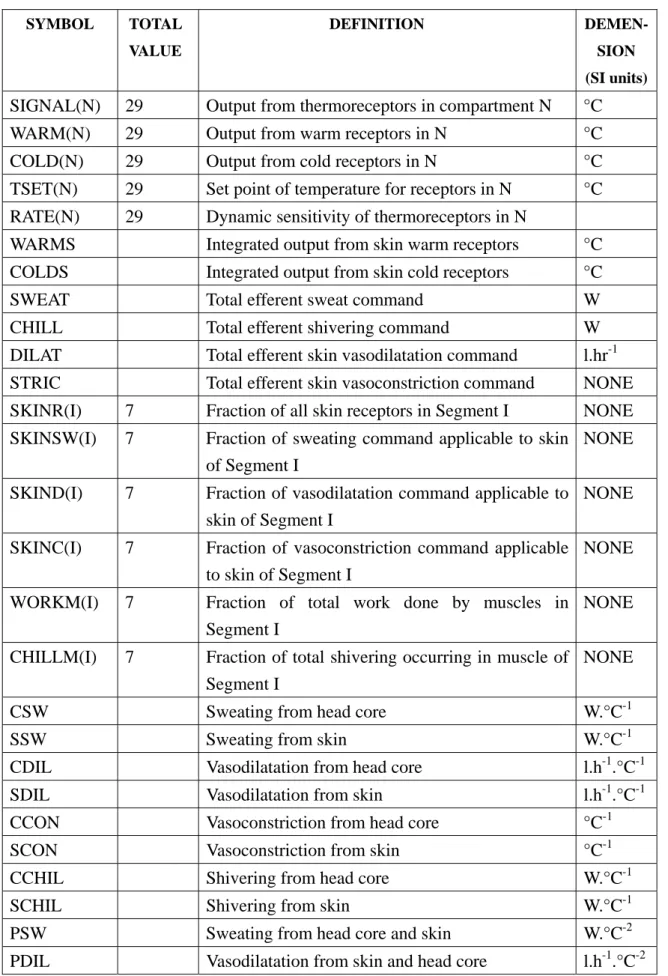
the calculation is taken as 172 cm in height and 74.4 kg in weight. Table 3.1 shows the definition of symbols and their dimension used in FORTRAN programming. In numerical calculation, each segment is presented as I and each compartment is presented as N. Therefore, the symbol I in Table 3.1 are refer to the segment, I=1 being the head,I=2, the thorax, I=3, the
CB 2 4 4 6 6 7 7 5 1 5 3
core, N
muscle, N+1
fat, N+2
skin, N+3
abdomen, I=4, the arms, I=5, the hands, I=6, the legs and I=7, the feet. The character N is refer to the individual compartment, i.e. N=4*I-3 always indicates the core layer of segment I, N=4*I-2 the muscle layer, N=4*I-1 the fat layer and N=4*I the skin compartment. The central blood compartment is represented by N=29. Table 1 (Appendix A) gives the surface area and weight of each segment together with parameters of weight and heat capacitance for each compartment. The values of heat capacitance are based on a specific heat for the skeleton of 0.58 W.h/kg.°C, 0.70 W.h/kg.°C for fat and 1.05 W.h/kg.°C for all other tissues. The central blood compartment representing the blood in the heart and the great vessels is assumed to contain 2.5 liters of blood at a specific heat of 1.04 W.h/°C. Table 2 (Appendix A) shows the thermal conductance between compartments, basal metabolic heat production and basal blood flow for each compartment (Data are taken from Handbook of Physiology ~ Reaction to
Environmental Agents [1]).
Table 3.1 Definition of Symbols used in Controlled System.
SYMBOL TOTAL VALUE
DEFINITION DEMEN- SION
(SI units) QC(N) 29 Heat capacitance of compartment N W.h°C-1 QF(N) 29 Rate of heat flow into or from N W
T (N) 29 Temperature of C °C
F(N) 29 Rate of change of temperature in N °C.h-1 MB(N) 28 Basal metabolic heat production in N W M(N) 28 Total metabolic heat production in N W EV(N) 28 Total evaporative heat loss from N W TK(N) 28 Thermal conductance between N and N+1 W. °C-1 TD(N) 28 Conductive heat transfer rate, N to N+1 W BFB(N) 28 Basal effective blood flow to N l.h-1 BF(N) 28 Total effective blood flow to N l.h-1
BCV(N) 28 Convective heat transfer between central blood and N
W
S(I) 7 Surface area of Segment I m2
HRD(I) 7 Radiation heat transfer coefficient for Segment I Wm-2°C-1 HCV(I) 7 Air environmental convective heat transfer
coefficient for Segment I
W.m-2°C-1 H(I) 7 Total environmental heat transfer coefficient for
Segment I
W.°C-1 HW Water environmental convective heat transfer
coefficient for Segment I
W.m-2°C-1 EMAX
(I)
7 Calculated maximum rate of evaporative heat loss from Segment I
W PSKIN
(I)
7 Saturated water vapor pressure at skin temperature
Torr PV 10 Vapor pressure from 5-50°C (from Steam Table) Torr WORK Total metabolic rate required by exercise W
TAIR Air temperature °C
TW Water temperature °C
V Air Movement m.s-1
RH Relative humidity in air NONE
PAIR Water Pressure in air Torr
TIME Elapsed time hr
ITIME Elapsed time min
DT Integration Step hr
3.11 Metabolic Heat Production
Metabolic rate of the brain is estimated about 17% of the basal metabolic rate, and the trunk core accounts for about 60% of the resting metabolic rate. The total skin and musculature to produce 18% of the basal metabolic heat which leaves 5% for the skeleton and connective tissue. Since the resting metabolic rate is taken as 86.5 W for the whole standard man (45.8 W.m-2), the head core has a metabolic rate of 14.9 W, the trunk core of 52.6 W and 15.6 W is to be divided between skin and musculature. The full estimated values of basal metabolic rate, MB(N) is shown in Table 2 (Appendix A).
3.12 Convective Heat Exchange Resulting from Blood Flow.
Convective heat transfer occurred between its parts as a result of blood flow. Some regions are characterized as relatively constant blood flow. For example, the brain receives a constant blood flow of about 45 l.hr-1. Resting muscle is estimated to require 1.2 l.hr-1 of blood flow for each 1.16 W of metabolic heat production, purely on the basis of supplying the needed oxygen. The distribution blood flood to different compartment in different segment including that of different skin areas is shown in Table 2 (Appendix A).
3.13 Heat Exchange with Environment
In air environment, the environmental heat transfer coefficient of each segment is shown in Table 3 (Appendix A). Air velocity considered in terms of the convective coefficient and estimated in Table 3 are for the natural convection. Substitution of proper environmental factors into the heat loss equations enables the model to respond so as to simulate thermoregulatory activity. For the condition estimated in Table 3, the sensible heat loss from the skin of segment I in air environment can be written as
In water environment, expression HA(I)*(T(4*I)-TAIR) will then be present in HW(I)*(T(4*I)-TW).
3.2 CONTROLLING SYSTEM
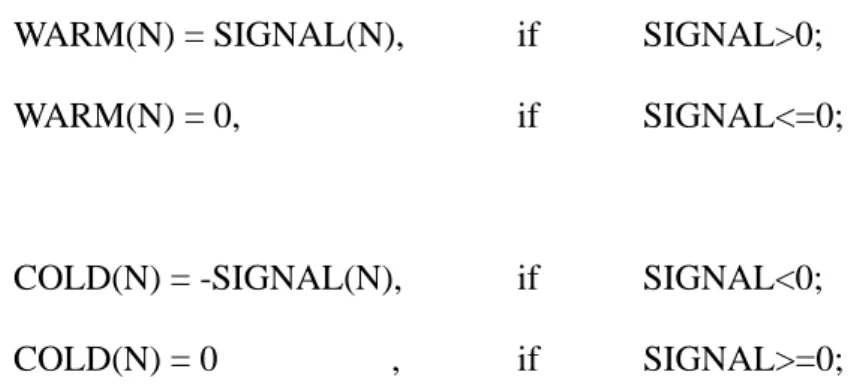
A controlling system of the model is developed to simulate human physiological response by body thermoregulation. A closed control loop with set and feedback temperature for each compartment is developed to simulate the four kinds of thermal sensations: vasoconstriction and shivering against cold; vasodilatation and shivering against heat. The actual instantaneous temperature in all the compartments are compared with the set point temperature so that “SIGNAL” can be obtained and then the outputs of “WARM” or “COLD” can be determined as the following:
SIGNAL(N) = T (N) – TSET(N) + RATE(N)*F(N) (3.2)
In the first approximation, the SIGNAL is thus equal to the difference between the instantaneous temperature T(N) and the reference temperature TSET(N). For appropriate compartment where dynamic sensitivity of the thermoreceptors is quantitatively known, the dynamic term RATE(N)*F(N) can assume positive or negative values. T(N) and F(N) are continuously computed from the passive system, and TSET(N) and RATE(N) are controlling system characteristics supplies as initial constants.
WARM(N) = SIGNAL(N), if SIGNAL>0;
WARM(N) = 0, if SIGNAL<=0;
COLD(N) = -SIGNAL(N), if SIGNAL<0; COLD(N) = 0 , if SIGNAL>=0;
Table 3.2 Definition of Symbols used in Controlling System. SYMBOL TOTAL VALUE DEFINITION DEMEN-SION (SI units) SIGNAL(N) 29 Output from thermoreceptors in compartment N °C WARM(N) 29 Output from warm receptors in N °C COLD(N) 29 Output from cold receptors in N °C TSET(N) 29 Set point of temperature for receptors in N °C RATE(N) 29 Dynamic sensitivity of thermoreceptors in N
WARMS Integrated output from skin warm receptors °C COLDS Integrated output from skin cold receptors °C
SWEAT Total efferent sweat command W
CHILL Total efferent shivering command W
DILAT Total efferent skin vasodilatation command l.hr-1 STRIC Total efferent skin vasoconstriction command NONE SKINR(I) 7 Fraction of all skin receptors in Segment I NONE SKINSW(I) 7 Fraction of sweating command applicable to skin
of Segment I
NONE SKIND(I) 7 Fraction of vasodilatation command applicable to
skin of Segment I
NONE SKINC(I) 7 Fraction of vasoconstriction command applicable
to skin of Segment I
NONE WORKM(I) 7 Fraction of total work done by muscles in
Segment I
NONE CHILLM(I) 7 Fraction of total shivering occurring in muscle of
Segment I
NONE
CSW Sweating from head core W.°C-1
SSW Sweating from skin W.°C-1
CDIL Vasodilatation from head core l.h-1.°C-1
SDIL Vasodilatation from skin l.h-1.°C-1
CCON Vasoconstriction from head core °C-1
SCON Vasoconstriction from skin °C-1
CCHIL Shivering from head core W.°C-1
SCHIL Shivering from skin W.°C-1
PSW Sweating from head core and skin W.°C-2
PCON Vasoconstriction from skin and head core °C-2
PCHIL Shivering from skin and head core °C-2
The distribution of receptors is different in individual compartment. This is to ensure every different part of compartment can have different temperatures especially important in skin compartment. Thus, the value for fraction of all skin receptors in particular segment I , SKINR shown in Table 4 (Appendix A) have been estimated from experiment by Nadel et.al [1]. The distribution of vasodilatation and vasoconstriction is also not uniform over the skin area. The relative distribution of sweat secretion, in the absebce of information based on local secretion measurements is estimated by the distribution od sweat glands. Table 4 also shows the value of SKIND, SKINC and SKINSW.
The total warm receptor output from the skin, WARMS, is obtained by summing of SKINR(I)*WARM(4*I) for the skin compartments of all segment. The total cold receptor output can be calculated from the same summation.
WARMS=
∑
SKINR(I)*WARM(I) where I = 1 to 7 andCOLDS=
∑
SKINR(I)*COLD(I) where I = 1 to 7Based on a central temperature signal from head core and the integrated signal from the skin, the efferent outputs of the controlling systems are determined, respectively, for the four thermal reactions:
SWEAT = CSW*SIGNAL(1)+SSW*(WARMS-COLDS)+PSW*WARM(1)*WARMS DILAT = CDIL*SIGNAL(1)+SDIL*(WARMS-COLDS)+PDIL*WARM(1)*WARMS CHILL=(CCHIL*SIGNAL(1)+SCHIL*(COLDS-WARMS))*PCHIL*(WARMS- COLDS) STRIC = CCON*SIGNAL(1)+SCON*( COLDS- WARMS)+PCON*COLD(1)COLDS
The controlling system equations all have a first term consisting of the product of control coefficient and a central temperature signal, a second term consisting of the product of a control efficient and an integrated skin temperature signal, and a third term consisting of the product of control efficient, a central temperature signal, and a skin temperature signal. These expression will become negative under some circumstances, therefore, any negative values of SWEAT, DILAT, CHILL or STRIC will be set to zero in numerical calculation.
3.21 Metabolic Heat Production – Work and Chill
The basal metabolic rates for all core compartments can be expressed in numerical form as the following:
M(N) = MB(N) (3.3)
These expression shows that the basal metabolic rate for all core compartments is not change under the relatively short-term condition.
For the muscle layer,
M(N+1) = MB(N+1)+WORKM(I)*(WORK)+CHILLM(I)*CHILL (3.4) The metabolic heat production in muscle compartment is the sum of the basal heat production MB(N+1), and the heat production rates assigned to muscular work done and shivering thermogenesis. Table 5 (Appendix A) shows the estimated values of WORKM and CHILLM, which is taken from the Handbook of Physiology [1]
In the fat and skin compartments, it is assumed that the basal metabolic heat production does not change in the conditions to be evaluated by the model, so that
M(N+2) = MB(N+2) (3.5)
3.22 Blood Flow
The convective heat transfer by blood flow plays a very important role in the thermal response to internal and external stresses. The blood flow to the core compartment is assumed to be remain at the basal values:
BF(N) = BFB(N) (3.7)
This expression ignores the fact that blood flow to the trunk core can be reduced during exercised stress, but the blood flow to these compartments is considerably in excess of that required to supply oxygen to these compartments, and thus only small thermal gradients can exist between core compartments.
Unlike the core compartment, muscle compartment can have widely different metabolic rates and, consequently, variations in blood flow as well. Under conditions in which heat loss in exercise is mostly from evaporation of sweat, the working muscle is about 1.0 °C above that of the arterial blood supplying oxygen. If venous blood leaves at muscle temperature, then every liter of blood contains about 200 ml O2 which, if completely scavenged, could
produce 1.16 W.h of heat. As the result, the following equation expresses the blood flow to the muscle compartment.
BF(N+1) = BFB(N+1) + M(N+1) – MB(N+1) (3.8)
Blood flow to the fat layer is not very high in basal value, and it is not effectively changed as a result of thermoregulatory adjustments
BF(N+2) = BFB(N+2) (3.9)
Skin blood flow is highly dependent on the thermoregulatory controller. The basal blood flow at thermal neutrality can be reduced to very low values through vasoconstriction, and increased through vasodilatation. The expression for local skin blood flow then becomes
In this expression, the weighted DILAT central drive is added to the basal blood flow. The weighted constrictive tone operates through a resistance and thus is entered as a divisor. The local skin temperature effect (2**(SIGNAL(N+3/10)) then acts on the total flow drive multiplying it by unity in neutral condition (SIGNAL(N+3)=0), by less than unity at skin temperatures below normal and by more than one at skin temperature above the neutral value.
3.23 Evaporative Heat Loss and Sweating
For the resting subject in air environment, evaporative heat loss occurred through skin diffusion and respiratory system. Respiratory water loss is a function of water pressure in the inspired air (PAIR) and the ventilation volume. The ventilation volume is closely related to the metabolic rate. Thus, the evaporative heat loss from respiratory water loss can be as EV(5) = (86.4+WORK)*(0.0026749)*44.0-PAIR) (3.11) Where 44.0 is the vapor pressure in expired air.
There is no evaporation heat loss occurred in other core, muscle and fat compartment, thus EV(N) = EV(N) = 0 (besides EV(5)) (3.12)
EV(N+1) = EV(N+1) = 0 (3.13)
EV(N+2) = EV(N+2) = 0 (3.14)
From eq.2.2 (Chapter 2), the evaporative heat loss through skin diffusion (ED) for segment I can be rewritten in numerical form as the following:
ED(I)=(1.6944×10⁻⁴)*HFGSKIN*SA(I)*(PSKIN-PAIR) (3.15) Where HFGSKIN is calculated by interpolation from the steam table.
The different skin compartments receive a sweating drive, SWEAT from the central controller. The local response in a skin compartment depends on the surface area and on the number of sweat glands present, expressed by SKINS(I). The evaporative heat loss through sweating (ES) then can be expressed as
ES(N+3) = SKINS(I)*SWEAT)*2.**((T(N+3)-TSET(N+3)) (3.16)
The maximum evaporative heat loss (EMAX) from a totally wet skin is proportion gradient from the water vapor on the skin surface to the water vapor in the ambient air and can be described by the relation
EMAX = λ .hD(PSKIN-PAIR) (W.m2) (3.17)
where λ is latent heat of sweat in 0.68 W.h.g-1: hD is mass transfer coefficient (for diffusion
of water vapor) in m.hr-1.
The wetted area of the skin (Aw) us defined as the area of skin, if covered with sweat,
would provide the observed rate of skin evaporation under the prevailing condition. Thus by definition
EV = Aw.EMAX/Atotal (3.18)
Skin wettedness (w) is defined as the ratio of Aw/AD. Thus
w = Aw/AD = EV/EMAX (3.19)
Skin wettedness ranges from a certain minimum value, which occurs when there is no evaporative heat loss by regulatory sweat (i.e., ES=0), to a maximum theoretical value of unity. A theoretical minimum value of zero would occur if the skin were completely impermeable to water vapor. At the minimum w value the evaporative heat loss from the skin surface is entirely due to the diffusion of water vapor (ED), evaporated within outer layers of the skin. The ED is also directly proportional to the value of EMAX. When regulatory sweating begins, evaporative heat loss may occur both by diffusion (ED) as well as by the evaporation of sweat (ES). When the skin is completely wet (i.e., w =1 ), ED no longer occurs and EV is attributed entirely to regulatory sweating (ES). The ratio ES/EMAX describes the skin wettedness (wS) due to sweating, i.e.,
and the ratio ED/EMAX is the skin wetttedness due to diffusion (wD), i.e.,
wD = ED/EMAX (3.21)
The total wettedness (w) any time is given by
w = wD + (1 - wD) wS (3.22)
By substitute Eq. (3.20) and Eq. (3.21) into Eq. (3.22), we get
CHAPTER 4
EXPERIMENTS
4.1 INTRODUCTION
Numerous studies have simulated the human physiological response in water immersion. In order to validation of the simulation result, experiments have been conducted on human subjects to measure the oral and skin temperature. Oral temperature can be used to compare with core temperature that was calculated in the simulation whereas skin temperature will be directly validated by simulation results.
4.2 METHOD
4.21 Instrumentation
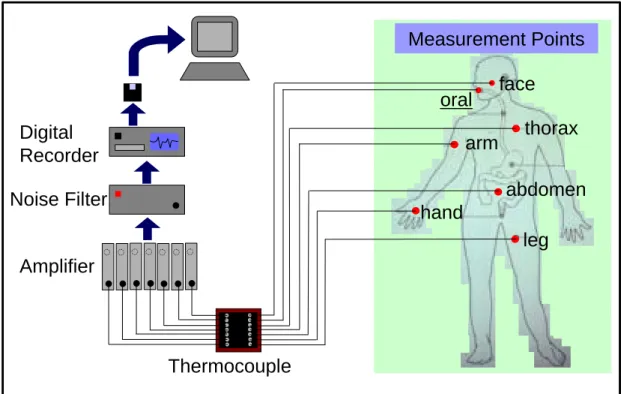
Figure 4.1 illustrates the experimental instrumentation. Oral temperature (Toral) was measured using a Copper-Constantan thermocouple directly inserted into mouth. Skin temperature was also measured by same thermocouple placed on the following sites: face, chest, abdomen, arm, forehand and leg (thigh). The measured sites were insulated with a small patch of plastic and masking tape. A layer of water strong bandages were also pasted over the patch to prevent them getting out from water. The area weighted mean skin temperature, Tsk was calculated by assigning the following regional percentages: face 7%,
chest 17.5%, abdomen 17.5%, arm 14%, hand 5% and thigh 39%. Signal were amplified, noise filtered and then collected and digitized (by NEC digital recorder, model DR-F2A) at 1-s intervals and recorded in a floppy disk. The data in Volt will then converted to temperature in Celsius by computer programming (see Programming 2: Conversion Volt to Celsius, Appendix B).
Measurement Points Noise Filter Amplifier Digital Recorder Thermocouple leg hand abdomen thorax arm face oral
Figure 4.1 Experiment apparatus
4.22 Experiment procedure
The experiments were done in a single apartment where the room and bath room temperature was around 23 to 25 °C and relative humidity was 50 to 60%. Subjects were taking bath in a one person use bathtub. Subjects were nude (wearing only swimming trunk is assumed to be nude) and were instrumented appropriately before the experiments were started. When the experiment was started, subject was resting by sitting on a chair in the room for 10 minutes (pre-immersion phase). The subject then immersed into water in the bathtub with set water temperature for 15 minutes (water immersion phase). After the water immersion, subjects then sat in the room for 30 minutes that allow the body and skin temperature recovered back to the normal condition (recovery phase).
4.23 Experiment Cases
There were 3 variable parameters in the experiments i.e. subjects, water temperature and body part of immersion. However, only one of the three parameters was become variable parameter and the other two were constant. Therefore, there were 3 cases in the experiments where in the first case, subjects were variable whereas water temperature and body part of immersion were set to constant. In the second case, water temperature was variable and subjects and body part of immersion were set to constant. Finally, in the last case, body part of immersion was variable whereas subjects and water temperature were set to constant.
Case 1:
Variable: Subjects
Constant: Water temperature and body part of immersion.
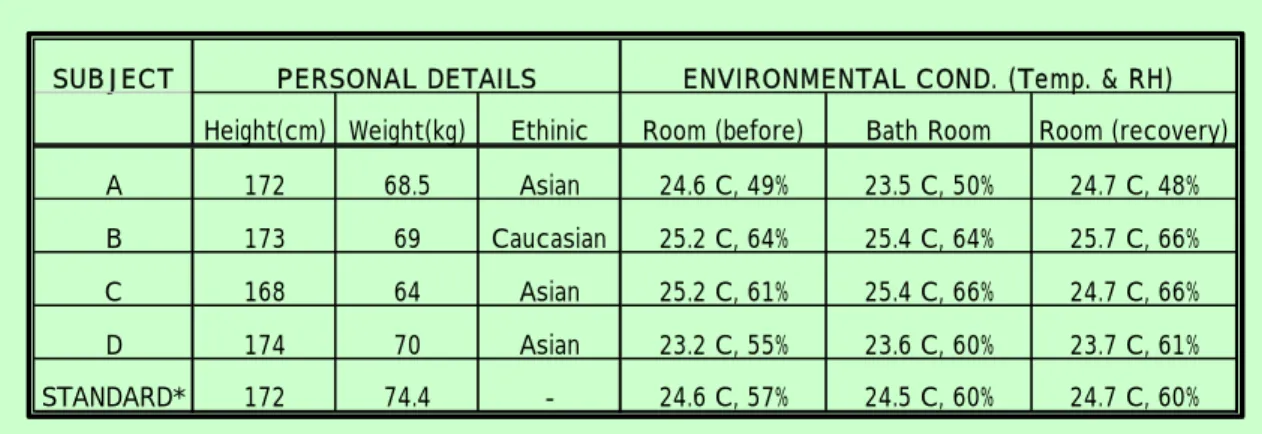
Four experiments with different subjects were carried on in this case. Four male subjects A, B, C and D, in theirs 20s with details individual particular showing in Table 4.1 participated in the experiment.
Table 4.1: Subjects Particular and Environmental Conditions
SUBJECT PERSONAL DETAILS ENVIRONMENTAL COND. (Temp. & RH)
Height(cm) Weight(kg) Ethinic Room (before) Bath Room Room (recovery)
A 172 68.5 Asian 24.6 C, 49% 23.5 C, 50% 24.7 C, 48%
B 173 69 Caucasian 25.2 C, 64% 25.4 C, 64% 25.7 C, 66%
C 168 64 Asian 25.2 C, 61% 25.4 C, 66% 24.7 C, 66%
D 174 70 Asian 23.2 C, 55% 23.6 C, 60% 23.7 C, 61%
STANDARD* 172 74.4 - 24.6 C, 57% 24.5 C, 60% 24.7 C, 60%
Water temperature was fixed to 40°C and the immersions were done by whole body immersion with only head out for the entire four experiments. Table 4.1 shows also the
carried on.
Case2:
Variable: Water temperature
Constant: Subjects and body part of immersion.
Only subject A was participated in these experiments and immersion was whole body immersion with head out. Subject A was immersed in water at 28, 40 and 44 °C in different day. Water temperature at 40°C is the normal hot bath water temperature recommended by non-technical researcher. Cold water (relatively to skin temperature) at 28°C was selected to validate the experiment and simulation results for the cold water. For the same reason, water temperature at 44°C was selected for the extremely hot water condition.
Case 3:
Variable: body part of immersion
Constant: Subjects and water temperature
In this case, subject and water temperature were fixed to subject A and 40°C. There were two experiments were carried out, first one was whole body immersion with head out and the other was half body immersion (until chest level). This experiment is to investigate the different between the different part body of immersion where some non-technical researcher suggested that half body immersion hot bath is beneficial to human.
CHAPTER 5
RESULTS AND DISCUSSIONS
5.1 EXPERIMENTAL RESULTS Case 1
The experimental results of mean skin temperature of four subjects, A, B, C and D were shown in Figure 5.1. It can be seen that mean skin temperature. Tsk remained stable and
constant (around 32 to 34 °C) during the 10 minutes period prior to water immersion,. Immediately upon immersion Tsk increased sharply to about 38 °C in 5 minutes time and kept
on increasing slowly until the end of immersion. Immediately the subjects left the water, Tsk
fell sharply to normal mean skin temperature of around 32°C in 5 minutes time and kept on decreasing slowly until it reached a constant state at the end of recovery phase.
No significant different of Tsk were observed among the four subjects. The minor different
of Tsk in the pre-immersion and recovery phase was due to the different individual particular
(such as weight, height, fat percentage etc) and the slightly different environmental conditions (Table 4.1) when the experiment was carried out.
The experimental results of oral temperature for the four subjects are indicated in Figure 5.2. As shown in the figure, the oral temperatures, Toral have reached a constant state of
around 35°C to 36°C before the immersion. The head-out immersion only induced small increase (about 1 to 1.5°C) in oral temperature. After the immersion, the oral temperature slightly increased in the first 1 to 2 minutes and then decreased slowly and returned to pre-immersion values within 20 minutes of leaving the water.
Subject B, C and D show very consistent results whereas there was not so good result was taken from subjects A. The inconstant of experimental data is due to the difficulty of oral
affected the accuracy of temperature measurement.
Mean Skin Temperature
Time (minute) 0 5 10 15 20 25 30 35 40 45 50 55 T e m p er at u re ( C el s iu s ) 28 30 32 34 36 38 40 Subject A Subject B Subject C Subject D
PRE-IMMERSION WATER IMMERSION RECOVERY
Figure 5.1 Experiment Results: Mean Skin Temperature of Different Subjects
Oral Temperature Time (minute) 0 5 10 15 20 25 30 35 40 45 50 55 Te mp era tur e ( C elsiu s ) 30 32 34 36 38 40 Subject A Subject B Subject C Subject D
PRE-IMMERSION WATER IMMERSION RECOVERY
Case 2
Figure 5.3 shows the experimental results of mean skin temperature for different water temperature conditions (44, 40 and 28°C). For water temperature of 44 and 40 °C, Tsk
increased sharply immediately upon immersion whereas Tsk decreased for water temperature
of 28 °C. In the recovery phase, for higher water temperature of 44 and 40 °C, Tsk fell sharply
to normal mean skin temperature of around 35°C in 5 minutes time and kept on decreasing slowly until it reached a constant state at the end of recovery phase. On the other hand, for lower water temperature of 28 °C, Tsk kept on decreasing and only reached stable Tsk at the
end of recovery phase.
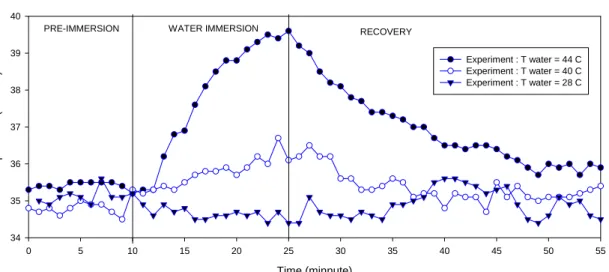
The oral temperature profiles are given in Figure 5.4. It is obvious that Toral increased
tremendously from 35.0 °C upon immersion to 39.6 °C at the end of immersion. For water temperature of 40 °C, even though the data is inconstant (increasing and decreasing) from time to time, it can be seen clearly that Toral increased in water immersion phase and
decreased after the immersion. The experimental results of Toral for water temperature of
28 °C were rather inconstant, but in generally it fluctuated at the line of oral temperature of 35°C. This indicates that there was no significant change of oral temperature profile for the immersion of 28°C water temperature condition. The inconstant of experimental data is due to the same reason as indicated in 5.1 Experiment – Case 1. This also suggests that thermocouple is not a good device to measure oral temperature.
Mean Skin Temperature Time (minutes) 0 5 10 15 20 25 30 35 40 45 50 55 T e m p e rat ur e ( C el s iu s ) 28 30 32 34 36 38 40 42 Experiment: T water = 44 C Experiment: T water = 40 C Experiment: T water = 28 C
PRE-IMMERSION WATER IMMERSION RECOVERY
Figure 5.3 Experiment Results: Mean Skin Temperature of Different Water Temperature Conditions
Core Temperature Time (minnute) 0 5 10 15 20 25 30 35 40 45 50 55 Te mperature (Celsius) 34 35 36 37 38 39 40 Experiment : T water = 44 C Experiment : T water = 40 C Experiment : T water = 28 C RECOVERY WATER IMMERSION PRE-IMMERSION
Case 3
Some non-academic researcher suggested that taking half body (until chest level) immersion bath can be more relaxing than whole body immersion. In order to see the physiological response of human in half body immersion, experiments were carried out. Figure 5.5 are results for mean skin temperature Tsk with different part body of immersion i.e.
either whole body immersion with head out or half body immersion. It can be seen that in both cases, Tsk has same profile. However, in the water immersion phase, Tsk for head-out
whole body immersion is much higher than half body immersion, which is about 2 °C higher at the end of immersion. In recovery phase, Tsk for half body immersion recovered to that of
pre-immersion phase much faster than head-out whole body immersion.
The experimental oral profile for the both body part of immersion are given in figure 5.6. Similarly, the less efficient performance of the measurement by thermocouple caused the experimental data rather inconstant. However, it still can be seen that Toral fluctuated around
the temperature line of 36°C for half body immersion whereas in head-out whole body immersion, Toral increase slowly upon immersion and decreased to that temperature of
pre-immersion phase after immersion.
The half body immersion that has much less increasing in Tsk and no increasing in Toral
and faster recovery suggest that half body immersion can be more relaxing bath and can cater for higher water temperature.
Mean Skin Temperature Time (minute) 0 5 10 15 20 25 30 35 40 45 50 55 Te mperature (Celsius ) 31 32 33 34 35 36 37 38 39
Experiment : Whole body w/ head out Experiment : Half body
PRE-IMMERSION WATER IMMERSION RECOVERY
Figure 5.5 Experiment Results: Mean Skin Temperature of Different Part of Body Immersion
Oral Temperature Time (minute) 0 5 10 15 20 25 30 35 40 45 50 55 T e mperatu re (Cels ius) 30 31 32 33 34 35 36 37 38
Experiment: Whole body w/ head out Experiment: Half Body
PRE-IMMERSION WATER IMMERSION RECOVERY
5.2 EXPERIMENTS VS SIMULATIONS
The simulation results are validated with experiment data.
Case 1
The human` temperature simulation in pre-immersion phase is begun with mean skin temperature Tsk of 34°C and core temperature, Tcore of 37°C. In order to let the simulated
human` temperature get equilibrium with the experiment environment condition, the human is simulated for 60 minute period before the immersion. Figure 5.7 shows the last 10 minute simulation result of Tsk in pre-immersion phase and the comparison between simulation and
experiments results. It can be seen that the predicted Tsk matches well with the experimental
results especially in water immersion phase. This suggests that the predicted mean skin temperatures are practically accurate and useful. However, it is noticed that the predicted Tsk
is slightly higher than experiment results for all subjects in recovery phase. The deviation is due to small measurement error in experiment. The bandages that were pasted on top the skin got wet when the subjects immersed into water. The wet bandage would not dry immediately after the immersion in the recovery phase. As the result, the wet bandage cooled down the skin surface that consequently decreased the skin temperature. Thus, the measured skin temperatures were lower then the actual skin temperature.
The “cooling effect” of bandage is given in Figure 5.7, where comparison between experiments with dry bandage (change wet bandage to dry one immediately after immersion), and the one with wet bandage. It can be seen that by changing the bandage to dry one, the mean skin temperature recovered very fast to normal mean skin condition. The sudden drop of Tsk immediately after the immersion was due to the time that changing the wet bandage to dry
Mean Skin Temperature Time (minute) 0 5 10 15 20 25 30 35 40 45 50 55 T e m p e rat ur e ( C el s iu s ) 28 30 32 34 36 38 40 Subject A Subject B Subject C Subject D Simulation
PRE-IMMERSION WATER IMMERSION RECOVERY
Figure 5.7 Experiments VS Simulation Results: Mean Skin Temperature of Different Subjects
Mean Skin Temperature
Time (minute) 0 5 10 15 20 25 30 35 40 45 50 55 Tem per atu re (C el s ius) 31 32 33 34 35 36 37 38 39
Experiment: Change to Dry Bandage Experiment: Wet Bandage Simulation
PRE-IMMERSION WATER IMMERSION RECOVERY
Estimation
Figure 5.8 Comparison between experiment with dry bandage and wet bandage usage with simulation result.
The comparison of core temperature in simulation and oral temperature in experiment data are given in Figure 5.9. One important point has to stress that oral temperature is not equal to core temperature and in fact core temperature is always higher than oral temperature. Oral temperature is measured during the experiments but not core temperature because no experiment apparatus is available for measurement without consultancy from medical specialist. It can be seen from the diagram that the predicted core temperature always higher than oral temperature and follow the same trend of increasing and decreasing. This suggest that the predicted core temperature is reasonable accurate.
Oral and CoreTemperature
Time (minute) 0 5 10 15 20 25 30 35 40 45 50 55 Tem per ature (C elsiu s ) 30 32 34 36 38 40
Subject A (Core Temperature) Subject B (Core Temperature) Subject C (Core Temperature) Subject D (Core Temperature) Simulation (Oral Temperature)
PRE-IMMERSION WATER IMMERSION RECOVERY
Case 2
In order to test the performance of the model in predicting the results of mean skin temperature, Tsk and core temperature Tcore, in different water temperature conditions, a
comparisons was made between simulation and experimental data which is given in Figure 5.10. It can be seen that the simulation results follows exactly the trend of experimental results, i.e. Tsk increased when water temperature increased and Tsk decreased when water
temperature decreased. In addition, only Tsk for the water temperature of 28°C decreased upon
immersion, which is also matched with the experimental result very well. However, it is noticed that the predict Tsk is slightly higher than experimental data in higher water
temperature (44 and 40 °C) and slightly lower than experimental data in lower water temperature (28 °C). The deviation is due to the fact that Subject A has different individual characteristic (such height weight, body fat and etc) with standard man that used in numerical calculation. In recovery phase, experimental data of Tsk was always lower than the predicted
one and took longer time to recover. The deviation is mainly due to the cooling effect of bandage, which has been discussed in 5.2 Experiments vs. Simulations – Case 1.
The comparison between simulation and experimental results of oral temperature, Toral are
given in Figure 5.11. Similar observations to that from Figure 5.10 can be obtained, i.e. Toral
profile of simulation result increased when water temperature increased and decreased when water temperature decreased. However, the performance of experimental results is not so good and this give rise to difficulty of comparison with simulation results.
The good agreement of simulation and experimental result especially for mean skin temperature suggests that the model can be applicable to simulate mean skin temperature and core temperature for different water temperature conditions including cold water.
Mean Skin Temperature Time (minutes) 0 5 10 15 20 25 30 35 40 45 50 55 T e mp era tur e (Cels ius) 26 28 30 32 34 36 38 40 42 44 Experiment: T water = 44 C Experiment: T water = 40 C Experiment: T water = 28 C Simualtion: T water = 44 C Simualtion: T water = 40 C Simualtion: T water = 28 C
WATER IMMERSION RECOVERY PRE-IMMERSION
Figure 5.10 Experiments vs. Simulation Results: Mean Skin Temperature of Different Water Conditions
Oral / Core Temperature
Time (minnute) 0 5 10 15 20 25 30 35 40 45 50 55 Te mperature (Celsius) 34 35 36 37 38 39 40 41 Experiment : T water = 44 C Experiment : T water = 40 C Experiment : T water = 28 C Simulation : T water = 40 C Simulation : T water = 44 C Simulation : T water = 28 C RECOVERY WATER IMMERSION PRE-IMMERSION
Figure 5.11 Experiments vs. Simulation Results: Oral and Core Temperature of Different Water Conditions
Case 3
Figure 5.12 represents the comparison of Tsk between simulation and experimental results.
The agreement is good despite the predicted Tsk is a little bit higher than experimental data in
immersion phase. This is due to the different individual characteristics (such height weight, body fat and etc) with standard man that used in numerical calculation. In the recovery phase, predicted T sk for head-out whole body immersion is always slightly higher than experimental
data. The discrepancy was due to the same reason, i.e. cooling effect of bandage, which has been discussed in 5.2 Experiments vs. Simulations – Case 1.
The comparison between predicted Tcore and Toral in experimental data are given in Figure
5.13. As indicated in the diagram, both predicted Tcore and experimental Toral have same
profile, i.e. a small increasing (about 1°C) in water immersion phase for head-out whole body immersion whereas no increment of temperature was found in half body immersion phase.
The constant results in the comparison between simulation and experimental data suggest that the model can also be used to predict half body immersion.
Mean Skin Temperature
Time (minute) 0 5 10 15 20 25 30 35 40 45 50 55 Te mperature (Celsius ) 30 32 34 36 38 40
Experiment : Whole body w/ head out Experiment : Half body
Simulation: Whole body w/ head out Simulation: Half Body
PRE-IMMERSION WATER IMMERSION RECOVERY
Figure 5.12 Simulation vs. Experimental Results: Mean Skin Temperature of Different Part of Body Immersion
Core/ Oral Temperature Time (minute) 0 5 10 15 20 25 30 35 40 45 50 55 T e mperatu re (Cels ius) 30 31 32 33 34 35 36 37 38 39
Experiment: Whole body w/ head out Experiment: Half Body
Simulation: Whole body w/ head out Simulation: Half body
PRE-IMMERSION WATER IMMERSION RECOVERY
5.3 SIMULATIONS
This model is not only able to predict core and skin temperature but also other human physiology response in water immersion such as metabolism rate, evaporative heat loss and how the heat flow into and out of the body. Examples of the simulation results of these parameters are given in the following diagram. They are the predicted thermal response for whole body immersion with head out in water temperature of 40°C. They are similar environmental and phases conditions with the previous experiments in section 5.1
Experiments.
Figure 5.14 shows the predicted metabolic rate for the above mentioned conditions. As shown, the metabolism rate is about constant at the around 46 W, which is the resting metabolic rate for normal people. Immediately upon immersion, metabolic rate is raising linearly to maximum at the end of immersion. After the immersion, metabolic rate is decreasing and takes about 15 minutes to reach the resting metabolic
rate. M E T A B O L IS M R A T E T IM E ( M IN U T E ) 0 5 1 0 1 5 2 0 2 5 3 0 3 5 4 0 4 5 5 0 5 5 6 0 M E TABOLLISM R A TE (W AT T) 4 4 4 6 4 8 5 0 5 2 5 4 5 6 5 8 P R E - IM M E R S IO N W A T E R IM M E R S IO N R E C O V E R Y
The simulation results of evaporative heat loss, EV are given in Figure 5.15. It is noticed that at the resting conditions of pre-immersion phase, human is predicted to loss heat to environment mainly through skin diffusion and latent respiration at the rate below 20 W. Upon immersion, EV slightly decrease because evaporative heat loss through skin no longer occurred in water immersion except in small potion of face skin. In this phase, the evaporative heat loss is mainly through latent respiration and it is increasing slowly. This is because the body try to loss heat to environment that against the heat transfer from higher water temperature into body. Once the subject leave water, EV increases sharply to about 170 W mainly from sweating through skin all over the body. It can be then prove that sweating is the important means for human loss heat to environment. EV is decreasing slowly when the subject continuous transfer heat to environment and recover to normal conditions after 15 minutes when core and skin temperature recover to optimum conditions.
EVAPORATIVE HEAT LOSS
Time (minute) 0 5 10 15 20 25 30 35 40 45 50 55 60 Ev a por ativ e H e a t L o ss ( W att) 0 20 40 60 80 100 120 140 160 180
PRE-IMMERSION WATER IMMERSION RECOVERY
Figure 5.16 represents the simulation results of how heat flow into or out of body in term of body storage of heat. Positive value means that heat is flow from the outside environment into body and on the other hand, negative values represent the heat flow from body to outside environment. It can be noticed that, in the resting conditions in pre-immersion phase, the value of storage of heat is slightly below zero, which indicates that the slightly losing heat to environment in that environment conditions. However, immediately upon immersion, the storage heat of the body has very high value of higher than 400 W, this is due to the sudden heat transfer into the body from the 40 °C warm water. During the immersion phase, it is noticed that even though it has a positive value but it is decreasing. This suggests that, the thermoregulation has activated some mechanism such as vasodilatation and evaporation heat loss through latent respiration to against the increased body and skin temperature. At recovery phase, the subject immediately has a storage of heat of the value of about –200 W. This indicates that the body loss a lot of heat to environment, main through sweating immediately after leaving water. This losses of heat to environment become decreasing as shown in diagram, the value tend to become less negative, and it takes about 15 minute to reach the optimum conditions as it was in pre-water immersion phase.
STORAGE OF HEAT Time (minute) 0 5 10 15 20 25 30 35 40 45 50 55 60 Storag e of H eat (w att) -400 -200 0 200 400 600
PRE-IMMERSION WATER IMMERSION RECOVERY
CHAPTER 6
CONCLUSION
A 29-node human thermoregulation model in water immersion has been developed to simulate the human thermal response such as skin and core temperature, metabolic rate, evaporative heat loss and etc. Meanwhile, the model can predict the mentioned thermal response with different water temperature and part of body immersion. Experimental data of oral and mean skin temperature are used for the validation of the model. The experiments were done in three cases so that validated with simulation result in different criteria. It is noticed that in most cases the simulation results are consistent with experimental data. This concludes that the model can be useful in the simulation of human thermal reaction in water immersion.
APPENDIX A – TABLES
Table 1: Surface Area, Weight and Heat Capacity of the Four Compartment in each Segment.
Segment SA Wt CO RE MUS CLE FA T SK IN
m2 kg Wt,kg QC,Wh/°C Wt,kg QC,Wh/°C Wt,kg QC,Wh/°C Wt,kg QC,Wh/°C HEAD 0.1326 4.02 3.01 2.57 0.37 0.39 0.37 0.26 0.27 0.28 THORAX 0.3402 19.25 6.09 5.72 8.95 9.4 3.54 2.47 0.68 0.71 ABDOMEN 0.3402 19.25 6.09 5.72 8.95 9.4 3.53 2.47 0.67 0.70 ARMS 0.2536 7.06 2.25 1.63 3.37 3.54 0.97 0.67 0.48 0.50 HANDS 0.0946 0.67 0.26 0.16 0.07 0.07 0.15 0.10 0.19 0.20 LEGS 0.5966 20.68 6.94 4.94 10.19 10.67 2.38 1.66 1.20 1.25 FEET 0.1299 0.97 0.43 0.27 0.07 0.07 0.22 0.15 0.24 0.26 CB 2.5 2.5 2.6 TOTAL 1.8877 74.4 27.574 23.61 31.97 33.54 11.16 7.79 3.73 3.90 *CB = central blood
Table 2: Thermal Conductance between Compartments, Basal Metabolic Heat Production and Basal Blood Flow for Each Compartment.
SEGMENT COMPAERMENT TK(N) MB(N) BFB(N) (I) (N) W/°C W l/hr HEAD core 1.61 14.95 45 1 muscle 13.25 0.12 0.12 fat 16.1 0.13 0.13 skin 0 0.1 1.44 THORAX core 0.8 26.31 105 2 muscle 2.77 2.9 3 fat 11.54 1.24 1.28 skin 0 0.23 1.05 ABDOMEN core 0.8 26.31 105 3 muscle 2.77 2.9 3 fat 11.54 1.24 1.28 skin 0 0.23 1.05 ARMS core 1.4 0.82 0.84 4 muscle 10.3 1.11 1.14 fat 30.5 0.21 0.2 skin 0 0.15 0.5 HANDS core 6.4 0.09 0.1 5 muscle 11.2 0.23 0.24 fat 11.5 0.04 0.04 skin 0 0.06 2 LEGS core 10.5 2.59 2.69 6 muscle 14.4 3.32 3.43 fat 74.5 0.5 0.52 skin 0 0.37 2.85 FEET core 16.3 0.15 0.16 7 muscle 20.6 0.02 0.02 fat 16.4 0.05 0.05 skin 0 0.08 3 TOTAL 86.45 285.13
Table 3: Values of Heat Transfer Coefficient for Each Segment
Table 4: Estimation of Distribution of Skin Receptors, Sweating, Vasodilatation and Vasoconstriction Command over the different Skin Areas.
Table 5: Estimates of Distribution of Heat Production in Muscle Compartment.
SEGMENT HR HC W/M2.C W/M2.C HEAD 4.8 3.0 THORAX 4.8 2.1 ABDOMEN 4.8 2.1 ARMS 4.2 2.1 HANDS 3.6 4.0 LEGS 4.2 2.1 FEET 4.0 4.0
SEGMENT
SKINR
SKINS
SKINV
SKINC
(I)
(I)
(I)
(I)
HEAD
0.21
0.081
0.132
0.01
THORAX
0.21
0.24
0.161
0.025
ABDOMEN
0.21
0.24
0.161
0.025
ARMS
0.1
0.154
0.095
0.19
HANDS
0.04
0.031
0.121
0.2
LEGS
0.2
0.219
0.23
0.2
FEET
0.03
0.035
0.1
0.35
SEGMENT
WORKM
CHILLM
(I)
(I)
HEAD
0
0.02
THORAX
0.15
0.43
ABDOMEN
0.15
0.43
ARMS
0.08
0.05
HANDS
0.01
0
LEGS
0.6
0.07
FEET
0.01
0
Table 6: Temperature Set Point for initial condition.
SEGMENT N COMPARTMENT TSET
C HEAD 1 core 36.96 1 2 muscle 35.07 3 fat 34.81 4 skin 34.58 THORAX 5 core 36.89 2 6 muscle 36.28 7 fat 34.53 8 skin 33.62 ABDOMEN 9 core 36.89 3 10 muscle 36.28 11 fat 34.53 12 skin 33.62 ARMS 13 core 35.53 4 14 muscle 34.12 15 fat 33.59 16 skin 33.25 HANDS 17 core 35.41 5 18 muscle 35.38 19 fat 35.3 20 skin 35.22 LEGS 21 core 35.81 6 22 muscle 35.3 23 fat 35.31 24 skin 34.1 FEET 25 core 35.14 7 26 muscle 35.03 27 fat 35.11 28 skin 35.04 CENTRAL BLOOD 29 36.71
APPENDIX B
Programming 1: Simulation of Physiology Reaction in water immersion
Figure B.1 indicates step by step how the simulation of body temperature regulation in air and water environment is written by programming in FORTRAN .
Input CHOISE Read Constant: CONTROLLED SYSTEM Read Constant: CONTROLER Read INITIAL CONDITIONS Read EXPERIMANTAL CONDITIONS Determine “SIGNAL” OUTPUT Establish THERMO-REGULATION Calculate M, EV & BCV SUBROUTINE “EVAPORATION” Calculate HEAT FLOW Determine INTEGRATION STEP Calculate NEW TEMPEARTURE OUTPUT < LIMIT ? Establish OUTPUT ITIME < SET TIME ? END 1 2 3 4 5 8 6 7 11 10 9 12
Figure B1 Flow Chart of Programming Steps
The first step is to select if the programming simulates water immersion with only head out or half body immersion. If (CHOICE=1) then simulation will do for water immersion with
only head out whereas (CHOICE=2) for half body immersion.
The second section reads the constants as defined in the tables in Appendix A (Table 1,2 &3). The values of PV are taken from the Steam table and consist of the saturated water vapor pressure at 5°C intervals from 5°C to 50°C. As the same way, the third phase read the constants for controlling system as defined in the Table 4,5, & 6 (Appendix A). Table 6 shows the temperature set point, TSET, the value of steady-state equilibrium temperature which have reached the following conditions: air temperature 29.45°C, air velocity 0.1 m/s and relative humidity of 0.3.
The fourth step read the initial conditions for all compartment and set all elapsed time (TIME & ITIME) and rate of change of temperature in N to zero. The initial values for temperature of all compartments are set to those values of TSET.
The fifth step read the experimental conditions according to its environmental conditions. A loop is established here to run the program for 3 phases: 1. air environment, 2. water environment and 3. air environment again. The environmental conditions for air environment are air temperature (°C), air velocity (m/s), relative humidity (%), work rate (W) and intervals between output (INT). The value from work rate will be then used to calculate the total extra heat production in the working muscle by subtracting it from basal metabolic rate. Thus, WORK represents the total extra heat production in the working muscle. Next is to determine H(I), the total environmental heat transfer coefficient according to its environment: (MEDIA=100) for air environment and other for water environment. In water environment is further divided into water immersion with head out and half body immersion. Lastly, PAIR is calculated from the interpolation of PV according to the air temperature in experimental conditions.