学習を促し、課題を監督するためのスタンプカード
システムの導入
著者
HARDY Darrell
雑誌名
観光学研究 = Journal of tourism studies
号
14
ページ
75-97
発行年
2015-03
URL
http://id.nii.ac.jp/1060/00007099/
Creative Commons : 表示 - 非営利 - 改変禁止 http://creativecommons.org/licenses/by-nc-nd/3.0/deed.jaAbstract
For specialized English language courses such as content based or English for Specifi c Purposes (ESP), teachers may feel the need to promote broader language learning outside of the classroom in an attempt to fi ll in gaps that students may have in their current language competencies that the program may not fulfi ll. This paper reports the initiation of a Stamp Card System designed to encourage learners in a Tourism ESP program at Toyo University in Japan to study English outside of the classroom with the goals of: introducing a system to monitor homework; introduce students to resources and activities that will help develop different language skills; and to plant the seeds for autonomous learning. Although having met with limited success, the students seem to be willing to accept a self-study system such as this. As a result, this project will continue to develop via action research.
1.0 Introduction
1.1 Mandatory English Courses for Tourism majors at Toyo University
Students in the Faculty of Global Regional Development who major in Tourism at Toyo University are required to complete two mandatory English language courses: Tourism English and Applied English. Both of these courses are topic based covering major topics in tourism such as jobs in tourism, package tours, air travel, etc. Tourism English, which is offered in the fi rst year, is an introductory course where as Applied English, a required course for second year students, is more focused on group projects based on the tourism topics studied in class. Both of these courses are considered English for Specifi c Purposes (ESP) (Hutchinson and Waters, 1987; Harding, 2007) and are designed to provide English language training to English as a Foreign Language (EFL) students for a specifi c need, in this case possible future employment within the tourism industry in Japan or abroad.
1.2 ESP and the need for independent study
Due to the specialized nature of ESP courses, students may not receive the benefi ts offered by a more general approach to EFL where the focus is on overall language competency. As a result, ESP
Introducing a Stamp Card System to Monitor Homework,
Broaden Exposure to English Outside of the Classroom, and
to Promote Autonomous Learning
Darrell HARDY*
courses may not address the comprehensive language needs of a given group of learners, especially students who are of lower level. This creates the need for teachers to come up with a solution of trying to fi ll in “gaps” that students may have in their language competency without deviating too far from the original syllabus.
One solution to this problem is to create a self-study program where students are required to complete language tasks which could help to provide more balance to studentsʼ learning. If designed properly, a study program could provide students which additional benefi ts. First of all, a self-study program could help to introduce students to resources available on campus. At Toyo University Hakusan campus there are a number of useful resources to promote language use and learning which student may not be aware of. For instance, the library has a comprehensive collection of graded readers from several different publishers. Graded readers are books where the level of diffi culty has been set to meet the language needs of the various levels of language learners. The level of graded readers is decided by the frequency and complexity of lexicon, length, and the complexity of grammar. Extensive Reading, where the focus is on reading volume and reading for pleasure, has a number of benefi ts such as building vocabulary, reinforcing syntax, and developing a positive attitude towards reading in English (Renandya and Jacobs (2002)). Another valuable resource for students is the English Community Zone (ECZ). The ECZ is a conversation lounge where students can meet and speak English with foreign exchange students and students from other classes. The ECZ also offers a variety of seminars on a number of topics relating to English language education such as training for the TOEIC test and seminars on study abroad programs. Although the ECZ provides an excellent opportunity for students to practice oral communication, few students take advantage of this resource.
Self-study programs have perhaps a greater importance in terms of the development of learner centered study skills. Scharle and Szabo (2000) state that learner centered self-study programs promote the development of independent learners where the student begins to take responsibility for his or her own language development rather than simply follow instruction from the teacher. According to Scharle and Szabo the development of independent learning is a gradual process beginning with raising studentsʼ awareness to activities and language resources outside of the classroom. Students then develop a sense of responsibility for their own learning where the student begins to feel that an uncompleted task such as homework represents a missed learning opportunity rather than an obligation.
Another key concept of self-study programs, according to Pezeshkian and Kafi pour (2011) is the development of learning strategies. Students subconsciously employ some form of learning strategies in the early stages of L2 acquisition as a way of memorizing vocabulary, enunciating sounds, or internalizing grammar. However, when students consciously develop and use strategies to help them
learn as such word association to memorize vocabulary, it is considered an important step meta-cognitively. Learning strategies also include developing preferences which may depend on factors such as personality, culture, and a sense of priority. Introducing students to a variety of activities to promote different language skills will create opportunities for students to build preferences and develop new learning strategies.
Finally, self-study or student centered study programs have been shown to create positive attitudes among students and develop intrinsic motivation. Obviously developing a positive attitude is an important fi rst step developing intrinsic motivation. According to Dönyei (2001) intrinsic motivation or the motivation to do something because of a fondness for doing such a thing is a key factor in learning a language. Although there are other forms of motivation, intrinsic motivation is perhaps the most powerful. Giving students the choice of what to study and when to study leads to the development of learning strategies and preferences, which in theory leads to the development of a positive attitude towards the second language which leads to a desire to study to improve mainly for personal satisfaction.
1.3 Case study: Stamp Card System at Toyo Gakuen University
The main problem with self-study programs is how to encourage students to take the initiative to study outside the classroom materials or language tasks that are not homework requirements of the course per se but activities that will benefi t the student in his or her pursue for English language profi ciency. One such program was initiated at Toyo Gakuen University with campuses in Tokyo and Chiba in 2010 by the English Education Development Center (EEDC) which is the department responsible for coordinating English language classes and teachers for the university.
This system, known as the Stamp Card System, was conceived by one instructor, Clair Taylor, who designed a credit card sized card with several tasks including visiting the English Lounge, reading graded readers, and building vocabulary through activities on the website smartFM. Taylorʼs idea was when students completed a task such as spending lunch time in the English Lounge speaking English with teachers and other students, the student would receive a “stamp.” The student shows his or her card to the teacher in charge and receives an ink stamp on the card in a box next to the activity. Taylor issued stamp cards to her student as a pilot program in the 2009 academic year and helped to initiate a coordinated effort by all native English teachers and several Japanese English teachers in the spring of 2010 (Talandis Jr, G., Taylor, C.et all. (2011)) of which the author participated in.
The main goals of this project were to increase attendance of the English Lounge and to make use of other university resources such as graded readers. Another goal was to enhance student motivation for studying English thus promoting autonomous learning. The stamp card drastically increased English
Lounge attendance and participation at special lounge events and more students took advantage of school resources and other activities. Overall the stamp card was considered a success even though overall student participation was less than 50% (i.e., over half of the students either lost or did not use the stamp card at all) and completion of the stamp card was rare. Another factor was differences in approach by teachers. Some teachers assigned up to 20% of the course grade based on the stamp card and spent much class time in computer rooms allowing students to work on smartFM and other stamp card related tasks in class while other teachers introduced the stamp card as optional homework for ‘bonusʼ points and spent less time promoting the stamp card perhaps believing that student centered learning should be encourage but not forced.
2.0 The Project
2.1 Purpose
As discussed earlier, students who major in Tourism at Toyo University may not receive comprehensive English language study due to the focus of their ESP English language courses in Tourism English. A system could be created, adopted, or adapted to encourage students to utilize resources outside of the classroom that could help to fi ll in gaps in learning and provide greater exposure to English since attending two 90 minute English classes a week is not really enough time to fully develop English language skills.
Furthermore, as previously discussed, there are other benefi ts to students that self-study programs can bring. We have considered the fi ndings of previous researchers that student centered learning programs promote awareness of the learner to the importance of self-study to the advancement of his or her language ability. Awareness leads to responsibility, the development of learning strategies, goal setting, which fosters a positive attitude, often greater motivation, and fi nally the development of the autonomous learner.
Therefore, the objectives of this project are:
1. To design, adopt, or adapt a system of independent learning that is versatile and easy to manage
2. To encourage students to take advantage of university English language resources to develop a variety of language skills
3. To improve learner motivation for studying English and promote autonomous learning
2.2 Background information about classes and students
Department of Tourism, Faculty of Regional Development at Toyo University in Japan. The Title of the fi rst course is Tourism English (Kanko Eigo in Japanese) and all fi rst year students are required to take this course. Tourism English is a four skills course providing instruction and practice to improve speaking, listening, reading, and writing while following a topic based syllabus. The topics covered in this course are tourism related topics such as jobs in tourism, tour operators, accommodations, and so on. Assessment is based mainly on two paper tests (a midterm and fi nal), a speaking test (role-play), and attendance.
The second course, Applied English (Oyo Eigo in Japanese), is a mandatory course for second year students and is similar to Tourism English in that it is a four skills course following a topic based syllabus. As the name implies, students are required to work in groups on projects which incorporate the topics covered in class. Students are assessed on attendance and the presentation of their projects
The studentsʼ language ability in English vary and are placed into classes according to their TOEIC test scores. It is mandatory for students to take the TOEIC test at the end of the academic year as well as prior to begin classes in the fi rst year. There are eight Tourism English (TE) classes consisting of approximately 30 students each and six Applied English (AE) classes with an average of 40 students each. The top level class in each category is labeled “A1” followed numerically down to the lowest level class (according to TOEIC scores). Generally speaking most students have a reasonable explicit understanding of English grammar and basic vocabulary which they have learned in high school English. However, as typical of Japanese students entering university, they struggle to communicate even on a basic level.
Both TE and AE courses are designed to run two terms, spring and fall, for 15 weeks each. The classes are mostly taught by native English language instructors and each class meets twice a week for a total of 30 classes a term. As mentioned earlier, both TE and AE are four skill course, however, the classroom environment is meant to be as “communicative” as possible with a focus on speaking and listening.
2.3 The Stamp Card System
Due to my prior experience with the stamp card system used at Toyo Gakuen University, I decided to adapt a similar system for my two TE classes (A2 and A6) and three AE classes (A2, A4, and A6) at Toyo University.* The stamp card is the size of a regular business card (in fact the cards were printed out on paper templates design to print out homemade business cards) (see fi gure 1). In the Spring and Fall terms of 2013 the stamp card included three activities: the English Community Zone (ECZ), * (classes are listed as “A” in the Spring term and “B” in the Fall term. In this study both Spring and Fall term
graded readers (GR), and Quizlet (QL). These activities were chosen to develop different language skills and competencies.
Figure 1: Stamp Card (slightly larger than actual size)
Stamp Card: Tourism English Name: Class:
The ECZ, meaning visits to the English Community Zone, allows students the opportunity to practice speaking and develop fl uency. Students were required to spend at least 30 minutes in the ECZ to receive a stamp or the initials of the foreign exchange student they were talking to or receive a stamp or initials from the person at the reception.
Graded readers were included as a way for students to improve reading skills and hopefully become interested in reading books in English. Students were encouraged to select any reader they found interesting and were recommended to choose an easy level at fi rst. After fi nishing a reader, students were required to fi ll in a simple book report form and turn it in to the teacher in order to receive a stamp.
The third activity was a vocabulary building activity using the website, Quizlet (www.quizlet.com). First, students were required to register and set up a user account. Once set up, students could log in anytime, search and select word lists, and begin studying vocabulary through a variety of word games and quizzes. The website could track the number of words students had learned and this was displayed on the studentʼs profi le page. Students were then required to print out their profi le page and show it to the teacher. Students received a stamp per 100 words learned according to the website.
2.4 Implementation
This project was initiated in the Spring term of 2013 involving fi ve classes: two TE classes and three AE classes. Of the two TE classes, the upper level class, TE A2, consisted of 30 students and the TOEIC scores ranged from 420 to 460. The lower level class, TE A6, consisted of 29 students with TOEIC scores from 320 to 360. The three AE classes were A2, A4, and A6 with 38, 41, and 48 students
100 200 300 400 500 600 700 800 900 1000 English Community Zone Graded Readers Quizlet
respectively and the TOEIC ranges were 470 to 535 for A2, 390 to 425 for A4, and 330 to 385 for A6. On the fi rst day of classes, students were each given a stamp card and a hand out explaining the purpose of the stamp card system, the activities, and impact on grade (10% of the fi nal grade for the semester). Since 30 stamps are required to complete the stamp card, each stamp was worth approximately 0.33% of their total grade. Each activity was discussed in detail, especially quizlet since this website is entirely in English (except for word lists in other languages, such as, Japanese to English). Quizlet registration involves a number of steps, so the orientation covered this in detail. After initial orientation, students were reminded throughout the term to complete stamp card activities and were encouraged to see the teacher after class to receive stamps for completed activities.
2.5 Data Collection
At the end of each term students were given a questionnaire to provide feedback for participation or lack of it, and their opinion of the activities and the system itself. Also, students were required to turn in their stamp cards for grading.
2.6 Action Research
It is rarely the case that the implementation of a new initiative, whether it be a project like this to promote independent learning, or a new syllabus, can be executed perfectly from the beginning. Instead the development of a program or project is an ongoing process of adjustments and modifi cations as a result of data collection and feedback from students and teachers alike. This ongoing process is referred to as Action Research. According to Nunan (1993) and is vital part of course and professional development.
During the project, adjustments to the stamp card and the means of implementation have been modifi ed in an attempt to improve upon the system. These changes and the reasons behind them will be discussed together along with the results of each term of data collection.
3.0 Results and Discussion
The data presented here is derived from two sources: data from an end of term questionnaire completed by students and data from stamp cards received by students. The implications of the data is discussed in this section including student preferences in activities and the differences in participation between classes. Also, as an Action Research project, the changes implemented and reasoning behind these changes will be discussed.
3.1 Spring 2013
Questionnaire:
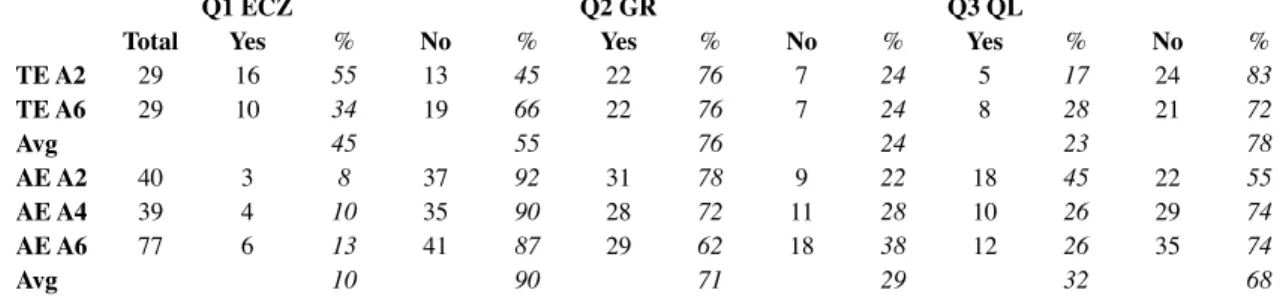
At the end of The Spring term 2013, students from all fi ve class were asked to submit their stamp cards and complete a questionnaire (see appendix 1) about their participation, opinion of the various activities, and opinion of the system itself. The fi rst three questions asked about their participation of the three activities: English Community Zone (ECZ), Graded Readers (GR) and Quizlet (QL). The results are presented in Table 1. (the column labeled “total” indicates the number of questionnaires completed per class)
Table 1: Summary Spring 2013 Stamp Card Questionnaire Questions 1 to 3
Question 1: “Did you visit the English Community Zone (ECZ)?” Students were prompted to select either “yes” or “no” and write a comment. On average 45% of TE student responded “yes” while 55% responded “no.” In comparison signifi cantly fewer AE students visited the ECZ (10%) which is surprising because AE students are second year students and should be familiar with the ECZ and therefore, less apprehensive to visit. More than half of TE A2 students (55%) visited the ECZ which is high relative to the other classes.
Question 2: “Did you read any graded readers?” Here the average for both TE and AE is over 70% (TE 76% and AE 71%), representing the highest participation of all three activities. There could be a number of reasons to explain this. First of all, reading is an activity that most students enjoy to a certain extent and probably have read simple stories in English in high school or in the case of AE students, had been required to read graded readers in their fi rst year TE class the previous year. Along with being a familiar activity, perhaps it is the less intrusive activity in the sense that it is probably the most passive of the three activities.
Question 3: “Did you try Quizlet?” This activity was rather unpopular for both TE and AE as the participation for each was on average 23% and 32% respectively meaning most students did not even try this activity. There were several drawbacks to this activity. First of all, students were required to create user accounts and even though it was not complicated and a thorough explanation was given
Q1 ECZ Q2 GR Q3 QL
Total Yes % No % Yes % No % Yes % No %
TE A2 29 16 55 13 45 22 76 7 24 5 17 24 83 TE A6 29 10 34 19 66 22 76 7 24 8 28 21 72 Avg 45 55 76 24 23 78 AE A2 40 3 8 37 92 31 78 9 22 18 45 22 55 AE A4 39 4 10 35 90 28 72 11 28 10 26 29 74 AE A6 77 6 13 41 87 29 62 18 38 12 26 35 74 Avg 10 90 71 29 32 68
in class, the website is entirely in English and this may have intimidated some students. Also, it takes some time to fi nd good word Japanese ̶English / English̶ Japanese word lists and to get accustom to the activities, and quizzes. Once students invest some time to use the website, most fi nd it enjoyable, however, it seems most students were unable to overcome the initial learning curve.
Table 2: Summary Spring 2013 Stamp Card Questionnaire Questions 4 and 5
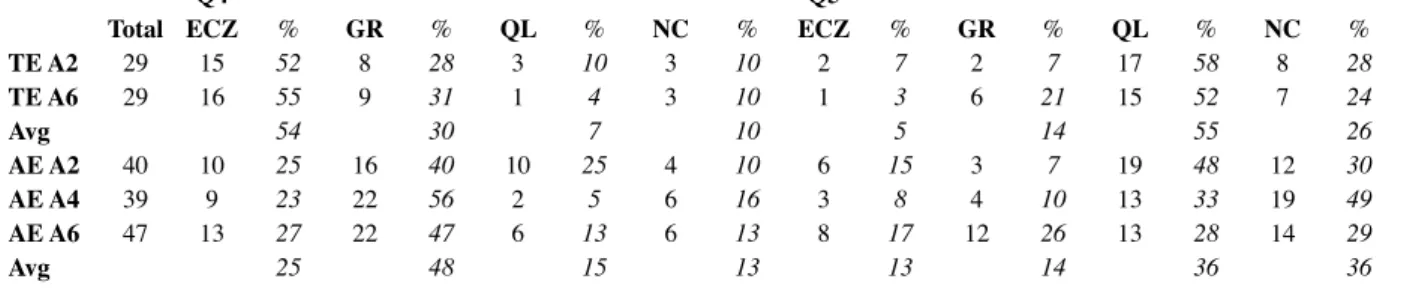
Questions four and fi ve were to determine which activity students perceived to be the most useful (4) and the least useful (5) to improve their English. Table 2 above presents the data.
As the most useful activity, 54% of TE students selected ECZ followed by GR (30%) and QL (7%). This is a rather curious result as only 45% of TE students claimed to have visited the ECZ. One possible explanation for this is that even though some students had never been to the ECZ for whatever reason, they recognize the importance of visiting the ECZ and interacting in English. AE student on the other hand chose GR as their number one (48%) which is consistent with participation rate. However, ECZ (25%) was chosen over QL (15%) even though more students attempted QL than visited the ECZ.
For question fi ve we should expect to see the reverse of question four which is the case with TE. AE students also chose QL as the least useful activity, however, slightly more students selected GR as the second least (14%) than ECZ (13%) even though GR was voted the most useful activity in question four. Naturally, this kind of questionnaire with a rather small sample size can be used only as a rough guide, however, this a good reminder that student preferences vary and even a popular activity like GR will not be liked by all.
Table 3: Summary Spring 2013 Stamp Card Questionnaire Comments Questions 1-3, 6:
Q4 Q5
Total ECZ % GR % QL % NC % ECZ % GR % QL % NC %
TE A2 29 15 52 8 28 3 10 3 10 2 7 2 7 17 58 8 28 TE A6 29 16 55 9 31 1 4 3 10 1 3 6 21 15 52 7 24 Avg 54 30 7 10 5 14 55 26 AE A2 40 10 25 16 40 10 25 4 10 6 15 3 7 19 48 12 30 AE A4 39 9 23 22 56 2 5 6 16 3 8 4 10 13 33 19 49 AE A6 47 13 27 22 47 6 13 6 13 8 17 12 26 13 28 14 29 Avg 25 48 15 13 13 14 36 36 Q1 Q2 Q3 Q6
Total Pos % Neg % NC % Pos % Neg % NC % Pos % Neg % NC % Pos % Neg % N % NC %
TE A2 29 19 66 6 20 4 14 17 59 5 17 7 24 2 7 15 52 12 41 12 41 0 0 5 17 12 41 TE A6 29 4 14 15 52 10 34 10 34 6 21 13 45 0 0 21 72 8 28 10 34 0 0 0 0 19 66 Avg 40 36 24 47 19 35 4 62 35 38 0 9 54 AE A2 40 1 3 16 40 23 57 18 45 4 10 22 55 5 13 20 50 15 37 12 30 4 10 12 30 12 30 AE A4 39 2 5 30 77 7 18 11 28 4 10 24 62 5 13 21 54 13 33 6 15 0 0 7 18 26 67 AE A6 47 1 2 31 60 15 32 16 34 15 32 16 34 6 13 29 62 12 25 7 15 1 2 7 15 32 68 Avg 3 61 36 36 17 50 13 55 32 20 4 21 55
For questions one to three students were prompted to comment as to why or why they did not participate in the particular activity. The comments were classifi ed as positive (Pos), negative (Neg), or no comment (NC). Examples of positive comments were: “I could talk with foreign students.” (ECZ); “I enjoy reading books.” (GR); or “Quizlet is fun.” (QL). Examples of negative comments were: “I was afraid to enter.” (ECZ); “I was busy.” (GR); “I donʼt understand Quizlet.” (QL). Sometimes it is not clear whether a statement like, “I was busy.” or “no time” is negative, however, in this case this and similar comments were interpreted as excuses not to complete a task and therefore negative.
As mentioned in the previous section, visiting the ECZ was considered the most useful activity by TE students, yet AE students did not rate it as high. Nevertheless, AE students rated the ECZ as number two in question four and number three in question fi ve indicating that they see valve in this activity even though participation was the worst of the three. The comments AE students made for question one does shed some light on this problem. Only 3% of the comments were positive, 61% negative, and 36% no comment. Many of the comments such as “I canʼt speak English.” or “no confi dence” indicate a strong apprehension to enter the ECZ even though students can see the value in attending an English lounge like the ECZ.
Student comments on question three are also tell taling. The majority of the comments for both groups of students were negative for the use of QL. Comments such as “I donʼt understand how to use.” or “Itʼs diffi cult.” were very common. Even though students were presented with a seemingly clear explanation. They were voicing the need for greater support which they should have received. Unfortunately, it was not practical to allocate class time to take fi ve classes of students to a computer room and set up QL accounts, fi nd word lists, and practice some of the activities.
Finally, for question six students were asked the open ended question, “How do you think we can improve the stamp card system?” Not surprisingly most students chose not to comment to this rather direct question, however, the ones who did wrote mostly positive or neutral comments. Even among the few negative comments, none were overly negative. TE students wrote more positive comments than AE students (38% vs. 20%) and most were similar to, “Stamp card is a good system.” or just “good.” Some AE students wrote more objective comments offering advice which have been classifi ed as neutral. Many of these comments are quiet insightful showing perhaps greater maturity of second year students. More than one student commented that the teacher should take the class to the ECZ for orientation. Also, several students asked for a clearer explanation and bilingual explanation in English and Japanese (all materials are in English only). However, the most common comment was that the stamp card should be mandatory (which it is) and that the teacher should check it more often such as one a month or once every two weeks. In short, studentsʼ responses to question six indicate that students generally agree with the system (or at least are not overly opposed to it judging from the lack of negative comments) and
seem to be willing to accept stricter monitoring of the completion of stamp card activities. Stamp Card:
Table 4: Summary Spring 2013 Stamp Card:
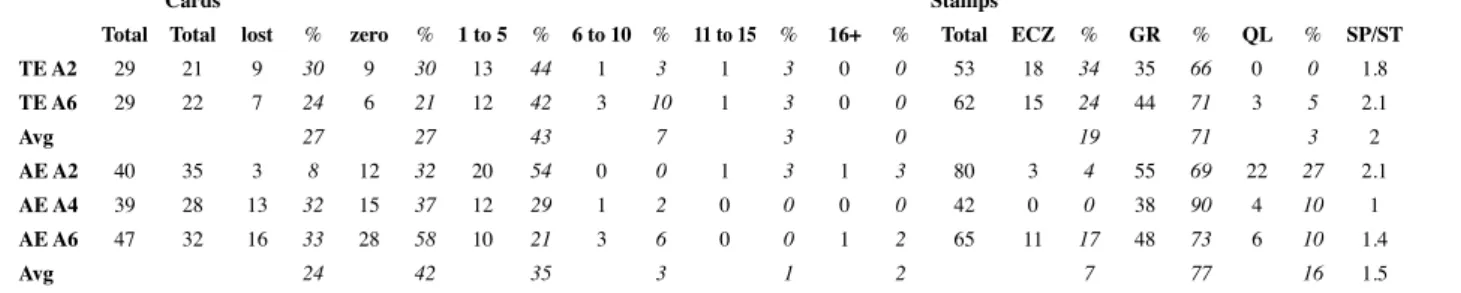
Each student from received a stamp card at the beginning of the term and were required to turn in their stamp cards for grading at the end of the term. The above table (table 4) lists the data collected from the stamps for all fi ve classes.
As the data shows, approximately one quarter of the students did not turn in their stamp cards, in most cases, claiming that they had lost their cards. Also, a large percentage of cards were turn in blank, meaning the students had not completed any of the tasks or provided evidence to prove that they had completed tasks required to receive stamps. On average, 48% of TE stamp cards were not turned in or blank, whereas more than 60% (68%) of AE stamp cards were not submitted or blank. Therefore, for TE, only 52% of students participated with the vast majority, 43%, collecting only 1 -5 stamps per card. Only 41% of AE students bothered to collect stamps, of which 35% collected 5 or less stamps. In other words, only seven cards or approximately 10% of TE students collected more than 5 stamps, whereas only 6 AE students (6%) collect more than 6 stamps. Clearly, this data shows a lack of participation and students did not seem compelled or obligated to compete tasks to receive stamps. This is further demonstrated by the student to total stamp ratio which is 2.0 for TE and 1.5 for AE.
In terms of stamps collected, stamps for GR were the most received by quite a margin (TE 71% and AE 77%). For TE, ECZ was number two at 19% of the stamps collected and only 3% of the stamps collected were for QL. This corresponds with the questionnaire data for TE. As for AE classes, QL (16%) was more popular than ECZ (7%) and this again is consistent with the questionnaire results of questions one to three. Comparison of Questionnaire and Stamp Card Data:
Ideally the data regarding activity participation compiled from questions one to three in the questionnaire should match the actual numbers from the stamp cards, however, in reality this is quite different. According to the questionnaire 26 TE students claimed to have visited the ECZ, while 13 AE
Cards Stamps
Total Total lost % zero % 1 to 5 % 6 to 10 % 11 to 15 % 16+ % Total ECZ % GR % QL % SP/ST TE A2 29 21 9 30 9 30 13 44 1 3 1 3 0 0 53 18 34 35 66 0 0 1.8 TE A6 29 22 7 24 6 21 12 42 3 10 1 3 0 0 62 15 24 44 71 3 5 2.1 Avg 27 27 43 7 3 0 19 71 3 2 AE A2 40 35 3 8 12 32 20 54 0 0 1 3 1 3 80 3 4 55 69 22 27 2.1 AE A4 39 28 13 32 15 37 12 29 1 2 0 0 0 0 42 0 0 38 90 4 10 1 AE A6 47 32 16 33 28 58 10 21 3 6 0 0 1 2 65 11 17 48 73 6 10 1.4 Avg 24 42 35 3 1 2 7 77 16 1.5
students made the same claim. However, only 14 TE students and fi ve AE students actually received stamps on their stamp cards for this activity. This is the same with the other activities, for instances the actual number of cards stamped for GR is approximately 50% less than as claim by the questionnaire (TE: 28 vs. 44; AE: 31 vs. 88). The biggest difference is with QL where 18 TE students claimed to have tried QL, however, only two cards were stamped. AE was only slightly better with 30 students claiming to have tried QL versus nine cards actually stamped for this activity.
This observation brings up the question as to why students would over estimate their participation in these activates considering the questionnaire was anonymous and students would have nothing to gain for answering “yes” when in fact they had not completed the task. Perhaps one reason lies in the questions themselves. Students were ask if they visited the ECZ, read GR, or tried QL, which they may have done with the intension of doing the task but ultimately not completing it. For example, students may have visited the ECZ briefl y and decided to leave after a short time or logged on to QL only give up before “learning” 100 words, the number required to get a stamp.
Finally, there were probably a number of students who had indeed completed tasks but for some reason did not submit the evidence to the teacher to get a stamp or hesitated to ask at the ECZ for a stamp or initials. Also, there may have been students who had completed tasks and received stamp yet lost or failed to submit their cards.
Action Research:
Even though data from both the questionnaire and the stamp cards indicate that overall participation was low. I decided not to make any major changes to the stamp card system with the idea that it takes time for students to become familiar with the system and therefore should be able to participate more in the Fall term. I was hoping that familiarity would result in more awareness, responsibility, and motivation and wanted to use the next term to test my assumption.
In an attempt to increase QL participation and in response to student comments regarding problems with QL, I decided to reintroduce QL by providing a new handout including screen shots on how to create a user account and links to useful wordlists.
3.2 Fall 2013
Since the data from spring 2013 term was presented in detail, raw data and in depth discussion of points already mentioned will be omitted from this point on to avoid repetition and minimize lengthy discussion. The data presented from this point on will be only be to summarize and to discuss new procedures and fi ndings.
Questionnaire:
The Fall 2013 questionnaire was similar to the Spring questionnaire, however a few more questions were added. First of all, Student responses to questions one to three (participation) were quite similar to the results of the Fall version: visits to the ECZ were slightly lower, GR participation was slightly higher and QL participation was lower, even with additional orientation.
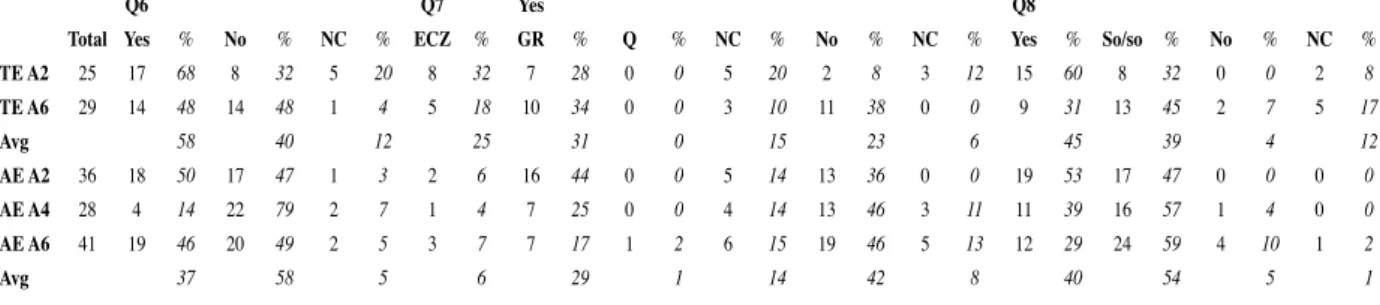
Three additional questions (6, 7, and 8) were added to gage studentsʼ motivation for the stamp card, possible continuation of stamp card activities, and general feeling towards studying English. (Question six from the Spring questionnaire became question nine in the Fall questionnaire). The following table lists the results from these questions:
Table 5: Summary Fall 2013 Stamp Card Questionnaire Questions 6 - 8:
Question 6: Did you use the stamp card more this term (Fall) than last term (Spring)? For this question more TE students answered “yes” (58%) than “no” (42%). Unfortunately, more AE students answered “no” (58%) than “yes” (37%). From this data, one can probably assume that stamp card participation will be slightly lower than last term
Question 7: Do you think you will continue any of these activities in the future? This question was included to test student motivation for continued self-study and perhaps an indication of the initiation of autonomous learning. TE students answered positively to this question with 71% indicating that they were willing to continue one or more of these activities. GR was the most popular activity at 31% followed by ECZ at 25%. AE students were divided, 50% indicated that they were willing to continue studying whereas 42% indicated negatively and 8% were undecided. Overall, the results of this question were quite encouraging: the majority of students expressed an interest to continue to study one or more of these activities in the future.
Question 8: How do you feel about studying English? The choices were: I really like studying English (“Yes” on table 5); I donʼt mind studying English (“so/so” on table 5); or I donʼt like studying English (“No”) on table 5. This question was included to get a feel for studentsʼ attitude towards
Q6 Q7 Yes Q8
Total Yes % No % NC % ECZ % GR % Q % NC % No % NC % Yes % So/so % No % NC %
TE A2 25 17 68 8 32 5 20 8 32 7 28 0 0 5 20 2 8 3 12 15 60 8 32 0 0 2 8 TE A6 29 14 48 14 48 1 4 5 18 10 34 0 0 3 10 11 38 0 0 9 31 13 45 2 7 5 17 Avg 58 40 12 25 31 0 15 23 6 45 39 4 12 AE A2 36 18 50 17 47 1 3 2 6 16 44 0 0 5 14 13 36 0 0 19 53 17 47 0 0 0 0 AE A4 28 4 14 22 79 2 7 1 4 7 25 0 0 4 14 13 46 3 11 11 39 16 57 1 4 0 0 AE A6 41 19 46 20 49 2 5 3 7 7 17 1 2 6 15 19 46 5 13 12 29 24 59 4 10 1 2 Avg 37 58 5 6 29 1 14 42 8 40 54 5 1
studying English which could be interpreted in a broader sense to their general attitude to English. The majority of students from both groups answered either “yes” or “so/so” with only a few students expressing a dislike for English. This again is an encouraging result as it is much easier to motivate students who like English or do not have a strong dislike for the language.
Stamp Card:
Table 6: Summary Fall 2013 Stamp Card:
Concerning the number of cards received, the Fall data is similar to the Spring data with regard to TE classes. In fact slightly more cards with stamps were received in the Fall than the Spring (35 vs. 34). However, signifi cantly fewer cards with stamps were received from AE students (30 vs. 39) and most of these were received from one class (A2). This is a rather discouraging trend and also demonstrates that higher level classes tend to maintain a higher level of motivation than lower level classes.
The stamp data shows a similar trend in which the number of stamps per TE student has decreased slightly from the Spring term (1.8 vs. 2.0). AE classes show a more signifi cant drop in stamps per student (.9 vs. 1.5). Again this can be contributed to poor participation from the lower level A4 and A6 classes. In terms of activities, fewer students visited the ECZ and almost no students used QL with the exception of one student who collected all ten QL stamps. The vast majority of students preferred GR to the other activities.
Action Research:
Now that two terms of the stamp card system had been completed. It was time to refl ect on the data and consider changes. Results from the Fall term were rather discouraging and indicated that some of the activities should be changed or monitored differently.
QL was especially problematic because students were still having diffi culty navigating the site and soon became frustrated. Even though web based learning offers a huge potential of learning opportunities for language learning, perhaps it is a mistake to assume that because university students have grown up
Cards Stamps
Total Total lost % zero % 1 to 5 % 6 to 10 % 11 to 15 % 16+ % Total ECZ % GR % QL % SP/ST TE A2 30 19 11 37 4 13 13 44 1 3 1 3 0 0 51 6 12 45 88 0 0 1.7 TE A6 29 25 4 14 5 17 19 66 1 3 0 0 0 0 56 1 2 54 96 1 2 1.9 Avg 26 15 54 3 2 0 7 92 1 1.8 AE A2 38 29 9 24 11 29 15 39 2 5 1 3 0 0 64 0 0 57 89 7 11 1.7 AE A4 42 22 20 48 18 43 4 9 0 0 0 0 0 0 6 1 17 4 66 1 17 0.1 AE A6 44 28 16 36 20 45 6 13 1 2 1 2 0 0 34 5 15 17 50 12 35 0.8 Avg 36 39 20 2 2 0 16 68 21 0.9
in the computer era, they are competent and eager to use computers. Also, the massive uptake of smart phones, especially among young people has probably resulted in decreased computer usage by students, since student no longer require a computer to accomplish most of their computing needs.
After careful consideration, I decided to implement several changes for the 2014 academic year. First of all, Students would be required to use a notebook labeled “My Homework Diary” to keep notes of their stamp card activities. Instead of handing in a graded reader form as before, students were required to write the graded readerʼs title, authorʼs name, a brief summary, and their impression of the book in their homework notebooks. Also, after visiting the ECZ, students were expected to write a brief note with the date and time, who they talked to, what they talked about, and their feelings at the time.
Another change was the replacement of QL with My Word List (MWL). In order to receive a stamp for vocabulary, students must make a list of 25 new words in their homework diaries and include at least one sample sentence. After completing a task or task(s) students were instructed to show the teacher their homework diaries before or after class to receive a stamp or stamps on their stamp cards.
3.3 Spring 2014
Questionnaire:
The data for the Spring 2014 questionnaire is very similar to that of the Spring 2013 questionnaire with a few exceptions. Examining questions one to three, more TE student claimed to have visited the ECZ and fewer AE students indicated that they have read GRs. The biggest difference, however, is a greater participation with MWL compared to QL especially for TE students in which over 50% claimed to had done MWL tasks as to only 23% QL participation a year ago.
Also, the data for questions four and fi ve indicate a more positive reception for MWL than QL. Even though MWL ranked third overall in question four by both TE and AE students, the difference between activities was minimal. Question results are almost equal among the three showing greater balance between preferences of students.
Stamp Card:
Table 7: Summary Spring 2014 Stamp Card
Cards Stamps
Total Total lost % zero % 1 to 5 % 6 to 10 % 11 to 15 % 16+ % Total ECZ % GR % MWL % SP/ST TE A2 33 26 7 21 3 9 15 46 6 18 1 3 1 3 109 23 21 54 50 32 29 3.3 TE A6 33 29 14 43 7 21 11 33 1 3 0 0 0 0 39 14 36 22 56 3 8 1.2 Avg 32 15 40 11 2 2 29 53 19 2.3 AE A2 44 34 10 23 17 39 15 34 1 2 0 0 0 0 52 5 10 34 65 23 44 1.2 AE A4 43 20 23 54 9 20 9 20 1 3 1 3 0 0 44 11 25 12 27 21 48 1 AE A6 40 23 17 42 16 40 5 13 2 5 0 0 0 0 24 1 4 14 58 9 38 0.6 Avg 40 33 22 3 2 0 13 50 43 0.9
The results for the number of cards received is consistent with other terms, however, there are some exceptions with the number of stamps collected. First of all, one class, TE A2 was quite exceptional in the ratio of stamps per student which was signifi cantly higher that other classes in the past. TE A6 and AE A2 in Spring 2013 both achieved 2.1 stamps per student whereas TE A2 Spring 2014 achieved 3.3. Also, the average participation of MWL was much higher than that of QL in previous terms, especially for AE classes. It seems that students agree with the switch from QL to MWL as a vocabulary building activity.
Action Research:
Although the switch from QL to MWL seems to have helped balance out student participation among the three stamp card activities, there still remains the problem of relatively low participation, especially with the lower level AE classes, A4 and A6. Having tried many times to explain the benefi t of stamp card activities and attempting to motivate students to complete stamp card activities for the benefi ts they may have on improving language skills and not succeeding, I decided to take a more aggressive approach. At fi rst I would try to monitor students progress more closely by keeping a running tally on the type and number of stamp they collected and possibly set targets, something I was reluctant to do previously.
3.4 Fall 2014
Stamp Card:
Although the Fall 2014 term had yet to conclude at the time of this paper submittal and students had not had a chance to complete questionnaires, data from a running tally on stamps can be displayed.
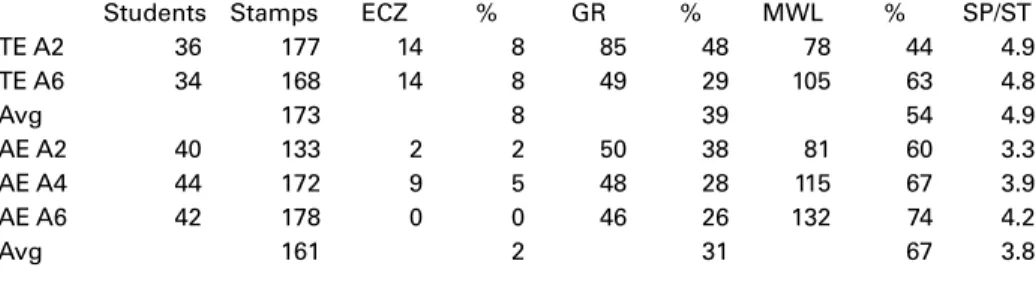
Table 8: Summary Fall 2014 Stamp Card:
The stamp card data presented here, though incomplete, represents a large step forward in terms of the number of stamps received per student. The reason for this is the setting of a “check point” in which students had to have at least fi ve stamps before the fi rst check point which was November 17 for TE and November 21 for AE. Students were asked to show their stamp cards and homework
Students Stamps ECZ % GR % MWL % SP/ST
TE A2 36 177 14 8 85 48 78 44 4.9 TE A6 34 168 14 8 49 29 105 63 4.8 Avg 173 8 39 54 4.9 AE A2 40 133 2 2 50 38 81 60 3.3 AE A4 44 172 9 5 48 28 115 67 3.9 AE A6 42 178 0 0 46 26 132 74 4.2 Avg 161 2 31 67 3.8
diaries and were told they would receive a “demerit” point subtracted from their course attendance and participation score (20% of fi nal grade). Fortunately, most students complied and completed the fi ve stamps with little or no fuss. It seems that the students are quite open to the idea of “check points” and two more have been set before the end of the term.
Another interesting result is MWL has become the most popular activity of the three. Possibly this because students are accustom to making wordlists and probably fi nd it an effective way to learn new words. Making wordlists is not fancy or high tech but it has a practical application which students seem to rely on.
4.0 Conclusion
As mention previously in section 2.1 the objectives of this project were:
1. To design, adopt, or adapt a system of independent learning that is versatile and easy to manage
2. To encourage students to take advantage of university English language resources to develop a variety of language skills
3. To improve learner motivation for studying English and promote autonomous learning
For the fi rst objective, I decided to adapt a stamp card system designed by Talandis Jr, G., Taylor, and C.et all. (2011).due to my familiarity with the system. The system is simple and relatively easy to administer. Students are familiar with stamp cards because it is common for shops to use stamp cards as a system to reward loyal customers. Students do seem to enjoy receiving stamps as it implies a reward for an achievement. One drawback of this system is that some lose or fail to turn in their cards. This problem can be minimized by having students record their stamp card activities in a notebook, such as the homework diary as a backup. In conclusion, the stamp card system is relatively easy to manage and students seem to enjoy receiving stamps as a recognition of their achievements.
In response to the second objective, the stamp card system can be a good method to introduce students to resources outside of the classroom, however, in this case the stamp card met with limited success. The biggest problem was of students participation which was very low. This can be attributed to several reasons.
First of all, orientation is very important to the implementation and understanding of the system. Clearly written explanations, preferably in both English and Japanese is required along with illustrations. Unfortunately, it seemed that some students were confused with some of parts of the explanation, especially for QL. The explanations were entirely in English which could have been
diffi cult for some students to fully comprehend. Having a Japanese translation of the stamp card orientation would have probably helped reduce confusion as to what was required of the students.
Also, spending class time to visit, demonstrate, and try the activities is important for students to get a better grasp at what is required to complete stamp card tasks. An example of this is taking students to the library and showing them in person where the graded readers are located and physically show them some of the different titles and levels available. Regrettably, this was impractical for several reasons. First, classes are quite large: TE classes have 30 or more students and AE classes 40 or more making it diffi cult to arrange class visits to the library or ECZ. Secondly, the ECZ opens at 11:00 a.m. making it diffi cult to arrange visits for morning classes. Finally, there is only a limited amount of time to spend on stamp card orientation. If orientation takes more than one class period, the regular class schedule or syllabus could be compromised.
Never the less, in spite of these limitations, a means around them should be an important part of any further Action Research.
Success or failure of the third objective is diffi cult to measure because the development of autonomous learning is a gradual process which begins with developing awareness and responsibility. Hopefully the stamp card has prompted awareness of some of the options and resources that students have in order to engage in learning outside of the classroom. Through the questionnaire we have determined that most students have a positive or neutral attitude towards learning English which is a good starting point for any self-learning program.
Another important concussion involves the degree to which a student centered learning program like this should be monitored. One of the confl icts with setting up a student centered learning system is how much energy and class time the teacher should put into the project and to what extent completion of the stamp card tasks should count towards studentsʼ fi nal grade. The term autonomous can be defi ned as doing for oneʼs self or doing a task on oneʼs own accord. Thus when promoting autonomous learning we are trying to direct students down a pathway to discover their own language needs and decide on the methods and strategies on how to accomplish their language goals. The contradiction that teachers are faced with is, if we put too much emphasis on such a program does it not contradict the purpose of the program? In other words how can we call it autonomous learning if we force our students to complete the self-study tasks and/or the tasks are weighed to the extent that students will fail the course if they refuse to participate?
The answer to the above dilemma is not clear, however, as indicated by the results of the Fall 2014 data when stamp card progress was monitored by check points, participation dramatically improved.
As indicated by the questionnaire students seem to welcome a stricter approach. Perhaps it gives more relevance to the project. This concussion was also reached by Taylor, C, et, al (2012), a project which I was also involved in, however, at that time I was still rather skeptical of the approach of forcing students to complete task in order to promote “autonomous learning.” However, now I am much more open to the idea because students seem to need this kind of supervision. Perhaps this is due to cultural respect and dependency on the teacher and to the relative young age of the students. Regardless of the reasons, teachers should take advantage of this tendency for “the greater good.” Although it seems necessary to “push” students to expose them to various activities that they can do outside of the classroom, it may be benefi cial to them in the long term to develop important skills for self-study such as awareness, responsibility, learning strategies, on the way to becoming autonomous learners.
Reference
Dönyei, Z. (2001). Motivational Strategies in the language classroom. Cambridge, UK: Cambridge University Press.
Harding, K. (2001). English for Specifi c Purposes. Oxford, UK: Oxford University Press.
Hutchinson, T., Waters, A. (1997). English for Specifi c Purposes; A learning-centred approach. Cambridge, UK: Cambridge University Press.
Nunan, D. (1993). Action research: What, How, and Why. The Language Teacher, 17, 15-17.
Scharle, A. and Szabo, A. (2000). Learner Autonomy, A guide to developing learner responsibility. Cambridge: Cambridge University Press.
Renandyra, W. and Jacobs, G. (2002). Extensive Reading: Why Arenʼt We All Doing It? In C. Richards, W. Renandya (Eds), Methodology in Language Teaching, An Anthology of Current Practice (pp.295-302). New York: Cambridge University Press.
Pezeshkian, F. and Kafi pour, R. (2011). Language Learning Strategies, The Relationship with Attitude and
Motivation. Saarbrucken, Germany: Lap Lambert Academic Press.
Talandis Jr, G., Taylor, C.et all. (2011). The Stamp of Approval: Motivating Students towards Independent Learning. The Toyo Gakuen Daigaku Kiyo (Bulletin of Toyo Gakuen University) 19, 165-181.
Taylor, C., Beck, D., Hardy, D., Omura, K., Stout, M., & Talandis, G. (2012). Encouraging students to engage in learning outside the classroom. In K. Irie & A. Stewart (Eds.), Proceedings of the JALT Learner Development SIG Realizing Autonomy Conference, {Special issue} Learning Learning, 19(2), 31-45. Retrieved from http://Id-sig.org/LL/19two/taylor.pdf
授業外で英語へ触れさせることを広げかつ自主的な学習を促し、課題を
監督するためのスタンプカードシステムの導入
ダレル・ハーディ 概要 コンテンツベースドなどの専門英語コースまたは特定な目的の英語(ESP)では、教員は学生が その専門のプログラムでは習得せず、また現段階において持っている言語能力とのギャップを埋め るために、授業外でより広範な言語学習を促進する必要性を感じることがある。本論文では、課題 を監視するシステムの導入、別の言語能力を発達させるのに役立つ手段や活動を学生への紹介、そ して自主的な学習を芽生えさせることを目標に授業外でも英語を学習し、東洋大学の観光 ESP プ ログラムにおいて学生を育成するために考えられたスタンプカードシステムの導入についての報告 である。達成した例はまだ限られているが、学生このような自習システムを受け入れているように 見られる。結果として、このプロジェクトはアクションリサーチによって進められていくのである。Appendix 1
Stamp Card Questionnaire Spring 2013
The stamp card system is designed to encourage students to study English outside of the classroom and to introduce different ways to study English. The various activities were included to help improve different skills, for example, the English Community Zone to improve speaking skills; graded readers to help improve reading skills; and quizlet to build vocabulary and promote online learning.
We would like to evaluate this system and make changes to improve the stamp card. Please answer the questions by checking one of the boxes for each question and write a brief comment. This survey is anonymous so please do not write your name. Thank you very much for your cooperation.
1. Did you visit the English Community Zone (ECZ) □ Yes What did you think of the ECZ? □ No Why not? _
2. Did you read any graded readers?
□ Yes What did you think about graded readers? □ No Why not?
3. Did you try quizlet?
□ Yes What did you think of quizlet? □ No Why not?
4. Which activity did you fi nd the most useful to improve your English? □ ECZ
□ Graded readers □ Quizlet
5. Which activity did you fi nd the least useful? □ ECZ
□ Graded readers □ Quizlet
Appendix 2
Stamp Card Questionnaire
Fall 2013
The stamp card system is designed to encourage students to study English outside of the classroom and to introduce different ways to study English. The various activities were included to help improve different skills, for example, the English Community Zone to improve speaking skills; graded readers to help improve reading skills; and quizlet to build vocabulary and promote online learning.
We would like to evaluate this system and make changes to improve the stamp card. Please answer the questions by checking one of the boxes for each question and write a brief comment. This survey is anonymous so please do not write your name. Thank you very much for your cooperation.
1. Did you visit the English Community Zone (ECZ) □ Yes What did you think of the ECZ? □ No Why not?
2. Did you read any graded readers?
□ Yes What did you think about graded readers? □ No Why not?
3. Did you try quizlet?
□ Yes What did you think of quizlet?
□ No Why not?
4. Which activity did you fi nd the most useful to improve your English? □ ECZ
□ Graded readers □ Quizlet
5. Which activity did you fi nd the least useful? □ ECZ
□ Graded readers □ Quizlet
6. Did you use the stamp card more this term(fall) as compared to last term(spring)? □ Yes
□ No Why or why not?
7. Do you think you will continue any of these activities in the future? □ Yes Which one(s)?
8. How do you feel about studying English?
□ I really like studying English □ I donʼt mind (so/so) □ I donʼt like studying English (comment)