South East Asian Studies,Vol. 14, No.3, December 1976
Paddy Soils in Tropical Asia
Part 6. Characteristics of Paddy Soils in Each Country
Keizaburo KAWAGUCHI* and Kazutake KYUMA**
In the preceding papers1-S) paddy soils in tropical Asia have been dealt with
in a general manner. In most cases only country means were given without dis-cussing the regional differences within a country. In this paper we try to give a more detailed account on the paddy soils in each country, using the material classification and the fertility grading scheme developed in Part 4 and Part 5, respectively, of this series.
Bangladesh
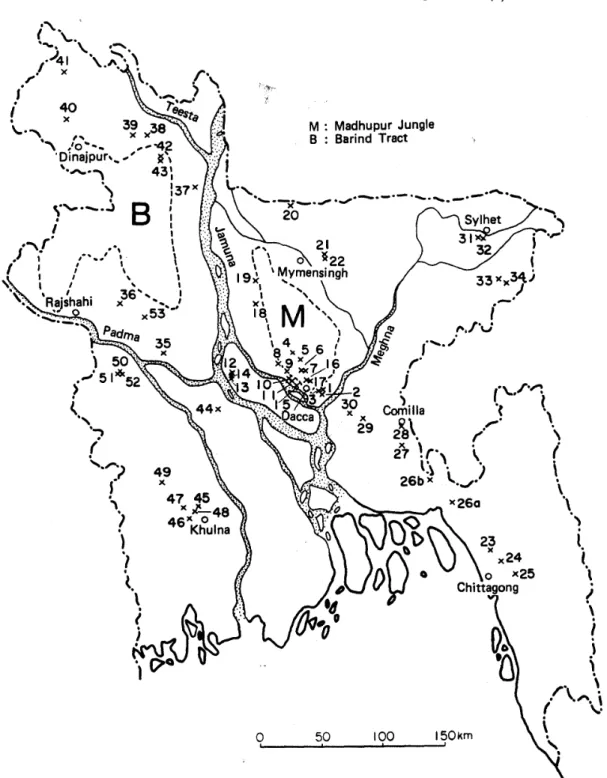
Paddy soils In Bangladesh are distributed throughout the country with the exception of hilly areas along the northern and eastern borders, and the saline coastal areas, notably in Sunderbans. Most of the parent materials of the paddy soils are recent alluvial sediments deposited by the Brahmaputra (or Jamuna) and the Ganges (or Padma), and to a lesser extent by the Teesta, Meghna, and other minor rivers originated from the eastern Tertiary hills. There are two areas made up of Pleistocene terrace materials, the Madhupur Jungle and the Barind Tract. They are apparently more highly weathered and contain iron and manganese nodules. Some of the terrace soils have a peculiar morphological feature, the occurrence of a bleached horizon or whitish sand separations in the subsurface, on which Brinkman6 )
developed a discussion of "ferrolysis". Along the coast to the south of Chittagong acid sulfate soils locally known as "kosh" soils occur in small areas (Islam7)). In Sunderbans which is a wide coastal swamp forest area to the west of the present mouth of the Ganges-Brahmaputra, some potentially acid sulfate soils are known to occur (Brammer8 ). But in this latter area development of acidity would not be very severe because of the free lime contained in the Gangetic sediments.
No large areas remain for further expansion of rice lands unless coastal areas are effectively protected from saline water intrusion and from occasional flood tides caused by cyclones.
The sampling sites in Bangladesh are plotted in Fig. 1. The samples may be
• )11D;fi=:B~, Faculty of Agriculture, Kyoto University
K. KAWAGUCHI &K. KYUMA: Paddy Soils in Tropical Asia (6) M : Madhupur Jungle B : Barind Tract
.,
·... ·-x...·"""""'·...".·...·-·_· ... ·...· ..·.".-
.-.
20o
l - ' 50...' 1001 - '_ _- - - "150km Fig. 1 Map showing Sampling Sites in BangladeshBd-12-14, 35, 36,44-53
Bd-I-3,8, 10, 11, 15, 18, 19,21, 22,27, 29 Bd-4-7, 9, 16, 17, 42, 43
Bd-20, 23-26, 28, 30-34, 37-41 grouped into the four according to the origin and
(Brammer*) .
Gangetic alluvium Brahmaputra alluvium Peistocene terraces Marginal areas
the nature of parent materials
*
Undated map showing distribution of parent materials.331
\ 1 (': 5'-3 ("
,.
.... ...) I' ''\ ) ').,
't. \ i i i \...,...-.--..,...."..._
..-...-.-.-...-. 8c
\ 2 ) "--1 (",.
.... ,.,...) I' ~ ) ') i ·t. \ i i Q 50 190 i \...,.-.".;.-.._
..."... ..,._._-_._._._._.-.-5 f'-./''''l '/ . "... \ I' , , i i 'I \ .~ i i " ; "'i i,
/\-\
( .'", i ". 150kmFig. 2 Map of Bangladesh, showing Distribution of Samples in Terms of Soil Material
and Fertility Characteristics_
As shown in Fig_ 2A soil materials are generally moderate in quality_ Many of the soils on the Ganges and Brahmaputra sediments belong to the soil material classes III, V, and VII, the last one being more silty and illitic in nature. The terrace materials and the materials in the piedmont of the Tertiary hills (included
K. KAWAGUCHI&K. KYUMA: Paddy Soils in Tropical Asia (6)
in Marginal areas) are grouped in class II, which is more depleted and siliceous. Inherent potentiality grades 2 and 3 dominate in the Ganges and Brahmaputra sediment areas, while grades 4 and 5 are frequent in the terrace and piedmont areas. The northwestern region covered by the Teesta sediments is sandy in soil texture and this is reflected in the low inherent. potentiality grade (see Fig. 2B).
Organic matter status varies widely depending on the local topography and no generalization according to the region is possible (see Fig. 2c).
Available phosphorus status is generally good for the Ganges-Brahmaputra sediment areas, whereas it tends to be poor in the terrace and piedmont areas. Relatively high phosphorus content is one remarkable feature of the recent Ganges-Brahmaputra sediments (see Fig. 2n).
Burma
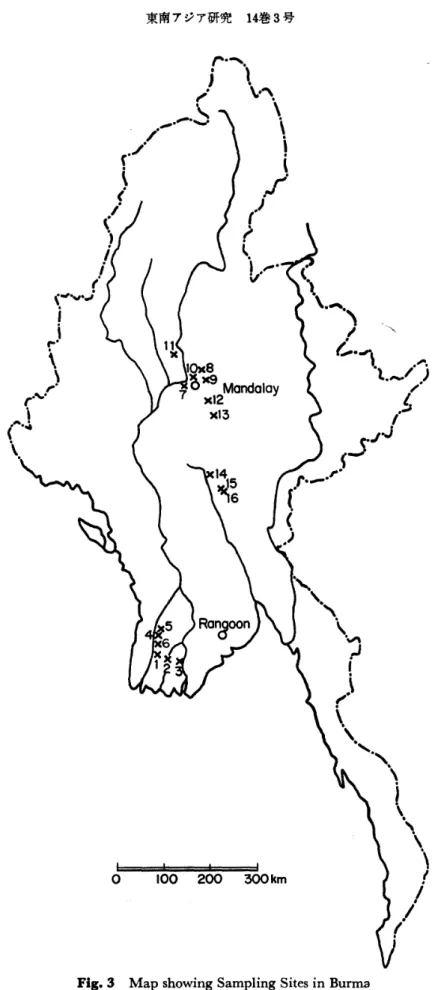
As stated previouslyl), the paddy soil samples taken in Burma are not satis-factory not only because of their small number but also because they represent paddy soil inadequately. Burma has two major rice growing areas Lower Burma and Upper Burma with entirely different climatic and physiographic conditions. Lower Burma comprises the Irrawaddi-Sittang delta and coastal areas facing the Bay of Bengal. It is humid to perhumid during the rainy season receiving more than 2000 mm of rainfall in 6 months (May-Oct.). Upper Burma is represented by the area around Mandalay, characterized by a much drier climate. More than 55% of rice acreage is in the Irrawaddi-Sittang delta and about 18% in Upper Burma. The coastal areas and the mountain states have 13.5% each of the total rice acreage (Government of Burma9) ) •
Of the 16 samples taken in Burma 6 (B-I-6) come from the Irrawaddi delta, 7 (B-7-13) from the area around Mandalay and 3 (B-14-16) from the transition zone along the Sittang valley (see Fig. 3). B-7, taken in kaing-land or a sand bar in the Jrrawaddi, and B-14 are non-paddy soils.
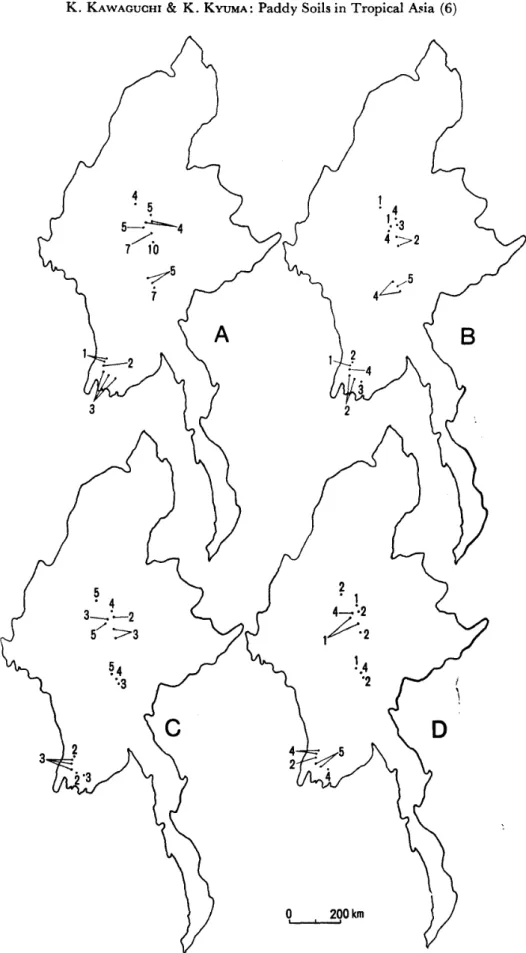
The climatic difference between Lower and Upper Burma is reflected in the soil materials. As shown in Fig. 4A, the samples from the Irrawaddi delta are clayey but have moderate to low base status, classes I, II, and III, while those from Upper Burma are characterized by moderate to high base status, classes IV, V, VII, and X.
Inherent potentiality is high for clayey soils in the delta and Upper Burma, but moderate to low for sandy non-paddy soils and for those on older alluvia (B-6, 15, and 16) in the wetter climate areas (see Fig. 4B).
Organic matter status is poorer for Upper Burma soils in a drier climate and richer for wetter deltaic soils. Phosphorus status is, on the contrary, poorer for the
300km 200 !())c8
7~X9
Mandalay )(12 )(13 100o
",.-..j
\
".
\."'\."
\
_.-...
\
/.
.
,
r/
.
,
.
\
r'
<'
'"
/
.J
(
.
;
( » •.
~ I .,
.
,
,....
.
v·
( ("""•.,j;
,
,.'
\
\
,.
r·....· \ .""'.~ (\.
K. KAWAGUCHI & K. KYUMA: Paddy Soils in Tropical Asia (6)
o
...---'''''''-200km...Fig. 4 Map of Burma, showing Distribution of Samples in Terms of Soil Material and Fertility Characteristics.
deltaic soils and generally better for Upper Burma soils (see Fig. 4c and 4n). Because of the inadequacy of the samples we cannot make further generalizations.
CalDbodia
The Mekong floodplain and the area around TonIe Sap (Grand Lac) are the two areas for rice growing in Cambodia. The area downstream of Phnom Penh is part of the Mekong delta, but only a small percentage is utilized for rice cultivation because of the difficulty of water control. Physiographically, the rice lands are sub-divided into two, one covered with relatively rich recent river and lacustrine sedi-ments and the other with depleted terrace sedisedi-ments derived mainly from weathered Mesozoic rocks. Basalt and limestone outcrops supply part of the parent materials, and produce exceptionally rich, for Cambodia, soils of grumusol nature among generally very poor soils. But rice is rarely grown on these better soils, which mainly
a
~ I --1..'100 - 1 '200km x 14 o Takea ( .J /.,...-.
.,.",....---,
-.".""'-.-
...."..,....-".
/' . / \...
\.
-I '-' \1/
.~, ·/'11 J )(...
i
I\.
\.
t
\ '''\.,,
.I
\\
"
\
.
K. KAWAGUCHI&K. KYUMA:Paddy Soils in Tropical Asia (6)
support commercial crops such as rubber and coffee.
The sampling sites are plotted in Fig. 5. Ca-l, 2, and 7 are derived from la-custrine alluvium. Ca-IO is on recent riverine sediment, and Ca-16 is taken from a low levee of the Mekong. Ca-13 is from an area delineated as Alumisol (acid sulfate soil) on Crocker'slO) 1 : 1,000,000 soil map. It seems to be on the margin of the Plain of Reeds, a well-known acid sulfate soil area of the Mekong delta of Vietnam. Ca-6 is exceptional, being on a level basalt plateau developed as paddy fields. The others are all on terraces.
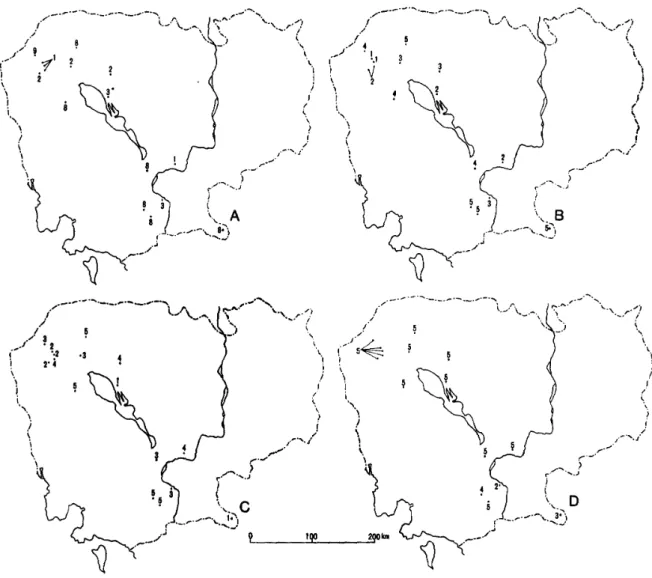
As shown in Fig. 6A many of the terrace soils are in soil material class XIII, poorest of all the soil material groups. The inherent potentiality grade of these soils is 5 (see Fig. 6B). Only the soils on recent lacustrine sediments and the basalt plateau have high inherent potentiality.
lQO I ( " '\
\
i i J I < \ ! r ;' " , ... J. ,...". ('"._" r-.""., ...} i (\. A
._.,...-.'-.:!:)
I ( \ \ \ ", i / I I <\
i f,·,.l';,....-.
1',,,,-(',/...1
I
\. c
( ._.,...·-·\..~;'\I.
-' ."... .._ /•.J ..-.,.._...-._.-..__
...-.." f" l ...-,\ ..../
- \
f"'2
{' ' . 2 · 3 i 2'4 \ "'i i " \ / \ i \"
Fig. 6 Map of Cambodia, showing Distribution of Samples in Terms of Soil Material and Fertility Characteristics.
Organic matter status is generally poor, as shown in Fig. 60, with the exception of the lacustrine soils and Alumisol. Available phosphorus status is very poor (see Fig. 6D), with only one exception, the Mekong levee soil. All the fertility character-istics of this Mekong levee soil are similar to those of the soils in a comparable physiographic position in the Mekong delta of Vietnam (see below).
India
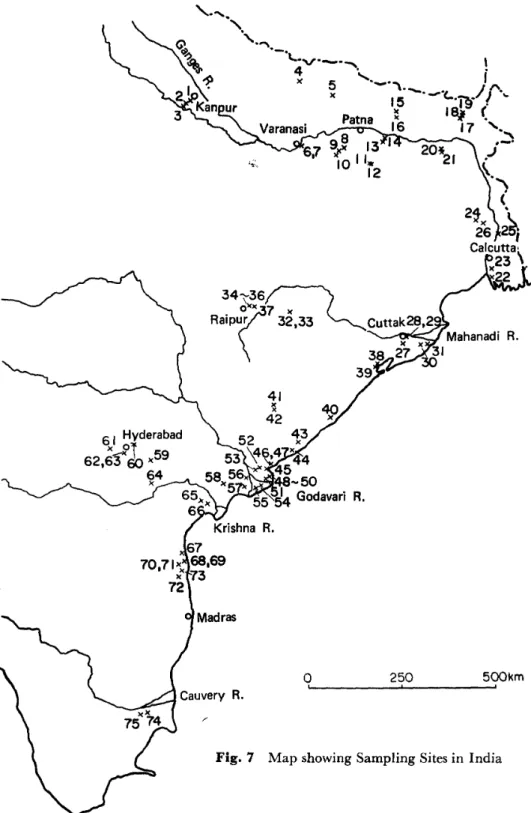
Only the eastern States of India, with the exception of Assam, were surveyed. The samples collected represent roughly 70% of total rice growing areas. Variety of climate and parent material is so great that a simple generalization is not possible. Rice lands may be categorized into the following:
1. Gangetic floodplain and terraces,
2. Deltas at the mouths of big rivers; Ganges, Mahanadi, Godavari-Krishna, and Cauvery,
3. Coastal lowlands, and
4. Local alluvia in the interior of the Decan Peninsula.
Fig. 7 shows the sampling sites. 1-1-21 are in the Ganges basin. Of these 1-5 and 1-16 are exceptionally rich in free lime, which derives from the sediments of the Gandak river, a tributary of the Ganges. 1-7 is a grumusol locally called karail soil. 1-4 was
sampled in an area called terai, a piedmont plain of the foothills of the Himalayas.
I-I 7-1 9 are the recent Kosi river sediments.
Soils in the second category include 1-22-26 from the Ganges-Hooghly delta, 1-28-31 from the Mahanadi delta, at the apex of which Cuttack is located, 1-51-57 and 1-65 and 66 from the Godavari-Krishna delta, and 1-74 from the Cauvery delta. I-52 is on a terrace remnant within the Godavari delta.
Soils in the third category, coastal lowland soils, comprise 1-27, 38-40, 43-50, 58, 67-73, and 75. 1-27 was taken from an area in which many abandoned laterite quarries are to be found. The soil materials ofl-43, 67,70-72 are also thought to be derived from nearby lateritized areas. I-58 and 1-75 are on terraces at the periphery of deltas. 1-48-50 and 1-68 and 69 are on coastal sand ridges.
1-32 and 33, 1-34-36, 1-41 and 42 are derived from local alluvia in the interior valleys to the west of the Eastern Ghats. 1-34-36 are from a catena; 1-34 is the lowest-lying sample, a lime-containing grumusollocally calledkanhar while 1-36 and 35 are
on successively higher positions and have no free lime in the upper part of the profile. 1-59-63 were sampled on the way to and around Hyderabad. Except for 1-63, which is at the foot of a granite hill, all the rest contain free lime in the profile. 1-62 is a typical grumusol on recent alluvium.
K. KAWAGUCHI&K. KYUMA: Paddy Soils in Tropical Asia (6)
34\36~
f
":><7 Raipur 32.33 Cuttak28.2 '--""Uf"""---_,1 Mahanadi R. )( :>< 38 27 31 39 30 41 ~ 42o
''- --10.'250 - - - ' '500kmFig. 7 Map showing Sampling Sites in India
regionality in the occurrence of different soil material classes. For example, class VII occurs exclusivelyin~Gangeticalluvia, which gave rise to many class VII soils in Bangladesh also. Class VI is confined to interior valleys, the Hyderabad area, and the Godavari-Krishna delta. Most of the class II samples occur in the Ganges terraces.
B D 1 1,1 1 ~4 4 \ 2~ 13~ ~ 1 ----... .2'.1 • 3 11,1,1 2 ~ .\ 3 4.1 1· 3-...,.A • 1 2 ~ • 2,1,3 2. ! \ 3.1 ~ .~ 2
r .
1,3 o...__~25r..:0~_--:..J5QOkm ~,6 4,2 \ 1 11 3' A 5,4,5 551
J'
Fig.8 Map of India, showing Distribution of Samples in Terms of Soil Material
K. KAWAGUCHI&K. KVUMA: Paddy Soils in Tropical Asia (6)
Similarly distribution of class I and class IX are confined to a relatively narrow area around the mouths of the Godavari and Krishna. Two class X samples are on lime-rich soils of the Gandak sediments.
Inherent potentiality, as shown in Fig. BB, is high for soils on deltaic sediments and basin soils on local alluvia. In fact, the soils of the Godavari-Krishna delta have the highest inherent potentiality of all the geographical regions (see Part 5). Soils with low inherent potentiality grades, 4 and 5, are rare, occurring only on sandy alluvia of the Ganges tributaries and on strongly weathered terrace sediments.
Organic matter status is poor for most soils, probably a reflection of the drier climate (see Fig. Be). Only two soils, in basins of rolling terrain in the interior of the Decan Peninsula, have organic matter status grade 2.
On the contrary, available phosphorus status is generally moderate to high, as seen in Fig. 8n. The only exceptions are two soils derived from the exceptionally lime rich sandy Gandak sediments. They have available phosphorus status grade 5, probably due to phosphate fixation by lime.
Indonesia
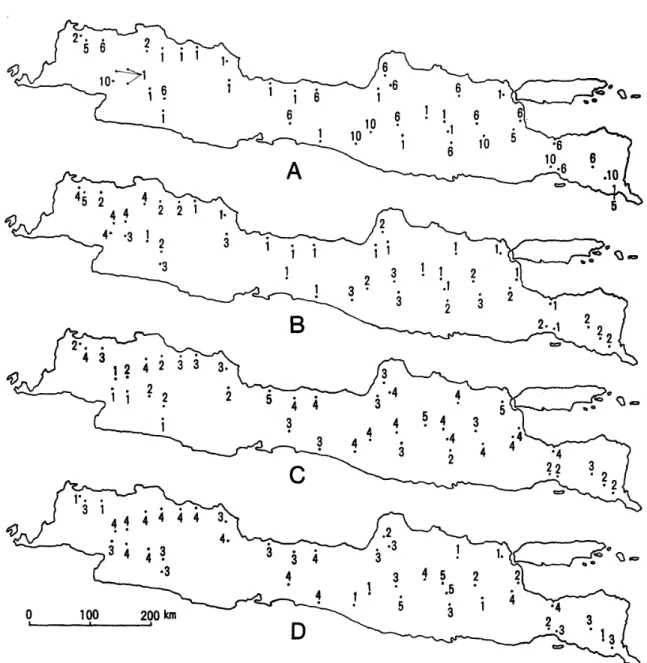
Only the island ofJava was covered, but 70% of the total population live on Java and more than 60% of total paddy land in Indonesia is found there. The most pro-minent feature of paddy soils in Java is their parent material of volcanic origin. Phy-siographically, paddy soils occur either on river and coastal alluvia or on the lower slopes of volcanoes of pyroclastic materials. According to the Indonesian system of soil classification (Soil Research Institutel l)), many of the latter soils are latosols,
mediterranean soils, and regosols, but they may be grouped as Eutropepts and Dystropepts of the US system, depending on their base status. Reflecting the vari-ation in climate, both vertical and horizontal, and also slight differences in material, the soils in West Java are generally more depleted than those in Central and East Java.
The sampling sites in Java are shown in Fig. 9. The samples may be grouped according to the Indonesian system of soil classification and by geographical regions, as follows:
West Central East
In-37, 39, 42, 45 In-34,44 In-35,4I In-3I,46 In-28 In-I9, 29 In-20 In-I-3,5, 13, 16 Mediterranean soils Regurs In-I7
Gray hydromorphic& In-6-8, 10 Red-yellow podzolic soils
Regosols In-26, 27
Andosols In-4, (15)* (In-30)*
Alluvial soils In-9, 11, 12, 14 In-18, 21-25 In-32, 33, 36, 38, 40, 43
*
Two Andosols (In-IS and 30) are non-paddy soils and not included in the discussion.x 22 24 x 100 Ix J. West 4xoBogor 17 x3 x 15 16xx x OBondung 14 a
Fig.9 Map showing Sampling Sites in Java, Indonesia
Brief descriptions of the conditions under which these groups occur are given according to Dudal and Soepraptohardjo12).
1. Latosols occur mainly on volcanic parent materials. They are found from sea level to elevations of900 m on rolling to hilly and mountainous land. Climate of the latosol area is wet, with annual rainfall ranging from 2500 to 7000 mm. They occur throughout Java.
2. Red-yellow and brown mediterranean soils have been found on limestone, cal-careous sandstone and volcanic material. Elevation varies from sea level to 400 m. Climate has a well pronounced dry season and annual rainfall ranges from 800 to 2500 mm. They occur extensively in Central and East Java.
3. Regur soils are formed from marls, calcareous shales, argillaceous limestones, old alluvial deposits, and volcanic materials. Relief is level to undulating, elevation ranging from sea level to about 200 m. Annual rainfall ranges from 800 to 2000 rom. They occur over large areas in Central and East Java. They were formerly called Margalite soils in Indonesia.
4. Gray hydromorphic soils include planosols and low humic gley soils. They occur along the north coast of Java in association with red-yellow podzolic soils.
5. Regosols are soils from deep, unconsolidated material, other than alluvium, showing weak or no profile differentiation. Regosols on volcanic ash and tuffs are widely distributed in Java.
6. Andosols in Java are found on unconsolidated volcanic materials. They occur on undulating to mountainous land from sea level up to elevations of about 3000 m, the majority at higher elevations. They are mostly found in cool and high rainfall areas.
7. Alluvial soils occur extensively along the north coast ofJava. Wide alluvial plains are also found along important rivers, such as the Solo, Brantas, Tjimanuk, and Tjitaram.
K. KAWAGUCHI& K. KVUMA: Paddy Soils in Tropical Asia (6) 1
6
6 6 1 '.1 6 1,~fI~_ ~.-6 ~. {O4
4
,~fI~_
5 5 ..0 ~ 4 4 31
, ,,4 3 2 4 4 , 33 3
4 1,C2f1~_ 4 ' .. 0 ,3 4 3 1 5 2 ~ ',5 53
4 0, 100.
0
Fig. 10 Map ofJava, Indonesia, showing Distribution of Samples in Terms of Soil Material and Fertility Characteristics.
X is also found, corresponding to the occurrence of regosols on fresh volcanic sands. Two soils belonging to class II, a poor material, are gray-hydromorphic soils on the northern coastal terraces of West Java.
Inherent potentiality is generally high, as shown in Fig. lOB. Poor soils with inherent potentiality of grade 4 or 5 are exclusively found in West Java and are either gray hydromorphic soils or latosols. An Andosol is also grade 4, probably due to sandy texture and low base status.
Organic matter status is generally low for the soils in Central and East Java as a reflection of the drier climate (see Fig. 100). Soils in grade 1 for organic matter
status are all on higher elevations in West Java where the climate is humid through-out the year.
Available phosphorus status is quite variable (Fig. IOD). Regosols on volcanic sand in Central and East Java and the soils on the Solo alluvia are grade 1, while alluvial soils and latosols around Mt. Lawu on the border between Central and East Java are very poor in available phosphorus status, that is grade 5.
Malaysia
A detailed account of paddy soils in West Malaysia is given In our earlier
treatise on "Lowland Rice Soils in Malaya"13). As stated in that work, the climate of West Malaysia is Koppen's tropical rainforest climate (Af) except in a small area in the northwestern part, that is the Kedah-Perlis plain. Geologically, granite is the most important rock species, occupying about half of the total land surface.
The sampling sites are plotted in Fig. 11. Two broad subdivisions may be set up; soils on the west coast and those on the east coast. Many paddy soils on the west coast occur in more or less swampy conditions reflecting the climate and the flat terrain. The soils of the Krian area of Perak, M-1 7-21, are the notable examples. Of the west coast soils, those of the Kedah-Perlis plain (M-l-lO) deserve special at-tention. The climate of the area is characterized by a dominantly dry period in January and February and, therefore, swamp conditions are less prevalent. The soils of this area have certain morphological similarities to those of the Bangkok Plain of Thailand.
Many of the west coast soils originated from marine or brackish clay. Actually, most soils of the Kedah-Perlis plain, except M-l and 5, and two of the Krian soils (M-17 and 18) are of this type. Two of the brakish soils, M-9 and 27, are active acid sulfate soils.
Although the soils of the west coast are generally clayey, M-14 and 24 are very sandy, as they are derived from alluvia of granite origin.
The soils on the east coast are mostly on fresh water sediments originated from granitic mountain ranges and are therefore coarser textured. A sample, M-36, was taken from what is called "bris sand", or a subrecent coastal sand ridge. It has a profile very similar to the degraded akiochi type of paddy soil of Japan, with an apparently bleached subsurface horizon.
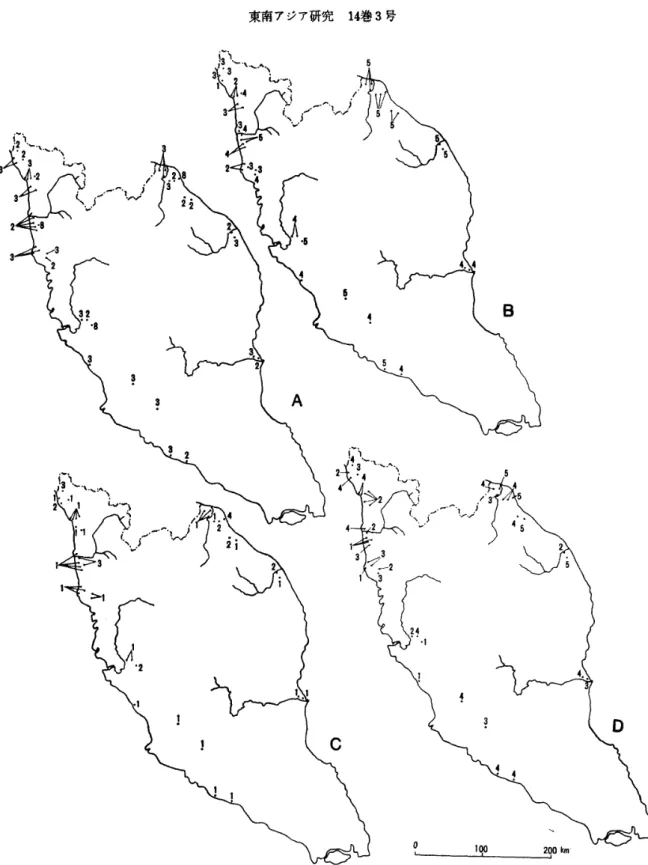
As shown in Fig. l2A, many of the soil materials belong either to class IIor III, both of which are characterized by low base status. As stated in Part 1, a very low pH is the most remarkable characteristic of Malaysian soils. Soils derived from coarse-textured fresh water sediments are often found in classIIand those of brackish clay origin in class III. Class VIII samples are all very sandy soils rich in quartz.
K. KAWAGUCHI &K. KYUMA: Paddy Soils in Tropical Asia (6) (""~
~
j
xl '-''\.'_'''''\ x2 x4 • x3 7t....
.r-.
6\\ Ox5 .~, - 0 • AlorStar ~ ,\)(9
(",'
10 I .~.'", J
\,....9
'--- - - ~ - -19
.L..-0 .l-._ _---JI200 kmFig.ll Map showing Sampling Sites in West Malaysia
Inherent potentiality is generally low due to the low base status and kaolin-rich clay, as stated in Part 2 (see Fig. 12B). Inherent potentiality grades 1 and 2 occur only in the Kedah-Perlis plain and the Krian area and correspond to the soils of brackish clay origin. Generally speaking, east coast soils are poorer than west coast
Fig. 12 Map of W. Malaysia, showing Distribution of Samples in Terms of Soil Material and Fertility Characteristics.
soils in inherent potentiality.
Organic matter status is high to very high, except for a few sandy soils (see Fig. 12c). In fact, Malaysian soils have by far the highest mean organic matter and
K. KAWAGUCHI& K. KYUMA: Paddy Soils in Tropical Asia (6)
nitrogen score, as previously stated in Part 5.
Available phosphorus status varies widely, as shown in Fig. 12n. This is partly a result of fertilizer application, which was more common in West Malaysia than in the other countries at the time of our sampling. Generally east coast soils are lower in available phosphorus status, reflecting partly the low reserves of the nutrient and partly the less intensive management in this area.
The Philippines
As the Philippines is located in the Circum-Pacific volcanic zone, paddy soil materials are strongly influenced by volcanic materials and in this respect they are generally similar to those in Java. But as climatic conditions vary very greatly within the archipelago, soil variation is also great.
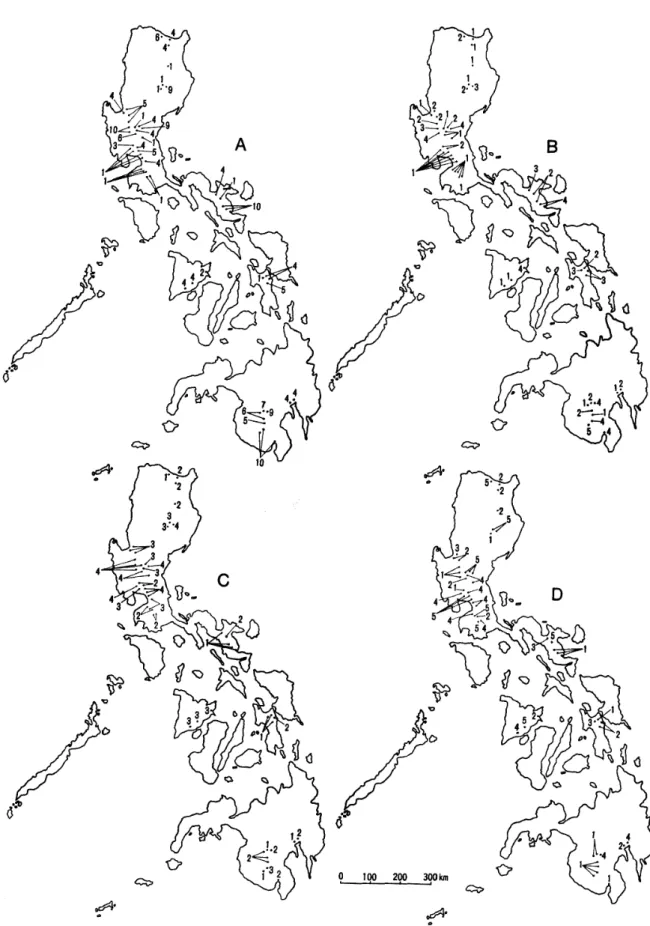
Fig. 13 shows the sampling sites. The following six broad geographic regions were covered:
Luzon Central Plain Ph- 1-25
Cagayan Valley Ph-26-32
Bicol Peninsula Ph-50-54
Panay Coastal Plain Ph-33-35
Southern Mindanao Ph-36-45
Northern Leyte Ph-46-49
The soils in the Luzon Central Plain are strongly affected by recent volcanic materials. Only in the eastern periphery are paddy soils developed on older materials on dissected terraces, of which Ph-21 is an example. The region has a wet and dry monsoon climate, which seems to have led to the occurrence of grumusols and grumusolic alluvial soils on the volcanic materials.
Cagayan valley has a narrow strip of floodplain with relatively elevated terraces. Ph-27 was sampled on a well-weathered river terrace which had many iron and man-ganese nodules. Ph-31 sampled near Aparri shows many layers of buried A horizon, thus fitting the concept of Fluvent in US classification. Ph-30 is a brackish clay soil sampled on the northern coastal plain.
Bicol peninsula is another area of strong volcanic activity, as represented by the beautiful Mt. Mayon near Legaspi. All the samples are apparently influenced by volcanic materials. The climate is more humid here than in the Luzon Central Plain. Panay coastal plain soils are also affected by volcanic materials, but one sample, Ph-35, taken on a terrace is of strongly weathered material.
Of the Mindanao samples, Ph-36 and 37 are from the Davao area, the former being a brackish swamp soil. Ph-38 to 45 were sampled in Cotabato; Ph-39 was taken from an old terrace remnant with laterite block in the subsoil. The others are
~.
o
Fig.13 Map showing Sampling
Sites in the Philippines
K. KAWAGUCHI& K. KYUMA: Paddy Soils in Tropical Asia (6)
A
o 100 200 300km
,
'~
'D
Fig. 14 Map of the Philippines, showing Distribution of Samples in Terms of Soil
Material and Fertility Characteristics.
all derived from recent alluvia of volcanic material origin.
The Tacloban area of Leyte is perhumid throughout the year and often ex-periences strong typhoons. At the time of sampling, a problem for the people working in the paddy fields was the possibility of infection with schistosomiasis. Many of the low-lying paddy fields from which we took samples do not dry up at any time of the year.
The soil material classes are shown in Fig. 14A. Class I and IV are most fre-quent, both being the materials often encountered in volcanic regions. Soils on fresh volcanic sands without exception fall into class X. Three of the four soils on old terraces (Ph-21, 27, 35 and 39) fall into class IX and one into class II, both of which classes are characterized by siliceousness and low base status.
Inherent potentiality is high for Luzon Central Plain soils, with the exception of a terrace soil, Ph-21 (see Fig. 14B). The lowland soils of other regions have also high potentiality. The relatively low potentiality of the soils around Tacloban, Leyte, may be explained by stronger leaching and weathering of parent materials under the perhumid conditions. Besides the terrace soils, many of the soils on recent volcanic sands have also grades 4 and 5 because of their coarse texture.
Organic matter status clearly reflects rainfall conditions (see Fig. 14c). In Bicol and Leyte where the climate is wetter, organic matter status grade I occurs frequent-ly, whereas grades 3 and 4 dominate in the Luzon Central Plain and Panay where the dry season is pronounced. Mindanao seems to be intermediate in this respect.
Available phosphorus status is highest in Cotabato, Mindanao, as seen in Fig. 14n. Luzon Central Plain soils are not well endowed with this quality, except for those on sandy volcanic material. In fact, soils on fresh volcanic sands all have an available phosphorus status of grade 1. We do not know the reason why this high available phosphorus status cannot be retained by clayey materials of similar nature in the Luzon Central Plain.
Sri Lanka
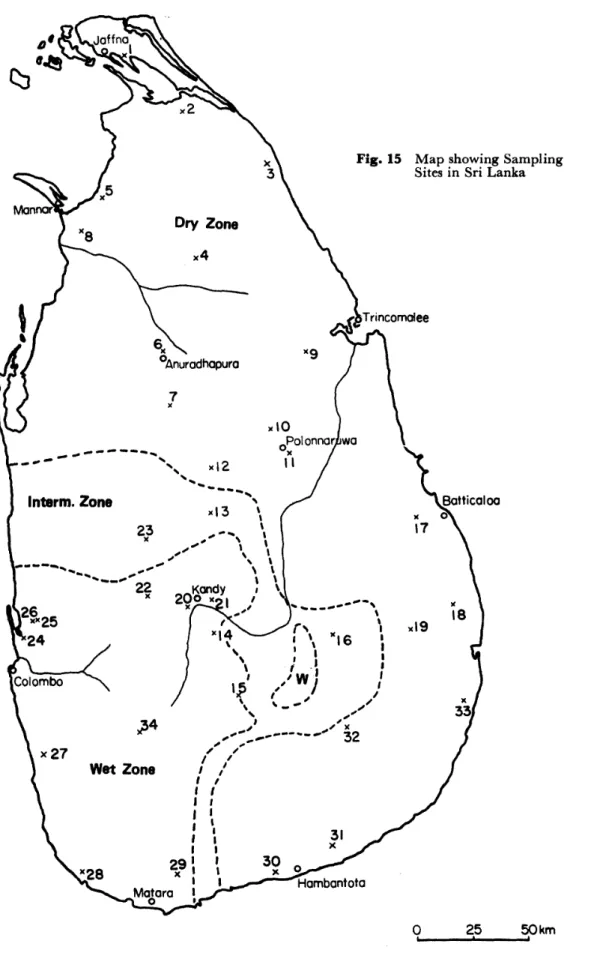
Paddy fields occur mostly on the coastal plain and on the lowest peneplain surface; the middle peneplain has a small area of rice land in narrow dissection valleys. Geologically 80% of the island consists of Paleozoic and Precambrian metamorphic rocks, of which garnet-sillimanite schists and gneisses are most wide-spread, and therefore the most important sources of soil parent materials. Miocene limestones occurring extensively in the northwestern part and Jaffna are another important geologic formation (Cooray14)).
Climatic variation is great within the island. About a quarter of the total area, the southwestern part, is usually called the Wet Zone, and the greater part of the
K. KAWAGUCHI&K. KYUMA: Paddy Soils in Tropical Asia (6)
""17
Fig. 15 Map showing Sampling
Sites in Sri Lanka
....
---
...
~\r,
\
I '''''16 I I ' II .\
:
,,' WJ
1
' ",_...
","
I , ; ;"
"
"" ,,--" ,..---; 32,,"
,,,
,
I I J,
I J J I,
I ,,13 7 " 23 ""--
.",...
----
...
-
...., " ,,12"-
...
_-
...
,
\ \ \,
\,
,
\ \ \ Interm. Zoneo
~'_ _...'l.o.._ _...l'25 50km 311rest is called the Dry Zone, leaving a narrow strip between the two, the Intermediate Zone (see Fig. 15). Even the Dry Zone has 40-75 inches of rain annually but it is unevenly distributed with the maximum during the northeast monsoon season, or Maha (December to February). Relatively small areas of the Dry Zone are used for cultivation during the southeast monsoon season, Yala, and they depend on tank-irrigation, which is of ancient origin.
Sampling sites are plotted in Fig. 15. As there are few samples from the Inter-mediate Zone, they were combined with those from the Wet Zone for computing the regional means of fertility component scores (see Part 5). Of the Dry Zone samples, Sr-1-3, 5, 8, 9, 17, 30, 31 and 33 are from coastal plain; Sr-2 and 3 occur on low terraces and their material seems to have corne from lateritized higher terraces further inland. Sr-5 and 8 are grumusolic alluvial soils, the materials of which were derived from the Miocene limestone area. Near Sr-5 gilgai microrelief was observed. The remaining Dry Zone samples were derived from local alluvia on the undulating to rolling terrain of the low and middle peneplains.
Since no wide coastal plains have developed along the Wet Zone coast, all the soils are considered to have been derived frOlll local alluvia. A slight complication occurs in the case of Sr-28, where peaty organic matter accumulates in the surface and crude ambers were found in the organic layer.
As shown in Fig. 16A, soil material class IX predominates among the soils on the low peneplain. This class of material is characterized by coarse texture and low base status, and in particular by an exceptionally low silt content. Fair numbers of classes V and VIII are seen, which are also characterized by coarse to very coarse texture. In the Dry Zone, heavy textured soils have either class I or VI materials, while in the Wet Zone a heavy textured soil falls into class II, the siliceous and base poor group. Two class X soils seem to have been derived from charnockite, a dark-colored hyperthene containing metamorphic rock that occurs as narrow bands regularly interbedded with quartzites, garnet bearing gneisses, etc.
As shown in Fig. 16B, inherent potentiality of Wet and Intermediate Zone soils is very low with the exception of Sr-21 which corresponds to one of the soil material class X samples. The soils in the Dry Zone are usually a little better than the Wet Zone soils, because their base status is better, though the texture of both is coarse. Grumusolic soils in the limestone area, Sr-5 and 8, have high potential, with inherent potentiality of grade 1.
Organic matter and nitrogen status is better for the Wet and Intermediate Zone soils than for the Dry Zone soils (see Fig. 160). Here again climatic influence on organic matter accumulation can be seen. Available phosphorus status is generally not good (see Fig. 16n). In view of the fact that most of these samples were taken at
K. KAWAGUCHI& K. KYUMA: Paddy Soils in Tropical Asia (6)
B
3 , ? 4' Ac
0
9 9 o 25Fig. 16 Map of Sri Lanka, showing Distribution of Samples in Terms of Soil Material and Fertility Characteristics.
experimental stations, the different grades assigned may show only the difference in intensity of management on the particular plot sampled.
Thailand
The samples from Thailand may be considered the most accurate in representing the paddy soils of a particular country. The eighty samples used in this study were selected from two hundred and forty samples collected from all over the country at different times, and correspond to the extent of rice land in different regions. A de-tailed study of these samples was conducted by Prachak Charoen15) in his doctral thesis at Kyoto University. Here the results of his study were fully utilized. We also used the results of our previous study, "Lowland Rice Soils in Thailand"16)
There are five geographical regions, the intermontane basins of the North, the Upper Central Plain, Bangkok Plain, the Northeast or Khorat Plateau, and the southern Peninsula. Climatically Thailand is fairly uniform, the only exception being the southern peninsular region, which is not only wetter but also has a different rainfall pattern. In parent material, the Northeast is quite different from the rest, being composed almost exclusively of weathered Mesozoic sandstones, a continuation of the Mesozoic formations in Cambodia.
Physiographically, two major subdivisions are possible in each region, that is areas of low-lying recent fluvial or deltaic sediments and fan-terrace (or plateau) areas of higher elevation. The relative extent of these two varies from one region to another. The Northeast has a large area of fan-terraces, which, together with the parent material, conditions the characteristics of the soil cover.
The sampling sites are plotted on Fig. 17. The Northeast with the largest rice acreage has the largest number of samples, followed by the Bangkok Plain. The Upper Central Plain is somewhat important in both acreage and production. The northern intermontane basins and the southern Peninsula are of minor importance for rice production, but the former produces many kinds of annual crops, such as vegetables and pulses, as irrigated off-season crops, and the latter specializes in perennial commercial crops, such as rubber and fruits.
Dominant soil material classes are VIn in the Northeast, I and III in the Bangkok Plain, and n and III in the other regions (see Fig. 18A). Class I in the Bangkok Plain, and elsewhere, is mostly grumusols and grumusolic alluvial soils. Class III is typically soils on brackish sediments, but also includes some backswamp soils in the Upper Central Plain. Class II is mostly for strongly leached fan-terrace soils. Class VIII is sandy, severely depleted material as typically seen in the North-east. It consists of pink-colored quartz sand and contains very little available nutrient of any kind.
K. KAWAGUCHI &K. KYUMA:Paddy Soils in Tropical Asia (6)
NE :
NortheastN :
NorthUCP:
Upper central PlainBP :
Bangkok PlainSP :
Southern Peninsula0..., '...90 290...km
Fig. 17 Map showing Sampling Sites in Thailand
o
, 100, 5'?
~ 5 23 ~ 5:,,--3 5 3·~ 5~1J
.5
2 . 1. 5 1 ·5 . 3 4 : .. 2 ·5B
Fig. 18 Map of Thailand, showing Distribution of Samples in Terms of Soil Material and Fertility Characteristics.
V-2, 4,6,7, 9, 10, 12,22,44,46,49-51 V-I, 3, 5, 36,45,47, 48
K. KAWAGUCHI& K. KYUMA: Paddy Soils in Tropical Asia (6)
Inherent potentiality reflects the soil material characteristics. Soils with inherent potentiality grade 5 are in the majority in the Northeast (see Fig. 18B). Southern Peninsula soils derived from granitic parent materials are often grade 4 or 5. Grumu-sols and grumusolic alluvial soils have inherent potentiality grade 1. Many Bangkok Plain soils are graded 2 and acid sulfate soils are not differentiated from others as far as surface soil is concerned.
Organic matter status is again poor for soils in the Northeast and for fan-terrace soils on the periphery of the Bangkok Plain and the Upper Central Plain, as seen from Fig. 18c.The soils in the Bangkok Plain proper and in the southern Peninsula have higher organic matter status, reflecting the wetter soil water regime due respectively to physiography and climate.
Asshown in Fig. 18D,available phosphorus status is generally poor. This is even true of Bangkok Plain soils. Just one soil, on non-acid coastal marine clay, has an exceptionally high available phosphorus status, grade 1, which is probably due to biological concentration of phosphorus by an unknown mechanism.
VietnalD
The Vietnamese part of the Mekong delta has about 2 million hectares of rice land, which accounts for a very substantial part (>70%) of total rice acreage in the southern part of Vietnam. The Mekong delta region was surveyed for this study (see K yuma17») after the preparation of the first draft of the previous papers. Be-cause of the then unfavorable security situation, samples were collected from areas with ready access by main road, thus omitting the Plain of Reeds, the Ha Tien Plain in Kien Giang Province, and the broad depressions in Chuong Thien Province on the right bank of the Bassac river. These unsurveyed areas are known to have large areas of acid sulfate soils, most of which have not been utilized for rice cultivation. A total of 49 paddy soil samples was collected, using the physiographic map
prepared by the Netherland Delta Development Team18) for the Mekong
Com-mitee. These samples represent tidal flats along the South China Sea coast, river and estuarine floodplains, river levees, and broad depressions that presumably are filled-up lagoons.
Parent material classification and fertility evaluation were carried out by extrapolating the newly acquired data into the respective schemes, as developed in Part 4 and 5.
Fig. 19 shows the sampling sites. The samples were grouped according to physiographic units as follows:
High Tidal Flat Low Tidal Flat
Co Mouo x2 20x x3 17)( 16)( Con Thoo )( 15 xl4 )(13 )(6
01:::::======5::t:9======:::::ij'QOkm
Fig.19 Map showing Sampling Sites in the Mekong Delta, Vietnam
Floodplain V-13-16, 19,20,27,30-32,37,39,41-43
Levee V-23, 28, 29, 33-35
Broad depression V-17, 18,21,25,26,38,40
Piedmont V-24
From Fig. 20A, extreme uniformity of soil materials is at once clear. The two class VIII samples in the northwestern part of the delta are V -24 on a piedmont of granite hills and V -26 on outwashes from nearby granite hills. The class II sample,
K. KAWAGUCHI& K. KYUMA: Paddy Soils in Tropical Asia (6) " - - - '~...' \ \
"_._'
'2C
0
5Jl lpokin BFig. 20 Map of the Mekong Delta, Vietnam, showing Distribution of Samples in Terms of Soil Material and Fertility Characteristics.
V-22, is underlain by a layer containing large iron nodules that cement sandy subsoil materials and thus is better drained. The widely occurring class III materials are fine-textured and poor in bases. The mean pH of 4.5 and the fact that 86% of the
samples have heavy clay texture explain the predominance of class III in the
Mekong delta. As our samples include only a few soils of acid sulfate nature, the low pH is not necessarily ascribable to acid sulfate soils. Even soils on the Mekong and Bassac levees show quite low pH around 5.
Fig. 20B shows that inherent potentiality grades for the sample soils are also quite uniform. The soil on the granite piedmont has a very low potentiality, but others are either intermediate or high in inherent potentiality, grade 2 or 3. Figure
20cshows organic matter status, which is generally high, the one exception being the piedmont soil. Soils on high tidal flats and river levees tend to be a little poorer in organic matter status. Available phosphorus status is not good for the Mekong delta soils, as is apparent from Fig. 20D. Many soils are grade 4 or 5. In this case, the levee soils appear to be little better than others.
References
1. Kawaguchi, K. and Kyuma, K. "Paddy Soils in Tropical Asia: Part I-Description of Fertility Characteristics" Tonan Ajia Kenkyu, Vol. 12 No.1, 1974.
2. Kawaguchi, K. and Kyuma, K. "Paddy Soils in Tropical Asia: Part 2-Description of Material Characteristics" Tonan Ajia Kenkyu, Vol. 12 No.2, 1974.
3. Kawaguchi, K. and Kyuma, K. "Paddy Soils in Tropical Asia: Part 3-Correlation and Regres-sion Analysis of Soil Data" Tonan Ajia Kenkyu, Vol. 13 No.1, 1975.
4. Kawaguchi, K. and Kyuma, K. "Paddy Soils in Tropical Asia: Part 4-Soil Material Classifica-tion" Tonan Ajia Kenkyu, Vol. 13 No.2, 1976.
5. Kawaguchi, K. and Kyuma, K. "Paddy Soils in Tropical Asia: Part 5-Soil Fertility Evaluation"
Tonan Ajia Kenkyu, Vol. 13 No.3, 1976.
6. Brinkman, R. "Ferrolysis-A Hydromorphic Soil Forming Process" Geoderma, Vol. 3, 1969. 7. Islam, M. A. Reclamation of Kosh Soil of Chittagong Coastal Region, Dep't. of Agric., Gov't. of East
Bengal, Dacca, 1975.
8. Brammer, H. and Hesse, P. R. "Some Unsolved Problems of Soil Science in East Pakistan" Pak. ].
Soil Sci.,Vol. 6, 1970.
9. Gov't. of Burma. Report to the People, 1971-1972, Rangoon, 1972.
10. Crocker, C. D. Exploratory Survey of the Soils of Cambodia, Royal Cambodian Gov't. Soil Commission and USAID Joint Pub!., Phnom Penh, (Mimeo.), 1962.
11. Soil Research Institute Exploratory Soil Map of iowa and Madura, Bogor, 1960.
12. Dudal, R. and Soepraptohardjo, M. Soil Classification in Indonesia, Contr. Gen. Agric. Res. Sta., No. 148, Bogor, 1960.
13. Kawaguchi, K. and Kyuma, K. Lowland Rice Soils in Malaya, Center for Southeast Asian Studies, Kyoto Univ., Kyoto, 1969.
14. Cooray, P. G. An Introduction to the Geology of Ceylon, Nat. Museums of Ceylon Pub!., Colombo, 1967. 15. Charoen, Prachak. Studies on Parent Material, Clay Minerals and Fertilily of Paddy Soils in Thailand,
Doctoral Thesis, Kyoto Univ., Kyoto, 1974.
16. Kawaguchi, K. and Kyuma, K. Lowland Rice Soils in Thailand, Center for Southeast Asian Studies, Kyoto Univ., Kyoto, 1969.
17. Kyuma, K. Paddy Soils in the Mekong Delta of Vietnam, Discussion Paper No. 85, Center for Southeaast Asian Studies, Kyoto Univ., (Mimeo.), 1976.
18. Netherland Delta Development Team. Recommendations Concerning Agricultural Development with
Improved Water Control in the Mekong Delta, Working Paper VA, Agriuclture, Land Resources, Bangkok, (Mimeo.), 1974.