D07
On the Pre-failure Shear Behavior of Clayey Soil:
Shear Banding and Corresponding Changeable Physical Precursors
〇Chengrui CHANG, Gonghui Wang
1. Introduction
The prediction of landslides is of great social and economic significance and the related problems are widely encountered in recent decades. The preceding accelerating behavior is widely noticed and perceived as a precursor for the prediction of time to failure [Voight., 1988, 1989]. Since Saito and Uezawa [1966] pioneered an empirical attempt to predict the failure time of a landslide successfully, a phenomenological approach has been established gradually. Using slope models, Fukuzono [1985] found that the surface velocity is proportional to the acceleration in logarithmic coordinates in the terminal stage of slope failure. Further, Voight [1988, 1989] generalized Fukuzono’s finding as a fundamental law that governs diverse forms of material failure:
𝛺̈ = 𝐴𝛺̇𝛼 (1)
where A and α are empirical constants and Ω denotes a measurable quantity. The dot refers to the differentiation of the quantity to time. This approach had been widely applied for the retrospective analysis of volcano eruptions, landslides, and laboratory data. Nevertheless, since the approach did not consider the effect of physical properties of the target materials, it might introduce uncertainty even great error into predictions. Besides, the validation of the approach is questionable without taking adequate account of mechanical behavior. Thus, we are devoted to examining the possible factors on this empirical approach, which attempts to deliver us a better understanding of the underlying physical process and background.
2. Methods
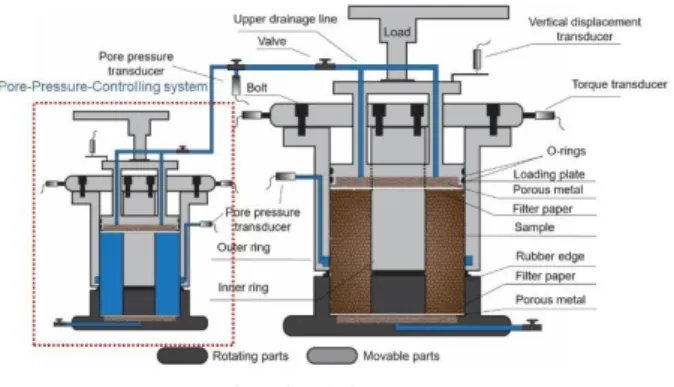
We conducted a series of ring shear tests to mimic the creep behavior of slopes due to the increasing ground water table during rainfall with different intensities. The clayey soil is taken from a natural landslide site. We employed two connected ring-shear apparatuses as one being a pore-pressure controlling system to induce failure in another being under constant stress conditions (Fig. 1). The applied/monitored pore pressures were measured separately and simultaneously. All the samples were pre-consolidated at constant normal stress (σ) of 200 kPa, and we varied the shear stresses (τ) to simulate two different slope angles of 20° and 25°.
Fig. 1 Sketch of the testing system
Additionally, the ring-shear apparatus enables us to carry out such tests repeatedly to investigate the shear behavior of pre-existing shear zones. Then the parameters (A and α) of the equation (Eq. 1) are determined by a retrospective analysis of the kinematic feature in the pre-failure stage with linear regression.
3. Results
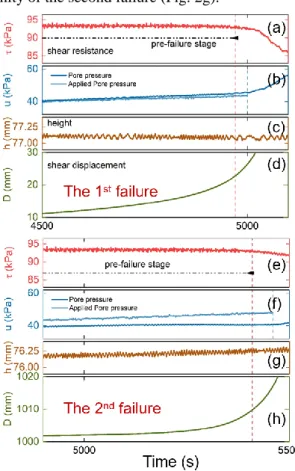
As a selected result shows in Fig. 2, the pore pressure in soil mass increases with the monotonic increase of
the applied pore pressure, which reduces the effective normal stress and leads to failure eventually. The increase of the shear displacement ahead of the failure illustrates an acceleration process. We find that: (1) unlike pore pressure increases before the first failure, it doesn’t increase prior to the second failure (Fig. 2b and Fig. 2f); (2) an outstanding dilation appears in the vicinity of the second failure (Fig. 2g).
Fig.2 Testing results in two counts of failure
Fig. 3 shows that α (slope of the regression line) decreases with failure count (i.e., pre-sheared displacement).
4. Discussion and summary
The value of α determines the kinematic precursors (velocity, acceleration) of an impending landslide and failure time. The reduction of it with longer pre-sheared displacement indicates the failure is prone to be less catastrophic. We infer that a pre-existing shear band exerts a fundamental control on such behavior as well the post-failure mobility. Wang et al. [2010] suggest catastrophic failure may not occur in some reactivated landslides with the shear resistance of soil exhibiting
positive-rate-dependence.
In closing, our observation highlights a hitherto little-studied aspect of an empirical approach that is competent in the retrospective analysis of the accelerating behavior preceding material failure. We detected the variability of key parameters in this approach, which enables us to look further into the possible physical factors on such kinematic precursors and elevate the precision of prediction.
Fig. 3 Values of α in different failure counts
Acknowledgments The first author would like to express his special thanks of gratitude to Dr. Issei DOI for his insightful discussions and suggestions.
References
Saito, M., Uezawa, H. 1966 Forecasting the time of occurrence of a slope failure. Journal of Japan Landslide Society, 4(4): 1-8
Fukuzono, T., 1985. A method to predict the time of slope failure caused by rainfall using the inverse number of velocity of surface displacement. Journal of Japan Landslide Society, 22(2): 8-13 Voight, B., 1988. A method for prediction of volcanic
eruptions. Nature, 332: 125-130
Voight, B., 1989. A relation to describe rate-dependent material failure. Science, 243: 200-203
Wang, G., et al., 2010. Shear-rate-dependent strength control on the dynamics of rainfall-triggered landslides, Tokushima Prefecture, Japan. Earth Surface Processes and Landforms, 35: 407-416