Japan Advanced Institute of Science and Technology https://dspace.jaist.ac.jp/ Title 大容量ストップドフロー法を用いたチーグラー・ナッ タ触媒における様々なドナーの影響の速度論的評価 Author(s) 池谷, 光博 Citation Issue Date 2013-03
Type Thesis or Dissertation
Text version none
URL http://hdl.handle.net/10119/11224
Rights
Description Supervisor:寺野稔, マテリアルサイエンス研究科, 博
Kinetic Evaluation of Various Donor Effects on Ziegler-Natta Catalysis
with Large-Scale Stopped-Flow Technique
Terano Laboratory 1040003 Mitsuhiro Ikeya
1. Background
Heterogeneous Ziegler-Natta (ZN) catalysts nowadays produce polypropylene (PP) more than 50 million tons per year over the world, which is one of the most popular and important plastic materials and still has much room for development. The ZN catalysts are generally composed by a solid catalyst (TiCl4/internal donor/MgCl2) and an activator system (alkeyl-alminium/external donor/hydrogen). Lewis base compounds called as donors play an important role in the modification of catalytic properties, especially for the improvement of the stereoregularity of PP. Catalytic properties of ZN catalysts are largely influenced by the combination of different internal and external donors, making the discovery of new donors as a key to the development of catalyst. The present focus to find new donors is to offer added-values in addition to high isospecificity, especially for broader MWD and chain transfer properties.1 However, it is generally thought that broad MWD and chain transfer properties are incompatible.
There are four kinds of basic reactions in ZN propylene polymerization ; activation and propagation and chain transfer, and termination reaction. The chain transfer reaction is the termination reaction of the propagation, which accompany the transfer reaction of the growing chain to some agent such as monomer, alkeyl-alminium, and hydrogen. Additionally, chain transfer reaction is more important for the control of molecular weight as most important first order structure. However, there is no evidence on effects of donors for the chain transfer reaction. For achieving the above-mentioned requirement for donors, it is essential to understand how a donor affects MWD and chain transfer properties through the interaction with Ti species. Generally, a broad MWD is believed to originate from the heterogeneity of the active sites nature, more precisely, the distribution of the ratio between the propagation and chain transfer rate constants (kp/ktr). Since it was previously found that the distribution of kp is rather narrow for isospecific catalysts.2 Therefore, the distribution of ktr is the key for broader MWD. In detail, to expand the distribution of ktr with a donor is required for the expansion of MWD. Consequently, the understanding of the acting mechanism of a donor on MWD is will be firstly achieved by uncovering the acting mechanism of a donor on chain transfer properties, especially on ktr.
2. Objective
The objective of this dissertation is to investigate the influences of donors on the chain transfer properties of initially formed active sites using the Large-Scale Stopped-Flow (LSF) method. For this purpose, SF method was selected with various internal donor based grinding catalysts (Cat-G). Because LSF polymerization method is free from various side reactions during polymerization and therefore the characterization of produced PP leads to direct insights for active sites and polymerization mechanisms.
3. Results and discussion
The stopped-flow (SF) technique was extended for Ziegler-Natta polymerization over a quasi-living period in order to obtain deeper insights into chain transfer (CT) reactions. Propylene polymerization with a TiCl4/MgCl2 catalyst containing 2-isopentyl- 2-isopropyl-1,3-dimethoxypropane (DE) as an internal donor exhibited a linear growth of
Mn for the polymerization time below 0.3 s, indicating quasi-living polymerization. Over 0.4 s, Mn deviates from the linearity in a convergent manner due to the increasing contribution of CT reactions (Figure 1). On the other hand, the polymerization yield evolved completely proportionally to the polymerization time even up to 1.6 s, which enabled us to presume a constant active site concentration ([C*]). k
p and ktr were evaluated according to theoretical equation:
Mn (t) = kpM0[M]t / (1+ktrt). In spite of the expected heterogeneity of active sites, the time-Mn curve was accurately fit by a theoretical equation. Thus, it is revealed that the SF technique can be applied for the simultaneous determination of propagation and CT rate constants in heterogeneous ZN polymerization.
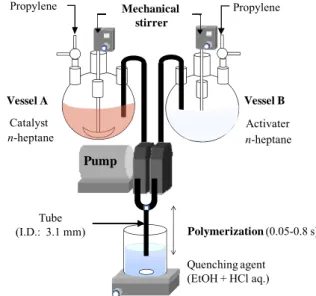
More recently, a large-scale SF (LSF) polymerization apparatus was developed, which enables highly reproducible and scalable polymerization over wider polymerization time without changing any polymerization conditions (figure 2).3 The LSF polymerization was conducted for three catalysts with ethyl benzoate (EB) and DE, and dibutylpthalate (DBP) as an internal donor to examine the effects of the internal
0 10000 20000 30000 40000 50000 60000 0 500 1000 1500 2000 2500 3000 3500 4000 4500 5000 0.0 0.2 0.4 0.6 0.8 1.0 1.2 1.4 1.6 1.8 M n Yi el d (g -P P/ m ol -T i) Polymerization time (s)
Figure 1. Time-dependence of Yield (circle) and Mn (square) of the
conventional Stopped-Flow polymerization results with Cat-G(DE).
Time-dependence of Mn (solid line) was the best fit to the theoretical
equation. 0 200 400 600 800 1000 1200 0.0 0.1 0.2 0.3 0.4 Yi el d ( g-PP/ m ol -T i) Polymerization time (s)
Figure 3. Comparison of yields of polypropylene obtained with the LSF polymerization: (●) Cat-G(EB), (■) Cat-G(DE), (▲) Cat-G(DBP).
Quenching agent (EtOH + HCl aq.) Catalyst Activater Propylene Polymerization (0.05-0.8 s) Vessel A Vessel B Propylene n-heptane Mechanical stirrer Pump Tube (I.D.: 3.1 mm) n-heptane
Figure 2. Schematic illustration of Large-Scale Stopped-Flow apparatus.
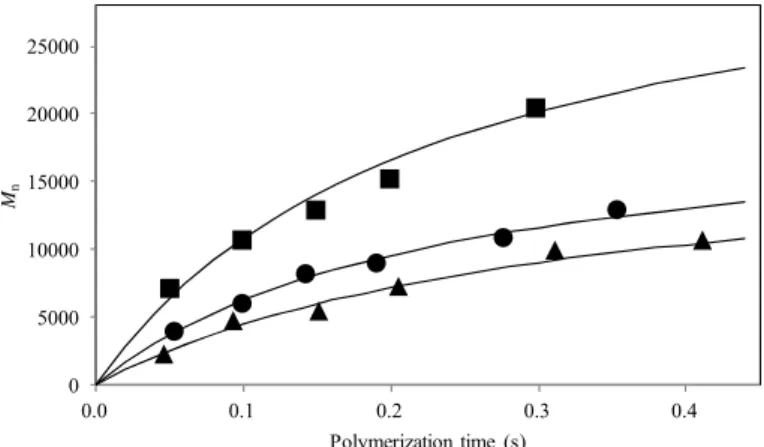
donor. The yield linearly increased with time for all of the catalysts, indicating that the nature and the number of active sites were kept constant. Mn linearly increased at the beginning, then started to converge because of the increasing contribution of chain transfer reactions (Figure 3, 4). The kp and the ktr were evaluated according to the theoretical equation. Since the kp values are known to correlate with mmmm, the improvement of the streospecificity followed the order of Cat-G(DE) > Cat-G(EB) > Cat-G(DBP). On the contrary, ktr values did not largely change despite of the electronic and structural differences of donors (Table 1).
Finally, the effects of donors on the chain transfer properties to hydrogen were examined. In the above result, first of all, the effects of donors on the chain transfer properties to both alkylalminum and monomer were examined. And then, it is acceptable to investigate the effects of donors on the chain transfer properties to hydrogen in order to add the hydrogen which has high chain transfer ability. The differences of hydrogen response on the different catalyst system were observed with LSF polymerization technique on 0.15 s and 0.3 s in a different hydrogen volume. Two polymerization time, i.e. 0.15s and 0.3 s, were selected as the polymerization time in order to evaluate chain transfer properties
because 0.15 s is included in quasi-living region and 0.3 s is included in the time region that chain transfer reaction apparently occurs. Figure 5 showed Mn using LSF polymerization technique with Cat-G(EB) and Cat-G(DE) in the presence and absence of hydrogen. Hydrogen has almost no effects on both yield and Mn for 0.15 s with both Cat-G(EB) and Cat-G(DE) regardless of hydrogen volume. This result has good agreement with our previous research.4 On the other hand, hydrogen has almost no effects on yield for 0.3 s with both Cat-G(EB) and Cat-G(DE), however Mn slightly increased with Cat-G(EB) and clearly decreased with Cat-G(DE)
0 5000 10000 15000 20000 0 5 10 15 20 Mn
Hydrogen flow ratio (vol.%)
Figure 5. Mn of the LSF polymerization results in different
hydrogen volume ratio: Cat-G(EB) at 0.15 s (●), Cat-G(EB) at 0.3 s (○), Cat-G(DE) at 0.15 (■), and Cat-G(DE) at 0.3 s (□).
0 5000 10000 15000 20000 25000 0.0 0.1 0.2 0.3 0.4 Mn Polymerization time (s)
Figure 4. Comparison of Mn of polypropylene obtained with the
LSF polymerization: (●) Cat-G(EB), (■) Cat-G(DE), and (▲) Cat-G(DBP). Solid line is the best fit to the theoretical equation.
kp (l·mol–1·s–1)
ktr,lump (s–1)
[C*] (mol%)
MSE×1000 a)
a MSE×1000 represented fitting error
1.1 6.3 4.5
4.5 4.4 3.3
3.5 1.0 0.1
Table 1. Results of kinetic analysis in various catalysts system
Cat-G(EB) Cat-G(DE) Cat-G(DBP)
for 0.3 s. These results might indicate that activation effect and/or time-difference of chain transfer reaction to hydrogen seems to be affected on the catalyst system.
Thus obtained discussion in this work suggests for finer design of ZN catalysts to control a MW, MWD in PP. The results and discussion in this dissertation will be helpful in improvement and in development for the ZN catalyst having more superior catalytic properties.
4. Reference
(1) For example, G. Cecchin, G. Morini, A. Pelliconi, Macromol. Symp. 2001, 173, 195. (2) H. Matsuoka, B. Liu, H. Nakatani, M. Terano, Macromol. Rapid. Commun. 2001, 22, 326. (3) T. Taniike, S. Sano, M. Ikeya, V. Q. Thang, M. Terano, Makromol. Rapid Eng. 2012, 6, 275. (4) For example, H. Mori, K. Tashino, M. Terano, Macromol Rapid Common. 1995, 16, 651.
Contents
Chapter 1 General Introduction 1
Chapter 2 New Method for Kinetic Evaluation of Initial Propylene Polymerization 23
Chapter 3 Effects of Various Donors on Kinetic Parameters in Propylene Polymerization 45
Chapter 4 General Conclusions 65
Achievements
Original Articles
Precise Evaluation of Chain Transfer Rate Constant for Initial Stage of Propylene Polymerization with TiCl4/Diether/MgCl2 Catalyst
Ikeya, M.; Hiraoka, Y; Taniike, T; Terano, M. Current Trends in Polymer Science, 2013, accepted.
Kinetic Evaluation of Chain Transfer Properties in Propylene Polymerization for Precise Molecular-Level Structure Design
Ikeya, M.; Taniike, T; Terano, M.
Journal of Materials Life Society, 2013, submitted.
Others
Development of Large-Scale Stopped-Flow System for Heterogeneous Olefin Polymerization Kinetics Sano, S.; Ikeya, M.; Thang, V, Q.; Taniike, T; Terano, M.