JAIST Repository
https://dspace.jaist.ac.jp/Title A roughness measure for fuzzy sets Author(s) Huynh, Van-Nam; Nakamori, Yoshiteru Citation Information Sciences, 173(1-3): 255-275 Issue Date 2005-06-16
Type Journal Article
Text version author
URL http://hdl.handle.net/10119/5000
Rights
NOTICE: This is the author's version of a work accepted for publication by Elsevier. Van-Nam Huynh and Yoshiteru Nakamori, Information Sciences, 173(1-3), 2005, 255-275,
http://dx.doi.org/10.1016/j.ins.2004.07.017 Description
A Roughness Measure for Fuzzy Sets
Van-Nam Huynh ∗, Yoshiteru Nakamori,
School of Knowledge Science
Japan Advanced Institute of Science and Technology 1-1 Asahidai, Tatsunokuchi, Ishikawa 923-1292, Japan
Abstract
Recently, an attempt of integration between the theories of fuzzy sets and rough sets has resulted in providing a roughness measure for fuzzy sets (Banerjee and Pal, 1996). Essentially, Banerjee and Pal’s roughness measure depends on parameters that are designed as thresholds of definiteness and possibility in membership of the objects to a fuzzy set. In this paper we first remark that this measure of roughness has several undesirable properties, and then propose a parameter-free roughness measure for fuzzy sets based on the notion of the mass assignment of a fuzzy set. Several interesting properties of this new measure are examined. Furthermore, we also discuss how the proposed approach is used to describe the rough approximation quality of a fuzzy classification.
Key words: Rough sets, fuzzy sets, roughness measure, rough fuzzy sets
1 Introduction
The notion of fuzzy sets aimed at mathematically modeling vague concepts was first introduced by Zadeh in [27], in connection with the representation and manipulation of human knowledge automatically. Formally, the theory of fuzzy sets is a generalization of classical set theory, making use of the notion of partial degrees of membership. Practically, the theory of fuzzy sets provides a systematic framework for dealing with complex phenomena in describing the behavior of systems which do not lend themselves to analysis by classical methods based on probability theory and bivalent logic. Since its inception, the mathematical foundation as well as extensive application of the theory to many different areas have already been well established [11].
∗ Corresponding author.
After nearly twenty years since the introduction of fuzzy sets, Pawlak [17] introduced the notion of a rough set as a new mathematical tool to deal with the approximation of a concept in the context of incomplete information. Basically, while a fuzzy set models the ill-definition of the boundary of a concept often described linguistically, a rough set characterizes a concept by its lower and upper approximations due to indiscernibility between objects arose because of incompleteness of available knowledge. The rough set theory is also proven to be of substantial importance in many areas of application (cf. [16,18,20]).
Since the introduction of rough set theory, many attempts to establish the relationships between the two theories, to compare each to the other, and to simultaneously hybridize them have been made (e.g. [7,14,16,19,22,21,24,25]). As an attempt in the line of integration between the two theories, Banerjee and Pal [4] have recently proposed a roughness measure for fuzzy sets, making use of the concept of a rough fuzzy set [7]. Although this measure of roughness satisfies some interesting properties and has potential applications in the field of pattern recognition as mentioned in [4]. At the same time, it also has some undesirable properties as remarked in the following. In this paper we propose an alternative roughness measure for fuzzy sets based on the notions of the mass assignment of a fuzzy set and its α-cuts. Several properties of this mea-sure are examined. We moreover discuss how to extend the notion of rough approximation quality γ within the context considered in this paper.
The structure of the rest of this paper is as follows. Section 2 briefly introduces necessary notions of rough sets and fuzzy sets, the mass assignment of a fuzzy set as well as its relation to the probabilistic based semantics of a membership function. In Section 3, after recalling the notion of a rough fuzzy set [7], Benerjee and Pal’s approach to roughness of a fuzzy set [4] is reviewed. In Section 4, a new roughness measure of a fuzzy set is proposed based on the mass assignment of the fuzzy set, and several of its properties are proved. Section 5 discusses some possible extensions of the approximation quality, which may be used to describe the rough approximation quality of a fuzzy classification. Finally, some concluding remarks are presented in Section 6.
2 Preliminaries
In this section we recall basic notions in the theories of rough sets and fuzzy sets. For the purpose of this paper we confine ourselves the consideration on only the finite version of universes of discourse.
2.1 Rough Sets
Formally, the theory begins with the notion of an approximation space, which is a pair hU, Ri, where U be a non-empty set (the universe of discourse) and R an equivalence relation on U, i.e., R is reflexive, symmetric, and transitive. The relation R decomposes the set U into disjoint classes in such a way that two elements x, y are in the same class iff (x, y) ∈ R. Let denote by U/R the quotient set of U by the relation R, and
U/R = {X1, X2, . . . , Xm}
where Xi is an equivalence class of R, i = 1, 2, . . . , m.
If two elements x, y in U belong to the same equivalence class Xi ∈ U/R, we
say that x and y are indistinguishable. The equivalence classes of R and the empty set ∅ are the elementary sets in the approximation space hU, Ri. Note that in the context of rough-set-based data analysis, the equivalence relation in an approximation space is often interpreted via the notion of infor-mation systems 1. An information system with U as universe would be a triple
hU, A, {Va}a∈Ai, where U is a set of objects, A is a set of attributes and Vathe
set of attribute values for attribute a undestood as a mapping a : U → Va. It
is easily seen that each subset A of the attribute set A induces an equivalence relation ind(A) called indiscernability relation as follows
ind(A) = {(x, y) ∈ U × U|a(x) = a(y), for all a ∈ A}
and ind(A) = T
a∈Aind(a), where ind(a) means ind({a}). If (x, y) ∈ ind(A) we
then say that the objects x and y are indiscernible with respect to attributes from A. In other words, we cannot distinguish x from y, and vice versa, in terms of attributes in A.
Let us return to an arbitrary approximation space hU, Ri. Given an arbitrary set X ∈ 2U, in general it may not be possible to describe X precisely in hU, Ri.
One may characterize X by a pair of lower and upper approximations defined as follows [17]: R(X) = [ Xi⊆X Xi; R(X) = [ Xi∩X6=∅ Xi
That is, the lower approximation R(X) is the union of all the elementary sets which are subsets of X, and the upper approximation R(X) is the union of all the elementary sets which have a non-empty intersection with X. The interval
[R(X), R(X)] is the representation of an ordinary set X in the approximation space hU, Ri or simply called the rough set of X.
The lower (resp., upper) approximation R(X) (resp., R(X)) is interpreted as the collection of those elements of U that definitely (resp., possibly) belong to X. Further, we also define:
• a set X ∈ 2U is said to be definable (or exact) in hU, Ri iff R(X) = R(X).
• for any X, Y ∈ 2U, X is said to be roughly included in Y, denoted by X ⊂ Y,∼
iff R(X) ⊆ R(Y ) and R(X) ⊆ R(Y ).
• X and Y is said to be roughly equal, denoted by X ≈R Y, in hU, Ri iff
R(X) = R(Y ) and R(X) = R(Y ).
In [18], Pawlak discusses two numerical chacracterizations of imprecision of a subset X in the approximation space hU, Ri: accuracy and roughness. Accuracy of X, denoted by αR(X), is simply the ratio of the number of objects in its
lower approximation to that in its upper approximation; namely αR(X) =
|R(X)| |R(X)|
where | · | denotes the cardinality of a set. Then the roughness of X, denoted by ρR(X), is defined by subtracting the accurcy from 1:
ρR(X) = 1 − αR(X) = 1 −
|R(X)| |R(X)|
Note that the lower the roughness of a subset, the better is its approximation. Further, the following observations are easily obtained:
(1) As R(X) ⊆ X ⊆ R(X), 0 ≤ ρR(X) ≤ 1.
(2) By convention, when X = ∅, R(X) = R(X) = ∅ and ρR(X) = 0.
(3) ρR(X) = 0 if and only if X is definable in hU, Ri.
In [23], Yao has interpreted Pawlak’s accuracy measure in terms of a clas-sic distance measure based on sets, called Marczewski-Steinhaus metric [13], which is defined by DM Z(X, Y ) = |X ∪ Y | − |X ∩ Y | |X ∪ Y | = 1 − |X ∩ Y | |X ∪ Y |
Using the Marczewski-Steinhaus metric, the roughness measure of a set X in hU, Ri is the distance between its lower and upper approximations. Moreover, it would be worth noting that this metric has been also used to re-interpret the so-called rough approximation quality γ and ascertain its statistical sig-nificance in [8]. Related to the context of this paper, a recent survey on prob-abilistic approaches to rough sets could be found in [26].
2.2 Fuzzy Sets
Let U be a finite and non-empty set called universe. A fuzzy set F of U is a mapping from U into the unit interval [0, 1]:
µF : U −→ [0, 1]
where for each x ∈ U we call µF(x) the membership degree of x in F .
Practi-cally, we may consider U as a set of objects of concern, and a crisp subset of U represent a “non-vague” concept imposed on objects in U. Then a fuzzy set F of U is thought of as a mathematical representation of a “vague” concept described linguistically.
Usually in the setting of fuzzy sets, the set theoretic operations union, intersec-tion and complement can be realized with the aid of the so-called De Morgan triples [11], among which the system (max, min, 1−) is the most widely-used. Given a number α ∈ (0, 1], the α-cut, or α-level set, of F is defined as follows
Fα = {x ∈ U|µF(x) ≥ α}
which is a subset of U. A strong α-cut is defined by Fα+ = {x ∈ U|µF(x) > α}
An implication of the (max, min, 1−) system is that the set theoretic opera-tions on fuzzy sets can be defined by those on α-cuts. However, this may be not the case when another pair of t-norm and t-conorm is used.
In [9], a formal connection between fuzzy sets and random sets was established. Furthermore, viewing the body of evidence as a random set [15], a fuzzy set F is a consonant random set; the family of its α-cuts forms a nested family of focal elements [6,7]. Note that in this case the normalization assumption of F is imposed due to the body of evidence does not contain the empty set. Inter-estingly, this view of fuzzy sets has been used by Baldwin in [1,2] to introduce the so-called mass assignment of a fuzzy set with relaxing the assumption, and to provide a probability based semantics for a fuzzy concept defined as a family of possible definitions of the concept. These varying definitions may be provided by a population of voters accompanied with a probability distri-bution where each voter is asked to give a crisp definition of the concept. The mass assignment of a fuzzy set is defined as follows.
Let F be a fuzzy subset of a finite universe U such that the range of the membership function µF, denoted by rng(µF), is rng(µF) = {α1, . . . , αn},
denoted by mF, is a probability distribution on 2U satisfying
mF(∅) = 1 − α1, mF(Fi) = αi− αi+1, for i = 1, . . . , n
with αn+1 = 0 by convention, where
Fi = {x ∈ U|µF(x) ≥ αi}
for i = 1, . . . , n. {Fi}ni=1 (or {Fi}ni=1∪ {∅} if F is a subnormal fuzzy set, i.e.
maxx∈U{µF(x)} < 1) are referred to as the focal elements of mF. The mass
assignment of a fuzzy concept is then considered as providing a probability based semantics for membership function of the fuzzy concept. A formal con-nection between this semantics of membership functions and the modal logic based interpretation of fuzzy concepts has been established in [10]. The mass assignment theory has been applied in some fields such as induction of decision trees [3], computing with words [12], among others.
In the following we utilize this notion of the mass assignment of a fuzzy set to introduce a new roughness measure for fuzzy sets within a given approximation space.
3 Roughness Measure of a Fuzzy Set: Banerjee and Pal’s Approach
First, we briefly recall the notion of a rough fuzzy set and allied notions [7] that forms the basis of a roughness measure of a fuzzy set proposed in [4]. 3.1 Rough Fuzzy Sets
Given a finite approximation space hU, Ri. Let F be a fuzzy set in U with the membership function µF. The upper and lower approximations R(F ) and
R(F ) of F by R are fuzzy sets in the quotient set U/R = {X1, X2, . . . , Xm}
with membership functions defined [7] by µR(F )(Xi) = max x∈Xi {µF(x)} µR(F )(Xi) = min x∈Xi {µF(x)}
for i = 1, . . . , m. (R(F ), R(F )) is called a rough fuzzy set.
The rough fuzzy set (R(F ), R(F )) then induces two fuzzy sets F∗ and F ∗ in
U with membership functions are defined respectively as follows µF∗(x) = µR(F )(Xi) and µF∗(x) = µR(F )(Xi)
if x ∈ Xi, for i = 1, . . . , m. That is, F∗ and F∗ are fuzzy sets with constant
membership degree on the equivalence classes of U by R, and for any x ∈ U, µF∗(x) (respectively, µF∗(x)) can be viewed as the degree to which x possibly
(respectively, definitely) belongs to the fuzzy set F [4].
Under such a view, we now define the notion of a definable fuzzy set in hU, Ri. A fuzzy set F is called a definable if R(F ) = R(F ), i.e. there exists a fuzzy set F in U/R such that µF(x) = µF(Xi) if x ∈ Xi, i = 1 . . . , m. Further, as
defined in [4], fuzzy sets F and G in U are said to be roughly equal, denoted by F ≈RG, if and only if
R(F ) = R(G) and R(F ) = R(G)
The following proposition states fundamental properties on rough fuzzy sets taken from [4].
Proposition 1 Let F and G be fuzzy sets in U. Then (1) F∗ ⊆ F ⊆ F∗, (2) R(F ∪ G) = R(F ) ∪ R(G), (3) R(F ∩ G) = R(F ) ∩ R(G), (4) R(F ) ∪ R(G) ⊆ R(F ∪ G), (5) R(F ∩ G) ⊆ R(F ) ∩ R(G), (6) R(Fc) = R(F )c, R(F )c = R(Fc).
where fuzzy set operations union, intersection and complement are defined via max, min and 1−, respectively.
3.2 Banerjee and Pal’s Roughness Measure
In [4], Banerjee and Pal have proposed a roughness measure for fuzzy sets in a given approximation space. Essentially, this measure of roughness of a fuzzy set depends on parameters that are designed as thresholds of definiteness and possibility in membership of the objects in U to the fuzzy set.
More explicitly, let us be given a finite approximation space hU, Ri and a fuzzy set F in U. We now consider parameters α, β such that 0 < β ≤ α ≤ 1. The α-cut (F∗)α and β-cut (F∗)β of fuzzy sets F∗ and F∗, respectively, are called
to be the α-lower approximation, the β-upper approximation of F in hU, Ri, respectively. Then a roughness measure of the fuzzy set F with respect to parameters α, β with 0 < β ≤ α ≤ 1, and the approximation space hU, Ri is defined by
ρα,βR (F ) = 1 − |(F∗)α| |(F∗)
It is obvious that this definition of roughness measure ρα,βR (·) strongly depends on parameters α and β.
Remark 2 By the assumption made on parameters, we have (1) 0 ≤ ρα,βR (F ) ≤ 1.
(2) If F is such that there is a member x in each equivalence class Xi (i =
1, . . . , m) with µF(x) < α, then ρα,βR (F ) = 1.
(3) If F is a definable fuzzy set, i.e. µF is a constant function on each
equiv-alence class Xi (i = 1 . . . , m) and α = β, then ρα,βR (F ) = 0.
Note that while the third statement seems interesting as it says that the measure ρα,βR (·) inherits a property of Pawlak’s roughness measure, that is the roughness of a definable subset is equal to 0, the second one may not be well-justified. Furthermore, the following property of ρα,βR (·) proved in [4] may be also undesired, unless the support of a constant fuzzy set, i.e. its strong 0-cut, is definable in the approximation space.
Proposition 3 If F is a constant fuzzy set, say µF(x) = δ, for all x ∈ U, then
ρα,βR (F ) = 0, with the exception when β < δ < α, in which case ρα,βR (F ) = 1. Several properties of the measure ρα,βR (·) and its potential applications in the field of pattern recognition have been reported and mentioned in [4], and more recently in [28].
4 A New Roughness Measure for Fuzzy Sets
In this section we introduce a parameter-free measure of roughness of a fuzzy set that in fact is a generalization of Pawlak’s notion of roughness measure and avoids the undesirable properties held by Banerjee and Pal’s roughness measure as mentioned above.
Given a finite approximation space hU, Ri and a normal fuzzy set F in U. As-sume that the range of the membership function µF is rng(µF) = {α1, . . . , αn},
where αi > αi+1 > 0, for i = 1, . . . , n − 1, and α1 = 1. Let us denote mF the
mass assignment of F defined as in the preceding section. Let Fi = {x ∈ U|µF(x) ≥ αi}, for i = 1, . . . , n
It is of interest that if {Fi}n=1 could be interpreted as a family of possible
definitions of the concept F , then mF(Fi) is the probability of the event “the
concept is Fi”, for each i.
respect to the approximation space hU, Ri as follows ˆ ρR(F ) = n X i=1 mF(Fi)(1 − |R(Fi)| |R(Fi)| ) ≡ n X i=1 mF(Fi)ρR(Fi)
That is, the roughness of a fuzzy set F is the weighted sum of the roughness measures of nested focal subsets which are considered as its possible defini-tions.
Remark 4 • Clearly, 0 ≤ ˆρR(F ) ≤ 1.
• ˆρR(·) is a natural extension of Pawlak’s roughness measure for fuzzy sets,
i.e. if F is a crisp subset of U then ˆρR(F ) = ρR(F ).
• F is a definable fuzzy set if and only if ˆρR(F ) = 0.
For the sake of illustration, let us consider a very simple example depicting the introduced notion.
Example 5 Suppose we are given an approximation space hU, Ri, where U = {0, 1, 2, . . . , 10} and R is such that
U/R = {{0, 2, 4}, {1, 3, 5}, {6, 8, 10}, {7, 9}}
Let us consider a linguistic value small whose membership function is defined by Table 1:
Table 1
The membership function of small
u 0 1 2 3 4 5 6 7 8 9 10
µsmall(u) 1 1 0.75 0.5 0.25 0 0 0 0 0 0
The approximations of the fuzzy set µsmall in hU, Ri are given in Table 2.
Table 2
The approximations of the fuzzy set µsmall
{0,2,4} {1,3,5} {6,8,10} {7,9}
µsmall∗ 0.25 0 0 0
µsmall∗ 1 1 0 0
Then we obtain the mass assignment for the linguistic value small, and ap-proximations of its focal sets given in Table 3 as follows.
Table 3
Mass assignment for small and approximations of its focal sets
rng(µsmall) 1 0.75 0.5 0.25
smallα {0, 1} {0, 1, 2} {0, 1, 2, 3} {0, 1, 2, 3, 4}
msmall(smallα) 0.25 0.25 0.25 0.25
R(smallα) ∅ ∅ ∅ {0, 2, 4}
R(smallα) {0, 1, 2, 3, 4, 5} {0, 1, 2, 3, 4, 5} {0, 1, 2, 3, 4, 5} {0, 1, 2, 3, 4, 5}
Using Banerjee and Pal’s notion, we obtain ρα,βR (small) = 1 for α > 0.25 0.5 for 0.25 ≥ α > 0
where the constraint α ≥ β > 0 is always assumed. On the other hand, the new measure of roughness yields
ˆ ρR(small) = X α∈rng(µsmall) msmall(smallα)(1 − |R(smallα)| |R(smallα)| ) = 0.875
We now need the following [7].
Lemma 6 For any α ∈ (0, 1], we have
R(F )α = R(Fα) and R(F )α = R(Fα)
Let F∗ and F
∗ be fuzzy sets induced from the rough fuzzy set (R(F ), R(F ))
as above. Denote
rng(µF∗) ∪ rng(µF∗) = {ω1, . . . , ωp}
such that ωi > ωi+1 > 0 for i = 1, . . . , p−1. Obviously, {ω1, . . . , ωp} ⊆ rng(µF),
and ω1 = α1 and ωp ≥ αn. Assume that ωj = αij, for j = 1, . . . , p and i1 = 1.
Then numbers in the set {ω1, . . . , ωp} makes a partition of {α1, . . . , αn}, say
{{α1, . . . , αi2−1}, . . . , {αij, . . . , αij−1}, . . . , {αip, . . . , αn}}
where the enumeration preserves strict descreasing order. With these nota-tions, we have
Lemma 7 For any 1 ≤ j ≤ p, if there exists αi, αi0 ∈ rng(µF) such that
PROOF. Indeed, since αi < αi0 we have Fi0 ⊆ Fi2, so R(Fi0) ⊆ R(Fi), and
R(Fi0) ⊆ R(Fi). The inverse inclusions are proved by the contrary as follows.
Assume that there exists x ∈ U such that [x]R ⊆ R(Fi) and [x]R6⊆ R(Fi0). By
Lemma 6 we have R(Fi0) = R(F )α
i0. By definition, we get
R(Fi0) = R(F )α
i0 = (F∗)αi0
It follows from [x]R 6⊆ R(Fi0) that miny∈[x]R{µF(y)} < αi0, which implies
µR(F )([x]R) ≤ ωj+1. On the other hand, since αi 6∈ rng(µF∗) and ωj+1 < αi <
ωj we also have
R(Fi) = R(F )αi = (F∗)αi = (F∗)ωj
which implies µR(F )([x]R) ≥ ωj, since [x]R ⊆ R(Fi), a contradiction. An
anal-ogous argument is also applied for the remaining inclusion. Consequently, the lemma is proved completely.
Now we can represent the roughness ˆρR(F ) in terms of level sets of fuzzy sets
F∗ and F∗ in the following lemma.
Lemma 8 ˆρR(F ) = p P j=1(ωj− ωj+1)(1 − |(F∗)ωj| |(F∗) ωj|), where ωp+1 = 0, by conven-tion.
PROOF. Indeed, we have ˆ ρR(F ) = n P i=1mF(Fi)(1 − |R(Fi)| |R(Fi)|) = Pn i=1mF(Fi)ρR(Fi) = Pp j=1 ij+1P−1 i=ij mF(Fi)ρR(Fi) = Pp j=1 ij+1P−1 i=ij mF(Fi)ρR(Fωj) = Pp j=1(ωj − ωj+1)ρR(Fωj) = Pp j=1(ωj − ωj+1)(1 − |R(Fωj)| |R(Fωj)|) = Pp j=1(ωj − ωj+1)(1 − |R(F )ωj| |R(F )ωj|) = Pp j=1(ωj − ωj+1)(1 − |(F∗)ωj| |(F∗) ωj|) 2 Note that F i stands for Fαi
As mentioned in [8], by Lemma 8 it is worth noting that ˆρR(F ) can also be
used in all three steps of modelling–learning, testing and applying a model– because it is properly defined with the knowledge of the fuzzy set F in the learning and testing stage, and without knowing F but its approximations in the application stage.
Lemmas 7 and 8 are illustrated by the following example.
Example 9 Let us continue with the approximation space hU, Ri and the fuzzy set small given in Example 5. We have
rng(µsmall) = {1, 0.75, 0.5, 0.25}
By Table 2, we obtain
rng(µsmall∗) ∪ rng(µsmall∗) = {1, 0.25}
which makes a partition of rng(µsmall) as {{1, 0.75, 0.5}, {0.25}}. It is easily
to see that Table 3 illustrates for Lemma 7, and by Lemma 8 and Table 2 we get ˆ ρR(small) = (1 − 0.25)(1 − (small∗)1 (small∗) 1 ) + 0.25(1 − (small∗)0.25 (small∗) 0.25 ) = 0.875 which coincides with that given in Example 5.
More interestingly, we have the following proposition.
Proposition 10 If fuzzy sets F and G in U are roughly equal in hU, Ri, then we have ˆρR(F ) = ˆρR(G).
PROOF. Assume that the ranges of the membership functions µF and µG
are
rng(µF) = {α1, . . . , αn} and rng(µG) = {β1, . . . , βk}
respectively. Further, let us denote mF and mG the mass assignments of F
and G, respectively. By definition, F ≈RG follows R(F ) = R(G) and R(F ) =
R(G). This directly implies α1 = β1. Furthermore, we have F∗ = G∗ and
F∗ = G∗. Clearly also, the ranges of the membership functions µ
F∗ and µF∗
are subsets of the set rng(µF). It follows by the fact F ≈RG that
rng(µF∗) = rng(µG∗) ⊆ {α1, . . . , αn} ∩ {β1, . . . , βk}
rng(µF∗) = rng(µG∗) ⊆ {α1, . . . , αn} ∩ {β1, . . . , βk}
These immediately imply
Then Lemma 7 and Lemma 8 conclude the proof.
5 Rough Approximation Quality of a Fuzzy Classification
5.1 Extended Measures
Recall that roughness of a crisp set is defined as opposed to its accuracy. First, in the following we will see that it is possible to make a similar correspondency between the roughness and accuracy of a fuzzy set.
It should be noticed that if F is a subnormal fuzzy set, we have mF(∅) > 0,
and then the empty set may be also considered as a possible definition of F . In this case, we should define the roughness measure of F as
ˆ ρR(F ) = n X i=1 mF(Fi)ρR(Fi) + mF(∅)ρR(∅)
which trivially turns back to the normal case above as, by convention, ρR(∅) =
0. However, we should take the case into account when once we want to con-sider the accuracy measure instead of roughness, with the convention that αR(∅) = 1.
Under such an observation, it is eligible to define the accuracy measure for a fuzzy set F by ˆ αR(F ) = n X i=1 mF(Fi)αR(Fi)
if F is a normal fuzzy set, or ˆ αR(F ) = n X i=1 mF(Fi)αR(Fi) + mF(∅)αR(∅)
if F is a subnormal fuzzy set. With this definition we have ˆ
αR(F ) = 1 − ˆρR(F )
for any fuzzy set F in U.
In the rough set theory, the approximation quality γ is often used to evaluate the classification success of attributes in terms of a numerical evaluation of the dependency properties generated by these attributes.
Let us turn back to an approximation space hU, Ri. Assume now that there is another partition (or, classification) C of U, say C = {Y1, . . . , Yn}. Note that,
as mentioned above, R (or equivalently, U/R) and C may be induced respec-tively by sets of attributes applied to objects in U. In [18] Pawlak defines two measures to describe inexactness of approximation classifications as follows. The first one is called the approximation accuracy of C by R defined by
αR(C) = Pn i=1|R(Yi)| Pn i=1|R(Yi)| (1) which is easily represented in terms of accuracies of sets as follows
αR(C) = n X i=1 |R(Yi)| Pn i=1|R(Yi)| αR(Yi) (2)
That is, the approximation accuracy of a classification can be regarded as the convex sum of accuracies of its classes.
The second measure called the approximation quality of C by R is defined by γR(C) =
Pn
i=1|R(Yi)|
|U| (3)
which is also represented in terms of accuracy as follows γR(C) = n X i=1 |R(Yi)| |U| αR(Yi) (4)
In this case the measure γR(C) can be regarded as the weighted mean of the
accuracies of approximation of C by R [8].
Now let us consider a fuzzy classification FC of U instead of a crisp one C, i.e., FC = {Y1, . . . , Yn} is a fuzzy partition of U. This situation may come up in
a natural way when a linguistic classification must be approximated in terms of already existing knowledge R. For example, assume that we have a per-sonnel database given as D = PERSONNEL[ID; Name; P osition; Salary], and Position attribute induces an approximation space hD, ind(P osition)i. Given a linguistic description on the attribute Salary, say ‘high’, it defines a fuzzy set on D denoted by µhigh. Then we can measure the accuracy of the
fuzzy set µhigh, namely ˆαind(P osition)(µhigh), which may express the degree of
completeness of our knowledge about the statement “Salary is high”, given the granularity of D/ind(P osition). Further, a linguistic classification, say {low, medium, high}, may be imposed on the Salary attribute that induces a fuzzy partition of D. Now one may want to measure a degree of depen-dency between ‘knowledge on Salary attribute expressed linguistically’ and ‘knowledge on Position attribute’.
In such a situation, quite naturally with the spirit of our proposal in the preceding section, one may define the accuracy and quality of approximation
of FC by R respectively as ˆ αR(FC) = n P i=1 ni P
j=1mYi(Yi,j)|R(Yi,j)| n
P
i=1 ni
P
j=1mYi(Yi,j)|R(Yi,j)|
(5) and ˆ γR(FC) = 1 |U| n X i=1 ni X j=1
mYi(Yi,j)|R(Yi,j)| (6)
where for i = 1 . . . , n, mYi and {Yi,j} ni
j=1 stand for the mass assignment of Yi
and the family of its focal elements, respectively.
By Lemma 7 and a simple transformation, we easily infer
ni
P
j=1mYi(Yi,j)|R(Yi,j)| = |Yi∗| ni
P
j=1mYi(Yi,j)|R(Yi,j)| = |Y ∗ i |
where the cardinality of a fuzzy set Y∗
i is defined as |Yi∗| = X x∈U µY∗ i (x) Therefore, we have ˆ αR(FC) = n P i=1|Yi∗| n P i=1|Y ∗ i | (7) and ˆ γR(FC) = 1 |U| n X i=1 |Yi∗| (8)
Furthermore, similar as mentioned in [18], the measure of approximation qual-ity (also called the measure of rough dependency) ˆγR does not capture how
this partial dependency is actually distributed among fuzzy classes of FC. To capture this information we need also the so-called precision measure ˆπR(Yi),
for i = 1, . . . , k, defined by ˆ πR(Yi) = ni X j=1 mYi(Yi,j) |R(Yi,j)| |Yi,j| (9) which may be considered as the expected relative number of elements in Yi
approximated by R. Clearly, we have ˆπR(Yi) ≥ ˆαR(Yi), for any i = 1, . . . , k.
As such the two measures ˆγR and ˆπR give us enough information about the
“classification power” of the knowledge R with respect to the linguistic clas-sification FC.
Table 4
Relation in a Relational Database
ID Degree Experience (n) Salary 1 Ph.D. 6 < n ≤ 8 63K 2 Ph.D. 0 < n ≤ 2 47K 3 M.S. 6 < n ≤ 8 53K 4 B.S. 0 < n ≤ 2 26K 5 B.S. 2 < n ≤ 4 29K 6 Ph.D. 0 < n ≤ 2 50K 7 B.S. 2 < n ≤ 4 35K 8 M.S. 2 < n ≤ 4 40K 9 M.S. 2 < n ≤ 4 41K 10 M.S. 8 < n ≤ 10 68K 11 M.S. 6 < n ≤ 8 50K 12 B.S. 0 < n ≤ 2 23K 13 M.S. 6 < n ≤ 8 55K 14 M.S. 6 < n ≤ 8 51K 15 Ph.D. 6 < n ≤ 8 65K 16 M.S. 8 < n ≤ 10 64K
On the other hand, the representations (2) and (4) may also suggest other possible extensions of αR and γR for a fuzzy classification by
ˆ αR(FC) = n X i=1 |R(Yi)| Pn i=1|R(Yi)| ˆ αR(Yi) = n X i=1 |Y∗ i | Pn i=1|Yi∗| ˆ αR(Yi) (10) and ˆ γR(FC) = n X i=1 |R(Yi)| |U| αˆR(Yi) = n X i=1 |Y∗ i | |U|αˆR(Yi) (11)
respectively. However, these extensions will not be considered in the rest of this paper.
In the following we consider a simple example to illustrate the proposed no-tions.
5.2 An Illustration Example
Let us consider a relation in a relational database as shown in Table 4 (this database is a variant of that found in [5]).
Then by the attributes Degree and Experience we obtain an approximation space
hU, ind({Degree, Experience})i
where U = {1, . . . , 16}, and the corresponding partition as follows
U/ind({Degree, Experience}) = {{1, 15}, {2, 6}, {3, 11, 13, 14}, {4, 12}, {5, 7}, {8, 9}, {10, 16}}
Further, consider now for example a linguistic classification {Low, Medium, High}
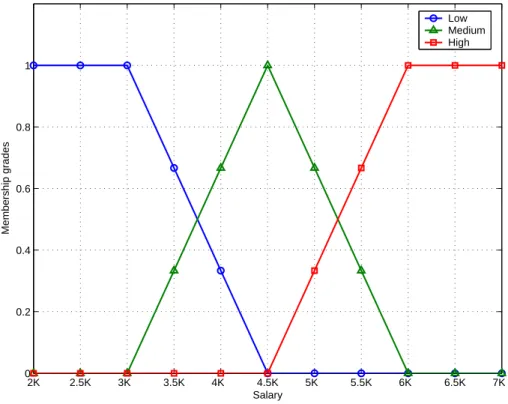
defined on the domain of attribute Salary, say [20K, 70K], with member-ship functions of linguistic classes graphically depicted as in Fig. 1. Then the linguistic classification induces a fuzzy partition on U whose membership functions of fuzzy classes are shown in Table 5.
2K 2.5K 3K 3.5K 4K 4.5K 5K 5.5K 6K 6.5K 7K 0 0.2 0.4 0.6 0.8 1 Salary Membership grades Low Medium High
Fig. 1. A Linguistic Partition of Salary Attribute
Then approximations of the fuzzy partition induced by Salary in the ap-proximation space defined by Degree and Experience are given in Table 6.
Table 5
Induced Fuzzy Partition of U Based on Salary
U µLow µM edium µHigh
1 0 0 1 2 0 0.87 0.13 3 0 0.47 0.53 4 1 0 0 5 1 0 0 6 0 0.67 0.33 7 0.67 0.33 0 8 0.33 0.67 0 9 0.27 0.73 0 10 0 0 1 11 0 0.67 0.33 12 1 0 0 13 0 0.33 0.67 14 0 0.6 0.4 15 0 0 1 16 0 0 1 Table 6
The approximations of the fuzzy partition based on Salary in
hU, ind({Degree, Experience})i
Xi {1, 15} {2, 6} {3, 11, 13, 14} {4, 12} {5, 7} {8, 9} {10, 16} µHigh∗ 1 0.13 0.33 0 0 0 1 µHigh∗ 1 0.33 0.67 0 0 0 1 µM edium∗ 0 0.67 0.33 0 0 0.67 0 µM edium∗ 0 0.87 0.67 0 0.33 0.73 0 µLow∗ 0 0 0 1 0.67 0.27 0 µLow∗ 0 0 0 1 1 0.33 0
Using (7) and (8) we easily obtain ˆ α{Degree,Experience}(Salary) = 13.46 18.21 = 0.739 and ˆ γ{Degree,Experience}(Salary) = 13.46 16 = 0.84 respectively.
Table 7
Mass assignment for µLow and approximations of its focal sets
α 1 0.67 0.33 0.27
Lowα {4, 5, 12} {4, 5, 12, 7} {4, 5, 12, 7, 8} {4, 5, 12, 7, 8, 9}
mLow(Lowα) 0.33 0.34 0.06 0.27
R(Lowα) {4, 12} {4, 5, 12, 7} {4, 5, 12, 7} {4, 5, 12, 7, 8, 9}
R(Lowα) {4, 5, 12, 7} {4, 5, 12, 7} {4, 5, 12, 7, 8, 9} {4, 5, 12, 7, 8, 9} That is we have the following partial dependency in the database
{Degree, Experience} ⇒0.84Salary (12)
To calculate the precision measures for the fuzzy classes we need to obtain the mass assignment for each fuzzy class and approximations of its focal sets respectively. For example, the mass assignment of Low and approximations of its focal sets are shown in Table 7.
Therefore, by (9) we have ˆ
π{Degree,Experience}(Low) = 0.878
Similarly, we also obtain ˆ
π{Degree,Experience}(Medium) = 0.646
ˆ
π{Degree,Experience}(High) = 0.876
Now in order to show how the influence of, for example, attribute Experience on the quality of approximation, let us consider the partition induced by the attribute Degree as follows
U/ind({Degree}) = {{1, 2, 6, 15}, {3, 8, 9, 10, 11, 13, 14, 16}, {4, 5, 7, 12}} Then we obtain approximations of the fuzzy partition induced by Salary in the approximation space defined by Degree given in Table 8.
Thus we have
ˆ
γ{Degree}(Salary) =
3.2 16 = 0.2 Similarly, we also easily obtain
ˆ
γ{Experience}(Salary) =
5.06
Table 8
The approximations of the fuzzy partition based on Salary in hU, ind({Degree})i
Xi {1, 2, 6, 15} {3, 8, 9, 10, 11, 13, 14, 16} {4, 5, 7, 12} µHigh∗ 0.13 0 0 µHigh∗ 1 1 0 µM edium∗ 0 0 0 µM edium∗ 0.87 0.73 0.33 µLow∗ 0 0 0.67 µLow∗ 0 0.33 1
As we can see, both attributes Degree and Experience are highly signifi-cant as without each of them the measure of approximation quality changes considerably.
6 Conclusions
This paper has proposed a new roughness measure of a fuzzy set based on the notion of the mass assignment of a fuzzy set and its α-cuts. It is shown that the proposed measure inherits interesting properties of Pawlak’s measure of roughness of a crisp set and, moreover, avoids the undesired properties of the measure proposed by Banerjee and Pal. As roughness measure is defined as opposed to its accuracy in rough set theory, it has been shown that there is also a similar correspondence between the roughness and accuracy of a fuzzy set. Furthermore, some possible extensions of the so-called approxima-tion quality, which may be used to describe the rough approximaapproxima-tion quality of a fuzzy classification have been suggested. It would be of interest that such measures may support us as numerical characteristics to realize partial de-pendency between attributes which is intuitively infered based on background knowledge and often expressed linguistically, while such a dependency could not be expressed in terms of traditional data dependencies. However, further work should be done to explore the theoretical features as well as practical implications of the introduced measures.
Acknowledgements
The authors would like to thank the referees for their constructive comments as well as helpful suggestions from the Editor-in-Chief, which have helped improve this paper significantly.
References
[1] J.F. Baldwin, The management of fuzzy and probabilistic uncertainties for knowledge based systems, in: S.A. Shapiro (Ed.), The Encyclopaedia of AI, Wiley, New York, 1992, pp. 528–537.
[2] J.F. Baldwin, J Lawry, T.P. Martin, A mass assignment theory of the probability of fuzzy events, Fuzzy Sets and Systems 83 (1996) 353–367.
[3] J.F. Baldwin, J Lawry, T.P. Martin, Mass assignment based induction of decision trees on words, Proceedings of IPMU’98, 1996, pp. 524–531.
[4] M. Banerjee, S.K. Pal, Roughness of a fuzzy set, Information Sciences 93 (1996) 235–246.
[5] S. M. Chen, C. M. Huang, Generating weighted fuzzy rules from relational database systems for estimating null values using genetic algorithms, IEEE
Transactions on Fuzzy Systems 11 (2003) 495–506.
[6] D. Dubois, H. Prade, Properties of measures of information in evidence and possibility theories, Fuzzy Sets and Systems 24 (1987) 161–182.
[7] D. Dubois, H. Prade, Rough fuzzy sets and fuzzy rough sets, International
Journal of General Systems 17 (1990) 191–209.
[8] G. Gediga, I. D¨untsch, Rough approximation quality revisited, Artificial
Intelligence 132 (2001) 219–234.
[9] I.R. Goodman, Fuzzy sets as equivalence classes of random sets, in R. Yager (Ed.), Fuzzy Set and Possibility Theory (Pergamon Press, Oxford, 1982) 327– 342.
[10] V. N. Huynh, Y. Nakamori, T. B. Ho, G. Resconi, A context model for fuzzy concept analysis based upon modal logic, Information Sciences 160 (1–4) (2004) 111–129.
[11] R. Klir, B. Yuan, Fuzzy Sets and Fuzzy Logic: Theory and Applications, Prentice-Hall PTR, Upper Saddle River, NJ, 1995.
[12] J. Lawry, A methodology for computing with words, International Journal of
Approximate Reasoning 28 (2001) 51–89.
[13] E. Marczewski, Steinhaus, On a certain distance of sets and the corresponding distance of functions, Colloquium Mathematicum 6 (1958) 319–327.
[14] T. Murai, H. Kanemitsu, M. Shimbo, Fuzzy sets and binary-proximity-based rough sets, Information Sciences 104 (1–2) (1998) 49–80.
[15] H.T. Nguyen, On random sets and belief functions, Journal of Mathematical
Analysis and Applications 65 (1978) 531–542.
[16] S. K. Pal, A. Skowron (Eds.), Rough Fuzzy Hybridization: New Trends in
[17] Z. Pawlak, Rough sets, International Journal of Computer and Information
Sciences 11 (1982) 341–356.
[18] Z. Pawlak, Rough Sets: Theoretical Aspects of Reasoning about Data, Kluwer Academic Publishers, Boston, MA, 1991.
[19] Z. Pawlak, Rough sets and fuzzy sets, Fuzzy Sets and Systems 17 (1985) 99–102. [20] L. Polkowski, Rough Sets: Mathematical Foundations, Physica-Verlag,
Heidelberg-New York, 2002.
[21] W. Z. Wu, W. X. Zhang, Constructive and axiomatic approaches of fuzzy approximation operators, Information Sciences 159 (3-4) (2004) 233–254. [22] M. Wygralak, Rough sets and fuzzy sets: some remarks on interrelations, Fuzzy
Sets and Systems 29 (1989) 241–243.
[23] Y. Y. Yao, Information granulation and rough set approximation, International
Journal of Intelligent Systems 16 (2001) 87–104.
[24] Y. Y. Yao, Combination of rough and fuzzy sets based on alpha-level sets, in T. Y. Lin & N. Cercone (Eds.), Rough Sets and Data Mining: Analysis
of Imprecise Data (Kluwer Academic Publishers, Boston/London/Dordrecht,
1997) 301–321.
[25] Y. Y. Yao, A comparative study of fuzzy sets and rough sets, Information
Sciences 109 (1998) 227–242.
[26] Y. Y. Yao, Probabilistic approaches to rough sets, Expert Systems 20 (5) (2003) 287–297.
[27] L.A. Zadeh, Fuzzy sets, Information and Control 8 (1965) 338–353.
[28] H. Zhang, H. Liang, D. Liu, Two new operators in rough set theory with applications to fuzzy sets, Information Sciences, in press.