Telephone Calls in MEXT Approved High School
Textbooks
著者
立木 ドナ
journal or
publication title
Journal of foreign studies
volume
66
number
2
page range
13-37
year
2016-12-22
URL
http://id.nii.ac.jp/1085/00001913/
Creative Commons : 表示 - 非営利 - 改変禁止 http://creativecommons.org/licenses/by-nc-nd/3.0/deed.jaTelephone Calls in MEXT Approved High School
Textbooks
TATSUKI Donna
1. Introduction
Despite the fact that learners need exposure to and instruction in pragmatics in order to effectively develop interactional practices of real conversation (Wong & Waring, 2010), this area is generally ignored by textbook writers (Vellenga, 2004). Other research on ESL textbooks has found that the contents (or lack thereof) and the way the contents were presented led to pragmatic problems (Bouton, 1996; Crandall & Basturkmen, 2004; Akutsu, 2001). This kind of neglect results in the production of dialogues that “are not sufficiently in sync with the sequential structures of real interaction” (Wong, 2012, p. 135) and seem stilted or unnatural (Bernsten, 2002; Grant & Starks, 2001; Wong, 2002, 2007).
According to Wong (2002) telephone calls are an important speech genre for daily conversational life, yet language learners do not get enough practice. Learners may avoid or minimize telephone talk because they felt ill prepared and therefore, would benefit from practice in using pragmatically reliable materials (Wong, 1984; 2002). This paper investigates the quantity and quality of telephone dialogues available in language teaching materials, specifically, MEXT approved high school textbooks.
It must of course be noted that over the past decade the means of telecommunicating have been changing. Beyond the use of the traditional fixed landline telephones, many people have the choice of mobile phones as well as computer mediated sevices like Skype, voice-over-IP (VoIP), or Facetime. Scott, Scott, Coursaris, Kato, Kato, & Liu (2013) estimate that over 80% of young people in America, Japan and China have mobile phones. Indeed, Japan is considered to be a leader in terms of consumer trends of mobile phone use (Ito, 2004) and has a rather unique history of mobile phone adoption (for social purposes). Young women led the way with personal pagers (Fujimoto, 2005); by 1996 it was estimated that 48.8% of middle and highschool students had a pager (Ito, 2004), which was designed to receive text as well as numbers. Pagers gave way to the Personal Handyphone System (PHS) and later to
cell phones, called keitai, which were predominantly used for text messaging. Keitai can be considered multimedia because they offer “Internet access services like i-mode (NTT DoCoMo), ez-web (au, TU-KA), and J-sky ( J-Phone, currently Vodafone’s Vodafone Live!)” (Okada, 2005). Although young people initially were the early adopters, the adoption of mobile media by the general population caught up by 2002 (Yoshii, et al. 2002).
In an ethnographic research study, Ito (forthcoming) reported that “All teenagers stated a preference for calling a mobile rather than a home phone because they could avoid talking to a parent” (cited in Ito, 2004) and similarly spouses preferred calling their partner’s mobile rather than the office landline if it was considered to be a personal call. Matsuda (2005) notes that keitai is predominantly used for texting “among young people, the keitai is not so much as phone as primarily an email-machine” (cited in Ito, 2004, n.p.) and studies have been done that cite the adverse effects of keitai use among the adolescent age group (Ishii, 2011). In 2009 there was a move to prohibit the bringing of keitai to school.
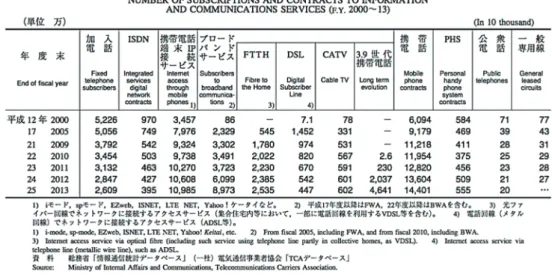
According to Ministry of Public Management data (cited in Okada 2005), on average, keitai internet use is much higher (75.2%) than voice only (24.8%). If one considers the 13-19 year old age group, the margin is even higher: 90% internet use (predominantly for email/messages, followed by music and image downloads) and 10% voice only use. In otherwords, highschoolers might carry keitai but they use them for texting rather than as a voice-based, telephone like appliance. Furthermore, households and businesses continue to purchase and use fixed landline telephones because, “Japan has also been an early adopter of triple-play models which provide TV, broadband internet and voice telephony as packaged services from a single provider” (Budde.com, 2016, p. 1). Although, the number of subscribers for fixed lines is declining in comparison to the growth of mobile phone subscribers (see Figure 1, cited from
http://www.stat.go.jp/english/data/nenkan/pdf/z12-1.pdf), these numbers are a bit more complicated. Businesses and households that want to provide multiple phone handsets for several users (employees or family members) are counted as one subscriber, no matter how many users there are. On the other hand, mobile devices are personal so each subscription
represents one user. Therefore the high growth in mobile subscriptions can not be fairly compared with the decline in fixed landline based subscriptions since they represent different user patterns. Figure 2 (cited from http: //www.stat.go.jp/english /data/nenkan/pdf/yhyou12. pdf) provides the numerical break down for subscribers.
Figure 2. Numerical break down of subscriptions
So it could be argued that keitai may not have completely displaced the landline telephone for voice-based communication. Indeed, the Japanese usage pattern has been considered unique: Even though youths in other countries employ text messaging (Kasesniemi & Rautiainen, 2002; Kasesniemi, 2003; Agar, 2003), the rate of texting versus voice calls in Japan is far higher (Okada, 2005). Student groups reported making or recieving one or two voice calls per day, in comparison to an average of 10 sent and 10 received email messages These points will be returned to in a later section.
2. Previous Textbook Research 2.1 Dialogues in General
Myers-Scotton and Bernstein (1988) were among the earliest to compare textbook dialogues with authentic data. They looked at how requests and direction giving were performed and discovered that textbook dialogues were deficient in a number of ways. They rarely contained orientation checks, parenthetical comments, or fillers (let’s see, um, okay) that were regular features of authentic dialogues. Bardovi-Harlig, Hartford, Mahan-Taylor, Morgan and Reynolds (1991) in their study of conversational closings, found that no
textbooks contained any pre-closing moves whereas they were present in natural discourse. Akutsu (2008) also focused on conversational closings, looking at MEXT approved textbooks in Japan and found that not only were they poorly represented in terms of quantity, the few closings that were present tended to be problematic due to “possible transfer from Japanese norms [that] could be sources of teaching-induced pragmatic failure “ (p. 122). Also in Japan, Griffee (1993) compared native speaker role plays of conversation openers and direction giving with textbook dialogues and found that in contrast to the dialogues, the role plays were generally longer, had more turns and used conversation management strategies (repair, back channeling).
Gilmore (2004) compared natural discourse with MEXT approved textbook dialogues in terms of nine features of discourse (lexical density, false starts, repetition, pauses, terminal overlap, latching, hesitation devices and backchannels). Apart from lexical density, the textbook data contained virtually none of these features (Although he commented that more recent textbooks (circa 2001) were starting to include small numbers of these features). To great credit, Goodman and Hou (2011) used Gilmore’s research model to guide the design and later evaluate the conversational authenticity of textbooks their team prepared in advance of the World Games held in Taiwan in 2009.
2.2 Telephone Dialogues Specifically
Telephone dialogues in textbooks have received some research attention starting with Wong’s pioneering research in 2002 and followed up by Tatsuki in 2005. Both studies compared textbook telephone dialogues with the canonical structures reported in CA (Conversation Analysis) research. Wong (2002) found:
Very few (10%) contained a complete Summons-Answer sequence. Virtually none indicated that the phone rang to start the call.
Because of the lack of ring and proper summons-answer sequence, it was sometimes hard to be sure which speaker is the caller or recipient:
o When the summons answer sequence was missing, the dialogue did not have a way to include an initial voice sample, so the type of recognition-identification sequence that is most frequent in real life calls was underrepresented in the dialogues.
o This led to strange/stilted conversations between friends and family who unrealistically failed to recognize each other’s voices.
Tatsuki (2005) examined telephone calls depicted in MEXT approved Junior High School level textbooks and found serious shortcomings. Findings by Tatsuki (2005) paralleled and supported Wong’s results almost completely with the additional note that telephone calls in films and television were far superior as models of natural telephone dialogues when compared with those in Junior High School EFL textbooks. With the passing of 10 years, it is time to take another look to see if current textbook materials have changed or improved. This study will use similar methods as found in Wong (2002) and Tatsuki (2005) but the target data will be new: MEXT approved textbooks for High School currently in use in 2015-2016. Also, the study will note whether the forms of telecommunication modeled are restricted to land line use or if they included alternatives (such as keitai, Skype, Facetime, Whatapp, Line, email, etc). Since readers might not be familiar with CA findings related to telephone sequences, it bears repeating here with pertinent updates related to analyses of interactions using mobile technology..
3. Telephone Sequences According to CA research
Schegloff did the first serious work on telephone sequences (1968, 1979, 1986, 1993). Through his analysis of more than 500 telephone interactions he concluded that a generic four-part set of sequences is common to the openings of telephone dialogues. This four-part generic sequence contains the following components: “summons-answer sequences, identifications, greetings and how-are-yous” (Schegloff, 2002, p. 350).
Extract (1), (adapted from Schegloff, 1986 and also presented in Tatsuki, 2005) provides an illustrative basis to discuss the way speakers co-construct an opening sequence.
(1) [#247. R stands for recipient/answerer and C for the caller] <<ring>> 01 R: Hello 02 C: Hello, Jim? 03 R: Yeah 04 C: It’s Bonnie. 05 R: Hi
06 C: Hi, how are yuh. 07 R: Fine, how are you? 08 C: Oh, okay I guess. 09 R: Oh, okay
10 C: Uhm (0.2) what are you doing new year’s eve?
3.1 Summons-Answer Sequences
The beginning of a telephone call requires that the caller and the recipient establish contact (ten Have, 2002), which starts with the ringing, blinking or vibrating of the phone followed by the first thing uttered by the recipient of the call. In other words, the ring of the phone “summons” the recipient to pick up the phone and answer the summons—typically with expressions like hello, hi, yeah and self-identification. Schegloff contends that hello is the most common, preferred, minimally graded recognition used to allow both speakers mutual identification/recognition.
The only rare deviation from this is in the case when a call is expected or the recipient’s telephone has a caller-ID system and the answerer might say, “it’s me” or use some other preemptive caller identification (e.g. “Hey <caller name>, what’s up?”). According to various research (Murtagh, 2001; Vihavainen, 2002), answerers are under little pressure to answer the phone promptly (in contrast to land line behaviors).
Research indicates however, that mobile phone users do receive calls from strangers/unknown callers about 38% of the time (Arminen & Leinonen, 2006). When they do, they typically revert to the predominant landline summons-answer style (Arminen & Leinonen, 2006). Therefore, regardless of the proliferation of keitai and other telecommunication devices, as long as there is a chance of a call from an unknown caller, the practices of landline fixed telephones continue to be valid and necessary routines to be learned and developed.
The notion of a “distributive rule for first utterances” (Schegloff, 1968) where it is expected that the recipient of the call speaks first is incredibly important for the sequences that follow.
3.2 Recognition-Identification Sequences
By speaking first, the call recipient gives the caller a voice sample that will enable the caller to identify him/her. There is a lot of overlap between greeting sequences and recognition-identification sequences because even a small word like hello or hi provides enough of a voice sample to let each party recognize each other (assuming they have met or spoken to each other before) and re-establish their relationship. Among intimates and acquaintances, this typically moves on to a how-are-you sequence prior to the first topic or reason for the call. If the two speakers are not well acquainted, they have to do more interactional work to mutually identify each other before moving to an explanation for the call.
Sometimes one or both parties might pre-emptively identify themselves, and such a “pre-emptive identification” (Schegloff, 1967) cuts down on the overall interactive work.
Although the preponderance of CA data suggests that North Americans generally rely on voice-based recognition, “the use of self-identification answers vary cross-culturally” (Tatsuki, 2005, p. 62). According to Houtkoop-Steenstra (1991), in the Netherlands it is conventional to explicitly self-identify when answering a telephone, even at home and it would be considered rude or even suspicious to make the caller rely on voice recognition alone (except for close friends and family relations). Telephone calls in Swedish (Lindstrom, 1994) and Japanese (Park, 2002; Yotsukura, 2002) contexts have been observed to have similar characteristics regarding self-identification.
3.3 How-are-you Sequences
How-are-you sequences are reciprocal and it is usually the callers rather than recipients that start the sequence (Schegloff, 1986, 1995). The call recipient may offer positive (e.g., good,
fine, great), negative (e.g., terrible, awful) or neutral (okay) responses (Sacks, 1975), which
may be followed up by a reciprocal how-are-you before segueing into the purpose of the call/first topic.
3.4 Closing Sequences
Most agree that openings are important but so too are closings. Yet, they are often completely overlooked in textbook dialogues (Wong, 2002, 2007; Akutsu, 2008; Wong & Waring, 2010). Closings are not as simple as “Bye” or “Goodbye”—if and when a person utters “Bye” may incur “negative interactional consequences (e.g., the person is seen as impatient, impolite, or aloof)” (Wong, 2012b, p. 135). The structure of telephone closings typically includes pre-closing signals, pre-closing sequences and terminal exchanges.
Here is a simple example (see extract (2) to illustrate: (2)
A: OK. Preclosing signal (first pair part; turn 01) B: OK. Preclosing signal (second pair part; turn 02) A: Bye bye. Terminal exchange (first pair part; turn 03) B: Bye. Terminal exchange (second pair part; turn 04)
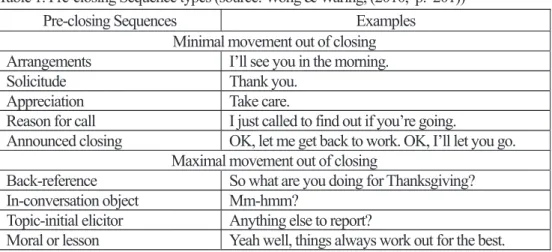
(Schegloff & Sacks, 1973, p. 317) However, besides giving pre-closing signals that the terminal exchange is coming, sometimes interlocutors also use pre-closing sequences to “jointly navigate conversational closure” (Wong, 2012b, p. 136). Table 1 adapted from Wong and Waring, (2010, p. 201) summarizes
the variety of possible pre-closing sequence types. To see how the pre-closing sequences exert minimal movement out of closing consider this example in excerpt (3) from Button (1990, p. 97-98) adapted for better understanding by the inclusion of explanation of minimal movement type.
Table 1. Pre-closing Sequence types (source: Wong & Waring, (2010, p. 201)) Pre-closing Sequences Examples
Minimal movement out of closing Arrangements I’ll see you in the morning. Solicitude Thank you.
Appreciation Take care.
Reason for call I just called to find out if you’re going.
Announced closing OK, let me get back to work. OK, I’ll let you go. Maximal movement out of closing
Back-reference So what are you doing for Thanksgiving? In-conversation object Mm-hmm?
Topic-initial elicitor Anything else to report?
Moral or lesson Yeah well, things always work out for the best. Note that arrangement sequences are special because they show that the interlocutors have a special relationship that enables them to close the conversation more quickly and easily than the effort and formally required for strangers/mere acquaintances.
(3) [PCL = pre-closing; TER = terminal exchange]
PCL (appreciation) 01 Emma: Um, sleep good tonight, sweetie.
PCL (arrangements) 02 Lottie: OK, OK. Well, I’ll see you in the morning. PCL (arrangements) 03 Emma: All right.
PCL (arrangements) 04 Lottie: All right. TER 05 Emma: Bye bye, dear. TER 06 Lottie: Bye bye. ((end call; hang up))
(Schegloff & Sacks, 1973) Based on the available research findings regarding the generic structure of telephone dialogues, it made sense to investigate whether or not teaching materials, especially those in mandated government textbooks, adhered to what could be considered authentic patterns.
4. Method
4.1 Data Collection
Although previous research (Wong, 2002; Tatsuki, 2005) had merely taken a sample of textbooks, this time all available MEXT approved textbooks for high school use were examined: 88 newly published textbooks (2015) were searched page by page for telephone dialogues. Only 22 textbooks (25%) were found to include telephone dialogues (a mere total of 36), although some textbooks provided a short mention of telephones and offered “useful phrase” lists.
In keeping with the methodology followed by Tatsuki (2005), “only dialogues with roles explicitly marked by speaker names or letter denotations of speaker roles (e.g., speaker A and B or M and F) were included in this analysis” (Tatsuki, 2005, p. 67) (see Appendix A for the final list of 22 textbooks).
4.2 Analysis
Once the telephone dialogues were isolated, they were transcribed and then analyzed in terms of their sequence structure with particular attention to the structures in opening sequences, the core sequences within openings and the presence/absence of closings.
5. Results
A page-by-page examination of the textbooks isolated those pages that contained dialogues related to telephone related topics. The complete list of textbooks (with indications of each textbook’s market share, i.e., possible influence/reach) is in Appendix A. There were 36 land line telephone dialogues and two keitai calls in only 23 of the 88 (26.13%) new textbooks (in the case of one textbook there was advice on telephone call opening but no dialogue). Interestingly, cell phones/keitai were mentioned in many textbooks (the topic of a reading passage, included in vocabulary or sentence translation activities), so the topic is gaining attention.
From among the 88 textbook consulted, 36 contain information related to email messages. In most cases (28 textbooks), email is merely included as a vocabulary item or as part of a reading passage/sentence based grammar exercise. 11 textbooks contain model emails and of these, eight include writing activities that give learners practice producing an email in English. Analysis and evaluation of the structural elements of these email models is beyond the scope of the present study.
Most fixed line telephone calls were between friends or family (20); the second most frequent were between strangers (10); the least frequent were business related (6). The
following sections will examine Summons-Answer (SA) sequences, Recognition-Identification (R-I) sequences, How-Are-You (HAY) sequences and Closings.
5.1 Summons-Answer Sequences
There is only one complete summons-answer sequence (starting with the explicit ringing of the phone) in all 36 dialogues (see dialogue extract (4)). This echoes a similarly dismal result in the Tatsuki (2005) study.
(4)
1 rrrrr……
2 Operator: Softball City Stadium. Kathy McLean speaking. How may I help you?
(dialogue continues)
(Sailing English Conversation, p. 90) It might be argued that because it is “common sense” that phones ring and that people answer them, it is not really necessary to include such trivial matters in dialogues. However, without the ringing of the phone it is not so easy to know who is the caller and who is the recipient of the call. Furthermore, if learners are under the mistaken impression that the caller speaks first in an English telephone call, they may speak over the person who answers. In fact on numerous occasions I have experienced precisely that kind of problem in telephone calls with Japanese students (the callers not waiting for the the receiver of the call to speak before launching into the call), resulting in misfired openings and initial breakdowns of communication. (5) 1 A: Hello. Jane? 2 B: Yes. 3 A: Takuya here. (dialogue continues)
(Compass English Communication II, p.72) This problem is only compounded when the dialogue writers, quite erroneously, make the caller speak first (see for example, dialogue extract (5)). This goes completely against the “distributive rule” (Schegloff, 1968) that the recipient of the call speaks first. Such a dialogue falsely implies to the learner that callers should speak first, which is a completely incorrect
supposition and sets them up for pedagogically induced errors/problematic communication. There were nine dialogues in which the caller spoke first and thus, by flouting the “distributive rule” could be considered seriously problematic.
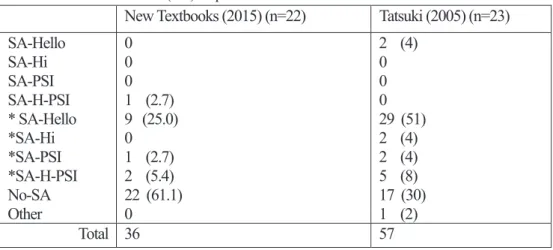
However, the analysis revealed a far greater problem: A very large percentage (61%) of telephone dialogues contained no summons-answer sequence at all (see Table 2). This is much higher than was observed in the Junior High School textbooks examined in 2005. The problems related with the absence of summons-answer sequences will be explained in more detail in the next section (5.2), which discusses recognition-identification sequences.
Table 2. Summons-Answer (SA) sequences
New Textbooks (2015) (n=22) Tatsuki (2005) (n=23) SA-Hello SA-Hi SA-PSI SA-H-PSI * SA-Hello *SA-Hi *SA-PSI *SA-H-PSI No-SA Other 0 0 0 1 (2.7) 9 (25.0) 0 1 (2.7) 2 (5.4) 22 (61.1) 0 2 (4) 0 0 0 29 (51) 2 (4) 2 (4) 5 (8) 17 (30) 1 (2) Total 36 57 Percentages in parentheses *no ring or explicit summons.
Overall variety in the way that these telephone calls started is much lower when compared with the 2005 data. The use of informal greeting word “Hi” for example is noticeably missing. The use of pre-emptive self-identification (PSI) by the call recipient was seen in only four calls (extracts (4), and (6)-(8)) whereas in the 2005 data it appeared in seven different calls. In all cases in the 2015 data the situation being modeled was formal or business-oriented, which fits with the observations in Schegloff’s (1968) research regarding this sequence type.
(6)
1 Yan: Dr. Chang’s office. How may I help you? 2 Masaya: Hi. I’d like to see the dentist urgently.
(dialogue continues)
(My Way English Communication II, p. 26)
(7)
1 Staff: Hello, this is the ticket center of Venezuela.
2 Hitomi: Do you have any tickets for the concert of traditional music? (dialogue continues)
(Unicorn English Communication I, p. 115) (8)
1 A: Hello, this is Jane speaking. I’d like to speak to my teacher, Mr. Williams.
2 B: もしもし、私がウイリアムズです. Can I help you?
(dialogue continues)
(Monument English Expression I, p. 11) Although these business oriented calls are few in number, it is encouraging to see that they are have been included at all since they provide models of some of the few remaining instances of fixed landline telephone calls. Regardless of whether or not a young person uses a mobile device, they will at some point in their lives be required to call a business which uses a fixed line and therefore should be familiar with the expected call sequence.
5.2 Recognition-Identification (R-I) Sequences
The conventional greetings used in telephone interactions (e.g., hello and hi) give voice samples that may be used to assist in identification-recognition. This is presented effectively in seven dialogues. An example is in extract (9). Jiro answers the call and Ann is able to use voice recognition (VR) to determine his identity. Ann returns the greeting and then identifies herself (CSI).
(9)
1 Jiro: Hello!
2 Ann: Hi Jiro. This is Ann. Can I talk to you now? 3 Jiro: Sure. What’s the matter?
(dialogue continues)
Self-identification (by the receiver of the call and/or the caller) can be found in several dialogues. However, there were a number of strange R-I sequences observed in the textbook data. Take for instance the conversation in extract (10). There is no Summons-Answer sequence included so the caller, Hiroshi, speaks first.
(10)
1 Hiroshi: Hello. This is Hiroshi speaking. May I speak to Kate? 2 Kate: Hi Hiroshi. It’s me.
3 Hiroshi: Hi Kate. Do you have any plans for the weekend? (dialogue continues)
(New One World Communication I, p. 97) This illustrates again that the learner is being led to the incorrect impression that the caller should speak first—and once again, this directly flouts Schegloff’s (1979) “distributive rule.” Then, the caller goes directly into a “switchboard request” (Wong, 2002, p. 42), which implies that the caller did not recognize the voice of the person who answered the phone (Kate). If Hiroshi knows Kate well enough to ask her on a date/out to play tennis, surely he knows her well enough to recognize her voice. But of course, since the author of this text failed to include a proper summons-answer sequence in which the first obligatory line of this dialogue should have been Kate saying “Hello?” in response to the ringing phone, Hiroshi apparently does not have the voice sample he would need in order to recognize her.
Now, of course it might have been the intent of the author to make the caller speak first (i.e. have the call speak before the recipient has a chance to say a minimal “hello”). If that is so, however, this dialogue is not following the conventions of typical telephone conversations of any kind, or from any culture. Research into Japanese telephone call data by Park (2002) indicates that although the exchange of self-identifications is frequent in her Japanese data, it occurs after an initial “hello” (moshi-moshi) or “this is X’s residence” (p. 29) said by the call recipient in non-business settings. Table 3 shows the distribution of switchboard type requests in the calls.
Furthermore, Yotsukura (2002), observed that call recipients in a business setting will usually answer the ringing phone by self-identifying, although they sometimes will precede self-identification this with “hai” as an acknowledgement of the telephone ring. On in-house business phones, however, the call recipient will usually start with “moshi-moshi” and perhaps his or her last name. Therefore, the lack of a complete summons-answer sequence has lead to a problematic recognition-identification sequence that cannot be explained away
as being an example of L1 transfer of Japanese conversational strategy—it is just plain wrong and terribly misleading.
Table 3. Distribution of switchboard (SWB) and non-switchboard (NonSWB) requests New Textbooks (2015) (n=22) Tatsuki (2005)
(n=23) BizSWB-R BizNonSWB-R nonBizSWB-R nonBizNonSWB-R 1 (3) 4 (11) 12 (33) 19 (53) 2 (4) 2 (4) 31 (53) 22 (39) Total 36 57 Percentages in parentheses 5.3 How-Are-You Sequences
When compared with previous research (Tatsuki, 2005), there is a greater number of
how-are-you (HAY) or equivalent sequences (see Table 4). On the surface this may seem like an
improvement but closer inspection reveals other problems (see excerpt 10). There were no instances in which HAY was reciprocated; in all 5 cases in which there was an initial HAY, the responses were neutral (fine, good) and in only once case was a thank you token included that indicated a recognition of the HAY initiation.
Table 4. How-Are-You (HAY) sequences New Textbooks (2015) (n=22) Tatsuki (2005) (n=23) HAY *HAY No-HAY 5 (14) 5 (14) 26 (72) 3 (5) 3 (5) 51 (89) Total 36 57 Percentages in parentheses
* how-are-you equivalent expressions (e.g. What’s up? Howzit goin’?) (10) 1 2 3 4 Mai: Jim: Mai: Jim:
Hello. This is Mai speaking. Can I speak to Jim, please? This is Jim speaking. How are you doing, Mai? I’m doing fine, thank you.
That’s great! Is Sue doing well at your home? (dialogue continues)
5.4 Closings
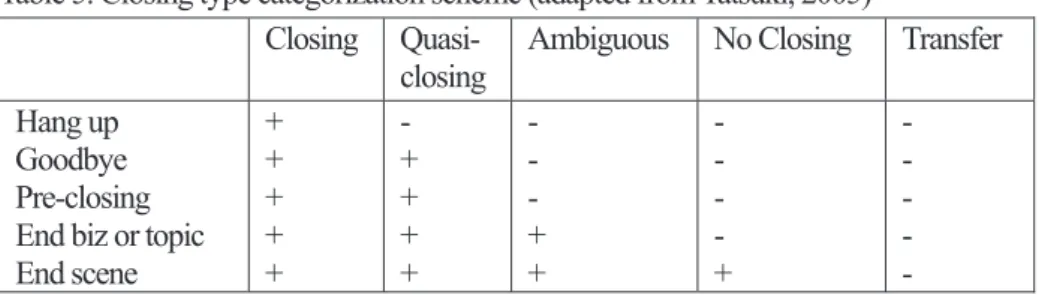
In order to effectively categorize closings, Tatsuki (2005) established a closing type categorization scheme (see Table 5). The counterpart of the explicit ring of the opening summons would be an explicit hang-up action. It could be said that the act of hanging up is the actual moment of closure for a telephone conversation. If a scene contained a combination or two or more closing types among the categories of goodbyes, pre-closing formulae or ending the business of the call, it was labeled a quasi-closing. If there was only an end of business closure, the ending was considered ambiguous. A scene, which ended mid-topic or immediately after the opening sequence was categorized as no closing. In the case where one person answered the call and then passed the phone to another speaker, it was deemed a transfer.
Table 5. Closing type categorization scheme (adapted from Tatsuki, 2005)
Table 6 shows the distribution of closing types among the textbook dialogues examined and compares the new findings with that of previous research (Tatsuki, 2005). Although none of the textbook dialogues explicitly showed in pictures or in words the act of hanging up, they did come to an end in a variety of ways: by uttering goodbyes (e.g., goodbye, bye, ciao,
Table 6. Distribution of closing types Percentages in parentheses
* how-are-you equivalent expressions (e.g. What’s up? Howzit goin’?)
Closing
Quasi-closing Ambiguous No Closing Transfer Hang up
Goodbye Pre-closing End biz or topic End scene + + + + + - + + + + - - - + + - - - - + - - - - -
New Textbooks (2015) (n=22) Tatsuki (2005) (n=23) Closing Quasi closing Ambiguous No closing Transfer 0 13 (36) 13 (36) 8 (22) 2 (6) 0 17 (30) 22 (39) 15 (26) 3 (5) Total 36 57
sayonara), using pre-closing formulae (e.g., talk to/see you later, I’ve got to go), and by
ending the business of the call (e.g., thanks, that’s all for now). There was the same number of quasi-closings and ambiguous closings each of which accounted for 36% of the closings. However eight dialogues (22%) opted for the explicit end of the scene (e.g. the scene just ends, no further text) rather than an actual closing, which is similar to previous findings. This is considered problematic by learners who have expressed concern about the lack of support materials in the past (Akutsu, 2008).
6. Discussion
Based on this survey of all available MEXT approved high school texts for use in the 2015 academic year, the majority of telephone dialogues are incomplete; they lack crucial features of opening and /or closings and therefore fail to represent accurately “the actual use of that language as discourse outside the classroom” (Yule, 1995, p. 185). When Wong observed similar problem in her 2002 research she surmised that these omissions occurred because certain sequences might be “taken for granted” (Wong, 2002, p. 54) but a more likely explanation is that the intuitions of dialogue writers, even native speaker writers “are not necessarily sufficient for the development of naturalistic textbook materials” (p. 54). There has been a movement towards more corpus-based, data-driven textbook development (see for instance, McCarthy, 2004) in internationally based textbook series in recent years and one would hope that the same happens in Japan.
To be fair, some telephone dialogues do follow the canonical sequences described by Schegloff (1987). Extracts 11 and 12 (with the exception of omitting the ringing of the telephone) each provide a good general model of telephone talk. They correctly depict the call recipient as speaking first, which provides the caller with a voice sample. This can enable the caller to either determine the speaker identity or (as intended in in these cases) creates the need for the caller to ask for the person they really want to talk to. This identified need may lead to a switchboard type request (as exemplified in extract 11) or the leaving of a message (as exemplified in extract 12). After completing the business of the call, there is a complete pre-closing and closing sequence.
However, (as an anonymous reviewer pointed out) it is not very likely that telephone call of this kind would ever happen in Japan these days. Since Japanese highschoolers use Line or other messaging services, they would be unlikely to bother with a voice call. This is related to an overall low rate of voice-based calls as reported on at the beginning of this paper. But, if adolescents are not using their keitai to make voice calls very much, where will they develop the experience to talk properly with strangers for business oriented calls? Furthermore, if
Japanese students are texting more and voice-calling less than their international peers, how will that impact their abilities to communicate well using the voice function if they want to make and maintain friendships with non-Japanese/International peers?
(11)
1 Mrs. Brown: Hello?
2 Miki: Hello. May I speak to Tom please? 3 Mrs. Brown: Yes. Who’s calling, please? 4 Miki: This is Suzuki Miki.
5 Mrs. Brown: Hi Miki. I’ll get him. Hold on Please 6 Miki: Thank you, Mrs. Brown.
7 Tom: Hi Miki. What’s up?
8 Miki: Hi Tom. Would you like to play tennis next Sunday? 9 Tom: Sure. I’ll be free in the afternoon.
10 Miki: Great! How about two o’clock at Chuo Park? 11 Tom: Sounds good. I’ll see you then.
12 Miki: See you. Bye.
(English Now English Communication I, p. 26) (12)
1 You: Hello?
2 Judy: Hello, this is Judy. Is Misaki home?
3 You: I’m afraid she’s out right now. Can I take a message?
4 Judy: Thanks. We’re supposed to study together for the exam at my house tomorrow, but I need to reschedule it to Sunday because my uncle is visiting us tomorrow. Could you tell her that?
5 You: OK. I’ll give her your message. 6 Judy: Thank you. Goodbye.
7 You: Bye.
(Vision Quest English Expression II, p. 28) It would be helpful if textbooks included models of business oriented telephone calls that students may need to be able to handle in the future (e.g., making reservations, making or changing appointments, inquiring about services, complaining about lapses in service, etc.). Also, for the sake of authenticity, examples of other kinds of media communications (email, SMS, etc) could be included in textbook materials.
As mentioned earlier, there were two examples of a keitai (cell phone) call. As an anonymous reviewer noted, since the receiver of a keitai call usually knows who is calling,
the receiver would likely show this when they answer, as in the following:
Receiver
Hello Mary, how are you?/ Hello Mary. I was JUST about to give you a call right this minute/ Hello Mary, long time no hear!
(Anonymous Reviewer, 2016, page 2) However look closely at extract 13. The description (in Japanese) precedes the conversation: アンは、一緒にサッカーを見に行くために、駅の前でじろを待っています。も うすぐ約束の時刻です。アンはじろの携帯電話に電話をします。 (13) 1 2 3 4 5 6 7 8 Ann: Jiro: Ann: Jiro: Ann: Jiro: Ann: Jiro:
Hi, Jiro. This is Ann speaking. Can I talk to you now? Hi, Ann. Yes, go ahead.
I’ve arrived at the station already. Where are you now? I’m at Nishi Station.
Nishi Station? Will you be here on time? Sorry, I’ll be 10 minutes late.
I sent an email about today’s game to your cell phone. Have you read it? Yes, I have. I’ll email you later about it. See you.
Bye.
(Select English Conversation, p. 54) First, as the Japanese description indicates, Ann is calling Jiro. Therefore, Jiro, as the receiver of the call would be expected to answer. But, as we can see, the initial turn is missing—the receiver (Jiro) is not seen answering his keitai and acknowledging that he knows who is calling. Then, in Ann’s initial turn, Ann self-identifies despite the fact that is it not necessary—Jiro can see who is calling when he answers his keitai. Therefore, the opening turns of this sequence do not ring true and are misleading about what keitai telephone openings in English should look like. Yet, they are presented in a chapter titled, “Talking on a Cell Phone” (p. 49).
One of the implications for textbook writers and for teachers is that authentic, naturally occurring samples of telephone calls and other forms of mobile telephonic communication should be collected and examined to better inform the creation of teaching materials. Textbook consumers (teachers and students) should also exercise their right to “demand that textbook writers provide evidence that they have collected or consulted natural data and how this data was utilized in the development of new teaching materials” (Tatsuki, 2005, p. 78). To date there is no way for consumers to independently verify this information.
Although Widdowson (1998) argues that it may be necessary to tolerate some artificiality in ELT textbooks (since completely authentic texts might be too context dependent and complex for use as pedagogical materials) this does not give textbook authors license to ignore current research. Gilmore (2004) rightly concludes that at least some (higher proficiency) students should be exposed to the discourse features found in authentic conversations (that are hitherto virtually absent from textbooks) and taught conversational strategies that would enable them to develop fluent speech.
References
Agar, J. (2003). Constant touch: A global history of the mobile phone. UK: Icon Books. Akutsu, Y. (2001). Examining Speech Acts in “Oral Communication A” Textbooks. Kyoai
Ronsyu, 13, 163-178.
Akutsu, Y. (2008). Examining Closing Sections in “Oral Communication I” Textbooks. The
Economic Journal of Takasaki City University of Economics, 50(3), 111-124. Last
accessed on September 13, 2015 at http://www1.tcue.ac.jp/home1/k-gakkai/ ronsyuu/ ronsyuukeisai/ 50_3.4/akutu.pdf
Arminen, I. & Leinonen, M. (2006). Mobile phone call openings: Tailoring answers to personalized summonses. Discourse Studies, 8(3), 339-368.
Bernsten, S. (2002). Using conversation analysis to evaluate pre-sequences in invitation,
offer, and request dialogues in ESL textbook (Unpublished master’s thesis). University
of Illinois, Urbana-Champaign.
Bouton, L. (1996). Pragmatics and language learning. In L. Bouton (Ed.), Pragmatics and
language learning, monograph series vol. 7 (pp.1-20). Urbana-Champaign: Division of
English as an International Language, University of Urbana-Champaign.
Budde.com (2016). Japan - Fixed Broadband, Digital Economy and Digital Media - Statistics and Analyses. Last accessed August 24, 2016 at https:// www.budde.com.au/Research/ Japan-Fixed-Broadband-Digital-Economy-and-Digital-Media-Statistics-and-Analyses? r=51
Button, G. (1990). On varieties of closings. In G. Psathas (Ed.) Interaction competence. Washington DC: Internationa Institute of ethnmethodoglogy and Conversation Analysis and University Press of America.
Crandall, E. & Basturkmen, H. (2004). Evaluating pragmatics-focused materials. ELT
Journal, 58, 38-49.
Fujimoto, K. (2005). The third-stage paradigm: Territory machines from the girls’ pager revolution to mobile aesthetics. In M. Ito, D. Okabe, & M. Matsuda (Eds.), Personal,
portable, pedestrian: Mobile phones in Japanese life (pp. 77-102). Cambridge, MA:
MIT Press.
Gilmore, A. (2004). Textbooks and authentic interactions. ELT Journal 58 (4), 363-374. Goodman, D. & Hou, H. (2011). Advanced English Conversations for World Games 2009
Textbook: Design and Evaluation. The Journal of AsiaTEFL, 8 (2), 27-44.
Grant, L., & Starks, D. (2001). Screening appropriate teaching materials: Closings from textbooks and television soap operas. International Review of Applied Linguistics, 39, 39–50. doi:10.1515/iral. 39. 1. 39
Griffee, D. (1993). Textbooks vs. authentic dialogues: What’s the difference? The Language
Teacher, 17 (10), 25-31.
Houtkoop-Steenstra, H. (1991). Opening sequences in Dutch telephone conversations. In D. Boden & D. Zimmerman (Eds.), Talk and social structure (pp. 232–250). Berkeley: University of California Press.
Ishii, K. (2011). Examining the adverse effects of phone use among Japanese adolescents.
Keio Communication Review 33, 69-83.
Ito, M. (2004, October). Personal portable pedestrian: Lessons from Japanese mobile phone
use. Paper presented at Mobile Communication and Social Change, the 2004
International Conference on Mobile Communication in Seoul, Korea.
Kasesniemi, E. (2003). Mobile messages. Young people and new communicateon culture. Vamala: University of Tampere Press.
Kasesniemi, E. & Rautiainen, P. (2002). Mobile culture of children and teenagers in Finland. New York: Cambridge University Press.
Matsuda, M. (2005). Introduction: Discourses of Keitai in Japan. In M. Ito, D. Okabe, and M. Matsuda (Eds.). Personal, Portable, Pedestrian: Mobile Phones in Japanese Life (pp. 19-39). Cambridge: MIT Press.
McCarthy, M. (2004). Touchstone: From corpus to course book. Cambridge: Cambridge University Press.
Murtagh, G.M. (2001) ‘Seeing the “Rules”: Preliminary Observations of Action, Interaction and Mobile Phone Use’. In B. Brown, N. Green and R. Harper (Eds). Wireless World, (pp. 81–91). London: Springer-Verlag UK.
Myers-Scotton, C., & Bernstein, J. (1988). Natural conversation as a model for textbook dialogue. Applied Linguistics, 9, 372-384.
Okada, T. (2005). Youth Culture and the Shaping of Japanese Mobile Media: Personalization and the Keitai Internet as Multimedia. In M. Ito, D. Okabe, and M. Matsuda (Eds.).
Cambridge: MIT Press.
Park, Y. (2002). Recognition and identification in Japanese and Korean telephone conversation openings. In In K. K. Luke & T. Pavlidou (Eds.), Telephone calls: Unity
and diversity in conversatonal structure across languages and cultures. (pp. 25-47).
Amsterdam: John Benjamins.
Sacks, H. (1975). Everyone has to lie. In M. Sanchez & B. Blount (Eds.), Dimensions of
language use. (pp. 57-80). New York: Academic Press.
Schegloff, E. A. (1967). The first five seconds. The order of conversational opening. Ph.D. dissertation. University of California, Berkeley.
Schegloff, E. A. (1968). Sequencing in conversational openings. American Anthropologist,
70, 1075–1095. doi:10.1525/aa.1968.70.6.02a00030
Schegloff, E. A. (1979). Identification and recognition in telephone conversation openings. In G. Psathas (Ed.), Everyday language studies in ethnomethodology (pp. 23–78). New York, NY: Irvington.
Schegloff, E. A. (1986). The routine as achievement. Human Studies, 9, 111–151. doi:10. 1007/BF00148124
Schegloff, E. A. (1993). Telephone conversation. In R. E. Asher (Ed.). Encyclopedia of language and linguistics. (pp. 4547-4549). Oxford: Pergamon Press.
Schegloff, E. A. (1995). Parties and Talking Together: Two Ways in Which Numbers Are Significant for Talk-in-Interaction. In P. ten Have & G. Psathas (Eds.), Situated Order:
Studies in Social Organization and Embodied Activities (pp. 31–42). Washington,
University Press of America,.
Schegloff, E. A. (2002). Reflection on research on telephone conversations. In K. K. Luke & T. Pavlidou (Eds.). Telephone calls: Unity and diversity in conversatonal structure
across languages and cultures. (pp. 249-281). Amsterdam: John Benjamins.
Schegloff, E. A. & Sacks, H. (1973). Opening up closings. Semiotica, 8, 289-327.
Scott, D., Coursaris, C., Kato, Y., Kato, S., & Liu, S. (2013). 新データ収集システムを使 った三ヵ国に於ける携帯電話使用比較. Ningen Kagaku Kenkyu, 26 (2), 235-236. Tatsuki, D. (2005). Telephone call behavior in films and textbooks. Gaidai Ronso 56, 59-82. ten Have, P. (2002). Comparing telephone call openings: Theoretical and methodological
reflections. In K.K. Luke and T. Pavlidou (Eds.). Telephone Calls: Unity and diversity
in conversational structure across languages and cultures (pp. 234–248). Amsterdam:
Benjamins.
Vellenga, H. (2004). Learning pragmatics from ESL and EFL textbooks: How likely?
Vihavainen, M. (2002). ‘Kännykän käyttö julkisissa tiloissa’ [‘The Use of the Mobile Phone in Public Places’], final report for course, Department of Sociology, University of Helsinki.
Widdowson, H. G. (1998). Communication and Community. The Pragmatics of ESP.
English for Specific Purposes, 17(1), 3-14.
Wong, J. (1984). Using conversational analysis to evaluate telephone conversations in
English as a second language textbooks (Unpublished master’s thesis). University of
California, Los Angeles.
Wong, J. (2002). “Applying” conversation analysis in applied linguistics: Evaluating dialogue in English as a second language textbooks, International Review of Applied
Linguistics in Language Teaching, 40, 37–60. doi:10.1515/iral.2002.003
Wong, J. (2007). Answering my call: A look at telephone closings. In H. Bowles & P. Seedhouse, Conversation analysis and language for specific purposes (pp. 271–304). Bern, Switzerland: Peter Lang.
Wong, J. (2012a). Pragmatic competency in telephone conversation openings. In N. Houck & D. Tatsuki (Eds.), Pragmatics: Teaching Natural Conversation. Alexandria: TESOL. Wong, J. (2012b). Pragmatic competency in telephone conversation closings. In N. Houck &
D. Tatsuki (Eds.), Pragmatics: Teaching Natural Conversation. Alexandria: TESOL. Wong, J., & Waring, H. Z. (2010). Conversation analysis and second language pedagogy: A
guide for ESL/EFL teachers. New York, NY: Routledge.
Yoshii, H., Matsuda, M., Habuchi, C., Dobashi, S., Iwata, K., & Kin, N. (2002). Keitai Denwa Riyou no Shinka to sono Eikyou. Tokyo: Mobile Communications Kenkyuukai.
Yotsukura, L.A. (2002). Reporting problems and offering assistance in Japanese business telephone conversations. In K.K. Luke and T. Pavlidou (Eds.). Telephone Calls: Unity
and diversity in conversational structure across languages and cultures (pp. 135-170).
Amsterdam: Benjamins
Yule, G. (1995). The paralinguistics of reference: Representation in reported discourse. In G. Cook & B. Seidlhofer (Eds.), Principles and practice in applied linguistics: Studies in
Appendix A: Textbooks containing (landline) telephone dialogues (2015)
Textbook Name and Publisher Market share % # tel. dialogs Communication English/English Communication I
All aboard! Communication English I. 東京書籍 12.4 1 Discovery Communication English I. 東京:開隆堂 1.5 3 English Now Communication English I. 東京:開隆堂 2.4 1 New One World Communication English I. 東京:教育出版 2.6 1 Unicorn English Communication I. 京都:文英堂 2.7 1 *Vivid English Communication I. 広島:第一学習社 5.9 0 (*)
Communication English/English Communication II.
Big Dipper Communication English II. 東京:数研 4.9 1 Compass World Communication English II. 東京:大修館 2.1 1 My Way Communication English II. 東京:三省堂 7.2 1 New One World Communication English II. 東京:教育出版 3.5 1 Prominence Communication English II. 東京:書籍 3 1
English Conversation
My Passport English Conversation. 京都:文英堂 17.3 1 Sailing English Conversation. 大阪:啓林館 18.7 4 Select English Conversation. 東京:三省堂 27.1 1
English Expression I.
Big Dipper English Expression I. 東京:数研 7.5 3 Monument English Expression I. 東京:開拓社 0 4 Polestar English Expression I. 東京:数研 4.3 1 Unicorn English Expression I. 京都:文英堂 2.5 3 Vivid English Expression I. 広島:第一学習社 5.3 2
English Expression II.
Big Dipper English Expression II. . 東京:数研 6.5 1 Polestar English Expression II. 東京:数研 6.2 1 Vision Quest English Expression II. 大阪:新興出版社啓林館 41.9 1
Communication Kiso
Joyful English コミユケーシーヨン英語基礎コ基. 東京:三友社 100 2 Total Dialogues=36 *no dialogue/only advice
Telephone Calls in MEXT Approved High School
Textbooks
TATSUKI Donna
Kobe City University of Foreign Studies
Abstract
This study examined all 88 MEXT approved textbooks for High School currently in use in 2015-2016. A page by page search for telephone dialogues revealed their inclusion in only 22 textbooks (25%) with a total of 36 dialogues (although some textbooks provided a short mention of telephones and offered “useful phrase” lists). Following previously suggested methodology (Wong, 2002; Tatsuki 2005) the dialogues were transcribed and then analyzed in terms of their sequence structure with particular attention to structures in opening sequences, core sequence within openings and the presence/absence of closings. Findings indicate serious shortcomings in both the quantity and quality of the textbook telephone dialogues presented in government approved Japanese high school textbooks.