1. Introduction
This paper analyzed fundraising methods that draw out effects of the privatization in relation to Private Finance Initiative (PFI) methods. PFI methods provide for and manage social capital improvement using the management methods and techniques of private capital and businesses. PFI methods use a financing method called “project finance,” which looks for the ability of businesses to reimburse rather than that of borrowers; however, this has advantages and disadvantages when compared with corporate finance, which seeks reimbursement from the borrowers. Then, this paper focus on mezzanine financing, tranching, and monoline insurers as points of discussion in applying this approach toward PFI methods and examine their effects and issues. Finally, we analyze the significance of using project finance in the public sector.
PFI is defined as “a method of providing the same level of service more cheaply or higher quality of service at the same cost by utilizing the funds, management capability, and technical capability of the private sector for the construction, maintenance, and operation of public facilities
1.” In 2017, the number of such projects reached 609, with contract amounts reaching 546.86 billion yen
2. The business area covers a wide range of activities—from public facilities-related “hard” activities to town planning and culture-related activities
1
Cabinet Office Private Fund Utilization Project Promotion Office (2017, p. 1); quoted from “The Current State of PFI.”
2
See Note 1 on p. 3.
A Note on Financing by PFI Method in Japan
Makoto OSHIMA
and more.
“PPP/PFI Promotional Actions
3” were announced as a recent initiative by the government. The total amount within that initiative will be a business scale of 21 trillion yen between FY2013 and FY2023, with the breakdown being 7 trillion yen in concession businesses, 5 trillion yen in for-profit businesses, 4 trillion yen in public real estate businesses, and 5 trillion yen in other businesses
4. Although large-scale PFI projects are planned, the government declares to “positively utilize the capital supply features of PFI promotion organizations as well as its consulting features for forming projects
5” and hopes for financial institutions to play their role to this end. This action supports the projects from a financial perspective, including providing a method of financing, such as risk money and subordinated bonds. It was under these circumstances in 2013 that the government and business operators jointly invested to establish Japan’s first infrastructure fund, the “Private Finance Initiative Promotion Corporation of Japan
6.”
Prior research on finance and fund procurement via PFI methods has accumulated certain results since these operations were first undertaken in Japan. For example, The Dai-Ichi Kangyo Bank International Finance Division (1999) explains project finance using this method’s operating scheme, lays out the results and key points of the financial trends in the U.K., where PFI methods were established, and examines the significances and issues of introducing it in Japan. Kashiwagi (2004), expounds about how financing in specific cases is
3
PPP is an abbreviation for “Public Private Partnership.” PPP are long-term contracts where the private sector designs, builds, finances and operates an infrastructure project.
4
Cabinet Office, “PPP / PFI Promotion Action Plan (Revised Edition 2017)” (Cabinet Office Homepage: www8.cao.go.jp/pfi/actionplan/pdf / actionplan1.pdf, Accessed December 16, 2017).
5
Quoted from material in Note 4.
6
See: Private Funds Utilization Project Promotion Organization (www.pfipcj.co.jp/
about/overview.html, Accessed December 16. 2017).
organized mainly funding procurement and case studies, and under the planning and supervision of the specified non-profit corporation, the Japan PFI Association (2006), specific financing examples are collected. Nagano and Hirose (2003) summarize various financing methods. In recent years, Higuchi (2014) has summarized contracts between investors and entities; Nishimura and Asahi (2015) include not only project finance but also syndicated loans and intellectual property finance; and Fukushima and Suga (2014) cover infrastructure markets and investments, including PFI. Mizushima (2014) investigates methods of fund procurement that consider the characteristics of roadwork projects and the Japan Sports Agency and the Ministry of Economy, Trade and Industry (2017) examine financing in the case of designing, constructing, and maintaining sports stadium facilities while using PFI methods. In addition, Sugimoto (2006), Nishimura and Partners (2003), Fukushima and Nemoto (2012), and Kashiwagi (2004) discuss in detail fund procurement from the legal perspective.
This paper intends to be positioned as a research work that clarifies the significance of project finance, various kinds of financing, and facility purchase clauses among the various research works related to PFI methods in finance. In particular, we not only explain project finance by using institutional frameworks but also believe that there is a significance that this paper refers to the effects and challenges, as well as various fund procurement methods when project finance is applied to PFI. This paper examines the effects of facility purchase clauses which function as collaterals when a project using PFI fails, as well as key points to be noted when applying project finance to the public sector. We believe that these will contribute to the future development of the PFI market.
The overall structure is as follows. Section 2 outlines project finance
and explains its significance. Section 3 examines the effects and issues when
using mezzanine funds, tranching, or monoline insurers as a method of fund
procurement. In Section 4, we analyze the potential of project finance in the public
sector. Section 5 summarizes the results obtained in this paper.
2. Project Finance and PFI 2.1. What is Project Finance?
Fund procurement in PFI is based on project finance. Project finance is defined as “financing for a specific project as collateral, and as a general rule, it limits the funds for repayment of the principal
7.” In other words, this method demands a collateral of the borrowed money of the business from project in itself. The investor takes influence only in the range of the investment even if this business fails. In the scheme for procuring finance here, the business engaged in the project does not borrow the necessary funds for a specific project by itself but establishes a special-purpose company (SPC), and that SPC borrows funds using the project as collateral. In other words, the SPC does not receive direct credit enhancement through the guarantee of the parent company when borrowing.
Considering the borrowed funds, repayment sources, repayment responsibilities, risk burdens, and collaterals of this method of financing covered in Table 1, we find that unlike corporate finance, in which the parent company of the business entity is responsible for the borrowing, this method of financing is thought to be the optimal funding method for drawing out the effects of PFI methods.
Borrower
In corporate finance, the borrower is a business entity (investor) that has initiated the project. When a business takes on debt, banks review their financial statements for the past several years to judge whether to provide financing based
7
Reffered from The Dai-Ichi Kangyo Bank International Finance Division (1999, p.
19).
on the business’s use of funds, the effect of financing, the profitability of the company, the soundness of its financials, the stability of management, and so on.
Conversely, borrowers in project finance are SPCs, newly established to engage in the project. At the time of a loan, an SPC has no activity record, being newly established, and the income expected from the project is also unclear.
Therefore, a bank provides funding after considering the projected operability and risks expected from the project. However, because the investment subject is specified under this method, it is possible to limit the risk arising from a specific project. Thus, it is possible to increase the accuracy of forecasts such as growth potential, profitability, and investment effect, which makes risk management easier. Banks taking on risks can expect a higher interest rate on loan.
Repayment Sources
Repayment sources in corporate finance cover all revenue that is earned as a company continues its business activities. If multiple projects are running, then the total amount of revenue from each division of the business will be a source of repayment. However, repayment sources in project finance are limited to cash
Corporate Finance Project Finance
1. Borrower Business Entity Special-Purpose Company 2. Repayment
Sources Corporate Profit Project Cash Flow
3. Repayment
Responsibility Full Recourse Nonrecourse or Limited Recourse
4. Risk Burden All by Business Entity Appropriate Allocation among Related Parties 5. Collateral Borrower’s Corporate Assets SPC’s Corporate Assets
(Mainly Cash Flow) Table 1 : Differences between Corporate Finance and Project Finance Source: Prepared from The Dai-Ichi Kangyo Bank International Finance
Division (1999, pp. 75–77).
flows generated from the project. Therefore, banks must examine the profitability and feasibility of the project. Thus, projects using this method can expect to be monitored by the bank.
Repayment Responsibility
In corporate finance, all the business risks are carried by the parent company, which is the investor, and this is known as “full recourse
8.” Conversely, in project finance, the parent company’s business entity is not responsible for repaying the financing. Therefore, even if the project fails, the borrower is a different entity from the parent company. Thus, banks cannot ask the parent company for repayment. In other words, it is nonrecourse finance where repayment cannot be sought from the parent company. However, because some financial support can, in fact, be obtained to some extent from the investor, or the parent company, it is common to end up in limited recourse, with some amount of repayment responsibility remaining with the parent company.
Risk Burden
Various risks are involved when carrying out a project. The total amount of risk is constant for one project, and there is no difference among financing methods. Therefore, the way risk is allocated becomes an issue. In corporate finance, all risks are borne by the parent company, which is the borrower conducting the business. Conversely, in project finance, risks are clearly shared among the parties involved, and each party assumes risk based on their judgment and responsibilities. Meanwhile, an SPC, a nominal business entity in project finance, can reduce risk relative to corporate finance. For example, to clarify the
8
Even in project finance, if it ultimately relies on the creditworthiness of the investor’s
repayment sources, it is effectively classified as corporate finance (for example, when the
investor fully guarantees the debt).
risk burden of each entity, many contracts are entered into among the parties involved. Banks consisting of multiple lenders participate in a review of the project as the lending group to clarify and understand the risks associated with the project. Furthermore, the lending group appropriately allocates risks among the parties involved, thus structuring a financial scheme to mitigate risks.
Collateral
In general, corporate assets such as head office buildings and factories are offered as collateral in corporate finance. In project finance, conversely, it is common to secure as collateral all and only those assets and rights that are limited to the project. Assets and rights, in this case, mean all the assets such as land, buildings, and facilities that are necessary to carry out the planned project and to generate future cash flow, as well as the rights possessed by the SPC in its authorizations through permits and contracts. Even if the project fails, collecting on loans by disposing of assets is the final measure, and the repayment of principal and interest remains dependent on the cash flow generated by the project.
2.2. The Significance and Framework of Project Finance The Significance of Project Finance
There are three main points of significance in the use of project finance with PFI methods when compared with corporate finance.
The first point is to make it off-balance from the company’s financial statements. In corporate finance, if a large amount of funds is raised, then the debt ratio increases in the financial statements and the financial strength is deemed to have deteriorated. Consequently, corporate creditworthiness declines and the rating is downgraded, along with other changes that occur. This is a factor that restricts new fund procurement, making entry into other new businesses difficult.
In addition, for either nonrecourse or limited recourse, an SPC is separated
financially from the investors. Therefore, borrowings by SPCs are not recorded as debt in the financial statements of its investors
9. Furthermore, in corporate finance, it is also difficult to separate and transfer risks from the parent company of the project.
The second point is the improvement of fundraising capacities. In corporate finance, funds are raised according to financial conditions and creditworthiness. Therefore, some projects may not be necessarily appropriate. In project finance, as long as the business plan, economics, and financial structure of the project are robust, the business entity is able to raise funds that are not subject to its financial conditions and creditworthiness.
The third point is that it benefits from the merits of being a joint venture. In project finance, a broad range of projects, including bidding, design, construction, operations, and maintenance, are carried out through an SPC to which multiple companies contribute. Even if a project is excessive for some of its companies, in a joint venture, other high-performing companies can join in and contribute to increasing the synergy effects of the corporate body.
Framework
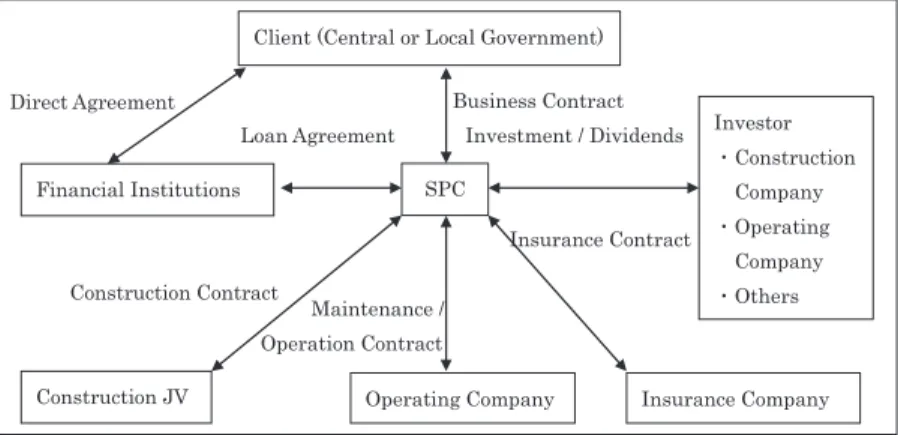
A general framework of a PFI operation is shown in Figure 1. Using such a framework allows for risk sharing to be achieved appropriately among stakeholders.
Based on Figure 1, the following effects can be expected from each entity.
An SPC is a paper company composed of investors. Investors have the advantage of being able to avoid chain-reaction bankruptcy from other investors or projects by introducing SPCs. Even if, from the government’s perspective, it transfers risks to the private sector, if the business fails and the service is not provided, then
9
Depending on the investment ratio of investors and the degree of influence, SPCs may
also be subject to the consolidated statements of investors.
Value for Money (VFM), or maximization of tax per unit of residents, cannot be achieved. Therefore, even if the risk transferred to an SPC is appropriately borne by a controllable company entrusted with handling it, the entrusted company or SPC goes bankrupt in the middle of operations, or the management situation deteriorates, the continuity of stable operations that is appropriately entrusted is indispensable. If financing through project finance is implemented, as in Figure 1, then financial institutions’ monitoring functions would become active to determine whether the work is being undertaken appropriately by the companies (investors) subcontracted by the SPC
10. Financial institutions with screening capabilities cultivated over many years of financing contracts are able to monitor the finances of SPCs and judge whether the overall project is functioning properly.
From the perspective of a business entity, it is not reasonable for a business operator to bear all the risks associated with PFI projects. Conversely, risks can
10
The subcontracted business are called the “investing companies” if they are the shareholders of the SPC, and they are called “cooperating companies” if they are not the shareholders of the SPC.
Business Contract Loan Agreement Investment / Dividends
Insurance Contract
Maintenance / Operation Contract
Client (Central or Local Government)
SPC
Operating Company
Construction JV Insurance Company
Financial Institutions
Investor
・Construction Company
・Operating Company
・Others Construction Contract
Direct Agreement
Figure 1. PFI Operation Framework
Source: Partially edited from Kashiwagi (2004, p. 12).
be controlled if an appropriate risk burden is shared among a number of business operators. In other words, this method has an advantage in that if it adopts the special purpose business operation structure, then the risks will be made off the balance from the investors’ financial statements, enabling them to maintain their financial health.As mentioned above, project finance isolates the risk of bankruptcy from other businesses and enables risk transfer from the public sector to the private sector. It is possible to say that this method is the most suitable funding method to promote participation by business operators and achieve the ideals of PFI methods.
Then, what is the difference between project finance limited to the private sector and project finance in which the government adopts it for PFI projects?
One of the biggest differences is that the government provides compensation when the business operator collapses. In other words, the difference is whether the government provides compensation for repayment of a debt and whether a “facility purchase clause,” which functions as an implied warranty, is provided should the business operator go under. Should the project terminate before its conclusion period, for example, this provision would allow the client to buy the facility at a market price evaluated by a third-party specialist. That is, substantially, it functions as collateral. While, on the surface, it may seem that financial institutions investing in the SPC are bearing the risk, the reality is that the funding is guaranteed by the government in full if the funding is within the purchase price of the facility. This is one major difference when applying project finance to the private sector and PFI projects.
In addition, as PFI methods are usually said to “start and end with a
contract,” vast and detailed contracts are executed between the SPC and the
financial institutions. Moreover, with this method, the SPC must take on the
risk should the project collapse. Conversely, SPCs with nonrecourse or limited
recourse do not possess assets with market value that would be used as collateral
at the time of bankruptcy
11. Even if the business goes under, the creditor cannot claim the debt resulting from the bankruptcy against the parent company, which is an investor. Therefore, when a PFI project collapses, although the business operator is nominally specified as being responsible, substantively they are not.
In the event of a business collapse, if the expected gains from a project end up negative by considering the facility purchase price granted by the client government, financial institutions would be prompted to bring the PFI business into bankruptcy. On the financial institution side, if the debt is within the amount of the purchase price of the facility, all of the debt amounts would be compensated by the government; hence, it is possible to accept the bankruptcy of the business.
In this instance, the business’s collapse cannot be avoided through either a direct agreement or a funding contract. Therefore, as in Figure 1, for a financial institution that signs a direct agreement with the government to benefit most from the advantages of project finance, it is an option not to include the clauses related to the facility purchase. That is, it is one way to leave the contracts incomplete.
Such measures should prioritize the continuity of the project. Financial institutions also constantly monitor whether proper management is being implemented through the financial monitoring of SPCs, and as a result, simple business failures become avoidable.
11
In the Build Operate Transfer (BOT) method, unlike the Build Transfer Operate (BTO)
method, there are cases in which a business owner holds the rights to a facility or similar
asset until the end of the project, and in some cases mortgaging rights are established as
well. For projects that have value in providing a level of publicness as a good supplied
by the public sector, there will likely be few goods with high market value based on the
value levels in the market economy. For example, roads and art museums have high
public value but low market value. Therefore, facilities cannot be said to be sufficient as
assets.
3. Various Funding Methods 3.1. Mezzanine Funds
Methods for raising funds for businesses can be roughly categorized as shares and debt; however, in the United States and elsewhere, “mezzanine funds12” are used as a means of diversified financing with characteristics somewhere in-between. Table 2 lists methods that are thought to be available as a mezzanine fund in Japan in the order of which has the most share-like characteristics according to Nishimura and Partners (2003).
When investors invest in a business entity that is a borrower, they must pay attention to investment indicators. The critical issue at hand is whether the amount procured through mezzanine funds would be included in the capital of the banks as investors under the regulations of the Bank for International Settlements (BIS)—in other words, whether the raised amount would be included in the interest-bearing debt is particularly critical. This is because the amount of interest- bearing debt affects the rating of the subject company, which, in turn, affects the funding cost of the entire business entity.
Table 2 categorizes 1 through 14 relative to BIS regulations, and only a portion of 1 (noncumulative dividend-type perpetual preferred stock) and parts of 2, 3, 4, 5, 6, and 14 can be included in Tier I of capital under BIS regulations for the amount of financing. As for Tier II, depending on the set-up, a part of the financing amount or its entirety from 1 through 14 can be included in either Upper-Tier II or Lower-Tier II.
12 “Mezzanine fund” means being between shares and debt (mezzanine refers to a
mezzanine floor).
Banks and other depository institutions that are focused on capital adequacy requirements benefit more in relation to capital adequacy requirements and solvency margin regulations by using a portion of 1 ,as well as by portions of 2, 3, 4, 5, 6, and 14 rather than from funding through other mezzanine funds. When classifying 1 through 14 above from the perspective of whether or not the funds raised by mezzanine funds are included in the interest-bearing debt, only 1, 2, 3, 4, 5, and 6 are not included. Thus, it is clear that from the perspective of credit rating and other factors, it is relatively more beneficial for banks, particularly for those with large balances of interest-bearing debt, to raise funds through these methods than through mezzanine funds.
13