Fukushima Medical University
福島県立医科大学 学術機関リポジトリ
This document is downloaded at: 2021-11-07T23:16:20Z
Title Assessment of Cognitive and Motor Skills in Parkinson's Disease by A Robotic Object Hitting Game( 本文 )
Author(s) Winnugroho, Wiratman
Citation
Issue Date 2019-09-30
URL http://ir.fmu.ac.jp/dspace/handle/123456789/1049
Rights © The Author(s)
DOI
Text Version ETD
0
学 位 論 文
Assessment of Cognitive and Motor Skills in Parkinson’s Disease by A Robotic Object Hitting Game
仮想現実空間でのゲーム課題を用いたパーキンソン病の認知・
運動機能評価
福島県立医科大学大学院医学研究科 神経内科学専攻
Winnugroho Wiratman
1
Table of Content
Table of Content ………... 1
論文内容要旨(和文) ………. 2
Abstract ………. 4
Introduction ………... 5
Methods ………. 7
Results ………... 12
Discussion ………. 15
Acknowledgement ………. 18
References ………. 19
Table 1 ………... 22
Table 2 ………... 23
Table 3 ………... 24
Figure 1 ………. 25
Figure 2 ………. 27
Figure 3 ………. 28
Figure 4 ………. 29
Figure 5 ………. 30
2
論 文 内 容 要 旨(和文)
パーキンソン病 (PD)患者は錐体外路症状や前頭葉機能、視空間認知機能など多 彩な症状を呈し、それらが複合的に日常生活に影響を及ぼす。しかし現実的な 状況下でPDの複合要因による障害について分析検討した研究は少ない。本研 究は、仮想現実空間で認知・運動両側面で高負荷がかかるゲームを遂行時の行 動成績を解析することにより、PD患者の日常生活での問題解決にかかわる障害 を明らかにすることを目的に行った。26名のPD患者と年齢を対照した健常者 14 名が実験に参加した。仮想現実空間でロボットアームを操作して落下してく る標的物体を打ち返し、非標的物体を避ける課題をPD患者はlevodopa治療が onおよびoffの状態で2回、健常者は1回施行した。ターゲットとディストラ クターの落下速度は課題遂行中に次第に増加し、それに伴い迅速な視覚弁別処 理と運動計画・遂行能力が要求された。ロボットデバイスのセンサが両上肢の 位置、速度、探索範囲を記録した。その他にMini Mental State Examination (MMSE)、Frontal Assessment Battery (FAB)などの標準的認知課題を全被験者で施 行し、PD 患者ではMovement Disorder Society Unified Parkinson’s Disease Rating
Scale (MDS-UPDRS) part IIIを用いて運動症状を評価した。仮想現実ゲーム課題で
PD 群は健常群と比較して正しく標的を捕捉する数が少なく、誤って非標的を捕 捉する数が多かった(p<0.05)。またPD 群は健常群と比較して上肢の平均運動速 度が遅く、探索範囲が狭かった(p<0.001)。Levodopa治療により上肢の速度 は有意に速くなり、探索範囲は広くなった(p<0.01)。ゲーム課題における標的補
足数はMDS-UPDRS part IIIと負の相関を示し、運動パラメータと正の相関を示し
た。ゲーム課題における非標的の捕捉数は MDS-UPDRS part IIIと正の相関を示 したが、運動パラメータとは有意な相関を示さなかった。以上の結果より、単
回levodopa治療の急性効果による運動症状の改善をセンサデバイスにより定量
的に運動パラメータとして計測することが可能であることが示された。また高 度な視覚弁別・運動計画・遂行機能が要求される課題の遂行能力がMMSEや FABなどの簡易なスクリーニング検査で予測可能であることが示された。日常
3
生活における複合的な問題の解決能力を評価する上で認知機能の評価の重要性 が示唆された。
4 ABSTRACT
Parkinson’s disease (PD) patients suffer from various symptoms including extrapyramidal motor disturbances and cognitive impairments. Presumably, both cognitive and motor impairments are causing difficulties in daily life. However, PD patients have rarely been studied under realistic task situations that require high-level interaction of cognitive and motor skills. The aim of this study was to investigate contribution of cognitive and motor factors to performance of PD patients when they are placed under high cognitive and kinematic loads. Twenty-six PD patients and 14 control subjects participated in the study. PD patients performed a task to hit targets and avoid distractors in levodopa On and Off states. A robotic manipulandum device recorded the numbers of target and distractor hit and hand kinematics, including movement area and speed. Standard cognitive batteries and MDS-UPDRS motor scores were examined.
Results showed that the PD patients hit significantly fewer targets and more distractors than controls (p < 0.05). In PD patients, average hand speed was slower, and the area of hand movement was smaller as compared with the control subjects (p < 0.001). Levodopa increased the average hand speed and movement area significantly (p < 0.01), but levodopa had insignificant effect on the number of correct target hit and erroneous distractor hit. The scores of cognitive batteries predicted performance of both target hit and distractor avoidance. Our result suggests a dynamic interaction between cognitive and kinematic skills while PD patients performed a virtual reality game. Single-dose levodopa enhanced kinematic capacity and global intelligence level predicted the game performance
5
INTRODUCTION
Parkinson’s disease (PD) is a neurodegenerative disease which manifests with cardinal motor symptoms of bradykinesia, rigidity, resting tremor, and postural instability.
Recently, clinicians are increasingly aware of non-motor symptoms of PD. Muslimovic et al. (Muslimovic, Post, Speelman, & Schmand, 2005) reported that approximately 25%
of de novo PD patients present with cognitive deficits. The most frequently impaired cognitive domains are attention, visuospatial, and executive functions (Foltynie, Brayne, Robbins, & Barker, 2004; Mamikonyan et al., 2009; Muslimovic et al., 2005). Only a limited number of studies have examined association between motor disabilities and cognitive dysfunction in PD patients. Varalta et al. (Varalta et al., 2015) reported that PD patients show more problems in balance skills when their executive function is more compromised. Dahdal et al. (Dahdal et al., 2016) reported that, in PD patients, precision finger movements are more impaired when mild cognitive impairment is also present. In stroke patients, pyramidal weakness and cognitive disturbances often coexist. Thus, tasks that require both cognitive and motor skills have been used in some studies for the purpose of rehabilitation and prediction of functional prognosis after stroke (Cumming, Brodtmann, Darby, & Bernhardt, 2012; Sánchez-Cubillo et al., 2009). Because motor and non-motor symptoms also coexist in PD patients, such integrative and comprehensive approach is important to understand the real-life conditions of PD patients.
In daily life, cognitive and motor functions operate rarely in isolation. Even very simple actions may be preceded with decision processes to select an action from alternative options and by preparatory processes to generate purposeful movement. We are often required to execute optimal decisions and actions in timely manner adapting to
6
dynamically changing environment. For instance, when driving a car, one must perform visual analysis on the information from traffic signs, other vehicles, and pedestrians to make adaptive decisions whether to apply pressure on brake or accelerator pedals, or turn the steering wheel. The basal ganglia and the dopamine system are known to play an important role in integrating cognitive and motor processing in the brain (Nagano-Saito, Martinu, & Monchi, 2014). Thus, it is plausible that various daily-life problems in PD patients are caused by disrupted interaction of cognitive and motor skills due to dopamine depletion and disintegrated cortico-basal ganglia circuits.
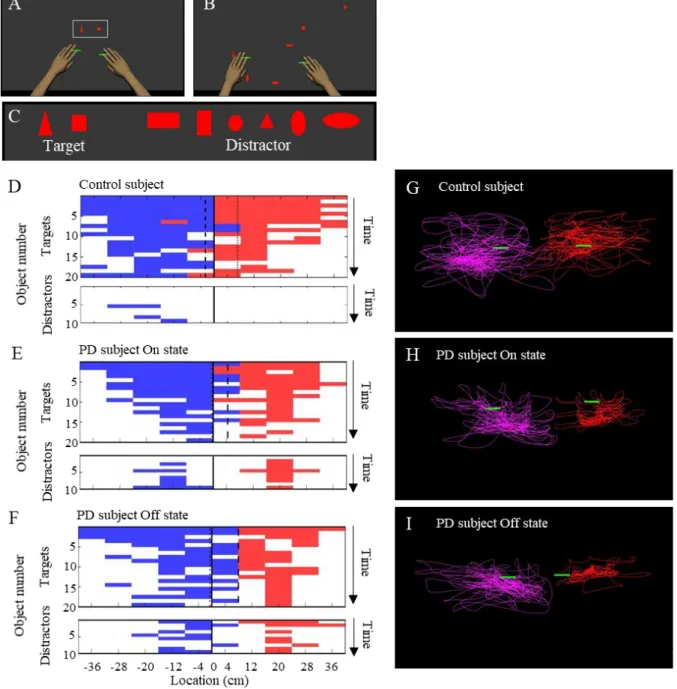
The robotic manipulandum device allows for flexible visual presentation on an LCD screen and multi-joint free arm movement in two-dimensional space (Figure 1A).
The device provides an excellent environment in which to study the interactions between voluntary motor control and various cognitive factors including visuospatial attention, working memory, and executive function. Previously, the robotic manipulandum device has been used to assess several clinical conditions including stroke and traumatic brain injuries (Bourke et al., 2016; Hawkins & Sergio, 2014; Tyryshkin et al., 2014), but it has not been used to assess PD patients.
The object hit and avoid task allows testing visual discrimination, rapid motor decisions, and precision arm movement. The robotic manipulandum device provides quantitative measures of arm kinematics as well as cognitive performance simultaneously.
In the present study, we aimed to use a robotic manipulandum device to examine the relationship between conventional clinical evaluation scores and performance in a virtual reality complex task. We compared between PD patients and age-matched healthy subjects and examined the acute effect of levodopa in PD patients.
7 METHODS
Subjects
We recruited PD patients and age-matched control subjects to participate in the present study. PD patients were enrolled from the outpatient clinic as well as inpatient ward of Fukushima Medical University Hospital, from 2014 to 2018. The inclusion criteria for PD patients were (1) to meet UK Parkinson’s Disease Brain Bank criteria, (2) with the Hoehn-Yahr grade ≤ IV, and (3) without severe dyskinesias. Exclusion criteria were patients with (1) Mini Mental State Examination (MMSE) score of <23 (Ideno, Takayama, Hayashi, Takagi, & Sugai, 2012), (2) other psychiatric or additional neurologic condition, and (3) orthopedics, osteoarthritis, or any other conditions that might influence upper extremities sensation and motor movement. We selected subjects with normal vision and subjects wore eyeglasses when necessary. Control subjects were healthy volunteers without history of neuropsychiatric disorders. Exclusion criteria (1) was to ensure that enrolled patients understand the task introduction. We applied the same exclusion criteria as those of PD patients to the control subjects.
During the study period, the PD subjects were instructed to take their PD medications regularly. Each PD subject underwent the following cognitive and motor assessments during the On state (1-2.5 h after having taken levodopa), and motor assessments during the Off state (>5 h after having taken levodopa).
Clinical assessment
Each subject underwent neuropsychological assessment consisting of MMSE (Ideno et al., 2012), Frontal Assessment Battery (FAB) (Kugo et al., 2007), Raven’s
8
Coloured Progressive Matrices (RCPM), Rey-Osterrieth Complex Figure Test (ROCF), and overlapping figure test (OFT) (Doubleday, King, & Papageorgiou, 2002; Dubois, Slachevsky, Litvan, & Pillon, 2000). The PD patients also underwent a standard odor test (odor stick identification test for Japanese, OSIT-J). Each PD subject underwent the cognitive batteries in On state (1-2.5 h after having taken their medication). We evaluated motor symptoms of PD in the On and Off states using the Movement Disorder Society – Unified Parkinson’s Disease Rating Scale (MDS-UPDRS) part III (Goetz et al., 2008).
Experimental setup
We used a bimanual KINARM exoskeleton robot (BKIN Technologies Ltd, Kingston, ON, Canada) to evaluate upper limb motion during an object hit and avoid task.
Details of the robotic set-up have been reported previously (Dukelow et al., 2010; Scott, 1999). Briefly, the participants sat in a modified wheelchair base, and their arms were fitted in supports that permitted movement in the horizontal plane only. The arm supports were adjusted such that the robot’s linkages aligned with the subject’s elbows and shoulders. Subjects received visual feedback from a virtual reality system which displayed fingertip position and virtual objects in the same plane as the arms.
Behavioral task
Each PD patient performed an object hit and avoid task twice during the On and Off states on separate days. The control subjects were tested once without medication.
The details of the object hit and avoid task have been described previously (Bourke et al., 2016) (Fig 1A-C). Briefly, at the beginning of the task, subjects were presented two
9
shapes on the screen. Subjects were instructed to hit these two shapes (‘targets’) away from them and avoid all other shapes (‘distractors’).
Eight different geometric shapes of similar dimensions were used (rectangles [2cm x 4cm, 4cmx 2cm], square [2cm x 2cm], triangles [2cm x 1.73cm, 2cm x 2.23cm], circle [2cm diameter], and ovals [2cm x 4cm, 4cm x 2cm], [width x height]). All shapes were in red color. The luminance was set 2.4 cd/m2 for red objects in the center of the display as viewed by the subject. Within a session, the targets and distractors were fixed in the same sets, but across the subjects, shapes for targets and distractors were randomized.
The subjects could use both hands, which were represented by horizontal paddles.
They performed the task in a free viewing. The assignment for target/distractor shapes was randomized across sessions. Both targets and distractors fell from one of 10 locations that were placed 8 cm apart along the top of the screen (virtual bins). A total of 30 objects (20 targets and 10 distractors) were released from each bin (200 targets and 100 distractors in total). Objects were released from all 10 bins before a bin was reused. The speed of the object increased from 10 cm/sec to 50 cm/sec, and the rate of the object appearance also increased from 0.5 object/s to 3 object/s toward the end of the task. The number of objects on the screen at a given moment ranged from 1 to 16 over the course of the task.
Position of the objects and the hand position were recorded at 200 Hz. The task took a little over 2 min to complete. Targets hit by a paddle were knocked away and haptic feedback of the contact was provided by the robot, whereas distractors simply passed through the paddle to provide immediate feedback that it was a distractor. Every effort was made to ensure subjects understood the task instructions. The operators obtained verbal confirmation that the subjects understood which target to hit when presenting the
10
target objects before starting the task. Before the task, every subject gone through a similar task but without distractors, to ensure they knew the objective of the game and familiarize with the robotic arm.
Data analysis
We used 4 measurements to quantify the performance of the object hit and avoid task.
1. Hand speed (cm/s). Hand speeds were filtered using a sixth-order double-pass Butterworth filter with cut-off frequency of 10 Hz. The robot measured the hand speed in every 5ms for each hand. We used the speed averaged for both hands over the course of the task.
2. Movement area (cm2). Movement Area was the areas of space used by each hand during the task, which was computed as the area of the convex hull, i.e., a complex polygon that captures the boundaries of the movement trajectories of each hand (Tyryshkin et al., 2014). The robot measured the movement area for each hand separately. In the present study, we used the average movement area of both hands.
3. Targets hit score (%). The robot counted the number of target objects hit by the paddle over the course of the task. The proportion of the successful target hit out of 200 target objects was calculated and reported as target hit score.
4. Distractor proportion (%). The robot counted the number of distractor objects that were hit by the paddle over the course of the task. The proportion of the erroneous distractor hits of the total number of objects hit (targets + distractors) was calculated and reported as distractor proportion.
11 Statistical analysis
We compared the four measurements (hand speed, movement area, targets hit score, and distractor proportion) between groups (PD On versus Off by using paired t- test, PD On versus control, PD Off versus control using a t-test). We then performed univariate linear regression of the target hit score, distractor proportion in the On and Off states. These dependent variables were regressed by the following variables: MDS- UPDRS part III score, hand speed, and movement area. The β values were tested against null hypothesis (β = 0) by an t-test.
To evaluate the influence of the cognitive factor on the robotic game performance, we conducted a median split of the PD cohort based on the MMSE score. The target hit score and distractor proportion were compared across three groups: PD with higher MMSE, PD with lower MMSE, and controls by using one-way analysis of variance (ANOVA) and post-hoc least significant difference (LSD).
The correlation between the target hit score and distractor proportion with other variables were evaluated using Pearson’s correlation coefficient or Spearman’s correlation coefficient. The correlation among the cognitive batteries were evaluated using Spearman’s ρ.
The data were analyzed using SPSS for Windows, version 23.0 (SPSS Inc, Illinois, USA). In all tests, a value of p < 0.05 was considered to be statistically significant.
12 RESULTS
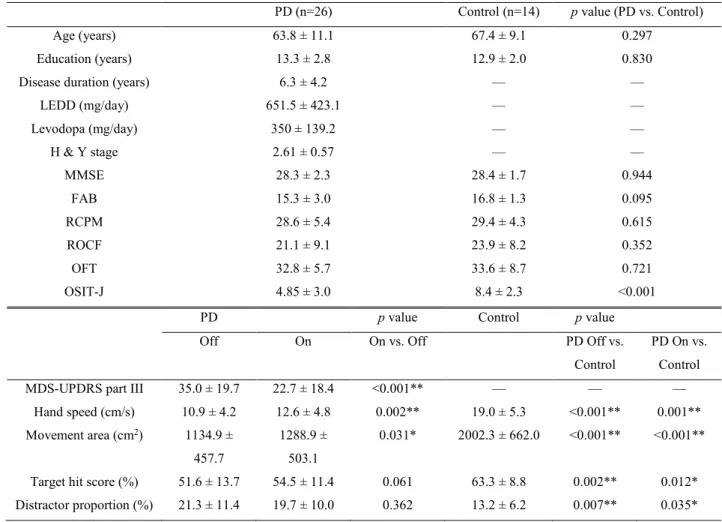
We recruited 26 PD patients (age 38-79 years old, 20 males and 6 females) and 14 age-matched control (age 52-85 years old, 5 males and 9 females) subjects in the present study. We found no significant differences in age, education, and the scores of all the cognitive tests between the two groups (p > 0.05, t-test; Table 1). The OSIT-J score was significantly lower in PD patients than in control group (p = 0.002, one-tailed t-test).
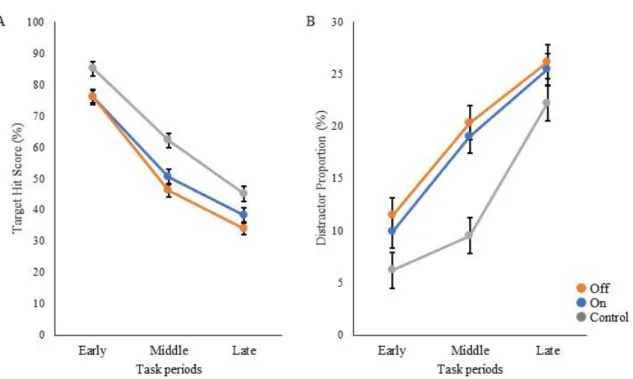
We compared the performance on the robotic object hitting task between the PD and control groups (Figure 1D-F). The control subjects hit significantly more targets than did the PD patients (p < 0.001, one-tailed t-test; Table 1). In contrast, the control subjects hit significantly fewer distractors than did the PD patients (p < 0.05, t-test). Between the On and Off states of PD patients, neither the target hit score nor distractor proportion changed significantly (p > 0.05, one-tailed paired t-test). Because the pace of object presentation increased with time, the task increased in difficulty toward the end (Figure 2). Two-way ANOVA (time and group) revealed a significant main effect of time for both target hit score (F(2,126) = 323.4, p < 0.001) and distractor proportion (F(2,126) = 50.83, p < 0.001). The group main effect was also significant for target hit score (F(2,63) = 4.624, p = 0.013) and the distractor proportion (F(2,63) =3.703, p = 0.03). Post-hoc tests revealed that the control group hit more targets and less distractors than PD in On and Off states (p < 0.05). There was no significant interaction effect between time and group (p > 0.05).
These results indicate that the performance of the PD patients on the hit and avoid task was poorer than that of the control subjects, as they hit fewer targets and more distractors, and that levodopa did not have a significant influence on the task performance.
13
We examined the effect of levodopa on kinematic measures and found that the average hand speed and movement area increased significantly with the use of levodopa in PD patients (hand speed, p < 0.001; movement area, p = 0.03, one-tailed paired t-test;
Table 1). Hand kinematics also differed significantly between the PD and control groups;
the PD patients were slower and moved within a smaller area than did the controls (p <
0.001, one-tailed t-test).
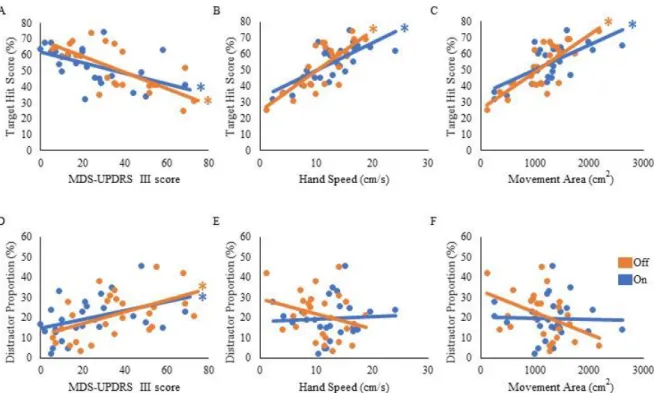
We then examined how well the task performance could be predicted by disease severity and hand kinematics in the PD group. The target hit score correlated negatively with the MDS-UPDRS part III score, and positively with hand speed and movement area;
patients with severer symptoms (i.e., higher MDS-UPDRS part III score) hit fewer targets in the On (β = -0.54, t(24) = -3.11, p = 0.005) and Off states (β = -0.73, t(24) = -5.21, p <
0.001; Fig. 3A). Patients with faster hand speed and larger movement area hit more targets in the On (β = 0.71, t(24) = 4.99, p < 0.001 and β = 0.67, t(24) = 4.39, p < 0.001, respectively; Fig 3B, C) and Off states (β = 0.78, t(24) = 6.06, p < 0.001 and β = 0.77, t(24) = 5.98, p < 0.001, respectively; Fig. 3B, C). The number of erroneous distractor hits exhibited a significantly positive correlation with MDS-UPDRS part III score (On state, β = 0.41, t(24) = 2.22, p = 0.036; Off state, β = 0.50, t(24) = 2.81, p = 0.01; Fig. 3D).
However, distractor proportion did not correlate significantly with hand speed or movement area (p > 0.05; Fig. 3E, F). These results suggest that the kinematic capacity of PD patients is an important predictor for the performance of target hit, but not of distractor avoidance.
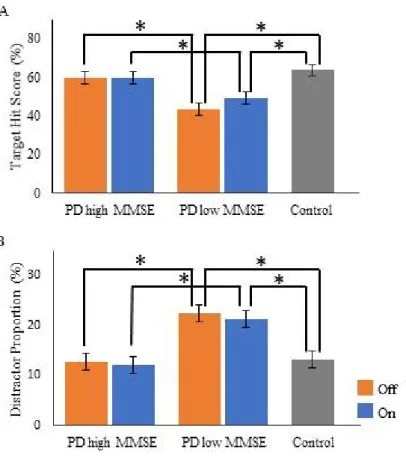
To examine the influence of global mental state on the performance of hit and avoid task, we conducted a median split analysis by dividing PD patients into two subgroups based on MMSE score (Figure 4). A one-way ANOVA of the target hit score
14
for group with five levels (High MMSE On, High MMSE Off, Low MMSE On, Low MMSE Off, and Control) revealed a significant main effect for Group (F(4, 61) = 8.876, p < 0.001; Fig. 4A). PD patients with higher MMSE scores hit more targets than did PD patients with lower MMSE scores in both the On and Off states (p < 0.05, post-hoc LSD).
In addition, the control subjects hit more targets than did the PD with lower MMSE scores in both On and Off states (p < 0.05, post-hoc LSD). A one-way ANOVA for the distractor proportion also revealed a significant main effect of group (F(4, 61) = 8.562, p < 0.001;
Fig. 4B). The post-hoc LSD tests revealed that PD patients with higher MMSE scores hit fewer distractors than did PD with lower MMSE scores in both the On and Off states.
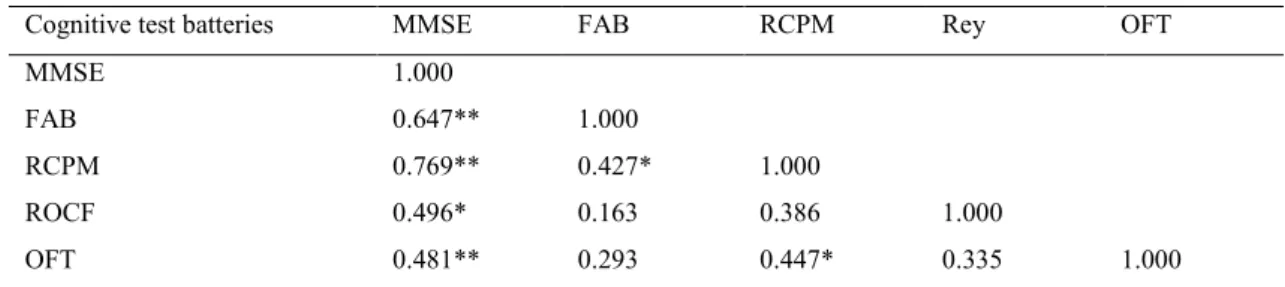
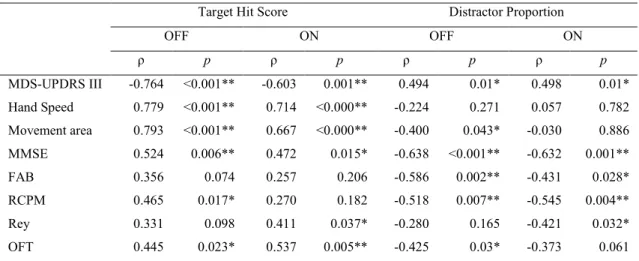
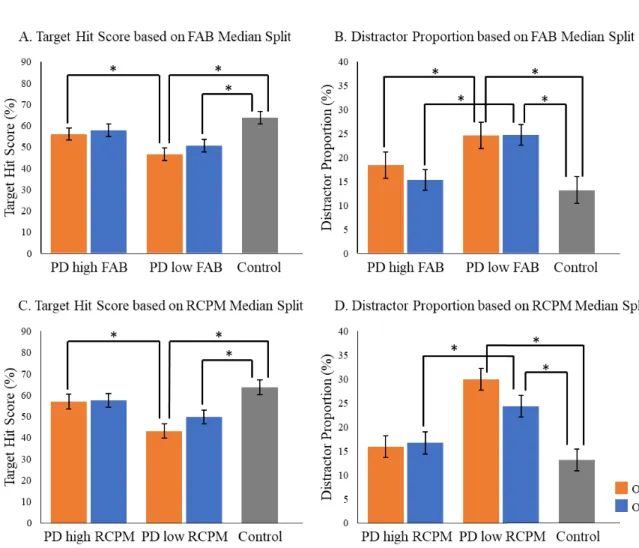
Additionally, the control group hit fewer distractors than did PD with lower MMSE scores in both the On and Off states (p < 0.05; post-hoc LSD). Among the five cognitive batteries, the results of the MMSE, FAB, and RCPM exhibited strong correlations each other (ρ ≈ 0.4-0.8, p < 0.05; Table 2). By using median split based on the FAB and RCPM scores, the above results based on the MMSE score (Fig. 4) were reproduced (Fig. 5). In separate correlation analysis, the scores of MMSE, FAB, RCPM scores showed strong correlation with distractor proportion (Table 3). In contrast, hand kinematic parameters (speed and movement area) exhibited a strong correlation with the target hit score, but not with the distractor proportion. Taken together, the results suggest that global cognitive capacity has significant influences on the ability to hit targets and avoid distractors.
15 DISCUSSION
We examined 26 PD patients and 14 control subjects by using a robotic object hitting game that required visual discrimination of the objects and accurate motor control.
The performance of the PD patients was generally poorer than that of controls. The clinical score of motor symptoms (i.e., MDS-UPDRS part III) of PD patients predicted the number of targets hit and distractors hit. The numbers of hitting targets and distractors also depended on the individual MMSE score; PD patients with low MMSE scores hit fewer targets and more distracters than did PD patients with high MMSE scores and controls. These results suggest functional interactions between the cognitive system that discriminates stimuli and makes decisions, and the motor system that controls rapid and accurate sequential hand responses.
One of the advantages of using the robotic device is its precise kinematic measurements. Accurately measured hand speed and movement area predicted the total number of targets hit. The effect of levodopa on the kinematic measures was also evident.
Motor improvement in response to levodopa is a hallmark of PD. However, only a limited number of studies have quantitatively evaluated the influence of levodopa on kinematics (Espay et al., 2009, 2012). Movement disorders of basal ganglia and cerebellar origins are characterized by disturbances in accurate and smooth execution of voluntary movement. Conventionally, evaluation of movement disorders relied mostly on visual inspection. However, quantitative measurement of kinematics is essential for sensitive and specific evaluation of movement disorders. The present study demonstrates the robotic manipulandum device is useful in the evaluation of movement disorders with its precise measurements of the upper extremities during free and natural movements.
16
In addition to motor control, the present task required cognitive resources, including visual discrimination, general attention, and inhibitory control (Bourke et al., 2016). Indeed, we found that the MMSE, FAB, and RCPM scores were significant predictors of target hit score and distractor proportion (Fig. 4, 5). The scores of these cognitive batteries correlated with each other (Table 2), suggesting an underlying general factor of intelligence (Barbey, Colom, Solomon, Krueger, & Forbes, 2012; Reynolds, Floyd, & Niileksela, 2013; Spearman, 1923). These results indicate that global cognitive capacity is a factor that explains the between-subject variability of the game performance in PD patients. Because cognitive impairments vary across PD patients, global intelligence level may have yielded significance in the correlation analysis due to an averaging effect. In sum, target hit score was sensitive to motor disturbance, as it requires fast and precise motor control. Distractor proportion, on the other hand, was sensitive to cognitive impairments, as it reflects visual discrimination, attention, and inhibition of prepotent hitting responses.
Interestingly, single-dose levodopa did not influence cognitive skills to the same extent as it did motor control. Clinical research on the dopaminergic influence on cognitive performance remains controversial (Cools, 2001; Gotham, Brown, & Marsden, 1988). In a physiological study, using a robotic manipulandum device in macaque monkeys, dopamine neurons were demonstrated to generate teaching signals that guide visually triggered reaching movement (Pasquereau & Turner, 2015). Thus, the dopamine system appears to structure the temporal aspect of motor planning. Further study is needed to clarify the effects of dopaminergic treatment on cognitive function in PD patients.
17
The present study has several limitations. First, the number of subjects in the present study was relatively small and the results of this pilot cross-sectional study should be confirmed in future studies with a larger scale. Second, we used a within-subject design for levodopa for motor performance including the robotic manipulandum game and MDS- UPDRS, but the cognitive batteries were tested only in the On state. Assessment of the effects of levodopa on the scores of cognitive batteries is warranted for future testing using a within-subject design.
In summary, we demonstrated dopaminergic enhancement of kinematic features during a dynamic and multifactorial game setting. The global cognitive capacity predicted the ability to hit targets and avoid distractors. In the future study, the current device-aided set-up may turn out to be useful in the assessment of therapeutic effects in clinical trials, estimating daily life activities, and predicting disease prognosis.
18
ACKNOWLEDGMENT
I thank you Prof. Yoshikazu Ugawa and Dr. Shunsuke Kobayashi for the supervision, Prof. Kazuaki Kanai as the patron, and Dr. Nozomu Matsuda for technical support in this study. This work was supported in part by JSPS KAKENHI (SK
#23500393, YU #15H05881) and scholarship to WW by the Japanese Government (MEXT). The authors declare that there is no conflict of interest.
19
REFERENCES
Barbey, A. K., Colom, R., Solomon, J., Krueger, F., & Forbes, C. (2012). An integrative architecture for general intelligence and executive function revealed by lesion mapping, 1154–1164. https://doi.org/10.1093/brain/aws021
Bourke, T. C., Lowrey, C. R., Dukelow, S. P., Bagg, S. D., Norman, K. E., & Scott, S.
H. (2016). A robot-based behavioural task to quantify impairments in rapid motor decisions and actions after stroke. Journal of NeuroEngineering and
Rehabilitation, 13(1), 1–13. https://doi.org/10.1186/s12984-016-0201-2
Cools, R. (2001). Enhanced or Impaired Cognitive Function in Parkinson’s Disease as a Function of Dopaminergic Medication and Task Demands. Cerebral Cortex, 11(12), 1136–1143. https://doi.org/10.1093/cercor/11.12.1136
Cumming, T. B., Brodtmann, A., Darby, D., & Bernhardt, J. (2012). Cutting a long story short: Reaction times in acute stroke are associated with longer term cognitive outcomes. Journal of the Neurological Sciences, 322, 102–106.
https://doi.org/10.1016/j.jns.2012.07.004
Dahdal, P., Meyer, A., Chaturvedi, M., Nowak, K., Roesch, A. D., Fuhr, P., &
Gschwandtner, U. (2016). Fine motor function skills in patients with Parkinson disease with and without mild cognitive impairment. Dementia and Geriatric Cognitive Disorders, 42(3–4), 127–134. https://doi.org/10.1159/000448751 Doubleday, E. K., King, P., & Papageorgiou, C. (2002). Brief report Relationship
between fluid intelligence and ability to benefit from cognitive-behavioural therapy in older adults : A preliminary investigation. British Journal of Clinical
Psychology, 423–428. https://doi.org/10.1348/014466502760387542 Dubois, B., Slachevsky, A., Litvan, I., & Pillon, B. (2000). The FAB: a Frontal
Assessment Battery at bedside.[see comment][comment]. Neurology, 55(11), 1621–1626. https://doi.org/10.1212/WNL.57.3.565
Dukelow, S. P., Herter, T. M., Moore, K. D., Demers, M. J., Glasgow, J. I., Bagg, S. D.,
… Scott, S. H. (2010). Quantitative assessment of limb position sense following stroke. Neurorehabilitation and Neural Repair, 24(2), 178–187.
https://doi.org/10.1177/1545968309345267
20
Espay, A. J., Beaton, D. E., Morgante, F., Gunraj, C. A., Lang, A. E., & Chen, R.
(2009). Impairments of speed and amplitude of movement in Parkinson’s disease:
A pilot study. Movement Disorders, 24(7), 1001–1008.
https://doi.org/10.1002/mds.22480
Espay, A. J., Giuffrida, J. P., Chen, R., Payne, M., Mazzella, F., Dunn, E., … Fredy, J.
(2012). NIH Public Access, 26(14), 2504–2508.
https://doi.org/10.1002/mds.23893.Differential
Foltynie, T., Brayne, C. E. G., Robbins, T. W., & Barker, R. A. (2004). The cognitive ability of an incident cohort of Parkinson’s patients in the UK. The CamPaIGN study. Brain, 127(3), 550–560. https://doi.org/10.1093/brain/awh067
Goetz, C. G., Tilley, B. C., Shaftman, S. R., Stebbins, G. T., Fahn, S., Martinez-Martin, P., … Zweig, R. M. (2008). Movement Disorder Society-Sponsored Revision of the Unified Parkinson’s Disease Rating Scale (MDS-UPDRS): Scale presentation and clinimetric testing results. Movement Disorders, 23(15), 2129–2170.
https://doi.org/10.1002/mds.22340
Gotham, A. M., Brown, R. G., & Marsden, C. . (1988). ’ Frontal ’ Cognitive Function in Patients With Parkinson ’ S Disease ’ on ’ and ’ Off ’ Levodopa. Brain, (July), 299–321.
Hawkins, K. M., & Sergio, L. E. (2014). Visuomotor impairments in older adults at increased Alzheimer’s disease risk. Journal of Alzheimer’s Disease, 42(2), 607–
621. https://doi.org/10.3233/JAD-140051
Ideno, Y., Takayama, M., Hayashi, K., Takagi, H., & Sugai, Y. (2012). Evaluation of a Japanese version of the Mini-Mental State Examination in elderly persons.
Geriatrics & Gerontology International, 12(2), 310–316.
https://doi.org/10.1111/j.1447-0594.2011.00772.x
Kugo, A., Terada, S., Ata, T., Ido, Y., Kado, Y., Ishihara, T., … Kuroda, S. (2007).
Japanese version of the Frontal Assessment Battery for dementia. Psychiatry Research, 153(1), 69–75. https://doi.org/10.1016/j.psychres.2006.04.004
Mamikonyan, E., Moberg, P. J., Siderowf, A., Duda, J. E., Have, T. Ten, Hurtig, H. I.,
… Weintraub, D. (2009). Mild cognitive impairment is common in Parkinson’s disease patients with normal Mini-Mental State Examination (MMSE) scores.
Parkinsonism & Related Disorders, 15(3), 226–231.
21
https://doi.org/10.1016/j.parkreldis.2008.05.006
Muslimovic, D., Post, B., Speelman, J. D., & Schmand, B. (2005). Cognitive profile of patients with newly diagnosed Parkinson disease. Neurology, 65(8), 1239–1245.
https://doi.org/10.1212/01.wnl.0000180516.69442.95
Nagano-Saito, A., Martinu, K., & Monchi, O. (2014). Function of basal ganglia in bridging cognitive and motor modules to perform an action. Frontiers in Neuroscience, 8(8 JUL), 1–12. https://doi.org/10.3389/fnins.2014.00187
Pasquereau, B., & Turner, R. S. (2015). Dopamine neurons encode errors in predicting movement trigger occurrence. Journal of Neurophysiology, 33(19), 8288–8830.
https://doi.org/10.1152/jn.00401.2014
Reynolds, M. R., Floyd, R. G., & Niileksela, C. R. (2013). How Well Is Psychometric g Indexed by Global Composites ? Evidence From Three Popular Intelligence Tests, 25(4), 1314–1321. https://doi.org/10.1037/a0034102
Sánchez-Cubillo, I., Periáñez, J. A., Adrover-Roig, D., Rodríguez-Sánchez, J. M., Ríos- Lago, M., Tirapu, J., & Barceló, F. (2009). Construct validity of the Trail Making Test: Role of task-switching, working memory, inhibition/interference control, and visuomotor abilities. Journal of the International Neuropsychological Society.
https://doi.org/10.1017/S1355617709090626
Scott, S. H. (1999). Apparatus for measuring and perturbing shoulder and elbow joint positions and torques during reaching. Journal of Neuroscience Methods.
https://doi.org/10.1016/S0165-0270(99)00053-9
Spearman, C. (1923). The nature of intelligence and the principles of cognition.
London: Macmillan.
Tyryshkin, K., Coderre, A. M., Glasgow, J. I., Herter, T. M., Bagg, S. D., Dukelow, S.
P., & Scott, S. H. (2014). A robotic object hitting task to quantify sensorimotor impairments in participants with stroke. Journal of NeuroEngineering and Rehabilitation. https://doi.org/10.1186/1743-0003-11-47
Varalta, V., Picelli, A., Fonte, C., Amato, S., Melotti, C., Zatezalo, V., … Smania, N.
(2015). Relationship between cognitive performance and motor dysfunction in patients with Parkinson’s disease: A pilot cross-sectional study. BioMed Research International, 2015. https://doi.org/10.1155/2015/365959
22
Table 1. Demographics, clinical features, and data of robotic object hitting game.
PD (n=26) Control (n=14) p value (PD vs. Control)
Age (years) 63.8 ± 11.1 67.4 ± 9.1 0.297
Education (years) 13.3 ± 2.8 12.9 ± 2.0 0.830
Disease duration (years) 6.3 ± 4.2 — —
LEDD (mg/day) 651.5 ± 423.1 — —
Levodopa (mg/day) 350 ± 139.2 — —
H & Y stage 2.61 ± 0.57 — —
MMSE 28.3 ± 2.3 28.4 ± 1.7 0.944
FAB 15.3 ± 3.0 16.8 ± 1.3 0.095
RCPM 28.6 ± 5.4 29.4 ± 4.3 0.615
ROCF 21.1 ± 9.1 23.9 ± 8.2 0.352
OFT 32.8 ± 5.7 33.6 ± 8.7 0.721
OSIT-J 4.85 ± 3.0 8.4 ± 2.3 <0.001
PD p value Control p value
Off On On vs. Off PD Off vs.
Control
PD On vs.
Control
MDS-UPDRS part III 35.0 ± 19.7 22.7 ± 18.4 <0.001** — — —
Hand speed (cm/s) 10.9 ± 4.2 12.6 ± 4.8 0.002** 19.0 ± 5.3 <0.001** 0.001**
Movement area (cm2) 1134.9 ± 457.7
1288.9 ± 503.1
0.031* 2002.3 ± 662.0 <0.001** <0.001**
Target hit score (%) 51.6 ± 13.7 54.5 ± 11.4 0.061 63.3 ± 8.8 0.002** 0.012*
Distractor proportion (%) 21.3 ± 11.4 19.7 ± 10.0 0.362 13.2 ± 6.2 0.007** 0.035*
Values are mean ± SD. MDS-UPDRS, Movement Disorder Society Unified Parkinson's Disease Rating Scale; MMSE, Mini Mental State Examination; FAB, Frontal Assessment Battery; RCPM, Raven's Colored Progressive Matrices; ROCF, Rey-Osterrieth Complex Figure; OFT, Overlapping Figure Test. The scores were compared between PD and control groups separately for on and off levodopa conditions by one-tailed t-test (PDOff vs. Control, and PD On vs. Control). MDS-UPDRS part III score and the four measures of robotic object hit and avoid task were compared between off and on levodopa conditions in PD by one-tailed paired t-test (On vs. Off). ** and * represent statistical significant at p < 0.01 and p < 0.05, respectively.
23
Table 2. Correlation matrix of the scores of cognitive test batteries.
Cognitive test batteries MMSE FAB RCPM Rey OFT
MMSE 1.000
FAB 0.647** 1.000
RCPM 0.769** 0.427* 1.000
ROCF 0.496* 0.163 0.386 1.000
OFT 0.481** 0.293 0.447* 0.335 1.000
MMSE, Mini Mental State Examination; FAB, Frontal Assessment Battery; RCPM, Raven's Coloured Progressive Matrices; ROCF, Rey-Osterrieth complex figure; OFT, overlapping figure test. Correlation between variables using Spearman’s ρ. **, and * represent significance level at p = 0.01 and 0.05, respectively (2-tailed).
24
Table 3. Correlation between target hit score, distractor proportion, with other variables.
Target Hit Score Distractor Proportion
OFF ON OFF ON
ρ p ρ p ρ p ρ p
MDS-UPDRS III -0.764 <0.001** -0.603 0.001** 0.494 0.01* 0.498 0.01*
Hand Speed 0.779 <0.001** 0.714 <0.000** -0.224 0.271 0.057 0.782 Movement area 0.793 <0.001** 0.667 <0.000** -0.400 0.043* -0.030 0.886 MMSE 0.524 0.006** 0.472 0.015* -0.638 <0.001** -0.632 0.001**
FAB 0.356 0.074 0.257 0.206 -0.586 0.002** -0.431 0.028*
RCPM 0.465 0.017* 0.270 0.182 -0.518 0.007** -0.545 0.004**
Rey 0.331 0.098 0.411 0.037* -0.280 0.165 -0.421 0.032*
OFT 0.445 0.023* 0.537 0.005** -0.425 0.03* -0.373 0.061
ρ is Pearson’s correlation coefficient for MDS-UPDRS III, hand speed, and movement area, and it is Spearman’s correlation coefficient for MMSE, FAB, RCPM, Rey, and OFT. **, and * represent statistical significance at p = 0.01 and p = 0.05, respectively (2-tailed).
25
Figure 1. The object hit and avoid task and the results from exemplar subjects. (A-C) Virtual reality set-up. Two green cursors indicate the position of the middle fingers, which moved contingently with hand movement. The shapes of hit targets were displayed at the beginning of the task (A). Targets and distractors fell down from the top of the screen (B).
Objects included 2 target shapes and 6 distractor shapes (C). (D-F) Task performance results of exemplar subjects (D, control; E, PD in On state; F, PD in Off state; E and F
26
are from the same subjects). Horizontal axis represents horizontal extension of the virtual screen, which was divided into 10 bins. Vertical axis represents the total number of target/
distractor that appeared in each bin. Time flows from top to bottom. Objects hit at specific time (vertical axis) at specific spatial bin (horizontal axis) are plotted for targets (top panel) and distractors (bottom panel). Objects hit by the left and right hands are in blue and red, respectively. White areas indicate objects that were not hit. Because the speed of the object increased toward the end of the task, number of successful target hit decreased toward bottom of the plot (upper panels of D-F). Compared to the control subject, this PD subject hit more distractors during both On and Off states (lower panels of D-F). This PD patient used the left hand predominantly in hitting targets (more blue squares than red squares in E and F), reflecting lateralized involvement of parkinsonism on the patient’s right-hand side. (G-I) Trajectory of both hands plotted on the virtual space for control, PD On and Off states (the same data as shown in D-F).
27
Figure 2. Comparisons of target hit score and distractor proportion in three task periods.
The whole task session with 300 falling objects was divided into three periods (early, middle, and late; 100 objects in each period). The scores of target hit (A) and distractor proportion (B) are plotted for each period.
28
Figure 3. Univariate regression of the performance scores of the robotic game. The scores of target hit (A-C) and the distractor proportion (D-F) were regressed with disease severity (MDS-UPDRS part III) (A, D), hand speed (B, E), and movement area (C, F). * represents statistical significance of the β at p < 0.05.
29
Figure 4. Comparisons of target hit score and distractor proportion in PD with higher and lower MMSE (median split). There were significant group differences for both target hit score (A) and distractor proportion (B) (p < 0.001, one-way ANOVA). PD with higher MMSE and control subjects hit more targets than PD with lower MMSE (A). PD with lower MMSE hit more distractors than PD with higher MMSE and control subjects (B).
Orange bars, PD in Off state; Blue bars, PD in On state. Grey bars, control. Error bars, standard error of mean. * represents significance at p < 0.05 by post-hoc LSD tests.
30
Figure 5. Target hit score and distractor proportion in relation with the performance in FAB and RCPM. PD patients were divided into two groups by median split based on FAB (A, B) and RCPM (C, D). There were significant group main effect for both target hit score (A, C) and distractor proportion (B, D) (p < 0.001, one-way ANOVA). Orange bars, PD in Off state; Blue bars, PD in On state; Grey bars, control subjects. Error bars, standard error of the mean. * represent significance at p = 0.05 by post-hoc LSD.