• 検索結果がありません。

-nomic Inequality: A Legal Origins and Welfare Regime Theory Perspective

N/A
N/A
Protected

Academic year: 2021

シェア "-nomic Inequality: A Legal Origins and Welfare Regime Theory Perspective"

Copied!
26
0
0

読み込み中.... (全文を見る)

全文

(1)

 Key words: Public education expenditure, Social security expenditure, Economic inequality, Legal origins, Welfare state

 JEL Classifications:E61, H52, H60, K15

Peer-reviewed articles

The Impact of Public Education and Social Security Expenditure on Eco- nomic Inequality: A Legal Origins and Welfare Regime Theory Perspective

Yosuke Tomita  Akinori Kimura

 This paper analyzes the impact of public education and social secu- rity expenditures on economic inequality depending on the origins of a particular state’s legal system using data from 36 countries. We ex- amine the different marginal effects of public education and social se- curity expenditures on economic inequality. We based our inquiry on the theoretically-informed hypothesis that as origins of a country’s le- gal system influence the formation of the welfare state, differences in legal origins lead to varying institutions among states. The results of our study suggest that directing public social investment into public education expenditure reduces economic inequality in states with English legal origins. Our findings also recommend that states with French legal origins expand both their public education and social se- curity expenditures in order to address economic inequality. Further- more, increasing social security expenditures might reduce economic inequality in states with German and Scandinavian legal origins.

Abstract

(2)

1 .Introduction

 This study examines whether different legal origins among countries have different impacts on economic inequality due to public education and social security expenditure factors.

1 )

The overall hypothesis is that if countries’ legal origins vary, then the effective legal environments in those countries will correspondingly vary, leading to variations in the outcomes of social policies. According to Means (1980), the legal system is a “cogni- tive institution” as formal institutions, like the legal environment, interact dynamically with endogenous institutions such as customs and informal systems.

2 )

In this study, we will statistically verify the results using inter- national data published by the Organization for Economic Co-operation and Development (OECD) as well as from other sources. We categorize legal systems into four types of legal origin: English, French, German, and Scandinavian.

 The public education and social security expenditures in each country are important variables in the perception of public social investment. The impact of these variables on economic inequality is a vital issue in the pub- lic social investment literature. For instance, according to Alvaredo et al.

(2018), the national wealth of countries (total private and public property within a country) tends to increase over time. However, they showed that while private wealth is generally increasing, public wealth is decreasing.

In particular, the ratio of net public and net private wealth to national in- come is negative in the United States and the United Kingdom, and slight- ly positive in Japan, Germany, and France. Therefore, Alvaredo et al.

(2018) pointed out that the ability of national governments to decrease

economic inequality through regulation of the economy and income redis-

tribution has been reduced. In a review of the discussion in Alvaredo et al.

(3)

(2018), we noticed that the findings for Anglo-Saxon countries such as the United States and the United Kingdom differ from those for countries that adopted Continental European law, such as France, Germany, and Japan.

 Esping-Andersen (1990, 1999) describes these differences in public so- cial investment by categorizing welfare states into three types: social dem- ocratic, conservative, and liberal regimes. These three categories were created based on a decommodification index that considers benefit levels and the generosity of eligibility requirements. The social democratic re- gime has the highest welfare level, followed by the conservative regime and finally the liberal regime. Meanwhile, Castles and Mitchell (1992), Lewis (1992), Siaroff (1994), Ferrera (1996), and Sainsbury (1996) sug- gest other types of classifications.

3 )

We use Esping-Andersen’s framework

Table 1. Classification by welfare state type and legal origins Esping-Andersen (1990) La Porta et al. (1998)

Liberal regime

  Australia, Canada, Ireland, New Zea- land, Switzerland, United Kingdom, United States

English legal origins

  Australia, Canada, Hong Kong, India, Ireland, Israel, Kenya, Malaysia, New Zealand, Nigeria, Pakistan, Singapore, South Africa, Sri Lanka, Thailand, Unit- ed Kingdom, United States, Zimbabwe Conservative regime

  Belgium, France, Italy, Netherlands, Austria, German, Japan

French legal origins

  Argentina, Belgium, Brazil, Chile, Co- lombia, Ecuador, Egypt, France, Greece, Indonesia, Italy, Jordan, Mexico, Nether- lands, Peru, Philippines, Portugal, Spain, Turkey, Uruguay, Venezuela

German legal origins

  Austria, German, Japan, South Korea, Switzerland

Social democratic regime

 Denmark, Finland, Norway, Sweden Scandinavian origin

 Denmark, Finland, Norway, Sweden Source: The categories presented in this table are based on Esping-Andersen (1990) and La Porta

et al. (1998).

(4)

because of its pioneering implications for the study of the welfare state.

However, the aforementioned research on diversity in social welfare does not focus on the sources of diversity in each country but merely categoriz- es the resulting status quo. Therefore, this paper will focus on legal origins as a possible source of diversity.

 In this paper, we posit that legal origins have a certain influence on the formation of the welfare state. We compare Esping-Andersen’s (1990, 1999) classification based on welfare regime theory with La Porta et al.’s

(1998) classification based on legal origins (Table 1). The table below shows that the welfare regime and legal origins theories are similar, ex- cept for Switzerland which is classified as a liberal regime. Therefore, this study will focus on the similarities between Esping-Andersen’s (1990)

classification and the classification of the legal origins and subsequently proceed with the analysis.

 Hall and Soskice (2001) classify countries as liberal market economies and coordinated market economies based on the coordination between their institutions and firm-level practices. Meanwhile, Amable (2003) clas- sifies countries by focusing on five sectors: product market competition, wage and labor relations, financial sector, social security, and education.

This classification scheme emphasizes institutional complementarity. Ac-

cording to Batifoulier (2001), customs (conventions) enhance social bene-

fits under various social constraints and play a key role in economic coor-

dination. In essence, he argues that high economic performance can be

achieved by removing institutional discrepancies and increasing institu-

tional complementarity according to each country’s institutions, supporting

the overall argument for the variety of capitalism theses. In this context,

Batifoulier (2001) states that it is important to analyze how conventions

lead to economic coordination. Finally, North (1990, 2005) contends that

(5)

the “informal constraints” of customary practices broadly compensate for the “formal constraints” of the legal system and can lower transaction costs.

 This paper explores the institutional complementarity of national institu- tions by comparing states’ legal origins as the basis of their legal institu- tions. A distinctive feature of our paper is that we consider legal origins to be the fundamental reason for the classification in Esping-Andersen’s

(1990) theory of welfare regimes. Concurrently, we suggest that public so- cial investment in each country differs because legal origins affect national institutions. Therefore, we employ the aforementioned four types of legal origins as dummy variables in this paper. We then attempt to clarify the relationship through a regression model with economic inequality as the dependent variable and public education and social security expenditure as the independent variables. We also add into the model an intersection term between the dummy variables representing the legal origins and public education expenditure, and an intersection term between the dum- my variables representing legal origins and social security expenditure.

This approach allows us to estimate the marginal effects of public educa- tion and social security expenditures on economic inequality across states with different legal origins.

2 .Public education, social security, and economic inequality  This section discusses economic inequality’s relationship with public ed- ucation expenditure and social security expenditure. Heidenheimer (1981)

examined social security and education expenditures in Western Europe

and North America and identified differences in the development of wel-

fare states. According to Heidenheimer (1981), the foundations of citizen-

ship were laid with the enactment of national social security laws in both

(6)

Germany and the United States. However, he concluded that the bureau- cratic tradition in Germany and the pluralistic tradition in the United States have each been effective in the development of education and social security in their respective countries.

 Similarly, Hokenmaier (1998) presented an international comparison of economic inequality based on public education and social security expendi- ture. Hokenmaier (1998) found a trade-off between education and social security in public social investment. Furthermore, he suggested that the share of public social investment on education in 18 OECD countries dif- fers when classified according to the welfare regime theory proposed by Esping-Andersen (1990), with each country differing in the share of public social investment on education. According to Hokenmaier (1998), the ratio of public education expenditure to public social investment is relatively large in countries with liberal regimes. Further, the proportion of public education expenditure is greater in countries with social democratic re- gimes and lower in countries with conservative regimes.

 Korpi and Palme (1998) classified 18 developed countries according to whether they were “Encompassing” (Sweden, Norway, and Finland), “Cor- poratist” (France, Germany, Austria, Belgium, and Italy), “Basic security”

(the United States, the United Kingdom, Ireland, Switzerland, Canada, and

Denmark) or “Targeted” (Australia).

4 )

“Encompassing” countries are

more effective at income redistribution because of their extensive social

benefits and the scale of public social investment. Conversely, in “Basic se-

curity” and “Targeted” countries, which provide minimum social benefits

to low-income earners, the scale of social security expenditure is small and

income redistribution is less effective. Korpi and Palme (1998) suggest

that economic inequality can be ameliorated by social security with a ben-

efit slope, even in “Basic security” and “Targeted” countries.

5 )

(7)

 Informed by these studies, this paper sets out to:

[1] Statistically verify whether increases in public education and social se- curity expenditure have the effect of reducing economic inequality in general. Those effects will test whether different results have been de- rived by each country based on legal origins.

[2] Statistically ascertain whether, for each legal origin, there is a trade-off between public education expenditure and social security expenditure for economic inequality.

 We can then compare methods [1] and [2] to elucidate which countries’

policies are most effective in reducing economic inequality, despite differ- ences in legal origins. This paper makes a significant contribution to the literature, as it focuses on the need for countries to adopt policies to tackle economic inequality that are tailored to their own legal origins.

3 .Data and models

 This section presents the study’s data and regression model. Table 2 shows the countries covered in this paper and their respective legal ori-

Table 2. Legal origins and target countries Countries

Legal Origins English

  Australia, Canada, Ireland, Israel, New Zealand, United Kingdom, United States French

  Belgium, Chile, France, Greece, Italy, Lithuania, Luxembourg, Mexico, Netherlands, Portugal, Spain, Turkey

German

  Austria, Czech Republic, Estonia, Germany, Hungary, Japan, South Korea, Latvia, Po- land, Slovak Republic, Slovenia, Switzerland

Scandinavian

  Denmark, Finland, Iceland, Norway, Sweden

Note: English, French, German, and Scandinavian refer to legal origins. The target countries number

36 in all.

(8)

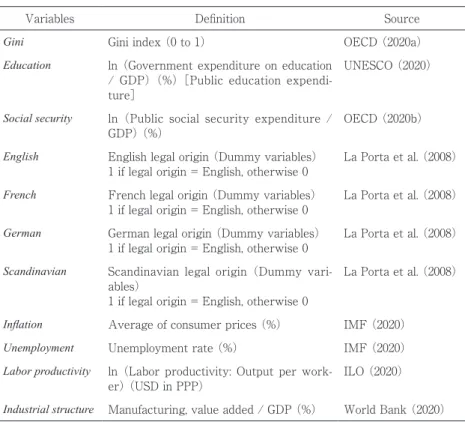
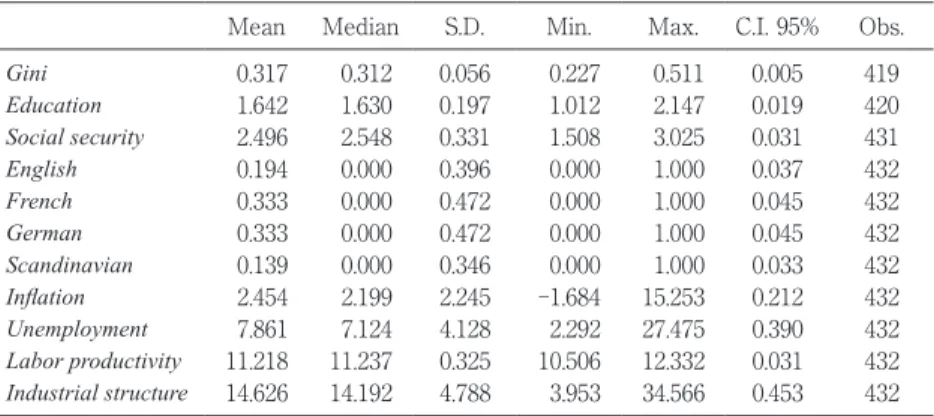
gins. The target countries were OECD members, and data were available for 36 countries. The classification for the legal origins is based on La Por- ta et al. (2008). Table 3 shows the definitions of the variables and the sources of the data. Descriptive statistics for the variables are listed in Ta- ble 4.

 We test whether each variable of economic inequality, public education expenditure, and social security expenditure is differentiated by its legal

Table 3. Definition of variables and data sources

Variables Definition Source

Gini Gini index (0 to 1) OECD (2020a)

Education ln (Government expenditure on education / GDP) (%) [Public education expendi- ture]

UNESCO (2020)

Social security ln (Public social security expenditure /

GDP) (%) OECD (2020b)

English English legal origin (Dummy variables)

1 if legal origin = English, otherwise 0 La Porta et al. (2008)

French French legal origin (Dummy variables)

1 if legal origin = English, otherwise 0 La Porta et al. (2008)

German German legal origin (Dummy variables)

1 if legal origin = English, otherwise 0 La Porta et al. (2008)

Scandinavian Scandinavian legal origin (Dummy vari- ables)

1 if legal origin = English, otherwise 0

La Porta et al. (2008)

Inflation Average of consumer prices (%) IMF (2020)

Unemployment Unemployment rate (%) IMF (2020)

Labor productivity ln (Labor productivity: Output per work-

er) (USD in PPP) ILO (2020)

Industrial structure Manufacturing, value added / GDP (%) World Bank (2020)

Note: The data are from 2004 to 2015. We used data from the previous year for missing values. If

data from the previous year did not exist, data from the next year were used. Where both

the previous year’s and next year’s data existed for missing values, we used the arithmetic

mean of both. If no data existed for either the previous or next year, the data for the year

are missing values. Therefore, the data used are unbalanced panel data.

(9)

origins. Table 5 is the estimated result of a t-test to confirm if the differ- ence in legal origins leads to a difference in the mean of the Gini index.

6 )

 Table 5 shows that Gini is not significant between English and French, so

Table 5. T-test of mean difference for Gini index Gini

Average T-test Obs.

English vs French 0.342 0.348 -0.824 84 139

English vs German 0.342 0.295 11.112*** 84 136

English vs Scandinavian 0.342 0.259 22.612*** 84 60

French vs German 0.348 0.295 8.166*** 139 136

French vs Scandinavian 0.348 0.259 14.517*** 139 60

German vs Scandinavian 0.295 0.259 9.679*** 136 60

Note: T-tests are estimated by a test of difference that does not assume homogeneity of variance.

The number of observations for each of the four types of samples is small because the sam- ple is classified into four types. Therefore, we used Welch’s estimation method, which does not assume homogeneity of variances, as it may not be possible to assume such homogenei- ty. ***, **, and * imply significance at the 1%, 5%, and 10% levels, respectively. Obs. is the number of observations.

Table 4. Descriptive statistics

Mean Median S.D. Min. Max. C.I. 95% Obs.

Gini 0.317 0.312 0.056 0.227 0.511 0.005 419

Education 1.642 1.630 0.197 1.012 2.147 0.019 420

Social security 2.496 2.548 0.331 1.508 3.025 0.031 431

English 0.194 0.000 0.396 0.000 1.000 0.037 432

French 0.333 0.000 0.472 0.000 1.000 0.045 432

German 0.333 0.000 0.472 0.000 1.000 0.045 432

Scandinavian 0.139 0.000 0.346 0.000 1.000 0.033 432

Inflation 2.454 2.199 2.245 -1.684 15.253 0.212 432

Unemployment 7.861 7.124 4.128 2.292 27.475 0.390 432

Labor productivity 11.218 11.237 0.325 10.506 12.332 0.031 432 Industrial structure 14.626 14.192 4.788 3.953 34.566 0.453 432 Note: S.D. means standard deviation. 95% C.I. means 95% confidence interval. Obs. means number

of observations. For missing values, data from the previous year were used. If data from

the previous year did not exist, data from the next year were used. Where both the previ-

ous year’s and next year’s data existed for missing values, we used the arithmetic mean of

both. If no data existed for either the previous or next year, the data for the year are miss-

ing values.

(10)

no difference exists.

7 )

To summarize Table 5, the average value of the Gini index was higher in countries with French and English legal origins, and these countries had greater degrees of economic inequality. Countries with German legal origins followed next, and countries with Scandinavian legal origins had the lowest degree of economic inequality.

 In discussing Table 5, the following two relationships were analyzed fur- ther due to possible overlaps. The first relationship concerns the classifica- tion system of Esping-Andersen (1990), which detects whether economic inequality differs between countries depending on their legal origins be- cause of the decommodification index. The second relationship is between economic inequality and the rule of law. Taken together, the classification system of Esping-Andersen (1990) and the one based on legal origins con- tain many similarities and may directly affect economic inequality. That is, we should consider the possibility that liberal competitive markets can create economic inequality. On the other hand, according to Silkenat, Hick-

Table 6. T-test of mean difference for public education expenditure Education

Average T-test Obs.

English vs French 1.687 1.554 6.833*** 84 133

English vs German 1.687 1.563 7.454*** 84 143

English vs Scandinavian 1.687 1.958 -15.516*** 84 60

French vs German 1.554 1.563  -0.473 133 143

French vs Scandinavian 1.554 1.958 -20.561*** 133 60

German vs Scandinavian 1.563 1.958 -23.441*** 143 60

Note: T-tests are estimated by a test of difference that does not assume homogeneity of variance.

The number of observations for each of the four types of samples is small because the sam-

ple is classified into four types. Therefore, we used Welch’s estimation method which does

not assume homogeneity of variances, as it may not be possible to assume such homogenei-

ty. ***, **, and * imply significance at the 1%, 5%, and 10% levels, respectively. Obs. is the

number of observations.

(11)

ey, and Barenboǐm (2014), the rule of law is based on the notion of remov- ing, as much as possible, a ruler’s arbitrary will from the legal system. The rule of law is justified by the ethical principle of normative individualism – that is, even a ruler is equal before the law.

8 )

Tomita and Kimura (2021)

found that the level of the rule of law in a country differs depending on its legal origins, resulting in different levels of economic inequality. Therefore, the differences in economic inequality due to the legal origins could to an extent be driven by both the decommodification index and/or the influ- ence of the rule of law.

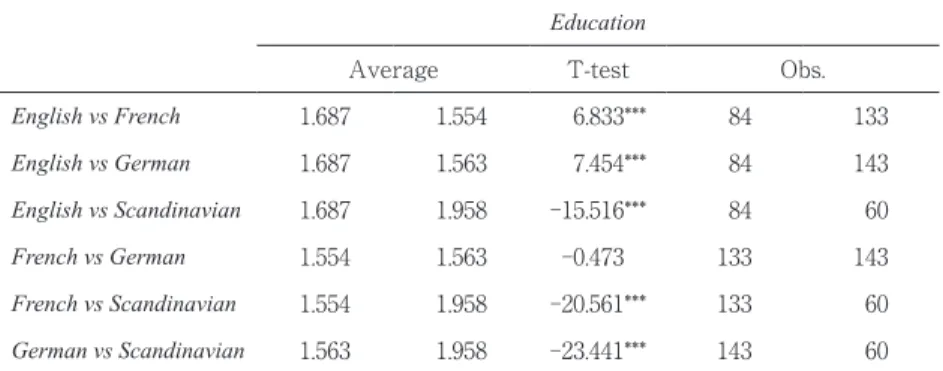
 Table 6 uses the same methodology as Table 5 to estimate whether the legal origins influence the average value of public education expenditure.

It shows that countries with Scandinavian legal origins have the highest values for public education expenditure, followed by countries with Eng- lish legal origins. Public education expenditure for countries with French and German legal origins were comparatively low, and there was no signif-

Table 7. T-test of mean difference for public social security expenditure Social security

Average T-test Obs.

English vs French 2.887 2.901 -0.353 84 144

English vs German 2.887 2.889 -0.079 84 143

English vs Scandinavian 2.887 3.140 -8.208*** 84 60

French vs German 2.901 2.889  0.253 144 143

French vs Scandinavian 2.901 3.140 -5.128*** 144 60

German vs Scandinavian 2.889 3.140 -6.479*** 143 60

Note: T-tests are estimated by a test of difference that does not assume homogeneity of variance.

The number of observations for each of the four types of samples is small because the sam-

ple is classified into four types. Therefore, we used Welch’s estimation method which does

not assume homogeneity of variances, as it may not be possible to assume such homogenei-

ty. ***, **, and * imply significance at the 1%, 5%, and 10% levels, respectively. Obs. is the

number of observations.

(12)

icant difference between them in this regard.

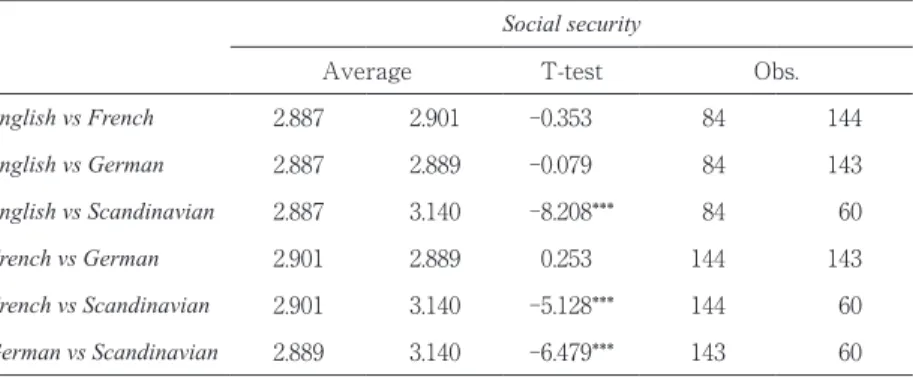
 Table 7 shows the results of a t-test to estimate whether a country’s le- gal origins influence the average value of its social security expenditure using the same methodology as Tables 5 and 6. It shows that there are no significant differences between countries with English and French, English and German, and French and German legal origins, and that countries with Scandinavian legal origins had higher social security expenditures.

 Figure 1 was plotted to observe the relationship between the Gini index and public education expenditure. This regression model is a log-approxi- mation curve estimated by the least-squares method with the independent

Figure 1. Relationship between Gini index and public education expenditure

Note: This graph plots the relationship between the Gini index and public education expenditure.

These values use the arithmetic means from 2004 to 2015 in each country. The regression model is a logarithmic approximation curve that converts public education expenditure to the natural logarithm. Country names are given in accordance with ISO 3166-1 alpha 3. ***,

**, and * imply significance at the 1%, 5%, and 10% levels, respectively.

(13)

variable public education expenditure as the natural logarithm. According to Figure 1, there is a negative relation between the Gini index and public education expenditure.

 We plotted Figure 2 to observe the relationship between the Gini index and social security expenditures. This regression model was also estimated by the least-squares method, and its log-approximation curve uses the in- dependent variable (social security expenditure) as the natural logarithm.

According to Figure 2, there is a negative relation between the Gini index and social security expenditures.

 We use the following model to test whether the impact of public educa- tion and social security expenditures on economic inequality varies de- Figure 2. Relationship between Gini index and public social security expenditure

Note: This graph plots the relationship between the Gini index and public social security expendi-

ture. These values use the arithmetic means from 2004 to 2015 in each country. The regres-

sion model is a logarithmic approximation curve that converts public social security expen-

diture to the natural logarithm. Country names are given in accordance with ISO 3166-1

alpha 3. ***, **, and * imply significance at the 1%, 5%, and 10% levels, respectively.

(14)

pending on a country’s legal origins:

Gini

it

= α

0

1

Education

it

2

Education

it

×Origin

i

3

Social security

it

4

Social security

it

×Origin

i

5

Origin

i

6

Control variables

it

it

(1)

 Here, the variables used are the values defined in Table 3. Gini is the Gini index. Education refers to public education expenditure. Education × Ori- gin is the interaction term of public education expenditure and legal origin

(for instance, the interaction term for public education expenditure and a country with English legal origins would be Education×English). In the model, we estimate three types of legal origins as a base category in order to compare the four types of legal origins. By using a model with an inter- action term, we can estimate the different effects of public education ex- penditure on economic inequality in countries with different legal origins.

  Social security is a social security expenditure. Likewise, Social security × Origin is an interaction term (of social security expenditure and legal ori- gins), as is Education × Origin . Using a model with an interaction term, we can estimate the effect of social security expenditure on economic inequali- ty through past adoption of a legal origin. Simultaneously, we can also esti- mate the marginal effects of these two types of interaction terms. By mea- suring marginal effects, we can compare the impact of public education expenditure and social security expenditure on economic inequality via each of the legal origins.

 The control variables are Inflation, which is the rate of inflation; Unem-

ployment , which is the rate of unemployment; Labor productivity , which is

output per worker; and Industrial structure, which is the proportion of

manufacturing.

9 )

In addition, a dummy year, Year , is added, and ε is the

error term, where i is the country and t the period. The model is estimat-

(15)

ed by a random effects model.

10)

4 .Estimation results and discussion

 This section presents the estimation results of the model described above and its marginal effects. Table 8 shows the results of the estimates in equation (1).

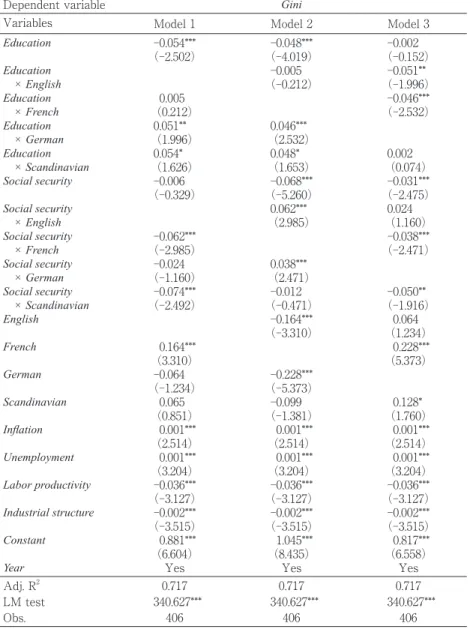
 First, we describe a model in which English is the base category for the dummy variables. Next, we describe the model with French as the base category for the dummy variables. Finally, we discuss the model with Ger- man as the base category for the dummy variables. The estimates in Table 8 show that the impact of an increase in public education expenditure on the Gini index is similar in countries with English and French legal origins.

It also shows that public education expenditure is less effective in lower- ing the Gini index in countries with German legal origins than it is in countries with English legal origins, and that public education expenditure tends to be less effective in lowering the Gini index in countries with Scan- dinavian legal origins than in countries with English legal origins. The ta- ble also shows that public education expenditure is less effective in lower- ing the Gini index in countries with German legal origins than in countries with French legal origins, and that it also tends to be less effective in low- ering the Gini index in countries with Scandinavian legal origins than in countries with French legal origins.

 The results regarding social security expenditure in Table 8 are sum-

marized below. Table 8 shows that increases in social security expenditure

reduce the Gini index more in countries with French legal origins than it

does in countries with English legal origins. It also shows that the impact

of increases in social security expenditure on the Gini index is similar in

countries with English and German legal origins. Furthermore, increases

(16)

Table 8. Estimated result

Dependent variable Gini

Variables Model 1 Model 2 Model 3

Education -0.054*** -0.048*** -0.002

(-2.502) (-4.019) (-0.152)

Education -0.005 -0.051**

 × English (-0.212) (-1.996)

Education  0.005 -0.046***

 × French (0.212) (-2.532)

Education 0.051** 0.046***

 × German (1.996) (2.532)

Education 0.054* 0.048* 0.002

 × Scandinavian (1.626) (1.653) (0.074)

Social security -0.006 -0.068*** -0.031***

(-0.329) (-5.260) (-2.475)

Social security 0.062*** 0.024

 × English (2.985) (1.160)

Social security -0.062*** -0.038***

 × French (-2.985) (-2.471)

Social security -0.024 0.038***

 × German (-1.160) (2.471)

Social security -0.074*** -0.012 -0.050**

 × Scandinavian (-2.492) (-0.471) (-1.916)

English -0.164***  0.064

(-3.310) (1.234)

French  0.164***  0.228***

(3.310) (5.373)

German -0.064 -0.228***

(-1.234) (-5.373)

Scandinavian  0.065 -0.099  0.128*

(0.851) (-1.381) (1.760)

Inflation  0.001***  0.001***  0.001***

(2.514) (2.514) (2.514)

Unemployment  0.001***  0.001***  0.001***

(3.204) (3.204) (3.204)

Labor productivity -0.036*** -0.036*** -0.036***

(-3.127) (-3.127) (-3.127)

Industrial structure -0.002*** -0.002*** -0.002***

(-3.515) (-3.515) (-3.515)

Constant  0.881***  1.045***  0.817***

(6.604) (8.435) (6.558)

Year Yes Yes Yes

Adj. R

2

0.717 0.717 0.717

LM test 340.627*** 340.627*** 340.627***

Obs. 406 406 406

Note: Each model is estimated using a random effects model, as the variables of the legal origins

do not change over time and therefore cannot be measured in a fixed effects model. The fig-

ures in parentheses indicate the t-value. ***, **, and * imply significance at the 1%, 5%, and

10% levels, respectively. Obs. is the number of observations.

(17)

in social security expenditure reduce the Gini index more in countries with Scandinavian legal origins than in countries with English legal ori- gins, and that social security expenditure is less effective in lowering the Gini index in countries with German legal origins than in countries with French legal origins. The impact of increased social security expenditure on the Gini index is the same for countries with French and Scandinavian legal origins, and increases in social security expenditure reduce the Gini index more in countries with Scandinavian legal origins than in countries with German legal origins.

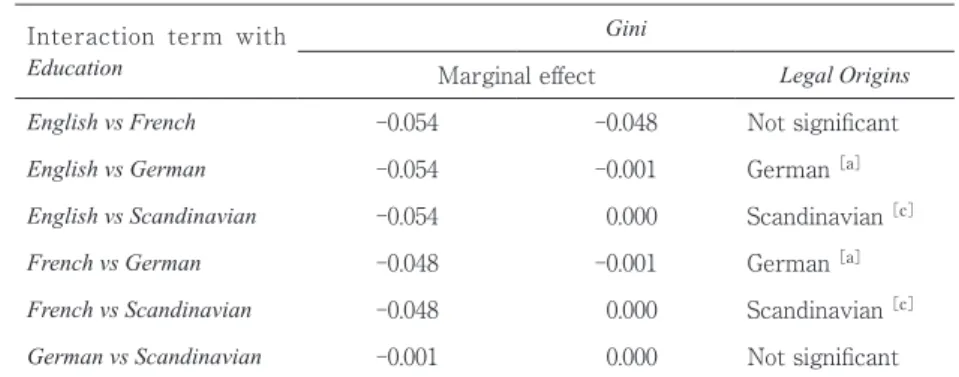
 Table 9 shows the marginal effect of public education expenditure on the Gini index for each type of legal origin. The strongest marginal effect of public education expenditure on lowering economic inequality was -0.054 (countries with English legal origins), followed by -0.048 (French).

No differences were detected between countries with English and French legal origins in this regard. The strength of the marginal effect of public

Table 9. Marginal effect of Education on Gini Interaction term with

Education

Gini

Marginal effect Legal Origins

English vs French -0.054 -0.048 Not significant

English vs German -0.054 -0.001 German

[a]

English vs Scandinavian -0.054 0.000 Scandinavian

[c]

French vs German -0.048 -0.001 German

[a]

French vs Scandinavian -0.048 0.000 Scandinavian

[c]

German vs Scandinavian -0.001 0.000 Not significant

Note: The table shows the marginal effects of the intersection term between public education ex- penditure and the legal origin, with the Gini index as the dependent variable. The column for Legal origins shows which legal origin has the greater marginal effect.

[a]

indicates that both the base category and the intersection term are significant at the 5% level.

[b]

indi- cates that either the base category or the intersection term is significant at the 5% level.

[c]

indicates that it is significant at the 10% level.

(18)

education expenditure on economic inequality was weaker for countries with German (-0.001) and Scandinavian (0.000) legal origins. According to Table 9, the marginal effect of public education expenditure on economic inequality is weak for countries with legal origins that have relatively low Gini index values (as shown in Table 5, above).

 Table 10 shows the marginal effects of social security expenditure on the Gini index by type of legal origin. The strongest marginal effect of so- cial security expenditure on lowering economic inequality was -0.081

(countries with Scandinavian legal origins), followed by -0.068 (French).

No differences were detected between countries with Scandinavian and French legal origins in this regard. The marginal effect of social security expenditure on reducing economic inequality for countries with German legal origins was -0.031, weaker than that of countries with French legal origins, and was even lower in countries with English legal origins

(-0.006). However, we did not detect a difference between countries with Table 10. Marginal effect of Social security on Gini

Interaction term with Social security

Gini

Marginal effect Legal Origins

English vs French -0.006 -0.068 English

[a]

English vs German -0.006 -0.031 Not significant

English vs Scandinavian -0.006 -0.081 English

[b]

French vs German -0.068 -0.031 German

[a]

French vs Scandinavian -0.068 -0.081 Not significant

German vs Scandinavian -0.031 -0.081 German

[a]

Note: The table shows the marginal effects of the intersection term between public social security expenditure and the legal origin, with the Gini index as the dependent variable. The column for Legal origins shows which legal origin has the greater marginal effect.

[a]

indicates that both the base category and the intersection term are significant at the 5% level.

[b]

indi- cates that either the base category or the intersection term is significant at the 5% level.

[c]

indicates that it is significant at the 10% level.

(19)

German and English legal origins in this regard. These estimates are con- sistent with those of Esping-Andersen (1990).

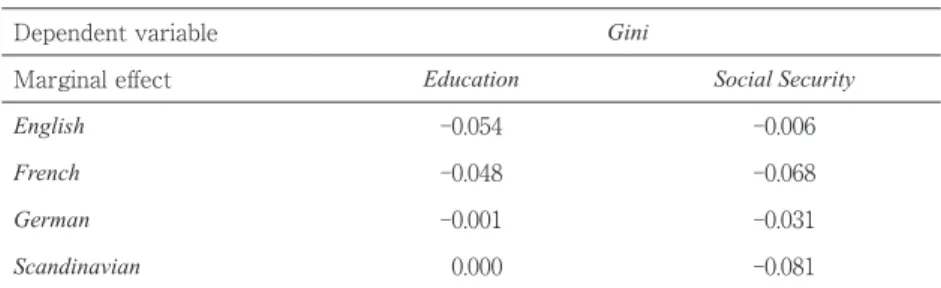
 Table 11 compares the marginal effects of public education expenditure and social security expenditure on economic inequality by countries’ legal origin. In countries with English legal origins, the marginal effect of public education expenditure was strong (-0.054) but the marginal effect of so- cial security expenditure was weak (-0.006). In countries with French le- gal origins, the marginal effect of public education expenditure was strong

(-0.048) and the marginal effect of social security expenditure was also strong (-0.068). In countries with German legal origins, the marginal effect of public education expenditure was weak (-0.001) but the marginal effect of social security expenditure was strong (-0.031). Finally, in countries with Scandinavian legal origins, public education expenditure had little ef- fect on economic inequality but the marginal effect of social security ex- penditure was strong (-0.081).

 In other words, increasing public education expenditure may reduce economic inequality in states with English legal origins, the expansion of both public education and social security expenditure might reduce eco- nomic inequality in states with French legal origins, and an increase in so- cial security expenditure might reduce economic inequality in states with

Table 11. Comparison of marginal effects

Dependent variable Gini

Marginal effect Education Social Security

English -0.054 -0.006

French -0.048 -0.068

German -0.001 -0.031

Scandinavian 0.000 -0.081

Note: Values are calculated from the estimation results of the interaction term’s marginal effect.

(20)

German or Scandinavian legal origins. These estimates indicate that the existence of trade-offs in the marginal effects of public education and social security expenditures varies with the legal origins and is not a common phenomenon.

11)

5 .Conclusion and implications

 This paper discussed whether public education and social security ex- penditure reduce economic inequality, and whether states’ legal origins impact this relationship. Because this paper views states’ legal origins as the underlying source of welfare regime theory (Esping-Andersen 1990), it is concerned with statistically examining what types of social policies might reduce economic inequality in countries with different legal origins.

 This study’s estimation results show that the marginal effect of public education expenditure is strong for countries with English and French le- gal origins and that increasing public education expenditure might reduce economic inequality in these countries. It also found that the marginal ef- fect of public education expenditure tends to be stronger for legal origins that have higher Gini index values. In this case, we can assume that coun- tries with high Gini index values also have a greater ability to increase public education expenditure. The study also found that the marginal ef- fect of social security contributions on economic inequality is strong for countries with Scandinavian and French legal origins. The strong marginal effects here appear to be related to Esping-Andersen’s (1990) classification framework.

 In short, this paper brings forth the following conclusions. First, increas-

ing public education expenditure might reduce economic inequality in

states with English legal origins. Second, increasing both public education

and social security expenditure might reduce economic inequality in states

(21)

with French legal origins. Third, increasing social security contributions might reduce economic inequality in states with German or Scandinavian legal origins.

 This study’s findings have several implications. For instance, it is ineffi- cient to blindly adopt successful social policies from one country without considering that country’s legal origins and the endogenous institutions in one’s own country. Thus, we suggest that policy-makers acknowledge and act on the knowledge that public social investment policies should consider their own state’s legal origins.

 This paper has a few limitations. For instance, it uses legal origins–the historical evolution of a country’s legal system-to analyze the efficacy of policy-making in the present, marking a temporal disconnect between the two. Despite this limitation, we believe it is meaningful to observe signifi- cant results even for the current index because of the tendency for path dependence. Future research could expand on this area by performing in- ternational comparisons based on the detailed institutional environment of each country.

Notes

1 ) Based on La Porta, Lopez-de-Silanes, Shleifer, and Vishny (1998, 2000, 2002),

this study classified legal origins into four types: English, French, German,

and Scandinavian. La Porta, Lopez-de-Silanes, and Shleifer (2008) defined a

fifth type–Socialist–however, we did not use this type as it was not included

in the countries covered by this paper. English legal origins mean that the

country’s laws are mainly based on English Common Law. French and Ger-

man legal origins are called Civil Law, a legal system which is based mainly

on Statute or Continental Law. French legal origins can be traced back to

the Napoleonic Code, and German legal origins to Roman law. Scandinavian

legal origins have their roots in Northern Europe and are influenced by an-

cient Germanic Common law.

(22)

2 ) According to Berkowitz, Pistor, and Richard (2003a, 2003b), a gap between the legal system and endogenous institutions is associated with a discrepan- cy in economic development. Berkowitz et al. (2003) show that the gap aris- es when colonial policy transplants legal origins from one country to another.

Because this paper focuses on the economically developed OECD countries, we assume that the gap between legal origins and endogenous systems is at the same level.

3 ) Castles and Mitchell (1992) advocate a “Wage earner welfare state.” Lewis

(1992) categorizes welfare states into four types: “Strong male-breadwinner state,” “Modified male-breadwinner state,” “Weak male-breadwinner state,”

and “Male-breadwinner model.” Siaroff (1994) classifies countries into four regimes based on family welfare indices constructed from family benefits, childcare, maternity, or parental leave, etc., and the degree of women’s ac- ceptance into the labor market, constructed from wages and labor market participation rates. Ferrera (1996) describes weak interventions in the wel- fare system in southern European countries and advocates the “Universal breadwinner model,” the “Caregiver parity model,” and the “Universal care- giver model.” Sainsbury (1996) advocates the “Male breadwinner family model” and an “Individual model” from the perspective of entitlement in so- cial policy and taxation.

4 ) In view of Esping-Andersen’s (1990) theory of welfare regimes, “Encompass- ing” can be considered to correspond to the social democratic regime, “Cor- poratist” to the conservative regime, and “Basic security” and “Targeted” to the liberal regime.

5 ) Kenworthy (2011) and Marx, Salanauskaite, and Verbist (2013) state that economic inequality can be reduced by providing a tax credit with benefits in both “Basic security” and “Targeted” countries.

6 ) The number of observations is small because the sample is divided into four

parts for each legal origin. In other words, it becomes difficult to assume ho-

moscedasticity. We confirmed by the F-test (one-tailed test), and it was sig-

nificant at less than and equal to the 5% level for most combinations of legal

origins. Therefore, the t-test was estimated by Welch’s test, which does not

assume homoscedasticity. The estimation method is a non-parametric test,

(23)

and the t-test is a two-tailed test. The same test method is used in Tables 6 and 7.

7 ) The Gini coefficient used in this paper is the value after income redistribu- tion.

8 ) The rule of law attaches great importance to the system of precedents set by courts due to the existence of unwritten rules and customs, and the legal state (Rechtsstaat) attaches great importance to the Act of Congress. How- ever, Silkenat et al. (2014) suggest that both are essentially aligned to the protection of human dignity and democracy.

9 ) Inflation and unemployment rates are included in the model because they can have a direct impact on economic inequality. Furthermore, we add labor productivity to the model as a control variable with a view to removing the impact of its variables on economic inequality. In other words, if the produc- tivity is low for general workers, there may be a bias in income distribution.

This means that economic inequality between employers with capital and workers without capital can be high. We also add industry structure to the model for the same reason, as it may have an impact on economic inequality.

10) The variables indicating the legal origins are dummy variables that do not change during the target period. In other words, it is not possible to esti- mate them in a fixed effects model that completely removes the effect of time-invariant covariates. Therefore, in this paper, we estimate using a ran- dom effects model.

11) The correlation coefficient between education and social security was posi- tive, at 0.341. We implemented a t-test for the correlation coefficient and found it to be significant at the 1% level. Namely, no trade-off was observed between the two when compared as a scale rather than a marginal effect.

References

Alvaredo, F., Chancel, L., Piketty, T., Saez, E., and Zucman, G. (Eds.) (2018).

World Inequality Report 2018. Belknap Press.

Amable, B. (2003). The Diversity of Modern Capitalism. Oxford University Press.

Batifoulier, P. (2001). Théorie Des Conventions (Economie) [in French]. Economi-

ca.

(24)

Berkowitz, D., Pistor, K., and Richard, J. F. (2003a). “Economic development, legality, and the transplant effect,” European Economic Review, 47(1), 165–195.

Berkowitz, D., Pistor, K., and Richard, J. F. (2003b). “The transplant effect,”

The American Journal of Comparative Law, 51, 163–203.

Castles, F. G., and Mitchell, D. (1992). “Identifying welfare state regimes: the links between politics, instruments and outcomes,” Governance, 5(1), 1–26.

Esping-Andersen, G. (1990). The Three Worlds of Welfare Capitalism. Princeton University Press.

Esping-Andersen, G. (1999). Social Foundations of Postindustrial Economies. Ox- ford University Press.

Ferrera, M. (1996). “The ‘Southern Model’ of welfare in social Europe,” Journal of European Social Policy, 6(1), 17–37.

Hall, P. A. and Soskice, D. (2001). Varieties of Capitalism: Institutional Foundation of Comparative Advantage. Oxford University Press.

Heidenheimer, A. J. (1981). “Education and social security entitlements in Eu- rope and America,” in Flora, P., and Heidenheimer, A. J. (Eds.) The Develop- ment of Welfare States in Europe and America, Transaction Books, 269–304.

Hokenmaier, K. G. (1998). “Social security vs. educational opportunity in ad- vanced industrial societies: is there a trade-off?” American Journal of Political Science, 42(2), 709–711.

ILO. (2020, August). ILO, Statistics on Labour Productivity. Retrieved from/

https://ilostat.ilo.org/topics/labour-productivity/

IMF. (2020, August). IMF, World Economic Outlook Database, October 2019.

Retrieved from https://www.imf.org/en/Publications/WEO/

Issues/2019/10/01/world-economic-outlook-october-2019

Kenworthy, L. (2011). Progress for the Poor. Oxford University Press.

Korpi, W. and Palme, J. (1998). “The paradox of redistribution and strategies of equality: welfare state institutions, inequality, and poverty in the West- ern countries,” American Sociological Review, 63(5), 661–687.

La Porta, R., Lopez-de-Silanes, F., and Shleifer, A. (2008). “The economic conse- quences of legal origins,” Journal of Economic Literature, 46(2), 285–332.

La Porta, R., Lopez-de-Silanes, F., Shleifer, A., and Vishny, R. W. (1998). “Law

and finance,” Journal of Political Economy, 106(6), 1113–1155.

(25)

La Porta, R., Lopez-de-Silanes, F., Shleifer, A., and Vishny, R. W. (2000). “Inves- tor protection and corporate governance,” Journal of Financial Economics, 58

(1–2), 3–27.

La Porta, R., Lopez-de-Silanes, F., Shleifer, A., and Vishny, R. W. (2002). “Inves- tor protection and corporate valuation,” The Journal of Finance, 57(3), 1147–

1170.

Lewis, J. (1992). “Gender and the development of welfare regimes,” Journal of European Social Policy, 2(3), 159–173.

Marx, I., Salanauskaite, L., and Verbist, G. (2013). “The paradox of redistribu- tion revisited: and that it may rest in peace?” IZA Discussion Paper No.

7414. Available at http://ftp.iza.org/dp7414.pdf

Means, R. C. (1980). Underdevelopment and the Development of Law. University of North Carolina Press.

North, D. C. (1990). Institutions, Institutional Change and Economic Performance.

Cambridge University Press.

North, D. C. (2005). Understanding the Process of Economic Change. Princeton Uni- versity Press.

OECD. (2020a, August). OECD, Income Inequality Indicator. Retrieved from https://data.oecd.org/inequality/income-inequality.htm

OECD. (2020b, August). OECD, Social Expenditure Statistics. Retrieved from https://www.oecd-ilibrary.org/social-issues-migration-health/data/oecd- social-expenditure-statistics_socx-data-en

Sainsbury, D. (1996). Gender, equality and welfare states. Cambridge University Press.

Siaroff, A. (1994). “Work, welfare and gender equality: a new typology,” in Sainsbury, D. (Ed.) Gendering Welfare States, Sage, 82–100.

Silkenat, J. R., Hickey, J. E., and Barenboǐm, P. (Eds.) (2014). The Legal Doc- trines of the Rule of Law and the Legal State (Rechtsstaat) (Vol. 38). Springer.

Tomita, Y. and Kimura, A. (2021). “Financial resource of public social security expenditure, the rule of law, and economic inequality: international compar- ison of legal origins,” Economic Research-Ekonomska Istraživanja, 1–21.

UNESCO. (2020, August). UIS Statistics–UNESCO, Statistics: Education. Re-

trieved from http://data.uis.unesco.org/index.aspx?queryid=189#

(26)

World Bank. (2020, August). World Bank, World Development Indicators Data. Retrieved from https://data.worldbank.org/indicator

Acknowledgements

 We would like to thank the anonymous reviewers and the chief editor for their meaningful comments. Special thanks also to our family. We would like to thank Editage (www.editage.com) for English language editing.

Funding

 This research was partially supported by special research grants from Toyo Gakuen University, 2020–2021.

(とみた・ようすけ/東洋学園大学現代経営学部専任講師)

(きむら・あきのり/東洋学園大学現代経営学部専任講師)

Table 3. Definition of variables and data sources
Table 5. T-test of mean difference for Gini index Gini
Table 6. T-test of mean difference for public education expenditure Education
Table 7. T-test of mean difference for public social security expenditure Social security
+5

参照

関連したドキュメント

Both families of spaces seen to be different in nature: on the one hand, Branciari’s spaces are endowed with a rectangular inequality and their metrics are finite valued, but they

By applying the method of 10, 11 and using the way of real and complex analysis, the main objective of this paper is to give a new Hilbert-type integral inequality in the whole

Our guiding philosophy will now be to prove refined Kato inequalities for sections lying in the kernels of natural first-order elliptic operators on E, with the constants given in

We provide an extension of the Fefferman-Phong inequality to nonnegative sym- bols whose fourth derivative belongs to a Wiener-type algebra of pseudodifferential operators introduced

DRAGOMIR, A converse result for Jensen’s discrete inequality via Grüss’ inequality and applications in information theory, Analele Univ.

Henry proposed in his book [7] a method to estimate solutions of linear integral inequality with weakly singular kernel.. His inequality plays the same role in the geometric theory

On the other hand, modeling nonlinear dynamics and chaos, with its origins in physics and applied mathematics, usually concerned with autonomous systems, very often

As application of our coarea inequality we answer this question in the case of real valued Lipschitz maps on the Heisenberg group (Theorem 3.11), considering the Q − 1