37 The Bulletin of Institute of Technologists, No. 5
論 文 Article
高強度繊維補強コンクリートの耐火性能改善に関する基礎的研究
原稿受付 2014 年 4 月 1 日 ものつくり大学紀要 第 5 号 (2014) 37~40辻正哲
*1,澤本武博
*2,横山滋
*3,小林征之
*3,菊田弘之
*3 *1 ものつくり大学 技能工芸学部 建設学科 非常勤講師 *2 ものつくり大学 技能工芸学部 建設学科 *3 太平洋プレコン工業株式会社A Fundamental Study for
Improving Fire Resistance
of High Strength Fiber Reinforced Concrete
Masanori TSUJI*1, Takehiro SAWAMOTO*2, Shigeru YOKOYAMA,Masayuki KOBAYASHI and Hiroyuki KIKUTA
*1 Part-time Lecturer, Dept. of Building Technologists, Institute of Technologists *2 Dept. of Building Technologists, Institute of Technologists
*3 TAIHEIYO Precast Concrete Industry CO., LTD.
Abstract In this study, the effect of combined use of emulsion and synthetic high polymer fiber on fire resistant of
high strength fiber reinforced concrete was investigated. Then, EVA, EP, SBR andAcrylic emulsion were added to the concrete with polypropylene fiber. As a result, the fire-resistant of high strength fiber reinforced concrete could be greatly improved when EVA emulsion and polypropylene fiber were added to the concrete.
38 高強度繊維補強コンクリートの耐火性能改善に関する基礎的研究 は動脈を構成し,乳剤の添加が微細な毛細血管を 構成して,すみやかに内圧を外部に放出でき,高 強度コンクリートであってもある程度の耐火性能 が確保できるのではないかと考えたことによる.
2.実験概要
2.1 乳剤の種類 実験に用いた乳剤は,K 社製のエチレン酢酸ビ ニル乳剤(以下 EVA と略記:不揮発分 48%), エポキシ乳剤(以下EP と略記:不揮発分 35%), アクリル乳剤(不揮発分36%),SBR ラテックス 乳剤(以下SBR と略記:不揮発分 30%)の 4 種類 である. 2.2 供試体の作製 コンクリートは,高強度用セメント、シリカ質 骨材、鋼繊維繊維補強、上水道水、ポリカルボン 酸系高強度用混和剤を用いて作製した。そして、 コンクリートにポリプロピレン短繊維及び乳剤の 合成高分子短繊維には、ポリプロピレン短繊維を 用い、その添加量を変化させて実験を行った。な お,乳剤中の不揮発成分は外割で置換し,水分は 練混ぜ水の一部とした. 練混ぜは,自公転式モルタルミキサで行い,図 1 のようにφ50×100mm の供試体を作製した.そ の後,図2 および図 3 のように 90℃で 48 時間温 水養生を行い,圧縮強度試験,割裂引張強度試験 および耐火試験を行った.耐火試験前の圧縮強度 試験の様子を図4 に示す. 2.3 耐火試験 耐火試験は,供試体を耐火炉に入れ,845℃まで 上昇させ,その後供試体を取り出し観察する方法 により行った.加熱速度は,所定の温度に達する まで,耐火炉のスイッチを入れたままとしたが, JIS A 1304 の加熱標準曲線に近い値となっていた. なお,コンクリートが爆裂し,炉の内壁に損傷を 与える危険性があったため,ステンレス製の容器 内に供試体を入れて実験を行った.耐火試験の様 子を図5 に示す. 供試体に微小な損傷しか生じておらず強度試験 を行える場合には,図6 のように耐火試験後の圧 縮強度を求めた.3.実験結果および考察
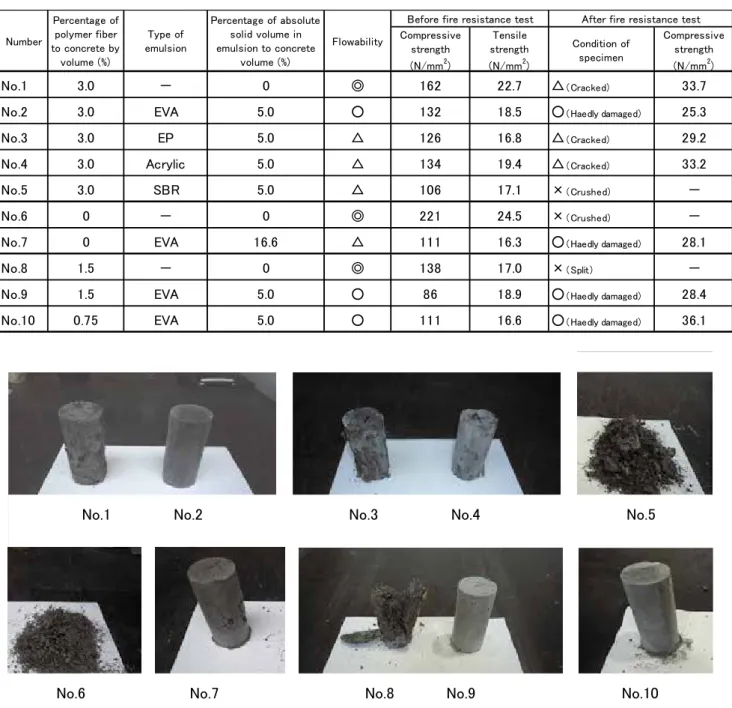
試験結果は,表1 に示すとおりである.なお, 表中の引張強度は,割裂試験時の最大荷重より求 めた値である.また,耐火試験後の供試体の外観 は,図7 に示すとおりである.合成高分子短繊維 を体積比で 3%添加すると、乳剤を添加しない場Fig.4 Compressive strength test Fig.5 Fire resistance test Fig.6 Compressive test after fire resistance test Fig.1 Placement of concrete Fig.2 Preparation for hot-water curing Fig.3 Hot-water curing for 48 hours
39 The Bulletin of Institute of Technologists, No. 5
合(No.1),EVA,EP およびアクリルの各乳剤を 添加した場合(No.2~No.4)は,耐火試験でひび 割れは生じたものの致命的な爆裂は生じなかった. 特に,EVA を添加した場合(No.2)は,表面に微 細なひび割れが生じる程度で,供試体外観は良好 であった.しかし,SBR を添加すると供試体は 粉々に壊れた.なお,エポキシ乳剤およびアクリ ル乳剤を添加した場合には,練混ぜ時に粘性が高 くなり,流動性が損なわれる傾向にあったため, その後の実験ではEVA 乳剤のみを対象とした。 合成高分子短繊維を添加せず,EVA の添加量 を 0%とした場合(No.6)供試体は粉々に壊れて いた.しかし,EVA の添加量を 16.6Vol.%とした 場合(No.7)は,合成高分子短繊維を添加しなく ても微細なひび割れしか生じず,供試体外観は良 好であった. 一 方 , 鋼 繊 維 を 添 加 せ ず 乳 剤 の 添 加 量 を 5Vol.%とした予備実験の結果,400~450℃で 1 時 間以上保持すると,その後 945℃まで温度上昇さ せても,微細なひび割れしか生じなかった。また, No.1 No.2 No.3 No.4 No.5
No.6 No.7 No.8 No.9 No.10
Fig.7 Outside conditionof specimens after fire resistance test Table 1 Fire resistance test results
Compressive strength (N/mm2) Tensile strength (N/mm2) Condition of specimen Compressive strength (N/mm2) No.1 3.0 - 0 ◎ 162 22.7 △(Cracked) 33.7
No.2 3.0 EVA 5.0 ○ 132 18.5 ○(Haedly damaged) 25.3
No.3 3.0 EP 5.0 △ 126 16.8 △(Cracked) 29.2
No.4 3.0 Acrylic 5.0 △ 134 19.4 △(Cracked) 33.2
No.5 3.0 SBR 5.0 △ 106 17.1 ×(Crushed) -
No.6 0 - 0 ◎ 221 24.5 ×(Crushed) -
No.7 0 EVA 16.6 △ 111 16.3 ○(Haedly damaged) 28.1
No.8 1.5 - 0 ◎ 138 17.0 ×(Split) -
No.9 1.5 EVA 5.0 ○ 86 18.9 ○(Haedly damaged) 28.4
No.10 0.75 EVA 5.0 ○ 111 16.6 ○(Haedly damaged) 36.1
After fire resistance test Number Percentage of polymer fiber to concrete by volume (%) Type of emulsion Percentage of absolute solid volume in emulsion to concrete volume (%) Flowability
Before fire resistance test