概要 日本の学校において英語カリキュラムにオーラルコミュニケーション(OC)に焦点 が当てられていないことが長年に懸念されている。その結果、義務として専門のOCの コースが大学で最近普及してきている。OCのコースのあり方は、大学生と大学教育者 にとって重要な課題である。そのため、本稿ではアクション・リサーチを用いて、OC の6つのクラスにおける日本人大学生の英語利用について議論する。英語利用は、専門 分野、学年、そしてタスクの評価による影響を与えている。学生の英語力が不足してい るときに、様々な補償ストラテジーを使い、英語利用に役立てようとしても、かえって 英語利用を妨げたこともあった。このような観点から、本稿では、今後のOCのコース 発展への示唆が議論される。 キーワード:英語教育学、オーラルコミュニケーション、補償ストラテジー English pedagogy, Oral communication, Language Learning Strategies Introduction
Communicative approaches to second language teaching became widespread from the 1980 s, in response to the limitations of traditional models of teaching, such as the Audio-Lingual Method and Grammar-Translation Method, which placed little emphasis on real-life communication (Krashen, 1982; Richards, 2006). Current discourse appears to be entering a post-methods era, moving away from the adoption of a single, strictly defined approach to teaching and learning, and instead there is an increasing recognition of the need for a coexistence of various approaches and methods with the focus on context requirements (Didenko & Pichugova, 2016, p. 4). Nevertheless, current prominent approaches to language instruction, such as Communicative Language Teaching, Task-Based Language
オーラルコミュニケーションのクラスにおける、
日本人大学生の英語利用について
メイソン・シャネン
Let’s speak English: A survey of Japanese university students’ use of the L2 in oral
communication courses
Teaching, and Content and Language Integrated Learning, are embedded in an understanding, supported by dominant theories of Second Language Acquisition (SLA), that proficiency is best facilitated when learners actively engage in and with the second language (Pinter, 2011).
As our understanding of SLA has developed, language education has seen major changes in terms of teaching pedagogy, assessment practices, and teaching materials. Lesson plans and classroom practices have undergone changes as well, for instance, translation as an exercise type has disappeared completely from classrooms (Didenko & Pichugova, 2016, p. 4). Exposing students to a second language (L2), and encouraging them to engage in that language is a feature of many contemporary language classrooms across the world. This is reflected by the position of the American Council on the Teaching of Foreign Languages (ACTFL) – an organisation dedicated to the improvement and expansion of language education in the United States, but which also has influence globally – that language educators and their students (should) use the target language as exclusively as possible (90% plus) at all levels of instruction (ACTFL, 2010, para. 1).
In order to assist students in their language learning, many have advocated the integration of instruction in the use of Language Learning Strategies (LLS) in language classrooms (Chamot & Kupper, 1989; Oxford, 2003; Tyacke, 1991). LLS, with its various definitions, can be defined broadly as the conscious thoughts and actions that learners take in order to achieve a learning goal (Chamot, 2004, p. 14). Educators and researchers involved in the field of language education have for many years been interested in the behaviours and characteristics of effective language learners. While it is certainly not the only variable to be proposed, the conscious and unconscious use of a variety of LLS is widely considered to be vital for developing proficiency in a second language (Gholami, Abdorrahimzadeh, & Behjat, 2014). While others have presented alternative taxonomies, perhaps the most comprehensive and widely cited classification of LLS was presented by Oxford (1990). Oxford proposed that LLS could be divided into six categories: Cognitive, metacognitive, memory-related, compensatory, affective, and social strategies. LLS become part of a toolkit for learners, which help them to overcome barriers to achieving specific communication goals (Færch & Kasper, 1983).
The case of Japan
While communicative approaches to language learning, and the inclusion of strategy instruction may be standard in many western educational systems, they are not the norm in Japan. Japan is a highly developed country which ranks well in international measures of student performance in mathematics, science, and reading (Organisation for Economic Co-operation and Development, 2012). Despite considerable financial investment and political support for English language education, it consistently ranks poorly in international measures, ranking 35th on the English Proficiency Index, behind economically emerging countries such as India, Indonesia and Vietnam (Education First, 2016). The oral communication skills of students in Japan, even after six or more years of English education, is an issue that has been raised by experts in education, business, and politics for some years, from both within and outside of the country (Fukushima, 2016; Suzuki, 1999; Voigt, 2001).
While sociocultural and affective factors should be acknowledged, the reality of language learning in Japanese schools is of particular importance in this discussion. English classes in Japan predominantly feature traditional methods of teaching, including rote memorisation of vocabulary, grammar drills, and translation exercises. It is not particularly common for students to be given opportunities to apply their knowledge of vocabulary and grammar to real communication, nor are they given regular instruction in the explicit skills and strategies needed to effectively communicate in a second language. When students are involved in communication, it is often for the purposes of learning English expressions, meaning they are forced to communicate information that has little interest or relevance to them (Yanase & Koizumi, 2015).
In recent years the Ministry of Education, Culture, Sports, Science and Technology (MEXT) has committed to improving the communicative competence of students in Japan, although by its own measures sufficient improvement was not seen in the English abilities [in all four skills] in lower and upper secondary schools between 2011 and 2015 (MEXT, 2015, p. 1). While educators in Japan are increasingly being trained in communicative approaches to language teaching, and while communicative instruction and activities have increased in schools, they are often detached from the study of other skills, and are often not given the same credence as the more serious study of grammar and vocabulary (Yamaoka, 2010).
Language learning is generally assessed through tests, where there is only one correct answer to any problem, and as such engaging in the messiness of communication can be daunting and foreign for students (Yanase & Koizumi, 2015). Many teachers struggle to reconcile a desire to dedicate time to oral communication, and a need to prepare students to pass standardised English examinations, which generally focus on reading, listening, and writing. Such examinations are used for entry to high school and universities, the selection of which can mean significant advantages for the future work prospects of students (Nishino, 2009; Sakui, 2004; Yanase & Koizumi).
Courses which focus specifically on English oral communication skills are an increasingly common and compulsory component of university study in Japan. Considering the experiences of English learning at school, for many students, these courses may constitute the first time that they are expected to communicate in English with their peers and teachers in a classroom setting. This can result in challenges for educators in encouraging Japanese students to speak in the L2. The context of university OC courses thus provides a perfect context for action research, as teachers attempt to understand and solve the problems presented in their own classrooms.
The study
Six English Oral Communication courses taught across two public universities in western Japan provided the context for this study. The courses were taught by a native English speaker (the author), where communication was both the aim and method of learning. The teacher used the L2 exclusively, and students were encouraged to use as much L2 as possible in a range of in-class speaking activities. Each course began with three weeks of explicit instruction and practice applying a number of
easy-to-implement compensatory LLS, which were referred to throughout the 15-week course. The course was divided into six topics of everyday interest and relevance to university students in Japan. Each topic covered two weeks of study, with the initial week dedicated to a variety of teacher-guided discussion activities, including chat rotations, pair Q&A, and peer interviews. In the second week, students were given a small amount of time for preparation, and then engaged in student-guided presentations, where they were required to share information about a particular topic, and stimulate further unscripted dialogue with their partners.
Students were regularly given opportunities to reflect informally on their use of the L2 throughout the course, and were encouraged to use different strategies to help them remain as much as possible in the L2. In the 13th week of the course, students were given a survey, allowing them to reflect formally on their use of the L2, and their use of strategies to help them in their goals.
Quantitative survey data and demographic information of students (gender, year of study, major, etc.) were entered into SPSS 20 statistical software package and where appropriate, totals, averages, frequencies and percentages were calculated for each item in the survey. Chi-square tests were conducted to reveal statistically significant differences between different groups of learners, and a Spearman s Rho Correlation test was applied to the scale data to reveal any significant differences between TL use and strategy use. For both types of analysis, results were considered significant at the p<0.05 level.
The aim of this study was to better understand the extent to which students sustained their use of English in OC courses. In particular, the data collected aimed to answer the following research questions:
◦ How much English (L2) do students use in Oral Communication classes? ◦ Are there differences in L2 use between different groups or situations?
◦ What strategies do students use (and not use) to compensate for gaps in knowledge? ◦ Are there differences in strategy use between different groups of students? ◦ Is there a correlation between L2 use and strategy use?
This study is a small-scale action research project. Action research in education is defined as research conducted by teachers, which allows them to study their own classrooms … in order to better understand them and be able to improve their quality (Mertler, 2008, p. 4). The findings of this study therefore are not representative of the whole population of university students in Japan. However, the study may provide insights which may help other educators in Japan who are also interested in increasing the level of L2 output by students.
Findings
Participants
universities in western Japan (University A and University B). The participants included an even mix of male (49%) and female (51%) students, who were both English-majors (48%) and non-English majors (52%). The majority of the students were in the first year of their university studies (64%), with the remainder made up of second year students (30%), and a small number of third and fourth year students (3% each).
How much L2 do students use in oral communication classes?
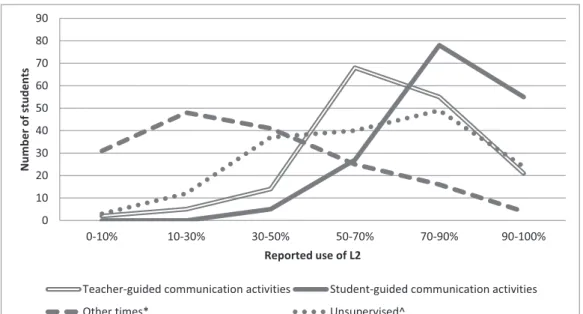
There was wide variety in students reported use of the L2 in class. As seen in Figure 1, students reported higher levels of L2 use in teacher-guided lessons compared to student-guided lessons. Lower levels of L2 use were reported during other times when L2 use was not explicitly expected or when the teacher was out of earshot.
Figure 1. Participants reported use of L2 in oral communication courses, n=165
*Other times include before and after class, between explicit activities, and during preparation time ^Unsupervised refers to times when the teacher is not within earshot of the participant, perhaps at the other side of the room, and/or talking to other students
Analysis of the survey data showed that there were no significant differences in L2 use between male and female students, although differences were found for students depending on their year of study and major. Students in the first year of study, and those whose major was not related to English, were more likely to revert back to the L1, and reported significantly lower levels of L2 use during student-guided communication activities, and when the teacher was not within earshot. Additionally, a positive correlation was found between class size and students reversion to their L1, meaning that as class size increased, students were more likely to revert back to Japanese during speaking tasks.
What compensation strategies do students use to help sustain L2 use?
All of the eight strategies introduced throughout the course were used by students during communication activities, as illustrated in Figure 2. The most commonly used strategy was gesturing, followed by the consultation of online apps, and dictionaries (which in all cases were electronic or online dictionaries). Students were three times more likely to ask a classmate for assistance, than to ask the teacher. Almost all students at one stage made a brief switch to the L1 in order to help them sustain their L2 conversation.
Figure 2. Participants reported use of compensatory strategies in OC courses, n=165
Chi-square analyses showed statistically significant differences between some groups of students. First, female students used more strategies more regularly compared to their male peers, particularly consulting a dictionary, and asking the teacher for assistance. English majors were more likely to consult apps, dictionaries, and to ask the teacher. Students in University A were more likely to ask the teacher than those in University B. No correlation was found between strategy use and class size.
Is there a correlation between L2 use and strategy use?
A positive correlation was found between participants use of the L2 and their use of strategies. This means that as students use of strategies increased, so did their reported use of English in class. In particular, students use of circumlocution and asking the teacher were the major contributors to this correlation. On the other hand, a positive correlation was seen between students reversion to the L1, and their use of apps, asking classmates, and brief codeswitching as compensatory strategies. This means that as students use of these strategies increased, so did the likelihood that they would revert back to Japanese.
Discussion
As described earlier, this particular course is divided into two distinct components, with each topic composed of a teacher-guided lesson and a student-guided lesson. The results of this study showed that the use of the L2 was used significantly more in the latter lesson. There are two possible explanations for this. The first explanation has to do with the way in which the different tasks were assessed. Students were explicitly assessed during student-guided activities, totaling 60% of their final grade. Teacher-guided activities were assessed under class participation , with the overall grade being 20%. As such, it appears that the weight of assessment might be a factor in students use of the L2. This is also supported by the fact that when there was no expectation of assessment, or when the teacher was not within earshot, L2 use decreased. This suggests that students, particularly non-English majors who show less L2 use overall, are less influenced by an intrinsic motivation to improve their oral communication skills, than an extrinsic motivation concerning their final grade.
A second explanation revolves around the nature of the course structure. Teacher-guided lessons were dedicated to getting students talking about a broad topic, and they were exposed to a range of relevant questions, sentence structures and vocabulary. When students moved to the central position in communication activities, they were aware of the topic, and had some foundational content and language knowledge that they could apply in their presentations. They were also given some time for preparation, which may have given students a sense of security.
The correlation between strategy use and L2 use is to be expected as the wider literature on strategy use attests. While students in this study who used strategies more often were more likely to use more L2, this does not suggest a causal relationship. The higher level of both L2 use and strategy use is more likely a cyclical relationship, reflective of the level of self-confidence some students have in using the language, and their willingness to take risks. This is also shown in the increasing use of L2 in students as they progress through their studies, noting that only English majors continue English study beyond their first year.
Developing relationships with students may also be an important factor in encouraging students to feel comfortable taking risks. Students at University A were more likely to engage in the risk-taking behaviour of asking the teacher for assistance. It is well acknowledged in SLA theory that student-teacher relationships play an important role in effective language teaching and learning (Dörnyei & Ushioda, 2011). The findings of this study fit with this theory, because the researcher spends more time at University A, a smaller institution where she is known to many of the students through other classes and extracurricular activities. This has perhaps strengthened relationships and allowed for more risk-taking behaviors among students at that university.
The role of L1 in the language classroom is much debated (see Ford, 2009 for a review of the debate in the Japanese university context), and the use of L1 was permitted in this course as a means to an end. However, this option is only available to students because their interlocutors share the same L1. This is one of the main disadvantages of classroom-based foreign language learning. Almost all students at
some point reverted briefly to the L1 during speaking activities in order to sustain their communication in the L2. For the participants in this sample, a brief code-switch was strongly correlated to reversion to the L1, meaning that the code-switch as a strategy to sustain L2 communication actually had the reverse effect. This was also the case when students asked their peers, presumably in the L1, and when they consulted apps and websites, which in all cases were those based in Japan for Japanese native speakers.
Implications
The study has produced interesting findings that will influence the way in which OC courses are approached by the teacher researcher in subsequent years. Firstly, more attention will be given to considering issues of student motivation, which has been an underlying theme throughout the study. It is not surprising that English majors appear to be more motivated, willing and able to use the L2 than those who have not pursued a related field of study. Non-English majors must enroll in compulsory courses as first year students, and then their English study generally ceases. To make the course itself more relevant to students and their future careers, it may be worthwhile to include topics that are more closely related to their own field of study.
One of the skills most lacking in Japanese students of English is their ability and confidence in speaking in unplanned, spontaneous situations, and the major aim of this course was to give students some experience in this area. However, it appears that students are able to produce more L2 after some period of preparation. The challenge is how to strike a balance between preparation and spontaneity. In the next academic year, students will be introduced to the differences between pre-planned and spontaneous conversation, and be given more explicit instruction on how to deal with the latter. Additionally, the amount of time given to students to prepare for their presentations will be decreased throughout the term, to help them to gradually remove their reliance on the planning time.
The direct instruction on compensatory strategies is one aspect of the course that will remain, although more attention will be given to how to ask classmates in the L2, and how to ask the teacher. It may also be worthwhile to introduce students to L2-based smartphone apps, which may help to keep students in the L2. For example, students may use a Voice Assistant program such as Siri to ask and find answers to content questions in English. Completely prohibiting the use of the L1, particularly for non-English majors, is not realistic in this context, and would probably bring only frustration for students, and for the teacher trying to enforce such a rule.
Large classes, which are common in Japan, make the development of positive relationships and classroom cultures more difficult, and thus promoting the use of the L2 can be challenging (Howard, 2008). It means that the teacher has less time to dedicate to talking to individual students, and getting to know them on a personal level. There are times in a large class when the teacher cannot be within earshot of all students, meaning they are regulated only by their own motivation to speak, which for some students can be quite low, as has been seen. It is uncommon for educators to have an influence on classroom policy decisions, such as class size, and so there is a need to consider ways to facilitate and
observe the use of L2 by the students, within the realities of the classroom contexts.
While students were asked to informally think about their L2 use, and sometimes discuss this with a partner, the survey used in this study proved to be an interesting tool for students, and they took some time and effort to complete the survey. A similar type of reflective tool will be introduced by the teacher as a part of each subsequent class. Students will be able to plot their L2 use, and check off strategies as they use them, making them more conscious of their decisions. This will allow more objective data for both teacher and student. A more even distribution of the final grade between teacher-guided and student-guided lessons will also be considered.
Limitations
As is the nature of action research, this study was limited in its size and scope. Data were collected at only one point in time, and it is likely that students use of the L2 was not constant throughout the semester. Certainly there are more factors involved than just the use of strategies, and further research, perhaps involving longitudinal and mixed-methods research design, would help to better understand the issues that students and educators face in encouraging students in Japan to use the L2 in classroom situations.
Conclusion
The aim of action research is to reflect critically on one s own practices in order to improve teaching, and ultimately student outcomes. The goal of this study was to consider the level of L2 use and strategy use, as reported by the researchers students. A small-scale study saw 165 students from two Japanese universities complete a quantitative questionnaire, reporting on their use of English, and their use of communication strategies, in Oral Communication courses. The findings have presented several different areas for contemplation in the planning, teaching, and assessment of the oral communication courses taught by the researcher, as well as other educators who are trying to overcome the challenges of encouraging and assisting university students in Japan to engage more in English.
The use of English in Oral Communication classes varied from student to student, with non-English majors and first year students reporting lower levels of L2 use. L2 use also varied from task to task. It appears that students used the L2 more during tasks which were explicitly linked to their final grade, and in tasks where they were given some time for planning and preparation. The use of Language Learning Strategies was connected in this study to higher levels of L2 use, although it is acknowledged that this is likely a cyclical relationship. There is a strong case for introducing students to a range of communication and compensation strategies to help them to overcome gaps in their language, although care needs to be taken to ensure that students select and use the strategies effectively to meet their communication goals. The challenge for educators is to balance students extrinsic motivation to pass the course, with an intrinsic motivation to reach in-class communication goals. There is also a need to balance students reliance on planning and preparation, with opportunities to engage in spontaneous speaking activities which more closely mimic real-life, natural communication.
References
American Council on the Teaching of Foreign Languages (ACTFL). (2010). Use of the target language in the classroom. Retrieved from
https://www.actfl.org/news/position-statements/use-the-target-language-the-classroom
Chamot, A. U., & Kupper, L. (1989). Learning strategies in foreign language instruction. Foreign
Language Annals, 22, 13-24.
Chamot, A. U. (2004). Issues in language learning strategy research and teaching. Electronic Journal of
Foreign Language Teaching, 1(1), 14-26.
Didenko, A. V., & Pichugova, I. L. (2016). Post CLT or Post-Method: Major criticisms of the communicative approach and the definition of current pedagogy. SHS Web of Conferences, 28, 1-4.
Dörnyei, Z., & Ushioda, E. 2011. Teaching and researching motivation (2nd ed.). Harlow, UK: Longman. Education First (2016). 世界最大の英語能力ランキング[World English Proficiency Index]. Retrieved
from http://www.efjapan.co.jp/epi/
Ford, K. (2009). Principles and practices of L1/L2 use in the Japanese university EFL context. JALT
Journal, 31(1), 63-80.
Fukushima, G. (2016, February 6). 世界に取り残される日本の「英語力」[Japan being left behind the rest of the world in English ability]. Forbes Japan. Retrieved from
http://forbesjapan.com/articles/detail/11042
Gholami, M., Abdorrahimzadeh, S. J., Behjat, F. (2014). L2 literacy proficiency and language learning strategy use. Modern Journal of Language Teaching Methods, 4(4), 77-90.
Howard, A. (2008). Teaching communicatively in a (very) large class. Teachers Helping Teachers Japan. Retrieved from http://tht-japan.org/publications/2008/a_howard46- 51.pdf
Krashen, S. (1982). Principles and practice in Second Language Acquisition. Oxford, UK: Pergamon. Mertler, C. A. (2008). Action Research: Teachers as Researchers in the Classroom. Los Angeles, CA: Sage. Ministry of Education, Culture, Sports, Science and Technology (MEXT). (2015). Plans on Promoting Improvement in Japanese Students English Proficiency. Retrieved from http://www.mext.go.jp/ en/news/topics/detail/1378469.htm
Nishino, T. (2008). Japanese Secondary School Teachers Beliefs and Practices Regarding Communicative Language Teaching: An Exploratory Survey. JALT Journal, 30(1), 27-51.
Organisation for Economic Co-operation and Development. (2012). Lessons from PISA for Japan, Strong Performers and Successful Reformers in Education. Paris, France: OECD Publishing. http://dx.doi.org/10.1787/9789264118539-en
Oxford, R. L. (2003). Language learning styles and strategies: An overview. GALA, 1-25. Pinter, A. (2011). Children Learning Second Languages. Basingstoke, UK: Palgrave Macmillan. Richards, J. (2006). Communicative language teaching today. Cambridge, UK: Cambridge University
Press.
Sakui, K. (2004). Wearing two pairs of shoes: Language teaching in Japan. ELT Journal, 58(2), 155-163. Suzuki, T. (1999). Nihonjinwa naze eigoga dekinaika. [Why can t Japanese people function in English?].
Tokyo, Japan: Iwanami Shoten.
Tyacke, M. (1991). Strategies for success: Bringing out the best in a learner. TESL Canada Journal, 8(2), 45-56.
Voigt, K. (2001, June 11). Japanese firms want English competency: Fluency is seen as way to internationalize industry, country. Wall Street Journal. B.7A.
Yamaoka, K. (2010). The current situation and future prospects of Japanese English teaching. 立命館 言語文化研究 [Ritsumeikan Studies in Language and Culture], 22(1), 59-66. Retrieved from http://www.ritsumei.ac.jp/acd/re/k-rsc/lcs/kiyou/pdf_22-1/RitsIILCS_22.1pp.59-66_Yamaoka. pdf
Yanase, Y. & Koizumi, K. (2015). What should we do about English education from Elementary School