Showa Univ J Med Sci 25 (4) , 277〜282, December 2013
Changes in Blood Pressure after the First Dose of Calcitonin ( Elcatonin )
Takashi N AGAI
1), Keizo S AKAMOTO
1), Kenichi M UNECHIKA
1, 2), Yutaka K UBOTA
1, 2)and Katsunori I NAGAKI
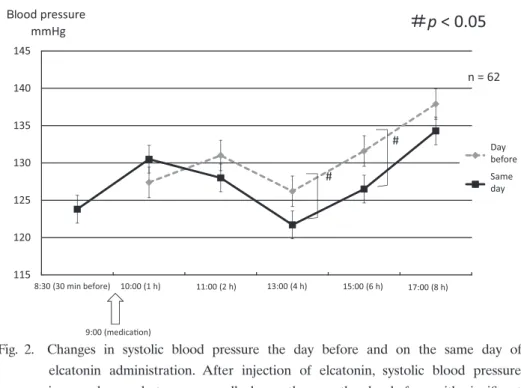
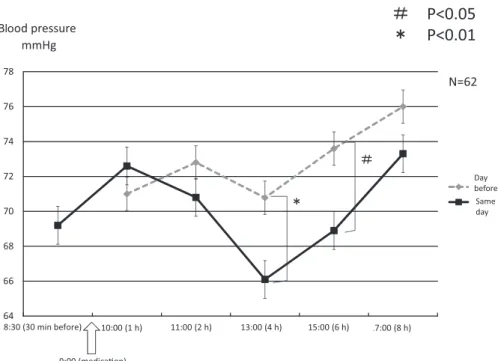
1)Abstract : We had found previously that calcitonin treatment (elcatonin once a week for 10 weeks) results in significant decreases in blood pressure. The aim of the present study was to determine whether these effects were due to a cumulative effect of elcatonin or could be elicited by treatment with a single dose. To this end, we recruited 62 patients (eight men, 54 women ; mean age 83 years ; range 67–101 years) with a chief complaint of lower back pain to the present study and examined changes in blood pressure following administration of the first dose of elcatonin. All subjects in the study had been hospitalized either at our institution or an affiliated hospital. After acute phase symptoms had settled, subjects received 1 U (1 mL) , i.m., elcatonin S20. Blood pressure was measured the day before the first scheduled treatment and on the day of treatment. Both systolic and diastolic blood pressure decreased from 2 h after administration, and dropped significantly 4 and 6 h after administration. Therefore, elcatonin decreased blood pressure without first having to be accumulated in the body. There are several possible explanations for the results, including effects mediated by changes in concentrations of calcitonin gene-related peptide and calcium ions, as well as involvement of the parasympathetic nervous system. In conclusion, calcitonin inhibits bone resorption and pain, lowers blood pressure, and is easy to use in elderly patients who exhibit age-related increases in blood pressure.
Key words : calcitonin, osteoporosis, blood pressure, elcatonin, blood flow
Introduction
Elcatonin is a calcitonin derivative that has an inhibitory effect on osteoporosis-related pain that is mediated via the serotonergic system
1, 2). In addition, it has been reported that elcatonin increases skin temperature
3)and blood flow
4), improves brachial-ankle pulse wave velocity, and decreases blood pressure
5, 6). Tissue blood flow improved significantly in individuals with decreased blood flow after the administration of elcatonin, and elcatonin has a significant hypotensive effect in patients with high compared with low blood pressure
6)(Fig. 1) . Generally, calcitonin is the only hormone that has been shown to lower serum calcium levels in vivo and to decrease high blood pressure and improve blood flow. In a previous study
6), we found that Original
1)
Department of Orthopaedic Surgery, Showa University School of Medicine, 1–5-8 Hatanodai, Shinagawa-ku, Tokyo 142-8666, Japan.
2)