
九州大学学術情報リポジトリ
Kyushu University Institutional Repository
木材細胞壁を構成するポリマー間の相溶性
重松, 幹二
九州大学農学研究科林産学専攻
https://doi.org/10.11501/3086537
出版情報:Kyushu University, 1991, 博士(農学), 課程博士 バージョン:
権利関係:
Chapter 3
Vapor Pressure Osmometry Studies on Solution Properties of Hemicellulose, Lignin and Their Mixture
3.1 Introduction
In Chapter 1 and 2, the adhesion and miscibility between
polysaccharides and lignin were described. Particularly, Flory polymer
polymer interaction parameter between hemicellulose and lignin (Xlz) was observed in Chapter 2. This result shows the X12 is positive and decreases with lignin content and temperature. The temperature dependence, however, is determined at above 140 · C, because the miscibility was not observed below it. This chapter deals to solution properties of hemicellulose and lignin in dimethylsulphoxide (DMSO) in the temperature range of 60 - 90 · C.
Moreover, the temperature dependence of X12 in this temperature region was evaluated.
There are several methods for measurement of X1z, such as osmotic
pressure [77] or small-angle neutron scattering [78]. In this research, the solution properties of solutions of woody polymer were investigated by a vapor pressure osmometric (VPO) measurement. First, activities were measured for polymer-sol vent solutions, from which we derived the
interaction between polymer and solvent. Secondly, activities were measured for polymer-polymer-solvent solutions and thus we were able to obtain the excess interaction of the ternary solution over the binary solution. This excess interaction corresponds to the interaction between polymer and
-91-
Chapter 3 polymer and is quantitatively expressed by Flory polymer-polymer interaction
parameter, X12·
There are many solvent for lignin, e. g., pyridine, DMF, DMSO and
dioxane etc. [79]. However, hemicellulose have a little solvent, e.g., NaOH aq. and DMSO. Hence, if we want to know the interaction between these
polymers by VPO in solutions, only DMSO is useful for measurement.
-92-
3.2 Experimental
3.2.1
Materials
Hemicellulose and lignin were prepared from wood meal of beech
(Fagus crenata
Bl.) in the same manner as described previously (Section1.2.1).
Dimethylsulfoxide (DMSO) used as a solvent was purchased from Wako Pure Chemical Industries, Ltd. (Japan) and used without further purification.
Solutions were mixed and stored at room temperature for one week.
3.2.2
Molecular weight
The number average molecular weight
(Mn)
was evaluated in DMSO at60
· C by using a vapor pressure osmometer (VPO) made by Knauer Co., Ltd.(Germany). The concentration range was
0.1 -0.5 g/g.
Mn is obtained
by plotting tlR/C vs. C and dividing K1 by the ordinate intercept; �R (D) is the resistance difference of the two thermistors placed in the drops of solution and solvent, K1 (g/mol·D) is the calibration constant determined by using benzil (M.W.=240) as a standard, and C (g/g) is the concentration of solution.The viscosity average molecular weight
(Mv)
for hemicellulose and lignin were calculated from the intrinsic viscosity in DMSO and in pyridineat 2
5
· C, respectively. The viscosity-molecular weight relationship used are[r;]
[r;]
5.9xlo-3DP w
0•940.0135Mw0•175
for hemicellulose [37], for lignin [38],
where [r;] (dl/g) is intrinsic viscosity,
DPw
is degree of polymerization based on the weight-average molecular weight,Mw.
-93-
Chapter 3 3.2.3 Measurement of Activity
The activity of solvent (ao) in solution was evaluated from
ln a.0 = - 6-R/Kz by using a VPO, where Kz (mol/mol·O) is the calibration constant determined in the same manner as K1. Values of ao were measured at 60 - 90 · C and 0.1 - 0.5 g/g.
-94-
3.3 Results and Discussion
3.3.1 Thermodynamic parameters of dilution
The free energy of dilution (�Go) is calculated from the activity of solvent in solution (ao) by
RT ln ao, (3-1)
where R is the gas constant and T is the absolute temperature.
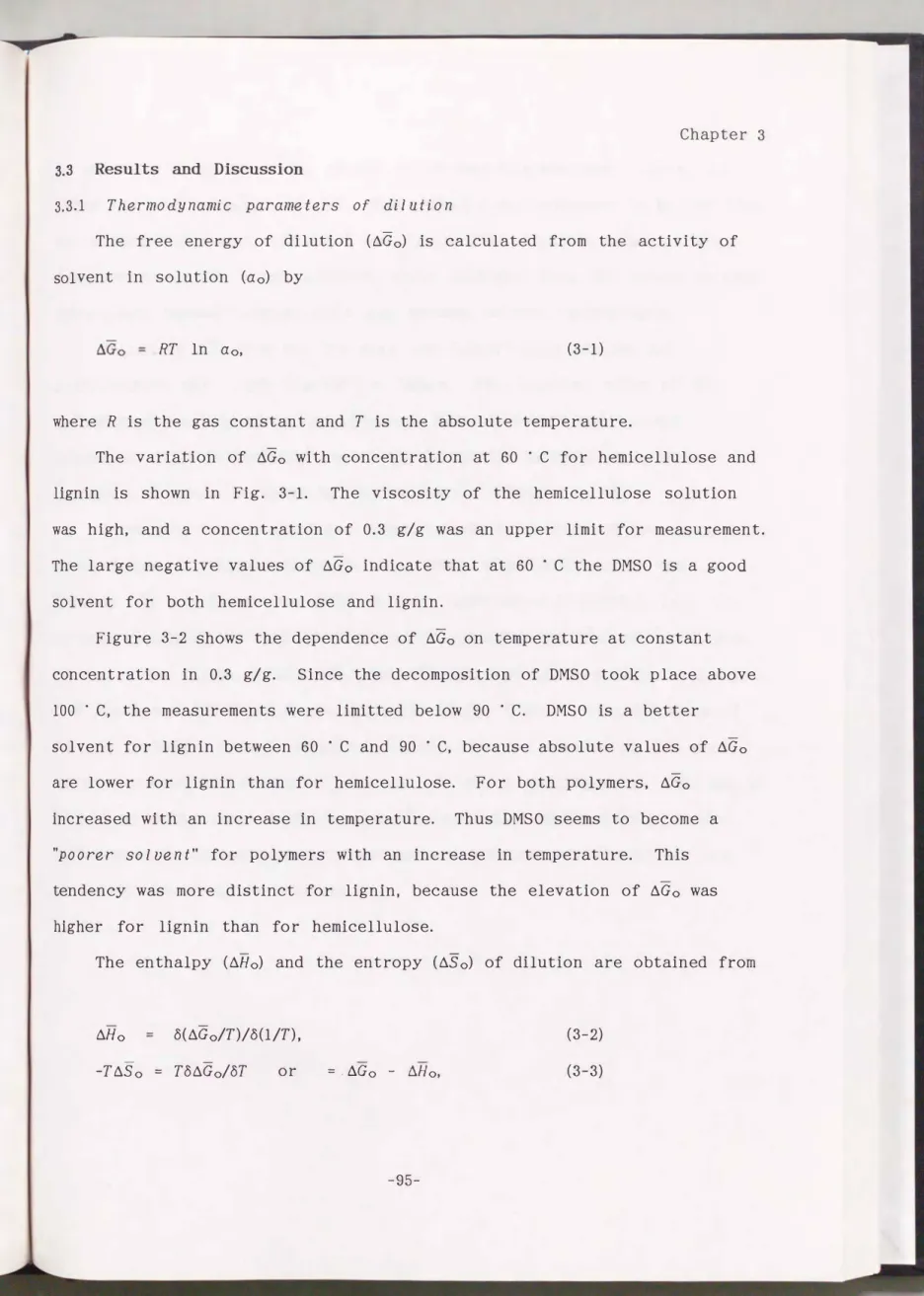
The variation of �Go with concentration at 60 • C for hemicellulose and lignin is shown in Fig. 3-1. The viscosity of the hemicellulose solution was high, and a concentration of 0.3 g/g was an upper limit for measurement.
The large negative values of �Go indicate that at 60 • C the DMSO is a good solvent for both hemicellulose and lignin.
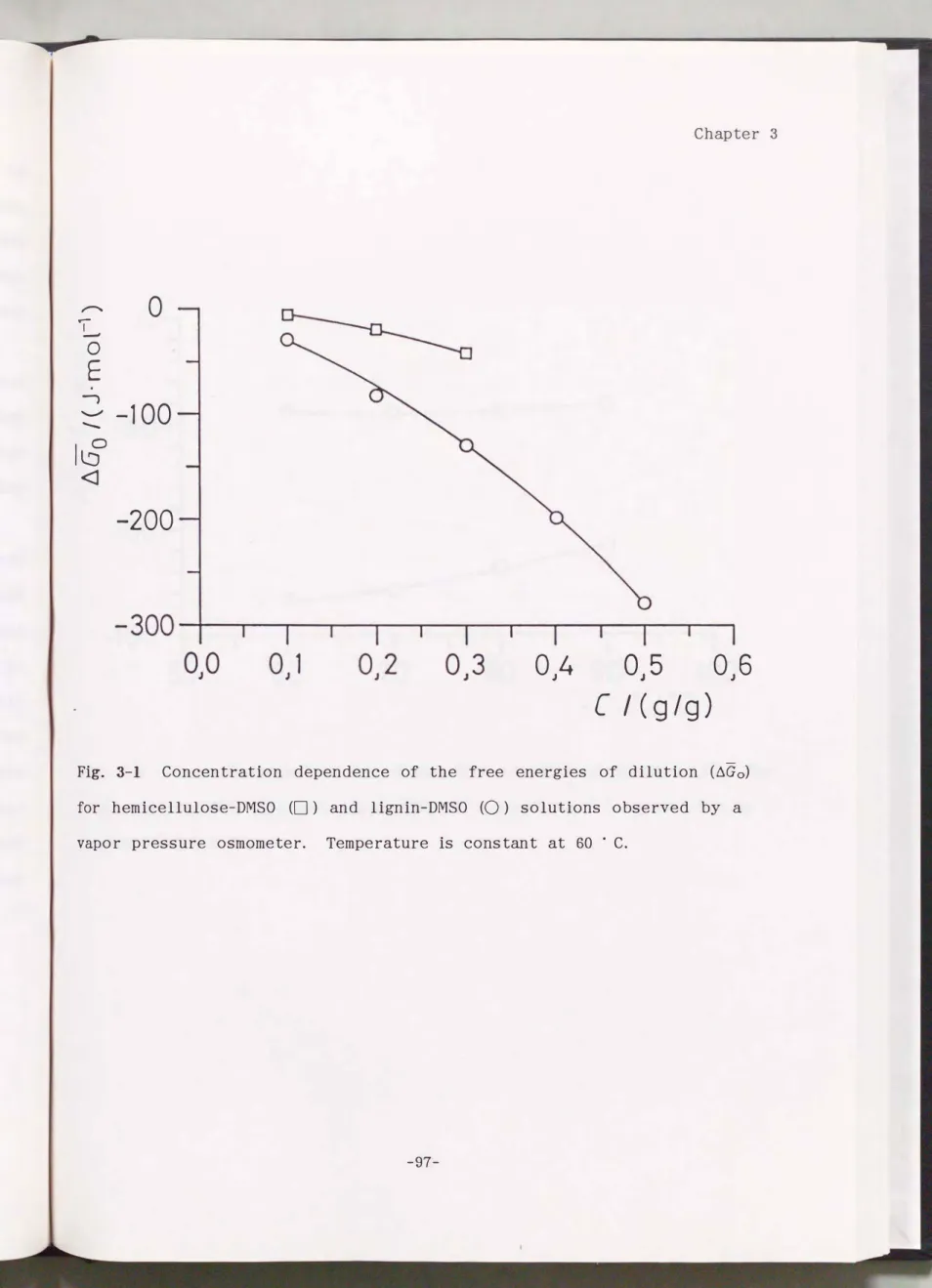
Figure
3-2
shows the dependence of �Go on temperature at constant concentration in 0.3 g/g. Since the decomposition of DMSO took place above100 · C, the measurements were limitted below 90 · C. DMSO is a better solvent for lignin between 60 · C and 90 · C, because absolute values of �Go are lower for lignin than for hemicellulose. For both polymers, �Go
increased with an increase in temperature. Thus DMSO seems to become a
"poorer sol vent" for polymers with an increase in temperature. This tendency was more distinct for lignin, because the elevation of �Go was higher for lignin than for hemicellulose.
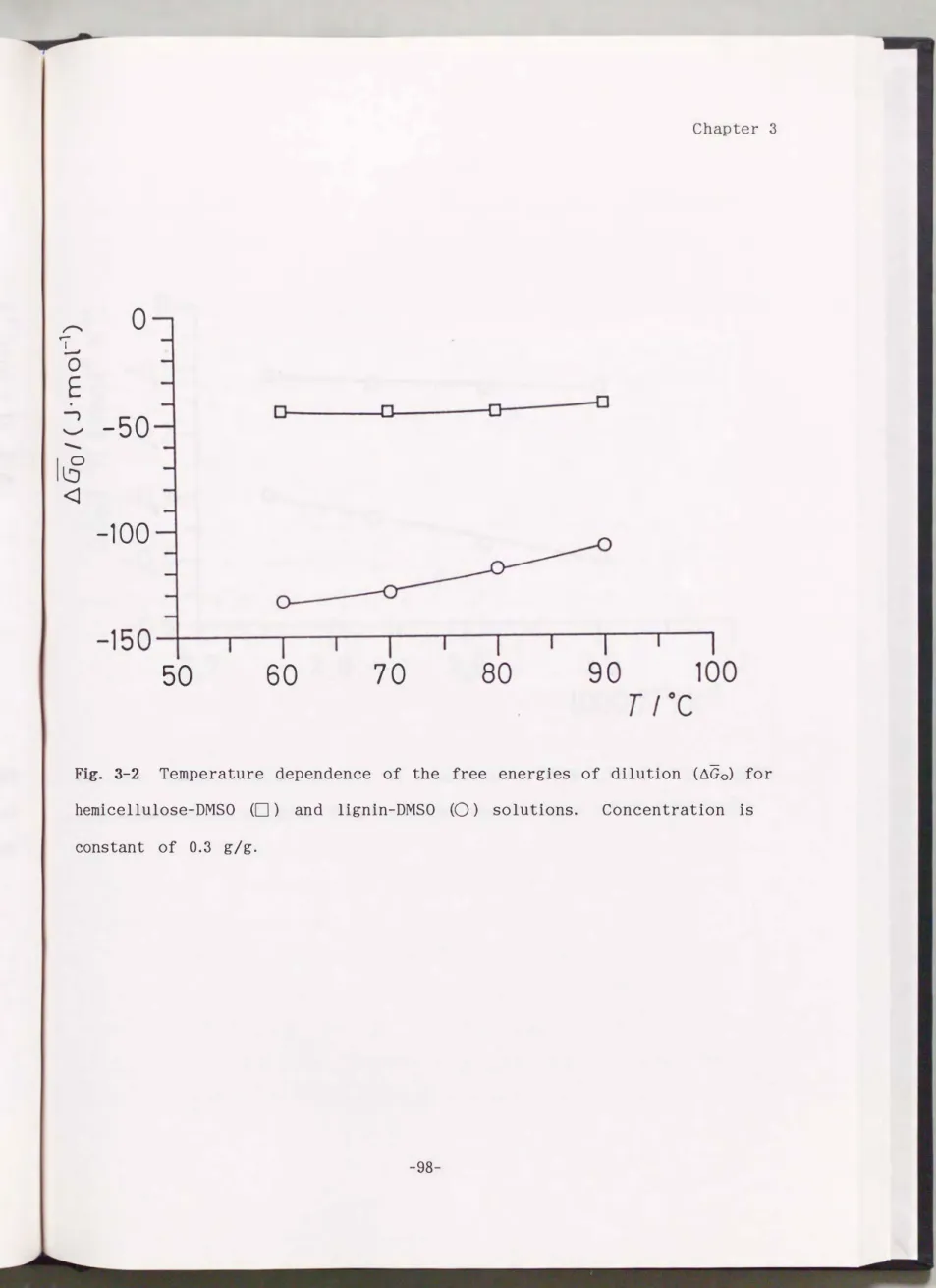
The enthalpy (�Ho) and the entropy (�So) of dilution are obtained from
�Ho o(�Go/T)/o(1/T),
-T�So = To�Go/oT or =.�Go - tlHo,
-95-
(3-2)
(3-3)
Chapter 3 bY substitution of the value of
r.':lGo
at various temperatures. Figure 3-3 shows the plot of r.':lGo
/T vs. 1/T. The enthalpy was estimated to be -76 J/mol for hemicellulose and-420
J/mol for lignin. The negative value ofr.':lH0
corresponds to exothermic dilution, which indicates that the solute-solvent interaction exceed solute-solute and solvent-solvent interactions.
Values of
r.':lSo
from Eq. 3-3 were low, being-0.092
J/mol·K for hemicellulose and-0.855
J/mol·K for lignin. The negative value ofr.':lSo
indicates a small decrease in randomness between solute and solvent molecules. This is probably caused by the strong interaction between solvent and solute as shown by the substantial changes in
!:lHo.
Brown
[80]
has obtained the thermodynamic parameters of the solution of kraft lignin in various solvents, e. g., DMSO, dimethylformamide and1,4-
dioxane. It was found that DMSO was the "best solvent" since it gave the largest negative value of
r.':lGo
(and, as discussed later, the smallest value ofXo2).
The values of!:lGo, r.':lHo,
andr.':lSo
measured by Brown were-105
J/mol, 71.6 J/mol and 177 J/mol·K, respectively, at52
· C and a concentration of0.3 g/g in DMSO. Brown's value of
r.':lGo
and mine are consistent with each other; however, the results ofr.':lHo
andr.':lSo
differ considerably. This may be caused by differences in the method of preparation of the lignin, and/or differences in the moisture content; present samples were absolutely dry while his contained2%
moisture.-96-
�
0
...-I .--J
0
E
--,
-100
..._, ..._
IL5 <l
-200
OJ4 OJ5 OJ6 [ /(g/g)
Fig. 3-1 Concentration dependence of the free energies of dilution
(.1Go)
for hemicellulose-DMSO (0) and lignin-DMSO (0) solutions observed by a vapor pressure osmometer. Temperature is constant at 60 · C.
-97-
Chapter
3�
0
..-__, I
0
E
. 0 D o- -0
I
-._;
-50
..._
18 <l
-100
50 60 70 80
Fig. 3-2
Temperature dependence of the free energies of dilution CL\Go) for hemicellulose-DMSO CD) and lignin-DMSO CO) solutions. Concentration is constant of
0.3g/g.
-98-
,-...
0
r-
�
"'
-
0 1
D--
0
J 0 0 0E
--, -
0
J2
� -...
I
I� <] -0.3
-04
J
-05 J
2J7 2J8 2J9 3 JO 3J 1
1 ooo· r-1, K-1
Fig. 3-3
Plots of D.Go/T vs. 1/T of hemicellulose-DMSO (0) and lignin-DMSO (0) solutions at
0.3g/g. Slope denotes the enthalpy of dilution (D.Ho).
-99-
Chapter 3 3.3.2 Interaction parameters between solvent and solute
The Flory interaction parameter between solvent and solute segments (Xod is obtained from Eq. 3-4 [24],
-ln ao (3-4)
where ao is the activity, Vo and v1 are volume fraction of solvent and polymer, respectively, and m1 a molecular chain length of polymer as shown
in Table 1-1. The value of Xo1 is a measure of the interaction of the solvent with a segment of polymer equivalent to the size of the solvent molecule. A positive value of Xo1 indicates a repulsive force, and a
negative value, an attractive one. Here, Vo and V1 were calculated with the assumption of additivity of volume; vi=(llh/Pl)/(wo!Po+wl/Pi) and Vo=1-vi where the llh is mass fraction of i-th polymer.
The following definition of Xo1 is sometimes preferred,
AVo/RT, (3-5)
where A is constant and represents the interaction energy density
characteristic of the sol vent-solute pair. If the constant A is essentially independent of concentration and temperature, Xo1 is proportional to 1/T and independent of concentration.
According to the theory of Flory and Huggins, equation 3-4 is valid for linear polymers. There is no equivalent theory for branched polymers. The hemicellulose is slightly branched. Lignin is believed to be branched and to have a three-dimensional structure [36]. Therefore application of the Flory-Huggins theory to present system will not be rigorously correct.
-100-
However the errors involved for the low-molecular-weights substances in the present works can be expected to be small. Also we are considering the variation of Xo1 with temperature rather than absolute values of Xo1• Thus
the use of the theory for linear molecules is justified.
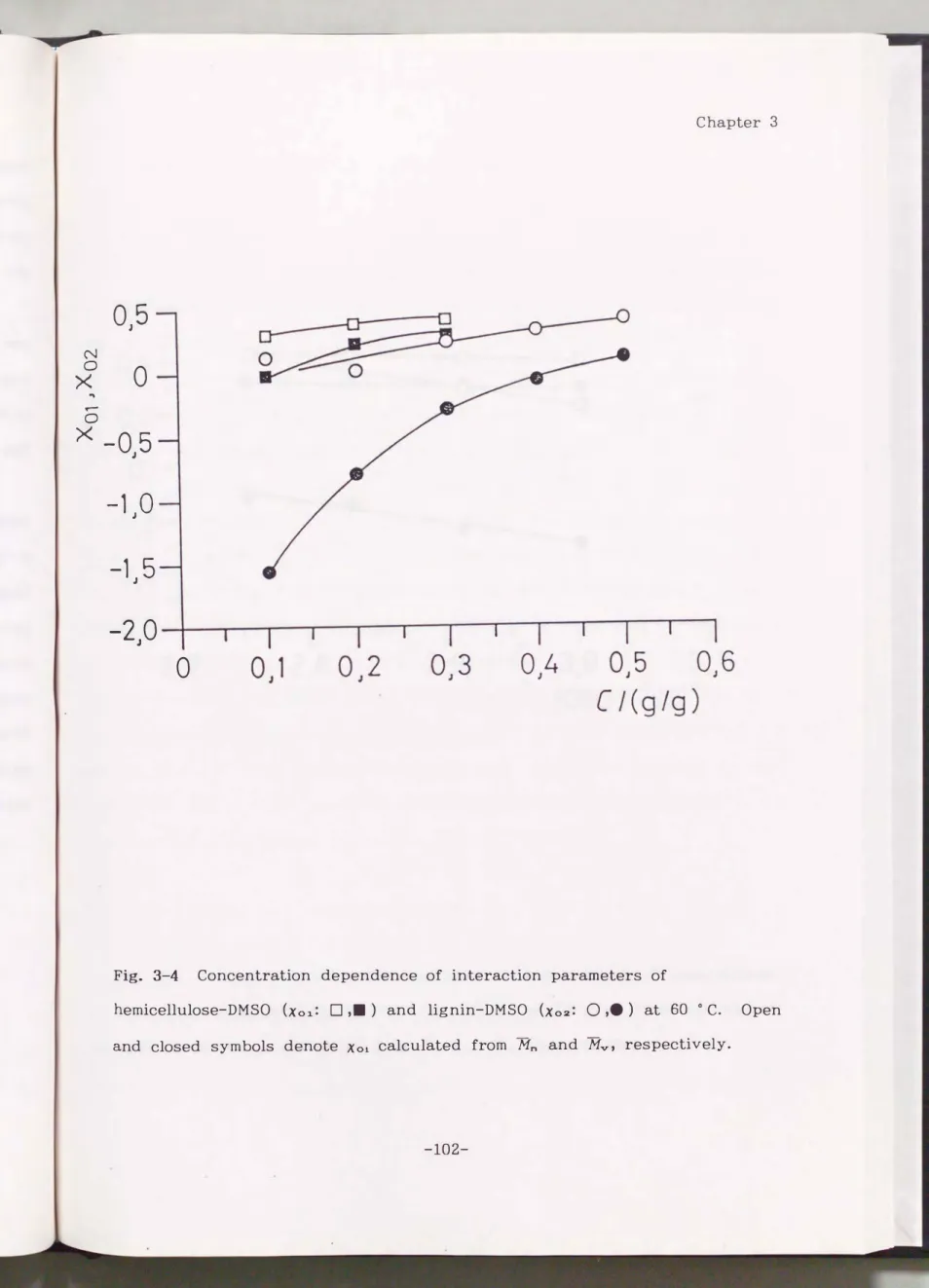
The values of Xo1 for various lignin and hemicellulose concentrations are shown in Fig. 3-4. Both Xo1 and Xo2 increased with an increase of concentration and approached to the value of 0.5 which is limit of
theoretical value and corresponds to the occurrence of phase separation.
The trend for lignin is consistent with the data published by Brown [80].
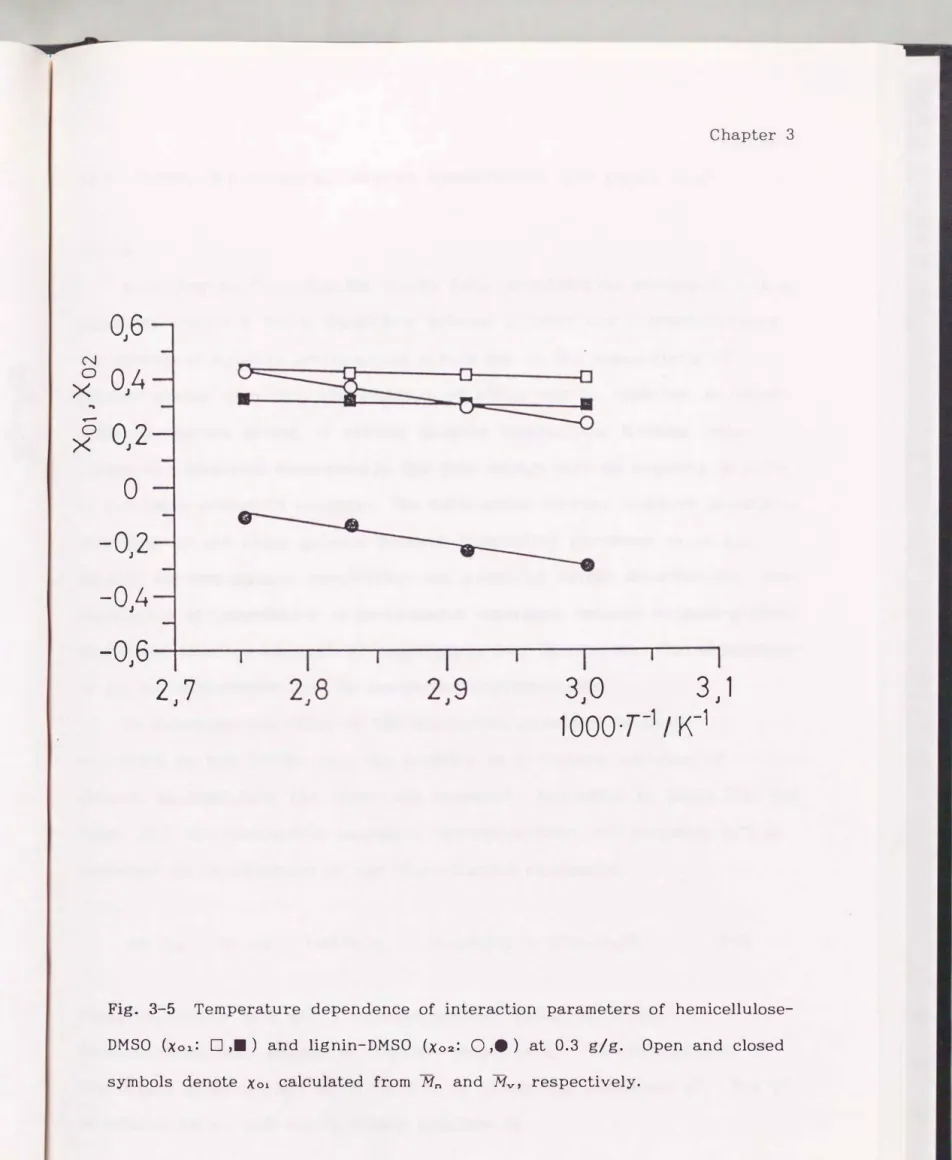
As shown in Fig. 3-5, both Xo1 and Xo2 increased with an increase in temperature and were proportional to 1/T. It is apparent that DMSO becomes a "poorer solvent" for both hemicellulose and lignin with an increase in temperature. This result is consistent with data for the thermodynamic parameters of dilution in the previous section. Furthermore, the
proportionality to 1/T for both polymers agrees with Eq. 3-5. From the slope of the lines in Fig. 3-5, values of A were calculated to be -11.7 J/cm3 for hemicellulose and -90.6 J/cm3 for lignin calculated with Mn for molecular weight, and -12.3 J /cm3 and -90.3 J /cm3 with
Mv.
Thus, the A values were the same for different molecular weight averages.-101-
Chapter 3
OJ5
N 0
0
><
"\
....-
0
>< -0 5
J
-
1
J0
-1 5
J
-2 0
J0
Fig. 3-4 Concentration dependence of interaction parameters of
hemicellulose-DMSO (xo1: D
,
. ) and lignin-DMSO (xo2: 0,e)
at 60 a C. Open and closed symbols denote Xo1 calculated from Mn and Mv, respectively.-102-
0 N
><
� -
0
><
OJ6 OJ4 OJ2
0 -0 2
J
-04
J
-0 6 J
2J7 3 Jo 3 J 1
1000·T-1 I K-1
Fig. 3-5 Temperature dependence of interaction parameters of hemicellulose- DMSO (xo1: 0
,
. ) and lignin-DMSO (xo2: 0,e)
at 0.3 g/g. Open and closed symbols denote Xo1 calculated from Mn and Mv, respectively.-103-
Chapter 3 3.3.3 Interaction parameter between hemicellulose and lignin (Xz2)
Theory
According to Flory-Huggins theory [24], combinatorial entropy is not an
important criterion for a miscibility between polymer and polymer, because the number of possible arrangements reduce due to the connectivity of polymer chains. However, the enthalpy of mixing can be negative, in other words exothermic mixing, if certain specific interactions between polar groups are involved; consequently the free energy will be negative in spite of the small change in entropy. The interaction between polymers is usually
described by the Flory polymer-polymer interaction parameter CX12); X12 depends on temperature, composition and molecular weight distribution. The dependence of temperature is particularly important, because polymer-polymer miscibility is often changed by temperature (see Chapter 2). The dependence
of X12 on temperature must be determined experimentally.
To determine the value of the interaction parameter between hemicellulose and lignin, X12, the activity in a ternary solution of
solvent, hemicellulose and lignin was measured. According to Scott [70] and Tompa [71], the interaction parameter between solvent and polymers (x*) is described by an extension of the Flory-Huggins expression,
-ln ao (3-6)
where subscripts 0, 1 and 2 indicate solvent (DMSO), polymer-1
(hemicellulose) and polymer-2 (lignin), respectively. By substitution of the values of ao, v1 and m1 in Eq. 3-6, we obtain the parameter x*. The x*
is related to Xo1 and Xo2 in binary solution by
-104-
x* (3-7)
and
(3-8)
where
�
is the volume fraction of polymer-2 for polymers. Like the FloryHuggins theory, Eq.
3-7
is not valid at low concentrations; therefore the following discussion is for data obtained at a concentration of0.3
g/g.Interaction parameter between hemicellulose and lignin
The temperature dependence of
x*
at�=0.505
calculated from Mn and Mv are shown in Fig.3-6
(a) and (b), respectively. These figures include the data ofXo1
andXoz
previously expressed in Fig.3-5.
Evidently, the change ofx*
is not linear to1/T.
This observation cannot be expressed by Eq.3-
5, whereas the temperature dependence ofXo1
andXo2
agrees with Eq.3-5.
The interaction parameter between polymers
(x12)
was estimated from Eq.3-7 by mi based on each
Mn
andMv.
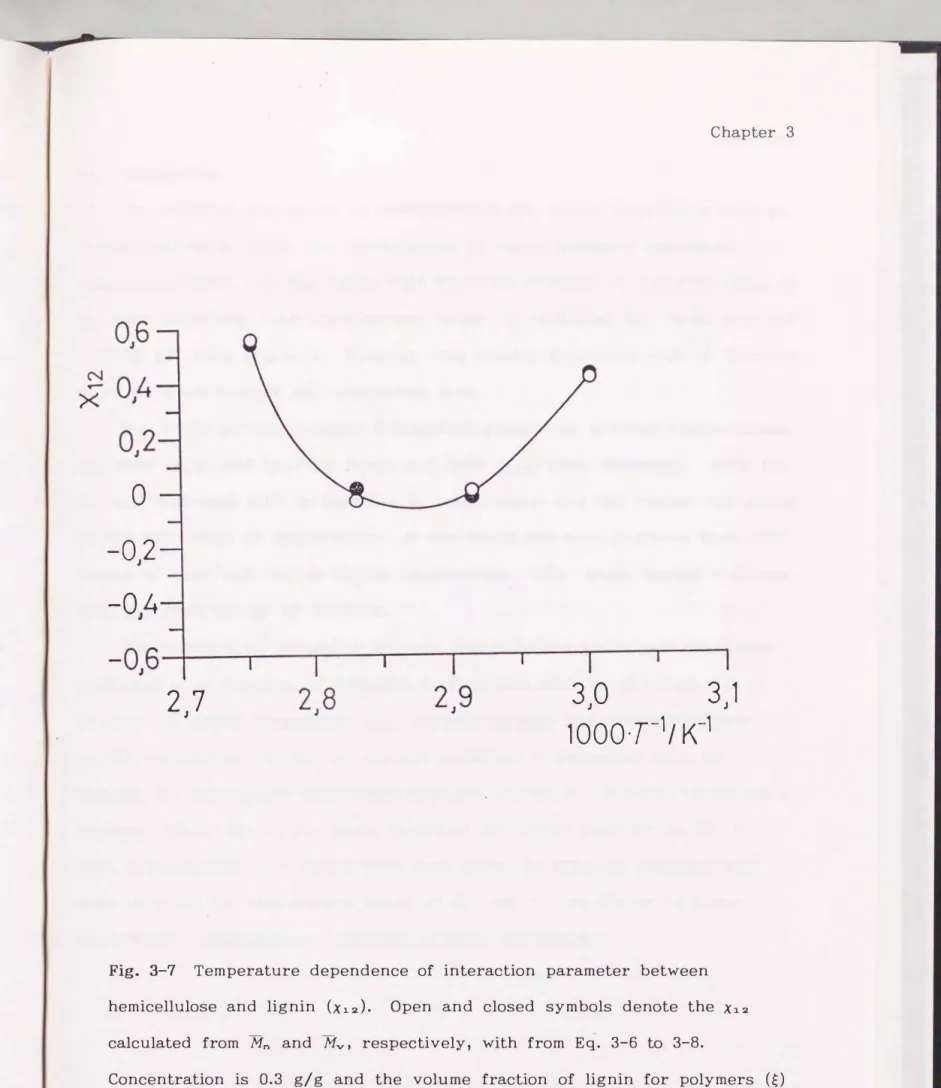
The results are shown in Fig.3-7.
For the two molecular weight averages, both the absolute values and the trendsin
X12
are identical. The value ofX12
varied widely from-0.036
to0.551
for a narrow change of temperature. As shown in Fig.3-7,
there is a pronounced minimum inX12
at around70 80
· C at which temperature theinteraction parameter is negative. On either side of the minimum,
X12
becomes positive. This indicates a net attractive force between lignin and hemicellulose in DMSO at70 - 80
· C, while at higher and lower temperatures repulsion forces predominate.Dambis e t al.
[5]
have calculated the isotherm solubility parameters(o)
of the three main cell wall components of wood with and without due account for hydrogen bonding. They have shown that o with hydrogen bonding-105-
Chapter 3 was 12.6 (cal/cm3)1/2 for 0-acetyl-4-0-methylglucuronoxylan, and 10.1 - 11.3 (cal/cm3)1/2 for lignin. It was also found that the 8 value of the
hemicellulose was decreased with increase of content of acetyl groups in the molecule. The 8 values for hemicellulose and lignin was close; this was unexpected because of differences in their molecular structures. Therefore, the authors have suggested that the lignin and hemicellulose may be
partially miscible in domains where the content of acetyl groups is higher than average. By substitution of the values of 8 in X1z=�' o/RT(81-82)2, X12 is calculated to be 0.048 - 0.179 at 25 · C. This positive value is in
general agreement with the present result. However, there is no information on temperature dependence from their results.
In most polymer systems, the X12 decrease with an increase in
temperature. In the present work the behavior of hemicellulose and lignin between 60 · C and 70 · C agrees with this trend. However above 70 · C, X12 goes through a minimum and then increases. This apparently anomalous
behavior may be due to the hydrogen bonding. Remko and Polcin [81] studied the interaction between hemicellulose and lignin by using the 'Perturbative Configuration Interaction using Localized Orbitals' method for model
complexes. They postulated that stable complexes exist, with the carboxyl group acting as a proton donor. If so, X12 would increase with temperature, because the strength of hydrogen bonding is decreased by increase in
temperature. Therefore, it may be that the minimum in X12 shown in Fig. 3-7 is the result of competition between normal decreasing trend given by Eq. 3-
5 and an increase caused by the weakening of the hydrogen bonding with an increase in temperature.
Miscibility for polymer-polymer blends is expected when X12 is negative
or very small. Usually X12 decreases slightly with an increase in
-106-
temperature for mixtures near the upper critical solution temperature (UCST). In contrast, the parameter slightly increases near the lower critical solution temperature (LCST). If X12 goes through a minimum with temperature, the blends have a phase diagram of UCST+LCST or the hourglass type. From the results shown in Fig. 3-7, binary blends of hemicellulose and lignin are predicted to be miscible at 70 - 80 · C and to have UCST+LCST or hourglass type of phase diagrams. However, this behavior cannot be demonstrated experimentally because of the high glass transition
temperatures of the woody polymers; as shown in Chapter 2, Tg values for hemicellulose and lignin are 210 · C and 131 · C, respectively. At above 90
· C, hemicellulose and lignin were found to be immiscible in attempts to cast blends in to film. This result agrees with the trends in x 12 shown in Fig.
3-7.
-107-
-
·-
OJ6
Chapter 30
><
� �
OJ5
><
OJ4 OJ3 OJ2 OJ 1
0 (a)
2 7 J 28 J 2J9 3JO
1 000· T-1 I K-1
·-06 o J
X
� ...
QJ4
X
II II • •OJ2 0 -02 J -04
J(b)
-
0 6 J
27 28 2 9 30
J J
J J1 OOO·T-1/ K-1
Fig. 3-6 Temperature dependence of interaction parameters between solvent- polymers (x*: D.
,.A)
calculated from (a) Mn and (b) Mv. The data for Xo1 and Xo2 in Fig. 3-5 are included.-108-
0
-02
J-04
J-06-L--����--�--��r-�--�
J2J7 3 Jo 3 J 1
lOOO·T-1/ K-1
Fig. 3-7 Temperature dependence of interaction parameter between hemicellulose and lignin (X12). Open and closed symbols denote the X12 calculated from Mn and Mv, respectively, with from Eq. 3-6 to 3-8.
Concentration is 0.3 g/ g and the volume fraction of lignin for polymers (�) is 0.505.
-109-
Chapter 3 3.4 Conclusion
The solution properties of hemicellulose and lignin from beech wood in dimethylsulfoxide
(DMSO)
was investigated by vapor pressure osmometricmeasurement
(VPO).
It was found that the free energies of dilution(L�G0)
of the both solutions were negative and large. It indicates the "good solvent"of
DMSO
for both polymers. However, this quality decreased with an increase in temperature because�Go
approaches zero.The Flory polymer-polymer interaction parameters between hemicellulose and
DMSO (Xo1),
and between lignin andDMSO (Xoz)
were evaluated. BothXo1
and
Xoz
increased with an increase in temperature, and the change was linear to the reciprocal of temperature. It was found for both polymers thatDMSO
become a "poor solvent" at higher temperature. This result agreed with one from the free energy of dilution.
The interaction parameter between hemicellulose and lignin
(X1z)
was evaluated as a function of temperature from the activity of solvent in a solution of three components; i.e., solvent-polymer and solvent-polymerpolymer solutions. At 60 · C,
X12
was positive; it decreased with anincrease in temperature and became negative at 70 - 80 · C where there was a minimum. Above 80 · C,
X1z
again increased to become positive at 90 · C.Thus, hemicellulose and lignin have been shown to interact strongly with each other in the temperature range of 70 - 80 · C. At higher or lower temperature, interpolymer repulsion exceeds attraction.
-110-
Chapter 4
Surface Tension Studies on Hemicellulose and Lignin Blends
4.1 Introduction
Most small-molecule organic liquids are mutually miscible and their mixtures do not form stable interfaces. Polymers are, however, usually immiscible and their mixtures form mul tiphase structures with stable interfaces. The dispersion, morphology, and adhesion of the component
phases are greatly affect by the interfacial energies, which thereby play an important role in determining the mechanical properties of a multiphase polymer blend. The behavior of phase-separated polymer systems is governed to a large extent by the interfacial properties
[82].
Surface tensions, interfacial tensions, and contact angles can be used as laboratory tools for the evaluation of the various intermolecular forces that determine cohesion in a single phase or adhesion between two dissimilar
materials at an interface. By the use of these tools, considerable
information about the magnitude of various intermolecular forces may become available
[ 82].
Despite its importance, reliable measurements of the interfacial tension between polymers
(y)
have not been reported until 1969 because of the experimental difficulty in handling highly viscous polymer melts. Ameasurement of
y
is very difficult, but some results have been reported. In these,y
of the mixture of two homopolymers was measured in meltingcondition by drop method
[83].
On the other hand, the surface tension of-111-
Chapter 4 solid polymer may also be evaluated indirectly from wettability data. Many methods have been proposed, for example, calculations are based on emprical or semiemprical relations between the surface tension and the contact angle
[84,85].
In Chapter 2, the miscibility between hemicellulose and lignin in bulk phase was evaluated by means of DSC, but information as to the surface states of the hemicellulose and lignin blends is not yet obtained. To examine the miscibility at the surface of the blend solid, the surface tension was investigated by measurements of contact angle of different liquids. First, the dependence of the critical surface tension on blending ratio was observed by using of Zisman plot. Next, the dispersion and polar contributing forces in surface tension and the surface tension of solid was estimated based on the Owens' equation. Further, the heterogeneity of surface examined by measurements of the advancing and receding contact angles on tilted plane.
-1 1 2-
4.2 Experimental 4.2.1 Materials
Hemicellulose and lignin were prepared from wood meal of beech (Fagus ere nata Bl.) as described in Chapter 1.
1,2-propanediol, 1,3-buthanediol and glycerol were reagent grade (Wako Pure Chemical Industries, Ltd., Japan) and used for wetting liquid. The surface tension values of the respective liquids were sited from literature [86]. The values of the dispersion and polar contributing forces of surface tension were estimated for these liquids by the measurement of contact angle on polytetrafluoroethylene solid [ 87].
4.2.2 Preparation of blend films
0.2 ml of 5 % sample solution in DMSO was spread on a thin cover glass for microscope. The solvent was removed by drying at 60 · C for 24 hours in vacuo.
4.2.3 Measurement of contact angle
There are several methods for the measurement of contact angles, but the most widely used method is to measure the angle of a drop resting on a solid surface with the aid of a microscope having an angle-measuring
eyepiece, as illustrated in Fig. 4-1. A drop of 5-15 tJl was placed on the sample film, and its contact angle was measured with a contact angle meter (Erma Model G-IlL Japan) at 25 · C and 5 min of waiting time. The data were obtained by averaging the results as ten or more measurements.
-113-
Chapter 4 4.3 Results and Discussion
4.3.1 Critical surface tension
Consulting the literature [84], the degree to which a liquid wets a
solid is measured by the contact angle (e). Figure 4-1 shows the schematic
I
diagram of liquid drop on solid surface and acting of surface tensions.
When e=O, the liquid spreads freely over the surface and is said to
completely wet it. Complete wetting occurs when the molecular attraction between the liquid and solid is greater than that between similar liquid molecules [88]. At incompletely wetting, the surface tensions are related to the contact angle by an expression from equilibrium considerations.
Ysv YsL + YLV cos e, (4-1)
where y sv = solid-vapor surface tension; y sL = solid-liquid surface tension;
and YLv = liquid-vapor surface tension. However, the liquid surface tension is little affected by the vapor phase, so that YLv � YL· The surface
tension of a solid that has adsorbed a layer of vapor, Ysv, is related to the surface tension of solid, y s, as y SV = y s - rr e• The 7r e is the reduction term of Ys resulting from vapor adsorbed on the solid surface. The value of spreading pressure, ne, in the above equations is very often zero, although there are a few systems in which ne must be taken into consideration.
A widely-used method for determining the surface tension of a solid was developed using contact angle measurements. It is well known the "Young's equation" [89]. A plot of cos e against the surface tension, YL, for
homologous series of liquids can be extrapolated to give a critical surface tension (Yc) at which cos e = 1. Any liquid with a surface tension less than y c completely wets the solid surface. The critical surface tension,
-114-
rc. has therefore been taken widely, but not exactly, as a measure of the surface free energy, y s, of the solid.
Figure 4-2 shows the typical examples called the Zisman plot [90,91];
YL is plotted against cos e for 1,2-propanediol, 1,3-butanediol and glycerol
on the surfaces of hemicellulose, lignin and their mixture (50:50). Since these liquids dissolve neither hemicellulose nor lignin, these liquids can be used for a contact angle measurement. Yc values obtained from the Zisman plots were 32.2 and 34.1 dyne/em for hemicellulose and lignin, respectively.
These values agreed with literatures [92,93]; Yc = 34 dyne/em for
hemicellulose, 36 dyne/em for some lignins. It is noted that the Yc values of hemicellulose and lignin are closed each other, although they are
different in chemical composition, especially hydrophobicity.
Figure 4-3 shows the Yc at various blending ratios. The values of Yc in the blends are found between those of hemicellulose and lignin and likely to have a linear relation. It indicates the surfaces of blends are similar at any blending ratio, while the miscibility in bulk phase apparently
depends on blending ratio (see Chapter 2).
It should be noted, however, that the precise value of Yc is generally dependent on the particular series of liquids used to determine it. A series of polar liquid, such as alcohols, will give a higher Yc than a series, such as simple hydrocarbons, which interacts less strongly with the same surface [94]. Moreover, the value of Yc is a measure of the
wettability for a series of liquids used, and Yc reflects complex
interaction parameters such as y sv, y sL and rr e in Eq. 4-1. So, there is less information about intermolecular interactions of blended polymers.
-115-
-
Chapter 4
Vapor
Liquid
Solid
Fig. 4-1 Schematic diagram of liquid drop on solid surface and acting of surface tensions.
Ysv: solid-vapor surface tension.
YsL: solid-liquid surface tension.
YLv: liquid-vapor surface tension.
e : contact angle.
-116-
Table 4-1 Surface tension of used liquids.
1,2-propanediol 1,3-butanediol glycerol
Surface tension (dyne/em)
36.5 37.8 63.0
24.5 22.6 37.4
12.0 15.2 26.0
YL : surface tension of liquid [86].
YLd: dispersion force contribution to YL ·
YLP: polar force contribution to YL ·
-117-
Chapter 4
CD (/) 0 u
Chapter
4Surface Tension of liquid (dyne/em)
30 40 50 60 70
(a) 0.5
0
1 �--���---
0.5
(b)
0
1
t.---='::>o...c-1' \---0.5
0
Fig. 4-2
Zisman plots for (a) hemicellulose, (b) mixture (50:50) and (c) lignin.
-118-
50
40
-0 0 0 0 0
E
_()
u
0
-...
(])
30 - 0 0
c >.
""0
u
:>-
20
-10 -
0 I I I I
0 0.2 0.4 0.6 0.8 1
Content of Lignin
Fig. 4-3 Yc of hemicellulose and lignin blends obtained by Zisman plots.
-119-
Chapter 4 4.3.2 Surface tension of solid (Ys)
In the case of the surface tension of a liquid, e. g. water, the surface tension can be considered the sum of a contribution resulting from
dispersion forces (yd) and a contribution resulting from the polar interactions (yP), mainly hydrogen bonds:
(4-2)
Since interactions in saturated hydrocarbons involve only dispersion forces and these materials interact with other materials almost exclusively by dispersion force interactions, these become good primary standards for determining the magnitude of yd contributions in more complex liquids and solids.
At the interface between a liquid and a solid, if the liquid and solid interact with dispersion forces only, the following expression has been derived by Fowkes [84],
YsL (4-3)
However in the present study, hemicellulose and lignin have some hydroxyl groups; this implies that not only dispersion forces but also polar
contributing forces should be taken into account.
Girifalco et al. [95], Rata et al. [87,96] and Owens et al. [97] have shown an expression of the surface tension of solid involving both
dispersion and polar forces by expanding the Fowkes' equation, as follows
YLv (1 + cos e)
-120-
(4-4)
where
Ysv Ysd + YsP � Ys, YL d + YL p � YL·
(4-5) (4-6)
Equation 4-4 shows that if we measure the contact angles of two or more liquids whose YL v, YL d and YL p are already known on a given solid surface, the dispersion force contribution to surface tension, Ysd, and the polar force contribution, YsP, are able to be determined for the solid surface.
If we obtain the Ysd and Ysp of the polymer surface, Ys is determinable from the relation Ys = Ysct + Ysp (Eq. 4-5).
The pair of water and methylene iodide are usually used as wetting liquids to obtain Ysd and Ysp. Nevertheless in the present study, water is not applicable because water causes swelling of hemicellulose. Moreover, methylene iodide is not usuable; Ray et al. suggested that there exists some
specific affinity of iodide for OH groups [98]. Instead of water and methylene iodide, therefore, 1,2-propanediol and 1,3-butanediol were
employed for the present work. The YLd and YLP values of diols are listed in Table 4.1.
For each wetting liquid, the known YL value and the observed e value at each mixing ratio of blend were substituted into the left hand side of Eq.
4-4, while the known values of YL d and YLP are substituted into the right hand side. Thus, we could solve two simultaneous equations in two unknowns,
Ysct and Ysp, at each mixing ratios. Figure 4-4 shows the Ysd, Ysp and Ys of the blend surface of hemicellulose and lignin as a function of mixing ratio.
In the figure, open circles and open squares denote Ysd and Ysp,
respectively, and filled circles denote y s which is sum of y s d and y s P.
-121-
Chapter 4 Looking at the data of homopolymers, Ysp of hemicellulose is larger
than that of lignin, while Ysct is contrast. The larger Ysp for
hemicellulose indicates that the hydrophilicity of hemicellulose is stronger than that of lignin, on the other hand lignin has larger y s ct, this means the stronger hydrophobicity of lignin. And also, Figure 4-4 indicates that the total surface tension of solid, Ys, is independent of blending ratio or may be in agreement with the linear relation within experimental error. The scattering of Ysct and Ysp may result from the history of samples examined, i.e., the measured points depend on the preparation process, or especially on the duration after the blend treatment. As to Ys, the trend to the change with blending ratio seems similar to that of Yc. This similarity is represented by the knowledge that the Ys is nearly equal to Yc. However, the absolute values of Ys are larger than Yc.
-1 22-
50
E
'Ys
u
40
'-..
•
Q)
• •
c
>.
•
u
• 0 • 0
• •
c 0
·�
(J)
30
c Q)
1-
0
Q)
0
0 u
4-L ::::J
20 0
8
(/)
10
0
D 0 0
0 0 0.2 0.4 0.6 0.8 1
Content of Lignin
Fig. 4-4 Dispersion force
(Ysd),
polar force(Ysp)
and total surface tension(
ys)
of blends of hemicellulose and lignin.-123-
Chapter 4 4.3.3 Dynamic contact angles
It is found that for a given liquid-solid system, a number of stable angles can be measured. Two relatively reproducible angles are the largest and the smallest. These are called an advancing angle (ea) and a receding angle (er), respectively. The difference, ea - er, is called the
"hysteresis" [85].
Concept of dynamic contact angle
The forces exerted by the solid on the liquid can be active or passive.
Active forces are those which cause the liquid to spread. Passive forces are those which resist movement of the drop periphery. They behave formally
as a frictional force. For example, if liquid is removed from a drop which
initially has an angle greater than er, the periphery will not move
(macroscopically), but the angle will decrease. As the angle decreases, the force exerted on the liquid increases just enough to prevent the periphery from moving. Its effect is clearly seen with a liquid drop on a tilted plate (Fig. 4-5). The drop in the upper position (solid line) is in a higher energy state than in the lower position (dotted line). Since the drop is stable in the upper position, there must be energy barriers
preventing its movement. The force on the drop due to gravity is mg ·sin a., where m is the mass of the drop and a. is the tilt angle. This body force must be balanced by the surface forces around the periphery. Rosano [99]
and Furmidge [100] have shown the situations by the equation,
mg · sina. (4-8)
where w is the width of the drop, eA refers to the contact angle at the
-124-
leading edge, and eR the angle at the rear. If a is not at its maximum value, the plate can be til ted still further and the drop will remain
stationary. The force from gravity will increase by mg ·�sin a. The contact angle eA and eR will adjust themselves to compensate for this force
increase. When they become the advancing and receding angles, respectively, the drop will no longer be able to adjust itself and will roll off the
plate. If there were no hysteresis, the drop would roll off at the slightest tilt of the plate.
If a surface is rough, the apparent (macroscopic) contact angles
measured with respect to the tilt plane are different at the front and rear while the front and rear edges both meet the solid with the same intrinsic
(microscopic) angle. Furthermore, surface heterogeneity can also cause
hysteresis. Consider the surface having high- and low-contact-angle
regions. As a drop periphery advances over such a surface, the edge of the liquid tends to stop at the boundaries of the high-energy islands. About this situation, Pease
[101]
suggested that advancing angles should be associated with the intrinsic angle of the high-contact-angle regions of surface. Similarly, receding angles should be associated with low-contactangle areas.
Johnson and Dettre have analyzed the relationship between hysteresis of contact angle and t he surface heterogeneity by specific model system
[85].
The several qualitative conclusions which are useful in interpreting experimental data are
1)
Advancing angles are more reproducible on predominantly low-energy surfaces whereas receding angles are more reproducible on predominantly high-energy surfaces.2)
Advancing contact angles alone are not a reliable measure of surface-125-
Chapter
4
coverage. Thus,
10
and90
% coverage (by a low-energy monolayer say) give about the same advancing angle. Similar considerations apply for recedingangles.
3)
An advancing angle is a good measure of the wettability of the lowenergy part of the surface and a receding angle is more characteristic of the high-energy part.
As shown above, dynamic contact angles are a good measure of
heterogeneity of surface
[102,103].
Since present system is mixture of hydrophylic (hemicellulose) and hydrophobic (lignin) polymers, thehysteresis of contact angle is a measure of heterogeneity for blend surface.
Blends of hemicellulose and lignin
Figure
4-6
shows the change of measured contact angles with increase in plane angle. Glycerol was employed as a liquid. For hemicellulose surface, a contact angle was42'
at horizontal plane. The advancing angleWa)
increased with increasing of plane angle
(a).
Conversely the receding angle(er)
decreased witha.
Increasing ofea
means that the development of drop by gravity is resisted by balance of surface tensions(Ysv, YsL
andYLv).
With further increase of
a, ea
ander
showed the steady values which were identical toeA
andeR,
respectively.Figure
4-7
shows theeA
andeR
of glycerol drop as a function of mixing ratio. It is noteworthy that a constancy ineA
data of mixed systems and an accordance with the value of lignin are found. This indicates that a kind of adsorption of lignin takes place at the air-solid interface during the process of solidification from gel state, since lignin is more hydrophobic compared with hemicellulose, so that lignin favors more the air-solid interface. This adsorption phenomenon is observed at any mixing ratio.-126-
Looking at the eR data, the data for mixed systems also are likely to be constant in between eR values of respective pure systems, but a little bit higher than that of pure hemicellulose. This slight increase in eR is also interpreted to be caused by the increase in lignin/hemicellulose ratio at the surface compared with the bulk phase of the polymer mixture.
Figure 4-8 shows the diagram of the hysteresis, e A - eR, against mixing ratio. The hysteresis was 32· for hemicellulose, 2T for lignin, and ca.
40-45. for their mixtures. It is noteworthy that the hysteresisses of mixtures are larger than those of homopolymers and seem to be constant.
This result indicates that the heterogeneity at mixture the surface is larger than at homopolymers and it is independent of mixing ratio.
The figures clearly tell us that the surface states of the mixture is governed mainly by the more hydrophobic species even though the mixing ratio is changed. This interesting finding suggests that the present surface tension method does not reflect the bulk phase property, that is, this
method is not applicable for estimate of cohesion in bulk phase when a solid material is produced from solution of two or more components whose
hydrophobicities are quite differnet from each other, and also the
composition of surface phase is not same as that of bulk phase. The bulk or gross properties such as cohesion between polymer molecules should be
evaluated from different methods such as shown in Chapter 2.
-127-
Fig. 4-5 Schematic diagram of contact angles on tilted plane.
a : angle of til ted plane.
ea: advancing contact angle.
er: receding contact angle.
-1 28-
Chapter 4
90 ---,
60
30
Q) eR
Q) L Q) 0'1
"0
(a)
Q) 0
0'1 0 30 60 90
<( c
+-J 90
u 0
+-J c eA
u 0
60
eR
30
(b)
o�o _________ _J3o------------5�o�-------
�o�---� 9 Angle of Plane <degree)
Fig. 4-6 Dynamic contact angles of glycerol drop on the surface of (a) hemicellulose and
(b)
lignin. Filled and open circles denote the advancing(ea.)
and receding(er)
contact angles. Steady values with increasing· of plane angle are identical toeA
andeR.
-129-
90
_...
Q) Q) L 0)
Q)
60
"'0
�
(1)
...-4
O'l c c:::::(
+-'·
u
0
30
+-' c 0 u
0
-o
0
0
0 0
0 0
0.5
Content of Lignin
0 o-
D 0
1
Fig. 4-7 The diagram of eA
(0)
and eR(D)
vs. mixing ratio.-130-
Chapter 4
60
50
0 () 0
_....
Q) Q)
L
40 0 0
01 Q) -o
...
0:::
CD I
30
c::l:
CD
""
...
(/) (/)Q)
20
L
Q) +-J (/)
� ::r:
10
0
0 0.2 0.4 0.6 0.8 1
Content of Lignin
Fig. 4-8 The diagram of hysteresis, eA - eR, vs. mixing ratio.
-131-
Chapter 4 4.4 Conclusion
The miscibility between hemicellulose and lignin was investigated from the behavior in surface tension of solid determined by a contact angle
method. Widely used analysing methods, the Zisman plot, the Owens' equation and the dynamic contact angle, were not available to examine the bulk state but available for surface state.
The critical surface tension (Yc) was evaluated from Zisman plot for the blended systems, but further information could not be derived. The balance between dispersion (Ysd) and polar (YsP) forces in surface tension evaluated from Owens' equation indicated that the hydrophilicity of
hemicellulose surface was larger than that of lignin as was expected from their chemical structures. For mixed systems, it was found that the blend surface was independent of mixing ratios. The dynamic contact angle was a good measure of heterogeneity for the surface of blends. The hysteresis behavior of dynamic contact angles indicated that the heterogeneity occurred in the blends of hemicellulose and lignin and was independent of mixing ratios. The results of dynamic contact angles clearly tell us that the surface states of the mixture are governed mainly by the more hydrophobic species even though the mixing ratios are changed.
The study for composition difference between in bulk and in surface should be important to the application of woody materials, e. g., the blends of cellulose derivative and functional polymer, the wood derivatives
involving both polysaccharides and lignin, etc.
-132-
Summary
The purpose of this research is to estimate the degree of interaction between cellulose, hemicellulose and lignin isolated from wood cell wall and also the effect of their copolymer, lignin-carbohydrate complex (LCC), on the interaction. For this purpose, some investigations were performed; the interfacial adhesion of those polymer layers, the miscibility of polymer blends by means of the observation of their glass transition temperatures;
the solution properties of hemicellulose and lignin; the cohesive forces of polymer molecules in solid surface by a surface tension. These discussions were carried out from the viewpoint of the Flory polymer-polymer interaction parameter between polysaccharide and lignin CX12).
In Chapter 1, to determine the adhesion for the different pairs among cellulose, hemicellulose and lignin, the interlaminar bond strength (a) was measured. The a was strong for a cellulose/hemicellulose pair, but weak for cellulose/lignin and hemicellulose/lignin pairs. However, the a between cellulose and lignin was enhanced by adding LCC. Further, it was more enhanced by the LCC situated at interface than that mixed in lignin lamina.
From the measurements of the contact angle of liquid drop, it was found that the LCC molecules spread on cellulose surface oriented their lignin part to air side and polysaccharide part to cellulose side. These results indicate that the LCC works as an adhesive or a surfactant. The enhancement of a by
a LCC of nearly equal proportion of polysaccharide and lignin in LCC molecules was stronger than those of lignin-rich or polysaccharide-rich compositions of LCCs. It has been found that LCC works as a compatibilizer between cellulose and lignin from observation by the tensile strength of
-133-
Summary solution casted film
[16].
Present results proved this behavior, i.e., the adhesion of interface of cellulose and lignin was enhanced by small amount of LCC.In Chapter 2, the miscibility between hemicellulose and lignin from hardwood was determined by differential scanning calorimetry. The glass transition temperature (Tg) was measured as a function of mixing ratio. The binary-blends of these polymers were separated into two phases showing two Tgs in a wide range of blending ratios. However, the Tgs of hemicellulose and lignin were getting close to the another Tg with blending of another polymer. Therefore, it is suggested that this binary-blends system is partially miscible. Based on this suggestion, the composition ratios in each phase were calculated from the values of Tgs by Kim and Burns's equation. It appeared that the polymers mutually dissolved to another polymer-rich phase. The value of the interaction parameter between them
(X12)
was evaluated to0.144 - 0.224;
it decreased with an increase of lignin content. This result shows that the miscibility is comparatively better at hemicellulose-rich surrounding than at lignin-rich one.In the ternary-blends system in which the LCC was added to the above system, the Tg of hemicellulose became indistinct, suggesting that the system approached to miscibility. Furthermore, after the quenching
treatment with heating at
120-160
· C followed by rapid cooling at-25
· C, only one Tg was observed for the ternary-blends system, indicating thesystem became completely miscible. Particularly, the sample was miscible at lower heating temperature with increased addition of LCC. Based on these results, it was concluded that the binary system of hemicellulose and lignin is immiscible, but becomes miscible at high temperature by the addition of LCC. This observation suggests that the LCC works as a compatibilizer.
-134-
The binary- and ternary-blends systems of hemicellulose, lignin and LCC were changed from immiscible to miscible by increasing temperature. This
behavior shows that this blends system has an "upper critical solubility temperature (UCST)" type composition-temperature phase diagram. But UCST could not be observed because of the decomposition of polymers. Also the value of X12 was evaluated from the phase diagram. It was found that the X12 decreased with temperature as well as the content of lignin. Estimated experimental equation was
X12 = (-0.085 + 130/T) + (0.25 - 160/T)<PL,
where T is temperature in K and <PL is overall lignin fraction in the blends.
In Chapter 3, the interaction parameter between hemicellulose and lignin was evaluated from vapor pressure osmometric measurement for the solvent-polymer and sol vent-polymer-polymer solutions. Dimethylsulfoxide (DMSO) was used as the solvent. The interaction parameters between
hemicellulose and DMSO (Xo1) and between lignin and DMSO (Xo2) increased with increase in temperature, and the change of Xo1 and Xo2 was linear to reciprocal temperature. It was found for both polymers that DMSO became a
"poor solvent" at higher temperatures. This result was also derived from the free energy of dilution. The interaction parameter between
hemicellulose and lignin (x12) was evaluated as a function of temperature from the activity of solvent in a solution of three components. At 60 · C, X12 was positive; it decreased with increase in temperature and became negative and showed a minimum at 70 - 80 · C. Above 80 · C, X12 again increased to become positive at 90 · C. Thus, hemicellulose and lignin attracted each other at 70 - 80 · C, but there was repulsion between the polymers at higher and lower temperatures.
In the final chapter, the miscibility in surface between hemicellulose
-135-
Summary and lignin was investigated from the behavior in surface tension of solid determined by a contact angle method. The critical surface tension (Yc) was evaluated from the Zisman plot for the blended systems, but further
information could be derived. The balance between dispersion (Ysct) and polar (YsP) forces in surface tension evaluated from Owens's equation indicated that the hydrophilicity of hemicellulose surface was larger than that of lignin as expected from their chemical compositions. For the mixed systems, it was found that the surface state was Independent of mixing ratios. The hysteresis behavior of dynamic contact angles indicated the heterogeneity occurred in the blends of hemicellulose and lignin and was independent of mixing ratios. The results of dynamic contact angles showed that the surface states of the mixture are governed mainly by the more hydrophobic species even though the mixing ratios are changed.
In conclusion, the present study proved that polysaccharide and lignin had a poor affinity to each other as was expected from their chemical
structures. However, LCC was found to work as a compatibilizer (a
surfactant or an emulsifier) between them. Since cellulose, hemicellulose and lignin have a laminated structure in wood cell wall, it may be
considered that a LCC situated at the interface between polysaccharide and lignin and reinforces the poor interfacial adhesion.
-1 3 6-
Acknowledgment
The author wishes to express his indebtedness to Prof. Isao Sakata, Kyushu University, for his enthusiastic discussion and helpful suggestion in detail. The author is deeply grateful to Prof. Kokki Sakai, Kyushu
University, and Assoc. Prof. Mitsuo Higuchi, Kyushu University, for their valuable suggestions and a critical reading of this manuscript.
Further, the author is grateful to Prof. Gohsuke Sugihara, Fukuoka University, and Dr. Mitsuhiro Morita, Kyushu University, for their kind advice and encouragement.
Great thanks are due to Assoc. Prof. Tohru Inoue, Fukuoka University, for the investigation by differential scanning calorimetric measurement.
Thanks are also due to all members of the Department of Forest
Products, Faculty of Agriculture, Kyushu University for their kind help and discussions.
-137-
References References
[1] A. Frey-Wyssling, Wood Sci. Technol., 2, 73-83 (1968).
[2] A. J. Kerr, D. A. I. Goring, Cellul. Chem. Technol., 9, 563-573 (1975).
[3] K. Ruel, F. Barnoud, D. A. I. Goring, Wood Sci. Technol., 12, 287-291 (1978).
[ 4] P. Erins, V. Cinite, M. Jakobsons, J. Gravitis, Appl. Polym. Symp., 28, 1117-1138 (1976).
[5] M. Dambis, M. Jakobsons, J. Gravitis, P. Erins, Khim. Drev., No.1, 14- 18 (1981); [Chem. Abst., 94, 176945].
[6] J. Gravitis, P. Erins, Appl. Polym. Symp., 37, 421-440 (1983).
[7] J. Gravitis, B. Andersons, M. Jakobsons, I. Dumina, P. Erins, Khim.
Drev., No.5, 99-102 (1984); [Chem. Abst., 101, 212909].
[8] D. R. Paul, S. Newman, Eds., "Polymer Blends", Academic, New York 1978, vol.l.
[9] 0. Olabishi, L. M. Robeson, M. T. Shaw, "Polymer-Polymer Miscibility", Academic, New York 1979.
[10] D. Rigby, J. L. Lin, R. J. Roe, Macromolecules, 18, 2269-2273 (1985).
[11] A. Bjorkman, Svensk Papperstidning, 59, 477-485 (1956).
[12] A. Bjorkman, B. Person, Svensk Papperstidning, 60, 158-169 (1957).
[13] A. Bjorkman, Svensk Papperstidning, 60, 243-251 (1957).
[14] A. Bjorkman, B. Persson, Svensk Papperstidning, 60, 285-292 (1957).
[15] A. Bjorkman, Svensk Papperstidning, 60, 329-335 (1957).
[16] S. Takase, N. Shiraishi, M. Takahama, Abstracts P8.pers of CELLUCON 88 Japan, Kyoto, 1988, p.35.: "Wood Processing and Utilization", J. F.
Kennedy, G. 0. Phillips, P. A. Williams, Eds., Ellis Horwood, Southampton 1989, p.243-249.
[17] M. Morita, M. Shigematsu, I. Sakata, Cellul. Chem. Technol., 21, 255- 265 (1987).
[18] M. Morita, T. Koga, M. Shigematsu, I. Sakata, "Wood Processing and Utilization", J. F. Kennedy, G. 0. Phillips, P. A. Williams, Eds., Ellis Horwood, Southampton 1989, p.293-298
[19] N. Shiraishi, Kobunshikako, 38, 338-344 (1989).
[20] T. G. Rials, W. G. Glasser, J. Appl. Polym. Sci., 37, 2399-2415 (1989).
[21] T. G. Rials, W. G. Glasser, Wood and Fiber Sci., 21, 80-90 (1989).
[22] M. Shigematsu, M. Morita, I. Sakata, Mokuzai Gakkaishi, 37, 50-56 (1991).
[23] M. Shigematsu, M. Morita, I. Sakata, Mokuzai Gakkaishi, in press.
[24] P. J. Flory, "Principles of Polymer Chemistry", Cornell University Press, Ithaca 1953, Chapter 12.
[25] M. Shigematsu, M. Morita, I. Sakata, Makromol. Chem., in press.
[26] E. Hagglund, B. Lindberg, J. McPherson, Acta Chem. Scand., 10, 1160- 1164 (1956).
[27] H. 0. Bouveng, P. J. Garegg, B. Lindberg, Acta Chem. Scand., 14, 742- 748 (1960).
[28] L. E. Wise, M. Murphy, A. A. D'Addieco, Paper Trade J., 122(2), 35 (1946).
[29] B. L. Browning, "Methods of Wood Chemistry, vol.II", John Wiley &
Sons, New York 1967, p.732.
[30] T. Koshijima, T. Taniguchi, R. Tanaka, Holzforschung, 26, 211-217 (1972).
[31] TAPPI Standard T 13 m-54.
[32] B. Lindberg, K. Rosell, S. Svensson, Svensk Papperstidning, 76, 30-32 (1973).
[33] D. Fengel, G. Wegener, "Wood: Chemistry, Ultrastructure, Reactions",
-138-


![Figure 4-2 shows the typical examples called the Zisman plot [90,91];](https://thumb-ap.123doks.com/thumbv2/123deta/9787465.1870589/26.1016.45.968.31.1165/figure-shows-typical-examples-called-zisman-plot.webp)
![[第 1 章]](data:image/gif;base64,R0lGODlhAQABAIAAAP///wAAACH5BAEAAAAALAAAAAABAAEAAAICRAEAOw==)