I
IntroductionAfter the Industrial Revolution, human ac-tivities have altered the nature at an unprecedented pace; the current environmen-tal problems, more or less, are the consequences of those activities desiring for physical comfort, personal security, relief from labor, mobility, and so forth. Over the past four decades, aca-demia has worked extensively on facilitating the understanding needed to change human behaviors that contribute to solving environ-mental problems. Put it simple, the actions that contribute to the improvement of environmenta l pro b lems can b e define d a s pro -environmental behaviors/activities.
Recent developments in theory and empirics have investigated individuals' motivations un-derlying pro-environmental activities. The central presumption of the literature is that, people's environmental behaviors are directly influenced by the degree of their environmen-t a l c o n c e r n s , i . e . , environmen-t h e i r i n d i v i d u a l environmental awareness, value judgment, and subjective recognition towards environmental problems. To be exact, people are likely to be-come engaged in pro-environmental behaviors to the extent that environmental problems have threatened various objects they value, and they are aware of the harmful impacts. This insight is largely captured in a series of studies of Value Belief Norm (VBN) theory (e.g., Stern et. al, 1993; Stern and Dietz, 1994; Stern et. al, 1995; Stern, 1999; Stern et. al, 1999; Stern, 2000). Those studies argued that environmental atti-tudes are the results of a person's more general set of values, which are further classified into three distinct dimensions, i.e., egoistic, altruis-tic, biospheric.
Exploring Social Factors
and Pro-environmental
Behaviors
A Nine-Country Survey in Southeast Asia
Jia Li
Faculty of International Studies and Regional Development,
University of Niigata Prefecture / Assistant Professor
The above-mentioned presumption stimulat-e d a linstimulat-e of stimulat-empirica l studistimulat-es which investigated the genesis of individuals' environ-mental concerns, especially, identifying the relationships between environmental indices with various socio-economic factors including age, gender, education, income, and residence (e.g., Arcury and Christianson, 1990; Baldssare and Katz, 1992; Howell and Laska, 1992; Ade-ola, 1994; Lyons and Breakwell, 1994; Davidson and Freudenburg, 1996; Zelezny et al., 2000; Aytulkasapoglu and Ecevit, 2002; Dietz et al., 2002; Hunter et al., 2004; and Deng et al., 2006). These factors consist of the social bases of environmental concerns and be-haviors.
To date, though plenty, the vast majority of the empirical studies addressed pro-environ-mental behaviors in developed countries. Regarding developing countries, there are few such studies due to the difficulties to conduct large-scale survey. In recent years, Asian coun-tries have been facing serious environmental problems due to rapid economic growth and urbanization. They will most likely use all of potential strategies available to solve the press-ing environmental challenges. In addition, the literature found that the structure of environ-mental values in Asian countries differs from those in Western countries (e.g., Aoyagi-Usui et al., 2003). In that case, social factors affecting environmental behaviors might be different be-tween Asian and Western countries. However, there is hardly any empirical study addressing the issues of pro-environmental behaviors in Asia. This study is thus an attempt in this re-spect.
Under the framework of ASEAN (Associa-tion of Southeast Asian Na(Associa-tions), the
Southeast Asian countries have been playing a leading role in the process of regional integra-tion in Asia. ASEAN member countries have stressed on enhancing environmental coopera-tion for sustainable development. Thus, it is reasonable to examine the environmental issues of ASEAN as a whole. The ASEAN member countries have especially addressed the cooper-ation in environmental educcooper-ation. They developed action programmes of environmen-tal education since the first International Conference on Environmental Education held in Belgrade in 1975. According to the latest ASEAN Environmental Education Action Plan (AEEAP) 2008-2012, ASEAN's move to-ward regional cooperation on the environment dates back to 1977 with drafting of the first ASEAN Subregional Environment Programme (ASEP I). This was followed by ASEP II (1982 - 1987) and ASEP III (1988 - 1992). All these three programmes had, as one of six priority programme areas, Environmental Education, Training and Information. The latest AEEAP 2008-2012, succeeding the AEEAP 2000-2005, clearly states its aim to improve people's aware-ness of environmental issues through formal and informal education, and consequently en-able them to participate as active and informed citizens in pursuing sustainable development. Therefore, this study will highlight the impor-tance of environmental education (defined as the diffusion of knowledge in this study), in improving environmental concerns and conse-quently pro-environmental behaviors in ASEAN countries. Specifically, this study will investigate the following relationships.
1. The relationship between various social factors such as gender, education,
resi-dence, income and environmental concerns/behaviors.
2. The relationship between the accessibili-ty to environment-related knowledge and environmental concerns/behaviors. Since it is difficult to measure the effects of environmental education directly, we consider that information access roughly captures the diffusion degree of relevant knowledge through diverse routes, both formal and informal education.
3. The relationship between environmental concerns and pro-environmental behav-iors at two levels, private-level behavbehav-iors related to the household consumption as well as public-level behaviors leading to public policy advocacy.
The rest of this paper proceeds as follows. Section 2 presents the methodology of this study. The detailed data description is also pro-vided in the section. In Section 3, we report the empirical results and their implications. Sec-tion 4 concludes the study.
II
Method2.1. ASEAN Barometer 2009
The present study is based on a questionnaire survey called "ASEAN Barometer 2009", the very first cross-country research project investi-gating public opinions on environmental issues and health risks in ASEAN member countries. The project encompassed nine countries in ASEAN, i.e., Cambodia, Indonesia, Laos, Ma-laysia, Myanmar, Philippines, Singapore, Thailand, and Vietnam. The questionnaire sur-vey was conducted through household visits with face-to-face interview in late 2009. The interviewees were selected carefully following
the method of stratified random sampling (three-stage or fourth-stage depending on the country). Each country was classified into a few regions according to geographical situa-tion, and several sampling units (districts, cities, states, provinces etc.) were chosen ran-domly. Then, within each sampling unit, a number of survey spots (sub-districts, wards, townships, villages etc.) were chosen using sys-tematic sampling. The sample size is distributed in each of the stratum according to official population statistics. Since it was impossible to get the detailed list of residents, the survey de-pended on area sampling. Experienced market research companies were selected in each target country, and they sent skilled interviewers to each sampling unit. Interviewers visited house-hold one by one and chose eligible househouse-holds and interviewee(s) in the house who is appro-priate in terms of the quota of gender, age group, and household income. The interview-ers continued household visits until 1,000 completed and valid answers were collected in each country. As a result, the response rate of the survey differed largely from country to country. The detailed fieldwork description is available upon request.
The questionnaire used in ASEAN Barome-ter 2009 is very comprehensive to incorporate 55 content questions and 10 demographic ques-tions. 55 content questions include three sections, i.e., health module, environment module and value module. This study only fo-cused on six content questions, - Q31, Q32, Q34, Q35-1, Q35-2 and Q39 in the original questionnaire -, which are mostly from the en-vironment module of the questionnaire. The six content questions used in this study include one question about information access to
envi-ronment-related knowledge, two questions about pro-environmental behaviors and three questions about environmental concerns. Reg a r d i n Reg t w o q u e s t i o n s a b o u t p r o -environmental behaviors, one is defined as public-level environment behaviors which re-flect the individuals' responsibility as citizens to voice their environmental concerns in public and take part in organized pro-environmental activities. It largely refers to the actions which do not bring any economic benefit to the peo-ple. Another one is defined as individual-level (private) environmental behaviors. It refers to the actions which are often aligned with direct economic benefits to the people. Regarding the three questions about environmental concerns, they are classified into concerns at the local lev-el (pollution, waste disposal etc.), concerns at the global level (climate change, deletion of ozone layer etc.), and health risk concerns (lo-cal environmental issues-induced health problems).
2.2. Characteristics of sample and Scale Construction
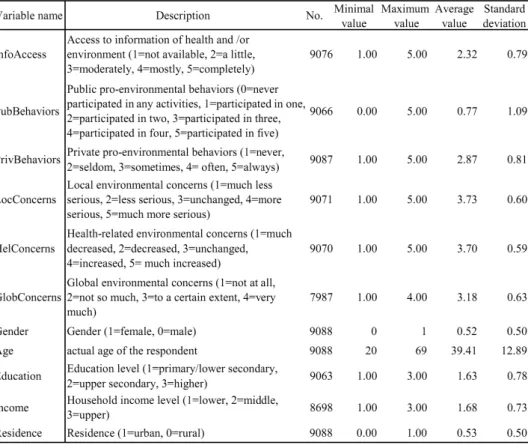
To examine the relationships between social factors and pro-environmental behaviors, this study includes five demographics of respon-dents, i.e., gender, age, education level, income level and urban/rural division of residence (Ta-ble 1). The sample population comprises 48.2% male and 51.8% female. Their age ranges from 20 to 69 years old, with a mean of 39 years old (20-29 (27.5%), 30-39 (26.5%), 40-49 (21.6%), 50-59 (15.6%), 60-69 (8.8%)). Regarding the education level, three levels are classified as pri-mary/lower secondary, upper secondary and higher. With a mean of 1.63 as the average edu-cational level, 55.2% of the respondents
completed primary/lower secondary educa-tion, 25.7% of the respondents completed upper secondary education, and only 18.8% of the respondents completed higher education. Regarding the income level, three levels (lower, middle, upper) are defined according to each country's stage of economic development. The exact amount in local currency and income range therefore differs from country to coun-try. On the whole, lower income group accounts for 45.3% of the respondents, middle income group accounts for 35.3% of the respon-dents, and upper income group accounts for 15.1% of the respondents. Regarding the urban/ rural division of residence, 52.9% of the respon-dents live in urban area, while 47.1% of the respondents live in the rural area.
To reflect the multiple perspectives of sophis-ticated concepts of environmental concerns and behaviors, we designed content questions containing multiple items (Table 2). To exam-ine the reliability of self-reported response to these item questions, we calculate the Cron-bach's Alpha. In general, the results ranged from 0.610 to 0.929, indicating an acceptable consistency of answers to these item questions in measuring the corresponding environmental indicator (Table 2). By transforming categori-cal responses of these item questions into interval data, it is possible to apply statistical techniques such as analysis of variance (ANO-VA), correlation analysis, regression and path analysis to capture the relationships among en-vironmental indices. The data transformation process for each environmental index is ex-plained as follows (Table 1).
1. Information access (InfoAccess)
This indicator measures the general ac-cessibility of ASEAN residents to
Table 2 Reliability analysis of environmental indices
Table 1 Summary of environmental behavior indices and factor variables
Note: A value of 0.7-0.8 is an acceptable value for Cronbach’s α; values substantially lower indicate an unreliable scale.
environment information and/or rele-vant health risks. It is formed by combining the answers for asking the re-spondents to subjectively identify their accessibility to the information sources of (a) TV or radio, (b) newspaper or magazines, (c) internet, (d) community-based meetings. Four information sources were presented as questions which started with "how available to you is the information of health and/or envi-ronment through the following?" The InfoAccess scale is constructed by calcu-lating mean of the scores for these four information sources.
2. Public pro-environmental behaviors (PubBehaviors)
In this study, we divide pro-environment behaviors into two types. One is the in-dicator called PubBehaviors, which measures to what extent the ASEAN residents are participating in organized pro-environmental activities to voice their environmental concerns in public, and consequently leading to public poli-cy advocapoli-cy. The construction of PubBehaviors scale is conducted by com-bining the answers for asking the respondents to subjectively identify whether they have done the following activities or not (a) to attend lectures or seminars about an environment issue, (b) to take part in volunteer activities for en-vironment conservation, (c) to sign a petition about an environmental issue, (d) to give money to an environmental group, (e) to take part in a protest or demonstration about an environmental issue. To reflect to what extent each
re-spondent takes part in public pro-environmental activities, PubBehaviors is developed by aggregating scores for the aforementioned five items. The result is a 6-point scale variable, ranging from 0 to 5.
3. Private pro-environmental behaviors (PrivBehaviors)
Another indicator to measure pro-envi-ronmental behaviors at the individual-level is called PrivBehaviors. It captures the spontaneous household activities to ameliorate environmental problems. These activities are often performed for economic reasons of the family, in other words, money-saving through consump-tion reducconsump-tion. The indicator is conducted by combining the answers for asking the respondents to indicate how often they performed each of five private pro-environmental activities (a) to reuse or recycle something rather than throw it away, (b) to try to reduce water con-sumption, (c) to try to reduce the amount of energy for cooking, cooling and heating, (d) to use public transpor-tation instead of using personal car, (e) to buy organic or chemical-free vegeta-bles. Five private pro-environmental activities were presented as questions which started with "how often have you done any of the following actions during the last 12 months?" The mean of the rat-ing scores for these five private pro-environmental activities is calculated as a rough measurement of individual behav-iors.
4. Local environmental concerns (LocCon-cerns)
This study also identifies two types of en-vironmental concerns. One is at the local level, LocConcerns, which measured the subjective evaluation of respondents on environmental changes of their places of residence. The construction of LocCon-cerns scale is conducted by combining the answers for asking respondents to in-dicate the level of their concerns about 16 environmental issues at the local level. It was presented as questions which started with "compared to five years ago, do you think that the following issues have become more serious now?" The 16 environmental issues at the local level ranged from living environmental prob-lems to ecological probprob-lems (a) air pollution, (b) water pollution, (c) soil pollution, (d) noise pollution, (e) cli-mate change, (f ) urban heat island, (g) pollution of beaches, river-side, lake-side etc., (h) deforestation, (i) genetically modified food issues, (j) water shortage, (k) using up our natural resources, (l) us-age of chemicals and pesticides, (m) disposal of household waste and garbage, (n) disposal of industrial waste, (o) dis-posal of toxic or nuclear waste, (p) loss of biodiversity. The mean of the rating scores for these 16 environmental issues is calculated as a measurement of each respondent's overall environmental con-cerns at the local level.
5. Health-related concerns (HelConcerns) Environmental problems often cause health risks, for instance, serious air pol-lution may cause the high incidence of respiratory of diseases. This study mea-sures the ASEAN residents'
health-related concerns by constructing an indicator of HelConcerns. It combines the answers for asking respondents to in-dicate the level of their concerns about 16 health risks induced by the corre-sponding environmental issues of LocConcerns. The mean of the rating scores for these 16 health risks is calcu-late d a s a mea surement of each respondent's health-related concerns. 6. Global environmental concerns
(Glob-Concerns)
Another type of environmental concerns is at the global level, i.e., the residents' awareness of environmental problems pertinent to the sustainability of human society and earth ecosystems. We con-struct the indicator, GlobConcerns, by combining the answers for asking re-spondents to indicate the level of their concerns about eight environmental is-sues at the global level (a) deletion of ozone layer, (b) acid rain, (c) climate change, (d) deforestation, (e) loss of bio-diversity, (f ) marine pollution, (g ) nuclear waste disposal, (h) usage of chemicals and pesticides. The mean of the rating scores for these eight environ-menta l issues is ca lcu late d a s a measurement of each respondent's global environmental concerns.
2.3. Hypotheses
Based on the previous studies' empirical find-ings, this study assumes:
1. Social factors including a broad range of demographic characteristics are impor-tant determinants of pro-environmental
behaviors and environmental concerns in the ASEAN countries;
2. Knowledge diffusion through formal and/or informal education activities, in this study, better access to information, improves people's awareness of environ-mental problems, as well as facilitates the participation of the ASEAN residents in pro-environmental behaviors;
3. Improved environmental concerns will lead to more active involvement in pro-environmental behavior.
It is worthy to mention that, though no con-sistent results in explaining socio-economic determinants of environmental concerns and pro-environmental behaviors, regarding the age, gender, education, income, and urban/ru-ral division of residence, the previous studies about Western countries generally suggest that younger people, female, higher education, high income and urban residents tend to express greater environmental concerns and support for pro-environmental activities.
III
Results and discussions 3.1. Pro-environmental behaviorsComparing the frequency of public-level pro-environmental behaviors to individual-lev-el (private) behaviors, it is clear that the vast majority of the respondents conducted indi-vidual-level behaviors to some extent in their daily life; however, there is only a minority of respondents involved in public-level pro-envi-ronmental activities in ASEAN countries (Table 3). More than half of the respondents reported that they have been performing indi-vidual-level environmental activities on a regular base (sometimes, often, or always). In
contrast, 23.0% of the respondents have the ex-periences to attend lectures or seminars about an environmental issue, 20.5% of the respon-dents have taken part in volunteer activities for environment conservation, and 24.2% of the respondents have given money to an environ-mental group. Furthermore, a much smaller share of respondents has the experiences to sign a petition about an environmental issue (6.1%) and take part in a protest or demonstration of an environmental issue (3.4%). Overall, re-spondents reported performing individual-level environmental activities which require the least organized efforts much more often than organized public activities. In addition, the re-spondents reported participating in organized environmental activities more frequently than voicing their environmental concerns in public. These facts may reflect the authoritarian fea-ture of Asian society and lack of tradition to participate in public activities.
Individual-level behaviors covered four do-mains of everyday behaviors including recycling/reusing, environmentally responsible consumption, transportation choices, and food consumption patterns. For all domains, over 70% of respondents reported performing envi-ronmental behaviors in their daily lives to some extent. Moreover, the respondents appear to engage in environmentally responsible con-sumption (saving water and energ y) and transportation choices (public transportation use) more actively than recycling/reusing and food consumption patterns (purchase of or-ganic and chemical-free vegetables). The respondents, therefore, are far more likely to engage in environmental activities that would bring a direct economic benefit to them.
3.2. ANOVA and Correlation Analysis
Table 4 summarizes the results of analysis of variance (ANOVA). The sociological attributes seem to be affecting environmental behaviors and concerns in ASEAN countries. Table 4 de-picts that there is a significant difference between female and male in terms of access to environment-related information, public proenvironmental behaviors, private pro -e n v i r o n m -e n t a l b -e h a v i o r s a n d l o c a l environmental concerns. Public pro-environ-mental behavior is also significantly different between respondents with different education level and living in urban/rural areas, but not different between respondents of different age and income level. In terms of access to informa-tion, private pro-environmental behaviors,
local environmental concerns, health-related environmental concerns and global environ-mental concerns, there are significant differences between respondents with different age, education, income and place of residence.
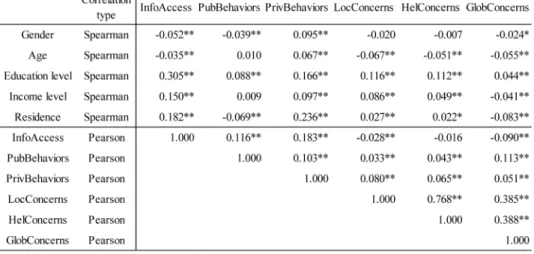
However, our survey could not reach consis-tent conclusion that younger people, female, higher educated, relatively high-income and urban residents are more likely to express their serious concerns about environmental prob-lems and/or perform pro-environmental behaviors than the other cohorts. Correlation analysis in Table 5 shows that the relationships between sociological attributes and environ-mental variables depend on the variable choice. The slight positive effects, if any, are observed only in the case of education level. The
tion level of the respondents appears to be robustly correlated with all environmental vari-ables.
Table 5 also presents the correlations among environmental variables. It shows that local en-vironmental concerns are significantly correlated with health-related environmental concerns (0.768). Considering the question de-sign which asked the respondents to indicate
the level of their health risk concerns related to local environmental problems, it is natural that two variables have a high correlation. Local en-vironmental concerns and health concerns are also rather strongly correlated to global envi-ronmental concerns, 0.385 and 0.388 respectively. People who reported having envi-ronmental concerns at the local level are more likely to perceive the importance of
environ-Table 4 Analysis of variance for gender, age, education level, income level, and residence (F-value)
Table 5 Correlation among different variables
Note: * indicates a 5% significant level. ** indicates a 1% significant level.
mental problems at the global level. In addition, though weakly, information access is correlated to public pro-environmental behaviors (0.116) and individuallevel pro -environmental behaviors (0.183).
3.3. Path Analysis
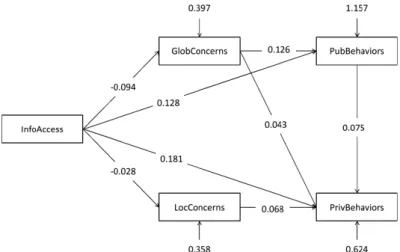
To trace the cause/effect relationships among various environmental variables, path analysis was conducted using the software Amos 19. The model was finalized in a two-step process. In the first step, the model was adjusted to find acceptable estimation results. In the subsequent step, all statistically insignificant paths were ex-cluded and the model was re-estimated. Figure 1 depicts one of the acceptable models, wherein all the significant path coefficients at the 5% level were indicated. Estimated significant path coefficients derived from the various steps of multiple regressions of environmental vari-ables. The direct effect of one variable on
another is presented as the weight given by the path coefficient, while the indirect effect can be calculated by multiplying the relevant esti-mated coefficients of direct paths. The value of direct effect lies into the range between -1 to +1. It indicates the relative change in the de-pendent variable induced by one unit of change in the independent variable.
Figure 1 indicates that our initial hypothesis of a causal effect from information access to en-vironmental concerns and consequently to environmental behaviors was not confirmed in ASEAN countries. The chi-square is significant with 2 degrees of freedom. The root mean square error of approximation (RMSEA) is 0.273. The significant chi-square value and a RMSEA larger than 0.05 indicate that the overall goodness of fit of the model is low, however, the predicted paths still provide in-dicative information about cause/effect relationships among environmental variables.
Figure 1 Path analysis: information access, environmental concerns, and pro-environmental behaviors.
The predicted paths among information access, environmental concerns and environmental be-haviors are significant, regardless the fact that the effects are negligible for both public-level and individual-level. In addition, the indirect effects of information access on environmental behaviors through environmental concerns are found to be negative (-0.094×0.126 and -0.028×0.068, respectively), while the direct ef-fects of information access on environmental behaviors are found to be positive (0.128 and 0.181, respectively). The finding implies that the access to environment-related information and/or knowledge might effectively promote people's involvement in pro-environmental ac-tivities (at both public- and individual-level), but not necessarily improve people's awareness of environmental issues in ASEAN countries. In the meantime, compared to public environ-mental behaviors, we found more diversified significant paths from various environmental variables to private environmental behaviors. In particular, there is a significant path from pub-lic environmental behaviors to private environmental behaviors. These findings sug-gest that, first, improved information access and environmental awareness are more likely to lead to active participation in environmental activities at the individual level, but less in en-vironmental activities at the public level. Second, improved environmental knowledge and awareness through organized public envi-ronmental activities might contribute to the more active involvement of in individual envi-ronmental behaviors.
IV
ConclusionThis study investigated various factors, par-ticularly, ordinary residents' accessibility to environment knowledge/information, affect-ing pro-environmental behaviors in the ASEAN member countries. It is worthy to mention that, educational intervention and providing information may come to affect en-vironmental awareness and behaviors over a long time period. It is, thus, difficult to conclu-sively demonstrate the cause/effect relationship between them. However, the education inter-vention and providing information are important because they can exert indirect ef-fects changing people's political behavior; this behavior, in turn, changes government policy. In this sense, the links among information, en-vironmental attitudes and behaviors might be a key to finding the solution of environmental problems.
The empirical results of this study lead to the following three main conclusions. First, through differentiating the pro-environmental behaviors between public-level one and indi-vidual-level one, we found that public pro-environmental behaviors, which largely involved organized activities, were overall less frequent than private pro-environmental be-haviors. The ordinary residents in ASEAN countries are more likely to participate in the pro-environmental activities that have direct self-interest (cost-saving) for the people in-volved. For instance, energy-saving behaviors appear to be more popular than green con-sumption behaviors. This fact suggests the importance of introducing economic incen-tives when ASEAN countries' governments implement environmental policies.
Appropri-ate economic incentives might enhance people's willingness to be involved in environ-mental protection activities, especially organized public activities in ASEAN coun-tries.
Secondly, sociological attributes including gender, age, education, income and place of residence seem to influence the awareness and behavior patterns of respondents towards the environment in ASEAN countries. However, we could not identify the robust signs of corre-lations between those sociological attributes and environmental variables. Among five de-mographics examined in this study, education level is the only one which appeared to explain the differences of environmental variables con-sistently, though rather weak.
Thirdly, the results of path analysis suggest the causal relationship from information access to pro-environmental behaviors, and the causal relationship from public-level environ-mental behaviors to private-level pro-environmental behaviors. However, we did not identify significant effects from improved envi-ronmental concerns on pro-environment behaviors. These findings imply the importance of environmental knowledge diffusion in ASE-AN countries. The knowledge diffusion may not necessarily be realized through formal school education. Instead, we highlighted the importance of improved accessibility to envi-ronment information through both traditional media such as newspaper, television and new media such as internet. In ASEAN, at this mo-ment, improved information access appears more likely to lead to active participation in environmental activities at the individual level, mostly household consumption behaviors, but less in organized environmental activities at the
public level. In the future, more detailed coun-try-wise study and regional comparison could be conducted to extend the findings of this study.
【Acknowledgement】
The dataset used in this study was collected through the survey, –“ASEAN Barometer”–. Professor Takashi Inoguchi is the project leader who initiated the survey. The author expresses her sincere gratitude to Prof. Inoguchi for his warm encouragement and support. The author also would like to thank Prof. Manabu Kondo for his generosity to share his research outcome and knowledge in the field of Environmental Economics during the past a few years.
References
⦿Adeola, O. Francis. 1994. Environmental Hazards, Health, and Racial Inequity in Hazardous Waste Dis-tribution. Environment and Behavior, vol. 26(1), 99-126.
⦿Aoyagi-Usui, Midori, Henk Vinken, and Atsuko Kurib-ayashi. 2003. Pro-environmental Attitudes and Behav-iors: An International Comparison. Research in Human Ecology, vol. 10(1), 23-31.
⦿Arcury, A. Thomas, Eric H. Christianson. 1990. Envi-ronmental Worldview in Response to EnviEnvi-ronmental Problems: Kentucky 1984 and 1988 Compared. Envi-ronment and Behavior, vol. 22(3), 387-407.
⦿ASEAN Secretariat. 2008. ASEAN Environmental Ed-ucation Action Plan (AEEAP) 2008-2012: Environmen-tal Education for Sustainable Development. Jakarta, In-donesia.
⦿Aytulkasapoglu, M., Mehmet C Ecevit. 2002. Attitudes and Behavior Toward the Environment: the Case of Lake Burdur in Turkey. Environment and Behavior, vol.
34(3), 363–377.
⦿Baldassare, Mark, Cheryl Katz. 1992. The Personal Threat of Environmental Problems as Predictor of Envi-ronmental Practices. Environment and Behavior, vol.
24(5), 602-616.
⦿Davidson, J. Debra, Wiluam R. Freudenburg. 1996. Gender and Environmental Risk Concerns: A Review and Analysis of Available Research. Environment and Behavior, vol. 28(3), 302-339.
⦿Deng, Jinyang, Gordon J. Walker, Guy Swinnerton. 2006. A Comparison of Environmental Values and At-titudes Between Chinese in Canada and Anglo-Cana-dians. Environment and Behavior, vol. 38(1), 22-47.
⦿Dietz, Thomas, Linda Kalof, Paul C. Stern. 2002. Gen-der, Values, and Environmentalism. Social Science Quarterly, vol. 83(1), 353–364.
⦿Howell, E. Susan, Shirley B. Laska. 1992. The Changing Face of the Environmental Coalition: A Research Note.
Environment and Behavior, vol. 24(1), 134-144.
⦿Hunter, M. Lori, Alison Hatch, and Aaron Johnson. 2004. Cross-National Gender Variation in Environ-mental Behaviors. Social Science Quarterly, vol. 85(3),
677–694.
⦿Lyons Evanthia, Glynis M. Breakwell. 1994. Factors Predicting Environmental Concern and Indifference in 13- to 16-Year-Olds. Environment and Behavior, vol.
26(2), 223-238.
⦿Stern, C. Paul. 1999. Information, Incentives, and Pro-environmental Consumer Behavior. Journal of Consum-er Policy, vol. 22(4), 461-478.
⦿Stern, C. Paul. 2000. Toward a Coherent Theory of En-vironmentally Significant Behavior. Journal of Social Is-sues, vol. 56(3), 407–424.
⦿Stern, C. Paul, Thomas Dietz. 1994. The Value Basis of Environmental Concern. Journal of Social Issues, Vol.
50(3), 65–84.
⦿Stern, C. Paul, Thomas Dietz, and Linda Kalof. 1993. Value Orientations, Gender and Environmental Con-cern. Environment and Behavior, vol. 25(3), 322-348.
⦿Stern, C. Paul, Thomas Dietz, Linda Kalof and Gregory A. Guagnano. 1995. Values, Beliefs, and Proenviron-mental Action: Attitude Formation toward Emergent Attitude Objects. Journal of Applied Social Psychology,
vol. 25(18), 1611–1636.
⦿Stern, C. Paul, Thomas Dietz, Troy Abel, Gregory A. Guagnano and Linda Kalof. 1999. A Value-Belief-Norm Theory of Support for Social Movements: The Case of Environmentalism. Human Ecology Review, vol. 6(2),
81-97.
⦿Zelezny, C. Lynnette, Poh-Pheng Chua, and Christina Aldrich. 2000. Elaborating on Gender Differences in Environmentalism. Journal of Social Issues, vol. 56(3),
Exploring Social Factors and Pro-environmental Behaviors
A Nine-Country Survey in Southeast Asia
Jia Li
Although the factors and their relationships with pro-environmental behaviors have re-ceived substantial attention in the literature, not much attention has been paid to the issue in the Asian context. This study applies survey data in nine Southeast Asian countries to ex-amine the relationships among sociological attributes, diffusion of environment knowl-edge/information, environmental concerns, and pro-environmental behaviors. The study found that, first, ASEAN residents more likely participate in the private-level pro-environ-mental activities with economic incentives, i.e., saving the cost of living. Second, education lev-el seems to be the only demog raphic characteristic which predicts environmental awareness and pro-environmental behaviors in ASEAN countries. Thirdly, improved accessi-bility to environment knowledge/information is expected to encourage pro-environmental behaviors in ASEAN countries, especially, changes in household consumption patterns.
Keywords: cross-country survey, pro-envi-ronmental behaviors, ASEAN Barometer