Beiträge zur Geschichte des Protestantismus in der Schweiz und seiner Ausstrahlung
Band 43 2016
Jahrbuch des Zwinglivereins
Sonderdruck
Theologischer Verlag Zürich
Reformationsgeschichte an der Theologischen Fakultät der Universität Zürich Gedruckt mit Unterstützung der Schweizerischen Akademie der Geistes- und Sozialwissenschaften
Herausgeber
Christian Moser, Universität Zürich Peter Opitz, Universität Zürich
Wissenschaftlicher Beirat
Hans Ulrich Bächtold, Universität Zürich Reinhard Bodenmann, Universität Zürich
Amy Nelson Burnett, University of Nebraska-Lincoln Emidio Campi, Universität Zürich
Rudolf Dellsperger, Universität Bern Bruce Gordon, Yale University
Randolph C. Head, University of California Riverside Andre´ Holenstein, Universität Bern
Thomas K. Kuhn, Ernst-Moritz-Arndt-Universität Greifswald Urs B. Leu, Zentralbibliothek Zürich
Elsie Anne McKee, Princeton Theological Seminary Martin Sallmann, Universität Bern
Frühere Jahrgänge der Zwingliana, weitere Informationen zum Jahrbuch sowie Richtlinien für Autorinnen und Autoren sind elektronisch abrufbar unter www.zwingliana.ch
Satz: Christian Moser Druck und Bindung: CPI, Ulm ISSN 0254–4407
ISBN 978–3–290–17885–7
©2016 Theologischer Verlag Zürich
Alle Rechte, auch die des auszugsweisen Nachdrucks, der fotografischen und audiovisuellen Wiedergabe sowie der Übersetzung bleiben vorbehalten
Zusammenarbeit in St. Gallen: Christoph Schappeler
und Joachim von Watt (Vadian) über das Gebet 1 Bernhard Stettler
A variant copy of Konrad Gessner’s “Bibliotheca
Universalis” 103
Koichi Yukishima
Eine unbekannte Schrift von Bernardino Ochino 125 Judith Steiniger
Der Zürcher Arzt Georg Keller und seine Studienzeit in
Lausanne (1549/50) 161
Kurt Jakob Rüetschi
Reconceiving the Clerical Corps: How Heinrich Bullinger
Resists the Expectations of Confessionalization 177 Jon Delmas Wood
Zur Verteidigung des »Protestant Cause«: Die konfessionelle Diplomatie Englands und der eidgenössischen Orte
Zürich und Bern 1655/56 193
Sarah Rindlisbacher
Eine nonkonformistische Bibliothek des 17. Jahrhunderts:
Klandestine Literatur am Vorabend des Pietismus 335 Kaspar Bütikofer
Vom Zürcher Straußenhandel zu Nietzsches Basler
Straußiade: David Friedrich Strauß als Märtyrer 387
Daniela Kohler
Ein reformierter Theologe in Siebenbürgen: Istva´n To˝ke´s
8. August 1916 – 15. Januar 2016 411
Kurt Jakob Rüetschi
Buchbesprechungen 419
Martin Heimbucher, Prophetische Auslegung, 2008 – Pierrick Hildebrand Heinrich Bullinger: Briefe von Juni bis September 1546, 2015 – Amy Nelson
Burnett
Benjamin M. Merkle, Defending the Trinity in the Reformed Palatinate, 2015 – Luca Baschera
Shaping the Bible in the Reformation, hg. von Bruce Gordon und Matthew McLean, 2012 – Jim West
Jan-Andrea Bernhard, Konsolidierung des reformierten Bekenntnisses im Reich der Stephanskrone, 2015 – A´da´m Hegyi
Jolanda Ce´cile Schärli, Auffällige Religiosität, 2012 – Christian Metzenthin Karl Barth: Predigten 1911, hg. von Eberhard Busch und Beate Busch-Blum,
2015 – Frank Jehle
119. Jahresbericht des Zwinglivereins über das Jahr 2015 437
Personenregister 441
A variant copy of Konrad Gessner’s
“Bibliotheca Universalis” 1
Koichi Yukishima
Konrad Gessner (1516–1565) was among the most eminent hu- manists and naturalists in Switzerland in the 16
thcentury. When he was 29 years old, he began to publish a series of bibliographies including the Bibliotheca Universalis, Pandectarum, Partitiones theologicae, and Appendix printed by Christoph Froschauer in Zurich. The series’ first volume, Bibliotheca Universalis (Zurich:
Christoph Froschauer, 1545), is especially considered as among his masterpieces and the great classics in the fields of bibliography and of library and information science. For his work on the Bibliotheca Universalis, Gessner is regarded by many as “the Father of Biblio- graphy”
2.
Although many scholars have researched and referred to the Bi- bliotheca Universalis since the first half of the 20
thcentury, atten- tion has not been given to its variant state or cancellation. In this regard, the author found two variant copies among the 10 copies available to the author, which include five copies in Japan, a copy annotated by Gessner himself, three copies in the Zurich Central Library, and another copy in Basel University Library. This paper presents a report on the copy of the Bibliotheca Universalis that has not been identified as a variant, with a focus on this copy’s
1This work was supported by JSPS KAKENHI Grant Number 25330401.
2J. Christian Bay, Conrad Gesner (1516–1565), the Father of Bibliography: An Appreciation, in: The Papers of the Bibliographical Society of America 10 (1916), 53–86.
variant typesetting. In the field of bibliography, this study offers the significant contribution of clarifying what happened in the time of printing the Bibliotheca Universalis.
In the course of examing all of the available copies of the Biblio- theca Universalis to identify the variant copies, the five copies housed at the following libraries in Japan (call No. & provenance) were accessed first:
1 Hiroshima University of Economics Library, Hiroshima (026, Georg Sa- binus’s copy)
2 Keio University Library, Tokyo (141X@40@1) 3 National Diet Library, Tokyo (WA 42–27)
4 Meiji University Library, Tokyo (091.3/970//H, a copy of the Society of Writers to the Signet, Edinburgh)
5 Waseda University Library, Tokyo (F026–36, a copy of Tegernsee Abbey, Bavaria, and then Jeno˝ Pa´szte´lyi’s copy)
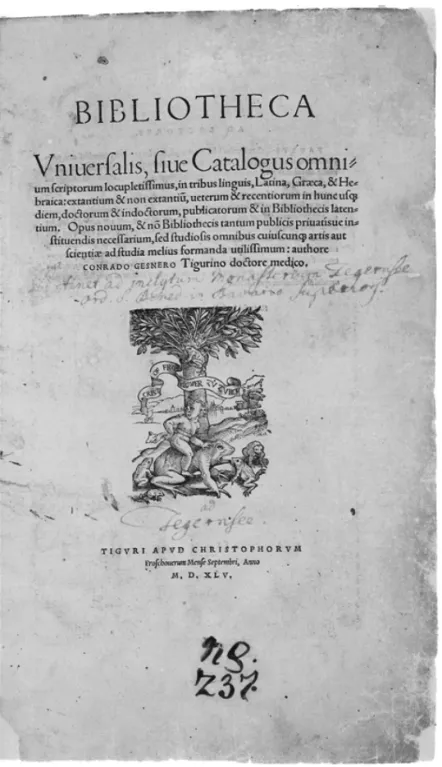
The Waseda copy of the Bibliotheca Universalis Bibliographical description of the Waseda copy (see Figure 1):
Gessner, Konrad. Bibliotheca Universalis. Tiguri: Apud Christophorum Fro- schouerum, 1545. folio.
Title, 1r (*1): BIBLIOTHECA Vniuersalis, siue Catalogus omni= um scrip- torium locupletissimus, in tribus linguis, Latina, Graeca, & He= braica: ex- tantiam & non extantiu‹m›, ueterum & recentiorum in hunc usq‹ue› diem, doctorum & indoctorum, publicatorum & in Bibliothecis laten= tium. Opus nouum, & no‹n› Bibliothecis tantum publicis priuatisue in= stituendis neces- sarium, sed studiosis omnibus cuiuscunq‹ue› artis aut scientiae ad studia melius formanda utilissimum: authore CONRADO GESNERO Tigurino doctore medico. [device: Vischer, Bibliographie, p. 544,
3Offizin Froschauer 6] TIGVRI APVD CHRISTOPHORVM Froschouerum Mense Septembri, Anno M. D. XLV.
Explicit: NN7v, line 8: FINIS.
Folio, *
8, A
6B
4, a-z
6,
2A-
2B
6C-Z Aa-Zz 2a–2z AA-MM
6NN
8[signed $4 (*5, B3, NN5)]. 650 leaves, ff. [8], [10], 1–631, [1].
3Manfred Vischer, Bibliographie der Zürcher Druckschriften des 15. und 16. Jahr- hunderts, Baden-Baden 1991.
Fig. 1: Title page of the Waseda copy of Bibliotheca Universalis. Waseda University Library (F026–36).
Contents: *1r, title; *1v, AD LECTORES.; *2r, ILLVSTRI ET GENEROSO VIRO D. LEONARDO BECKH A BECKENSTAIN, S. Caesareae maiestatis consiliario clarissimo, CONRA= DVS GESNERVS medicus S.D.P.; *6v, line 10, Vale, meq‹ue› clientem tuum ita ut caepisti fo= uere perge. Tiguri, quae primaria Heluetiorum urbs est, anno Chri= stiano, 1545. Mense Iulio.; *7r, line 20, Haecante operis ingressum habui, de quibus Lectores admonerem.
*7v, PRAEMIA VIRTVTIS FELICIA CONSPICIS ARMA. [woodcut of coat of arms, 192
×139mm]; *8, blank; A1r, AD LECTOREM DE VSV HVIVS INDICIS (10 lines) id quaque ex hoc Indice deprehandetur, Vale. index in 3 cols.; B4r, line 12, FINIS.; B4v, blank; a1r, text; NN7v, line 8, FINIS.
EMENDANDVM. (3 lines); NN8, blank.
a4r, text in 51 lines and headline, direction line and marginalia, 241 (251)
×137 (157) mm, 93R, 93Gr; *3r, preliminary in 42 lines and headline and direction line, 240 (248)
×140 mm, 112R, 93Gr; A1r, index in 3 cols., each col. in 55 lines, 86R.
Reference: VD 16
4, G 1698; Vischer, Bibliographie, C 350.
Copy: Waseda University Library, F026–36. 322× 200mm, bound in wooden boards covered with contemporary blind stamped pig skin in the South Ger- man style. MS ownership and pressmark on *1r: ‘Pertinet ad inclytum Mo- nasterium Tegernsee ord. S. Bened. in Bavaria superiorj’ ‘ad Tegernsee’ ‘ng.
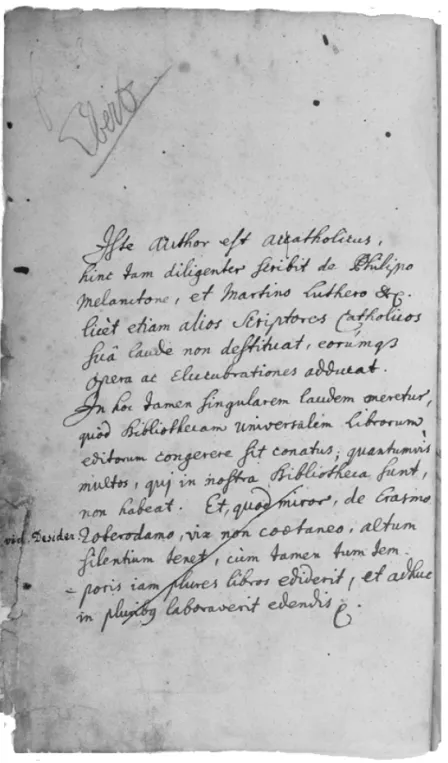
Z37.’ (Figure 1). Manuscript notes on the flyleaf verso (see Figure 2):
Iste author est accatholicus, hinc tam diligenter scribit de Philipo Melanc- tone, et Martino Luthero &c. lice`t etiam alios Scriptores Catholicos suaˆ laude non destituat, eoru´mq‹ue› opera ac Elucubrationes adducat. In hoc tamen singularem laudem meretur, quo`d. Bibliothecam universalem Li- brorum editiorum congerere sit conatas; quantumvis mu`ltas, qui in nostra Bibliotheca sunt, non habeat. Et, quod miror, de Erasmo Roterodamo [sinistra: ‘vidi Desider.’], vix non coaetaneo, altum silentium tenet, cu`m tamen tum tem -poris iam plures libros ediderit, et adhuc in plurib‹us›
laboraverit edendis c‹etera›.
Provenance: (MS on *1r) Order of Saint Benedict, Tegernsee, Bavaria; (stamp on a slip of paper pasted on NN7v) Dr. Pa´szte´lyi Jeno˝, könyvta´ra´bo´l, Sza´m:
1502. Waseda University Library bought the copy from Peter Tumarkin Fine Books, New York in July 1992.
The Waseda copy had been housed at Tegernsee Abbey in Bavaria, from the 16
thto the 18
thcenturies. The manuscript notes on the flyleaf indicated that the library had kept its copy even after the Tridentine index of the Roman Catholic Church in 1564. The ab-
4Verzeichnis der im deutschen Sprachbereich erschienenen Drucke des 16. Jahr- hunderts: VD 16, 22 vols, Stuttgart 1983–1995.
Fig. 2: Manuscript notes on the flyleaf of the Waseda copy of Bibliotheca Universalis.
Waseda University Library (F026–36).
bey regarded the Bibliotheca Universalis highly as it contained many records of Catholic authors together with Protestant ones.
At one point, the notes indicated that the scribe criticized Gess- ner for being deeply silent on Erasmus of Rotterdam as he could not find any item of the Dutch humanist in the book. Another reader of the Bibliotheca Universalis later noted “vidi Desider.” on the manuscript notes’ left margin and drew a slanted line over lines 11–15 of the notes. The latter reader pointed out that this note was necessary to aid the search for the item “Desiderius Erasmus”. The notes show how the Bibliotheca Universalis remained in use at the monastery in Southern Germany in the Counter Reformation
5pe- riod despite being banned by the Roman Catholic Church.
At the time of the secularization in 1803,
6most books and ma- nuscripts housed at the abbey were sent to the Royal Library in Munich. However, this copy was not added to the collection of the Royal Library but was later owned by a Hungarian collector, Dr.
Jeno˝ Pa´szte´lyi (1850–1918).
The typesetting of the other four copies of the Bibliotheca Univer- salis in Japan are the same as that in the Waseda’s. Any variant copy is unknown in Japan.
Subsequently, the author examined five other copies in the fol- lowing libraries in Switzerland from 2013 to 2015:
1 Zurich Central Library (Dr M 3, Konrad Gessner’s own copy, onwards Copy A)
2 Zurich Central Library (IV O 2, Konrad Pellikan’s copy, onwards Copy B)
3 Zurich Central Library (IV O 4 & IV O 5, bound in 2, a copy of ‘Ia- cobus Silvius Ambianus In Medicina’ [= Jacques Dubois], onwards Copy C)
4 Zurich Central Library (5.12, Konrad Klauser’s copy, onwards Copy D) 5 Basel University Library (BL I 1, Basilius Amerbach II, onwards the Basel
copy)
5Alberto Moreni, La Bibliotheca Universalis di Konrad Gesner e gli Indici dei libri proibiti, in: La Bibliofilia 88 (1986), 131–150.
6Josef Hemmerle, Die Benediktinerklöster in Bayern, Augsberg 1970 (Germania Benedictina 2), 300.
Gessner’s own copy of the Bibliotheca Universalis in Zurich Central Library (Copy A)
Copy A is the most important and interesting copy bibliographi- cally among these five copies as Gessner himself wrote many of the manuscript notes regards corrections, revisions, and deletions in the text as well as rearrangements and additions of items throug- hout the book; this copy also probably retains the original paper size (350×215 mm). Gessner added other pieces of publication in- formation in Copy A until the early 1550s.
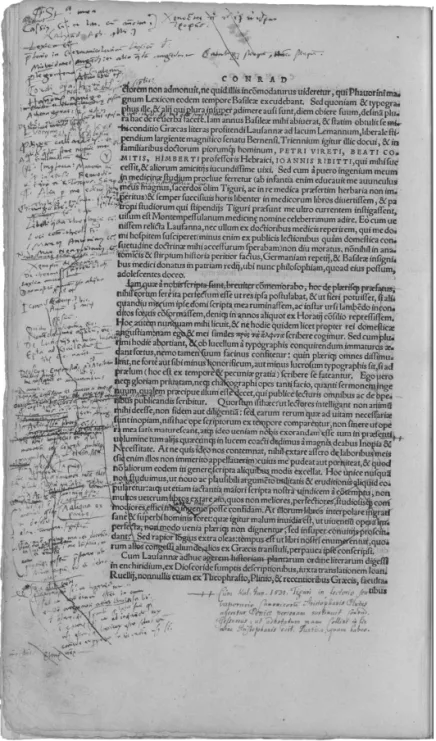
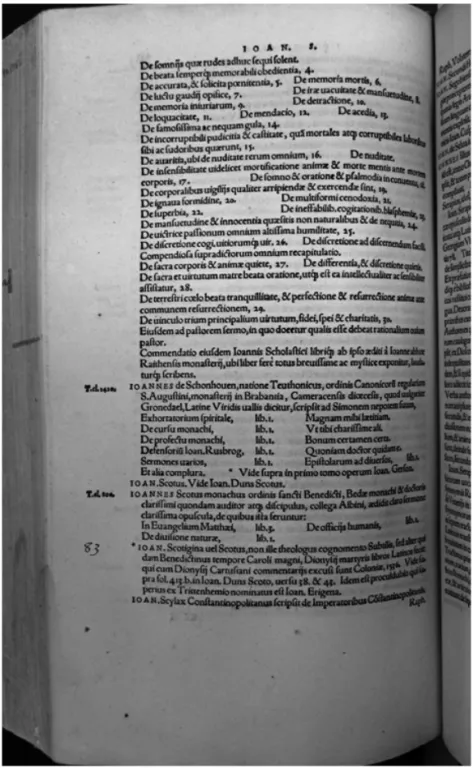
7Extremely remarkable deletions are shown in the latter part of the item by Gessner him- self in fol. 180v where he drew inclined lattice lines over the text and vertical lines for erasing several manuscripts notes on the left outer margin (see Figure 3). However, any variant typesetting of fol. 180v has been unknown.
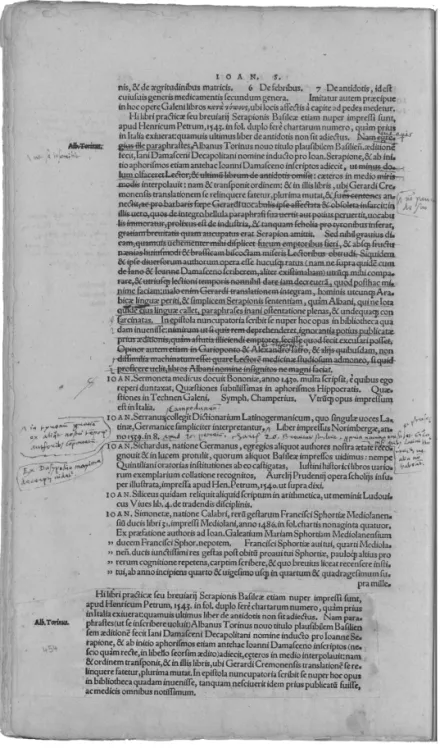
Moreover, Gessner crossed out lines 4–30 of fol. 454v in the latter half of the item of “IOANNES filius Serapionis” in the fol- lowing manner:
8Hi libri practicae seu breuiarij serapionis Basileae etiam nuper impressi sunt, apud Henricum Petrum, 1543. in fol. duplo fere` chartarum numero, qua`m prius 5
in Italia exiuerat: quamuis ultimus liber de antidotis non sit adiectus. Nam egre–
gius ille paraphrastes Albanus Torinus nouo titulo plausibilem Basililen˜, aeditione¯
fecit, Iani Damasceni Decapolitani nomine inducto pro Ioan. Serapione, & ab ini- tio aphorismos etiam antehac Ioanni Damasceno inscriptos adiecit , ut minus do–
lum olfacerer Lector, & ultimu˜ librum de antidotis omisit : caeteros in medio miris 10
modis interpolauit : nam & transponit ordinem : & in illis libris, ubi Gerardi Cre- monensis translationem se relinquere fatetur, plurima mutat, & sues centones an- nectit, ac pro barbaris saepe Gerardi uocabulis ipse affecta & obsoleta infarcit: in illis uero, quos de integro bellula paraphrasi sua uerit aut potius peruertit, uocabu lis immoratur, prolixus esy de industri, & tanquam scholia pro tyronibus inserat, 15
gratiam breuitatis quam aucupatus erat Serapion amittit. Sed nihil grauius di- cam, quamis uehementer mihi displiecet sucum emptoribus fieri, & absq(ue) fructu naenias huismodi & brassicam biscoctam miseris Lectoribus obtrudi, Siquidem
& ipse diuersorum authorum opera esse hucusq(ue) ratus (nam ne supra quide¯ cum de Iano & Ioanne Damasceno scriberem, aliter existimabam) utru˜q(ue) mihi compa- 20
rare, 6 utriusq(ue) lectioni temporis nonnihil dare iam decreuera˜, quod posthac mi- nime saciam: malo enim Gerardi translationem integram, hominis utcunq(ue) Ara- bicae linguae peritu, & simplicem Serapioni sententiam, qua`m Albani, qui ne Iota quide eius linguae callet, paragraphses inani ostentatione plenas, & undequaq(ue) con
7Gessner added a manuscript note, ‘et Basileae apud Hen. Petri 1551. ex eme‹n›dati= one ...’ at the item Hali filius Abenragel Arabs, on fol. 298v of Copy A.
8Line numbers by K. Yukishima.
sarcinatas. In epistola nuncpatoria scribit se nuper hoc opus in bilbiotheca qua 25
dam inuenisse: nimirum ut quis rem deprehenderet, ignorantia potius publicatae prius aeditionis, quam astutia illiciendi emptores, fecisse quod fecit excusari posset.
Opinor autem etiam in Garoponto & Alexandro Iatro, & & alijs quibusdam, non dissimilia machinatum esse: quare lectore¯ medicunae studiosum admoneo, si quid proficere uelit, libros Albani nomine insignitos ne magni faciat.
30
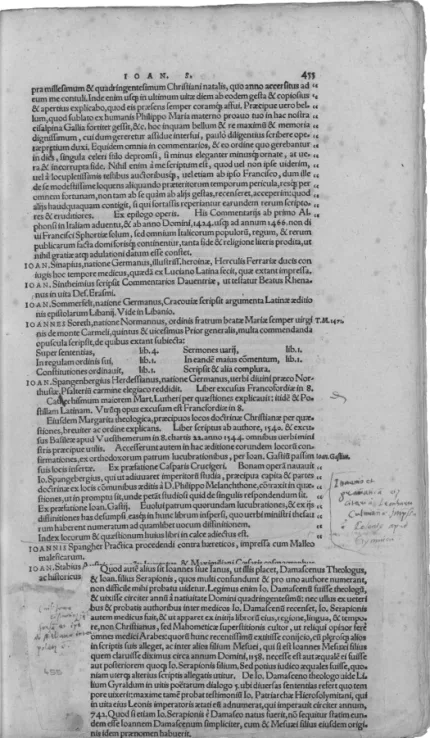
A slip sheet with 11 lines of printed text is pasted on the lower margin of fol. 454v and another one with 18 lines pasted on the lower margin of fol. 455r (see Figures 4 and 5). The 11 lines of the first slip correspond with lines 4–14 of fol. 454v in Copy B, where- as the 18 lines of the second are identified with lines 15–32 of fol.
454v in the same copy. Figure 6 shows lines 4–32 of fol. 454v in Copy B with the following sentences:
9Hi libri practicae seu breuiarij serapionis Basileae etiam nuper impressi sunt, apud Henricum Petrum, 1543. in fol. duplo fere` chartarum numero, qua`m prius 5
in Italia exiuerat: quamuis ultimus liber de antidotis non sit adiectus. Nam para=
phrastes (ut se inscribere uoluit) Albanus Torinus nouo titulo plausibilem Basilien sem aeditione¯ fecit Iani Damasceni Decapolitani nomine inducro pro Ioanne se=
rapione, & ab initio aphorismos etiam antehac Ioanni Damasceno inscriptos (ne=
scio qua`m recte, in libello seorsim aedito) adiecit, ce˛teros in medio interpolauit: nam 10
& ordinem transponit, & in illis libris, ubi Gerardi Cremonensis translatione¯ se re=
linquere fatetur, plurima mutat. In epistola nuncupatoria scribit se nuper hoc opus in bilbiotheca quadam inuenisse, tanquam nesciuerit idem prius publicatu˜ fuisse, ac medicis omnibus notissimum.
Quod aute¯ alius sit Ioannes siue Ianus, ut illis placet, Damascenus Theologus, 15
& Ioan. filius Serapionis, quos multi confundunt & pro uno authore numerant, non difficile mihi probatu uidetur. Legimus enim Io. Damascenu˜ fuisse theologu˜,
& uixisse circiter annu˜ a` natiuitate Domini quadringentesimu˜: nec ullus ex ueteri bus & probatis authoribus inter medicos Io. Damascenu˜ recenset, Io. Serapionis autem medicus fuit, & ut apparet ex initijs libroru˜ eius, regione, lingua, & tempo=
20
re, non Christianus, sed Mahometricae superstitionis cultor, ut reliqui opinor fere omnes medici Arabes: quoru˜ hunc recentissimu˜ extitisse conijcio, cu˜ ple˛rasq‹ue›
in scriptis suis alleget, ac inter alios filium Mesuei, qui si est Ioannes Mesaei filius quem claruisse diximus circa annum Domini, 1158 necesse est aut aequale¯ ei fuisse aut posteriorem quoq‹ue› Io. Serapionis filium. Sed potius uidico aequales quo=
25
niam uterq‹ue› alterius scriptis allegatis utitur. De Io. Damasceno theologo uide Li=
lium Gyraldum in uitis poe¨tarum dialogo 5. ubi diuersas sententias refert quo tem pore uixerit: maxime tame¯ probat testimoniu˜ Io. Patriarchae Hierosolymitani, qui in uita eius Leonis imperatoris aetati eu˜ adnumerat, qui imperauit circiter annum, 742. Quod si etiam Io. Serapionis e` Damasco natus fuerit, no˜ sequitur statim eun=
30
dem esse Ioannem Damascenum simpliciter, cum & Mesuaei filius eiusdem origi=
nis idem praenomen habuerit.
9Underlines and line numbers by K. Yukishima.
Fig. 3: Fol. 180v of Copy A of Bibliotheca Universalis. Zurich Central Library (DrM 3).
Fig. 4: Fol. 454v of Copy A of Bibliotheca Universalis. Zurich Central Library (DrM 3).
Fig. 5: Fol. 455r of Copy A of Bibliotheca Universalis. Zurich Central Library (DrM 3).
Fig. 6: Fol. 454v of Copy B of Bibliotheca Universalis. Zurich Central Library (IV O 2).
The comparison of above sentences between Copies A and B shows that Gessner reduced lines 4–30 of Copy A to lines 4–14 of Copy B with three additional sentences (lines 7, 9–10 and 13–14 underlined in Copy B’s citation). He also added new sentences located in lines 15–32 including an explanation on Ioannes filius Serapionis (Ibn Sara¯bı¯) being different from Ioannes Serapion (Yah ˙ ya¯ b. Sara¯fyu¯n). When creating new sentences, Gessner refer- red to Giglio Giraldi’s Dialogus V (i.e., Historiae poetarum tam Graecorum quam Latiorum dialogi decem) as mentioned to Io- hannes Damascenus (see lines 26–27 of Copy B). He used the Basel edition of Giraldi’s Dialogus published in 1545, which is listed in the preface of the Bibliotheca Universalis (*6v) as among his im- portant resources for Greek poets.
As such, the comparison between the two copies clearly shows that fol. 454v was reprinted. Gessner immediately corrected lines 4–30 upon seeing the printed fol. 454v of Copy A and created new sentences for lines 4–32; printer, Christoph Froschauer, printed another copy. Moreover, fol. 454v was spliced into two sheets of slips, and Gessner pasted them each on the lower margins of fol.
454v and fol. 455r of Copy A.
The increase by two lines (the 31
stand 32
ndlines) of fol. 454v in Copy B compelled the printer to omit two lines from the next two items, “IOAN. Sermoneta medicus” and “IOAN. Serranus”. The printer reduced four lines (the 34
thfrom the 31
stline) from the first item “IOAN. Sermoneta medicus” of Copy A to three lines (the 35
thfrom the 33
rdline) of Copy B without changing sentences (see Figure 6). Three lines (the 37
thfrom the 35
thline) of the latter item
“IOAN. Serranus” of Copy A were decreased to two lines (the 37
thfrom the 36
thline) of Copy B in the same way. In short, Fro- schauer adjusted the sentences with seven lines in Copy A to the sentences with five lines in Copy B in the following composition skill:
Lines 31–37 of Copy A:10
IOAN. Sermoneta medicus docuit bononiae, anno 1430. mula scripsit; e` quibus ego 31
reperi duntaxat, Wuaestiones subtilissimas in aphorismos Hippocratis. Quae=
32
10Line numbers by K. Yukishima.
stiones in Technen Galeni. Sumph. Champerius. Vtru‹m›q‹ue› opus impressum 33
est in Italia.
34
IOAN. Serranus collegit Dictionarium Latinogermanicum, quo singulae uoces La=
35
tinae. Germanice simpliciter interpretantur. Liber impressus Norimbergae, an=
36
no 1539. in 8.
37
Lines 33–37 of Copy B:11
IOAN. Sermoneta medicus docuit Bononiae, anno 1430. multa scripsit e` quibus ego re=
33
peri du‹m›taxat, Quaestiones subtilissimas in aphorismos Hippocratis. Quaestiones 34
in Technen Galeni. Symph. Champerius. Vtru‹m›q‹ue› opus impressum est in Italia.
35
IOAN. Serranus collegit dictionariu˜ Latinogermanicu˜, quo singulae uoces Latinae, 36
Germanice simmpliciter interpretantˇ. Liber impress. Norimberge˛ anno 1539. in 8.
37
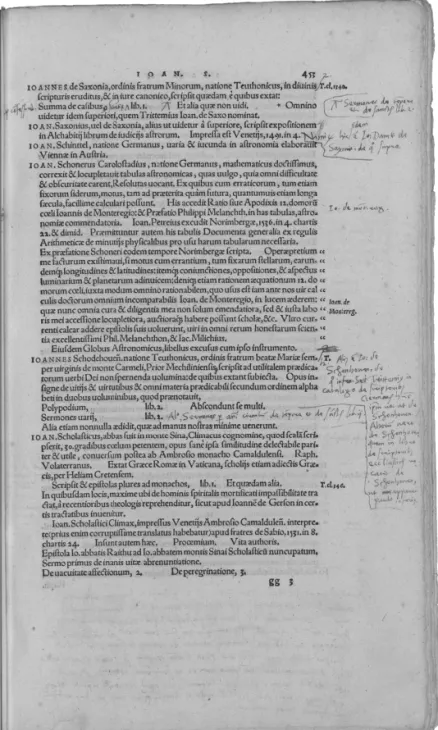
When comparing all sentences of fol. 453r–454v of Copies A and B (bifolium of signatures 2g3–2g4), several other differences bet- ween the two copies become evident, e.g.:
Copy A Copy B
453r, line 44: Gerson in cer= (Figure 7) Gerson in cer (Figure 8) 453v, line 46: sed alter qui= (Figure 9) sed alter qui (Figure 10) 454r, line 5: etiam in Chro (Figure 11) etiam in Chro= (Figure 12) 454r, line 41: Scotus impres (Figure 11) Scotus impres= (Figure 12) 454r, line 47: Oculorum, au (Figure 11) Oculorum, au= (Figure 12)
Dimension of printed areas (headline + 52 lines + direction line, with marginalia):
Copy A Copy B
453r (2g3r): 237 (247)×137 (157) 240 (249)×138 (158) 453v (2g3v): 237 (246)×137 (157) 238 (247)×137 (157) 454r (2g4r): 237 (247)×137 (157) 240 (248)×138 (158) 454v (2g4v): 238 (246)×137 (158) 240 (248)×138 (158)
Although any variant of typesetting or cancellation in the Biblio- theca Universalis have never been reported, the aforesaid differences between Copies A and B indicate that the outer (2g3r/2g4v) and inner (2g3v/2g4r) formes of fol. 453–454 of Copy A were completely changed to the formes of Copy B. This means that Copy B is bibliographically an ideal copy, whereas, Copy A is a variant one. A bibliographer, Fredson Bowers, defines ‘ideal co- py’ as “a book which is complete in all its leaves as it ultimately
11Line numbers by K. Yukishima.
Fig. 7: Fol. 453r of Copy A of Bibliotheca Universalis. Zurich Central Library (DrM 3).
Fig. 8: Fol. 453r of Copy B of Bibliotheca Universalis. Zurich Central Library (IV O 2).
Fig. 9: Fol. 453v of Copy A of Bibliotheca Universalis. Zurich Central Library (DrM 3).
Fig. 10: Fol. 453v of Copy B of Bibliotheca Universalis. Zurich Central Library (IV O 2).
Fig. 11: Fol. 454r of Copy A of Bibliotheca Universalis. Zurich Central Library (DrM 3).
Fig. 12: Fol. 454r of Copy B of Bibliotheca Universalis. Zurich Central Library (IV O 2).
left the printer’s shop on perfect condition and in the complete state that he considered to represent the final and most perfect state of the book”
12. He also defines the term ‘variant state’ as
“alterations of all varieties made during the printing and before copies are placed on public sale”
13, and then presents the following five major classes of variant state
14:
1. Alterations which do not affect the makeup and which were made in the type-pages of a forme, whether intentionally or unintentionally, while it was printing.
2. The addition, substitution, or deletion of any matter which affects the makeup but which was done in the course of ‘continuous printing’ and before public sale.
3. Alterations to the text or to any other part of the book which are made for the purpose of correcting or perfecting the edition but which are not accompanied by substitution of a different title-page and thus cannot be regarded as actually constituting a re-issue of the original sheets of the book, even though public sale had begun.
4. Errors and ‘corrections’ made in imposing, machining, or binding the sheets.
5. Large-paper or fine-paper copies machined without removing the forms from the press after ordinary printing except for washing, normal press- correction, or adjustment of margins.
Copy B is an ideal copy for Gessner and Froschauer and Copy A corresponds to the third class of variant state. The fol. 453–454 of the other two copies of the Zurich Central Library (Copies C and D) show that Copy C is a variant similar with Copy A. Meanwhile, Copy D, the Basel copy and the five copies in Japan are ideal ones similar with Copy B.
The variant copy occurred as a result of the printer changing the formes of fol. 453–454 based on Gessner’s corrections. From the viewpoint of bibliographical cancellation, a bifolium (a sheet of paper folded in two to make two leaves) of fol. 453–454 of Copy A is cancellanda (the plural of cancellandum), and that of fol.
453–454 of Copy B is cancellantia (the plural of cancellans).
15The-
12Fredson Bowers, Principles of Bibliographical Description, Winchester 1994, 113.
13Bowers, Principles, 42.
14Bowers, Principles, 46.
15Bowers defines the term ‘cancellans’ as “cancellans replacing a cancellandum”
Bowers, Principles, 243.
refore, it is necessary to describe the ideal collation of the Biblio- theca Universalis as follows:
Folio, *
8, A
6B
4, a–z
6 2A–
2B
6C–Z Aa–Zz 2a–2f
62g
6(±2g3.4) 2h–2z
6AA–MM
6NN
8Although Gessner, indeed, wrote many simple corrections and ad- ditions throughout Copy A, Froschauer never revised the text. Af- ter completing the quire 2g, however, Froschauer accepted Gess- ner’s own revision in fol. 454v (2g4), printed the aforesaid can- cellantia, and then replaced them in the quire 2g. These facts have clarified a part of the printing process of the Bibliotheca Univer- salis. The reasons why Froschauer did not proofread simple errors but accepted only the complicated cancellation as well as why Gessner revised the latter part of the item of “IOANNES filius Serapionis” in fol. 454v are questions that must be addressed in future studies.
Koichi Yukishima, Professor Library and Information Science, Waseda University, To- kyo
Abstract: Until recently, no variant copy or cancellation of Konrad Gessner’s “Biblio- theca Universalis” was known. The author examined five copies in Japan and four copies at the Zurich Central Library (Copies A, B, C and D), as well as one at Basel University Library, and discovered that variant copies do exist. Copy A was Gessner’s own copy, to which he added numerous notes, especially on fol. 454v. As a result of comparison with Copy B (Konrad Pellikan’s copy), it appears that Gessner corrected the text of lines 4–30 on this folio, shortened it to 11 lines, and added 18 new lines. The printer, Froschauer, recomposed four formes from fol. 453r to 454v, reprinted them and cancelled the former printed sheet of fol. 453r–454v. Copies B and D (Konrad Klauser’s copy), the Basel copy, and the five copies in Japan are considered to be the ideal copies and Copies A and C (Jacques Dubois’s copy) are regarded as variant copies.
One part of the printing process of the “Bibliotheca Universalis” became clear with this discovery.
Keywords: Konrad Gessner; Bibliotheca Universalis; bibliography; history of the book;
Zurich Central Library, Waseda University Library