Formation of the Concepts of Human Resource and Human Resource Management: Transformation from Industrial Relations
and Personnel Management (A Research Note)
Naoki KURIYAMA
Introduction
When we say ‘people management’ as a general term, there are the various naming of this field of concern. The terms human resource (HR) and human resource management (HRM) are used extensively by business practitioners and academic scholars. In fact, there is an HRM course taught in nearly every business school in the world. However, the interpretation of this term in local languages has caused some confusion. In Japan, for example, this term is not extensively used in the Japanese language.
The major objective of this study is to briefly review the process behind the formation of the concepts of HR and HRM, mainly from the earliest use of the term HRM to the first establishment of HRM as an academic course at the Harvard Business School in the early 1980s. In the preceding age of HRM, the terms industrial relations and personnel management were used extensively.
Consequently, the transformation of these terms to HRM is also observed.
The term HRM contains a perspective to regard humans as resources. This point of view should be reviewed in the early stages of the conceptualization of HRM. Although the strategic approach tends to be strengthened in the current business environment, the original ideas of HRM should be traced to find an important message for the management of sustainable development goals.
1. Implications of Human Resource
1.1 The agreed concept of human resource in HRM
It is generally acknowledged that people management is critical for the operation of organizational activities. The term human resource management has been widely used in the academic and business worlds, specifically in the field of people management since the 1980s. It
replaced the former standards of personnel management (PM) and industrial relations (IR) in the relevant fields. PM was used as an administrative, cost-control, and non-strategic model, while IR was viewed as the role of labour relations based on collective bargaining between employers and unions. (Kaufman 2014, p.481).
One of the reasons for this transformation was the contributions made by the development of behavioural sciences (i.e. anthropology, psychology, and sociology) in people management (Kaufman 2014, p.478). Human dimensions such as the motivation of workers were becoming an important factor for effective management in the development of management theory. At a later stage, HRM became a major topic for strategic management.
In modern management theory, this approach of HRM implies the potentiality of human resources in which the management utilises the inherent ability of people. Motivation is the most represented intrinsic potentiality of people . Boxall and Purcell (2016) explain that ‘human resource’
is not about ‘people’ as a resource but is about ‘employee competencies’ (e.g. attitudes, skills, motivation, etc.) which are the resources used by organizations to achieve their strategic goals.
Figure 1 illustrates an overall picture of work performances by utilizing human resources. The human resources of workers can be developed as competencies, such as skills, motivation, and attitudes, for some work performance. Using these competencies, a worker can implement some tasks or jobs with external technology to realize expected performances and services. Motivation and attitude are new components of human resources adding to HRM; these are critical factors for attaining competitive advantage.
This new perspective of people management was initially propounded by John Commons in the
Figure 1: Human resources and work performances (Source) Adapted and added from Sato et al. (1999)
Atarasii Jinji Romu Kanri (New personnel management), Yuhikaku, Tokyo.
early 20th century when he discussed the concept of ‘human resource’. He pointed out an important human factor about employees. He said that an employee’s goodwill is a competitive advantage and that investing in human skills and education would result in a more productive and strategic approach (Commons 1919, p.129; Kaufman 2007, p.23). Kaufman (2007) explained that the theme of 1920s HRM literature was to foster cooperation and unity of interest between the firm and workers.
A significant emphasis of the research in search of the terminology of human resources has been placed on one of the attitude issues: the topic of employee commitment. This attitude was induced by contracts between employees and employers. Bratton and Gold (2017, p.12) shows the effect of the employment and psychological contract between employees and employers.
A psychological contract is the perception of both parties to the employment relationship (organizational and individual) and of the reciprocal promises and obligations implied in that relationship (Guest and Conway 2002, p.22). In addition to an employment contract, a psychological contract through the interaction of the HRM practices becomes a lever for ‘individual commitment, motivation, and task performance beyond the expected outcome’ (Bratton and Gold 2017, p.12).
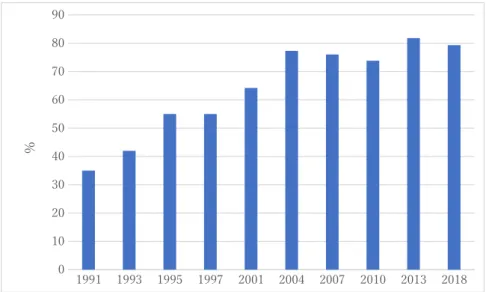
1.2 Key issue and practice: Employee Commitment and Management by Objectives However, it is very difficult to keep a psychological contract intact through HRM and leadership practices. It requires employers’ integrity. One of the well-known cases of HRM and leadership practice in Japan is the execution of Management by Objectives (MBO). This practice aims to keep a psychological contract intact during employment security. Figure 3 shows that the introduction rate of MBO by large companies in Japan increased rapidly from 1991, and it has
Figure 2: The employment and psychological contract between employees and employers
(Source) Bratton and Gold (2017) p12.
stayed at a high rate of around 80% for the last 15 years (The Institute of Labor Administration 2018 and 2010).
An employee can share the objectives of individuals and the organization through occasional meetings with leaders and followers at workplaces. Yokoyama (2004) emphasized that while aiming at the growth of individuals within the organization, MBO meetings should not result in any reward outcomes. This is important for the success of this scheme. Levinson (1970, p.134) pointed out the negative effect of MBO as self-defeating because based on the reward-punishment psychology’ as it puts pressure on the employee with no real choice of objectives (Bratton and Gold 2017, p.209).
Figure 4 shows the conceptual approach of MBO for sharing objectives at different levels of management. This is a joint agreement on the employee and employer’s goals. It includes periodical interim reviews during a stated period. In these reviews, appropriate inputs would be included and inappropriate goals would be eliminated. Subsequently, a review of the next common goals would be agreed on. There would be no punishment, but assistance would be given to each other for improved performance. This is a constant process of sharing objectives between individuals and the organization to ensure and improve commitment of the organization towards people’s growth and organizational development, and future orientation to share their individual values and organizational vision and mission. It would be based on the voluntary perception of commitment as the dignity of an employee is respected. An intrinsic approach should be taken for a successful psychological contract and resultant commitment rather than an extrinsic approach. The integrity of
1991 1993 1995 1997 2001 2004 2007 2010 2013 2018 0
10 20 30 40 50 60 70 80 90
%
Figure 3: Execution rate of MBO in the large companies in Japan (Source) The Institute of Labor Administration (2018, 2010), A questionnaire
survey of 440 companies listed on the first section of the Tokyo Stock Exchange and the equivalents.
the interests of employer to MBO is important.
1.3 Doubt in terms of human dignity and discussion at the International Labour Organization (ILO)
Boxall et al. (2008) define HRM as the management of work and people towards desired ends.
This definition may have a contradiction with the dignity of humans. As Immanuel Kant noted, that rational human beings should be treated as an end in themselves and never as a means to something else (Kant, 1785). From this perspective, Kimakowitz et al. (2011, p.5) state that utilising
‘human resources’ merely as a means of production rather than embracing as ends in themselves is the objectification of human beings within economic activities.
If the emphasis is placed on ‘resource’ in the phrase ‘human resource’, with no emphasis on the word ‘human’, then human resource falls into the objectification of human beings. Human resource is an object to be utilized. On the other hand, if the emphasis is placed on ‘human,’ then human resources could be subjective to the phrase ‘ human resources’. Human has enormous resources. For this subjectification of human resources, humans should have the right to decide for themselves without external intervention. Kimakowitz et al. (2011, p.6) pointed out that ‘avoiding this objectification and instrumentalization, people need to autonomously assume their roles to become a means to an end as a result of a self-determined process’.
The Declaration on Fundamental Principles and Rights at Work by the International Labour Organization (ILO) is a matter of concern. Mariappanadar (2019, p.8) explains that ‘ILO Conventions on human rights and industrial relations prohibits any human rights violation’. It
Figure 4: The process of Management by Objectives
means that every individual employee has the right to voluntarily choose to do any action.
The ILO was founded in 1919 by the Treaty of Versailles after the First World War. The preamble of the ILO Constitution states that ‘universal and lasting peace can be established only if it is based upon social justice’. The ILO has a unique principle of tripartism constituted by workers, employers, and government representatives to solve labour problems through the adoption and implementation of ILO Standards. After the Second World War, the ILO added the statement,
‘labour is not a commodity’, as a declaration that embodies it aims and purposes(Declaration of Philadelphia).
As the concept of HRM started to spread, the term human resources was discussed intensely around the same time of the adoption of the ILO Convention on Human Resources Development in 1975. It was the first time since the adoption of the ILO Standards that the term was widely used.
This is very interesting because it suggested how a traditional international organization based on industrial relations integrated the new concept of human resources. After meeting with largely negative opinions in the quest to adopt the concept of human resource into the ILO Standards, it was approved as the official title of ILO Standards. The policy of training and development needed a new approach apart from the traditional matter of industrial relations. A delegate of the Norwegian government voiced a representative opinion to adopt the term human resources (ILO 1975, p.8). He said that ‘this term is not only primarily associated with aspects of an economic character, but that it can also be interpreted as covering the human resources of a cultural, social and vocational nature’.
The implicit concept of human resources in the plural form is an indication of ‘unused resources’ to be developed and taken into use for the benefit of the individual and the society.
2. A Quick Review of Genealogy of HRM
2.1 History of the emergence of Labour Problems and Industrial Relations (IR)
The history of labour can be traced back to ancient slave labour as seen during the period of pyramid construction. This was the longest-lasting and worst form of forced labour. However, a large number of wage earners were created as modern employment relations improved after industrialisation in the 19th century. In the initial stages of industrialisation, no protection for wage earners caused many problems such as child labour in coal mining and inhumane labour conditions. Alcock (1971) suggested that industrialisation induced social exclusion with extensive inequality not only in material but also in psychological wealth.
This situation led to social unrest and growing complaints of the emerging working class: the proletariat. Starting from riot activity such as the Luddite movement in 1827 in the UK, unemployed workers engaged in machine breaking in protest of the introduction of machinery. It developed into
larger-scale industrial disputes in Europe and North America.
Considering the origin of the term of HRM, the genealogy in the United States is worthwhile to review. As the roots of HRM took hold, the emergence of ‘labour problems’ in the 1870s to 80s (Kaufman 2014, p.461) is an important background. One of the most serious concerns of the American society at that time was radical labour movements and violent labour battles. Kaufman (2007, p.21) indicated that the Bolshevik Revolution in Russia in 1917 caused these labour problems to become a widespread concern in the United States.
Workers encouraged the labour movement to be united as labour unions for effective negotiation with employers. These relations were called ‘industrial relations’ (IR) because these labour relations developed from the occupational level to the industry level. In due course, the term industrial relations was used extensively in the United States and Canada in 1919–20 (Kaufman 2007, p.22) because it became a powerful means for the settlement of ‘labour problems’ and fixing appropriate working conditions of employees through collective bargaining between employers’ and workers’ representatives. The term IR was used in the other regions after the Second World War.
IR requires government involvement in labour legislation for the freedom of association and the right of collective bargaining and implantation with labour inspection. Therefore, IR requires the framework of tripartism between workers, employers, and the government.
2.2 Welfare and personnel management (PM)
Another important term that was used before HRM is personnel management (PM). In general, a company needs PM in the fields of hiring, compensation, training, and in the termination of employment. However, historically, the term PM originated from industrial welfare work (Kaufman 2007, p.20). Humanitarian employers and philanthropists such as Robert Owen in the UK and Daniel Le Grand in France provided paternalistic welfare amenities to employees and their families in the 19th century. They proposed international labour legislation to improve working conditions because one nation alone could not improve it for fear of the risk of international competition. They are regarded as pioneers for the foundation of the ILO 1919.
After the First World War, American companies created a department of PM to provide welfare services to workers. The term PM was recognized as a major part of employment management.
At the time, this welfare side of personnel management pervaded in continental Europe (Kaufman 2007, p.22). The introduction of PM was accelerated in Europe and North America to mitigate radical labour movements caused by the Russian Revolution.
2.3 Scientific Management and Mass Production
Influential doctrines and the practice of new people management that appeared in the 1910s could be summarized as scientific management and mass production. Scientific management was represented by Frederick Taylor in his book Principles of Scientific Management, published in 1911. Taylor advocated for the division of planning and doing, and scientifically analysing all the tasks to be undertaken by employees as optimum tasks, and reducing time and motion waste. This movement was referred to as ‘Taylorism’. The core of Taylorism was the separation of tasks into their simplest constituent element (Bratton and Gold 2017, p.425). Japan was an early adopter of the credo of scientific management. Many study missions from Japanese businesses sponsored by the government and business associations visited the U.S. to observe the practices of scientific management in the 1920s (Kaufman 2007, p.25).
As a car manufacturer, Henry Ford applied major principles of Taylorism. The conveyor belt was installed to feed components and parts at each specified workplace in the assembly line.
Each of the tasks in the line was interdependent and had specialized machinery. Supervision of the operation of the assembly line was important to have economies of scale and lower unit costs through standardization. This came to be known as ‘Fordism’, a representative name of mass production.
Table 1 summarizes the features of Taylorism and Fordism. Both systems had serious challenges and problems over the enormous cost of supervision, workers’ dissatisfaction, and resultant high turnover. A famous movie by Charles Chaplin interestingly described inhumane working conditions in an assembly line in 1936.
In the same period, the new idea of human resources was recognized. Kaufman (2007, p.23) introduced to John Commons (1919, p.129), a statement on the conceptual transformation from the model of labour, which was regarded as a commodity to be traded and used, to ‘the combination
Table 1: Features of Taylorism and Fordism
Taylorism Fordism
Key word Scientific management Mass production Principles The division of a central plan
and simple task execution for employees
Standardization of tasks Economies of scale
Method One best way,
set optimum task by time and motion studies
Liner work sequencing in a moving conveyor line, the interdependence of tasks with specialized machinery
Challenges Cost of constant supervision,
lower commitment of workers Big hire and fire, high turnover,
dissatisfaction and deskilling of workers, and high absenteeism
Forming year 1911 1908 to 1929
of “machine” (scientific management), “goodwill” (high commitment), and “industrial citizenship”
(democratic governance) model’. The statement by Commons (1919, p.74) on the term human resource is also quoted as it suggests that the investment of human skills and education makes labour more productive and employee goodwill is a competitive advantage. This attraction of the term was transmitted to the new perspectives in the field of people management in later years.
3. The conception of Human Resource Management
3.1 Academic contribution by scholars at Harvard University
Studies of psychology centred at Harvard University contributed to the new perspectives of people management in the early stages of the predominance of IR and PM in the United States.
William James at Harvard University was the first official professor of Psychology in the United States. Figure 5 shows the result of his study that part-time workers demonstrated only 20% to 30% of their expected full ability whereas highly motivated workers demonstrated 80% to 90%. He pointed out the great degree of potential motivation on performance ( James 1890).
James invited Munsterberg from Germany to the professorship at Harvard from a German university. Germany was ‘the most active site for work in the new field of industrial psychology’
(Kaufman 2007, p.24). Munsterberg pioneered applied psychology in industry in his book, Psychology and Industrial Efficiency, published in 1913. He became the president of the American Psychological Association. These studies fostered a new movement on the importance of the human dimension of labour and long-term organizational relations (Kaufman 2014, p.466).
Employee full ability
80- 90%
Area affected by Motivation
20- 30%
Demonstrated ability
Figure 5: Potential influence of Motivation on Performance (Source) William James, 1890.
3.2 Human Relations and Humanistic psychology
Elton Mayo was appointed to the Harvard Business School (HBS) as a professor of industrial research in 1926. His research on Hawthorne experiments at the Western Electric company provided significant results, and were critical to the human relations movement in the 1940s.
Mayo identified that labour problems were caused by workers’ feelings of anomie, insecurity, and alienation which are the effects of Taylor-inspired methods (Kaufman 2014 p.473). Based on the
‘logic of human sentiments’ and the ‘logic of efficiency’, psycho-social needs of workers are very important in order to gain their effective cooperation (Kaufman 2014). It opened a door to the discussion of human dimension in the management of people. Roethlisberger, an assistant of Mayo, encouraged people to discuss management from a behavioural scientific point of view.
Intrinsic motivation theories have been one of the most popular topics in people management.
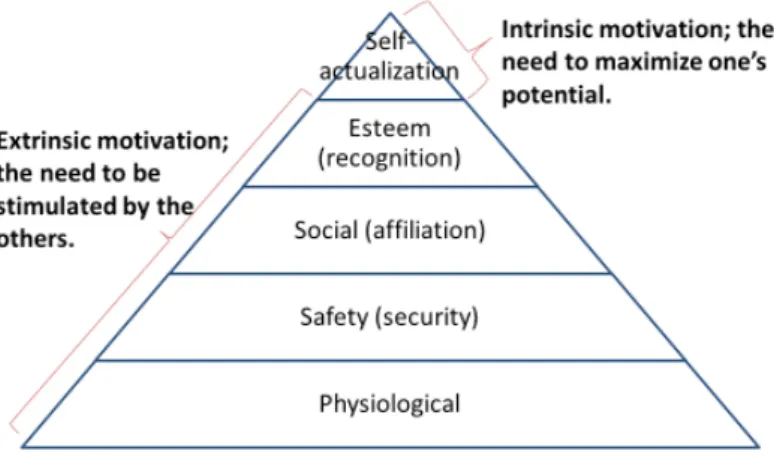
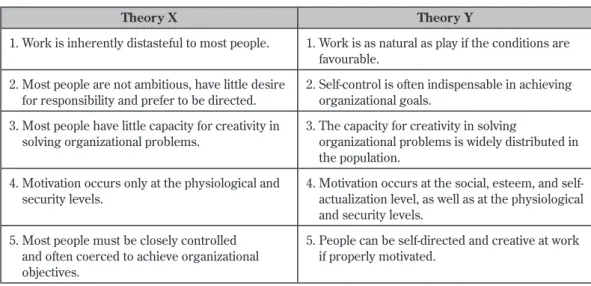
Self-actualization needs by Maslow is the most attractive concept to management. As Figure 6 illustrates, only self-actualization can be regarded as the intrinsic motivation to maximize one’s potentials, while other needs are stimulated by others as extrinsic motivations. As Table 2 shows, McGregor’s ‘ Theory X and Theory Y’ concepts are also well-known to be integrated into PM. He suggests that management based on Theory Y should be explored. Chris Argyris proposed the concept of maturity, and Theory Y should be respected in the practice of management in terms of intrinsic motivation. Additionally, Frederick Herzberg raised the Motivation-Hygiene Theory.
Hygiene factors are the characteristics associated with job dissatisfaction with no growth in output and capacity. On one hand, these are environmental factors such as money, working conditions, interpersonal relations, and supervision. On the other hand, motivators are positive effects on satisfaction with greater output. These are contained in the job itself such as achievement, recognition, growth and development and increased responsibility.
These models were called humanistic psychology because they are based on the dignity of
Figure 6: Maslow's Hierarchy of Needs
the human being. The process of forming HRM involved the study of Organizational Development and Organizational Behaviour (OD/OB). Kaufman (2007 p.35) cited the findings of Martin (1975);
the five most cited academic authors in the practitioner personnel literature were all behavioural scientists associated with OB/OD: Herzberg, MacGregor, Porter, Maslow, and Argyris.
3.3 The Harvard model of HRM
Thus, there had been an active contribution of academic theory to the new method of people management in the United States. Furthermore, proximity to the scholar might have promoted the interaction of the theories. Harvard University, for example, had played a key role in this interaction. Table 3 shows the major development of the ideas.
Table 2: McGregor’s Theory X and Theory Y
Theory X Theory Y
1. Work is inherently distasteful to most people. 1. Work is as natural as play if the conditions are favourable.
2. Most people are not ambitious, have little desire
for responsibility and prefer to be directed. 2. Self-control is often indispensable in achieving organizational goals.
3. Most people have little capacity for creativity in
solving organizational problems. 3. The capacity for creativity in solving
organizational problems is widely distributed in the population.
4. Motivation occurs only at the physiological and
security levels. 4. Motivation occurs at the social, esteem, and self- actualization level, as well as at the physiological and security levels.
5. Most people must be closely controlled and often coerced to achieve organizational objectives.
5. People can be self-directed and creative at work if properly motivated.
Table 3: Contribution to the concept of Human Resource Management by Harvard scholars
Years Advocator Ideas
1890 William James Principles of Psychology; The effect of motivation
1913 Munsterberg Pioneering applied psychology in industry.
In 1898 he was elected the president of the American Psychological Association.
1930s
1940s Mayo/
Roethlisberger Human relations movement;
Social side of work; Hawthorne experiments 1960s Maslow*, McGregor* Humanistic psychology
1969 Sterling- Livingston Pygmalion Management (Note) * They are not associated with Harvard University.
In particular, HBS has led the new trends of practical management. Pygmalion in management written by Sterling-Livingston at HBS in 1969, for example, had an extensive popularity for the business world, and it was repeatedly printed in the Harvard Business Review. The Pygmalion effect can be summarized as follows (Sterling-Livingston 1969). If managers’ expectations are high, productivity is likely to be excellent. If their expectations are low, productivity is likely to be poor. It is as though there was a law that caused subordinates’ performance to rise or fall to meet managers’
expectations. This study finds that the above quote was an impressive message from George Bernard Shaw’s Pygmalion.
In the play, the former flower girl said that ‘the difference between a lady and a flower girl is not how she behaves but how she’s treated. I shall always be a flower girl to Professor Higgins because he always treats me as a flower girl and always will; but I know I can be a lady to you because you always treat me like a lady and always will’.
It had a stimulating message to people management in that how you treat people is more important than how people perform. The organization can release the potentials of people by the way they treat their employees. It suggested a change of perspectives of people management.
HBS set up the first course of HRM as a core subject in 1981. The leading professor, Beer, and his team released the Harvard model of Human Resource Management in the book published in 1984.
The implication of the Harvard model to HRM can be summarized as follows (Bratton and Gold 2017, p.22).
1. Human Resource Outcome has 4Cs: commitment, competence, congruence, and cost- effectiveness. These form the prescriptive for HRM.
2. These outcomes lead to long-term effects on organizational effectiveness and societal well-being.
These long-term consequences have a feedback loop to stakeholder interests, situational factors, and HR policies.
3. HRM is indivisible from human growth and dignity at work. Bratton and Gold indicated that ‘the underlying assumption built into the framework is that employees have talents that are rarely fully utilized’ based on the assumption inherent in McGregor’s ‘ Theory Y’ (Bratton and Gold 2017, p.22).
4. The strength of the Harvard model lies in its classification of inputs and outcomes at both organizational and societal levels. The Harvard model was the first comprehensive statement on the nature of HRM (Bratton and Gold 2017, pp.19-20).
Kaufman (2007, p.34) summarized the claim by Beer that ‘IR/PM are reactive, piecemeal
part of a command and control the employment system, mediators of conflicting interests, and takes a short-term perspective; HRM, on the other hand, is proactive, integrative, part of employee commitment, and the participation system’.
John Storey (1992) provided a distinction between IR/PM and HRM as shown in Table 4.
Storey (1989) identified the development of two streams of HRM after the Harvard model. He labelled the Harvard model as Soft HRM whereas the other stream was labelled Hard HRM.
Soft HRM can be rooted in human relations school, focusing on the improvement of workers’
commitment by the care of relationship of workers (Bloisi 2007,p.14).
Figure 7: The Harvard Model of HRM (Source) adapted from Beer, et al. (1984),
some parts have been changed and added by the author.
Table 4: Points of difference PM/IR and HRM
PM/IR HRM
Assumptions ①Compliance
②Monitoring
③High Standardization
①Commitment
②Nurturing
③Low Standardization
Managerial aspects ①Supervision
②Separate
③Execution
①Development
②Integrated
③Independent and participation
Strategic aspects ①Short term
②Formal, centralized
③Cost minimization
①Long term
②Organic, flexible
③Maximum utilization (Source) Adapted from Storey (1992)
4. Conclusion
Before the extensive agreement on the concept of human resource and HRM, there have been various developments concerning people management. Rising ‘ labour problems’ required one to face the need for solving radical labour conflicts between employers and employees. The terms IR and PM appeared before this period.
In the process of modern industrialisation, the school of human relations and the contribution of psychology and behavioural sciences moved the direction of the theory and applied practices into a new direction away from traditional IR and PM. In particular, the academics at business schools in the United States started to use the term human resource and set up a course in HRM at the Harvard Business School in the 1980s. Beer et al. released the Harvard Model of HRM as a comprehensive model for analytical works and prescriptive work for academics and practitioners.
The adoption of the ILO Standards concerning human resources development was interesting to see how the traditional international system based on IR and PM integrated the concept of human resources without denouncing the objectification of people as resources. The ILO was set up in 1919 after the First World War so that it could adopt International Labour Standards to solve labour problems by international action. After the Second World War, the ILO restarted as a specialized agency of the United Nations, clarifying the principle that ‘labour is not a commodity’.
The perspective of the ‘subjectivisation’ of humans was kept in the ILO Standards. The introduction of the term human resources was a symbolic event and coherent with the development of IR and PM.
This review is important as it helps to understand the point of departure from the traditional concepts to the concepts of human resources and HRM as seen today. Business requires renewed people management in globalizing and realizing their Sustainable Development Goals.
Acknowledgement
The author would like to thank Editage (www.editage.jp) for English language editing.
References
Alcock, A. (1971) History of International Labour Organization, Macmillan, London, p.6.
Beer, M. Spector, B., Lawrence, P. R., Quinn Mills, D. and Walton, R. E. (1984) Managing Human Asset, The Free Press, New York.
Bloisi, W. (2007) An Introduction to Human Resource Management, McGrow-Hill, Berkshire.
Boxall, P. F., and Purcell, J. (2016) Strategy and Human Resource Management (4th edition), London, Palgrave.
p.1.
Boxall, P. F., Purcell, J., Wright, P. M. (ed) (2008) The Oxford Handbook of Human Resources Management, Oxford University Press.
Bratton, J. and Gold J. (2017) Human Resource Management: Theory and Practice, 6th edition, Palgrave Macmillan.
Commons, J. (1919) Industrial Goodwill, McGraw-Hill, New York. cited in Kaufman (2007).
Guest, D. E. and Conway, N. (2002) ‘Communicating the Psychological contract: an employer perspective’, Human Resource Management Jurnal,12 (2):22 - 38.
ILO (1975) Human Resources Development: Vocational guidance and vocational training. Report IV (2), International Labour Conference 60th Session, Geneva.
The Institute of Labor Administration (2018, 2010) Survey of the execution of human resource management schemes in 440 private companies in Japan (in Japanese), Tokyo, September 5.
James, W. (1890) The Principles of Psychology, 1. Macmillan, London.
Kant, I. (1785) Groundwork of the Metaphysic of Morals, Koenigsberg.
Kaufman, B. E. (2007) The Development of HRM in Historical and International Perspective, in Boxall P. Purcall J., Wright P. (ed.) (2007) The Oxford Handbook of Human Resource Management, Oxford University Press.
Kaufman, B. E. (2014) The origins, evolution, and current status of human resource management in the United States, The development of human resource management across Nations: Unity and Diversity, (Kaufman ed), Edward Elgar Pub.
Kimakowitz, E. V., Pirson, M., Spitzeck, H., Dierkmeier, C., Aman, W., (2011) Humanistic Management in Practice, Humanism in Business Series, Palgrave Macmillan, London.
Levinson, H. (1970) ‘Management by whose objectives?’, Harvard Business Review, July/August.
Mariappanadar, S. (ed)(2019) Sustainable Human Resource Management : Strategies, Practices and Challenges (Management, Work and Organisations), Red Globe Pr.
Martin, J. (1975 ) ‘The influence of the Behavioral Sciences on Management Literature’, Personnel Journal, 54/March. pp.150-153.
Sato et al. (1999) Atarasii Jinji Romu Kanri (New personnel management), Yuhikaku, Tokyo.
Sterling-Livingston, J. (1969, 1988 reprinted) ‘Pygmalion in Management’, Harvard Business Review, September - October 1988.
Storey, J. (1989) New Perspectives of Human Resource Management, Routledge, London.
Storey, J. (1992) Development in the Management of Human Resources, Oxford, Blackwell.
Yokoyama, T. ed. (2004) Career Development and Career Counseling (in Japanese), Japan Productivity Center, Tokyo.