Introduction
In 1986, Bentall described a technique for replacement of the ascending aorta and aortic valve using a composite graft in reconstruction surgery for aortic root diseases.
1)Later, a variety of modified surgical procedures for reconstruction of coronary arteries
2-4)were devised and the safety and du- rability of such procedures have been established.
4-9)Aortic root replacement (the Bentall operation) has achieved excellent surgical outcomes with no significant
difference in survival among pathological conditions, ac- cording to several reposts.
6,8,9)But the outcomes of proce- dures that require graft replacement of the ascending aorta and aortic arch simultaneously with aortic root replacement, remain clear. In this report we investigated the clinical out- comes including postoperative health-related quality of life (QOL) by dividing cases undergoing aortic root replacement into subgroups according to the extent of replacement of the aorta.
MS#AMN 07132
Influence of the extent of aortic replacement on survival and quality of life in patients with aortic root replacement
Daisuke O
NOHARA, Koji H
ASHIZUME, Tsuneo A
RIYOSHI, Yoichi H
ISATA, Takashi M
IURA, Kazuyoshi T
ANIGAWA, Tomohiro O
DATE, Wataru H
ASHIMOTO, Kiyoyuki E
ISHIDepartment of Cardiovascular Surgery, Graduate School of Biomedical Science, Nagasaki University, Nagasaki, Japan
Background: The influence of the extent of aortic replacement on the aortic root replacement is unclear. We investigated the clinical outcomes of the aortic root replacement in terms of the extent of aortic replacement and evaluated quality of life (QOL) after surgery.
Methods: Thirty six patients were enrolled in this study. The mean age was 59.0 ± 13.1 years. The 36 patients were divided into three groups according the extent of aortic replacement: 21 patients with replacement of the ascending aorta (SB), 7 pa- tients with hemi-arch replacement (HB), and 8 patients with total aortic arch replacement (TB). Postoperative health-related QOL was evaluated by SF-36 Version 2.
Results: The hospital mortality in the 36 patients was 2.8%. The patient (TB) died from fungal infection of the prosthetic graft. Three late deaths (8.6%) were observed: cerebral hemorrhage in one (SB), pneumonia in one (SB), and unknown in one (HB). The 5-year survival was 94.1 ± 5.7% in the SB group, 100% in the HB and 87.5 ± 11.7% in the TB groups, respectively (p=0.84). One patient (4.8%) in the SB group had an aorta-related event 7 years after surgery. No patinets had aorta-related events in both the HB and the TB groups. There was no significant difference in postoperative health-related QOL among the three groups.
Conclusions: Aortic root replacement at our hospital achieved excellent results. Neither long-term survival nor postopera- tive QOL differed significantly according to the extent of aortic root replacement. We plan to extend the present study by in- cluding a larger number of subjects.
ACTA MEDICA NAGASAKIENSIA 58: 49−56, 2013 Key words: aortic root replacement, Bentall operation, SF-36, health-related QOL
Address correspondence: Daisuke Onohara, Department of Cardiovascular Surgery, Graduate School of Biomedical Science, Nagasaki University, 1-7-1, Sakamoto, Nagasaki 852-8501, Japan
Telephone: +81-95-819-7307, Fax: +81-95-819-7311, E-mail: [email protected] Received April 3, 2013; Accepted June 3, 2013
Materials and Methods Patients
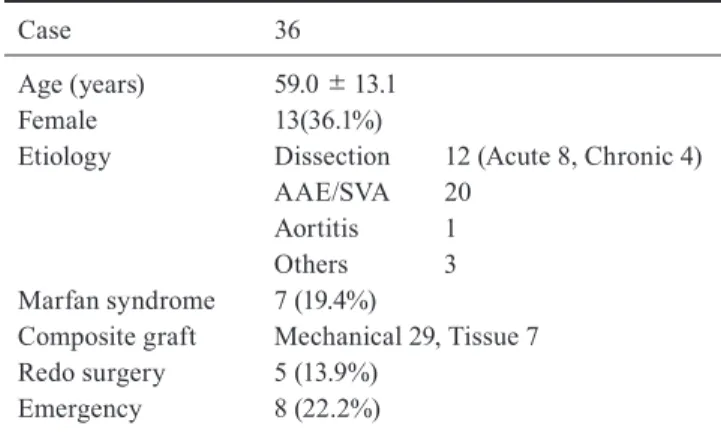
Between April 1999 and September 2011, 36 patients un- derwent aortic root replacement at our hospital. Preopera- tive patient characteristics are summarized in Table 1. The mean age of patients was 59.0 ± 13.1 years (range 25 - 70 years); 23 patients were male and 13 were female. The rea- sons for operation were aortic dissection in 12 patients (acute 8, chronic 4), annuloaortic ectasia/sinus of Valsalva aneurysm in 20 patients, aortitis syndrome in 1 patient, and others in 3 patients. Seven patients had Marfan syndrome (19.4%). Eight emergency operations (22.2%) and five reop- erations (13.9%) were included.
The 36 patients were divided into three groups according to the extent of replacement of the aorta: 21 patients who
underwent aortic root replacement with simple clamping of the ascending aorta (SB group), 7 patients who underwent aortic root replacement and hemi-arch replacement with open distal anastomosis technique combined with deep hy- pothermic circulatory arrest (DHCA)/selective antegrade cerebral perfusion (SACP) (HB group), and 8 patients who underwent aortic root replacement and total arch replace- ment (TB group).
Surgical outcomes and mid-term results were then com- pared. Table 2 shows demographics of the three groups. The mean age at operation was 59.9 ± 13.8 years in the SB group, 65.6 ± 8.7 years in the HB group, and 50.6 ± 11.2 years in the TB group. Compared with the SB and HB groups, the mean age tended to be lower in the TB group, but this difference was not significant (p = 0.07). In the SB group, annuloaortic ectasia was the cause in 18 of 21 pa- tients (85.7%). In the TB group, 7 patients (87.5%) had aor- tic dissection and so there were 6 emergency cases (75.0%).
Surgical Techniques
Basically, cardiopulmonary bypass was instituted by cannulation of the ascending aorta in cases with true aneu- rysm (annuloaortic ectasia/sinus of Valsalva aneurysm and aortitis syndrome). Cannulation of the femoral artery was employed in cases with acute aortic dissection and reopera- tion. For prevention of cerebral embolism by retrograde per- fusion from the femoral artery alone, a combination proce- dure with cannulation of the right axillary artery has been employed since 2008. Aortic root replacement was under- taken according to the inclusion technique, and the button
Table 1. Patient ProfileCase 36
Age (years) Female Etiology
Marfan syndrome Composite graft Redo surgery Emergency
59.0±13.1 13(36.1%)
Dissection 12 (Acute 8, Chronic 4) AAE/SVA 20
Aortitis 1 Others 3 7 (19.4%)
Mechanical 29, Tissue 7 5 (13.9%)
8 (22.2%)
AAE = annuloaortic ectasia, SVA = sinus of Valsalva aneurysm
Table 2. Preoperative Data
SB (n=21) HB (n=7) TB (n=8) p-Value
Age (years) Female Etiology
Dissection AAE/SVA Aortitis Others Marfan syndrome logistic Euro score(%) Emergency
Shock (preope.) Redo surgery
59.9±13.8 5(23.8%)
1 18
0 2 2 2.7±1.9
1 1 2
65.6±8.7 5(71.4%)
4 1 1 1 4.6±12.8
1 1 1
50.6±11.2 3(37.5%)
7 1 0 0 4 5.94±3.71
6 2 2
0.07 0.22
<0.001
<0.001 0.12 0.58 0.04 0.01
<0.001 0.29 0.56 SB = group of patients who underwent aortic root replacement with simple clamping of the ascending aorta, HB = group of patients who underwent aortic root replacement and hemi-arch replacement with open distal anastomosis technique combined with deep hypothermic circulatory arrest (DHCA)/selective antegrade cerebral perfusion (SACP), TB = group of patients who underwent aortic root replacement and total arch replacement, AAE = annuloaortic ectasia, SVA = sinus of Valsalva aneurysm
technique was used in all cases undergoing coronary artery reconstruction.
10,11)While the aortic arch was being recon- structed, SACP was used (this has been in use since August 2001); DHCA at 20ºC was previously used. For replacement of the aortic arch, moderate hypothermia at 27ºC and open distal anastomosis under circulatory arrest was employed.
Aortic arch branches were reconstructed by the island tech- nique between September 1999 and December 2003, and reconstruction of each such vessel with a branched aortic graft has been employed since then. In this study, recon- struction by the island technique was performed in only 1 patient.
Bioprosthetic valves were used for patients of 70 years or older and mechanical valves were used in cases aged young- er than 70 years and in those undergoing hemodialysis.
Warfarin intake was continued for only three months post- operatively in cases with bioprosthetic valve implantation without atrial fibrillation and for life in cases with mechani- cal valve implantation.
Follow-up
The follow-up rate was 100%. The follow-up period was 8.1 ± 3.2 years in the SB group, 6.6 ± 3.6 years in the HB group, and 5.7 ± 3.3 years in the TB group, and these peri- ods did not differ significantly among the three groups.
Postoperative imaging was performed three and six months after discharge from our hospital. Thereafter, imaging was perfprmed every year. However, such long-term follow-up was not possible for patients seen at other hospitals. There- fore, no imaging follow-up was available in some of these patients.
Definitions
Thromboembolic events ware defined as documented episodes resulting in transient or permanent central nervous system, visceral, or peripheral ischemia. Complications re- lated to anticoagulant therapy were defined as bleeding epi- sodes necessitating hospitalization or blood transfusion.
Aortic events were defined as size enlargement, re-interven- tion, and aorta-related death.
Evaluation of postoperative QOL
SF-36 Version 2 (Japanese version) was employed for evaluation of postoperative health-related QOL. SF-36 Ver- sion 2 contains 8 subcategories: physical functioning (ab- breviated PH), role physical (RP), bodily pain (BP), general health (GH), vitality (VT), social functioning (SF), role emotional (RE), and mental health (MH). Role functioning
reflects the impact of physical and emotional impairment on work and normal daily activity. All the patients who sur- vived in-hospital period received an SF-36 questionnaire.
Nonresponders were reminded after 3months. The three groups were scored and compared on a scale of 0 – 100 points and norm-based scoring, which is a general popula- tion mean score of 50 and a standard deviation of 10.
Statistical analysis
Demographic characteristics of patients and outcome variables were expressed either as a percentage of the total or as the mean ± standard deviation (SD). Continuous vari- ables between two groups were compared using Studentʼs t-test and comparisons between categorical values were per- formed using chi-square analysis. Comparisons among three groups were performed with a Turkey-Kramer multi- comparison test and the Bonferroni/Dunn method. Survival rates and cumulative rates of freedom from aortic events were calculated using the Kaplan-Meier method. Statistical analyses were carried out using the Stat-View (Version 5.0) statistical analysis software package (Abacus Concepts, Berkeley, CA, USA). P-values less than 0.05 were consid- ered significant.
Results
Table 3 shows operation details. Operation time was 312
± 65 min in the SB group, 405 ± 75 min in the HB group, and 526 ± 183 min in the TB group. It was significantly shorter in the SB group than in the TB group (p < 0.01).
Cardiopulmonary bypass time was 148 ± 36 min in the SB group, 215 ± 58 min in the HB group, and 276 ± 105 min in the TB group. It was significantly shorter in the SB group than in the HB group (p < 0.01) and TB group (p < 0.01).
Aortic cross-clamp time was 102 ± 17 min in the SB group, 120 ± 32 min in the HB group, and 179 ± 51 min in the TB group. It was not significantly different between the SB and HB groups but significantly shorter in the SB and HB groups than in the TB group (p < 0.01). In the SB group, ascending aorta cannulation was performed in 17 patients (81.0%), femoral artery in 3 (14.3%), and axillary artery and femoral artery simultaneously in 1 (4.7%). In the HB group, ascend- ing aorta cannulation was performed in 2 patients (28.6%), femoral artery alone in 3 (42.8%), and axillary and femoral arteries simultaneously in 2 (28.6%). SACP was employed in 4 patients (57.1%) and DHCA was employed in 3 (42.9%).
In the TB group, femoral artery cannulation was performed
in 5 patients (62.5%), axillary and femoral artery simultane- ously in 3 (37.5%), and selective cerebral perfusion was per- formed in all cases.
Early outcomes
In-hospital mortality among all 36 patients was 2.8%.
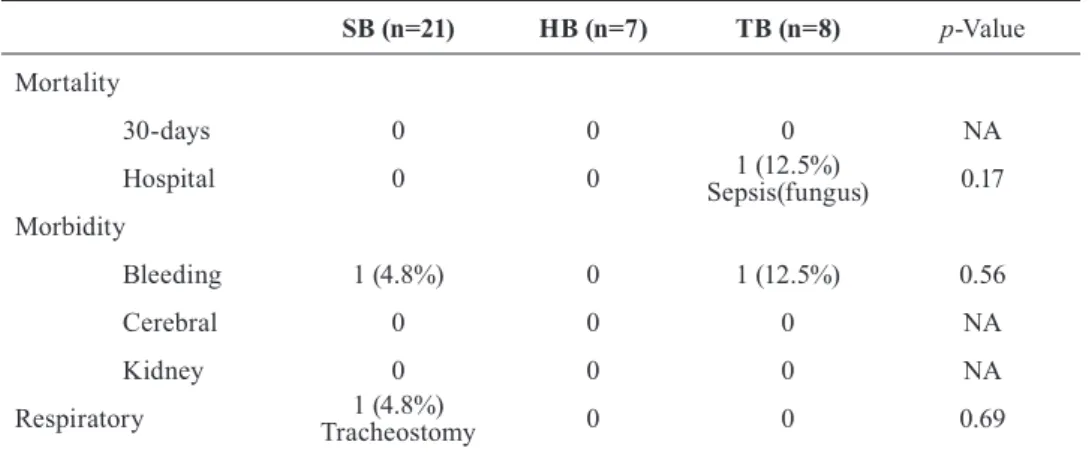
Table 4 shows outcomes of operations for the three groups.
There was no death within 30 days after surgery in any group, however there was one in-hospital death in the TB group and in-hospital mortality was 12.5%. This patient un- derwent an emergency operation for acute aortic dissection (Stanford type A) associated with Marfan syndrome, and
re-sternotomy was performed for postoperative bleeding from the aortic root. On postoperative day 99, the patient died from fungal infection of the prosthetic graft. No patient required dialysis or suffered a stroke in any group. Trache- otomy was carried out in 1 patient for airway stenosis after tracheal extubation in the SB group; the airway stenosis was thereby alleviated and the tracheostoma was closed before the patient was discharged from hospital. Postoperative bleeding was observed in 2 patients (5.6%): 1 patient in the TB group (12.5%) described above, and 1 patient in the SB group (4.8%). In the latter patient, circulatory insufficiency was caused by postoperative mediastinal hematoma and the hematoma was removed on postoperative day 6.
Table 3. Details of the Operation
SB (n=21) HB (n=7) TB (n=8) p-Value
Operation
operation time CPB time Cross-clamp time Brain protection
DHCA SACP Arterial cannulation Asc. Ao Femoral
Femoral + Axillary
312±65 148±36 102±17
0 0 17
3 1
405±75 215±58 120±32
3 4 2 3 2
526±183 276±105 179±51
0 8 0 5 3
<0.001
<0.001
<0.001 0.001
<0.001
<0.001 0.03 0.07 SB = group of patients who underwent aortic root replacement with simple clamping of the ascending aorta, HB
= group of patients who underwent aortic root replacement and hemi-arch replacement with open distal anasto- mosis technique combined with deep hypothermic circulatory arrest (DHCA)/selective antegrade cerebral per- fusion (SACP), TB = group of patients who underwent aortic root replacement and total arch replacement, CPB
= cardiopulmonary bypass, DHCA = deep hypothermic circulatory arrest, SACP = selective antegrade cerebral perfusion, Asc. Ao = ascending aorta
Table 4. Early Outcomes
SB (n=21) HB (n=7) TB (n=8) p-Value
Mortality 30-days Hospital Morbidity Bleeding Cerebral Kidney Respiratory
0 0
1 (4.8%) 0 1 (4.8%)0 Tracheostomy
0 0
0 0 0 0
1 (12.5%) 0 Sepsis(fungus)
1 (12.5%) 0 0 0
NA 0.17
0.56 NA NA 0.69 SB = group of patients who underwent aortic root replacement with simple clamping of the ascending aorta, HB = group of patients who underwent aortic root replacement and hemi-arch replacement with open distal anastomosis technique combined with deep hypothermic circulatory arrest (DHCA)/selective antegrade cerebral perfusion (SACP), TB = group of patients who underwent aortic root replacement and total arch replacement, NA = not available
Late outcomes
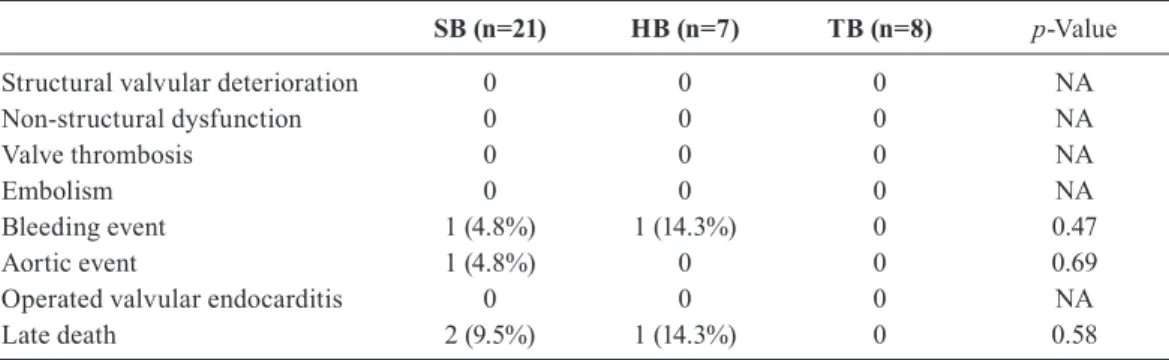
There have been 3 late deaths (8.6%): 2 patients (9.5%) in the SB group and 1 (14.3%) in the HB group. The causes of death in the SB group were cerebral hemorrhage (5 years after operation) and pneumonia (6 years after operation).
The 1 patient in the HB group died 11 years post operation, but the cause of death was unidentified. According to the Kaplan-Meier method, the 5-year and 10-year survival rate after surgery in the 36 patients was 93.5 ± 4.5% and 89.4
± 5.9% respectively. The 5-year survival was 94.1 ± 5.7%
in the SB group, 100% in the HB group, and 87.5 ± 11.7%
in the TB group, respectively (p=0.84. Figure 1). Only 1 patient (4.8%) in the SB group had an aorta-related event.
This case, after root replacement for annuloaortic ectasia,
developed a ruptured pseudoaneurysm at the distal side of the anastomosis 7 years after surgery. The patientʼs life was saved by emergency graft replacement of the aortic arch.
Actuarial freedom from aorta-related events in the 36 pa- tients was 100% at 5 years and 93.8± 6.1% at 8 years. The 7-year freedom from aorta-related events were 91.7 ± 8.0%
in the SB group, 100% in both the HB and TB groups (Fig- ure 2). No case developed reconstructed coronary artery events or artificial valve-related events in any group. Re- garding late morbidity, cerebral hemorrhage was observed in 1 patient (4.8%) in the SB group and 1 patient (14.3%) in the HB group. In both cases, a mechanical valve was used.
No case developed thromboembolism or prosthetic valve endocarditis (Table 5).
A
B
Figure1.Cumulative survival after root replacement Figure 1. Cumulative survival after root replacement
(A)All patient, and (B)Survival curves of each of the three groups SB = group of patients who underwent aortic root replacement with simple clamping of the ascending aorta, HB = group of pa- tients who underwent aortic root replacement and hemi-arch re- placement with open distal anastomosis technique combined with deep hypothermic circulatory arrest (DHCA)/selective antegrade cerebral perfusion (SACP), TB = group of patients who underwent aortic root replacement and total arch replacement
A
B
Figure2. Actuarial freedom from aorta-related events Figure 2. Actuarial freedom from aorta-related events
(A)All patient, and (B)freedom from aortic related events of each of the three groups
SB = group of patients who underwent aortic root replacement with simple clamping of the ascending aorta, HB = group of pa- tients who underwent aortic root replacement and hemi-arch re- placement with open distal anastomosis technique combined with deep hypothermic circulatory arrest (DHCA)/selective antegrade cerebral perfusion (SACP), TB = group of patients who underwent aortic root replacement and total arch replacement
Health-related QOL
Figure 3 shows the results from SF-36. The results in 33 patients, except for 2 patients with dementia and 1 patient with schizophrenia, are shown. There was no significant difference among the three groups in SF-36 subcategory score (0–100). Moreover, there was no significant difference in norm-based scoring. Considering the norm-based scor- ing, physical function and daily role function (physical) tended to be lower, but there was no significant difference in
postoperative QOL due to difference in the degree of re- placement.
Discussion
This study showed the following three results: Firstly, aortic root replacements we have performed showed excel- lent results including, those in the long-term. Secondly, the extent of replacement of the aorta had no impact on long-
Table 5. Late OutcomesSB (n=21) HB (n=7) TB (n=8) p-Value
Structural valvular deterioration Non-structural dysfunction Valve thrombosis
Embolism Bleeding event Aortic event
Operated valvular endocarditis Late death
0 0 0 0 1 (4.8%) 1 (4.8%)
0 2 (9.5%)
0 0 0 0 1 (14.3%)
0 0 1 (14.3%)
0 0 0 0 0 0 0 0
NA NA NA NA 0.47 0.69 NA 0.58 SB = group of patients who underwent aortic root replacement with simple clamping of the ascending aorta, HB = group of patients who underwent aortic root replacement and hemi-arch replacement with open distal anastomosis technique combined with deep hypothermic circulatory arrest (DHCA)/selective antegrade cerebral perfusion (SACP), TB = group of patients who underwent aortic root replacement and total arch replacement, NA = not available
A B
Figure3. Mid-term results with SF-36 ver.2 (PF=physical functioning; RP=physical role functioning;
BP=bodily pain; GH=general health; VT=vitality; SF=social functioning; RE=emotional role functioning; MH=mental health.)
Figure 3. Mid-term results with SF-36 ver.2 (PF=physical functioning; RP=physical role functioning; BP=bodily pain; GH=general health; VT=vitality; SF=social functioning; RE=emotional role functioning; MH=mental health.)
(A)SF-36 subscale scores (0 – 100) in the SB, HB, and TB groups were: PF: 74.4 ± 28.2, 71.0 ± 26.3, 87.0 ± 7.58; RP: 74.3 ± 33.4, 67.5 ± 33.5, 73.4 ± 28.7; BP: 81.9 ± 29.2, 96.8 ± 7.16, 73.4 ± 28.7; GH: 56.2 ± 21.2, 60.0 ± 9.08, 48 ± 10.2; VT: 66.5 ± 21.3, 66.3 ± 23.6, 61.3 ± 27.7; SF: 74.3 ± 29.5, 92.5 ± 11.2, 77.5
± 20.5; RE: 75.5 ± 32.5, 85.0 ± 20.7, 78.3 ± 24.0; MH3: 71.8 ± 17.7, 72.0 ± 19.6, 74.0 ± 18.5, respec- tively. There was no significant difference in each subcategory among the three groups.
(B)The scores in the SB, HB, and TB groups according to the norm-based scoring were: PF: 39.4 ± 20.4, 36.9
± 19.0, 48.5 ± 5.47; RP: 42.0 ± 17.8, 38.4 ± 17.8, 45.8 ± 7.79; BP: 53.6 ± 13.0, 60.3 ± 3.19, 49.8 ± 12.8;
GH: 46.4 ± 11.3, 48.4 ± 4.84, 42.1 ± 5.46; VT: 51.9 ± 10.9, 51.8 ± 12.1, 49.2 ± 14.3; SF: 43.8 ± 16.2, 48.6 ± 10.4, 45.2 ± 12.0; RE: 43.8 ± 16.2, 48.6 ± 10.4, 45.2 ± 12.0; MH: 50.1 ± 9.5, 50.2 ± 10.5, 51.3 ± 9.9, respectively. There was no significant difference in each subcategory among the three groups.
term survival and . Thirdly, the extent of replacement had no influence on postoperative QOL.
Previous reports showed in-hospital mortality of aortic root replacement to be 5.2-10.6%, 5-year survival of 77.7- 87.0%, 10-year survival of 63.0-79.9%, 5-year reoperation- free rate of 71- 96.3%, and 10-year reoperation-free rate of 81-92.2%.
4-9)The results for the 36 cases in this study exhib- ited in-hospital mortality of 2.8%, 5-year survival of 93.5 ± 4.5%, 10-year survival of 89.4 ± 5.9%, and 5-year and 8-year reoperation-free rates to be 100% and 93.8 ± 6.1%, respectively.
Our results are comparable to, or even better than those pre- viously reported, showing the rationality of our treatment strategies and operation techniques for aortic root diseases.
Aortic root replacement is more invasive than cardiac procedures such as valvular surgery and coronary artery bypass grafting, because it requires several surgical tech- niques such as aortic valve replacement, coronary artery reconstruction, and prosthetic graft replacement. Further- more, in cases with a wide-ranging aortic lesion, aortic arch replacement is sometimes necessary at the same time as aortic root replacement. In such cases, the risk of cerebral complications due to the surgical maneuver on the branches of the aortic arch, and invasiveness due to the prolonged cardiopulmonary bypass and overall operation times, have adverse effects on the outcome of the operation. Czerny et al. reported that preoperative instability of hemodynamics, cardiopulmonary bypass time, and postoperative permanent cerebral complications were independent risk factors for mortality from aortic arch aneurysm replacement by hypo- thermic circulatory arrest.
12)In this study, there was only one in-hospital death in the TB group, and this case was considered to be high-risk.
This patient required an emergency operation for aortic dis- section of Stanford type A associated with Marfan syn- drome, and we consider that preoperative unstable hemody- namic conditions and prolonged cardiopulmonary bypass time had a negative impact on surgical outcome. Compared with the SB and HB groups, patient background in the TB group was characteristic, with Marfan syndrome in 50%, acute aortic dissection in 88%, emergency cases in 75%, and preoperative shock in 25%. Since most cases in the TB group requiring aortic arch replacement in addition to aor- tic root replacement, and needing an emergency operation, exhibited unstable preoperative hemodynamics, the periop- erative risk was high. Therefore the SB and HB groups with stable preoperative conditions showed excellent surgical outcomes in this study, it will be a future challenge to im- prove surgical outcomes in severe cases in the TB group.
A striking finding in this study was the fact that no case
had perioperative cerebral complications. The strategies for cardiopulmonary bypass in aortic arch replacement that we have employed were: 1) a combination of axillary artery and femoral artery cannulation (to prevent retrograde perfusion- derived cerebral complications), 2) moderate hypothermic circulatory arrest at 27ºC, and 3) selective antegrade cere- bral perfusion. Of these, the combination of axillary artery and femoral artery cannulation has been reported to be markedly useful for prevention of perioperative cerebral complications,
13)which is consistent with our results. Axil- lary artery cannulation is considered an indispensable aux- iliary method to prevent cerebral complications in aortic arch branch reconstruction.
In this study, 1 patient (4.8%) in the SB group had an aortic arch pseudoaneurysm rupture 7 years post operation.
On the other hand, there were no long-term aortic complica- tions in the HB and TB groups. The one case in the SB group described above had been followed up using imaging modalities at our hospital for 5 years after surgery; however, this patient has been treated with oral medication alone at the nearby clinic since then, and image evaluation of the distal side of the anastomosis has not been undertaken. The experience of this case suggests the importance of periodi- cal imaging evaluation. This is because there was a possi- bility of developing a pseudoaneurysm long-term after the initial operation in the SB group which had a large distal anastomosis at the site of the ascending aorta, in particular, at the time of operation
14). In this study, there was no aortic complication long after operation in the HB and TB groups.
However, since some cases with dissection of the descend- ing aorta may show increase in diameter of a pseudo-lumen long after operation, continuous imaging evaluation is in- dispensable in such cases.
Recently the technique of valve sparing (reimplantation technique
15)and remodeling technique
16)) has been employed to prevent long-term complications associated with artifi- cial valves used in the Bentall operation. The advantages of this operation include preservation of physiological func- tions of aortic valves and sinuses of Valsalva as well as the absence of a need for anticoagulation therapy. In this study, 2 patients (5.6%), 1 in the SB group and 1 in the HB group, developed cerebral hemorrhage long-term post operation.
Although the cause of cerebral hemorrhage was not identi- fied, both cases underwent mechanical valve implantation and had taken warfarin. The anticoagulation therapy may have been the cause of postoperative cerebral hemorrhage.
An aortic valve sparing procedure may replace aortic root
replacement in preventing hemorrhagic complications after
surgery.
17)To date, several studies have reported QOL after aortic surgery,
18-21)but no report has examined QOL with different extent of aortic root replacement. The present study showed that the extent of aortic replacement did not have a negative influence on QOL after surgery. In all cases in the TB group, SACP was employed for protection of brain tissue and it was speculated that this auxiliary method contributed to preven- tion of a reduction in QOL due to prolonged extracorporeal circulation time. We consider that our brain protection strat- egy during cardiopulmonary bypass is useful in patients requiring total arch replacement in addition to aortic root replacement. Previous reports showed that the duration of DHCA had an adverse effect on postoperative QOL,
19)but DHCA was performed in only 3 of 36 patients in this study.
We could not therefore evaluate the relationship between the duration of DHCA and postoperative QOL.
Limitations
This study has several limitations. First, the number of subjects in each group was small, especially in the HB group and TB groups. To adress this limitation, we plan to extend the present study by including a larger number of subjects. Second, there were differences in distributions of the diseases with surgical indications among the groups.
Therefore, the present results may have been affected by differences in target disease distributions. Third, there were differences with respect to operative procedures among the groups, including cannulation site, cerebral protection, and aortic arch reconstruction. Therefore, the present results were also possibly affected by operative procedure differ- ences. Despite these limitation, our experience indicates extensive aortic arch replacement (TB group) to be as safe as aortic root replacement (SB group).
Conclusion
Aortic root replacement at our hospital achieved excellent results. Neither long-term survival nor postoperative QOL differed significantly according to the extent of aortic root replacement. Our study suggests that patients who require extensive aortic replacement can safely undergo surgery.
Therefore, a more extensive aortic arch replacement, such as total arch replacement, may be required to improve long- term results in patients undergoing aortic root replacement.
We plan to extend the present study by including a larger number of subjects.
References
1) Bentall H, De Bono A. A technique for complete replacement of the ascending aorta. Thorax 23(4):338-389, 1968
2) Cabrol C, Pavie A, Gandjabakhch I, et al. Complete replacement of the ascending aorta with reimplantation of the coronary arteries: new sur- gical approach. J Thorac Cardiovasc Surg 81:309-315, 1981
3) Piehler JM, Pluth JR. Replacement of the ascending aorta and aortic valve with a composite graft in patients with nondisplaced coronary ostia. Ann Thorac Surg 33:406-409, 1982
4) Kouchoukos NT, Wareing TH, Murphy SF, et al. Sixteen-year experi- ence with aortic root replacement. Results of 172 operations. Ann Surg 214(3):308-320, 1991
5) Dias RR, Mejia OA, Fiorelli AI, et al. Analysis of aortic root surgery with composite mechanical aortic valve conduit and valve-sparing re- construction. Rev Bras Cir Cardiovasc 25(4):491-9, 2010
6) Aoyagi S, Kosuga K, Akashi H, Oryoji A, Oishi K. Aortic root re- placement with a composite graft; results of 69 operations in 66 pa- tients. Ann Thorac Surg 58(5):1469-75, 1994
7) Bachet J, Termignon JL, Goudot B, et al. Aortic root replacement with a composite graft. Factors influencing immediate and long-term re- sults. Eur J Cardiovasc Surg 10(3):207-13, 1996
8) Pacini D, Ranocchi F, Angeli E, et al. Aortic root replacement with composite valve graft. Ann Thorac Surg 76(1):90-8, 2003
9) Tsunekawa T, Ogino H, Matsuda H, et al. Composite valve graft re- placement of the aortic root: twenty-seven years of experience at one Japanese center. Ann Thorac Surg 86(5):1510-7, 2008
10) Kawazoe K, Eishi K, Kawashima Y. New modified Bentall procedure:
Carrel patch and inclusion technique. Ann Thorac Surg 55(6):1578-9, 11) Hashimoto W, Hashizume K, Ariyoshi T, et al. Ten years experience 1993 or aortic root replacement using a modified bentall procedure with a carrel patch and inclusion technique. Ann Vasc Dis Vol.4,No.1;pp32-36, 12) Czerny M, Fleck T, Zimpfer D, et al. Risk factors of mortality and 2011 permanent neurologic injury in patients undergoing ascending aortic and arch repair. J Thorac Cardiovasc Surg 126:1296-1301, 2003 13) Svensson LG, Blackstone EH, Rajeswaran J, et al. Does the arterial
cannulation site for circulatory arrest influence stroke risk?. Ann Tho- rac Surg 78(4):1274-1284, 2004
14) Pacini D, Ranocchi F, Angeli E, et al. Aortic root replacement with composite valve graft. Ann Thorac Surg 76:90-98, 2003
15) David TE, Feindel CM. An aortic valve-sparing operation for patients with aortic incompetence and aneurysm of the ascending aorta. J Tho- rac Cardiovasc Surg 103:617-622,1992
16) Sarsam MA, Yacoub M. Remodeling of the aortic valve annulus. J Thorac Cardiovasc Surg 105:435-438,1993
17) Dias RR, Mejia OA, Fiorelli AI, et al. Analysis of aortic root surgery with composite mechanical aortic valve conduit and valve-sparing re- construction. Rev Bras Cariovasc. 25(4):491-499, 2010
18) Olsson C, Thelin S. Quality of life n survivors of thoracic aortic sur- gery. Ann Thorac Surg 67(5):1262-7, 1999
19) Immer FF, Krähenbühl E, Immer-Bansi AS, et al. Quality of life after interventions on the thoracic aorta with deep hypothermic circulatory arrest. Eur J Cardiothorac Surg 21(1):10-4, 2002
20) Immer FF, Lippeck C, Barmettler H, et al. Improvement of quality of life after surgery on the thoracic aorta; effect of antegrade cerebral perfusion and short duration of deep hypothermic circulatory arrest.
Circulation 14;110(11 Suppl 1):250-5, 2004
21) Stalder M, Staffelbach S, Immer FF, et al. Aortic root replacement does not affect outcome and quality of life. Ann Thorac Surg 84(3):775-80;discussion 780-1, 2007