琉球列島におけるソテツ(ソテツ科) の小羽片形態 の地理的変異
著者 Setoguchi Hiroaki, Kyoda Shigeharu, Maeda Yoshiyuki, Nomura Naofumi
著者別表示 瀬戸口 浩彰, 許田 重治, 前田 芳之, 野村 尚史
journal or
publication title
The journal of phytogeography and taxonomy
volume 57
number 1
page range 1‑6
year 2009‑10‑30
URL http://doi.org/10.24517/00053405
Creative Commons : 表示 ‑ 非営利 ‑ 改変禁止 http://creativecommons.org/licenses/by‑nc‑nd/3.0/deed.ja
Introduction
Cycas revolutaThunb.(Cycadaceae)is a cycad that grows on coastal rocky terrain of islands, including southern Kyushu and the most south- ern Ryukyu Islands of Japan(Jones 1993 ; Yamazaki 1989, 1995). The wide distribution range ofC.revoluta, i.e., >1,000 km in a north- east to southwest direction, may imply geo- graphical differences in morphology of the popu- lations. Fertile seeds of cycads are generally heavy and sink in water, and only inviable seeds float(Jones 1993). Nishida(1935)compared seed morphology among cycads on three islands, Amamioshima, Okinoerabujima and Okinawa, and suggested the existence of geographical dif- ferentiation, i.e., cycads from the former two is- lands produce seeds with a short and rounded base, whereas seeds from Okinawa Island are longer and have a pointed base. However, Naka- mura et al.(2005)did not find any geographical differentiation in seed morphology of cycads from four islands, Amamioshima, Okinawa, Ishigaki- jima and Iriomotejima.
No comparative study of differentiation in vegetative parts of cycads from different popula-
tions has been conducted. However, one of the authors(Y. Maeda)has noticed differences in leaflet morphology between the north and south Ryukyu Islands during commercial trading in cy- cads, i.e., the leaflet margin of the southerly cy- cads tends to recurve on the adaxial side. The recurved(revolute)leaflet margin has been recog- nized as characteristics to C. revoluta among other cycads(e.g., Jones 1993). In this study, we compared leaflet morphology of C. revoluta among populations on the Ryukyus and in southern Kyushu.
Materials and methods
Leaf samples of C. revoluta were collected from 16 populations(294 individuals)on the Ryukyu Islands and Kyushu, covering almost the whole distribution range(Fig. 1). For each population of C. revoluta, all samples were col- lected from natural habitats located in coastal rocky terrain. A leaflet was collected from the middle part of a mature pinnate compound leaf from each individual, and a transverse section at mid-length of the leaflet was measured(Fig. 2 A). Four morphological characteristics of leaflets
1Graduate School of Human and Environmental Studies, Kyoto University, Yoshidanihonmatsu-cho, Sakyo-ku, Kyoto 606―8501, Japan ; 2Hookaen Nursery, Tean 108, Setouchi-cho, Ooshima-gun, Kagoshima 894―1531, Japan
Journal of Phytogeography and Taxonomy57: 1-6, 2009
!The Society for the Study of Phytogeography and Taxonomy 2009
Hiroaki Setoguchi
1, Shigeharu Kyoda
1, Yoshiyuki Maeda
2and Naofumi Nomura
1: Geographical variation in leaflet morphology of Cycas revoluta ( Cycadaceae ) on the Ryukyu Islands
Abstract
Sixteen populations ofCycas revoluta(Cycadaceae), covering almost all distribution areas on the Ryukyu Is- lands and Kyushu, Japan, were examined to determine geographical differences in leaflet morphology. We as- sessed four morphological characteristics of leaflets and applied one-way analysis of variance(ANOVA)to test the difference in each morphological character. Cluster analysis based on four morphological properties resulted in two clear major clusters comprising northerly and southerly populations that were demarcated north of Yorontou and south of Tokunoshima Islands, respectively. Northern cycads tended to have leaflet margins with shallow re- curving and narrower leaflet lamina width, while the southern populations had deeply recurved leaflet margins and wider leaflet lamina width. The morphological differentiation may imply intraspecific differentiation.
Key words: Cycas revoluta, geographical variation, Kyushu, leaflet morphology, Ryukyu Islands.
were assessed(Fig. 2 B): thickness of the leaflet midrib(a), width of the leaflet lamina(b), thick- ness of the leaflet lamina(c)and height of re- curving of the leaflet margin(d). All dimensions
were measured using eyepiece micrometer on Olympus BX―51 microscope. One-way ANOVA was applied to test the difference in each mor- phological character, and post-hoc Tukey HSD test was used to determine the significant differ- ence between each population. The statistical analyses were performed using SPSS version 10
(SPSS, Chicago). Distances between populations were estimated with rescaled distances based on mean values, and dendrogram was generated by cluster analysis using group average methods implemented in package PVCLUST(Suzuki, R.
and Shimodaira, H. 2006. PVCLUST : Hierarchi- cal clustering with p-values via multiscale boot- strap resampling. http : //www.is.titech.ac.jp/~
shimo/prog/pvclust/)for R software version 2.8.1
(R Foundation, Vienna). Approximately unbi- ased p-value was computed on each cluster by 1,000 multiscale bootstrap resamplings.
Fig. 1. Locations of the 16 collection sites ofCycas revolutain Kyushu and the Ryukyu Islands. The distribution range is shown by a broken line. Number of samples examined are shown in brackets.
Fig. 2. Measurement of leaflet morphology ofCycas revoluta. A : position from which the leaflet sec- tion was taken(arrow). B : transverse section of leaflet. a, thickness of the leaflet midrib ; b, width of the leaflet lamina ; c, thickness of the leaflet lamina ; d, height of recurving of the leaflet mar- gin.
植物地理・分類研究 第57巻第1号 2009年10月
Results and discussion
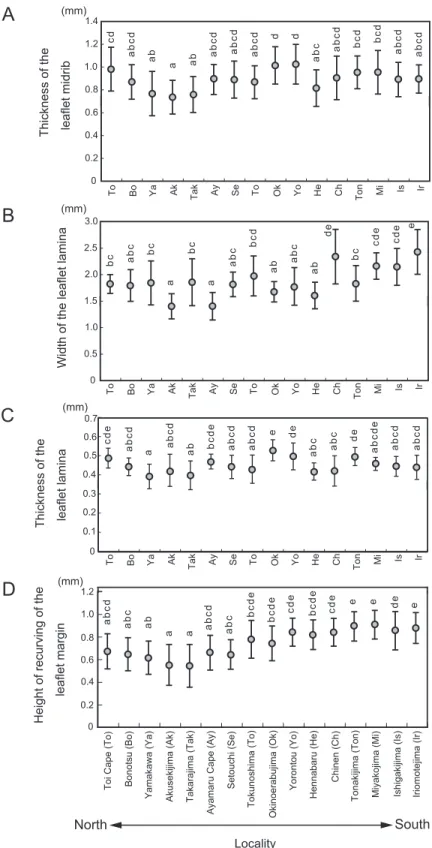
The four morphological characteristics were normally distributed, and values were signifi- cantly different among populations(ANOVA, p
< 0.001 ; Table 1). Thickness of the leaflet mid- rib and thickness of the leaflet lamina(Fig. 3 A, C)varied among populations but with no geo- graphical cline, ranging from 1.02±0.17 mm
(mean±standard deviation ; Yorontou Island)to 0.73±0.15 mm(Akusekijima)and from 0.53±0.06 mm(Okinoerabujima)to 0.39±0.06 mm(Yamak- awa of Kagoshima), respectively. Width of the leaflet lamina suggested a weak geographical trend, where some populations from southerly is- lands(Chinen of Okinawajima, Miyakojima, Ishi- gakijima, and Iriomotejima)showed a greater width than the other populations(Fig. 3 B, Tur- key HSD). The width of the leaflet lamina ranged from 2.42±0.42 mm(Iriomotejima)to 1.40
±0.24 mm(Akusekijima). Height of recurving of the leaflet margin implied distinct geographical cline, as height tended to increase in samples from southerly islands(Fig. 3 D, Turkey HSD). The height of leaflet recurving ranged from 0.91
± 0.20 mm(Miyakojima)to 0.54 ± 0.17 mm
(Akusekijima).
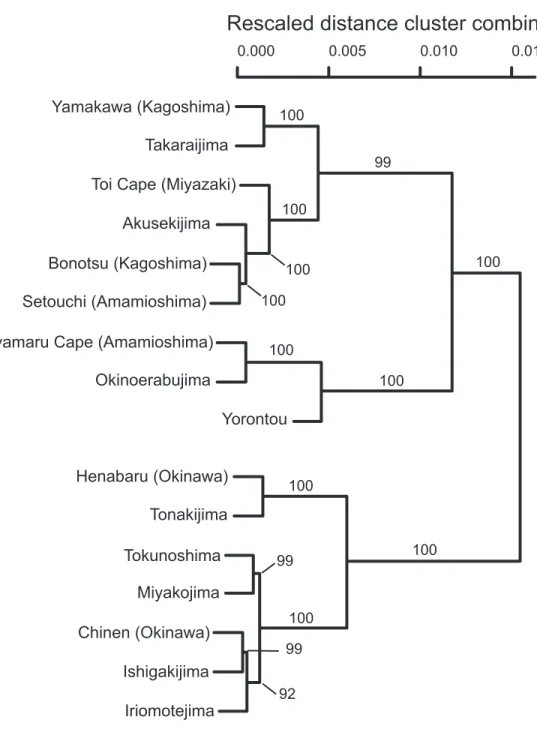
Cluster analysis using mean values of each four morphological characters resulted in two clear major clusters comprising northerly and southerly populations that were demarcated north of Yorontou and south of Tokunoshima Is- lands, respectively(Fig. 4). However, affiliation
of three island populations, Tokunoshima, Oki- noerabujima and Yorontou Islands, was over- lapped : Okinoerabujima and Yorontou belonged to northerly populations, whereas Tokunoshima belonged to southerly populations, possibly as- cribed to the wider leaflet lamina in Tokuno- shima that tends to be common in the southerly populations(Fig. 3 B).
Our results indicate that C. revoluta shows morphological differentiation in leaflet morphol- ogy in terms of recurving of the leaflet margins
(and leaflet lamina width). Although its north- south demarcation crosses at central Ryukyus
(between Tokunoshima and Yorontou Islands), northern cycads tended to have leaflet margins with shallow recurving(and narrower leaflet lamina width), while the southern populations had deeply recurved leaflet margins(and wider leaflet lamina width). As the distribution range of this cycad exceeds 1,000 km in a northeast to southwest direction, the morphological differen- tiation may imply intraspecific differentiation.
Comparative genetic studies should be under- taken to supplement our understanding of cycad morphological differentiation among the Ryukyu Islands and Kyushu.
We thank Mr. N. Nakazato of Tokai Univer- sity for giving us reference literature. This study was supported by Grant-in-Aid for Scientific Re- search(#13575011)from Japan Ministry of Edu- cation, Culture, Science, Sports and Technology.
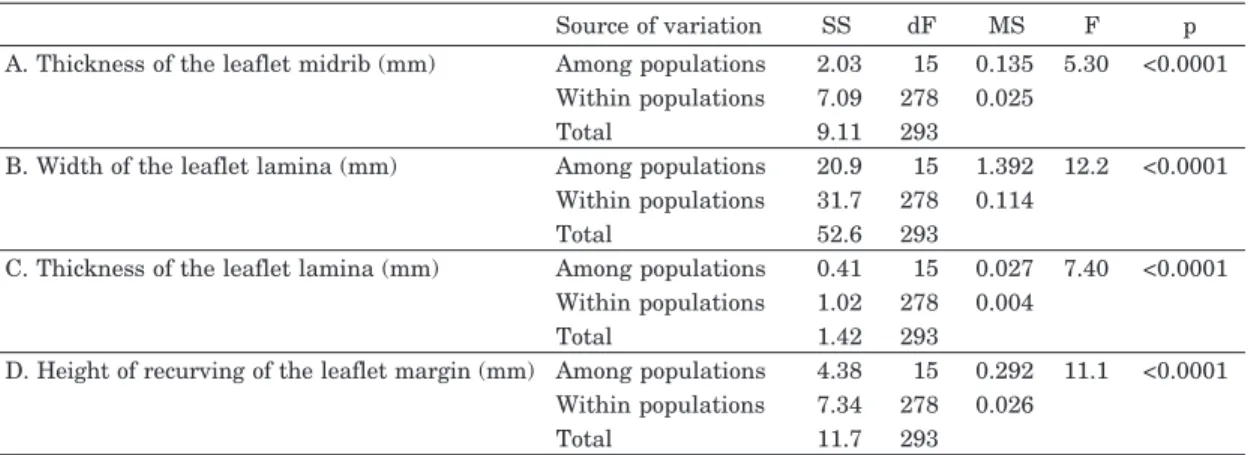
Source of variation SS dF MS F p
A. Thickness of the leaflet midrib (mm) Among populations 2.03 15 0.135 5.30 <0.0001 Within populations 7.09 278 0.025
Total 9.11 293
B. Width of the leaflet lamina (mm) Among populations 20.9 15 1.392 12.2 <0.0001 Within populations 31.7 278 0.114
Total 52.6 293
C. Thickness of the leaflet lamina (mm) Among populations 0.41 15 0.027 7.40 <0.0001 Within populations 1.02 278 0.004
Total 1.42 293
D. Height of recurving of the leaflet margin (mm) Among populations 4.38 15 0.292 11.1 <0.0001 Within populations 7.34 278 0.026
Total 11.7 293
SS, Sum of Squares ; dF, degree of Freedom ; MS, Mean Squares ; F, F-statistics ; p, p value for the null hypothesis.
Table 1. Results of ANOVA for four morphological parameters
October 2009 J. Phytogeogr. Taxon. Vol. 57. No. 1
Fig. 3. Means and standard deviations of dimensions of the thickness of the leaflet midrib, leaflet lamina width, leaflet lamina thickness and the height of recurving of the leaflet margin inCycas revoluta. Different abbre- viation above the vertical bar means significant difference in post-hoc Tukey HSD test.
植物地理・分類研究 第57巻第1号 2009年10月
Fig. 4. Population relationships represented by a dendrogram inCycas revolutabased on morphological charac- teristics of leaflets. Approximately unbiased p-values(%)are shown above the branches.
October 2009 J. Phytogeogr. Taxon. Vol. 57. No. 1
References
Jones, D. L. 1993. Cycads of the world. pp. 154―
155. Reed Books, Chatswood.
Nakamura, K., Denda, T. and Yokota, M. 2005.
Seed morphology of Cycas revoluta Thunberg
(Cycadaceae)in the Ryukyu Archipelago. Biol.
Mag. Okinawa(43): 53―57.(in Japanese)
Nishida, K. 1935. Seed dimorphisms of Cycas revoluta. Bull. Nat. Hist. Kagoshima Agr. 4: 22.(in Japanese)
Yamazaki, T. 1989. Cycadaceae. Satake, Y., Hara, H., Watari, S. and Tominari, T.(eds.). Wild flowers of Japan, woody plants, vol. 1, p. 3, pl.
1. Heibonsha, Tokyo.(in Japanese)
Yamazaki, T. 1995. Cycadaceae. Iwatsuki, K., Yamazaki, T., Boufford, D. E. and Ohba, H.
(eds.). Flora of Japan, vol. I, pteridophyta and gymnospermae, p. 263. Kodansha, Tokyo.
(Received October 15, 2008 ; accepted February 27, 2009)
瀬戸口浩彰1・許田重治1・前田芳之2・野村尚史1: 琉球列島におけるソテツ(ソテツ科)の小羽片形態 の地理的変異
琉球列島から九州にかけて分布するソテツ(Cy- cas revoluta Thunb.)の自生地16集団を対象にし て,小羽片の形態の地理的な分化を検証した。小羽 片の横断面における小羽片の幅と厚さ,中肋の厚さ,
小羽片の縁の巻き込みの高さの4形質を測定して クラスター解析にかけたところ,北方型と南方型の 2つのグループに分かれた。北方型には主に与論島 以北の集団が含まれ,南方型には主に徳之島以南の 集団が含まれる。ただし,この境界にある徳之島は 南方型に,沖永良部島は北方型に含まれる。これに は,小羽片の幅と縁の巻き込みの高さに南北間で違 いがあることが寄与しており,とくに縁の巻き込み の高さは,南側で大きく巻き込む傾向が見られた。
(1〒606―8501 京都市左京区吉田二本松町 京都 大学大学院人間・環境学研究科;2〒894―1531 鹿 児島県大島郡瀬戸内町手安108 芳華園)
植物地理・分類研究 第57巻第1号 2009年10月