The Challenges and Prospects of Japan's Energy Security in East Asia since the 1990s
Hideaki FUJII
Abstract
Firstly, this paper analyzes Japan's energy security issues in East Asia since the 1990s by examining the literatures that represent each concept in each period based on the transformation of the concept of energy security. The globalisation has triggered the expansion of the market economy and the convergence of economic levels on a global scale. The movement of the geographical centre of energy demand has also changed the global energy supply and demand structure. On the other hand, the globalisation has been the cause of new isolationism, protectionism, and regionalism. Secondly, this paper examines Japan's non-traditional energy security issues since the 1990s, and sounds the alarm stating that Japan needs to rethink its energy security after observing instability in international order and uncertainty in energy transition policies and connectivity. Finally, this paper emphasizes that a comprehensive and enforceable multilateral legal framework is needed in East Asia, and East Asian countries and regions should seek to form common values regarding order, justice, and peace.
Keywords: energy security; East Asia; traditional energy security concept; non-traditional energy
security concept; new energy security concept; multilateral legal framework; common values.1. Overview
Since the end of the US–Soviet Cold War due to the collapse of the Soviet Union in 1991, market opening of information and communication technology (ICT) to the private sector has progressed, and rapid technological progress of ICT services has been realised. The globalisation has triggered the expansion of the market economy and the convergence of economic levels on a global scale.
The movement of the geographical centre of energy demand has also changed the global energy supply and demand structure. On the other hand, it has been pointed out that this phenomenon has been the cause of new isolationism, protectionism, and regionalism (Bolton (1994), Rice
Faculty of Economics, Kyoto Sangyo University. This paper is based on the author’s presentation paper at the 4th AIEE (Associazione Italiana Economisti dell’Energia) Energy Symposium held between December 10 and December 12, 2019 in Rome, Italy. The author thanks to all the participants in the
(2000)).
Japan needs to rethink its energy security after observing instability in international order and uncertainty in energy transition policies and connectivity. This is because the environment surrounding Japan has changed dramatically since the end of the Cold War, and East Asia now accounts for approximately one-third of global energy consumption. This paper examines Japan's non-traditional energy security issues since the 1990s, and it discusses the new energy security issues to be recognised in the first quarter of the 21st century.
This paper does not include energy security issues in the COVID-19 pandemic and post-corona society.
2. Methods
This paper uses the following four elements that define the concept of security; security targets
(what to protect), risks to be guaranteed (from what to protect), security measures (how to protect it), "Who protects whom", according to Tanaka (1997) and Suzuki (2001).
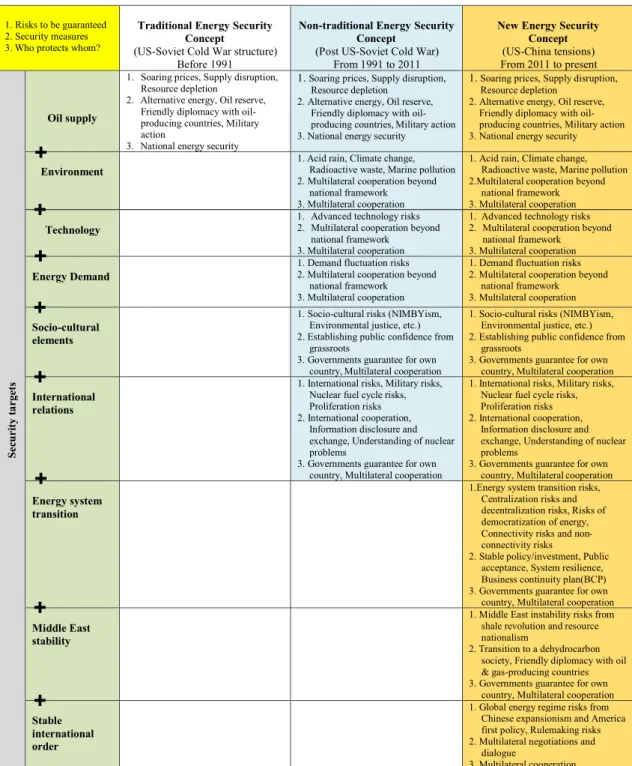
First, the method of defining the concept of energy security is reviewed (Tanaka (1997), Suzuki (2001)), and then it is divided into three eras according to the changing concept of energy security in Japan (Table 1). These are 1) Traditional Energy Security Concept: the 1950s to 1991, characterised by national energy security and oil supply security (Samuels (1997), Calder (1998),
Stares (2000)); 2)Non-traditional Energy Security Concept: 1991 to 2011, in addition to the feature of 1), characterised by multi-layered structure of risks in the process of globalisation, regional energy security and multilateral cooperation, and technology reliability (Allison et al.(eds.) (1992), Bedeski (1992), Fischer (1993), Utagawa (1995), Stares (1998), Matsui (2006),
Fujii (2005), Fujii (2008)); and 3) New Energy Security Concept: 2011 to present, in addition tothe features of 1) and 2), characterised by energy system transition (new risks from the decentralisation and democratisation of energy), Middle East instability (new risks from shale revolution and resource nationalism) and instable international order (new risks from Chinese expansionism and the America first policy).
This paper aims to clarify the challenges of Japan's energy security issues and strategy by
comparing the concept of Traditional Energy Security, Non-traditional Energy Security, and New
Energy Security.
Table 1. Transition of Energy Security Concepts in Japan
3. Results
3.1 Multi-layered multi-forums and frameworks for multilateral cooperation
Since the end of the US–Soviet Cold War, "Risks to be guaranteed" have expanded and become multi-layered, and the demand for a framework for such multilateral cooperation has grown
1. Risks to be guaranteed 2. Security measures 3. Who protects whom?
Traditional Energy Security Concept
(US-Soviet Cold War structure) Before 1991
Non-traditional Energy Security Concept
(Post US-Soviet Cold War) From 1991 to 2011
New Energy Security Concept (US-China tensions) From 2011 to present
Security targets
Oil supply
1. Soaring prices, Supply disruption, Resource depletion
2. Alternative energy, Oil reserve, Friendly diplomacy with oil- producing countries, Military action
3. National energy security
1. Soaring prices, Supply disruption, Resource depletion
2. Alternative energy, Oil reserve, Friendly diplomacy with oil- producing countries, Military action 3. National energy security
1. Soaring prices, Supply disruption, Resource depletion
2. Alternative energy, Oil reserve, Friendly diplomacy with oil- producing countries, Military action 3. National energy security Environment
1. Acid rain, Climate change, Radioactive waste, Marine pollution 2. Multilateral cooperation beyond
national framework 3. Multilateral cooperation
1. Acid rain, Climate change, Radioactive waste, Marine pollution 2.Multilateral cooperation beyond
national framework 3. Multilateral cooperation Technology
1. Advanced technology risks 2. Multilateral cooperation beyond
national framework 3. Multilateral cooperation
1. Advanced technology risks 2. Multilateral cooperation beyond
national framework 3. Multilateral cooperation Energy Demand
1. Demand fluctuation risks 2. Multilateral cooperation beyond
national framework 3. Multilateral cooperation
1. Demand fluctuation risks 2. Multilateral cooperation beyond
national framework 3. Multilateral cooperation
Socio-cultural elements
1. Socio-cultural risks (NIMBYism, Environmental justice, etc.) 2. Establishing public confidence from
grassroots
3. Governments guarantee for own country, Multilateral cooperation
1. Socio-cultural risks (NIMBYism, Environmental justice, etc.) 2. Establishing public confidence from
grassroots
3. Governments guarantee for own country, Multilateral cooperation International
relations
1. International risks, Military risks, Nuclear fuel cycle risks, Proliferation risks 2. International cooperation,
Information disclosure and exchange, Understanding of nuclear problems
3. Governments guarantee for own country, Multilateral cooperation
1. International risks, Military risks, Nuclear fuel cycle risks, Proliferation risks 2. International cooperation,
Information disclosure and exchange, Understanding of nuclear problems
3. Governments guarantee for own country, Multilateral cooperation Energy system
transition
1.Energy system transition risks, Centralization risks and decentralization risks, Risks of democratization of energy, Connectivity risks and non- connectivity risks
2. Stable policy/investment, Public acceptance, System resilience, Business continuity plan(BCP) 3. Governments guarantee for own country, Multilateral cooperation Middle East
stability
1. Middle East instability risks from shale revolution and resource nationalism
2. Transition to a dehydrocarbon society, Friendly diplomacy with oil
& gas-producing countries 3. Governments guarantee for own
country, Multilateral cooperation Stable
international order
1. Global energy regime risks from Chinese expansionism and America first policy, Rulemaking risks 2. Multilateral negotiations and
dialogue
3. Multilateral cooperation
Sources: Prepared by the author based on Allison et al.(eds.) (1992), Utagawa (1995), Fischer (1993), Samuels (1997), Calder (1998), Stares (1998), Stares (ed.) (2000), Fujii (2005), Matsui (2006).
+ +
+ +
+ +
+
+
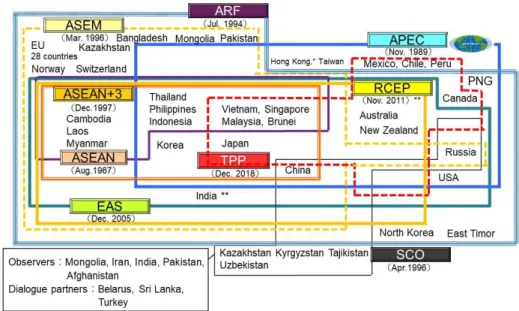
stronger. Under the Non-traditional Energy Security Concept, many multi-layered multi-forums and many frameworks for multilateral cooperation have been established (Fig. 1.).
Source: Prepared by the author.
Fig. 1. Multi-layered multi-forums and member countries in East Asia (as of December 2020)
The East Asian Energy Environment Community Initiative that affects survival rights, property rights, and democratising democracy1 would be very unlikely to be realised without trust between Japan, China, and Korea, and without these countries sharing the same values. Already in East Asia, functional integration has progressed in the fields of trade, investment, finance, and non-traditional security, which is sufficient for the strategic reciprocity aimed at the interests of trade transactions.
The European Union is evaluated as a community formation based on the top-down Gemainshaft (community) concept as a leading example for East Asia to design economic, energy and environmental policy cooperation. On the other hand, a community concept in East Asia that does not yet share the same values accorded priority to the method of building up economic and energy–environment cooperation by multiple bottom-up approaches (Fujii (2005), Fujii (2008)).
In East Asia, energy–environment cooperation has been carried out in the framework of international organisations, multilateral cooperation, and bilateral cooperation and within a range where the actions of each country/region can be decided independently without any restrictions.
However, if there are some restrictions on the relationship between players and they cannot act
based on their own decisions, an international regime consisting of principles, norms, rules and procedures is necessary(Matsui (2006)). It is generally difficult to continue the sectoral cooperation framework in the energy and environmental sector, as shown by the fact that the APP (Asia-Pacific Partnership), established in July 2005, was abolished in April 2011 due to US budget constraints.
3.2 Uncertainty in the energy transition policies and connectivity
In considering Japan's New Energy Security strategy, the following five high priority energy security issues should be noted.
(1) Nuclear policy issues after The Tokyo Electric Power Company Fukushima Daiichi Nuclear Power Plant accident
1) Design and deployment of multi-layered measures to prevent the recurrence of the nuclear accident due to various risks (human errors, natural disasters, terrorist acts, cyber-attacks, high-altitude nuclear explosions, and electromagnetic pulse attacks by high-power microwaves (Ichimasa (2016)).
2) Decontamination of radioactive materials in the Kanto and Tohoku regions, disposal of contaminated waste (isolation/storage), and nuclear damage compensation.
3) Domestic power generation dependency on nuclear power.
24) Nuclear back-end business (decommissioning of nuclear reactors, final disposal of radioactive waste, nuclear fuel cycle, prevention of diversion from nuclear power to military technology for non-proliferation, and nuclear non-proliferation.
5) Selection of nuclear power business operators and human resource development (including avoidance of human resources and information outside the country).
2 As of January 18, 2021, there are nine units of nuclear power plants in operation (5 units are stopping) (These are: Kansai Electric Power Takahama Power Station Units 3(stopping) and 4(stopping); Kansai Electric Power Ooi Power Station Units 3(stopping) and 4; Shikoku Electric Power Ikata Power Station Unit 3(stopping); Kyushu Electric Power Genkai Power Station Units 3 and 4(stopping); Kyushu Electric Power Sendai Power Station Units 1 and 2). A total of 24 reactors have been decommissioned (17.43 million kW), 7 reactors have been approved for changing the reactor installation, 11 are under review for compliance with new regulatory standards, and 9 have not yet been filed. Kansai Electric Power Company Takahama Power Station Unit 1 (46 years of operation) and Unit 2 (45 years of operation) have been given permission to change the reactor installation. Restarting a nuclear power plant after the 2011 earthquake required “decisions made by energy policy authorities and locals based on the judgment of the Nuclear Regulatory Commission and operators' explanations.” Taking account of the location conditions of Takahama Power Station (the risk of impact on the Kinki and Tokai areas), it should be noted that the extension of operation of these old nuclear power plants requires more careful deliberation and judgment.
As of March 11, 2011, there were 54 nuclear power plants in Japan, and approximately 30% of the
(2) Upward revision of global resource reserves’ assessment and progress of shale revolution The impact of the upward revision of oil resource reserve assessment and the progress of the
shale revolution on crude oil prices is complex. The following six main impacts are expected.
1) The principle of supply and demand will be applied, and a new equilibrium will be sought in accordance with price changes and quantity adjustment of supply and demand.
2) When the proportion of unconventional oil resources whose production conditions are difficult in oil supply increases, the marginal production cost of the entire oil supply will increase, and the oil supply curve will shift to the upper left.
3) Larger oil and natural gas capital and investment than before will be required (IEA (2018), IEA (2019), Nakićenović et al. (eds.)(1998)) .
4) As the establishment of the social cost of carbon raises the total supply cost of oil, the supply amount will not increase by as much as the upward revision of the resource reserve assessment (Ellerman et al. (2010)).
5) The United States will join the net oil and gas exporters (suppliers), and the oil and gas markets will become more competitive.
6) As shale gas production progresses around the world, demand for liquefied natural gas (LNG) will increase, and competition with crude oil will intensify. On the other hand, Japan's bargaining power, which has been due to a market structure in which the only buyer substantially controlled the LNG market in the Asia-Pacific region, will be relatively weak (Dahl (2015)).
(3) Expansion of renewable energy generation
Like many countries that have introduced the FIT (Feed-in tariff) system
3, Japan has benefited from expanding renewable energy power generation facilities (doubled in 5 years) and reducing costs (purchase price of residential solar power; ¥48/kWh in 2009 to ¥26/kWh in 2019). On the other hand, new problems of public burdens (2.1trillion yen/year) and grid constraints (Kyushu area in 2018) are emerging, and the continuing burden of public costs and the technical problems of grid connection are increasing the uncertainty of renewable energy policies (Burns (2019a), Burns (2019b)).
At present, there is no significant input–output spillover effect due to the increased introduction of solar power in Japan. This is because imports of solar panels made in China have been increasing, Chinese manufacturers accounted for 53% of the Japanese market share
3 With the implementation of FIT in 2012, the existing RPS (renewable portfolio standard) system will be phased out in five years from FY2017. Prior to the FIT, a surplus purchase system for residential solar power was introduced in 2009. From 2019 onwards, there will be power sources that end the fixed price purchase period for residential photovoltaic power generation under the FIT system.
of solar cell modules for industry in 2016.
(4) Research and development of new technology and diffusion
Technology is the key to breaking through energy security issues. The Government of Japan humbly acknowledged the uncertainty of technology development
4in the basic concept of the 2014 Energy-related Technology Development Roadmap. Meanwhile, a roadmap for specific energy technology development up to 2050 identifies 36 technical fields based on the energy supply chain.
(5) Economic development and energy supply and demand trends of China, which is a population- rich country located to the west of Japan
1) Chinese expansionism
China's political and economic presence in the world has been expanding significantly. China's GDP was 8.2 trillion dollars (2010 prices) in 2014, accounting for approximately 11% of the world's total. As a country, China’s energy consumption and CO
2emissions are the largest in the world. It should be noted that the Belt and Road Initiative, as a regional economic zone created by the Xi Jinping regime and the Asian Infrastructure Investment Bank (AIIB, founded in 2014), would have some negative impacts
5on the democratisation of democracy in relevant regions.
To confront the fact that China always adheres to an omnidirectional strategy, regardless of whether Japan prioritises a decarbonisation strategy, we cannot help but think about the problems of submarine resources with neighbouring countries and territorial issues surrounding oil and gas resources, the cobalt rich crust, rare earth resources, and methane hydrate.
2) Recognizing the failure of the Kyoto Protocol Clean Development Mechanism (CDM) Although China is currently the world's largest emitter of greenhouse gases, emitting considerably more greenhouse gases than does the United States, its dependence on coal in total primary energy supply remains at more than 60%. Based on the “Kyoto Protocol Clean Development Mechanism (CDM)” of the United Nations Framework Convention on Climate Change, environmental technology cooperation has been provided to China. However, as shown by the Jevons Paradox, the adverse effects of environmental technology cooperation
4 On December 21, 2016, the Ministerial Meeting on Nuclear Energy decided that the Fast Breeder Prototype Reactor "Monju" of the National Research and Development Organization of Japan would not resume operation as a nuclear reactor but would shift to decommissioning and would position itself to take on a new role in future fast reactor research and development.
5 The Chinese government's overseas investment already has experienced problems in Zambia, Myanmar, Vietnam, Brazil, Sri Lanka, and other countries. See “Sri Lankan government sells interest in a large port to Chinese company” (Nihon Keizai Shimbun, December 9, 2016).
have rather significantly increased China's greenhouse gas emissions. This means that a more compelling international regime is needed to ensure East Asian energy security.
4. Conclusions
Under the Non-traditional Energy Security Concept (1991 to 2011), functional integration was established in the fields of trade, investment, finance and non-traditional security by multiple bottom-up approaches in East Asia. The East Asian Energy Environment Community Initiative
6was studied and discussed by Japan, China, Korea, and ASEAN countries. During this period, little progress was made in the framework. If we wish to advance the various East Asian community initiatives further, we will have to secure a situation in which things can be decided by each country, ensure the reliability of technology, ensure trust between countries,
7and establish common rules.
Under the New Energy Security Concept (2011 to the present), priority has been given to building a decentralised energy system to secure various options for domestic energy supply and demand by emphasising technology and investment in Japan.
The following three points, as additional energy security strategies in Japan, should be emphasised in the first quarter of the 21st century under the New Energy Security Concept.
(1) Japan's energy policy should focus on promoting energy technology development, and it should be necessary not only to "get out of the fossil energy-dependent hydrocarbon society"
but also to have an innovative strategy of "full management of energy demand."
(2) There are possible options other than Japan’s domestic optimisation strategy.
A connectivity strategy among East Asian economies would include the Asian Super Grid initiative and an energy bridge (oil & gas, and electricity) initiative between Russia's Sakhalin
6 In civil society, private non-profit organizations, non-governmental organizations, think tanks, and other such groups play a central role, but a "social and governmental bridge" is required based on citizenship.
For example, in Japan, the “East Asia Community Council” (CEAC: The Council on East Asian Community, established in 2004) provides a place where industry, government, and academia gather together to discuss the concept of the East Asia community. A research group such as the CEAC that the accepts pros and cons of the East Asian community concept and is made up of people with different ideas (note that it is not a promoter group of the East Asian community) is one example.
7 In East Asia, there are sovereignty issues in the East China Sea (Senkaku Islands (Diaoyu Islands)) and Takeshima (Liancourt Rocks, Dokdo), North Korea's nuclear warhead missile issue, abduction issues, and history issues. Also, although Japan recognises that the comfort women problem and the issue of former civilian workers from the Korean Peninsula have been settled by the Agreement on the Settlement of Problems concerning Property and Claims and on Economic Co-operation between Japan and the Republic of Korea (1965), these two issues have been used for political purposes every time the president changes in Korea. If promises under the law are not guaranteed in constitutional countries, the relationship of trust could not be established forever. Needless to say, the Japanese reflect on Japan's harm to Asians during the World War II and the Japanese have been educated to reflect on this at least since the author was born, and the author believes that we still should reflect.
Island and Japan. These projects have positive effects (energy saving through regional optimisation, increase of the available transfer capability in the transmission line through the export of electric power,
8and a stable supply in the event of a disaster or accident) and negative effects (cost burden and profitability, and mutual dependence would be fixed by connecting either the power grids or the pipelines).
(3) In East Asia, a comprehensive and enforceable multilateral legal framework is needed, and East Asian countries and regions should seek to form common values regarding order, justice, and peace. It is necessary to understand that politics and economy cannot be separated between Japan–Russia, Japan–Korea, and Japan–China. Therefore, a comprehensive and enforceable multilateral legal framework, such as either the existing Energy Charter Treaty and International Energy Charter or a new East Asia Energy Charter Treaty, should be considered more positively.
References
[1] Allison, Graham, and Gregory T. Treverton (eds.) (1992). Rethinking America’s Security:
Beyond Cold War to New World Order. New York: W. W. Norton & Company.
[2] Bedeski, Robert E. (1992). “Unconventional Security Threats: An Overview”, North Pacific Cooperative Security Dialogue working paper; No. 11. North York, Ontario: Research Programme, York University, Canada.
[3] Bolton, John R. (1994). “Wrong Turn in Somalia,” Foreign Affairs, January/February.
[4] Burns Kelly (2019a). “Exploring the Relationship between Energy Policy Uncertainty and Investment in Renewable Energy”, 42nd IAEE International Conference “Local Energy, Global Markets,” Montreal, Canada, May 29-Jun 1.
[5] _______ (2019b). “On the Relationship between Policy Uncertainty and Investment in Renewable Energy”, IAEE ENERGY FORUM, Montreal Special Issue, pp.33-35, 2019.
[6] Calder, Kent E. (1998). “Energy and Security in Northeast Asia’s Arc of Crisis”, in Michael Stankieicz, ed., Energy and Security in Northeast Asia, Policy Paper No.35. Berkeley, California: University of California Institute on Global Conflict and Cooperation.
[7] Dahl, Carol A. (2015). International Energy Markets: Understanding Pricing, Policies, and Profits, 2nd Edition, PennWell Corp.
[8] Ellerman, A. Denny, Frank J. Convery, Christian de Perthuis, et al. (2010). Pricing Carbon, The European Union Emissions Trading Scheme, Cambridge University Press.
[9] Fischer, Dietrich (1993). Nonmilitary Aspects of Security: A Systems Approach. Brookfield:
Dartford Publishing.
8 The current Electricity Business Act in Japan does not assume exports and imports of electricity.