Errors in Writing: The Relationship between Uptake, Retention, and Target Form
著者(英) Masaki DATE journal or
publication title
福井大学教育地域科学部紀要 第I部 人文科学(外国 語・外国文学編)
volume 60
page range 49‑60
year 2004‑12
URL http://hdl.handle.net/10098/756
The Relationship between Uptake, Retention, and Target Form
Masaki DATE
Abstract
Many studies have been conducted to examine the effect of instructional intervention, such as explicit feedback, in writing on revising errors or on retaining their correct forms. Collectively, these studies are however unclear in two ways: 1. On the feedback effect on the whole process composed of both uptake1at revision and retention after revision, and 2. On the influence of target-form type on feedback effect. This study focuses on the effects of feedback on uptake and retention and of awareness enhancement on reten- tion, by using the same target forms among subjects and in every test. I began by positing three hypothe- ses:
1. Feedback causes uptake and retention more than no feedback.
2. More forms can be retained by enhanced awareness than simple awareness.
3. Each effect of feedback and awareness enhancement depends on the type of forms.
The study was conducted with 338 undergraduates, using eight target forms. The results supported the hypotheses, suggesting that feedback has a better effect than no feedback and awareness enhancement has a better effect than simple awareness, whereas both uptake and retention of target forms were more at sen- tence-level than context-level.
1. Background
Since instructional intervention, such as feedback of learners errors, is considered to be important for language learning, many studies have been conducted to examine its effect. The effect of explicit feedback in writing has been also studied, and some prefer indirect feedback such as underlining. This is because direct feedback, such as correction, is a time-consuming method of directing learners attention to errors (Robb, Ross & Shortreed, 1986). Similarly, there may also be a possibility that teachers themselves will
make errors while correcting (Ferris & Roberts, 2001) because they lack the skills to analyze and explain students problem (Truscott, 1996). Moreover, some studies show that indirect feedback is enough to cause the revision of erroneous forms or the learning of correct forms. Ferris and Roberts (2001) found that 60% of errors were revised through underlining and 64% through both underlining and coding. Robb et al. (1986) compared correction with coding, marking, and indicating the error number, on the subsequent compositions. The result showed the assumption underlying overt correction - that more correction results in more accuracy - was not convincingly demonstrated (p. 88). Hyland (2003) focused on gener- alized feedback (such as not clear ), specific feedback ( Where is the subject in this sentence? ), a refor- mulation, or comment at the end of the essay. The comparison of writing in the first week of study with that of the fourteenth week by one learner showed that feedback resulted in a greater control of sentence structure which was his most serious problem.
The above ideas and data seem to support the effect of indirect feedback on erroneous forms. However, the ideas are still abstract. The data come from only a small part of the learning process, such as errors cor- rected at revision or errors made in a subsequent composition. The whole process affected by feedback then remains unclear. There are three related issues which demand further clarification and which I enu- merate below:
1. The degree of awareness at uptake when given feedback and subsequently retained awareness after uptake
2. The degree of the effect of additional intervention given after awareness 3. The degree of the influence of target-form type on effectiveness of intervention
Unless these issues can be satisfactorily addressed, it is questionable to insist that the effectiveness of indi- rect feedback is greater than that of direct feedback.
1.1 The degree of both awareness at uptake and subsequently retained awareness
Uptake is an important and observable source for understanding the impact of the feedback. So, it is necessary to examine uptake, as did Ferris and Roberts (2001). However, it appears problematic to evalu- ate the effectiveness of feedback based only on learners uptake. Uptake does not mean that long-term learning has occurred, and uptake does not fully represent learners cognitive processing of the feedback (Nabei & Swain, 2002). Conversely, it is necessary to examine how much accuracy is improved by feed- back, through the comparison between the subject s English before and after feedback is given, as in the studies by Robb et al. (1986) and Hyland (2003). Neither studies, however, checked uptake. It is unclear then whether each piece of feedback was sufficient to cause awareness of errors or not in Robb et al., or which feedback was more effective in causing awareness in Hyland. It should therefore be examined both how much awareness at uptake takes place by feedback, and how much awareness caused by feedback is
subsequently retained.
1.2 The degree of the effect of additional intervention given after awareness
Hyland (2003) suggests that feedback needs to be examined in tandem with other contextual aspects, such as the enhancement provided in class. Robb et al. (1986) used one activity at home (revising the essays with feedback) and two activities in the classroom (editing grammatical errors made by others and sentence-combining exercises). However, there was no comparison group using only revision at home. It is therefore not clear whether these two activities in the classroom could be taken as an enhancement of awareness caused by revision at home. Even if this was the case, because there was also no comparison group using revision at home with only one activity in the classroom, it is still unclear which activity in the classroom was more effective. Therefore, we should carry out one activity after feedback to enhance awareness and examine its effect on retention of awareness by comparing groups with and without enhancement.
1.3 The degree of the influence of target-form type on the effectiveness of intervention
The nature of a target form (henceforth, TF) can affect the effectiveness of feedback. For example, Ayoun (2001) showed that any feedback (written recasts, models, grammar instruction) was effective on a TF representing one aspect, whereas only recasts were effective on a TF with three different aspects. Such influence by the nature of TFs is related to two factors to be considered in my present study. The first fac- tor is that TFs should be specific. Robb et al. (1986) and Hyland (2003) did not set up TFs to see how they changed from before to after feedback was given. Ferris and Roberts (2001) set up five categories of TFs.
However, each category included various forms - for example, sentence structure had sentence/clause boundaries, word order, omitted words or phrases, unnecessary words or phrases, other unidiomatic sen- tence construction. Consequently, the studies did not show on which form feedback was effective. The second factor is that TFs should be common to all subjects. There is a case when errors made by one learn- er are different from those by another while the same feedback is given to both. The effect of the feedback on a single learner can be different to that between one learner and another.
In the study on feedback, it is quite common to use learners composition and see how errors pointed out by feedback change in the subsequent composition. However, as Skehan (1998) argues, there will be a case when some learners rely on forms which are adequately controlled and do not intentionally risk using an erroneous form in the composition in order to avoid the error. It is necessary to remove such a case.
Therefore, the present study asked subjects to identify errors and correct them in a given passage rather than using their composition.
2. Study
2.1 Hypotheses
This study examines two issues: whether different feedback on specific TFs causes different degrees of awareness and retention, and whether enhancing awareness causes different degrees of retention. The fol- lowing three hypotheses can therefore be posited:
1. Feedback causes uptake and retention of TFs more than no feedback.
2. More TFs can be retained by enhancing awareness with additional intervention than simple (unen- hanced) awareness.
3. Each effect of feedback and awareness enhancement depends on the type of TFs.
2.2 Subjects
The subjects were undergraduates whose major was not English, taking 90-minute English classes as a general education course once a week. The subjects consisted of two groups. All subjects took a pretest, followed by treatment and an immediate post-test. In the treatment, one group received only feedback (henceforth, F); the other group had feedback and drill (named F + D). Each group was further divided into four groups and had different types of feedback. Each result of a Mann-Whitney test between F and F + D and a Kruskal Wallis test among eight groups showed no significant difference on the pretest. This means that they were initially at the same level of their tested ability to search for erroneous TFs.
2.3 Methodology
The study was comprised of pretest, treatment, and immediate post-test. Treatment and post-test were given one week after pretest. Two types of passages were used. One was for pretest and post-test, and the other was for treatment, as seen below. Both passages, with notes on unknown words, had the same eight types of TFs2. TFs also consisted of two levels: sentence-level whose error can be judged by words in front and behind (1 to 4 below), and context-level whose error should be judged by words in sentences in front and behind (5 to 8).
Passage used for pretest and immediate post-test
I have an idea about college. (7)Idea (The idea) is that college is a place (3)that (where) I study what I want to study. But now it is said There (1)is (are) a lot of students who think that in col- lege they can enjoy themselves without study; for example, they can enjoy drinking, (2)and travel- ing (traveling), and watching movies. One of my friends is (4)certain (certainly) confident that he
(6)is get (gets) a good salary easily (5)after graduates (after he graduates) from college.
Actually, college life is not (8)only study (for not only) but also play. *( ) shows the correct forms.
Passage used for treatment
1. My father and brother (1)is (are) smokers. So I always breathe smoke. Someday we become sick. If this thing (6)is happen (happens) in fact, anyone cannot solve this problem.
2. Now, the place (3)which (where) smokers can smoke, such as station, (2)and restaurant, movie theater (restaurant, and movie theater), is limited. (5)When think (When we think) of some restau- rants and coffee shops, nonsmoking sections are bigger than smoking sections.
3. We saw a video last week. (7)Video (The video) was (8)an experiment (about an experiment) by using some rabbits. It showed that smoking is (4)bad (badly) unhealthy and there is the fact that secondhand smoke is worse for our bodies than direct smoke. *( ) shows the correct forms.
The pretest asked subjects to find erroneous TFs in a passage and correct them in eight minutes. It was then returned uncorrected3. As common treatment, all groups received a paper showing the same passages including TFs. Each group among F and F + D had different feedback to TFs on the paper: correction, underlining/marking, a metalinguistic hint (henceforth, MH), and no feedback, as illustrated in Table 1.
They then tried to find TFs and either correct them or explain their characteristics4in eight minutes. F + D had another paper for drill exercises on TFs as additional intervention in five minutes, where they could see the feedback given on the first paper. The post-test was given to identify erroneous TFs and correct them in eight minutes, soon after the treatment papers were returned uncorrected. Only the correct forms in tests and treatment were counted as data. A repeated measure ANOVA, which was broken down by feedback (correction, MH, underlining, no feedback), drill (with, without), and test (pretest, treatment, post-test), was then run.
Table 1. Treatments given to each group (see Appendix1)
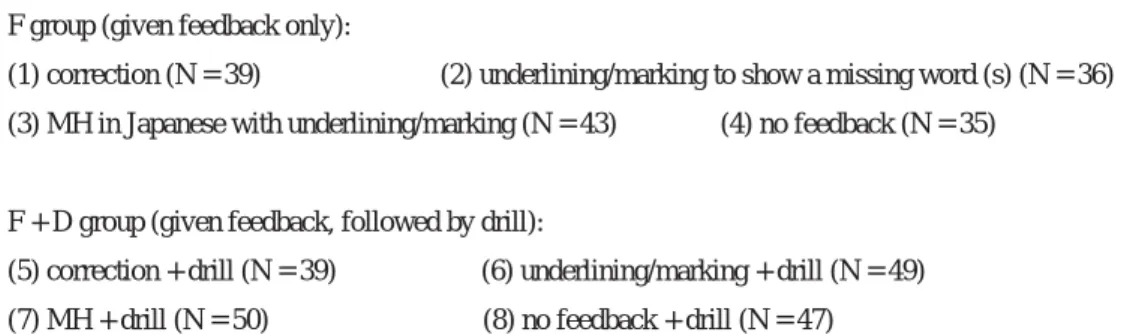
F group (given feedback only):
(1) correction (N = 39) (2) underlining/marking to show a missing word (s) (N = 36) (3) MH in Japanese with underlining/marking (N = 43) (4) no feedback (N = 35)
F + D group (given feedback, followed by drill):
(5) correction + drill (N = 39) (6) underlining/marking + drill (N = 49) (7) MH + drill (N = 50) (8) no feedback + drill (N = 47)
3. Results
Figure 1 shows that the scores similar at pretest showed the difference at uptake and post-test. Any feed- back except no feedback caused more uptake, where MH achieved the highest scores and correction the second highest. Every F + D scored higher than F at post- test, where MH + drill scored the highest.
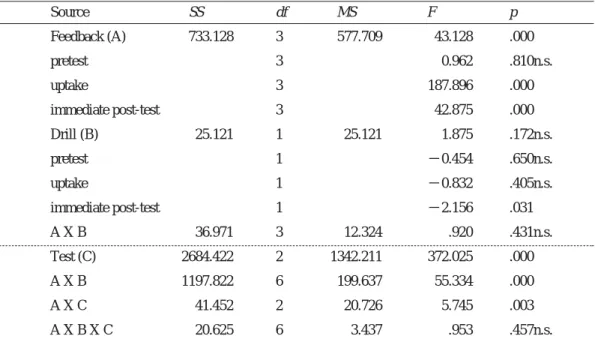
Table 2 shows the results of a repeated measure ANOVA and indicates feedback by test and drill by test interactions. The simple main effects of feedback using a Kruskal Wallis test among four groups showed significant differences at both uptake and post-test. Bonferroni s multiple comparisons (the level of signif- icance at p < .0083) showed significant differences: at uptake (any feedback > no feedback; MH > correc- tion, underlining) and at post-test (any feedback > no feedback; MH > underlining).
Figure 1. Mean scores at pretest, treatment, and immediate post-test.
As for correct response at drill, a Kruskal Wallis test among four F + D showed significant differences.
Bonferroni s multiple comparisons showed significant differences (MH > underlining, no feedback; correc- tion > underlining). Conversely, the simple main effect of drill using a Mann-Whitney test between two groups showed significant difference at post-test (with drill > without drill).
A Kruskal Wallis test among eight groups, four F and four F + D, also showed significant differences at post-test. Bonferroni s multiple comparisons (the significance level at p < .0017) indicated significant dif- ferences (MH + drill > underlining, underlining + drill, no feedback, no feedback + drill; correction + drill
> no feedback, no feedback + drill; underlining + drill, MH, correction > no feedback).
Table 2. Summary of a repeated measure three-way ANOVA for scores (p < .05)
Source SS df MS F p
Feedback (A) 733.128 3 577.709 43.128 .000
pretest 3 0.962 .810n.s.
uptake 3 187.896 .000
immediate post-test 3 42.875 .000
Drill (B) 25.121 1 25.121 1.875 .172n.s.
pretest 1 −0.454 .650n.s.
uptake 1 −0.832 .405n.s.
immediate post-test 1 −2.156 .031
A X B 36.971 3 12.324 .920 .431n.s.
Test (C) 2684.422 2 1342.211 372.025 .000
A X B 1197.822 6 199.637 55.334 .000
A X C 41.452 2 20.726 5.745 .003
A X B X C 20.625 6 3.437 .953 .457n.s.
Conversely, the simple main effects of the test using a Friedman s test showed significant differences in six feedback-given groups. Bonferroni s multiple comparisons (the significance level at p < .0167) showed significant differences (uptake > pretest, post-test; post-test > pretest). Practice effect was not observed because there was no significant difference between pretest and post-test in a no feedback-given group.
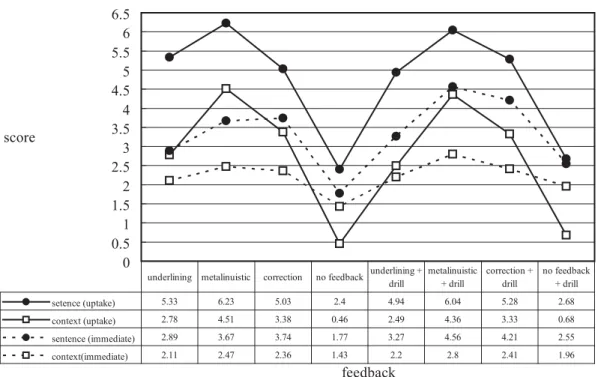
Next, we will consider the results based on sentence-level and context-level. As seen in Figure 2, a Wilcoxon signed-ranks test showed significant difference at both uptake and post-test (sentence-level >
context-level).
A Kruskal Wallis test among four groups at each level showed significant difference at both uptake and post-test. As for uptake, Bonferroni s multiple comparisons showed significant differences: at sentence- level (any feedback > no feedback; MH > correction, underlining) and context-level (any feedback > no feedback; MH > correction, underlining; correction > underlining). As for post-test, significant difference was seen at sentence-level (any feedback > no feedback; MH, correction > underlining) and context-level (MH > no feedback).
Conversely, a Kruskal Wallis test among eight groups showed significant difference in post-test at sen- tence-level. Bonferroni s multiple comparisons showed significant differences: sentence-level (MH + drill
> underlining, underlining + drill, no feedback, no feedback + drill; correction + drill > no feedback, no feedback + drill; underlining + drill, MH, correction > no feedback) and context-level (MH + drill > no feedback). A Mann-Whitney test between F and F + D also showed significant difference in post-test at sentence-level.
Figure 2. Mean scores of uptake and immediate post-test at each error level.
On the other hand, a Friedman s test showed significant differences at both levels. Bonferroni s multiple comparisons between pretest and post-test showed significant differences, where post-test was better, at sentence-level (seven groups, except no feedback) and at context-level (two groups, MH and MH + drill).
4. Discussion
Hypothesis 1, concerning the better effect of feedback on uptake and retention, was supported, because any feedback was effective on uptake and retention more than no feedback. However, groups given feed- back showed significant difference between uptake and post-test, meaning that little awareness at uptake was retained. It is therefore possible to suggest that feedback has a better effect on uptake and retention than no feedback, whereas feedback is insufficient to retain most awareness caused at uptake over even a short period of time.
Hypothesis 2, concerning the better effect of enhancing awareness on retention, was supported, because awareness was more retained by F + D than F. However, F + D showed significant difference between uptake and post-test, meaning that awareness at uptake was little retained. It therefore follows that enhanc- ing awareness can work for better retention than no enhancement, whereas enhancement is insufficient to retain most awareness over a short period of time.
Hypothesis 3, concerning the influence of TF type on the effectiveness of intervention, was supported.
Uptake and retention at sentence-level were more than at context-level. At post-test, whereas significant difference by feedback effect appeared in five pairs at sentence-level and one pair at context-level, signifi- cant difference by drill effect was seen at sentence-level. It therefore follows that effectiveness of instruc- tional intervention can change depending on TF type, and that TFs at sentence-level can get its influence more.
It is then necessary to consider why the degree of effectiveness of instructional intervention was differ- ent on uptake and on retention, and why the degree of effectiveness changed depending on the type of TFs.
The reason seems to be the quality of feedback, that is, how much feedback is distinct and detailed enough to cause awareness. The quality of feedback can then influence the quantity of awareness, the quantity of awareness enhanced, and the quantity of awareness retained. First, the more distinct and detailed feedback is, the more awareness can take place. Next, the more awareness takes place, the more the target for enhancement with additional intervention can occur. Finally, the more awareness is enhanced, the more awareness can be retained. In fact, this study showed that feedback, which caused more uptake and was combined with drill, retained more awareness. That was MH. The better effects of MH were also found on uptake by Lyster and Ranta (1997) and on retention by Carroll and Swain (1993).
The quality of feedback can also influence on the type of TFs to be aware of. TFs at context-level are
more complex than those at sentence-level. Therefore, feedback with more distinct and detailed informa- tion is necessary for awareness at context-level. Conversely, distinct and detailed information become redundant at sentence-level, and less distinct and less detailed feedback can be sufficient for awareness. In fact, this study showed that underlining - less distinct and less detailed than correction - caused as much awareness as correction at sentence-level and significantly less awareness than correction at context-level.
Correction - less detailed than MH - also caused significantly less awareness than MH.
However, as shown in this study, awareness does not necessarily guarantee its retention. Although inter- ventions caused significantly better retention than no feedback, awareness caused by feedback was signifi- cantly less retained afterwards. For example, although MH caused uptake significantly more than correc- tion and underlining at context-level, they all showed similar retention at post-test. The possible reason for such a decline of retained awareness is the learners developmental readiness for TFs. Mackey and Philp (1998) pointed out that recasts enabled learners to acquire a TF which they were developmentally ready to acquire. That is, it is not until learners become developmentally ready that feedback to the TF will be a help for acquiring or at least learning it. In that sense, subjects given feedback may be at the stage where they can be aware of more TFs at uptake because of their making use of distinct and detailed information in feedback, but they can be aware of less TFs at post-test because of no such information. This will be more prominent for TFs at context-level, which are more complex and problematic. In summary, the degree of the effectiveness of intervention on awareness and retention depends on three factors: 1. Quality of feed- back, 2. Type of TF, and 3. The developmental readiness of learners.
5. Conclusions
The results suggest two major conclusions:
1. The amount of awareness caused by feedback and the use of awareness enhancement after aware- ness, respectively, has an influence on retention.
2. The effectiveness of interventions changes depending on TFs which they focus upon.
This study does not claim that giving instructional intervention only once is enough for awareness to be maintained for a long period. However, uptake through feedback and its enhancement through drill can be the starting point for a long retention.
It will be necessary to conduct two further studies. We should examine how much of the effect caused immediately after instructional interventions can be retained for a long period. It is because some studies including Hyland (2003) show that feedback on error correction can improve students writing only in the short-term. Another study will be on the effect of interventions on erroneous uptake. It is because we can not rely on learners target-like use as the only evidence for growth or change in their interlanguage.
Notes
1 Uptake in this study is the same as Repair in Lyster and Ranta (1997).
2 The TFs were chosen from forms which are thought to be easy to mistake and be able to explain with explicit knowledge for Japanese learners of English.
3 In pretest, treatment, and post-test, the subjects were asked to mark the passage to show how far they looked it over before returning. Only the passage marked at its end was counted for data to get rid of the possibility that some subject did not look it over to the end.
4 Lyster and Ranta (1997) pointed out that correction caused no learner-generated repairs without checking the degree of learners awareness. It should be examined whether or how much correction causes aware- ness by asking to describe their awareness.
References
Ayoun, D. (2001). The role of negative and positive feedback in the second language acquisition of the pass´e compose´ and imparfait. The Modern Language Journal, 85(2), 226-243.
Carroll, S. & Swain, M. (1993). Explicit and implicit negative feedback: An empirical study of the learning of linguistic generalizations. Studies in Second Language Acquisition, 15(3), 357-386.
Ferris, D. & Roberts, B. (2001). Error feedback in L2 writing classes: How explicit does it need to be?
Journal of Second Language Writing, 10(3), 161-184.
Hyland, F. (2003). Focusing on form: Student engagement with teacher feedback. System, 31(2), 217-230.
Lyster, R. & Ranta., L. (1997). Corrective feedback and learner uptake: Negotiation of form in communicative classrooms. Studies in Second Language Acquisition, 19(1), 37-66.
Mackey, A. & Philp, J. (1998). Conversational interaction and second language development: Recasts, respons- es, and red herrings. The Modern Language Journal, 82(3), 338-356.
Nabei, T. & Swain, T. (2002). Learner awareness of recasts in classroom interaction: A case study of an adult EFL student's second language learning. Language Awareness, 11(1), 43-63.
Robb, T., Ross, S., & Shortreed, I. (1986). Salience of feedback on error and its effect on EFL writing quality.
TESOL Quarterly, 20(1), 83-95.
Skehan, P. (1998). A cognitive approach to language learning. Oxford: Oxford University Press.
Truscott, J. (1996). The case against grammar correction in L2 writing classes. Language Learning, 46(2), 327-369.
Appendices
Appendix 1.
Feedback in treatment (underlining/marking is common to other groups) In case of MH:
以下の文章には、(1)下線や記号(∧)で示されたエラーと(2)その下にエラーに関 するヒントがそれぞれ記入されています。ヒントを参考に余白に訂正しなさい。
We saw a video last week. ∧Video was ∧an experiment by using some rabbits.
この場合のビデオは限定しない 「video = experiment」という関係?
(一般的な)ビデオ? 「ビデオは(〜の)実験です」となる?
Appendix 2.
Drill given to F + D group after feedback of the TFs
括弧内に適切な語を入れなさい。1つの括弧には1つの単語が入ります。
Q1 私はこの店で売っている新しいイスが欲しい。I need ( ) new chair in this store.
私はそこにあるイスが欲しい。 I need ( ) new chair there.
Q2 彼は今学生です。 He is ( ) ( ) now.
彼は今学校です。 He is ( ) ( ) now.