Doctoral Dissertation
The Effectiveness of Computer Simulations for Improving Indonesian Junior High School Students’ Conceptual Understanding of Light and
Optical Instruments
ARIF WIDIYATMOKO
Graduate School for International Development and Cooperation Hiroshima University
March 2020
The Effectiveness of Computer Simulations for Improving Indonesian Junior High School Students’ Conceptual Understanding of Light and
Optical Instruments
D161086
ARIF WIDIYATMOKO
A Dissertation Submitted to
the Graduate School for International Development and Cooperation of Hiroshima University in Partial Fulfillment
of the Requirement for the Degree of Doctor of Philosophy in Education
March 2020
ABSTRACT
Conceptual understanding is one of the competencies in the science education curriculum in Indonesia. This competency is a part of the science graduation standard indicated in Ministry of Education and Culture (MoEC) article number 20, the year 2016.
Thus, conceptual understanding is needed by students for learning science successfully.
However, students’ conceptual understanding in Indonesia is low. According to Trends in International Mathematics and Science Study (TIMSS) in 2015, there were only 32% in the overall of Indonesian students who had the correct answer for a question that demands conceptual understanding ability on science. One of the factors that affect students’
conceptual understanding is misconceptions. Misconceptions have occurred if the students’
understanding of a concept differs from the scientific concept.
Previous studies on improving conceptual understanding suggested that the first step towards an effective learning process is to identify the misconceptions and employ effective teaching methods to overcome the misconceptions. One of the teaching methods to overcome students’ misconceptions is using computer simulations in the learning process.
Thus, the main objectives of this research were to investigate the effectiveness of computer simulations to improve students’ conceptual understanding and to overcome students’
misconceptions about light and optical instrument concepts.
Before investigating the effectiveness of computer simulations, this research was started by developing a two-tier multiple-choice test (TTMCT) to assess students’
conceptual understanding as well as to investigate students’ misconceptions of light and optical instrument concepts. The result from this test was twenty-two students’
misconceptions about light and optical instrument concepts. These misconceptions were used to develop computer simulations about light and optical instrument concepts. The computer simulations programs were reviewed by six science teachers to obtain comments and suggestions for further improvement using a set of questionnaires, which consisted of 10 item questions with a 5-point Likert scale.
The sample of this study consisted of 264 junior high school students in 8th grade from three public schools in Semarang city, Central Java Province, Indonesia. For this study, the sample was divided into two groups, the experimental and control group. For the experimental group (130 students), the learning process of light and optical instrument concepts was taught using the computer simulations. For the control group (134 students), the same concept was taught using science textbooks.
This study used a quasi-experimental design involving experimental and control groups. TTMCT measured students' conceptual understanding of light and optical instrument concepts. The TTMCT was administered to both the control and experimental group, first in the initial meeting before instructions and second in the seventh meeting after completing the instructions.
When the post-test scores were compared by means of the t-test to ascertain the effect of the computer simulations on the students’ conceptual understanding, it was found that there was a statistically significant difference between the control and experimental groups [Mexp = 48.61, SDexp = 14.58, Mcon = 36.66, SDcon = 12.7, t = 7.099, sig < 0.05]. The results showed that computer simulations have a positive effect on students’ conceptual understanding.
In conclusion, the computer simulations were found to improve students’ conceptual understanding of the light and optical instrument concepts and had contributed to the higher achievement of the experimental group. The findings in this study showed that computer simulation is an effective teaching method to improve students’ conceptual understanding and overcome their misconceptions about light and optical instrument concepts.
ACKNOWLEDGMENTS
The completion of this doctoral dissertation would not have been possible without the guidance and support of various individuals to whom I would like to express my sincere gratitude.
I sincerely thank the Almighty Allah SWT for His guidance in all respects of my life, in giving me direction and good health during the process of writing this dissertation.
I would like to express sincere thanks to my advisor Professor Kinya Shimizu for his guidance and patience. He is an amazing professor who has a vast knowledge and a keen ability to inspire and support his students to achieve their maximum potential.
I am eternally grateful to the members of my examination committee who gave invaluable feedback on the dissertation. Thanks to Professor Takuya Baba and Dr. Ayami Nakaya from the Graduate School for International Development and Cooperation, Hiroshima University.
Thanks to Professor Takuya Matsuura and Professor Hideo Ikeda from the Graduate School of Education, Hiroshima University. Thank you all for your priceless contribution. I appreciate all your advice and support.
Special thank you goes to the principals, teachers, and students for their participation in the study. Without the research participants, this work would not have been possible.
Conducting this research with you was a memorable experience. I wish you all the best in your life.
I would like to acknowledge the support of Indonesia Endowment Fund for Education (LPDP) for providing the scholarship and various kinds of support to pursue my doctoral degree in Japan. The scholarship made it possible for me to study in Japan, to have experience in a different culture and to achieve my goal of obtaining a PhD. in Science Education. I am very grateful.
Thanks to all my friends in Indonesia and Japan for their supports, good wishes and prayers.
I would like to thank my lab-mates in Shimizu Sensei’s Lab especially for their comments and feedback during seminar. Thanks to all my fellows in Indonesian Students Association (PPIH) for their supports throughout my life in Japan.
Special thanks to my beloved family, my loving wife Hanida Trisnawati and my beloved kids Ahmad Nabiil Taqiyyuddin and Afiqa Yasmine Charmaraiza, my parents, my parents- in-law for their continuous support, encouragement, understanding, care, and love after all immense throughout my study here in Japan.
Thank you all.
DEDICATION
To my beloved family Hanida Trisnawati, Ahmad Nabiil Taqiyyuddin, Afiqa Yasmine Charmaraiza and the rest of my family
TABLE OF CONTENTS
ABSTRACT.. ... iii
ACKNOWLEDGMENTS ... iv
DEDICATION ... v
TABLE OF CONTENTS ... vi
LIST OF TABLES ... x
LIST OF FIGURES ... xii
LIST OF APPENDICES ... xiii
LIST OF ABBREVIATIONS ... xiv
CHAPTER 1 INTRODUCTION ... 1
1.1. Overview of the chapter ... 1
1.2. Background of the study ... 1
1.3. Research objectives ... 4
1.4. Research questions ... 4
1.5. Significances of the study ... 5
1.6. Chapter lists of the dissertation ... 5
CHAPTER 2 LITERATURE REVIEW ... 10
2.1. Overview of the chapter ... 10
2.2. Conceptual understanding ... 10
2.2.1. Definition of conceptual understanding ... 10
2.2.2. An overview of conceptual understanding in Indonesian curriculum ... 14
2.3. Misconceptions ... 19
2.3.1. Analyzing factors contributing to students’ misconceptions in light and optical instrument concepts ... 21
2.3.2. Remediations of misconceptions ... 26
2.4. Computer simulations ... 27
2.5. Two-tier Multiple-Choice Test (TTMCT) ... 32
2.6. Light and optical instrument concepts ... 34
2.6.1. Misconceptions of the properties of light ... 35
2.6.2. Misconceptions of the formation of the image on mirrors and lenses ... 36
2.6.3. Misconceptions of optical instruments, human eye and eye disorders ... 38
2.7. Theoretical framework of the study ... 39
2.8. Summary ... 42
CHAPTER 3 METHODOLOGY ... 44
3.1. Overview of the chapter ... 44
3.2. Overall research design ... 44
3.3. Sample of study ... 47
3.3.1. Participating students ... 47
3.3.2. Participating teachers ... 47
3.4. Data collection instrument ... 48
3.4.1. Two-Tier Multiple-Choice Tests (TTMCT) ... 48
3.4.2. Computer simulations of light and optical instruments ... 49
3.5. Pilot study ... 51
3.6. Teaching intervention ... 51
3.6.1. Control group instruction ... 51
3.6.2. Experimental group instruction ... 52
3.7. Data analysis ... 54
3.8. Ethical considerations ... 55
3.9. Summary ... 55
CHAPTER 4 DEVELOPMENT OF TWO-TIER MULTIPLE-CHOICE TEST TO ASSESS STUDENTS’ CONCEPTUAL UNDERSTANDING ABOUT LIGHT AND OPTICAL INSTRUMENTS ... 56
4.1. Overview of the chapter ... 56
4.2. Introduction ... 57
4.3. Method for developing TTMCT ... 58
4.3.1. First stage: Defining the content area ... 59
4.3.2. Second stage: Identification of students’ conceptions ... 62
4.3.3. Third stage: Development of TTMCT... 62
4.3.3.1. Expert validation ... 64
4.3.3.2. Pilot study ... 66
4.4. TTMCT item analysis ... 72
4.4.1. Validity analysis ... 72
4.4.2. Reliability analysis ... 73
4.4.3. Item difficulty analysis ... 74
4.4.4. Item discrimination analysis ... 75
4.4.5. Recapitulation of the results of the item analysis ... 77
4.5. Discussion ... 78
4.6. Conclusion ... 81
CHAPTER 5 DEVELOPMENT OF COMPUTER SIMULATIONS TO OVERCOME STUDENTS’ MISCONCEPTIONS ABOUT LIGHT AND OPTICAL INSTRUMENTS ... 82
5.1. Overview of the chapter ... 82
5.2. Introduction ... 82
5.3. Methods for developing computer simulations ... 84
5.4. Results ... 84
5.4.1. Define phase ... 84
5.4.2. Design phase ... 86
5.4.3. Develop phase ... 94
5.4.4. Disseminate phase ... 98
5.5. Discussion ... 98
5.6. Conclusion ... 99
CHAPTER 6 IMPROVING STUDENTS’ CONCEPTUAL UNDERSTANDING USING COMPUTER SIMULATIONS ABOUT LIGHT AND OPTICAL INSTRUMENTS ... 100
6.1. Overview of the chapter ... 100
6.2. Introduction ... 100
6.3. Methods ... 102
6.4. Lesson analysis ... 103
6.4.1. Experimental group lesson (Example: Lesson 5. Human eye) ... 104
6.4.2. Control group lesson (Example: Lesson 5. Human eye) ... 107
6.5. Results ... 109
6.5.1. Analysis of students’ responses to items in the pre-test and post-test in the TTMCT ... 110
6.5.2. Pre-test and Post-test Comparisons of Total Scores in the TTMCT ... 111
6.5.3. Percentage of Students’ Misconceptions identified in the combined tiers of each item ... 112
6.5.3.1. Properties of light ... 114
6.5.3.2. Formation of an image in mirrors and lenses ... 115
6.5.3.3. Optical instruments ... 116
6.5.3.4. Human eye and eye disorders ... 117
6.6. Discussion ... 119
6.7. Conclusion ... 122
CHAPTER 7 CONCLUSIONS AND IMPLICATIONS ... 124
7.1. Overview of the chapter ... 124
7.2. Conclusions of the study ... 124
7.3. Limitations of the study ... 126
7.4. Implications of the study ... 127
7.5. Recommendation for further research ... 128
REFERENCES ... 129
LIST OF TABLES
Table 2.1. Summary of studies elements of conceptual understanding ... 11
Table 2.2. Science subject core competencies in curriculum 2013 ... 17
Table 2.3. Example of basic competencies of science subject in curriculum 2013 ... 17
Table 2.4. Summary of factors contributing to students’ misconceptions ... 20
Table 2.5. Difficult words in light and optical instruments concept ... 23
Table 2.6. The reasons why teachers propagate misconceptions ... 24
Table 2.7. The reasons why textbooks cause misconceptions ... 25
Table 2.8. Summary of studies the advantages and disadvantages of computer simulations ... 29
Table 2.9. Summary of studies two-tier multiple-choice test ... 34
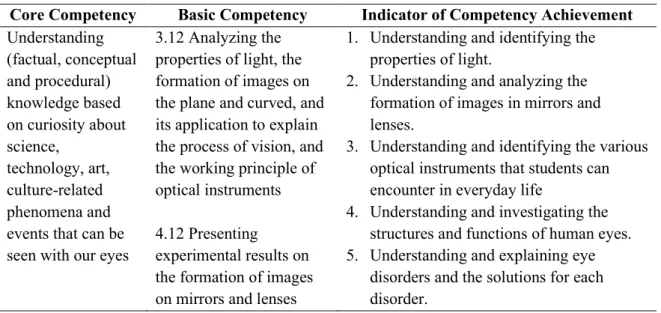
Table 2.10. Core competency, basic competency, and indicator of “light and optical instruments” concept ... 35
Table 2.11. Misconceptions about light in Fetherstonhaugh and Treagust’s ... 36
Table 2.12. Misconceptions about image by a plane mirror ... 36
Table 2.13. Misconceptions in optics in the study of Kutluay ... 38
Table 3.1. Distribution of students group sample ... 47
Table 3.2. Science teacher participant ... 47
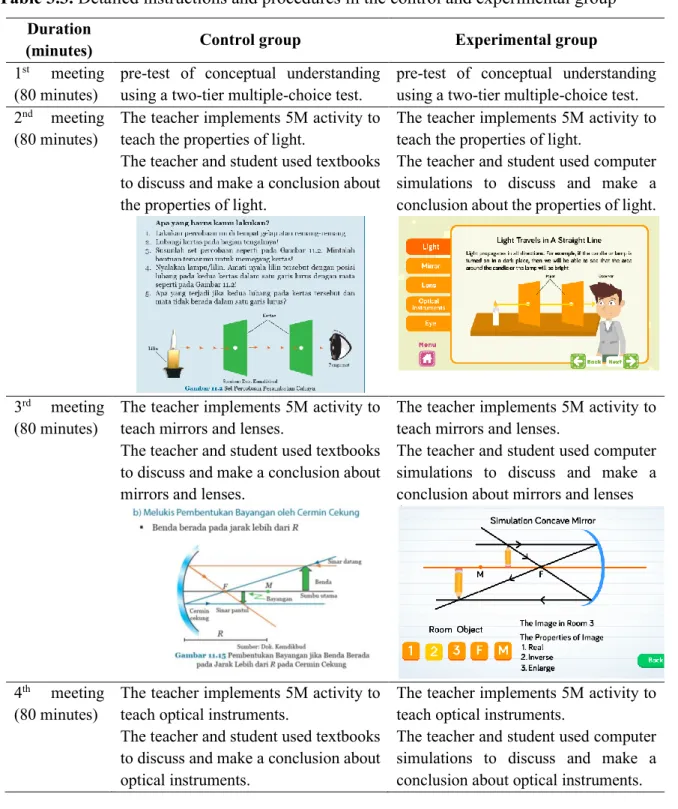
Table 3.3. Detailed treatment and procedures in the control and experimental group ... 52
Table 3.4. Criteria for analyzing the two-tier multiple-choice test ... 54
Table 4.1. Content area of light and optical instruments concept in the TTMCT ... 60
Table 4.2. Indicator of questions in TTMCT ... 63
Table 4.3. Expert validation results of the TTMCT ... 64
Table 4.4. Results of suggestions from experts to improve TTMCT ... 65
Table 4.5. Responses by grade 9th students and percentage for each item questions ... 67
Table 4.6. Students’ misconceptions from the administration of the TTMCT ... 71
Table 4.7. Validity analysis of the TTMCT ... 73
Table 4.8. Criteria of the Cronbach's Alpha value ... 73
Table 4.9. Results analysis of the level of difficulty in the TTMCT ... 75
Tabel 4.10. Criteria of discrimination index ... 76
Tabel 4.11. Analysis of discrimination index of the TTMCT ... 76
Tabel 4.12. Results analysis of item question ... 77
Table 5.1. Percentage of students’ misconceptions about light and optical instruments
concept ... 85
Table 5.2. Overcoming students’ misconceptions about light and optical instruments using computer simulations ... 87
Table 5.3. Content of computer simulations in light and optical instruments concept ... 95
Table 5.4. Assessment of simulations by science teachers ... 97
Table 5.5. Improvement of computer simulations based on suggestions from teachers .. 97
Table 6.1. Percentage of correct pre-test and post-test responses to the first tier and combined tiers of items in the TTMCT ... 110
Table 6.2. Means and standard deviations for the pre-test and post-test ... 112
Table 6.3. ANCOVA results comparing post-test mean scores of both groups ... 112
Table 6.4. The percentage of students’ misconceptions in the pre-test and post-test... 113
LIST OF FIGURES
Figure 1.1. Chapter lists of the dissertation ... 9
Figure 2.1. School system in Indonesia based on law number 20-year 2003... 16
Figure 2.2. Evaluation for measure conceptual understanding in science textbook ... 18
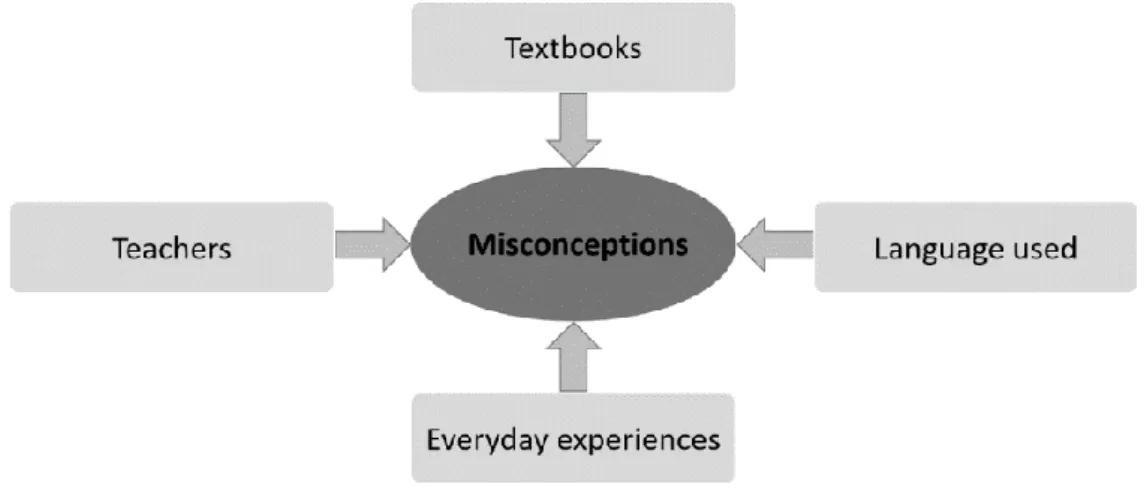
Figure 2.3. Factors contributing to students’ misconceptions in science learning ... 21
Figure 2.4. Parts of human eye ... 25
Figure 2.5 Accommodation of the human eye ... 26
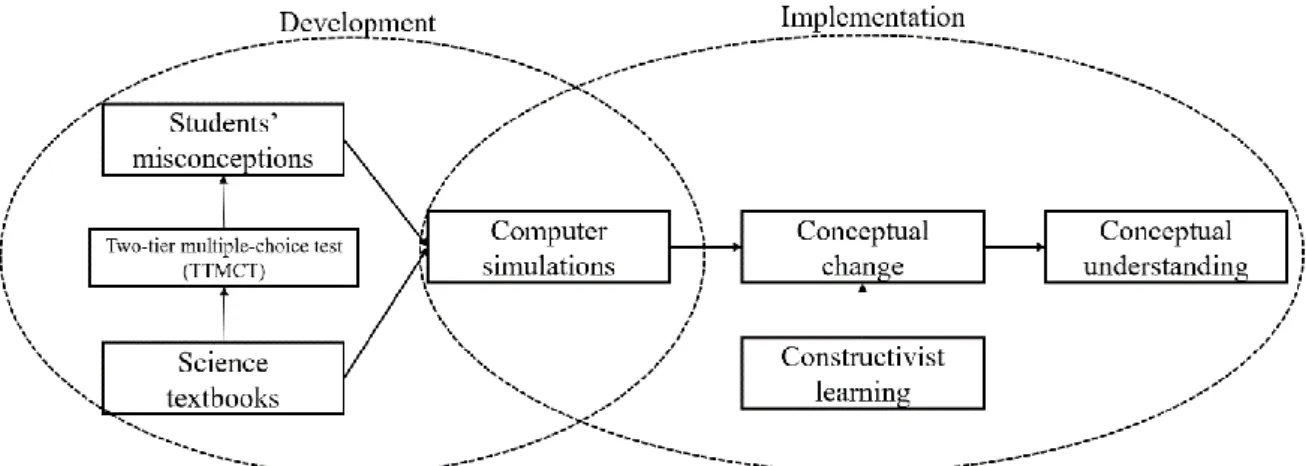
Figure 2.6. Theoretical framework ... 42
Figure 3.1. Overall research design of this study ... 46
Figure 3.2. Examples of questions in the TTMCT ... 48
Figure 3.3. Computer simulations program of light and optical instrument concepts ... 50
Figure 3.4. Learning process of light and optical instrument concepts ... 51
Figure 4.1. The flowchart of instrument development based on Treagust ... 59
Figure 4.2. Concept map of light and optical instruments ... 61
Figure 4.3. Questions to identifying students’ conceptions ... 62
Figure 4.4. The example of the item TTMCT and percentage of students selecting each response combination for item number 1 and 2 dealing with the properties of the light ... 66
Figure 4.5. Reliability analysis ... 74
Figure 5.1. The development of computer simulations using four D models ... 84
Figure 5.2. Design of computer simulations using software Adobe Flash Professional CS6 ... 86
Figure 5.3. Parts of computer simulations about light and optical instrument concepts . 94 Figure 5.4. Computer simulations of light and optical instrument concepts ... 96
Figure 6.1. Research design ... 103
Figure 6.2. Computer simulations of human eye and eye disorders ... 107
Figure 6.3. Textbooks of human eye and eye disorders ... 109
Figure 6.4. Percentage of the correct answer obtained by the control and experimental group in the pre-test and post-test ... 111
Figure 6.5. Percentage of students’ misconception obtained by the control and experimental group in the pre-test and post-test ... 114
LIST OF APPENDICES
Appendix 1. Two-tier multiple-choice test (TTMCT) ... 140 Appendix 2. Screen shoot of computer simulations program using Adobe CS6 ... 153 Appendix 3. Letter of permission ... 157
LIST OF ABBREVIATIONS
MoEC Ministry of Education and Culture
MoRA Ministry of Religious Affairs
TTMCT Two-Tier Multiple-Choice Test
CHAPTER 1 INTRODUCTION
1.1. Overview of the chapter
This study aims to improve Indonesian junior high school students’ conceptual understanding of light and optical instruments. Previous studies on improving conceptual understanding suggested that the first step towards an effective learning process is to identify the misconceptions and employ effective teaching methods to overcome the misconceptions.
One of the teaching methods for overcoming students’ misconceptions is using computer simulations in the learning process. A brief elaboration about these important issues commenced this introduction chapter. This chapter describes the background of the study, research objectives, research questions, significances of the study, and chapter list of dissertations. This introduction section offers a complete depiction of the whole study.
1.2. Background of the study
The Indonesian government has been making a series of alterations to the national curriculum during the 2000s, attempting to move from a content-based curriculum to a competency-based and from teacher-centered rote learning to student-centered active methods. The emphasis was on shifting the focus of education away from the memorization of facts and theoretical knowledge towards students being able to achieve competencies (MoEC, 2013). There are four core competencies which mandatory for all educational levels and all subjects, including science, namely spiritual, social, knowledge, and skill competencies. In particular of knowledge competencies, conceptual understanding is an inseparable part of the science concept. Conceptual understanding is one of the competencies in science learning in Indonesia. This competency is a part of the science graduation standard indicated in MoEC article number 20, the year 2016. Thus, conceptual understanding is needed by students for learning science successfully.
Students’ conceptual understanding in Indonesia is low. The result of TIMSS’ in 2015 showed that there were only 32% in the overall of Indonesian students who had the correct answer for a question which demands conceptual understanding ability on science (Martin et al., 2015). These facts indicated that the majority of Indonesian students’
conceptual understanding needs to be achieved. The problem in conceptual understanding is
difficult for students to make a connection with complex science phenomena in everyday life situation, for instance, light and optical instrument concepts.
Light and optical instruments is an important concept of everyday life (Yalcin et al., 2009) and it is used as the primary concept in many sciences area ranging from astronomy to zoology (Blizak et al., 2009). It is also an important science concept that is included in the curriculum of many countries. Furthermore, students’ conceptual understanding in light and optical instruments has attracted the interest of researchers in different countries from early education to university level and beyond (Heywood, 2005; Yalcin et al., 2009; Blizak et al., 2009; Tural, 2015; Kaltakci-Gurel et al., 2016). However, based on the previous studies, various difficulties in dealing with abstract concepts were found in the learning process. Ling (2017) stated that light and optical instruments are a complex and difficult concept. Due to the importance and the difficulty of this concept, students have various misunderstandings and hence have developed misconceptions about this concept (Yalcin et al., 2009). The reasons behind misconceptions include the instructional methods used (Barke et al., 2009), science textbooks (Kaltakci & Eryilmaz, 2010; Gudyanga & Madambi, 2014), teachers’
perceptions (Satilmiş, 2014; Erman, 2017) and even the students’ everyday life experiences (Kaltakci & Eryilmaz, 2010; Widarti et al., 2016).
Misconceptions are developed by the students when their understanding of the scientific concept is not in line with those provided by scientists (Nakhleh, 1992; Barke et al., 2009; Allen, 2014). The previous study mentioned that misconceptions impede effective learning because the new knowledge cannot be integrated appropriately into students’
cognitive structure due to the existing knowledge which is resistant to change (Taber, 2000;
Ebenezeer et al., 2010). These studies also suggested that to develop conceptual understanding, students’ misconceptions need modification in a process known as conceptual change (Chi & Roscoe, 2002; Ebenezeer et al., 2010). Previous studies on improving conceptual understanding suggested that the first step towards an effective learning process is to identify the misconceptions and employ effective teaching methods to overcome the misconceptions (Çepni et al., 2006; Cibik et al., 2008).
Overcoming students’ misconceptions in science have been explored by previous researchers in the science education field. Research related to misconceptions had shown that traditional teaching methods are not effective for overcoming students’ misconceptions (Saul & Redish, 1999; Jimoyiannis & Komis, 2001). One of the teaching methods for overcoming students’ misconceptions is using computer simulations in the learning process
(Chen et al., 2013; Moosa, 2015; Ramnarain & Moosa, 2017). Previous study on the effectiveness of computer simulations for supporting science conducted by Smetana and Bell (2012) stated that computer simulations could help students to eliminate their misconceptions. Computer simulations provide interactive, authentic, and meaningful learning opportunities for students because it facilitates the learning of abstract concepts in science learning, such as light and optical instrument concepts.
Computer simulations have the potential to improve conceptual understanding more effectively for abstract scientific concept, and not easily accessed through direct observation (Zacharia and Olympiou, 2011). According to Scalise et al. (2011), computer simulations are used to model which is not easily observed in real life. Part of computer simulations impacts students’ conceptual understanding can be attributed to the unique affordances that emerge from their multi-representational nature (Olympiou and Zacharia, 2012). For instance, an advantage of computer simulations compared to any other teaching methods is that they involve representations of abstract concept which are invisible in the physical world. As a result, computer simulations provide students through their multi- representational nature, which could lead to a deeper conceptual understanding of the scientific phenomenon.
A conceptual understanding is an important cognitive outcome in the science education field (Renken & Nunez, 2013). Students must be taught to develop a conceptual understanding that is aligned with the conceptual understanding accepted by the scientific community (Ausubel, 1963). Meaningful science learning requires conceptual understanding rather than memorization (Adadan et al., 2010). Meaningful learning requires knowledge to be constructed by the learners, not transmitted from the teacher to the students (Jonassen et al., 1999). To promote meaningful conceptual understanding, teaching strategies must be found to eliminate misconceptions. Meaningful learning activities helped students to cultivate deep learning and enhance conceptual understanding (Nieswandt, 2007). The conditions that affect the achievement of conceptual understanding apply to the process of learning science as well. Meaningful learning strategies allow students to implement from what they are learning. As students engaged in meaningful learning activities, they are also able to dispel misconceptions.
Misconceptions are also considered as one of the most important obstacles against meaningful learning (Kutluay, 2005). Meaningful and successful learning of science occurs when the misconceptions that students bring to the classroom are corrected (Bilgin, 2006).
Therefore, after students’ misconceptions were identified, the teacher can help the students to achieve the understanding of scientific concepts. Helping students to develop a meaningful conceptual understanding of how the concept can be used in their daily lives is an aim of science education.
1.3. Research objectives
The general objective of this study was to investigate the effectiveness of computer simulations to improve students’ conceptual understanding and overcome students’
misconceptions about light and optical instrument concepts. The specific objectives can be described as follows:
1. To develop the Two-Tier Multiple-Choice Test (TTMCT) for measuring students’
conceptual understanding and identifying students’ misconceptions about light and optical instrument concepts.
2. To develop computer simulations for improving students’ conceptual understanding and overcoming students’ misconceptions of light and optical instrument concepts.
3. To improve students’ conceptual understanding and overcome students’
misconceptions using computer simulations of light and optical instrument concepts.
1.4. Research questions
The main research question was: What is the effect of computer simulations on improving students’ conceptual understanding and overcoming students’ misconceptions about light and optical instrument concepts? The sub-research questions were:
1. How to develop a two-tier multiple-choice test to measure students’ conceptual understanding and identify students’ misconceptions of light and optical instrument concepts?
2. What are the misconceptions about light and optical instrument concepts held by the students?
3. How to develop computer simulations for improving students’ conceptual understanding and overcoming students’ misconceptions about light and optical instruments?
4. What is the effectiveness of computer simulations to improve students’ conceptual understanding and overcoming students’ misconceptions using computer simulations about light and optical instruments?
1.5. Significances of the study
The significance of the study can be discussed concerning the theoretical and practical levels. At the theoretical level, this research can contribute to the educational research review about: (1) the effectiveness of computer simulations on conceptual understanding in science learning, (2) an overview about conceptual understanding in science education curriculum in Indonesia, and (3) factors affecting students’
misconceptions about light and optical instrument concepts. At a practical level, this research provides science teachers in Indonesia with insight into teaching using technology such as computer simulations, particularly about light and optical instrument concepts. Furthermore, this research improves students’ conceptual understanding and overcome students’
misconceptions about light and optical instrument concepts. Moreover, this study covers the way for more research and studies in the future, such as the use of technology in science learning, which is in high demand, and the current trend in Indonesia.
1.6. Chapter lists of the dissertation
This dissertation is organized into seven chapters (Figure 1.1), and the synopsis of each chapter is given below.
Chapter 1: Introduction
Conceptual understanding in science learning has been the main concern of the researchers in the science education field. Students’ conceptual understanding cannot be easily measured or observed. Teachers need to probe students’ understanding before and after instruction. One of the factors that affect students’ conceptual understanding is misconceptions. Misconceptions have occurred if the students’ understanding of a concept differs from the scientific concept. Misconceptions are stable cognitive structures to change, affect students’ conceptual understanding, and must be overcome so that students learn scientific concepts effectively. From the previous research, there are several methods to overcome students’ misconceptions in science learning. One of the effective methods for overcoming misconceptions is using computer simulation in the classroom (Chen et al., 2013; Ramnarain & Moosa, 2017). Therefore, the purpose of this study is to investigate the effectiveness of computer simulations to improve Indonesian junior high school students’
conceptual understanding and overcome students’ misconceptions about light and optical instrument concepts.
Chapter 2: Literature Review
To achieve the purpose of this study, a literature review related to conceptual understanding, misconceptions, and computer simulations is needed. The first part discusses the definition of conceptual understanding in science learning and an overview of conceptual understanding in Indonesia. The second part discusses definitions of misconceptions, factors contributing to students’ misconceptions in light and optical instruments in Indonesia, and previous research regarding misconceptions about light and optical instruments. The third part discusses definitions of computer simulations, advantages and disadvantages of computer simulations, and the effect of computer simulations in overcoming students’
misconceptions and improving students’ conceptual understanding. The literature review suggests that computer simulations play important roles in the science classroom, and it led the researcher to explore the effectiveness of computer simulations to achieve students’
conceptual understanding and overcome students’ misconceptions.
Chapter 3: Methodology
This chapter presents the research methods used to investigate the impact and effectiveness of computer simulations as a treatment in 8th-grade junior high school students in learning light and optical instrument concepts. This study was conducted in three stages.
The first stage is developing the Two-Tier Multiple-Choice Test (TTMCT) for measuring students’ misconceptions about light and optical instrument concepts. The second stage is developing computer simulations based on students' misconceptions that have found in the pilot study. In the third stage, two groups of 8th-grade students were exposed to different teaching methods. This stage was performed using a quasi-experimental design involving experimental and control groups. For the experimental group (N = 130), the learning process on light and optical instrument concepts was taught using computer simulations, and for the control group (N = 134), the same concept was taught using the traditional method. This chapter describes the research design, research instruments, samples of the study, data collection, and data analysis.
Chapter 4: Results 1 (Development of the Two-Tier Multiple-Choice Test to Assess Students’ Conceptual Understanding about Light and Optical Instruments)
The first stage of this study is developing the Two-Tier Multiple Choice Test (TTMCT). A TTMCT about the concept of “light and optical instruments” was developed
by the author. The test development procedure had three general steps: defining the content area of the test, identification of students’ conceptions, and the development of the test. The final version of TTMCT consisted of 25 items question. To validate the TTMCT, a pilot study was conducted. For the pilot study, 95 junior high school students were involved.
These students had completed unit on light and optical instruments. The main goal of the pilot study was to evaluate the effectiveness of the TTMCT regarding content coverage and language appropriateness. From the pilot test, it was identified that students needed about 80 minutes to complete the TTMCT. Two experienced science teachers and three science lecturers validated the content of the questions. The validators were provided with a description of tasks and the concept outline to evaluate the validity of the instruments. The validator commented that the content of the instruments covered almost 95% of the syllabus and suitable to be used. The language used was easily understood by the students. The reliability of the TTMCT was 0.76, indicating that the instrument has high reliability. Based on the data analysis, twenty-two misconceptions were identified. The results of the study showed that the TTMCT was effective in determining the students’ misconceptions of light and optical instrument concept.
Chapter 5: Results 2 (Development of Computer Simulations to Overcome Students’
Misconceptions about Light and Optical Instruments)
The second stage of this study is developing computer simulations. The computer simulations were developed according to the students’ misconception, having assessed with TTMCT about light and optical instrument concepts. The computer simulations were developed using software Adobe Flash Professional CS6. Computer simulations were reviewed by six science teachers to receive comments and suggestions for further development using a set of questionnaires, which consists of 10 items with 5-point Likert scale. The items of the questionnaires were created to assess computer simulations from aspects of content explanation and its deepness, display, language use, content, curriculum, and students’ misconception. The results of the study show that: (1) The computer simulations program is suited with the contents in the science curriculum, (2) The quality of computer simulations based on science teacher responses is in very good criteria. The results of the study showed that computer simulations are feasible for junior high school students to overcome misconceptions about light and optical instrument concepts.
Chapter 6: Results 3 (Improving Students’ Conceptual Understanding Using Computer Simulations about Light and Optical Instruments)
The third stage of this study is implementing the computer simulations in the 8th- grade junior high school students. The purpose of this study was to investigate the effects of computer simulations on students’ conceptual understanding of light and optical instruments. This study is a quantitative method using TTMCT for investigating students’
conceptual understanding. For the experimental group (N = 130), the learning process on light and optical instrument concepts was taught using computer simulations, and for the control group (N = 134), the same concept was taught using the science textbooks. The TTMCT was administered to both the control and experiment group, once in the first week before instruction and again in the 4th week after completing the instruction. The learning process was conducted during regular science lessons and conducted twice a week. During the first week, the TTMCT was administered as a pre-test. After completing the instruction for three weeks (on the 7th meeting), the TTMCT was again administered as a post-test. For both groups, students’ pre-test and post-test responses to the first tier and the combined tiers to each of the 25 items. When the post-test scores were compared by means of the t-test to ascertain the effect of the computer simulations on the students’ conceptual understanding, it was found that there was a statistically significant difference between the control and experimental groups [Mexp = 48.61, SDexp = 14.58, Mcon = 36.66, SDcon = 12.7, t = 7.099, sig < 0.05]. The results of this study showed that computer simulations could improve students’ conceptual understanding of light and optical instrument concepts.
Chapter 7: Conclusions and Implications
In conclusion, the key focus of this research was to explore the effectiveness of computer simulations in improving students’ conceptual understanding and overcoming the students’ misconceptions of light and optical instrument concepts. The findings of this study showed that computer simulations are an effective method to improve students’ conceptual understanding and overcome students’ misconceptions about light and optical instrument concepts. Despite the findings of this study showed that computer simulations are effective in overcoming misconceptions and improving students’ conceptual understanding, the study exhibits several limitations. One of the limitations is that it lacks generalizability. Since the study involving a small number of participants, the findings from this study may not be generalized to the other contexts. According to the findings in this study, the
recommendations for further studies are: (1) replicate this study to use computer simulations not only for teaching light and optical instrument concepts but also for all concepts in the science subject in the junior high school level; (2) the TTMCT was administered to 264 8th grade students. However, the independent variables such as school type, gender, students’
learning styles, socio-economic status did not take into this study. Therefore, a study that investigates the effect of these independent variables on the students’ conceptual understanding can be studied.
Figure 1.1. Chapter lists of the dissertation
Chapter 1. Introduction
Chapter 2. Literature Review
Chapter 3. Methodology
Chapter 4. Development of Two-Tier Multiple-Choice Test to Assess Students’
Conceptual Understanding About Light and Optical Instruments
Chapter 5. Development of Computer Simulations to Overcome Students’ Misconceptions About Light and Optical Instruments
Chapter 6. Improving Students’ Conceptual Understanding Using Computer Simulations About Light and Optical Instruments
Chapter 7. Conclusions and Implications
CHAPTER 2
LITERATURE REVIEW
2.1. Overview of the chapter
The introduction section briefly discussed some background and research problems leading to the current study. This chapter offered elaboration and discussion of those backgrounds and problems by reviewing some literature from the previous study. This chapter attempts to explore research literature on the effectiveness of computer simulations to improve students’ conceptual understanding and overcome students’ misconceptions of light and optical instruments. It includes the definition of conceptual understanding, students’ misconceptions, advantages of computer simulations, two-tier multiple-choice test, and light and optical instrument concepts. Finally, conceptual framework of this study is also included in this chapter.
2.2. Conceptual understanding
2.2.1. Definition of conceptual understanding
The word concept has many different meanings for science educators. Concepts are the construction of the human mind (Lawson et al., 2000; Konicek-Moran and Keeley, 2015). Concepts are like mental representations which in their simplest forms (Carey, 2000), such as light, energy, force, evaporation, respiration, heat, and acceleration. They are abstractions developed in the minds of people who tried to understand what was happening in their world. Concepts also consist of more than one word or a short phrase (Konicek- Moran and Keeley, 2015), such as light and optical instruments, conservation of energy, and food chain. Concepts imply meaning behind natural phenomena such as phases of the moon, transfer of energy, condensation, or cell division. When humans use a concept, there are usually some understandings of what associated with it.
The main goal of science education is teaching for conceptual understanding (NSTA, 2015). Conceptual understanding has been one of the primary goals for science studies, at all levels of formal education. However, educators seem to have taken the “conceptual understanding" as an intuitively meaningful and have not attempted explicit definitions (Nickerson, 1995; Holme, Luxford & Brandiet, 2015). Therefore, conceptual understanding can be defined variously, and previous scientific research showed the variability of these intuitive understanding of student conceptualization in science learning. Furthermore, the
main benefit of articulating the various ways that science instructors view conceptual understanding is to bring into focus the greater whole of definition. The Summary of studies the elements of conceptual understanding can be seen in Table 2.1.
Table 2.1. Summary of studies elements of conceptual understanding
Authors and year of publication
Elements of conceptual understanding relationship
between the concepts
reorganization of the existing knowledge or conceptual
change
apply knowledge to solve the problematic new
situations
in the meaningful
learning condition
Posner, et al. (1982) √
Novak & Gowin (1984) √
Roth (1990) √
Heibert & Carpenter (1992) √
Tobin, Tippins & Gallard (1994) √
Cavallo (1996) √
NRC (1996) √ √
Wiggins & Mctighe (1998) √
Alao & Guthrie (1999) √
Duit (1999) √
Rittle-Johnson et al. (2001) √
Raviolo (2001) √
Novak (2002) √
Darmofal, et al. (2002) √ √
Vamvakoussi & Vosniadou
(2004) √
Gaigher, Rogan & Braun (2007) √
Nieswandt (2007) √ √
Puk & Stibbards (2011) √
Ellis (2013) √
NSTA (2015) √
Gale, et al. (2016) √
Firstly, the element of conceptual understanding is the students’ ability to see the relationship between the concepts (Novak & Gowin, 1984; Heibert & Carpenter, 1992; NRC, 1996; Alao & Guthrie, 1999; Rittle-Johnson et al., 2001; Puk & Stibbards, 2011; Raviolo, 2001; Darmofal, et al., 2002; Nieswandt, 2007). Conceptual understanding described the richness of interconnections and relationships made between concepts and the structure which organizes those concepts (Novak & Gowin, 1984). According to Alao & Guthrie (1999), conceptual understanding is the relationship between concept. Concepts must be developed through processes that allow individuals to make new meaning by connecting past
understandings and experiences with new ones (Puk &Stibbards, 2011). Conceptual understanding of the science concept is a complex phenomenon (Nieswandt, 2007). It combines an understanding of single concepts such as sunlight, chlorophylls, water, carbon dioxide, or of a more complex concept such as chemical energy, which following certain rules and models combines multiple individual concepts (e.g., photosynthesis), resulting in a new concept. Furthermore, conceptual understanding implies the ability to offer explanations and descriptions at the macroscopic level (experiments), the microscopic level (atoms, molecules, ions), and the symbolic level (symbols, formulas, equations), and the ability to establish appropriate connections among the three (Raviolo, 2011). Heibert and Carpenter (1992) described the process of understanding like a spider web with the
“junctures of the web as pieces of information and the threads as connections or relationships” they go on to state “All of the nodes are ultimately connected, making it possible to travel between them by following established connections, some nodes are connected more centrally than others” (p. 69). The more knowledge is connected to other knowledge, and the stronger these connections become, the more likely a subject is to be understood.
The second element of conceptual understanding is described as the reorganization of the existing knowledge or called by conceptual change (Posner, et al., 1982; Duit, 1999;
Tobin, Tippins & Gallard, 1994; Vamvakoussi & Vosniadou, 2004; Gaigher, Rogan &
Braun, 2007) as propounded by the cognitive constructivist theory of learning. In science education research, researchers drew an analogy between the Piagetian ideas about accommodation and assimilation and the Kuhnian ideas about theory change in the history of science. The key is about how concepts change in the process of learning (Posner et al., 1982). In general, conceptual change expresses learning pathways from students’ pre- instructional conceptions to the science concepts to be learned (Duit, 1999). Learning is built connections between what students already know or have experienced and the material they are learning (Vamvakoussi & Vosniadou, 2004). Learning a piece of new knowledge is integration into an existing knowledge framework (conceptual growth) or fundamental reorganization of existing knowledge to fit the new concept into the framework (conceptual change) (Treagust & Duit, 2008). Theory of Piaget (1985), explained how people use schemes to interpret new experiences concerning learners’ existing schemata (mental concept) through a process of assimilation and accommodation. If new information is presented that fits into a structure, the student incorporates (assimilates) the information. If
it does not fit into a structure, the student accommodates it. As a result, conceptual change describes the complex process of learning in domains where the pre-instructional cognitive structures of the learners have to be fundamentally restructured to allow understanding of the intended knowledge (Duit & Treagust, 2003; Vosniadou et al., 2001).
The third one, conceptual understanding might be interpreted students’ ability to transfer knowledge and to apply the learned scientific phenomena in everyday life (NRC, 1996; Darmofal, et al., 2002; Nieswandt, 2007; Ellis, 2013; NSTA, 2015). Understanding science concepts requires that an individual integrates a complex structure if many types of knowledge, relationships between ideas, reasons for these relationships, ways to use the ideas to explain and predict other natural phenomena, and ways to apply them to many events (NRC, 1996). In other words, when students have an understanding of a concept, they can use it in areas other than in which they earned it and can state it in their words (NSTA, 2015).
Furthermore, conceptual understanding is the ability to apply knowledge across a variety of instances or circumstances (Darmofal et al., 2002). This includes the ability to recognize new information as something different from someone’s current understanding and to construct explanations to accommodate knowledge conflicts, or to seek relationships among diverse pieces of information (Chan, Burtis, & Bereiter, 1997). Bereiter and Scardamalia (2003) describe these knowledge-processing activities as ‘‘knowledge building,’’ which describes the highest form of conceptual understanding. Transferring knowledge was highlighted in the education literature (Franz, Hopper, & Kristonis, 2007; Sigler & Saam, 2006). Knowledge transfer has been defined as an attempt by an entity to copy a specific type of knowledge from another entity (Rogers, 1983). In other words, knowledge transfer is the transfer of knowledge to a location where it is needed and can be used. Transfer most likely occurs when the students know and understand underlying principles that can be applied to problems in new contexts.
Besides, the attainment of conceptual understanding was also supported by the inclusion of meaningful learning activities (Roth, 1990; Cavallo, 1996; Wiggins &Mctighe, 1998; Novak, 2002; Nieswandt, 2007). Meaningful learning described as the formulation of relationships between ideas, concepts, and information of science (Ausubel, 1968).
Furthermore, meaningful learning is the meaning of new knowledge is constructed through its interaction with specifically relevant prior knowledge. A focus on meaningful learning is about the view of learning as knowledge construction in which students explore to make sense of their experiences (Roth, 1990). In constructivist learning, students involved in active
cognitive processing, such as paying attention to relevant incoming information, organizing incoming information into a coherent representation, and mentally integrating incoming information with the existing knowledge. Meaningful learning requires knowledge to be constructed by the learners, not transmitted from the teacher to the students (Jonassen et al., 1999). Meaningful learning activities helped students to cultivate deep learning and enhance conceptual understanding (Nieswandt, 2007). The conditions that influence the achievement of conceptual understanding applied to the process of learning science as well. Meaningful learning strategies allow students to apply and make sense of what they are learning. As students engage in meaningful learning activities, they are also able to dispel misconceptions.
Finally, it can be concluded that the definition of conceptual understanding is the ability to see a relationship between the concepts, reorganization of the existing knowledge, and apply it to solve the new problematic situations which strengthened under the condition of meaningful learning.
2.2.2. An overview of conceptual understanding in Indonesian curriculum
The purpose of this part is to discuss the term “conceptual understanding” in the science education curriculum in Indonesia. The Indonesian government has been making a series of alterations to the national curriculum. The transformation of Indonesian curriculum can be seen as follows: curriculum 1947, curriculum 1964 (the study plans for elementary schools), curriculum 1968, curriculum 1973, curriculum 1975, curriculum 1984, curriculum 1994, curriculum 2004 (competency-based curriculum), curriculum 2006 (education unit level curriculum), and the latest is the curriculum 2013 (MoEC, 2013).
The National Education, which based on Pancasila and the 1945 Constitution of the Republic of Indonesia, was explained in Law Number 20-year 2003 about National Education System. The national education functions to develop the capability, character, and civilization of the nation for enhancing its intellectual capacity, and is aimed at developing learners' potentials so that they become persons imbued with human values which are faithful and pious to one and only God; who process morals and noble character; who are healthy, knowledgeable, competent, creative, independent; and as citizens, are democratic and responsible.
The Indonesian education system recognizes two different paths of education:
school-based education and out of school education. Currently, Indonesia adopts a 6-3-3-4
school-based education system, which consists of 6 years of primary, three years of junior secondary, three years of senior secondary, and four years of tertiary education (see Figure 2.1).
In Indonesia, the education system has undergone a radical change in the twenty-first century (Berry, 2011). This reform has been marked by the implementation of school-based management, which includes reforming the national education objectives, decentralizing management from the government to the schools, and implementing the curriculum 2004, curriculum 2006, and curriculum 2013. In the past, the Indonesian education system placed a heavy emphasis on cognitive attainment by students (Yeom et al., 2002). The new curriculum aims at promoting students’ ability to apply knowledge in real-life situations and calls for teachers to use classroom-based assessment to support learning.
In the era of decentralization, the government created Curriculum 2004, which was then handed over to an independent institution, the National Agency of Education Standard, to formulate core-subject competencies and develop the School-Based Curriculum in 2006.
This was an era in which teachers had the authority to develop the curriculum based on the idea of “experiential and contextual learning”. Within the implementation, there was criticism on the administrative approach to school curriculum quality assurance. Many teachers were overwhelmed in developing syllabi, which hinders them in improving their instructional practices. This motivated the government to implement Curriculum 2013, which emphasizes the mastery of core competencies by putting forward a “project-based and scientific approach”. The government provides syllabi, student textbooks, and teacher handbooks. However, the initiative has been criticized by independent teacher associations because of hasty preparation and centralized and uniform approaches that may diminish teachers’ authority.
Schools in Indonesia are divided into two groups, public schools, and private schools.
Public schools are those organized by the Indonesian Government, especially the Ministry of Education and Culture (MoEC). Many public schools are Islamic schools or madrasah that are financed by the Ministry of Religious Affairs (MoRA). The education system in Indonesia has three formal levels of schooling, namely primary (Years 1-6), junior secondary (Years 7-9) and senior secondary (Years 10-12). Vocational schools (Years 10-12) that focus on several forms of vocational education, also exist at the third level. School education is compulsory for all students from Years 1 to 9.
School
Age Level of
Education MoRA MoEC
26
Higher Education
Islamic Doctorate
Program (S3) Doctorate Program
(S3)
Second Professional
Program (SP II) 25
24 Islamic Master Program
(S2) Magister
Master Program
(S2)
First Professional
Program (SP I) 23
22 Islamic Graduate
Degree Program (S1) Graduate Degree Program
(S1)
Diploma 4 Program
(D4)
21 Diploma 3
Program (D3)
20 Diploma 2
Program (D2)
19 Diploma 1
Program (D1) 18
Secondary Education
Madrasah Aliyah
(MA) Islamic General Senior Secondary
School
Madrasah Aliyah Kejuruan
(MAK) Islamic vocational
SSS
Sekolah Menengah Atas (SMA)
General SSS
Sekolah Menengah Kejuruan (SMK)
Vocational SSS 17
16
15
Basic Education
Madrasah Tsanawiyah (MTs)
Islamic General Junior Secondary School
Sekolah Menengah Pertama (SMP) General Junior Secondary School (GJSS) 14 13
12
Madrasah Ibtidaiyah (MI) Islamic Primary School
Sekolah Dasar (SD) Primary School 11 10
9 8 7 6
Early childhood Education
Bustanul Atfal/
Raudatul Atfal (RA/BA) Islamic Kindergarten
Taman Kanak-kanak (TK) Kindergarten 5 4
3 2 1 0
Figure 2.1 School system in Indonesia based on law number 20-year 2003
Curriculum 2013 highlights two types of competencies: Core Competencies and Basic Competencies. Core Competencies are the main competencies used throughout the curriculum documents; they are spiritual, social, knowledge, and skill (MoEC, 2013). The text of the core competencies develops through all levels. Basic competencies are different and developed at each level and between subjects. Basic competencies include all knowledge and skills that must be taught in each subject at each level. The core competencies in the curriculum 2013 are levels of ability to achieve graduate competency standards, which a
learner should have on each level. Table 2.2 shows the core competencies in science learning.
Table 2.2. Science subject core competencies in curriculum 2013
Core Competency Description
1. Spiritual competency Respect and appreciate the religion they believe
2. Social competency Respect and appreciate the honest behavior, discipline, responsibility, caring (tolerance, mutual assistance), mannered, confident, in interacting effectively with the social and natural environment within reach of the association and its existence 3. Knowledge
competency Understanding and applying the knowledge (factual, conceptual and procedural) based on curiosity about science, technology, art, culture-related phenomena and events that can be seen with our eyes
4. Skill competency Processing, presenting, and reasoning in the realm of the concrete (using, analyzing, composing, modifying, and making) and the realm of the abstract (writing, reading, counting, drawing, and writing) in accordance with what they learned in school and other sources in the same viewpoint/theory
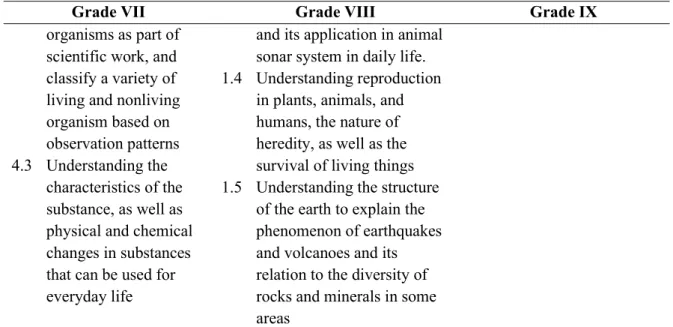
Basic competencies are the competencies of each subject for each class derived from core competencies. Basic competencies are a set of competencies that describe the minimum attitudes, skills, and knowledge that students need to achieve for each subject at the end of each semester of each grade. Table 2.3 shows the example of basic competencies in science subjects in grade 7th, 8th, and 9th.
Table 2.3. Example of basic competencies of science subject in curriculum 2013
Grade VII Grade VIII Grade IX
4.1 Understanding the concept of
measurement of various magnitudes that exist in themselves, living beings, and the physical environment around as part of the observation, as well as the
importance of the formulation of a standardized unit (basic) in the measurement 4.2 Understanding the
classification procedure of living and nonliving
1.1 Understanding linear motion, and the influence of the force of the motion based on Newton's laws, as well as its application to the motion of living beings and the motion of objects in everyday life
1.2 Understanding and applying fluids characteristic to explain blood circulation and liquid transportation in the plant, osmotic pressure, diffusion in the respiration process in daily life
1.3 Understanding of vibration, wave, sound, and hearing,
1.1 Understanding the concept of atoms and their composition, ions and molecules, and its relationship with the characteristics of the materials used in everyday life 1.2 Understanding the
importance of soil and the organisms that live in the soil for the sustainability of life through the observation
Grade VII Grade VIII Grade IX organisms as part of
scientific work, and classify a variety of living and nonliving organism based on observation patterns 4.3 Understanding the
characteristics of the substance, as well as physical and chemical changes in substances that can be used for everyday life
and its application in animal sonar system in daily life.
1.4 Understanding reproduction in plants, animals, and humans, the nature of heredity, as well as the survival of living things 1.5 Understanding the structure
of the earth to explain the phenomenon of earthquakes and volcanoes and its relation to the diversity of rocks and minerals in some areas
The teachers’ and students’ textbooks of science are the tools for implementing curriculum 2013 in the learning process. The teachers’ and the students’ textbooks have been prepared by the government based on Ministerial Regulation of Education and Culture No.
71 the year 2013. The students’ textbooks are the learning source that contains: the title of the topic, information about core competencies that are appropriate to the topic in each chapter. Each chapter is equipped with a conceptual map, the students’ activities such as experimental, non-experimental, discussion, exercise, summary, evaluation, and assignment for the students. In particular, the evaluation part in the students’ textbooks contains questions for measure conceptual understanding in a chapter that has been studied by students.
Figure 2.2. Evaluation for measure conceptual understanding in science textbooks
In measuring students’ learning outcome for conceptual understanding, MoEC published science textbooks contains general guidance, process skills, and assessment in science learning. In the evaluation part, the textbooks use authentic assessment to measure learning outcomes. Based on the implementation guidelines of the curriculum 2013, it is stated that assessment is directed to measure students’ competence stated in the curriculum, to measure conceptual understanding. Assessment can be performed by oral, tasks, daily test, mid-term test, final test, and national examination. Science tests that measure conceptual understanding focus on application, such as using the information to solve a problem or to make inferences about cause and effect relationships. The common methods to investigate conceptual understanding are asking students to recall information, labeling a diagram, explaining a scientific phenomenon, explaining why a particular instance is an example of the concepts, or distinguish between two similar concepts. Furthermore, the best way for students to improve their understanding of scientific concepts is to test them against their own experience (Soulios & Psillos, 2016).
2.3. Misconceptions
Conceptual understanding is one of the primary goals for science studies at all levels of formal education. Several studies have been conducted to investigate the students’
conceptual understanding of science learning (Alao & Guthrie, 1999; Nieswandt, 2007; Puk
& Stibbards, 2011; Konicek-Moran & Keeley, 2015). Students must be taught to develop a conceptual understanding that is aligned with the conceptual understanding accepted by the scientific community (Ausubel, 1963). The literature also indicates that various terms have been used to illustrate these ideas that contradict the scientific community. These ideas are known variously as misconceptions (Dykstra et al., 1992), alternative conceptions (Driver
& Easley, 1978; Wandersee et al., 1994), naive conceptions (Champagne et al., 1983), and preconceptions (Ausubel, 1963). Analysis of the differences of these terms indicates the existence of a subtle distinction in the use of these terms (Wandersee et al., 1994). Hence, similar to various other previous studies, the term “misconceptions” will be used in this study.
Misconceptions are deemed to have occurred if the students’ understanding of a concept differs from what is understood by the scientific community (Nakhleh, 1992).
Besides, misconceptions are a stable cognitive structure that affects students' understanding of scientific concepts (Taşlıdere, 2013). Misconceptions can occur in students’
understanding of scientific concepts as well as in their organization of scientific knowledge