Patterns in Minatogawa, Okinawa
著者
TAKEDA Jun
journal or
publication title
南太平洋研究=South Pacific Study
volume
13
number
1
page range
107-129
South Pacific Study Vol. 13, No. 1, 1992
Seasonality and Change in Traditional Fishing
Patterns in Minatogawa, Okinawa
Jun Takeda
Abstract
Within the coral reef of Okinawa, various methods of fishing have been developed since ancient times. These methods correspond to the habits and habitats of marine fauna on the coral reef. As a result of reversion to Japan in 1972, the people in Okinawa were under the same legal restrictions as those on the mainland. Some have continued fishing by conventional methods; others were forced to switch to different methods, or were even forced to change fishing grounds. Besides, conventional monthly fishing patterns have been altered recently because of the adoption of newly-introduced fishing methods. One is trolling around payaw, floating fish aggregation devices installed off the coast which attract tuna and bonito etc., and started in 1984. Another is handline fishing for diamondback squid (sode-ika) which began to be widely adopted in 1990. In particular, alteration in the former has greatly increased annual income while bringing about a change to the traditonal fishing patterns. Even though these newer methods may attract the younger generation to become fishermen because a simpler fishing skill is required, it is evident that it will accelerate to rapidly estrange fishermen from their traditional knowledge and skill necessary for fishing at sea. It may act as an unfavorable factor which will lead to an over-exploitation of the marine resources as well.
The ecological and socio-economic aspect of fishing activities in Okinawa is described and discussed here, focusing on the transition of the fishing methods and patterns.
Key words: Payaw (a floating fish aggregation device), Okinawan fishermen, Fishing pattern, Tradi
tional fishing methods, Coral reefs.
Introduction
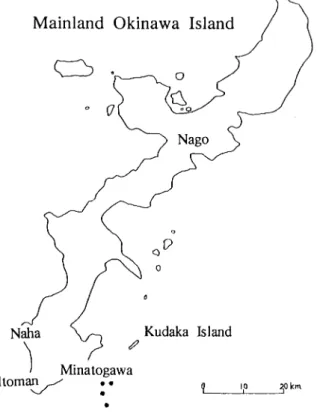
At present, some 52 full-time, unionized fishermen live in Minatogawa, Gushikami-son, a fishing village established by Itoman fishermen who moved into the area in the 1820's (Fig. 1). Although the Itoman fishermen founded Minatogawa because of its excellent natural harbor, the reef flat (inoh) is so poorly developed that these fishermen must fish in areas outside the reef (tou)—rather than in the lagoon itself—in order to sustain their livelihoods. In short, they have had to develop a system of fishing that relies mainly on handline fishing (tatenawa) or trolling (hikinawa) rather than the more complex fishing methods commonly associated with lagoon fishing (i.e. a combination of diving, drive-in netting and gathering).
This paper attempts an ecological anthropological study of how Okinawan fishing methods
have changed as a result of socio-economic factors such as World War II, the administration of the islands by the United States in the postwar years, and their reversion to Japan in1972—by tracing technological shifts from traditional fishing methods to more recently
introduced methods of the Minatogawa fishermen.
In additon, it attempts to provide
material for further ecological anthropological research regarding fishing in the Okinawa
coral reef area.
This study is based on data gathered by direct observations, interviews, and questionnaires
in 1986-1987, as well as records provided by the Minatogawa Fishermen's Cooperative.
Fishing Methods
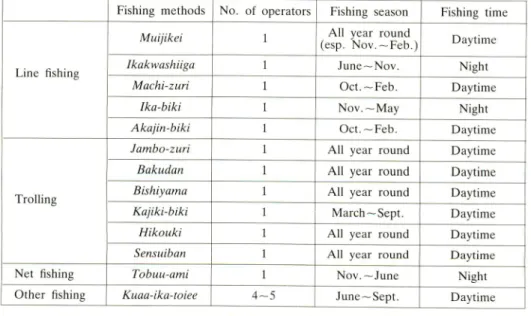
Some 23 fishing methods have been used in Minatogawa up to this time; of these, 13 are
still in use. These can be classified into four distinct types based on method and equipment
employed: (I) line fishing; (II) net fishing; (III) other fishing; (IV) gathering (see also Table 1
and 2).I. Line Fishing
1. Ikakwashiiga, a line fishing for flying squid (tobi-ika)
This form involves line fishing at night using by a lamp to catch squid; it was in use before
World War II and is still done today. Swordfish and tuna are often caught by this method as
well. The fishing is done in ocean areas 10-15 miles from the reef, from June to November.Fishermen leave port between 2 and 3 pm, and continue fishing until the moon sets, returning
home toward morning. By the old lunar calendar, the 14-16th days of the month—in other words, the nights of the full moon—proved to be a poor time to fish. Fishermen were often unable to catch even the first few squid that they normally used as bait. As wind and wavesrose and the moonlight dissipated on subsequent nights, however, they could expect some
Table 1. Fishing methods at Minatogawa
Fishing methods No. of operators Fishing season Fishing time
Line fishing
Muijikei All year round
(esp. Nov.— Feb.) Daytime
Ikakwashiiga June —Nov. Night
Machi-zuri Oct.-Feb. Daytime
Ika-biki Nov.— May Night
Akajin-biki Oct.-Feb. Daytime
Trolling
Jambo-zuri All year round Daytime
Bakudan All year round Daytime
Bishiyama All year round Daytime
Kajiki-biki March —Sept. Daytime
Hikouki All year round Daytime
Sensuiban All year round Daytime
Net fishing Tobuu-ami Nov.—June Night
Takeda: Seasonality and Change in Traditional Fishing Patterns in Okinawa 109
Table 2. Fishing trends at Minatogawa
Prewar (-1945) Postwar—Around Reversion (1945-1972) Present (1973-1988) Line fishing Muijikei C51-) Ikakwashiiga Machi-zuri Hokaki Akajin-biki Ika-biki Trolling Sawara-biki Jambo-zuri C85-) Bakudan-zuri Bishiyama C85-) Kajiki-biki ('85 ~) Hikouki Sensuiban ('78 ~) Katsuo-biki Net fishing Tobuu-ami Other fishing Kuaa-ika-toiee
success. By the 17th day of the lunar calendar their catch started to increase.
Fishing lights are used not only on board but are suspended over the sides of the boat by a fishing line to a depth of 30 centimeters below the keel.
In this method, three separate lines are used in tandem: a 25-meter-long line (gokusai) and two shorter lines (kubira; 10-20 meters) and a kokubira line (about 1.5 meters in length). The squid itself is used for bait, but female squid are preferred to males because they are flexible, with strong head sections and body sections which are difficult to detach, and so retain their shape longer. Squid attracted by the light of the lamp and gathering around the bait on the gokusai or kubira line are first nudged toward the surface of the water by a net lowered slowly beneath them and then raised. The surfaced squid are brought near the kokubira line and landed one by one with a gaff (sou or kakyaa). The kokubira line is there to prevent the surfaced school of squid from escaping. The gaff is almost exactly the same length as the kokubira, providing more effective leverage for hauling the squid on board. Two gokusai and kubira lines are used to attract the squid and draw them from one to
another in the direction of the kokubira, as well as to prevent the school of squid, once surfaced, from escaping. The boat is left to drift with the currents, so although in the past, stone anchors were dropped to depths of 150 meters, such anchors of cloths (kabankaa) are now suspended to depths of approximately 10 meters.
Sometimes, squid fished in this fashion attract tuna and swordfish as well. The wire leaders, up to a meter in length used on the ends of the lines, are designed to prevent them from being bitten through by sharks or tuna in search of squid.
In prewar times, this method of fishing was conducted in areas reached only after two or more hours of travel by small wooden boats (sabani). The only difference between the pre-and postwar methods is that in the former some 300 fine lines were used instead of three; but
then, too, the leaders were made of wire.
2. Ika-biki, a line fishing for squid (shiro-ika and aka-ika)
This method of fishing (ika-biki) involves the use of a kind of trolling line that is pulled in very slowly. It was used on small boats which were not equipped with engines, and is still in use on small diesal-powered boats today. It is used primarily to catch the bigfin reef squid (shiro-ika) and mitre squid (aka-ika).
Such fishing is conducted at night in the waters of the reef flat, less than a mile off the reef, in depths of about 2-40 meters. Such reef flat fishing for shiro-ika squid is conducted with best success during the months of August to October by the old lunar calendar (the fishing season itself was July-November, reckoned by this same calendar) and during the periods from 7th to 20th of the month, with the best catch on 7-13th, until the moon sets in. The 14-16th of the month are the nights of the full moon; the entire surface of the water is very bright at that time, thus limiting the effectiveness of the fishing lamps in attracting fish. At the same time, from the night of the 20th on, the moonlight is so dissipated that such fishing is hopeless.
By contrast it is possible to fish for aka-ika squid beyond the reef margin (hisi or pii) from September through April (by the old lunar calendar), with best results in January-February. The nights of the 7-20th of the month, until the moon sets, are most productive. The method involves setting out a 200-meter long red nylon line (akanawa) which is attached to a swivel. A sinker made of wire-reinforced thread is then attached by a swivel to a wooden fish-shaped lure, so the sinker does not catch so easily on the bottom as lead sinkers do.
The function of the wire reinforcement is to gauge the depth of the water and to force squid in the intermediate depths to the surface.
Fishermen prefer to catch the shiro-ika squid, which is sweet when marinated and retrieves a better price at auction than the aka-ika squid.
Some fishermen make their own wooden lures (ikayuu or ichayuu) by carving them; other use store-bought lures.
3. Hokakiy a shark fishing
In winter, after the squid season is over, Minatogawa fishermen have fished for sharks since before the war. Yet while the same equipment set-up is used for both summer squid fishing—in which 80-90% of fishermen participate and winter shark fishing, only a few
Takeda: Seasonality and Change in Traditional Fishing Patterns in Okinawa
participants in the latter. The reason is that, in the old days, it was back-breaking labor to move the small, engine-less boats of that time out into winter seas; additionally, shark fishing was not very rewarding and shark meat did not bring a good price.
The line itself was cotton, with a 30-40 centimeter leader composed of three strands of fine copper wire twisted together. Later, after the war, fishermen switched to steel wire leaders. The flesh of pigs slaughtered to celebrate the lunar new year was used for bait. When properly salted, this meat could last for up to a year. It is reported that some fishermen would cut open the belly of a shark caught with such meat, retrieve it, bring it home and re-salt it for use as bait another time.
For bait, the fishermen used fish heads, fish bones and the remains of ingredients used to make boiled fish paste. These things were packed into small bags and trailed over the sides of the boats.
Shark dorsal fins were exported to China and sold at high prices. There was a heavy demand for shark liver oil to smear on the hulls of the small boats, which cause boats to withstand long use. The meat was flayed and cut into thin strips, which were salted, left out in the sun to dry, and then eaten. Such meat (sougiri) has been also used as storage food. 4. Fishing for coral-trout (akajin)
4.1. Akajin-biki, a handline fishing for coral-trout
Akajin-biki is a handline fishing method that was derived almost by accident from the fact that coral-trout (akajin) are sometimes caught when fishing for Spanish mackerel (sawara). Before the war, the reeling in was done by hand and was temporarily interrupted. But after the war, with the introduction of gasoline engine-powered boats, one fishermen equipped his boat with an automatic reel. Three others soon followed suit. When the other fishermen, who were, until then skeptical of the idea, actually saw the good catch resulting from the introduction of the automatic reel, virtually all of them started to use it.
This method of fishing, which is still practiced, is conducted in waters off the reef that is about 60 meters in depth, usually during the winter.
The line itself is made of wire, so it is extremely difficult to reel it in by hand. The fishermen use store-bought artificial lures which resemble an octopus. Commercial soft
squid-shaped lures are expensive, so they use octopus whenever they can.
The length of the
line is usually set at about ten times the depth of the water in which they are fishing, so
waters 20 meters deep usually require wire lines of about 200 meters.
Such fishing is conducted in virtually the same areas as fishing for muijikei (see 1.4.2.).
But the latter is not conducted in areas where the currents run fast in the morning, so they
usually switch over to akajin handline fishing. The problem with akajin-biki fishing is that the lines often get caught on bottom corals and therefore the method requires a certain amount of skill acquired over long years of experience in order to be done successfully. In order to prevent such snags from occurring the fishermen usually test the depth of the water in the deepest areas first, adjust the length of the line accordingly, and then head forshallower waters.
Boat speed and line take-in speed are matched along the way. By
reeling the line in more quickly in shallow water the fish bite more often; if the line is taken in too slowly the fish will have a chance to hide in the coral. For this reason they take the
line in more slowly in deeper waters.
The fishermen troll repeatedly in any area in which they take one akajin, the reason being that such fish usually congregate in groups of four to five in one area, though infrequently. By the same token, they shift fishing grounds when a full sweep yields no fish.
The number of fishermen currently engaged in akajin linefishing is on the decline, in part, because of fewer akajin being caught but also because the introduction of payaw devices (see 1.1.7.) allows them to take a certain number of fish all the time. However, the number of fishermen fishing for akajin has increased dramatically, and with it the amount of muijikei fishing method (see 1.1.5.) is done as well, especially when people purchase akajin for the celebrations surrounding the new year.
4.2 Muijikei or Ishimakaa, a handline fishing
This method of fishing, once called hanashimui, started in Minatogawa around 1951, when fishermen from Naha came to fish on the leeward side of the island of mainland Okinawa during the winter, away from the strong winter winds.
This is a method of catching highly-valued fish that are bottom-dwellers in shallow water, such as grouper (miibai), grey large-eye bream (shiruyuu), longspine emperor (muruu), and Napoleon fish or ruby snapper (akamachi) that live in comparatively deeper waters. Though such fishing can be conducted all year round, it tends to be done most often in the period of October-February, because of the better fishing found around the payaw with the introduc tion of that method the rest of the year.
Fishing grounds are 2-3 miles off the reef of 20-100 meters deep where the best catch are retrieved. Sometimes fishermen go on fishing "expeditions" near the Yambaru and Kerama Islands for periods from 2 days up to a week. Normally, however, fishing is done during the day, with the best fishing at sunrise. The fishermen leave early in the morning and return home at nightfall. There are some fishermen who fish for muijikei at night, but they mainly catch barracuda (kamasu).
The hook is prepared in an interesting way in which rocks are necessary. There is a quarry near the port of Minatogawa, so the fishermen can get any number of rocks any time they want. They get their wives to help them bring rocks of suitable size to the port itself. The rocks, which are usually 10-15 centimeters in diameter, are then broken into pieces with a hammer. They then wrap the rocks in line, breaking off any rough edges so that the line can come off easily, thus to some extent smoothing the surface of the rocks. The fishermen prefer the heavier stones of the land or mountain to the light coral of the sea.
The line itself, which is adjusted for depth, consists of a nylon-like line with a 4-7 meters long leader attached. Frozen scad, bought at the cooperative, is used to bait the hook, which is placed on the rocks. More bait is ground up and placed over the hook and stones and the whole thing is tied together with about five meters of leader line. Sometimes the bait is thrown over the stones after they are wrapped in leaves of gajumaru fig trees, and then tied together with line. Sometimes saury or mackerel is used for bait, but these days scad is most often used. It appears that the smoothbelly sardinella (yamatomizun) caught by the net fishing of Kudaka Islanders make the best bait for muijikei. The stones are loosely tied with line, using any protuberance that seems suitable. The stones are then cast into the sea.
Takeda: Seasonality and Change in Traditional Fishing Patterns in Okinawa 113
When the stones are felt to hit bottom, the line is jerked sharply to free it. The bait and the baited hook then float freely.
Although such fishing offers the advantages of many hits and the frequent landing of fish, even larger than kugeyaa (see 1.5.), it also has disadvantages of taking much time to prepare the hooks and stones and, when the currents are running strong, the necessity of having to prepare and use 400-500 meters of line as well. As well, four-day trips to the Kerama Islands necessitates loading the boat with some eight kilograms of stones, which in turn requires a substantial investment of time to break them into usable shapes. The amount of fish taken is directly related to knowledge of where the fish usually live, and over many years of experience the fishermen have defined their own fishing grounds. The method of approach to such grounds is usually based on cross-transit, fishermen's locality-finding methods in the marine environment (yama-ate: Igarashi, 1977), but now many fishermen depend on electronic fish detectors and other such devices to ascertain water depth and
bottom conditions.
5. Machi-zuri or kugeyaa, a handline fishing for snapper (fuedai)
This type of handline fishing, conducted from November through about March, concen trates on snappers found at depths of 300-350 meters, in waters about an hour by small boat off the reef. This fishing method has been continued since before the war. In the days when shark liver oil brought a high price, this fishing was done at night as well as during the day, though now it is only done during the day.
The implements consist of a line approximately 300-350 meters in length, where several steel sinkers weighing about 1.5 kilograms are attached. Starting from the sinkers, some 7-10 leaders of about 40 centimeters each are placed along the line at intervals of about 1.5 meters. Saury and scad cut into sections of three are used as bait and their innards are also used for bait. Mixed into the bait are ground up sweet potatoes previously soaked in the bait, although cooked wheat distributed by the government were used for this purpose in the postwar year. A stone of about five kilograms is used as an anchorweight, with the thinner cotton line in which the stone is initially tied being supplemented with a thicker cotton line, to a length of up to 300 meters. When the line and weight are thrown overboard and the line is jerked sharply after a decent interval, the thin and thick cotton lines part; thus the weight is used only once. While the morning currents are running strong, the fishing line is attached to the boat via a float.
The entire line can be taken in manually in about seven minutes, and automatically in three minutes. Sometimes the hooks will be lost if the line is reeled in too fast.
Some fishermen continue to use this method today, even after they are able to use the muijikei fishing method. In prewar times, this method was conducted all year round, with a crew of three—one operator and two fishermen per boat. Today it is done single-handedly. The lines consist of up to 300 joined cotton lines of about 1 millimeter in diameter. Stones were used as anchorweights and sardines were used as bait.
6. Yama or hiru-tatenaa, a handline fishing for grouper (miibai) and snapper (shichuu-machi)
This method is used to catch snapper and grouper, which are found in waters some tens of meters deep.
The season is generally from November to about April; when fishing for shallow-water species is done at night.
The line is made of cotton, with the fishhooks fastened onto the ends of wire weights some
60-80 centimeters in length. Iron bars weighing a kilogram were used as sinkers until the appearance of lead sinkers around 1950.Saury are used as bait. The bodies are cut into pieces, with the heads and bones ground
up and used as bait.7. Trolling (hikinawa)
It has been known since ancient times that fish will congregate near driftwood and floating
seaweeds. Payaw is a fishing method that makes use of a raft-like construction of bamboo
or other, similar material that is then floated to attract and catch pelagic migratory fish such
as dolphin (shiira), Spanish mackerel, bonito and tuna. It is used in the islands of the
Southeast Asian Sea and the Philippines, can be seen in some parts of Japan and is also used
by fishermen in the village of Ginama in the northern part of the main island of Okinawa. After the war, a similar but simple floating fish aggregation device was installed off Minatogawa as well.
There are several reasons why such floating devices as payaw are effective in attracting fish. First, bait works better with the payaw, small food fish, crustaceans and seaweeds are more easily seen in the shadows of things floating on the surface, thus heightening the effectiveness of bait in attracting fish. Second, the fish are attracted to the difference in light contrast
Mainland Okinawa Island
° (7
Naha
\x^>
Kudaka Island
<?Minatogawa
Itoman^
..
?
io
$**
TAKEDA: Seasonality and Change in Traditional Fishing Patterns in Okinawa 115
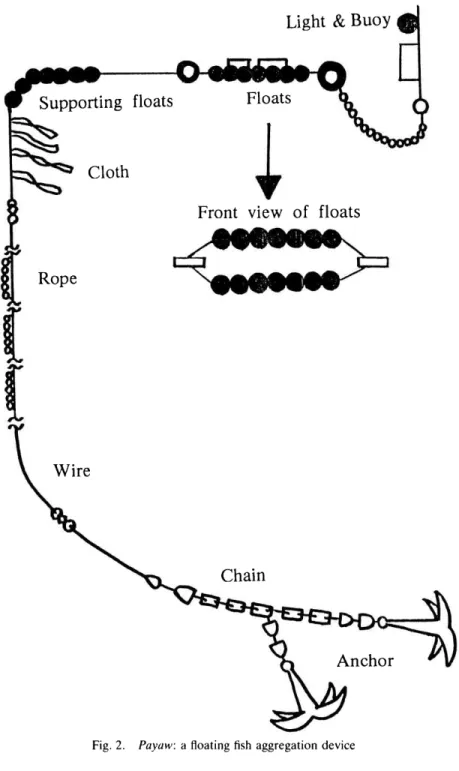
created by the shadows made by things floating on the surface of the water. Third, some fish use floating objects and their shadows to hide from predators. Fourth, these objects are used as places upon which to fasten eggs. Finally, these objects act as cleaning stations where fish can have parasites removed by so-called "cleaner fish" that gather here. In any case, conventional devices have never been placed so very far from shore areas to begin with. Modern payaws, however, which employ plastic floats and durable anchors, ropes, chains and
Light & Buoy
Supporting floats Floats
Cloth
Front view of floats
Rope
Wire
Chain
Anchor
so on, can now be installed in water several hundred meters deep up and ten miles off shore for long periods of time (Fig. 2). At Minatogawa, two payaw devices were installed into the waters to the east of the main island in October of 1984; at present there are now six payaw
devices in the region (Fig. 1). These devices, installed in the waters off Minatogawa through
which the Kuroshio Japan current runs, have proved more effective than the old methods in catching the bonito and tuna that use the Japan current as their main migration route.7.1.1. Katsuo-biki, a bonito trolling
This form of fishing for bonito and Spanish mackerel was conducted in waters about 300 meters deep throughout the year; it was practiced up to about the time Okinawa reverted to Japan in 1972.
The method consists of using a single pole over each of the two sides of the boat, to which
lines of 30 meters or more are attached. Some seven hooks are attached to the ends of the
lines and baited with artificial vinyl squid-shaped lures. The lines are trolled behind the boat as it maneuvers.
This method came into use after the introduction of gasoline engine-powered boats in the postwar era, but today it is not practiced.
In the prewar era, yambarudake bamboo (Pleioblatus linearis) cut to suitable length or goat horns wrapped with goat hairs and chicken feathers were used as the lures for this method. 7.1.2. Hikouki, a trolling for bonito
This fishing method is mainly used for catching bonito, but also targeting the dolphin and tuna that come to feed on the hooked bonito. Although it is possible to fish all the year round, the summer months are the season's peak. The method came into use two to three years after reversion of Okinawa to Japan and is still done today.
The implements consist of a wooden fish-shaped lure 30 centimeters in length (which actually resembles an airplane—hikouki; hence the fishing is derived from it) tied onto the end of a length of line some 25 meters in length. Onto this "airplane" is attached a nylon catgut line (24-30 lb wt.) about five meters in length. Two to four fishhooks baited with store-bought artificial lures that look like octopus are attached to the catgut line. As the "airplane" is towed by the boat it breaches the water, sinking and rising. This action attracts the bonito, which think the contraption is prey. The effect is identical to that of a method of fishing called bakudan (see 1.7.5.).
This line is taken in either manually or by automatic roller.
This method is employed in the vicinity of the payaw as well, but not frequently. 7.1.3. Sensuiban, a trolling for bonito with the submerged plank
This method is also used in waters about 300 meters deep to catch bonito and juvenile tuna (shibiko; usually yellowfin tuna under the weight of 6 kilograms) like that for the above-mentioned "airplane". Similarly, although it can be done throughout the year, it is mainly pursued during the summer months.
The submerged plank is actually a wooden board sheered to a strip and tied to the boat by a ten-meter length of catgut or line. Another 50-centimeter length of catgut is tied onto the rear tip of the plank, to which is attached a single artificial lure in the shape of an octopus; in this respect it differs from the "airplane" method mentioned above. This plank is normally
Takeda: Seasonality and Change in Traditional Fishing Patterns in Okinawa 117
submerged to a depth of about five meters below the surface. A fish hitting the lure overturns the plank and forces it to the surface.
This method was taught to the fishermen of Minatogawa by fishermen from Miyazaki Prefecture when the latter visited Minatogawa around 1980. However, the catch are poor and the method is seldom used here now.
As with the "airplane," this method is sometimes done with the boat engine stopped and the boat and line simply adrift.
7.2. Bishiyama, a trolling for small-sized tuna (shibiko) and bonito
This is the fishing mainly used for shibiko (juvenile tuna under the weight of six kilograms) and bonito, with Spanish mackerel and dolphin being taken as well. This type of fishing started around 1985, and is now conducted in the vicinity of the payaw devices.
Bonito are caught throughout the year, but they are most plentiful when the currents reverse and when the sun rises and sets. Catch of the shibiko juvenile tuna are most abundant from early spring to summer and are most often taken early in the morning (at sunrise). Fishermen try to get an advantage over their competitors and leave port around four o'clock in the morning. To reach the place of payaw earlier than others, those who use small boats equipped with small engines, leave port more quickly.
The implements consist of 60-100 lb test weight nylon line, with a leader of 30-90 lb test line. The line used is similar to that used in the bakudan method (see 1.7.4.), with no. 2 lead weights attached to the line at 10 centimeter intervals. The line with lead weights is called bishi.
Artifical lures are used for bait. The vinyl lures that closely resemble squid or octopi are commercially available. The fishermen change lures depending on what the fishing is like on any given day.
In this method, the fishing line is thrown overboard from a small boat. The fisherman has to take in or let out the line in order to simulate as closely as possible the movements of real squid or octopi. In the bakudan method this function is performed by the bakudan itself, but it appears that the fishermen are more successful when they handle this action by themselves.
The boats are equipped with winches and hydraulic rollers to reel in the fish, but the winches are more preferable to the hydraulic rollers because they take up the line at the same speed as when done directly by hand.
7.3. Sawara-biki, a trolling for Spanish mackerel (sawara-biki)
The method is designed to catch Spanish mackerel, which inhabits the intermediate depths off shore during the winter months but congregates near the surface in summer. It is conducted in waters about 60 meters deep and is also employed to catch other surface-dwelling fish such as bonito, swordfish, dolphin and tuna.
Such fishing is done from August until around May, reaching its peak during the flying fish season of October to April.
This method originated in the mid 1940's with the introduction of a gasoline engine used by the U. S. Army called a "magnet checker." It continued until about the time of reversion to Japan.
It appears that such fishing was physically taxing on the fishermen, because it was conducted during the height of the flying fish season, when fishermen would return home from night fishing for flying fish at about 3 am and then go out again at dawn to catch Spanish mackerel.
The method consists of two fishing poles suspended over the both sides of the boat, to which trolling lines were attached respectively. The lines were 30-40 meter lengths of cotton line with about two to three meters of wire leaders at the ends. The flying fish caught during the night served as bait while the boat motored slowly along.
At present no one fishes in exactly this manner. The method has been supplanted by the bakudan trolling method (see 1.7.4.) conducted in the vicinity of the payaw, where the depth of the water differs dramatically.
It is said that lures made out of goat horns wrapped in chicken feathers (these lures are called holo) were used for this kind of fishing until just after the end of the war, with some
success.
7.4. Bakudan-zuri, a trolling
This method is used to catch pelagic migratory fish near the surface of the sea. It is widely used to catch dolphin which, though only weighing about one kilogram each in the months of July-August, reach weights of seven to ten kilograms by February-March. It is possible to pursue such fishing all year the round, in areas ten miles or so from land. Today, however, this method, which got its start after reversion, is conducted mainly around the payaw.
As with other forms of trolling, this method yields the greatest catch at sunrise. Two fiberglass poles are suspended over the sides of the boat at a slight angle. There are metal canisters at the rear of the boats—one on each side—for holding the poles in place.
Both the poles and the lines are short, so it often happens that larger fish snap the lines and
get away.
The method uses a kind of commercially available fishing line that has 300-milligram lead sinkers attached to the line at intervals of 20 centimeters or so, and is suitable for catching tuna and other fish swimming just under the surface or at a depth of about 20 meters.
The method involves setting the length of the trolling line attached to the pole so that the plastic, bowl-shaped float called bakudan remains afloat on the surface of the water. The bakudan, which functions like the geta of the jambo-zuri method (see 1.7.5.) by acting as a drag against the forward movement of the boat, moves with the current and thus performs the same function as a person relaxing tension on the line in the jambo-zuri method.
A second towing line led out from the bakudan is used to catch the fish. An artificial vinyl squid called sofuto-ika is used for bait, but unlike jambo-zuri, only one such lure is used on the line.
Although the jambo-zuri method yields larger fish and larger catch, nevertheless, many fishermen have to resort to the use of the bakudan because of the small size of their boats. The existence of so many small boats at Minatogawa is not due solely to such economic factors as an inability to purchase larger boats; rather, it is due to the fact that during the summer trolling season the sea is calm enough for small boats to operate and, with the installation of the payaw, to get even fairly large catches of fish such as bonito, if not tuna.
Takeda: Seasonality and Change in Traditional Fishing Patterns in Okinawa 119
The fishermen are aware that the bigger boats are more effective because of the longer lines they use and consequently decrease such adverse factors as propeller noise and wash with added distance. This fact is especially true of tuna, but catches of bonito are not substantial ly affected by the factors attendant upon length of line.
Owners of small boats stop bakudan fishing and change instead to squid fishing whenever year round catches of bonito fall off.
7.5. Jambo-zuri, a trolling
This fishing method was introduced after the installation of the payaw. It is conducted during the months of July to December, in waters several hundred to 1,000 meters deep and two to three miles off the reefs on which the payaw have been installed. The boats move around the payaw devices anticlockwise after an hour's trip from port.
Although tuna and bonito can be fished year round, it is swordfish that are most often taken during the months of April to September and especially in July and August. The jambo-zuri method targets larger fish than that targeted by the bakudan method mentioned above. In the days when no payaw were installed, the fishermen would catch one swordfish every four or five years; now, however, they take as many as 280 swordfish in a year with the payaw in place. Some payaw have yielded an average of as many as four to five such fish a day.
The method involves placing a single 5-10 meter long fiberglass fishing pole practically upright in the middle or toward the stern of the boat; the length of this pole is determined by the length of the boat itself, as is the length of the line. For example, a 7 meter long pole would be used with 70-80 meters of line; a 10 meter pole would require 150-170 meters of line; and a 15 meter pole would have over 200 meters of line.
The line itself is a thick 200 lb test line. At the end of the pole a length of thinner 30 lb test line via a swivel is attached. This section of thinner line is held taut above the boat by a line. In addition, the line is further held taut by attachment to two upright poles of 200 lb test weight and 30 lb test weight. Four artificial, store-bought soft-squid lures are attached to the sea end of the line. A drag made out of cypress wood called geta is attached to the very end of the line to provide resistance against the current and hence to keep the line taut. A float is attached to the end of the geta to keep the latter from sinking as the boat moves through the water. A heavier geta can be used to anchor a longer line, but using such a heavier one places a strain on the poles, which bend so severely that they cause the boat to heel over whenever one changes course. If a fish strikes the bait when the boat is turning, it could overturn the boat. For this reason it is necessary to set the length of the line and the weight of the geta drag according to the size of the boat itself. In order to maintain the stability of the boat, both the length of the line and the pole must also be precisely determined in accordance with the size of the boat. At any rate, the line is alternately pulled tight and relaxed, simulating the movements of the squid. It is not necessary for the lures to actually enter the water in order to be effective as bait, and in fact it is more effective if they almost skim the surface of the sea. Fish such as swordfish will jump out of the water
to take the bait.
weighting 50 kilograms of more, at which time the lighter 30-lb test line is cut in order to prevent the poles from snapping. When the swordfish season arrives the fishermed do not reel in any bonito or other fish that happen to take this bait. Instead they wait for the swordfish to come after the hooked bonito.
7.6 Kajiki-biki, a trolling for swordfish
This type of fishing is used mainly for swordfish, tuna and dolphin; however, the most expensive tuna, northern bluefin tuna (kuromaguro or honmaguro), is also taken by this fishing, although infrequently. Conducted around the payaw from March to September, the peak season for its use comes in July and August. It was introduced at about the same time as the juvenile tuna and bonito fishing methods (see 1.7.2).
Sunrise is the best time for this kind of fishing.
As the fishermen fish for these relatively large fish, their lines are correspondingly heavy as well: 150 lb test weight for line and leader, with lengths of 60 meters for the line and about 8 meters for the leader. For bait they use whole bonito caught in by the bonito trolling method. Because they target such surface dwelling fish, they do not use a bishi line which has no. 2 lead weights attached to the line at 10 centimeter intervals.
A winch is required to help take in hooked fish.
II. Net Fishing
Although drive-in fishing methods use also bag nets ans wing nets, this section deals with gill nets. Gill nets can be classified into bottom gill nets and floating gill nets, depending on the placement of the nets and the manner in which they are used. There are bottom gill nets placed on or near the bottom of the lagoon and weighted with anchors or stones at both ends. In Okinawa bottom gill nets are subdivided. One is employed to catch Spanish mackerel etc., using highly suspended nets at night. Another is goatfish nets equipped with wing nets for catching goatfish and mitre squid. Meanwhile, there are two floating gill nets used near the surface of the water or fixed in place with anchors; the tobashii-ami nets are designed to catch halfbeaks. There are another floating gill net just like drift nets (nagashi-ami) employed to float freely, with the currents or the tides at or near the surface. The flying-fish net called a tobuu-ami is typical of this nagashi-ami.
Of these, nylon bottom gill nets and tobuu-ami nets are or have been used by the fishermen of Minatogawa. There are two types of gill nets: a single-walled net of uniform mesh size and a three-walled net which is composed of three different nets of varying mesh size placed on top of each other. The latter net catch both large and small fish at once and so is called devils' net. Both kinds are used to catch rabbitfish, goatfish and porcupinefish, etc. Fish caught in the three-walled net tend to soften tremendously and so do not bring high prices; they are mostly used to make boiled fish paste. These nets were employed year round before reversion; now, their use is prohibited in the period of the fish spawing season from June to October in an attempt at conservation. In the days before reversion there were only a few fishermen who employed such nets. With reversion and the ascendancy of local coastal fishing rights on a par with the rest of the naiton, their use ceased altogether. Most of the time, in other locales, women (usually the wives of the fishermen) helped with the
Takeda: Seasonality and Change in Traditional Fishing Patterns in Okinawa 121
netting (or at least helped to haul the nets in). In Minatogawa, however, there is no tradition of having women aboard fishing boats; it is a man's world there. Flying-fish nets, on the other hand, were in use before the war and are still in use today. Some 20 species of flying-fish are known to inhabit the surface waters of the seas around Okinawa; of these, seven species are recognized and fished for at Minatogawa. The best places for such fishing are waters five to seven miles off the reef and 70-120 meters deep.
The season for such fishing is comparatively long—from November to around April by the old lunar calendar. The peak comes in April, when the fish comes near the shore to spawn. The fishermen scout for signs of schools of flying-fish and for good currents when they set their nets. They leave port toward dusk, while it is still light, and set their nets between 5 :30 and 6 pm. They let their boats and nets drift with the currents for several hours. The fish head in toward shore up to about 8 pm and then start heading out to sea after 9 pm, so the nets will catch the fish on the movement two times. Nets placed tautly vertical tend to wind around the upper lines due to the action of the currents, so the nets are placed slack and at a slight angle to prevent nets from being entangled with the floating ropes. Automatic winches are not used to reel in the nets; instead, the fish are plucked from the nets by hand, one at a time, which takes approximately four hours. The fishermen return home after one o'clock at night. During the day the fish can see the nets and so avoid them, so the fishermen therefore fish at night. Even so, nights with some moonlight are best for such fishing. On nights of the full moon it is still possible to fish, provided the skies are cloudy or winds of five to six kilometers per hour rough up the surface of the water. These winds obscure the nets; otherwise, the fish will avoid the net. The nights of the 7-13th days of the old lunar month prove to be the best fishing.
Also, currents running to the east, like the Kuroshio, yield the best results. When the wind blows from the east the flying-fish will jump over the nets, so on these nights the fishermen switch to bigfin reef squid (shiro-ika) fishing.
The implements here consist of about 20 nets (measuring 1.5 meters long and 100 meters wide) tied together to form a single large net, which is then put into the sea. Before the war some 12-13 nets measuring 1 meter long and 50-70 meters wide comprised a single net; today's nets are some two kilombeters long. Prewar nets were once made out of banana leaf fibers; later, hemp rope was used. After the war they began to use nets made of cotton. However, such cotton nets tended to attract noctilucae and so were easily spotted by the fish, which causes the fish to avoid. Also, such nets required a tremendous amount of mainte nance—they had to be periodically smeared with pigs' blood and dried in the sun to keep them from rotting, the mesh from stretching and to make the net itself harder to see in the sea. After reversion the fishermen switched to nylon nets, obviating the necessity for such drudgery. At the time of reversion the fishermen used nets of different mesh size, depeding on the size of the flying-fish found, but these days they use nets of a uniform mesh size of about four centimenters to catch all the species and size of flying-fish.
The biggest difference between the prewar and postwar use of these tobuu-ami nets is that they now incorporate the use of lamps or lights on the corners of the nets—an innovation that has made the handling of such nets an easier task. Up to then the fishermen had, to
haul in the lines attached to the corners of the nets in order to ascertain the position of the nets once they had drifted with the currents; they also had to inspect the nets with lamps to see that they were not hung up on some obstruction. After the war, veterans returning from the South Pacific used lamps on the corners of the nets, which made it easier to locate the nets and to know if they were entangled. Flashlights for this purpose came into use after reversion. The effect of the lights on the catch can be overlooked as it is minimal anyway. The lights have also made it possible to eliminate the use of towing ropes fastened on the corners of the nets, because they serve as markers on the sea, and one had only to maneuver the boat accordingly to keep up with them once the nets have been set adrift.
At present, eight people in Minatogawa have boats equipped to conduct tobuu-ami fishing, but actually only two fishermen use this method. The most important factor cited in the decline of this method is that the trolling method around the payaw fishing grounds can get good catch rather than this method for flying-fish. Also, fishing boats that were operated by 2-3 persons before, have now become single-manned boats; the heavy physical labor involved in handling these nets single-handedly and the large amounts of time still needed to care for the nets have hastened their disappearance from the fishermen's arsenal. The continued use of tobuu-ami nets at Minatogawa is due to the following factors. They have not used the purse seine method (maki-ami) for the flying-fish, done in other areas, which squashes the fish together in the net with losing their scales and parts of their flesh. Besides, these drift nets have mesh sizes fitted so that they catch the fish at the heads, leaving the bodies relatively free from damage; furthermore, the nets are hauled by hand without using automatic winches and the fish are removed from the nets one by one at a time, and are then immediately packed in ice. The fish thus keep their freshness and usually fetch prices 80-100 yen per kilogram, higher than elsewhere at the Okinawa Prefectural Fishermen's Union
markets.
III. Fish diving
Agyaa, a traditional Itoman fishing technique, is a fishing method to drive schools of fish into the bag nets. About 50-60 fishermen participated in this fishing in the past, which did not rely on the use of air tanks or scuba kits but instead consisted of skin diving in depths of up to 40-50 meters in order to drive fusilier (takasago) into a bag net. These large-scale fishing methods are either no longer carried out or are carried out only infrequently among the fishermen of the Motobu, Izena and the Yaeyama islands with higly-improved technolo gy. The technique was never used at Miantogawa, either before or after the war, except the folowing small-scale version of agyaa driving-in method.
1. Kuaa-ika-toiee, fish diving for squid
This technique targets a species of squid called kuaa-ika (unidentified) that is usually about five centimeters in length (sometimes up to ten centimenters). It is a small-scale operation used by several men either inside the reef or just outside it, in waters five to ten meters deep. It was conducted before the war and is still conducted today, usually in the area of Chinen.
This squid is available in both winter and summer, with the peak of the spawning season in the third and fourth months of the old lunar calendar. Fishermen leave port for about two
Takeda: Seasonality and Change in Traditional Fishing Patterns in Okinawa 123
weeks of every month to catch squid with eggs. These spawners are locally called kugana-saa. On sunny days the surface of the water is pitch black, making it easy to spot the schools of squid; on cloudy days, however, the surface of the sea in much lighter, making it harder to find such schools.
Ten years ago, the number of fishermen engaged in this fishing began to decline drastically; today only two or three fishermen are equipped with the nets used in this technique, and can from two groups of tour to five fishermen apiece.
The net itself consists of a central bag net with wing nets extending out at either side, to an overall length of some 30 meters or so. The bag net itself is 7-15 meters tall. The fishermen swim along, driving the squid into the net. There are two towing-lines on the wing nets, one of which is held by one person remaining on the boat and the other by one of the persons swimming in the sea. The net is placed under water so that it extends naturally by the action of the currents. Two or three swimmers drive the schools of squid into the net, at the same time trying to keep the squid from escaping by swimming and splashing about along the sides of the net. Then, the wing nets are drawn, closed gradually and the entire net hauled aboard the boat.
At present, kuaa-ika fetches a price of over 3,000 yen per kilogram, which belong to an expensive class among fish because of freshness and taste. On any given fishing the catch averages about ten kilograms.
2. Tobuu-toiee, fish diving for flying-fish
Sagaamagua, a species of flying-fish some 15 centiemters in length, is found in these waters throughout the year. This type of small-scale fishing is engaged in especially during the period of June-August, in the outside of the reef. Although in the days of the war, the fishermen used to supply soldiers stationed at Gushikami Primary School with flying-fish captured by this method, and still used it as late as ten years ago, it is no longer conducted today.
The method involves a group of five fishermen and a 40-meter-long net to which floats are attached here and there along its length. This net, which can be as thick as a centimeter or more, is suspended between two boats, which pull it along. The fish are coaxed into the cul-de-sac formed by the net, which is then drawn closed. Due to the fact that the fishermen use white rags or some other similar object which they attach to the towing lines in order to frighten the fish into the nets. The method to frighten fish resembles the pantatakaa method (see III.5.). It differs from the latter, however, in that the net is suspended by floats. This method works better with larger numbers of people, who swim outside the net into which they attempt to frighten or drive the fish.
3. Sukumaai, fish diving for juvenile rabbitfish (suku)
This is a fishing technique designed to catch juvenile rabbitfish, as they head in toward the reef around the first day of the sixth month of the old lunar calendar. They are driven into a fine-meshed bag net. The name itself is derived from the action of searching for the schools of fish from around May 28 to June 4-5, but if no schools are found after two days of searching the hunt is called off. Usually the best days are around June 2-3 of the lunar
Since this type of fishing involves setting nets, at least two people are required, though four to five is more usual. However, anyone who can swim is put aboard the boats when they set
out to fish during this time.
According to the custom called yuimun which was widely
observed in Okinawan Islands, the catch is divided equally among all members of the crew.Suku fish that have approached the reef and already eaten the seaweeds are not recom mended to prepare suku-garasu (a kind of salted food), so it is important to find and catch the fish before they eat the seaweeds.
4. Hikaagua-toiee, fish diving for damselfish (hikaa)
Like the agyaa, the damselfish is driven into a bag net off the reef. However, this type of fishing differs from the agyaa in that it is done in water only 20 meters deep instead of about 50 meters and less that 14-15 people participate. Although here the number of fishermen involved also varies according to the size of the bag net used. A minimum of at least 7-8 hands are required, as well as two to four boats; the method was used in the days before the w a r .
During winter this technique is used from nearby Kyan to Mabuni. In March through
August, as well as September the fishing is done as far away as Kerama Islands. The fishermen do not carry ice with them on the boats because freezing fish on ice would ruin their market value; hence, they return home each day after the end of the fishing.5. Pantatakaa, a small-scale version of agyaa
This is a small-scale driving-in technique conducted mainly in winter to catch bigfin reef squid and broadclub cuttlefish (koo-ika). In summer it can also be used to catch rabbitfish, redmouth emperor (kuchinagi) and mojarra (ama-iyu). Done in reef flats no more than five meters deep by a group of 12 to 15 people, it is a technique mainly used by older people. It was most popular when there were a lot of young children around to help out, who were given some small change for their labors. Now they use wet suits, so even in winter the old can keep pace with the young. The net is stretched in a loose crescent between a boat and a rock. People swimming at the surface beat the water and swim after the fish to frighten the fish into the bag net.
6. Spearhshing (koochike)
This type of fishing was conducted in the years before the war and after as well; it consists of diving in water about two meters deep and spearing octopus, broadclub cuttlefish and other fish with a spear called yuugun.
About two meter long spears, which are made of iron, have backward-slanting barbs on the spearhead.
No one does such spearfishing professionally today. 7. Dynamite fishing
This technique was used for two to three years right after the end of the war. About six small boats (sabani) would be towed out to the seas off Yonagusuku by U.S. vessels. There each boat pursues its own fishing. Mostly they targeted schools of fusilier and Indian mackerel (gurukumaa). It was a simple method. All one had to do was to light the fuse and throw the stick of dynamite overboard. Sometimes shark appeared on the spot to prey on the fish shocked by dynamites, while damaging the fishermen. It was dangerous,
Takeda: Seasonality and Change in Traditional Fishing Patterns in Okinawa 125
however, and after a few years the method was prohibited.
8. Capturing of tropical fish
This kind of fishing arose in response to orders for such fish from the mainland Japan.
These orders tapered off, and today only one person fishes for tropical fish.
Before the
payaw were set up such fish brought high prices and there was good money to be made from
them, but most fishermen disliked the long hours of diving involved.IV. Gathering
Gathering activities have been limited in Minatogawa because of the poor development of
reef flats off coast, with specialized fishing techniques so far exploited through commercial
ized fishing activities.
However, the gathering on reef flats or near reef margins is an
important strategy for most communities in a coral reef ecosystem to survive as viewed from
the ecological anthropology (Takeda, 1992, in press a, b and c)
1. Shellhshing
Conducted from before the war until reversion, it took mainly turban snails, top shell,
pyramid top and boring clams.
It is conducted during the warm-weather monts of June to
about November. All such shellfish were used as food. The top shell and top pyramid had been sold as raw materials for making buttons before plastic ones were mass-produced.
Large top shells were collected in the sea of 10-20 meters and some 20 meters off the reef.
The others were taken in water one to two meters deep inside the reef.
Large boring clams were cheap; the smaller ones brought higher prices because of their
taste.2. Sea urchins and mozuku seaweed
From before the war to the time of reversion, Minatogawa fishermen went out to Oh and Chinen during the summer months of March through May to take sea urchins and mozuku seaweed (Cladosihon okamuranus). After reversion local fishing rights were enacted, and they were unable to continue this kind of activity.
From that time on, up to the establishment of the paraw, the Minatogawa fishermen
apparently suffered substantial economic hardship from their inability to take sea urchins and
mozuku seaweed.
Discussion
Several researchers have characterized the large number of fishing activities and the variety of fishing implements and methods utilized in Okinawan fishing communities. These
methods which supplemented diving are an adaptation to the rich variety of marine fauna and
habitats in the coral reef areas typical of Okinawan fishing activities. As well, IshigakiIsland (Kuchikura, 1977).
Ohgami Island, Miyako (Ichikawa, 1978) and the outlying
Okinawan island of Kudaka (Terashima, 1977), all utilize similar methods. This variety is not characteristic of all of Okinawa, however. For example, excluding Yonaguni Island and the western shore of the main island of Okinawa—where the fringing reef is poorlydeveloped—and the fishing societies of Itoman, Okinawa proper and Irabu, Miyako—where
large-scale modern fishing was already well established—this tendency still exists in fishing
villages not strongly characterized by traditional yet commercially viable fishing industries.
At Kudaka, with a population of only 350, the fishermen there have a total of 25 fishing
methods to draw on—ten types of net fishing, eight types of handline fishing, five types of
gathering techniques and two types of spearfishing or harpooning (Terashima, 1977). This
repertory may be said to represent a complete and full utilization of the reef surrouding the
island as well as such surge channel buttresses that exist in the reef flat.
By contrast,
although some 23 fishing methods were once used at Minatogawa, that number has now been
pared to 13. Although this decline is partly due to the lack of any reasonably good lagoon
environments and partly due to the ascendancy of local fishing rights attendant upon the
reversion of the islands to Japan, it is a traditional successor to the fishing regime mainly
using the net fishing techniques that depend on deep seas beyond the reef. The seas off
Minatogawa afford good locations for catching flying-squid.
Although the fishermen refer to
these fish as nuisances (waabamun), the fishermen nevertheless use the squid as bait to catch
larger fish such as swordfish and tuna, and thus the squid affords them places to catch these
larger fish.
For this reason the payaw set up near these locations have greatly altered
conventional monthly fishing patterns (Fig. 3). No single fishing technique predominated
over others before the introduction of the payaw; different techniques were used to catch
different fish.
After the introduciotn of the payaw, however, there was a marked increase in
trolling around these devices. Especially during the monts of January to July, this type of
fishing came to be practiced to the virtual exclusion of all other fishing methods.
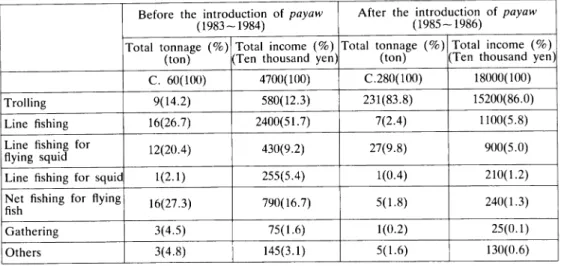
Annual catches also averaged about 60 tons (valued at 47 million yen) before the
Before the introduction of payaw
(%) (1983.11-1984.10) 100 80
\ ,
60 x \ s \ 40n\/
\JK
A\ \r y^--& *^X/ \A '1\\a
/ \ /
^~—-® Xx /' / \ -/x 20• a /WV(\
y/ • \ / A \ / 0i O l
V
• «^ © 11 12 1 2 3 4 5 6 7 8 9 10 (%) 100 Trolling • • Line fishing X X— Line fishing for flying squid 0 <>__ Net fishing for flying fish * *~. Line fishing for squid © @ After the introduction of payaw(1985.11-1986.10)
11 12 1 2 3 4 5 6 7 9 10
Takeda: Seasonality and Change in Traditional Fishing Patterns in Okinawa 127
Table 3. Comparison between the catch and income before and after the introduction of payaw
Before the introduction of payaw(1983-1984)
After the introduction of payaw (1985-1986)
Total tonnage (%) (ton)
Total income (%) (Ten thousand yen)
Total tonnage (%) (ton)
Total income (%) (Ten thousand yen)
C. 60(100) 4700(100) C.280(100) 18000(100)
Trolling 9(14.2) 580(12.3) 231(83.8) 15200(86.0)
Line fishing 16(26.7) 2400(51.7) 7(2.4) 1100(5.8)
Line fishing for
flying squid 12(20.4) 430(9.2) 27(9.8) 900(5.0)
Line fishing for squid 1(2.1) 255(5.4) 1(0.4) 210(1.2)
Net fishing for flying
fish 16(27.3) 790(16.7)
5(1.8) 240(1.3)
Gathering 3(4.5) 75(1.6) 1(0.2) 25(0.1)
Others 3(4.8) 145(3.1) 5(1.6) 130(0.6)
introduction of the payaw but 280 tons and 180 million Japanese yen after its introduction
(Table 3). This more than three-fold increase in income and just under five-fold increase in
catch came about as a result of a dependency on paraw fishing that accounted for 86% of the catch. With the payaw, the fishermen now catch as much fish in only three months as they used to in a year. Before the payaw was introduced the fishermen would not usually venture out of the harbor in rough weather; now, however, they go out anyway, knowing that there are fish to be caught. Also, the increase in the catch has spurred an increase in the fishingpopulation and revived the fishermen's livelihoods.
Despite the crash in fish prices that
overfishing has brought, the foreign competition resulting from the rise in the value of the yen and the raiding of payaw devices by boats from other prefectures, the number of payaw devices installed in Okinawa Prefecture has grown to 145 (belonging to 30 different fishermen's cooperatives) since the introduction of the first such payaw by the Irabu Fishery Cooperative, Miyako in 1983 (Takeda, 1988, 1989, 1990: Fig. 4). This development, together with the aquaculture of mozuku seaweed, makes the Okinawan fisheremen—who have long suffered the effects of a depressed industry—look upon the payaw as something akin to a savior of their livelihoods. It has also spurred the appearance of a stableo 0<£X> Yonaguni Is.
population of younger fishermen; at the same time, however, and together with the technical
ease thepayaw has provided, it has spurred the development of monocultural fishing (i.e., a
reliance on a single method of fishing; Itani, 1990) and hastened the disappearance of
traditional fishing techniques.
Fishing equipment has also changed dramatically and helped to improve efficiency. From
before the war up until about 1948, cotton was the mainstay of those implements, being
replaced by nylon nets and lines around 1955; electronic fish detectors were introduced around the time of reversion, along with automatic winch rollers and wet suits, and the smalldiesel-powered boats began to be made out of FRP (fiberglass reinforced plastic) instead of
wood.
Radio communications and larger boats came into use even before the payaw were
installed.
Also, after reversion, port facilities, fishermen's unions, distribution systems and
other such infrastructures were put on a sound footing, and the diffusion of freezing and
refrigeration equipment in recent times has been astounding.
Especially with the introduc
tion of the payaw, large fish such as swordfish and tuna—which until now had been
consumed locally, at best on the main island of Okinawa—have begun to be caught with
great frequency. With refrigerated air freight maintaining the freshness of such fish even when transported to the mainland Japan, interest has focused on ways to improve the prices of these fish retrieve at market. For example, the fishermen have acquired completely new transportation techniques—such as packing the fish in ice or ice water (a kind of partial freezing)—by inviting specialists from the mainland to give lectures on the subject. For these reasons the fishermen have been able to adapt to demands to ways they could not even envision before. It cannot be denied that a spirit of competition among fishermen has sprung up consciously or unconsciously—a competitiveness that manifests itself in the acquisition of more and better fishing equipment to get more income and a secretiveness about such equipment. However, it is also true that a system of cooperation among the fishermen with respect to the use of such equipment has evolved as well, for example by exchanging information on the location of fish via radio, calling on helpers to haul in catches and aid in engine trouble or other distress.Acknowledgements: This study was supported in part by a Grant-in-Aid for Scientific Re
search on Priority Areas, Ministry of Education and Culture (No. 04208107) and a
Grant-in-Aid for Scientific Research, Ministry of Education and Culture (No. 04640750) in completing
the English paper.
I gratefully acknowledge Mr. Shiro UEHARA, other fishermen of Minatogawa and the
Minatogawa Fishermen's Co-operative. I am also greatly indebted to Miss Melanie ODAfor revising my English paper. Thanks are due to Dr. Tetsuo YOSHINO, Department of
Marine Sciences, Faculty of Science, University of the Ryukyus, who helped me to check the
English names of the fish cited in the text.References
Takeda: Seasonality and Change in Traditional Fishing Patterns in Okinawa 129
Geography and Ethnographical Monograph. (Ed. Kato, Y.), 495-533, Chuo-kouron, Tokyo. Igarashi, T. 1977. Fishermen's locality-finding in the marine environment. In: Human Activity
System: Its Spatiotemporal Structure (Ed. Watanabe, H.), 171-206, University of Tokyo Press, Tokyo.
Itani, G. 1990. Mozuku seaweed farming activity in Izena Island, northern Okinawa. (In Japanese),
Okinawa Minzoku Kenkyu (Journal of Okinawa Folklore Studies), 10: 37-55.
Kuchikura, Y. 1977. An ecological approach to the fishing system of a coral island community in Okinawa. In: Human Activity System: Its Spatiotemporal Structure (Ed. Watanabe, H.), 117— 147, University of Tokyo Press, Tokyo.
Takeda, J. 1988. Changes in fishing methods in the Okinawan coral reef area: An ecological anthropological study of a fishing village on the sourthern shore of the main island of Okinawa. (In Japanese with English abstract), Jinrui Kagaku (Anthropological Sciences), 40: 81-113.
Takeda, J. 1989. Changes in Fishery: Socio-economic transition and ecological aspect. (In Japanese with English abstract), Jinrui Kagaku (Anthropological Sciences), 42: 3-4, 41.
Takeda, J. 1990. An ecological approach to the fishing activity system of a coral island community in Okinawa with special reference to its change. (In Japanese), Okinawa Minzoku Kenkyu (Journal of Okinawan Folklore Studies), 10: 17-36.
Takeda, J. 1992. On the utilization of natural resources in a coral ecosystem: An ecological anthropo logical study of the primitive fishing methods in Okinawa. (In Japanese), Mongoloid (Prehistoric Mongoloid Dispersals) 14: 10-17.
Takeda, J. in press a. The Ikei Islanders: Fishing practices in an Okinawan coral ecosystem. South
Pacific Study, 13(2).
Takeda, J. in press b. Gathering economy on the reef flat: Diversity of traditional fishing and gathering in a coral ecosystem. (In Japanese), In: Cultural Homogenization of Japanese Communities. [Ed. Council of Nine Learned Societies (Kyuu-gakkai)], Heibonsya, Tokyo.
Takeda, J. in press c. Gathering activities on the reef flat with special reference to the activities done by women, children and the aged. (In Japanese), In: Folklore of the Reef Flat (Ed. Nakamatsu, Y., Shimabukuro, S. and Inafuku, M.), San-ichi-syobou, Tokyo.
Terashima, H. 1977. Fishing activities of the Kudaka Islanders: An ecological-anthropological study of a coral island community. (In Japanese), In: Natural History of Mankind (Eds. Itani, J. and Harako, R.), 167-239, Yuuzankaku, Tokyo.