Analytic properties of
automorphic
$L$
-functions and Arthur
classification
保型
$L$関数の解析的性質と
Arthur
分類
Neven
Grbac*
Department
of
Mathematics,
University
of
Rijeka
Abstract
Langlands spectral theory describes the residual spectrum of a reductive group in
termsofintertwining operators andanalytic propertiesofautomorphic$L$-functions.
On the other hand, according to Arthur’s endoscopic classification of
automor-phicrepresentations ofclassical groups (dueto Mok forquasi-split unitary groups),
an
Arthur parameter is attached to every residual representation. Comparing thetwo approaches yields information on the analytic properties of automorphic
L-functions. In this expository paper we explainhow we applied thisgeneral idea to
prove the holomorphy in the critical strip of the complete symmetric and exterior
square, and Asai $L-$-functions.
Langlandsのスペクトル理論は、 簡約群の留数スペクトルを絡作用素と保型$L$ 関数の解析性質により記述するものである。 一方、Arthurによる古典群 (およ びMokによる準分裂ユニタリ群) の保型表現の内視論的分類によれば、全ての留 数的表現に対してArthur パラメータが付随している。 この2つのアプローチを比 較することで保型$L$関数の解析的性質についての情報が得られる。本解説記事に おいては、 この発想が、完備化された対称積$L$関数、 2次外積$L$関数、 浅井$L$関 数の臨界帯領域における正則性の証明にどのように適用されるかを説明する。
1
Introduction
Besides the standard $L$-function, the three important automorphic $L$-functions
at-tached to cuspidal automorphic representations of the general linear group
are
thesym-metric square, exterior square and Asai $L$-function [24]. These $L$-functions have been
extensively studied and many properties
are
known. In the paper [12] and the recentjointwork with
Shahidi
[13],we
proved the holomorphy of these L–functions in thecriti-cal strip, which
was
previously not known.The purpose of this expository paper is to point out clearly the underlying general
idea applied in [12, 13]. It does not contain any new results,
we
avoid many technical$*$
This work has been supported in part by Croatian ScienceFoundation underthe project 9364 and
issues and give almost
no
proofs. We refer the interested reader to the original papers[12, 13] for
more
details.The general idea in [12, 13]
was
to comparethe endoscopic classification of Arthur [3],which is due to Mok [20] for quasi-split unitary groups, to the spectral theory of
Lang-lands [18] (see also [19]). More precisely, according to endoscopic classification, every
automorphic representation in the discrete spectrum of
a
classical groupover
a
num-ber field should have
a
square-integrable Arthur parameter. On the other hand,we
can
construct residual representations of
a
classical group using Langlands spectral theory,starting with
a
cuspidal automorphic representations ofLevi factors. Since theconstruc-tion in
some cases
depends onsome
unknown properties of these cuspidal automorphicrepresentations, comparison with the possible Arthur parameters may lead to
some new
insight.
The paper is organized
as
follows. After this Introduction,we
present in Sect. 2 the general idea ofcomparing the endoscopicclassification
and Langlands spectraldecompo-sition. In Sect.
3 we
introduce the automorphic $L$-functions consideredin [12, 13], reviewtheir properties, and mention the main results of [12, 13]. Finally, in Sect. 4,
we
outlinevery roughly the proof for symmetric square $L$-functions by applying the general idea in
the
case
of split odd special orthogonal group.$* * *$
This paper is an outgrowth of the talk under the
same
title given at the workshopAutomorphic Forms and Related Zeta Functions held in January
2014
at the ResearchInstitute for Mathematical Sciences (RIMS), Kyoto, Japan. We would like to thank the
organizers Taku Ishii and Hiro-aki Narita for the invitationto give the talk. We
are
verygrateful to Takayuki Oda for his invitation to visit Tokyo University, during which
we
also attended the workshop in Kyoto.
2
General
idea
As already mentioned in the Introduction,
we
would like touse
the work of Arthur[3, 2], that is, his endoscopic classification, to extract
some
extra information aboutautomorphic representations. In particular, the holomorphy of certain automorphic
L-functions attached to them. Inthis section we explain the general idea whichis not
new.
It
was
already used in [12] and [13] to extract such information.2.1
Automorphic forms
We begin with
some
notation. Let $k$ bea
number field with the ring of ad\‘eles $\mathbb{A}$. Let$G$ be
an
algebraic groupover
$k$.
Although at this pointwe
could work witha
reductivegroup,
we assume
for simplicity that $G$ is semi-simple, thus avoiding the discussion ofcentral characters. Later on there will be
some
furhter assumptionson
$G.$We consider the space of$L^{2}$
automorphic forms on $G(\mathbb{A})$ defined as
$L^{2}(G)=L^{2}(G(k)\backslash G(\mathbb{A}))=\{c1$
asses o
$fmeasurab1ef$unctionsf
$onG(\mathbb{A})such\int_{G(k)\backslash G(A)}|f|^{2}<\infty f(\gamma 9)=f(g)for\gamma\in G(k)andg\in G(\mathbb{A}),and$ that
This is
a
Hilbert space, and the action of the group $G(\mathbb{A})$on
$L^{2}(G)$ by right translationis
a
unitary representation. The goal of spectral decomposition for $G$ is to decompose$L^{2}(G)$ with respect to that action.
As afirst step in the $G(\mathbb{A})$-invariant decomposition, we have
$L^{2}(G)=L_{disc}^{2}(G)\oplus L_{cont}^{2}(G)$,
where $L_{disc}^{2}(G)$ is the discrete spectrum of $G$ spanned by all closed irreducible $G(\mathbb{A})-$
invariant subspaces of$L^{2}(G)$, and$L_{c\circ nt}^{2}(G)$ is the continuous spectrumof$G$obtained
as
theorthogonal complementofthediscretespectrum. Classifyingautomorphic representations
that appear in the discretespectrumisthegoal ofArthur’sendoscopic classification. The continuous spectrum
can
be described in terms of direct integrals of Eisenstein series,which
was
already established by Langlands [18].2.2
Arthur’s
endoscopic
classification
Let
now
$G$ bea
classical group definedover
anumber field $k$. The endoscopicclassifi-cationof automorphic representations should provideaparametrizationof representations
appearing
as
summands in $G(\mathbb{A})$-invariant decomposition of the discrete spectrum of$G.$However, at the time of writing this paper, endoscopic classification still depends
on
the stabilization of the twisted trace formula for the general linear group. This problem is considered by Waldspurger [30, 31, 32], but not yet resolved.We summarize the state-of-the-art of endoscopic classification, upto the stabilization
mentioned above,
as
follows.$\bullet$ For $G$ a split symplectic or special orthogonal group, the classification is proved in
Arthur’s
book [3].$\bullet$ For$G$
an
innerform of split symplecticor
specialorthogonalgroup,theclassification
is statedwithout proof in the last section of Arthur’s book [3].
$\bullet$ For $G$
a
quasi-split unitary group (given bya
quadratic extension $K/k$), the classi-fication is recently proved by Mok [20].
In what follows,
we
givea
very rough description ofthe classification, sufficient onlyto express the general ideaof
our
work. Fora
classical group $G$, a set $\Psi_{2}(G)$ of$s\infty$calledsquare-integrable parameters is defined. A parameter $\psi\in\Psi_{2}(G)$ may be viewed
as
an
isobaric
sum
of automorphic representations in $L_{disc}^{2}(GL_{m})$ forsome
integers $m$. So ina
sense, the endoscopic classification for a classical group $G$ is given in terms of$GL_{m}.$
An Arthur packet $\Pi_{\psi}$ is associated to everyparameter$\psi\in\Psi_{2}(G)$
.
It isa
setof nearlyequivalent representationsof$G(\mathbb{A})$ with certainproperties. Packets associated to different
parameters
are
disjoint. The endoscopic classification amounts to the decomposition$L_{disc}^{2}(G) \cong\bigoplus_{\psi\in\Psi_{2}(G)}\bigoplus_{\pi\in\Pi_{\psi}}m_{disc}(\pi)\pi,$
where $m_{disc}(\pi)\geq 0$ is the multiplicity of$\pi$ in $L_{disc}^{2}(G)$ given in terms of certain objects
Observe that we use here the definition of $\Pi_{\psi}$ without the condition that the
mul-tiplicity $m_{disc}(\pi)$ of $\pi\in\Pi_{\psi}$ is non-zero. In other words, our definition allows that $\Pi_{\psi}$
contains representations $\pi$ that do not appear in $L_{disc}^{2}(G)$. However, this is sufficient for our purposes.
2.3
Langlands
spectral decomposition
We
assume
again that $G$ is semi-simple, although the theory works fora
reductive groupas
well. The Langlands spectral theory [18] is another way to construct represen-tations in the non-cuspidal part of the discrete spectrum of $G.$More precisely, let
$L_{cusp}^{2}(G)=\{f\in L^{2}(G)$ : $\int_{N(k)\backslash N(A)}f(ng)dn=0,$
proper parabolic subgroups o
$fGforu$
nipotent radicals N $ofa$llfor
almost a$llg\in G(\mathbb{A}),and\}$
be the cuspidal spectrum of $G$. It is
a
closed $G(\mathbb{A})$-invariant subspace of $L^{2}(G)$. Bya
fundamentalresult ofGelfand, Graev, Piatetski-Shapiro [10] and Langlands [18] (see also [11]), it decomposes into
a
Hilbert space directsum
of
irreducible invariant subspaceswith finite multiplicities. In particular, $L_{cusp}^{2}(G)$ is
a
subspace of the discrete spectrum.The residual spectrum $L_{res}^{2}(G)$ is the orthogonal complement of the cuspidal spectrum
$L_{cusp}^{2}(G)$ inside the discrete spectrum $L_{disc}^{2}(G)$. Thus,
we
havea
decomposition$L_{disc}^{2}(G)=L_{cusp}^{2}(G)\oplus L_{res}^{2}(G)$.
The Langlands spectral decomposition is
a
decomposition of the residual spectrum alongthe cuspidal support. Besides the original book of Langlands [18], main references
are
[19] and [9].
Let $P$beastandard properparabolic subgroupof$G$, and $\{P\}$ its associateclass.1 Let
$\sigma$be
a
cuspidalautomorphic representationofthe Levifactor$M_{P}(\mathbb{A})$, normalized insucha
waythat the poles ofEisenstein seriesand $L$-functions attachedto $\sigma$
are
real.2
Wedenoteby$\{\sigma\}$theassociate class of$\sigma^{3}$
Given
theassociateclasses $\{P\}$and $\{\sigma\}$,let$L_{res,\{P\},\{\sigma\}}^{2}(G)$be the (possibly trivial) spacespanned bysquare-integrable iterated residues of Eisenstein
series
on
$G(\mathbb{A})$ constructed from $\sigma$. The residual spectrum decomposes into$L_{res}^{2}(G)= \bigoplus_{\{P\}}\bigoplus_{\{\sigma\}}L_{res,\{P\},\{\sigma\}}^{2}(G)$.
Hence,
a
way to construct automorphic representations in the residual spectrum, is tostudy the poles ofEisenstein series.
1Hereweimplicitlyassumethat aminimal parabolic subgroup of$G$definedover $k$hasbeenfixed. By
definition, aparabolicsubgroupis standard, if it containsafixed minimal parabolic subgroup. Parabolic
subgroup $Q$ is associate to$P$iftheir Levifactors are $G(k)$-conjugate.
2More precisely, wealways assumethat $\sigma$ is trivialonthe connected component of the archimedean
part of the maximal split torus in the centerof$M_{P}$. This is notrestrictive, because it can be obtained
by twisting $\sigma$ with a unitary character of $M_{P}(\mathbb{A})$. Hence, it is just aconvenient normalization, which
makesthe poles of Eisensteinseries and$L$-functions attachedto a real.
3Associate class of a is a family of (non-empty) finite sets $\varphi_{Q}$, indexed by $Q\in\{P\}$, consisting of
cuspidal automorphic representationsof the Levi factor$M_{Q}(\mathbb{A})$ obtainedasconjugatesofabyelements
For simplicity of exposition,
we
do not define the Eisenstein series here. Wealso
assume
that $P$ isself-associate.4
We simply let $E(s, g)$ bean
Eisenstein serieson
$G(\mathbb{A})$constructed using
a
section ofrepresentations parabolically induced from $\sigma$ tensored bya character of $M_{P}(\mathbb{A})$ which depends on the complex parameter $\mathcal{S}\in \mathbb{C}^{r.5}$ The general
theory ofEisenstein series implies that the poles of the Eisenstein series $E(s, g)$ coincide
with the poles of its constant term along $P$, which is defined
as
$E(s, g)_{P}= \int_{N_{P}(k)\backslash N_{P}(A)}E(s, ng)dn,$
where $N_{P}$ is the unipotent radical of $P$
.
On the other hand, the constant termcan
bewritten
as
$E(s, g)_{P}= f\sum_{inite}$standard intertwining operators,
where standardintertwining operators
are
certainintegral operators actingon
the sectionof induced representations from which $E(s, g)$ is constructed. They are defined as the
analytic continuation from thedomain ofconvergence ofcertain integrals (see [25, 19] for
more
details). The study of poles of the Eisenstein series reduces to that of finitesums
of standard intertwining operators.
At
this pointwe
assume
that $G$ is quasi-split and $\sigma$ globally generic (with respect tosome
fixed non-trivial additive character of $k\backslash \mathbb{A}$),so
thatwe
may apply theLanglands-Shahidi method [25, 24]. In that case,
we
stillhavesome
serious difficulties toovercome.
1. The poles of standard intertwining operatorscan
be determined, in principle, frompoles (and zeros) ofcertain automorphic $L$-functions. But these could be unknown.
2. Even whenthe poles ofindividual standard intertwiningoperators
are
known, takingthe residue of a finite sum could lead to cancelations. Understanding the
cancela-tions involves demanding combinatorial considerations.
3.
Finally, the residuesare
isomorphic to images ofsome
intertwining operators. In particular, theyare
isomorphicto
a
constituent
of
some
induced
representation.2.4
The strategy
The very rough and incomplete description of the endoscopic classification and the
Langlands spectral theory, given in previous sections, is sufficient to explain
our
strategy.Now $G$ is
a
quasi-split classical groupso
thatwe
may apply both approaches to thediscrete spectrum.
By the Langlands spectral theory,
we can use
Eisenstein series to constructan
auto-morphicrepresentation$\pi$in the discrete spectrum $L_{disc}^{2}(G)$
.
The constructionwill depend4A standard parabolic subgroup is
self-associate
if it is the only standard parabolic in its associateclass.
5Let $f_{s}$ be a “good” section of the induced representation $Ind_{P(A)}^{G(A)}(\sigma\otimes\chi_{s})$, where
$\chi_{s}$ is a character of$M_{P}(A)$ that depends on the complex parameter $s\in \mathbb{C}^{r}$. The Eisenstein series $E(f_{s}, g)$ is defined as
the analytic continuation from the domain ofconvergence of the series$E(f_{s},g)= \sum_{\gamma\in P(k)\backslash G(k)}f_{8}(\gamma g)$,
where$g\in G(A)$. Forsimplicity,wewrite$E(s,g)$ forsuchEisenstein seriesconstructedfromsomesection
on some
propertiesof the cuspidal automorphic representation$\sigma$ofaLevi factor in$G$fromwhich the Eisenstein series is constructed. For example, certain automorphic $L$-fUnction
attached to a should have
a
pole.Having constructed $\pi$ in $L_{disc}^{2}(G)$, the endoscopic classification implies that there should be
a
square-integrable parameter $\psi\in\Psi_{2}(G)$, such that $\pi$ belongs to the packet $\Pi_{\psi}$.
Ifwe can
prove that such $\psi$ does not exist, then $\pi$ does not appear in $L_{disc}^{2}(G)$.
Hence, the properties of$\sigma$
on
which the construction of $\pi$ depends are not satisfied. Inthe example mentioned above, this
means
that the $L$-fUnction in question does not havea
pole.We applied this simple strategy in [12] and [13] to prove holomorphy ofcertain $aut_{G}$
morphic $L$-functions attached to $\sigma$ for
some
values ofthe complexparameter.3
Automorphic
$L$-functions
In thissection
we
introduce the automorphic $L$-function considered in this paper, and review their analytic properties. We state the main results of [12] and [13]. It is theholomorphy of these $L$-fUnctions in the critical strip, which
was
not known before usingother methods.
3.1
Definition
Let $k$ and $\mathbb{A}$
be a number field and its ring ofad\‘eles,
as
before. For a place $v$of $k$, wedenote by $k_{v}$ the completion of$k$ at $v$. Let $\sigma$ be acuspidal automorphic representation of
$GL_{n}(\mathbb{A})$
.
Let $v$ be anon-archimedean place of$k$such that the local component$\sigma_{v}$ of$\sigma$ is
an unramifiedrepresentation of$GL_{n}(k_{v})$. We denote by $c(\sigma_{v})$ its Satakeparameter [22, 8]
in $GL_{n}(\mathbb{C})$
.
Let $r$ be a finite-dimensional algebraic representation of $GL_{n}(\mathbb{C})$, which isthe dual group of $GL_{n}$. To these data, Langlands attached in [17] the local unramified $L$-fUnction
$L_{v}(s, \sigma, r)=L(s, \sigma_{v}, r)=\det(I-r(c(\sigma_{v}))q_{v}^{-s})^{-1}$
where $I$ is the identity matrix of appropriate size, and $q_{v}$ the cardinality of the residue
field of$k_{v}.$
In thispaper
we are
interested in three automorphic $L$-functions. Two of themare
thesymmetric and exterior square $L$-functions of $\sigma$, attached to the symmetric square $r=$
$Sym^{2}$ and exterior square $r=\wedge^{2}$ ofthe standard representation of$GL_{n}(\mathbb{C})$, respectively.
The third$L$-functionthat
we
consider in this paper is the so-calledAsai
$L$-function,as
it generalizes the
case
considered by Asai in [4]. It is attached toa
cuspidal automorphicrepresentation a of $GL_{n}(\mathbb{A}_{K})$, where $K/k$ is a quadratic extension of number fields, and
$\mathbb{A}_{K}$ is the ring of ad\‘eles of $K$. We
are
skipping the detailshere,6
but for a place $v$ of $k$6To precisely define the Asai $L$-function in the setting of Langlands [17], one should view $\sigma$ as a
representationof the group$H(\mathbb{A}_{k})$, where $H={\rm Res}_{K/k}GL_{n}$ is thealgebraic group over $k$obtained from
$GL_{n}/K$ by restriction of scalars. For an unramified place $v$ of$k$, the local $L$-function is attached to a
finite-dimensional representation $r_{v}$ of the $L$-group of$H$ viewed as a $k_{v}$-group. This is the reason for
a distinction between split and inert places in the definition. If$v$ splits in $K$, and $w_{1}$ and $w_{2}$ are the
two places of$K$ lying over $v$, the local $L$-function at $v$ is in fact the local unramified Rankin-Selberg
$L$-function attached tothe pair
$\sigma_{w_{1}}$ and $\sigma_{w_{2}}$. If$v$ is inert in $K$, and $w$ is the unique place of$K$ lying
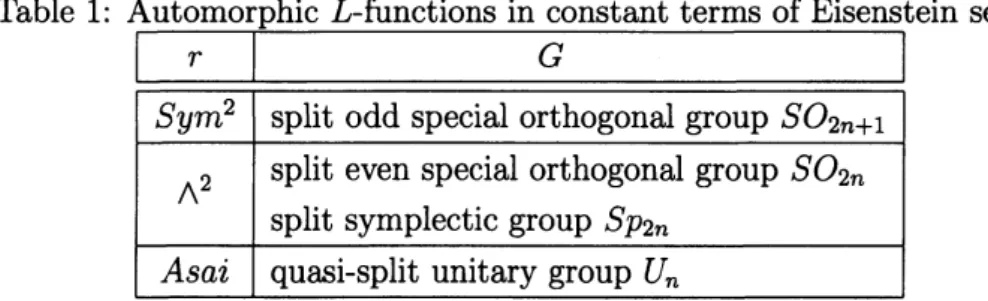
Table 1: Automorphic $L$-functions in constant terms of Eisenstein series
whichisunramified in$K$ and suchthatthe localcomponentsof$\sigma$ atplacesof$K$ lying
over
$v$
are
unramified, onecan
define the localAsai $L$-function at $v$.
The local Asai$L$-functionat $v$ attached to $\sigma$ is denoted by
$L_{v}(s, \sigma, Asai)$
in this paper.
Let $r=Sym^{2},$$\wedge^{2}$
or
Asai. Let $S$ be a finite set of places of $k$, containing allarchimedean places, and such that the local
L–function
$L_{v}(s, \sigma, r)$ attached to $\sigma$ isde-fined for all $v\not\in S$
.
The partial $L$-function
attached to $\sigma$ and $r$ is definedas
$L^{S}(s, \sigma, r)=\prod_{v\not\in S}L_{v}(s, \sigma, r)$
.
The product
on
the right-hand side converges absolutely insome
right half-plane.These partial $L$-functions appear in the constant term of the Eisenstein series
on
the appropriate (quasi-)split classical group $G$
.
The groups $G$ in question for $r=$$Sym^{2},$$\wedge^{2}$
,Asai
are
listed in Table 1. As $G$ is (quasi-)split and $\sigma$ is globallygeneric,7
Shahididefined in [24] the local$L$-functions$L_{v}(s, \sigma, r)$ atramified non-archimedean places. At archimedean places $L_{v}(s, \sigma, r)$ is just the Artin $L$-function attached to the Langlands
parameter of $\sigma_{v}$
as
in [23]. Hence,we can
define the complete automorphic $L$-functions
attached to $\sigma$ and $r$
as
$L(s, \sigma, r)=\prod_{v}L_{v}(s, \sigma, v)$,
wheretheproduct
over
all placeson
theright-hand sideconverges insome
right half-plane.3.2
Review of analytic properties
The three automorphic $L$-functions $L(s, \sigma, r)$, defined above, have been extensively
studied and many analytic properties are known. We summarize these properties below.
In what follows it is convenient to
use
the notation$\sigma^{*}=\{\begin{array}{ll}\tilde{\sigma}, if r=Sym^{2}, \wedge^{2},\tilde{\sigma}^{\theta}, if r=Asai,\end{array}$
where $\tilde{\sigma}$
is the representationcontragredient to $\sigma$, and $\theta$ is the uniquenon-trivial element
in the Galois group ofthe quadratic extension $K/k$. We denote by $\sigma^{\theta}$
the representation
conjugate to $\sigma$ by the Galois automorphism $\theta.$
7Every cuspidal automorphic representation of $GL_{n}(A)$ is globally generic. This follows from the
1. The defining product of$L^{S}(s, \sigma, r)$, and thus also $L(s, \sigma, r)$, has the analytic
contin-uation to
a
meromorphicfunction
in the whole complexplane8
(cf. [17,25
2. Thecomplete$L$-functions$L(s, \sigma, r)$ satisfy
a
functionalequation9
relatingthe valuesat $s$ and $1-s$ (cf. [24,25
3, Holomorphy of the complete $L$-function $L(s, \sigma, r)$ always implies holomorphy for
the partial $L$-function $L^{S}(s, \sigma, r)$, since local $L$-functions have
no zeros.
But theconverse
is not true, due to ramification and problems at archimedean places.4. If a is not isomorphic to its (Galois conjugate) contragredient $\sigma^{*}$
, then the
L-function $L(s, \sigma, r)$, and thus also the partial $L$-function $L^{S}(s, \sigma, r)$, is
entire.10
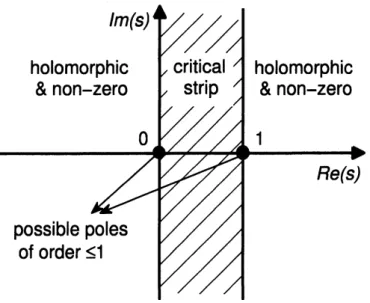
5. Fora isomophicto$\sigma^{*}$, i.e.,
$\sigma$ (Galois conjugate) self-dual, thesituationfor complete
$L$-functions is presented in Fig. 1.
(a) For $Re(s)\geq 1$ and $Re(s)\leq 0$the complete $L$-function$L(s, \sigma, r)$ is holomorphic
and non-zero, except for possible poles at $s=0$ and $\mathcal{S}=1$ of order at most
one.
(b) In the critical strip, i.e., for
$0<Re(s)<1$
, the holomorphy of the partial$L$-function $L^{S}(s, \sigma, r)$ is established using the integral representation approach in [27, 28, 29, 7] for $r=Sym^{2}$, in [6, 16, 5] for $r=\wedge^{2}$, and in [1] for $r=Asai.$
(c) In the critical strip, i.e., for $0<Re(s)<1$, the holomorphy of the complete
$L$-function $L(s, \sigma, r)$ was not known, and the goal of this paper is to explain
how the general idea ofSect. 2 is used in [12] and [13] to prove this fact.
3.3
Holomorphy
in
the
critical strip
Theholomorphy ofthe complete $L$-functions $L(s, \sigma, r)$ in the critical strip
was
the mainnew result, for which
a
crucial insight from the endoscopic classification was required, in[12] for $r=Sym^{2},$$\wedge^{2}$
, and in [13] for $r=Asai$. For convenience, we state these results in
separate theorems below.
Theorem$A$ (G. (2011), [12]). Let$\sigma$ be
a
cuspidal automorphic representationof
$GL_{n}(\mathbb{A})$.
Then the complete symmetric square $L$
-function
$L(s, \sigma, Sym^{2})$ and the complete exteriorsquare$L$
-function
$L(s, \sigma, \wedge^{2})$ are holomorphic in the criticalstrip, i. e.,for
$0<Re(s)<1.$Theorem $B$ (G. and Shahidi (preprint, 2014), [13]). Let $\sigma$ be a cuspidal automorphic
representation
of
$GL_{n}(\mathbb{A}_{K})$, where $K/k$ is a quadratic extensionof
numberfields.
Thenthe complete
Asai
$L$-function
$L(s, \sigma, Asai)$ is holomorphic in the critical strip, i.e.,for
$0<Re(s)<1.$
8The proof is essentially the same as for the Riemann $\zeta$-function, once a uniform bound for Satake
parametersover unramified places is known. See [25, Appendix 2.5] for details.
9Thefunctional equation is $L(s, \sigma, r)=\epsilon(s, \sigma, r)L(1-s, \sigma^{*}, r)$, where$\epsilon(s, \sigma, r)$ is the$\epsilon$-factor.
$1\fbox{Error::0x0000}$ is a
consequence of the theory of Eisenstein series. See Remark at the end of [19, Section
Figure 1: Analytic properties of symmetric square, exterior square and Asai complete
automorphic $L$-functions
4
About the
proof
We finish this paper with a few words about the proof of Theorem A and B. The
ideais to apply the strategy outlinedin Sect. 2.4, that is, comparethe Langlands spectral
decomposition and Arthurclassification for an appropriatequasi-split classical
group.
Forthe complete proof,
we
referthe interested reader to the originalpapers [12] for TheoremA and [13] for Theorem $B$, in which these two theorems
are
proved.The simplest
case
for the presentation is thecase
of symmetric square -function$L(s, \sigma, Sym^{2})$, where $\sigma$ is
a
cuspidal automorphic representation of$GL_{n}(\mathbb{A})$.
Othercases
are
proved ina
similar way.4.1
Step
1
From Table 1,
we
know that the symmetric square $L$-function $L(s, \sigma, Sym^{2})$ appearsin the constant term of the Eisenstein series for $G=SO_{2n+1}$. Hence, let $SO_{2n+1}$ be
the split odd special orthogonal group defined over a number field $k$
.
Let $P$ be theSiegel maximal proper standard parabolic
subgroup1l
of $SO_{2n+1}$.
This is the standard parabolicsubgroup with the Levi factor $M_{P}$ isomorphic to $GL_{n}$.
Consider
$\sigma$as a
cuspidalautomorphic representation of$M_{P}(\mathbb{A})\cong GL_{n}(\mathbb{A})$
.
For $s\in \mathbb{C}$, let
$I(s, \sigma)=Ind_{P(A)}^{SO_{2\mathfrak{n}+1}(A)}(\sigma|\det|^{s})$
betheparabolically induced representation, where theinduction is normalized, $\det$ isthe
11Hereweimplicitly assume thata Borelsubgroup $B$of$SO_{2n+1}$ has been fixed, and by definition, $P$
determinant
on
$M_{P}(\mathbb{A})$ and $|\cdot|$ is the ad\‘elic absolute value. Taking agood12
section $f_{s}$ of $I(\mathcal{S}, \sigma)$, the Eisenstein series constructed from $f_{s}$ is defined as the analytic continuationfrom the domain of convergence of the series
$E(f_{s}, g)= \sum_{\gamma\in P(k)\backslash SO_{2n+1}(k)}f_{s}(\gamma g)$
for $g\in SO_{2n+1}(\mathbb{A})$.
Asexplained in Sect. 2.3, the poles of$E(f_{s}, g)$
are
determined by those of theconstantterm $E(f_{s9})_{P}$ along $P$. Note that $P$ is self-associate. The constant term in this
case
isthe
sum
oftwo terms$E(f_{s,9})_{P}=f_{s}(g)+(std$ intertw op$)$$f_{s}(g)$.
But the first term is just the identity operator. Hence, the poles are the same as the
poles of
a
single standard intertwining operator. In particular, there isno
problem withcancelations in the
sum
mentioned in Sect.2.3.
It
turns
out that the standard intertwining operator, appearingin the constant term,has the
same
poles for $Re(s)>0$as
the $L$-function $L(2s, \sigma, Sym^{2})$.
Observe the factortwo appearing in the argument. Hence, for $Re(s)>0$ and the appropriate choice of $f_{s},$
the poles of the Eisenstein series $E(f_{s}, g)$
are
thesame as
the poles of the $L$-function$L(2s, \sigma, Sym^{2})$
.
Conclusion. Assumethat the $L$-fUnction $L(z, \sigma, Sym^{2})$ has
a
pole at $z=2s_{0}$ such that$0<2s_{0}<1$. Then $E(f_{s}, g)$ would have
a
pole at $s=s_{0}$ for appropriate choices of$f_{s}$.
Bythesquare-integrabilitycriterion ofLanglands (see [18, p. 104]
or
[14, p.187
theresiduesof$E(f_{s}, g)$ at the pole $s=s_{0}$ would span anautomorphic representation $\pi$ intheresidual
spectrum $L_{res}^{2}(SO_{2n+1})$. This representation $\pi$ would be isomorphic to
a
constituent ofthe induced representation
$Ind_{P(A)}^{SO_{2n+1}(A)}(\sigma|\det|^{s0})$ ,
since it is isomorphic to the image of certain normalized intertwining operator,
as
men-tioned in Sect. 2.3.
4.2
Step 2
In the previous step
we
constructed the representation $\pi$ in $L_{res}^{2}(SO_{2n+1})$, under theassumption that $L(s, \sigma, Sym^{2})$ has
a
pole in the critical strip. Hence, according toSect. 2.2, it should belongto the Arthur packet $\Pi_{\psi}$ for
some
square-integrable parameter$\psi\in\Psi_{2}(SO_{2n+1})$
.
Tosee
whatare
the possibilities, wenow
give an incomplete definitionof square-integrable parameters for $SO_{2n+1}$, which will be sufficient for our purposes.
Asquare-integrable Arthurparameter $\psi\in\Psi_{2}(SO_{2n+1})$ is
an
unordered formalsumofformal tensorproducts
$\psi=(\mu_{1}\otimes\nu(n_{1}))$ 田...田 $(\mu_{\ell}$図 $v(n_{\ell}))$, where
(i) $\mu_{i}\cong\tilde{\mu}_{i}$ is
a
self-dual
cuspidal automorphic representationof
$GL_{m_{i}}(\mathbb{A})$for
some
positive integer $m_{i},$
(ii) $n_{i}$
are
positive integers such that $\sum_{i=1}^{\ell}m_{i}n_{i}=2n,$(iii) $\nu(n_{i})$ is the unique irreducible $n_{i}$-dimensional algebraic representation of$SL_{2}(\mathbb{C})$,
(iv) the formal
sum
is multiplicity free,(v) certain condition
on
central characters of$\mu_{i},$(vi)
a
technical condition given in terms of the twisted endoscopic datum associated to$\mu_{i}.$
The conditions $(iv)-(vi)$ in this definition
are
not given precisely,as we
will not need themin this paper.
As explained in Sect. 2.2, Arthur packet $\Pi_{\psi}$, associated with $\psi\in\Psi_{2}(SO_{2n+1})$, is
a
set of nearly equivalent representations of $SO_{2n+1}(\mathbb{A})$. If $\pi\cong\otimes_{v}’\pi_{v}\in\Pi_{\psi}$, then $\pi_{v}$ is
unramified at almost all places, and its Satake parameter $c(\pi_{v})\in Sp_{2n}(\mathbb{C})$, viewed via
inclusion
as
an
element in $GL_{2n}(\mathbb{C})$, is at almost all places determined by the Satakeparameter of$\psi$, which is given
as
$c_{v}( \psi)=\bigoplus_{i=1}^{\ell}[c(\mu_{i,v})\otimes$diag
(
$q_{v}^{\tilde{2}}, q_{v}n\cdot-1n_{\lrcorner_{\frac{-3}{2}}}, ..., q_{v}^{-}n_{\tilde{2}}-1)]\in GL_{2n}(\mathbb{C})$,where $c(\mu_{i,v})$ is the
Satake
parameter of$\mu_{i,v}$, and $q_{v}$ the cardinality of the residue field of $k_{v}.$Conclusion. Given
an
automorphic representation $\pi\cong\otimes_{v}’\pi_{v}$ of $SO_{2n+1}(\mathbb{A})$ appearingin $L$ $(SO_{2n+1})$, the Satake parameters $c_{v}(\psi)$ of
some
square-integrable parameter $\psi\in$$\Psi_{2}(SO_{2n+1})$ should determine the Satake parameters $c(\pi_{v})$ of$\pi_{v}$ at almost all places.
4.3
End
of proof
Finally,
we
apply the strategy proposedin Sect. 2.4. In step 1,we
constructedan
au-tomorphic representation $\pi$ inthe residual spectrum $L_{res}^{2}(SO_{2n+1})$, which is
a
constituentof the induced representation
$Ind_{P(A)}^{SO_{2n+1}(A)}(\sigma|\det|^{s_{0}})$ ,
with $0<2s_{0}<1$, under the assumptionthat $L(z, \sigma, Sym^{2})$ has
a
poleinthecritical stripat $z=2s_{0}$. Hence,
we
can
determine the Satake parameters $c(\pi_{v})$ at almost allplaces.Since $\pi$ is in the discrete spectrum, it should have
a
square-integrable parameter$\psi\in\Psi_{2}(SO_{2n+1})$, such that the Satakeparameters of$\pi_{v}$ and $\psi$match at almost all places.
Looking at the possible Satakeparameters $c_{v}(\psi)$ of
a
square-integrable parameter $\psi$, andviewing parameters
as
induced representations of $GL_{2n}(\mathbb{A})$, the strong multiplicityone
for general linear groups [15] implies that necessarily $\ell=1,$ $\mu_{1}=\sigma$ with $m_{1}=n$, and
$n_{1}=2$, that is,
and thus $s_{0}=1/2$
.
In other words, there isno
Arthur parameter for $\pi$, because the onlypossible candidate is such that $2s_{0}=1$, and we assumed $0<2s_{0}<1$. Therefore, $\pi$
can
not exist, andour
assumption that $L(z, \sigma, Sym^{2})$ hasa
pole in the critical stripwas
wrong. This proves the holomorphy of$L(s, \sigma, Sym^{2})$ in the critical strip.
References
[1] U. K. AnandavardhananandC. S. Rajan, Distinguished representations, base change,
and reducibility
for
unitary groups, Int. Math. Res. Not. (2005),no.
14,841-854.
[2] J. Arthur, An introduction tothe trace formula, Harmonic analysis,the traceformula,
and Shimura varieties, Clay Math. Proc., vol. 4, Amer. Math. Soc., Providence, RI,
2005, pp. 1-263.
[3] J. Arthur, The endoscopic
classification of
representations: Orthogonal andsymplec-tic groups, Amer. Math. Soc. Colloq. Publ., vol. 61, Amer. Math. Soc., Providence, RI,
2013.
[4] T. Asai, On certain Dirichlet series associated with Hilbert modular
forms
andRankin’s method, Math. Ann. 226 (1977),
no.
1, 81-94.[5] D. D. Belt, On the holomorphy
of
exterior-square $L$-functions, ProQuest LLC, AnnArbor, MI, 2012,
Thesis
(Ph.D.) Purdue University.[6] D. Bump and S. Riedberg, The exterior square automorphic $L$
-functions
on $GL(n)$,Festschrift in honor of I. I. Piatetski-Shapiro on theoccasion of his sixtieth birthday,
Part II (Ramat Aviv, 1989), Israel Math. Conf. Proc., vol. 3, Weizmann, Jerusalem,
1990, pp. 47-65.
[7] D. Bump and D. Ginzburg, Symmetric square $L$
-functions
on
$GL(r)$, Ann. of Math.(2) 136 (1992),
no.
1,137-205.
[8] P. Cartier, Representations
of
$p$-adic groups: a survey, Automorphic forms,represen-tations and $L$-functions (Proc. Sympos. Pure Math., Oregon State Univ., Corvallis,
Ore., 1977), Part 1, Proc. Sympos. Pure Math., XXXIII, Amer. Math. Soc.,
Provi-dence, R.I., 1979, pp.
111-155.
[9] J. Franke and J. Schwermer,
A
decompositionof
spacesof
automorphicforms, and theEisenstein cohomology
of
arithmetic groups, Math. Ann. 311 (1998),no.
4,765-790.
[10] I. M. Gelfand, M. I. Graev, and I. I. Piatetski-Shapiro, Representation theory and
automorphicfunctions, W. B. Saunders Co., Philadelphia, Pa.,
1969.
[11] R. Godement, The spectral decomposition
of
cusp-forms, Algebraic Groups and Dis-continuous Subgroups (Proc. Sympos. Pure Math., Boulder, Colo., 1965), Amer.Math. Soc., Providence, R.I., 1966, pp.
225-234.
[12] N. Grbac, On the residual spectrum
of
split classical groups supported in the Siegel[13] N.
Grbac
and F. Shahidi, Endoscopictransfer for
unitarygroups
and holomorphyof
Asai $L$-functions, preprint.[14] H. Jacquet, On the residual spectrum
of
$GL(n)$, Liegrouprepresentations, II (CollegePark, Md., 1982/1983), Lecture Notes in Math., vol. 1041, Springer, Berlin, 1984,
pp.
185-208.
[15] H. Jacquet and J. A. Shalika, OnEuler products and the
classification of
automorphicforms.
II, Amer. J. Math. 103 (1981), no. 4,777-815.
[16] P. K. Kewatand R. Raghunathan, Onthe local and global exterior
square
$L$-functions
of
$GL_{n}$, Math.Res.
Lett.19
(2012),no.
4,785-804.
[17] R. P. Langlands, Euler products, Yale Mathematical Monographs, vol. 1, Yale Uni-versity Press, New Haven, Conn.,
1971.
[18] R. P. Langlands, On the
functional
equationssatisfied
by Eisenstein series, LectureNotes in Mathematics, Vol. 544, Springer-Verlag, Berlin,
1976.
[19] C. Moeglin and J.-L. Waldspurger, Spectral decomposition and Eisenstein series,
CambridgeTractsin Mathematics,vol. 113, Cambridge University Press, Cambridge,
1995.
[20] C. P. Mok, Endoscopic
classification of
representationsof
quasi-split unitary groups,Mem.
Amer.
Math. Soc., to appear.[21] I. I. Piatetski-Shapiro, Euler subgroups, Lie groups and their representations (Proc.
SummerSchool, Bolyai J\’anosMath. Soc., Budapest, 1971), Halsted, New York, 1975, pp.
597-620.
[22] I. Satake, Theory
of
sphericalfunctions
on
reductive algebraic groupsover
$\mathfrak{p}$-adicfields, Inst. Hautes Etudes Sci. Publ. Math. (1963),
no.
18,5-69.
[23] F. Shahidi, Local
coefficients
as Artinfactors for
real groups, Duke Math. J. 52(1985),
no.
4,973-1007.
[24] F. Shahidi, A proof
of
Langlands’ conjectureon
Plancherel measures; complementaryseries
for
$p$-adic groups,Ann.
of Math. (2)132
(1990),no.
2,273-330.
[25] F. Shahidi, Eisenstein series andautomorphic $L$-functions, Amer. Math. Soc. Colloq.
Publ., vol. 58, Amer. Math. Soc., Providence, RI,
2010.
[26] J. A. Shalika, The multiplicity
one
theoremfor
$GL_{n}$, Ann. of Math. (2) 100 (1974),171-193.
[27] S. Takeda, The twisted symmetric square $L$
-function of
$GL(r)$, Duke Math. J.163
(2014),
no.
1,175-266.
[28] S. Takeda, Metaplectic tensor products
for
automorphic representationsof
$\overline{GL}(r)$,[29] S. Takeda, On a certain metaplectic Eisenstein series and the twisted symmetric
square $l$-function, preprint.
[30] J.-L. Waldspurger, Preparation \‘a la stabilisation de la
formule
des traces tordue $I$:endoscopie tordue
sur un
corps local, preprint.[31] J.-L. Waldspurger, Preparation \‘a la stabilisation de la
formule
des traces tordue II:int\’egrales orbitales et endoscopie sur un corps local non-archim\’edien, preprint.
[32]
J.-L.
Waldspurger, Pr\’eparation \‘a la stabilisation de laformule
des traces tordue III:int\’egrales orbitales et endoscopie
sur
un corps local archim\’edien, preprint.Department ofMathematics, University of Rijeka
Radmile Matej\v{c}i\’{c} 2
HR-51000 Rijeka