Proceedings of the LREC 2018 Special Speech
Sessions
journal or
publication title
Proceedings of the LREC 2018 Special Speech
Sessions
page range
1-46
year
2018-05-09
Speech Resources Collection in Real-World
Situations
PROCEEDINGS
Edited by
Yuichi Ishimoto and Kikuo Maekawa
“Speech Resources Collection in Real-World Situations”
9 May 2018 — Miyazaki, Japan
Edited by Yuichi Ishimoto and Kikuo Maekawa
Acknowledgments: This session is supported by the Center for Corpus Development of the National
Institute for Japanese Language and Linguistics (NINJAL).
Session S1
14.35 – 14.55 Yuichi Ishimoto, Tomoko Ohsuga
Spontaneous Speech Resources in Japan
14.55 – 15.15 Yoshiko Arimoto
Challenges of Building an Authentic Emotional Speech Corpus of Spontaneous
Japanese Dialog
15.15 – 15.35 Norihide Kitaoka, Yurie Iribe, Hiromitsu Nishizaki
Construction of a Corpus of Elderly Japanese Speech for Analysis and Recognition
15.35 – 15.55 Nobuko Kibe, Tomoyo Otsuki, Kumiko Sato
Intonational Variations at the End of Interrogative Sentences in Japanese Dialects:
From the “Corpus of Japanese Dialects”
15.55 – 16.15 Hanae Koiso, Yasuharu Den, Yuriko Iseki, Wakako Kashino, Yoshiko Kawabata,
Ken’ya Nishikawa, Yayoi Tanaka, Yasuyuki Usuda
Construction of the Corpus of Everyday Japanese Conversation: An Interim Report
Session S2
16.35 – 16.55 Mayumi Bono, Rui Sakaida, Ryosaku Makino, Ayami Joh
Miraikan SC Corpus: A Trial for Data Collection in a open and
Semi-Controlled Environment
16.55 – 17.15 Kotaro Funakoshi
A Multimodal Multiparty Human-Robot Dialogue Corpus for Real World Interaction
17.15 – 17.35 Ryuichiro Higashinaka, Ryo Ishii, Narimune Matsumura, Tadashi Nunobiki, Atsushi
Itoh, Ryuichi Inagawa, Junji Tomita
Speech and Language Resources for the Development of Dialogue Systems and
Prob-lems Arising from their Deployment
17.35 – 17.55 General Discussion
Spontaneous Speech Resources in Japan
Yuichi Ishimoto, Tomoko Ohsuga . . . 1
Challenges of Building an Authentic Emotional Speech Corpus of Spontaneous Japanese Dialog
Yoshiko Arimoto . . . 6
Construction of a Corpus of Elderly Japanese Speech for Analysis and Recognition
Norihide Kitaoka, Yurie Iribe, Hiromitsu Nishizaki . . . 14
Intonational Variations at the End of Interrogative Sentences in Japanese Dialects: From the “Corpus
of Japanese Dialects”
Nobuko Kibe, Tomoyo Otsuki, Kumiko Sato . . . 21
Construction of the Corpus of Everyday Japanese Conversation: An Interim Report
Hanae Koiso, Yasuharu Den, Yuriko Iseki, Wakako Kashino, Yoshiko Kawabata, Ken’ya Nishikawa,
Yayoi Tanaka, Yasuyuki Usuda . . . 29
Miraikan SC Corpus: A Trial for Data Collection in a Semi-open and Semi-Controlled Environment
Mayumi Bono, Rui Sakaida, Ryosaku Makino, Ayami Joh . . . 30
A Multimodal Multiparty Human-Robot Dialogue Corpus for Real World Interaction
Kotaro Funakoshi . . . 35
Speech and Language Resources for the Development of Dialogue Systems and Problems Arising from
their Deployment
Ryuichiro Higashinaka, Ryo Ishii, Narimune Matsumura, Tadashi Nunobiki, Atsushi Itoh, Ryuichi
Inagawa, Junji Tomita . . . 40
Spontaneous Speech Resources in Japan
Yuichi Ishimoto
†, Tomoko Ohsuga
‡†National Institute for Japanese Language and Linguistics 10–2 Midori-cho, Tachikawa, Tokyo 190–8561, Japan
‡National Institute of Informatics
2–1–2 Hitotsubashi, Chiyoda-ku, Tokyo 101–8430, Japan [email protected]
Abstract
In this paper, we introduce representative corpora of spontaneous speech, which have been provided publically in Japan. A large amount of spontaneous speech data is required for research on various themes in speech studies such as speech analysis, speech recognition systems, and natural language processing in recent years. However, it is difficult to collect spontaneous speech data, and few corpora of spontaneous speech are available. Considering the diversity of speech in real-world situations, the data remain insufficient. We show the characteristics of spontaneous Japanese speech corpora gathered and distributed by two organizations: the Speech Resources Consortium at the National Institute of Informatics, and the National Institute for Japanese Language and Linguistics. Then, we describe prospects for the development of spontaneous speech resources.
Keywords: Japanese corpus, spontaneous speech, natural conversation, corpus distribution
1. Introduction
Speech resources are necessary to promote speech re-search; therefore various speech corpora have been compiled. Initially, most of the corpora consisted of words and sentences read aloud such as numbers, greet-ings, place names, and phonetically balanced phrases because in the past, some providers usually collected them for use in constructing early speech recognition systems. Although prior data used to be effective, it is no longer sufficient for systems to show high perfor-mance in real-world situations.
Read-aloud speeches have different characteristics from those of the words and sentences that we utter in everyday conversations; consequently, the old system derived from speech data did not exhibit competent performance for real-life situations. Moreover, spon-taneous utterances are more complex and have more disfluency than sentences prepared in advance. Spontaneous speech data have thus been required by researchers; however, it takes much more time to record spontaneous speech than read-aloud speech. The recorder needs to prepare an environment in which the speaker makes spontaneous utterances, or to visit a place in which natural conversations occur. Few cor-pora of spontaneous Japanese speeches exist.
In this paper, we introduce several spontaneous Japanese speech corpora that are publically dis-tributed and describe their characteristics. Then, we describe prospects for the development of spontaneous resources.
2. Spontaneous Japanese Speech
Corpora
In this section, we introduce representative speech re-sources of spontaneous Japanese gathered and dis-tributed by two organizations in Japan.
2.1. Corpora from NII-SRC
The Speech Resources Consortium at the National In-stitute of Informatics (NII-SRC) was established in 2006. It aims to collect speech resources from re-searchers who belong to universities, as well as com-panies that record speech sounds for various purposes, and to distribute them to researchers who need speech data suitable for their investigations. Although most researchers record speech for their purposes only and utilize it, they do not have the means or knowledge to distribute their data.
NII-SRC has distributed 43 corpora as of May 2018; Table 1 shows a list of them. As described in the in-troduction, corpora distributed earlier consist of read-aloud speeches, mainly because the providers aimed to apply words and sentences uttered fluently to fun-damental research on speech. Subsequently, sponta-neous speech was collected to apply speech informa-tion processing in an actual environment. Most of the earlier corpora for spontaneous speech were composed of role-play in different situations (such as navigation and shopping) because a question-and-response format was preferred for human-computer dialogue systems based on speech recognition technology. For example, RWCP-SP96 and RWCP-SP97 — the formal names of which are “RWCP Spoken Dialogue Corpus, 1996 edition” and “1997 edition” — contain face-to-face
di-Name Launched Contents Style Situation Note
PASL-DSR 2006 Words, Sentences Read-aloud —
UT-ML 2006 Words, Sentences Read-aloud —
TMW 2006 Words Read-aloud —
GSR-JD 2006 Words, Dialogue Read-aloud, Spontaneous Natural Dialect
RWCP-SP96 2006 Dialogue Spontaneous Role-play
RWCP-SP97 2006 Dialogue Spontaneous Role-play
RWCP-SP99 2006 Monologue Read-aloud —
RWCP-SP01 2006 Dialogue Spontaneous Role-play
PASD 2006 Dialogue Spontaneous Role-play
CIAIR-VCV 2006 Words, Sentences Read-aloud —
CENSREC-1 2006 Words Read-aloud —
CENSREC-1-C 2006 Words Read-aloud —
CENSREC-2 2006 Words Read-aloud —
CENSREC-3 2006 Words, Sentences Read-aloud —
JNAS 2006 Sentences Read-aloud —
FW03 2006 Words Read-aloud —
RWCP-SSD 2007 Sentences, Non-speech Read-aloud —
UME-ERJ 2007 Words, Sentences Read-aloud —
UME-JRF 2007 Words, Sentences Read-aloud —
RIKEN-DLG 2007 Monologue, Dialogue Spontaneous Role-play
MapTask 2007 Dialogue Spontaneous Natural Task-oriented
S-JNAS 2007 Sentences Read-aloud —
ASJ-JIPDEC 2007 Sentences, Dialogue Read-aloud, Spontaneous Role-play
FW07 2007 Words Read-aloud —
CENSREC-4 2008 Words Read-aloud —
UUDB 2008 Dialogue Spontaneous Natural Task-oriented
ETL-WD 2008 Words Read-aloud —
Tsuruoka91-92 2008 Words, Sentences Read-aloud —
INFANT 2008 Dialogue Spontaneous Natural
X-Ray 2010 Sentences Read-aloud —
MULTEXT-J 2010 Monologue Acted —
MULTEXT-C 2010 Monologue Acted —
CENSREC-1-AV 2011 Words Read-aloud —
Keio-ESD 2011 Words Acted —
JVPD 2011 Words Read-aloud —
TITML-IDN 2011 Sentences Read-aloud —
TITML-ISL 2012 Sentences Read-aloud —
AWA-LTR 2012 Words, Sentences Read-aloud —
Aragusuku 2013 Words, Sentences Read-aloud —
Oogami 2013 Words, Sentences Read-aloud —
OGVC 2013 Dialogue Acted, Spontaneous Natural
Chiba3Party 2014 Dialogue Spontaneous Natural
JWC 2017 Words Read-aloud —
Table 1: Corpora distributed by the NII-SRC (as of May 2018). Note: “Launched” means the first year of distribution by the NII-SRC, rather than the year in which the speech was recorded or distributed directly by the developers.
alogues involving two people: a professional and a cus-tomer who asks questions about purchasing a car and overseas travel plans. The Priority Areas “Spoken Di-alogue” Simulated Spoken Dialogue Corpus (PASD) also contains conversations between a user and various systems (such as those that involve a secretary system, scheduling appointments, travel guides, and telephone shopping); two people simulate the user and the sys-tem.
Although the speakers in these dialogues played roles
in simulated situations, they produced spontaneous ut-terances because they improvised what to say. These corpora have performed to some extent; however, they are still insufficient for general studies on spontaneous speech. The critical point of such investigations is not only to demonstrate the spontaneity of utterances, but also their naturalness and diversity; it is difficult to achieve these goals in role-playing situations.
Through these circumstances, various natural conver-sations have been collected as a new trend. As shown
in Table 1, in recent years, natural situations have be-come more popular than role-playing1. We introduce five corpora, as follows.
The Chiba University Japanese Map Task Dialogue Corpus (MapTask) (Ichikawa et al., 2000) is a Japanese version derived from the Home Communications Re-search Centre (HCRC) Map Task Corpus, which was developed by a group at the University of Edinburgh, mainly for linguistic research (Thompson et al., 1993). It contains task-oriented dialogues using maps, with two participants involved: an instruction-giver who has a map with a route, and an instruction-follower who has a map without one. Although the partici-pants had the roles of giver and follower, this was not role-play because they talked spontaneously in order to simulate how they naturally speak in everyday life. The Utsunomiya University Spoken Dialogue Database for Paralinguistic Information Studies (UUDB) (Mori et al., 2008) also consists of task-oriented dialogues. The dialogues were produced from “four-frame cartoon sorting tasks” (Mori et al., 2003) in which two participants have four cards extracted from a four-frame cartoon and they estimate the original order. The unique characteristic of this corpus is that it was designed to collect spontaneous and emotional utterances for studies on paralinguistic behavior.
The NTT Infant Speech Database (INFANT) (Amano et al., 2009) contains speech data uttered by five chil-dren (from three families) who are native Japanese speakers. The data were recorded for more than one hour per month since they were born until they were five years old. From this corpus, we can obtain the chil-dren’s spontaneous utterances in daily conversations and the changes they experienced that are associated with growing up.
The Online Gaming Voice Chat Corpus with Emo-tional Labels (OGVC) (Arimoto et al., 2012) is a col-lection of natural and acted speeches used for emo-tional studies. The natural speech dialogues were recorded from voice chats that took place in an online game involving 2–3 players. The players expressed a lot of emotions because they were absorbed in play-ing the game. In addition, the speech that profes-sional actors uttered in accordance with transcriptions of the natural speech is also included. For applications of emotional research, perceptual emotion labels and their intensity rates are appended to the utterances. The Chiba Three-party Conversation Corpus (Chiba3Party) (Den and Enomoto, 2007) is a collection of casual conversations among three peo-ple of the same gender who are friendly with each other. The recording operator tried to avoid placing 1 The GSR(A) “Regional Differences in Spoken Japanese Dialects” Spoken Japanese Dialect Corpus (GSR-JD) aimed to record dialects in each region of Japan and compare them. Although the launch year of GSR-JD is older than that of other natural speech corpora, the spon-taneity of the collected conversations is not the primary purpose.
any restrictions on the content and progress of the conversations; thus, the conversations have a high degree of spontaneity. This corpus aims to contribute to descriptions and modeling of human interactions. Consequently, the transcriptions and morphologi-cal information based on conversation analysis are substantial.
Hence, recent corpora have been constructed that take diversity of speech into account.
2.2. CSJ
The National Institute for Japanese Language and Lin-guistics (NINJAL) is a comprehensive research orga-nization. Collaborative efforts between NINJAL and the Communications Research Laboratory led to the development of a large-scale, spontaneous speech cor-pus called the Corcor-pus of Spontaneous Japanese (CSJ). This corpus is useful for the investigation and mod-eling of spontaneous speech, as well as the study of speech recognition and summarization technology; NINJAL has publically distributed the CSJ since 2004 (Maekawa, 2003). The CSJ contains monologues con-sisting of academic presentations, simulated public speech, and dialogues (such as interviews with speakers and free-form conversations). The academic presen-tations were recorded live in nine different academic societies covering the fields of engineering, the social sciences, and the humanities. The public speeches are studio recordings of paid laypeople on everyday topics presented in front of a small audience.
One of the special features of the CSJ is that it is the largest spontaneous speech corpus in Japan. Its speech signals amount to about 660 hours and were uttered by around 1,400 different speakers. This quantity of data satisfies the construction of the language model for recognition of spontaneous speech, as well as ap-plications to natural language processing studies on spontaneous speech. Furthermore, the wide range of speakers is useful for investigations on phonetic and linguistic variation caused by spontaneity.
Another unique quality of this corpus is its abundance of linguistic, phonetic, and prosodic labels aligned to the data. As for the linguistic labels, transcription texts were annotated using two types of part-of-speech systems, and differed regarding the length of morpho-logical units that reflect the complex word boundaries of the Japanese language. In addition, transcription tags that were designed to represent fillers and dis-fluency particular to spontaneous speech were embed-ded in the transcriptions. As for the phonetic labels, phoneme labels considering phonetic events — such as the release of stop closure, the distinction between voiced affricates and fricatives, and the voicing of vow-els — were assigned to the speech signals. Regarding the prosodic labels, X-JToBI labels (Maekawa et al., 2002) — which were extended from the J_ToBI scheme representing the intonational structure of Japanese — were appended to the transcriptions to represent prosodic variations observed in spontaneous speech. Although all of these labels have been adopted into
only a subset of the CSJ (called the CSJ-Core) due to the high cost of labeling, there is no other corpus with as many types of labels as these.
The CSJ is useful for research on speech recognition, natural language processing, prosodics, linguistics, and the paralinguistics of spontaneous speech
3. Prospects
As described in Section 2., some spontaneous speech resources were developed. However, considering the diversity of speech in real-world situations, the data remain insufficient. For example, although INFANT provides utterances of children under six years old, utterances of children who are a little older, as well as elderly speakers, are necessary to represent the di-versity caused by the growth and ages of speakers. The Chiba3Party provides casual conversations among three participants sitting face-to-face, but conversa-tions in everyday life do not always happen this way. The CSJ is mostly limited to presentations; there-fore, it is possible that the data do not represent general spontaneous speech. We believe that sponta-neous speech resources should be developed by many researchers in various organizations to satisfy the di-versity of utterances, because single organizations may produce biased data.
Currently, studies are investigating the following themes related to spontaneous Japanese speech:
• Emotional speech (Arimoto, 2018) • Elderly speech (Kitaoka et al., 2018) • Areal dialects (Kibe et al., 2018)
• Everyday conversations (Koiso et al., 2018) • Multi-party interactions (Bono et al., 2018) • Human-machine (i.e., robot and speech
assis-tant systems) interactions (Funakoshi, 2018; Hi-gashinaka et al., 2018)
The refereed papers provide details of each study.
4. Conclusion
We introduced representative speech resources of spon-taneous Japanese that are publically distributed, and described the characteristics of each resource. In re-cent years, the amount of corpora containing sponta-neous Japanese speech have increased; however, the quantity of speech resources is still insufficient to meet the demands of studies examining topics such as auto-matic speech recognition and natural language process-ing. We expect that more speech corpora that gather improvised utterances will gradually be developed to cover the diversity of spontaneous speech.
5. Acknowledgement
This work was supported by JSPS KAKENHI Grant Number 17H00914, and a project of the Center for Corpus Development, NINJAL.
6. Bibliographical References
Amano, S., Kondo, T., Kato, K., and Nakatani,T. (2009). Development of Japanese infant speech database using longitudinal recordings from birth to five years old. In 2009 Oriental COCOSDA
Inter-national Conference on Speech Database and Assess-ments, pages 31–37, Aug.
Arimoto, Y., Kawatsu, H., Ohno, S., and Iida, H. (2012). Naturalistic emotional speech collection paradigm with online game and its psychological and acoustical assessment. Acoustical Science and
Tech-nology, 33(6):359–369.
Arimoto, Y. (2018). Challenges on building authen-tic emotional speech corpus of spontaneous Japanese dialog. In Proceedings of LREC2018 Special Speech
Sessions, pages 6–13.
Bono, M., Sakaida, R., Makino, R., and Joh, A. (2018). Miraikan SC corpus: A trial for data col-lection in a semi-open and semi-controlled environ-ment. In Proceedings of LREC2018 Special Speech
Sessions, pages 30–34.
Den, Y. and Enomoto, M. (2007). A scientific ap-proach to conversational informatics: Description, analysis, and modeling of human conversation. In T. Nishida, editor, Conversational informatics: An
engineering approach, pages 307–330. John Wiley &
Sons.
Funakoshi, K. (2018). A multimodal multiparty human-robot dialogue corpus for real world inter-action. In Proceedings of LREC2018 Special Speech
Sessions, pages 35–39.
Higashinaka, R., Ishii, R., Matsumura, N., Nunobiki, T., Itoh, A., Inagawa, R., and Tomita, J. (2018). Speech and language resources for the development of dialogue systems and problems arising from their deployment. In Proceedings of LREC2018 Special
Speech Sessions, pages 40–46.
Ichikawa, A., Horiuchi, Y., and Tutiya, S. (2000). The Japanese map task dialogue corpus. Journal of the
Phonetic Society of Japan, 4(2):4–15.
Kibe, N., Otsuki, T., and Sato, K. (2018). Intona-tional variations at the end of interrogative sen-tences in Japanese dialects: From the “corpus of japanese dialects”. In Proceedings of LREC2018
Spe-cial Speech Sessions, pages 21–28.
Kitaoka, N., Iribe, Y., and Nishizaki, H. (2018). Con-struction of a corpus of elderly Japanese speech for analysis and recognition. In Proceedings of
LREC2018 Special Speech Sessions, pages 14–20.
Koiso, H., Den, Y., Iseki, Y., Kashino, W., Kawa-bata, Y., Nishikawa, K., Tanaka, Y., and Usuda, Y. (2018). Construction of the corpus of everyday Japanese conversation: An interim report. In
Pro-ceedings of LREC2018 (in print).
Maekawa, K., Kikuchi, H., Igarashi, Y., and Venditti, J. (2002). X-JToBI: An extended J_ToBI for spon-taneous speech. In Proc. ICSLP2002, pages 1545– 1548.
: its design and evaluation. Proceedings of The ISCA
& IEEE Workshop on Spontaneous Speech Process-ing and Recognition, pages 7–12.
Mori, H., Kasuya, H., Nakamura, M., and Amanuma, M. (2003). Some considerations for designing spo-ken dialogue database from the viewpoint of paralin-guistic information. Acoustical Science and
Technol-ogy, 24(6):376–378.
Mori, H., Satake, T., Nakamura, M., and Kasuya, H. (2008). Uu database: A spoken dialogue cor-pus for studies on paralinguistic information in ex-pressive conversation. In Proceedings of the 11th
International Conference on Text, Speech and Di-alogue, TSD ’08, pages 427–434, Berlin, Heidelberg.
Springer-Verlag.
Thompson, H. S., Anderson, A., Bard, E. G., Doherty-Sneddon, G., Newlands, A., and Sotillo, C. (1993). The HCRC map task corpus: Natural dialogue for speech recognition. In Proceedings of the Workshop
on Human Language Technology, HLT ’93, pages 25–
30, Stroudsburg, PA, USA. Association for Compu-tational Linguistics.
Challenges of Building an Authentic Emotional Speech Corpus
of Spontaneous Japanese Dialog
Yoshiko Arimoto
Faculty of Science and Engineering, Teikyo University 1-1 Toyosato, Utsunomiya, Tochigi, Japan
Abstract
This paper introduces the challenges involved in studying authentic emotional speech collected from spontaneous Japanese dialog. First, three key issues related to emotional speech corpora are presented: data type (acted or spontaneous), efficient collection of emotional speech, and appropriate emotion labeling. To address these issues, a data collection scheme was developed, and a labeling experiment was performed. First, a data collection scheme using an online game task was applied to efficiently collect speakers’ authentic emotional expressions during their real-life conversations. Then, to elucidate appropriate emotion labels for emotional speech and to commonize the emotion labels among several corpora, the relationship between emotion categories and emotion dimensions, which are two major approaches to psychological emotional modeling, was demonstrated by conducting a cross-corpus emotion labeling experiment with two different Japanese dialogue corpora (the Online Gaming Voice Chat Corpus with Emotional Label (OGVC) and the Utsunomiya Univer-sity Spoken Dialogue Database for Paralinguistic Information Studies (UUDB)). Finally, the results are presented, and the advantages and disadvantages of these approaches are discussed.
Keywords: emotional speech corpus, Japanese dialog speech, data collection, emotion labeling
1.
Introduction
Emotional speech has been studied to elucidate its acoustic profiles and for applications in automatic emotion recog-nition and emotional speech synthesis. Various emotional speech corpora have been used for such studies. Emo-tional speech corpora can be classified into two types based on how the speech is produced: acted emotional speech corpora and authentic emotional speech corpora. Many of the studies on emotional speech have used acted emotional speech to investigate the acoustical correlation with emotion (Williams, 1972; Itoh, 1986; Kitahara, 1988; Banse and Scherer, 1996; Engberg et al., 1997). Such acted speech consists of idealized speech samples gener-ated to match someone’s conception of what an emotion should be like (Cowie, 2009), with well-designed prosodic and acoustic expression recorded in the noiseless environ-ment of a soundproof room.
The contrast to acted emotional speech is authentic emo-tional speech. For practical applications such as au-tomatic emotion recognition research and emotional or expressive speech synthesis, speech corpora containing authentic emotional speech samples evoked during real-life conversation are indispensable because such ap-plications are designed for a real-world environment, not a laboratory setting. Several research groups be-gan to study spontaneous emotional speech in the late 1990s (Ang et al., 2002; Arimoto et al., 2007). In that re-search, several attempts were made to record the ex-pression of authentic emotions during spontaneous di-alogs: dialogs between the AutoTutor system and stu-dents (Litman and Forbesriley, 2006), dialogs between a robotic pet and a child (Batliner et al., 2011), and inter-views in which the speaker’s emotions were controlled by the experimenter (Douglas-Cowie, 2003). Devillers and Vidrascu investigated real conversations during telephone calls with a call center (Devillers et al., 2006). In addition,
several studies on authentic emotional speech have been performed with spontaneous materials (Campbell, 2004; Arimoto et al., 2008; Mori et al., 2011). Zeng et al. (Zeng et al., 2009) and Cowie (Cowie, 2009) have pre-sented detailed reviews of the history of emotional speech corpora and suggestions for constructing an emotional speech corpus.
However, some issues arise with regard to the use of au-thentic emotional speech samples collected from sponta-neous dialog. One issue is the data type: acted speech or spontaneous speech. Cowie (Cowie, 2009) demon-strated an example of the implications of this issue by means of a meta-analysis of automatic emotion recogni-tion. The recognition rate using authentic emotional speech is lower than that using acted emotional speech. This report suggested that authentic emotional speech acousti-cally differs from acted emotional speech. J¨urgens et al. supported this suggestion by identifying acoustic differ-ences between authentic emotional speech and acted speech (J¨urgens et al., 2011). Moreover, a method trained on acted speech, with deliberately and exaggeratedly expressed emotion, failed to generalize to authentic speech with subtle and complex emotional expression (Batliner et al., 2003; Zeng et al., 2009). Another critical issue noted with respect to spontaneous materials is the quantity of authentic emo-tional speech collected during spontaneous dialog. Cowie observed that even a large speech corpus contains few emo-tional samples (Cowie, 2009). Campbell recorded tele-phone conversations and labeled each recorded utterance with an observed emotion (Campbell, 2004). Although real-life conversations were successfully recorded, little of the speech displayed strong emotional content. Ang et al. (Ang et al., 2002) also obtained little emotional speech, although approximately 22,000 utterances were collected from a pseudodialog. Those studies suggested that meth-ods of evoking emotion are necessary to efficiently collect
authentic emotional speech from spontaneous dialog. Another issue is emotion labeling for authentic emotional speech. In research on emotion recognition from speech, the use of multiple large-scale speech corpora with com-mon emotion labels is needed to test the effectiveness of recognition. However, two different corpora typically can-not be used together because the emotion labels for each of the corpora are assigned based on their own criteria; there is no common shared labeling for both of them. A more crucial problem is that different emotion labeling schemes are adopted for different speech corpora. There are two primary types of emotion labels, each based on one of two different psychological emotion theories. One is emotion category theory, which claims that emotions are discrete internal states such as joy or sadness, such as Ekman’s Big Six emotions (Ekman and Friesen, 1975) or Plutchik’s eight primary emotions (Plutchik, 1980). The other is emotion dimension theory, which claims that emo-tion is a continuous internal state with several dimensions, such as pleasant–unpleasant and aroused–sleepy, as de-scribed by Russell’s circumplex model (Russell, 1980), for example. When different emotional speech corpora are beled with different emotion labels based on different la-beling schemes, it is not possible to use both corpora in the same study. Even if two corpora are labeled with emotion labels of the same type, the emotion labels are not consid-ered to be equivalent between the two corpora.
Although the emotion labels cannot be equivalent among multiple corpora, several researchers have ex-amined emotion recognition and emotional speech synthesis with multiple corpora (Zong et al., 2016; Song et al., 2016; Schuller et al., 2012; Zhang et al., 2011; Schuller et al., 2010; Schuller et al., 2009). Schuller et al. used eight emotional speech corpora in their research (Schuller et al., 2012; Zhang et al., 2011; Schuller et al., 2010; Schuller et al., 2009). The emo-tion labels for each of the eight corpora varied: one used four emotion categories, another used two emotion dimensions, another used two different emotion categories, and so on. The various emotion labels were classified by the researchers into one of four quadrants of an orthogonal two-dimensional space (pleasant–unpleasant and aroused–sleepy) to obtain ground-truth labels for the speech samples. However, this approach to using multiple corpora does not guarantee the equivalency of the emotion labels among the corpora. Zong et al. used four corpora for emotion recognition research by selecting speech samples that were labeled with the same emotions across all four corpora. However, this method also does not guarantee the equivalency of the emotion labels across the corpora and allows the use of only a limited number of utterances from the corpora. Thus, a standardization of common emotion labels across emotional speech corpora is required. This paper reports the author’s attempts to confront the is-sues described above. First, an authentic emotional speech collection scheme was developed to confront the issue of the efficient collection of emotional speech. Then, the re-lationship between the two well-known types of emotion labels, i. e., emotion categories and emotion dimensions, was investigated in a cross-corpus emotion labeling
ex-periment using two publicly available Japanese emotional speech corpora to confront the issue of standardized emo-tion labeling. Finally, the results of these studies are sum-marized in the conclusion section.
2.
Collection of Authentic Emotional Speech
For the efficient collection of emotional speech, a collection scheme based on an online game task was applied, and the results were assessed in comparison with other emotional speech material. The content of this section is a rewrite of the research paper (Arimoto et al., 2012).2.1.
Recording
2.1.1. Task
To record authentic emotional expression during real-life conversations, massively multiplayer online role-playing games (MMORPGs), which are part of daily life for some Japanese university students, were adopted as tasks for our recording sessions. The effective-ness of games in evoking emotion has been proven in previous studies (Anderson and Bushman, 2001; van’t Wout et al., 2006; Ravaja et al., 2008; Hazlett, 2006; Hazlett and Benedek, 2007; Tijs et al., 2008). The MMORPG used for each recording session depended on the group of players. The players in each group were allowed to select a game that more than one of them had actually played and enjoyed in their daily lives. The most popular online game wasRagnarok Online, which three groups
played during recording.M onster Hunter F rontier and Red Stone were chosen by the other groups. All players
were instructed to form a party and to participate together in quests (tasks in the game) while they were gaming. To encourage the game players to talk with each other and to vocally express their emotions, an online voice chat sys-tem was adopted as a tool for communication among the players. Players of a MMORPG typically discuss their strategies for collaboratively achieving their goals in game events through a chat function provided by the MMORPG. To ensure that their emotional reactions would be reflected in their speech, the players were instructed to communi-cate through a voice chat system rather than the text chat function. Through the use of a voice chat system, it was ex-pected that the players’ emotional reactions to game events and expressive speech influenced by the players’ internal emotional states would be observed.
2.1.2. Speakers
The speakers were 13 university students (9 males and 4 females, mean age 22 years (SD = 1.17)) with experience
playing online games. They participated in our recording sessions as online game players. The players participated in each recording session as a group with one or two friends of the same gender. Six dialogs (five dyadic dialogs and one triad dialog) were recorded. The mean prior online gaming experience per player was 38 months (SD = 14), and the
mean playing time per month was 33 hours (SD = 35).
2.1.3. Recording Environment
Figure 1 shows our recording environment. Each player in the group was located at a remote site on the campus of
Figure 1: Recording environment. Table 1: Number of utterances for each speaker. Speaker Utterances Speaker Utterances
01 MMK 816 04 MNN 934 01 MAD 740 04 MSY 938 02 MTN 884 05 MYH 464 02 MEM 736 05 MKK 539 02 MFM 557 06 FTY 712 03 FMA 561 06 FWA 781 03 FTY 452 Total 9114
Tokyo University of Technology and joined an online game together via the Internet. To make the recording environ-ment as close as possible to the environenviron-ments in which the players would usually play the game in their daily lives, a soundproof room was not used for recording. Each player sat on a chair in a classroom or on a tatami in a multipur-pose space to play the game. The players put on head-set microphones (Audio Technica ATH-30COM dynamic headsets) and talked with each other in a non-face-to-face environment via the Skype voice chat system. The dialogs among the players were recorded with a voice-recording system, Tapur for Skype. The speech was recorded sepa-rately at each recording site where each player was playing the game. Tapur recorded the local player’s voice and a re-mote player’s voice in different channels of a stereo sound file.
The recording time was approximately 1 hour for each group, and the total recording time was approximately 14 hours. The sound data were sampled at 48 kHz and digi-tized to 16 bits.
2.1.4. Segmentation and Transcription
The utterances in the recorded material were defined based on interpausal units (IPUs). Any continuous speech seg-ment between pauses exceeding 400 ms was regarded as one utterance. The segmented utterances were orthograph-ically transcribed into kanji (Chinese logograms) and kana (Japanese syllabograms). Jargon and special terms for on-line games, e. g., “bot” or “strage (“e su thi a: ru a ji” in reading)”, and figures and counters were transcribed in
katakana (angular Japanese syllabograms) as these words
were heard. The following three transcription tags were prepared for laughs, coughs, and other purposes.
• {laughs},{coughs}
Laughs, excluding utterances with laughing, and coughs.
• (?), (? (comment))
An utterance that could not be transcribed due to noise or low sound volume.
• [comment:(comment)]
Transcriber’s comment.
Ultimately, the total number of utterances in our corpus was 9114. Table 1 shows the number of utterances for each speaker. In Table 1, the speakers are represented by speaker IDs.
2.2.
Emotion Labeling
2.2.1. Speech Materials
For two speakers, 03 FMA and 02 MFM, 1009 utterances were not used in the analysis due to their low sound levels. Moreover, 1527 utterances with tags were also not used be-cause these utterances could not be transcribed and their acoustic features could not be calculated. As a result, the total number of utterances used in the following analysis was 6578.
2.2.2. Procedure
The utterances were labeled with emotional categories in accordance with their perceived emotional information. Af-ter category labeling, the labeled utAf-terances were rated for emotional intensity on the basis of how strongly the emo-tion was perceived from each utterance. Both the labelers and the raters were instructed to judge each utterance ac-cording to its acoustic characteristics, not its content. Twenty-two labelers (14 males and 8 females) participated in the emotion labeling. Because the labeling of all 6587 utterances by each labeler would be costly and difficult, the number of utterances to be evaluated by each labeler was adjusted such that each utterance was labeled by three la-belers. The labelers were instructed to choose one emo-tional state with which to label each utterance from ten al-ternatives: fear (FEA), surprise (SUR), sadness (SAD), dis-gust (DIS), anger (ANG), anticipation (ANT), joy (JOY), acceptance (ACC), a neutral state (NEU) with no emo-tion, or an utterance exhibiting an emotional state that is impossible to classify into any of the nine states above or subject to high noise or other disruption (OTH). The eight emotional states were selected with reference to the primary emotions of Plutchik’s multidimensional model (Plutchik, 1980). Table 2 lists the ten emotional state classifications, their abbreviations, and their definitions. These ten definitions were presented to the labelers to give them a common understanding of each emotional state. The definitions were prepared by referring to a dictionary (Yamada et al., 2005). Each utterance was presented in a random order to each labeler to mitigate possible order ef-fects.
Each utterance was rated for its emotional intensity by 18 raters (13 males and 5 females). Only utterances for which at least two of the three labelers agreed on one of the eight emotion labels were rated. The utterances were presented
Table 2: Abbreviations and definitions of emotional states. State Abbr. Definition
Fear FEA Feelings of avoidance toward people or things that are harmful
Sadness SAD Feelings of sorrow for irrevocable consequences such as misfortune or loss Disgust DIS Feelings of avoidance toward unacceptable states or acts
Anger ANG Feelings of irritation or annoyance with an unforgiven subject
Surprise SUR Feelings of being disturbed, caught off balance, or confused after experiencing unexpected events Anticipation ANT Feelings of longing for a desirable eventuality or a favorable opportunity
Joy JOY Feelings of gladness and thankfulness indicating intense satisfaction with something Acceptance ACC Feelings of active involvement in something fascinating or positive
Neutral NEU No feelings at all
Other OTH Impossible to classify into any of the nine states above, or utterances with noise, etc.
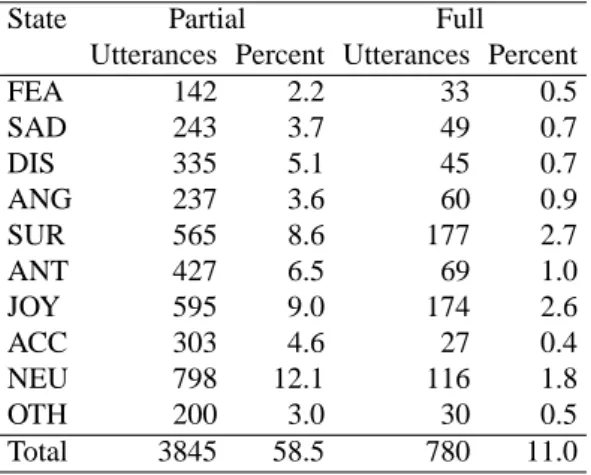
Table 3: Results of emotion labeling. The percentages were calculated by dividing the number of utterances cor-responding to each emotional state by the total number of utterances. The total number of utterances was 6578.
State Partial Full
Utterances Percent Utterances Percent
FEA 142 2.2 33 0.5 SAD 243 3.7 49 0.7 DIS 335 5.1 45 0.7 ANG 237 3.6 60 0.9 SUR 565 8.6 177 2.7 ANT 427 6.5 69 1.0 JOY 595 9.0 174 2.6 ACC 303 4.6 27 0.4 NEU 798 12.1 116 1.8 OTH 200 3.0 30 0.5 Total 3845 58.5 780 11.0
in a random order to each rater. The raters were instructed to rate the emotional intensity of each utterance on a five-point scale from 1 (weak) to 5 (strong).
2.3.
Analysis
Two types of agreement among the three label evaluations were calculated: partial agreement (two out of three label-ers agreed on one emotion) and full agreement (all three labelers agreed on one emotion). Moreover, the mean cor-relation coefficient among the 18 raters was calculated. To assess the efficiency of our data collection scheme for authentic emotional speech, the number of labeled in-stances among our speech materials was compared with those of two other sets of speech materials. One of these consists of spontaneous pseudodialogs for angry speech classification (Ang et al., 2002), and the other is a speech database for paralinguistic information studies, the Ut-sunomiya University Spoken Dialogue Database for Par-alinguistic Information Studies (UUDB) (Mori, 2008). The emotion labeling rate was calculated by dividing the num-ber of emotion labels by the total numnum-ber of labels, in ac-cordance with (Ang et al., 2002). Note that the labeling schemes for the three sets of materials are not completely the same and that the calculation was performed for the sake of comparison among them. Each utterance in the
an-gry speech material set (Ang et al., 2002) is labeled with one of 7 emotional state labels: neutral, annoyed, frus-trated, tired, amused, other, or not applicable (containing no speech data from the user). Utterances with the annoyed, frustrated, tired, amused, and other labels were regarded as emotional utterances for the comparison. The utterances in the UUDB are not labeled with single emotional states. Instead, they are rated on a seven-point scale for each of six paralinguistic information values: pleasant–unpleasant, aroused–sleepy, dominant–submissive, credible–doubtful, interested–indifferent, and positive–negative. The utter-ances are all associated with six paralinguistic information values; hence, a nonemotional state is never assessed. To compare the emotion labeling rates between our speech materials and the UUDB, the UUDB utterances rated with scores from 3 to 5 (weak or none) for all 6 values were regarded as nonemotional utterances, and the rest were re-garded as emotional utterances. Aχ2test was conducted to compare the emotion labeling rates among the three speech material sets.
2.4.
Results
Table 3 shows the numbers of utterances exhibiting the two types of interlabeler agreement. The number of utter-ances with partial agreement is 3,845, and the number of utterances with full agreement is 780. The partial and full agreement rates are58.5% (chance level: 28%) and 11.0%
(chance level:1%), respectively.
The mean correlation coefficient among the 18 raters is 0.24 (range = −0.01 – 0.52). The range of correlation
coeffi-cients among the 18 raters is widely spread, indicating that the criteria used to rate emotional intensity were different among the raters.
Figure 2 shows the frequency of emotion labels in each set of speech materials. Theχ2test revealed a significant difference among the three speech material sets (χ2(2) = 27659.87, p < 0.001). Our speech material set has a
sig-nificantly higher emotion labeling rate than the other two (p < 0.01, indicated by asterisks in Fig. 2).
2.5.
Discussion
Quite high agreement rates were obtained for both partial and full agreement. The partial and full agreement rates are58.5% and 11.0%, respectively, which are much higher
0 2 0 4 0 6 0 8 0 1 0 0
This material UUDB Ang et al. (2002)
***
***
Emotional Nonemotional F re q u e n cy o f la b e ls ( % )Figure 2: Frequencies of emotional labels. and1%, respectively). The results suggest that the labelers
could perceive the same emotions from the recorded utter-ances. This implies that the emotional speech collected via the proposed approach is perceptually distinguishable for listeners.
The χ2 test revealed a significant difference among the three sets of speech materials (χ2(2) = 27659.87, p < 0.001). Our speech material set has a significantly higher
emotion labeling rate than the other two. The total number of labeling instances in our speech material set is 19,734 labels (6,578 utterances× three labelers). Among them, 14,414 labels are emotional labels corresponding to the eight types of emotional state; consequently, a very high percentage, 73.0%, of the total labeling instances have
emotional labels. The total number of labeling instances in the speech material set of Ang et al. (Ang et al., 2002) is 49,553; these instances were judged by 2.62 mean labelers per utterance and include 4,904 emotional labels. The cor-responding emotion labeling rate is thus quite low,9.9%.
The UUDB has 14,520 labels assigned by three labelers. Of these labels,58.2% (8,446 labels) are emotional labels.
These results imply that the proposed collection scheme can yield a relatively high percentage of emotional speech that is perceptually distinguishable by listeners.
The speech materials with emotion labels recorded via the proposed collection scheme are publicly available from the distributor, NII–SRC, as the Online Gaming Voice Chat Corpus with Emotional Label (OGVC) (Arimoto and Kawatsu, 2013).
3.
Cross-corpus Emotion Labeling
To elucidate appropriate emotion labels for emotional speech and to standardize the emotion labels among sev-eral corpora, we investigated the relationship between two well-known types of emotion labels, i. e., emotion cat-egories and emotion dimensions. Using two publicly available Japanese dialog speech corpora with emotion bels, we conducted cross-corpus emotion labeling to la-bel the utterances in the two corpora with both emotion category labels and emotion dimension labels. The con-tent of this section is a rewrite of the conference paper (Arimoto and Mori, 2017).3.1.
Speech Materials
Two publicly available Japanese dialog speech corpora were used for this research: the OGVC (Arimoto and Kawatsu, 2013) and the UUDB (Mori, 2008).
The UUDB is a collection of natural, spontaneous dialogs from Japanese college students. The participants engaged in a “four-frame cartoon sorting” task, in which four cards, each containing one frame extracted from a cartoon, are shuffled and each participant is given two cards out of the four and is asked to estimate their original order without looking at the remaining cards. The current release of the UUDB includes dialogs from seven pairs of college stu-dents (12 females and 2 males), comprising 4,840 utter-ances. An utterance is defined as a continuous speech seg-ment bounded by either silence (> 400 ms) or slash unit
boundaries. For all utterances, the perceived emotional states of the speakers are provided. The emotional states are annotated with the following six abstract dimensions:
• pleasant–unpleasant • aroused–sleepy • dominant–submissive • credible–doubtful • interested–indifferent • positive–negative
The emotional state corresponding to each utterance is eval-uated on a seven-point scale for each dimension. On the pleasant–unpleasant scale, for example, 1 corresponds to extremely unpleasant; 4, to neutral; and 7, to extremely pleasant. All 4,840 utterances were used in this experiment.
3.2.
Procedure
The two corpora used in this study have different types of emotion labels; consequently, they cannot be used to-gether for any research in their original forms. Therefore, in this experiment, the emotion labels included in the orig-inal corpora were discarded, and all utterances in both cor-pora were newly labeled with emotion categories and emo-tion dimensions to obtain common emoemo-tion labels across the two corpora.
Three qualified labelers, selected via a previously per-formed labeler screening process, perper-formed the cross-corpus emotion labeling. The mean age of the three labelers was 22 years (SD = 0.82).
The emotion labeling frameworks for both emotion cat-egory labeling and emotion dimension labeling were the same as those used in the construction of the two original corpora. For emotion category labeling, the labelers were instructed to choose one of 10 categories (JOY, ACC, FEA, SUR, SAD, DIS, ANG, ANT, NEU, and OTH) for each utterance. The ground-truth label for each utterance was determined by majority vote among the labelers. For emo-tion dimension labeling, the labelers were instructed to rate each of the six emotion dimensions on a seven-point scale for each utterance. The ground-truth label for each emotion dimension for each utterance was defined as the mean score among the labelers. Each labeler performed both the emo-tion category and emoemo-tion dimension labeling tasks. The emotion dimension labeling task preceded the emotion cat-egory labeling task.
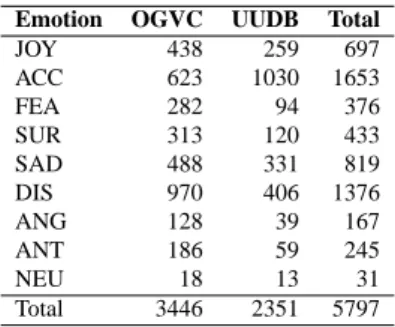
Table 4: The number of utterances in each emotion cate-gory.
Emotion OGVC UUDB Total
JOY 438 259 697 ACC 623 1030 1653 FEA 282 94 376 SUR 313 120 433 SAD 488 331 819 DIS 970 406 1376 ANG 128 39 167 ANT 186 59 245 NEU 18 13 31 Total 3446 2351 5797
Each labeler evaluated a total of 11,418 utterances from the OGVC and the UUDB (6,578 from the OGVC and 4,840 from the UUDB). The 11,418 utterances were randomly separated into blocks. The cross-corpus emotion labeling was performed in 104 blocks for 11,418 utterances × 2 types of labeling (category and dimension).
3.3.
Analysis
To assess the independence of each emotion category from the others in an n-dimensional emotional space,
equiva-lence tests between twon-dimensional Gaussian mixture
models (GMMs) were conducted. For each pair of emotion categoriesE1andE2, then-dimensional variables X1and X2belonging to each category were assumed to be gener-ated from their corresponding GMMs. Letx1 andx2 de-note the subdatasets belonging toE1andE2, respectively, andN1andN2denote the respective data sizes. The null hypothesis (H0) and the alternative hypothesis (H1) are as follows:
H0: All instances ofX1are generated from a GMMM1, and all instances of X2 are generated from a GMM M2that is identical toM1.
H1: All instances ofX1are generated from a GMMM1, and all instances of X2 are generated from a GMM M2that differs fromM1.
The null hypothesis can be tested using a parametric boot-strap likelihood ratio test, in which the distribution of the difference of the deviances (−2 times the log likelihood ratio) between the null model (M1 andM2 are trained as identical models on random samples with a data size of
N1+N2) and the alternative model (M1andM2are trained separately on random samples with a data size ofN1and random samples with a data size ofN2, respectively) is es-timated via random sampling underH0. If the difference of the deviances between the null model (identical GMMs trained on x1 + x2) and the alternative model (GMMs trained separately onx1andx2) falls into the critical region (α = 5%), then the null hypothesis is rejected, and the two
emotion categories are considered to be independently dis-tributed in then-dimensional emotional space. Such
likeli-hood ratio tests were conducted for all combinations of the nine emotion categories.
3.4.
Results
Table 4 shows the number of utterances in each emotional category identified as a result of the emotion category
la-Table 5: Differences in deviances between emotion cate-gories mapped to a three-dimensional emotional space.
ACC FEA SUR SAD DIS ANG ANT NEU JOY 1187.3∗ 762.7∗ 680.1∗ 1406.7∗ 1660.8∗ 679.6∗ 178.0∗ 159.1∗ ACC 501.8∗ 585.3∗ 1248.5∗ 1169.5∗ 765.3∗ 368.4∗ 367.2∗ FEA 98.3∗ 342.9∗ 123.7∗ 215.2∗ 268.4∗ 41.7∗ SUR 802.0∗ 482.7∗ 287.7∗ 253.2∗ 31.0 SAD 534.4∗ 603.8∗ 678.8∗ 38.2 DIS 108.6∗ 463.0∗ 11.6 ANG 361.6∗ 101.6∗ ANT 99.8∗
beling process. The total number of utterances for which two out of the three labelers agreed on one emotion label is 5,797 (3,446 for the OGVC and 2,351 for the UUDB), corresponding to 51% of the total utterances subjected to cross-corpus labeling (52% of the OGVC utterances and 49% of the UUDB utterances). The emotions assigned to the highest numbers of utterances, in descending order, are ACC, DIS, JOY and SAD. Following emotion category la-beling, these 5,797 utterances were used in the analysis of the mapping of the emotion categories to n-dimensional
emotional spaces.
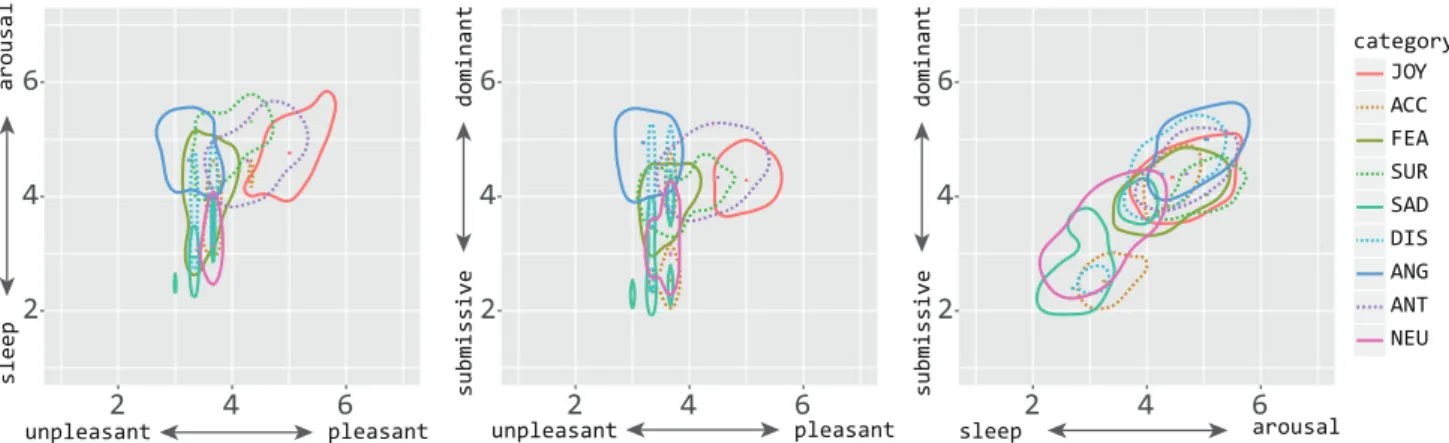
Figure 3 shows the distributions of the emotion categories in the two-dimensional emotional spaces of arousal vs. pleasantness, dominance vs. pleasantness, and dominance vs. arousal. Table 5 shows the differences in the deviances between the emotion categories when mapped to the corre-sponding three-dimensional emotional space. The asterisks in Table 5 indicate the combinations of emotion categories for which the hypothesisH0 is rejected and the hypothe-sisH1 is accepted (p < 0.05). For many combinations of emotion categories,H0is rejected;H0was not rejected in only three tests, namely, for NEU when testing with SUR, SAD, and DIS.
3.5.
Discussion
In the pleasantness vs. arousal space shown in the left panel of Fig. 3, JOY (the solid red line in Fig. 3) is placed in the upper right quadrant, corresponding to high arousal and high pleasantness; SUR (dashed green line) corresponds to high arousal; SAD (solid green line) corresponds to low arousal; and ANG (solid blue line) lies in the up-per left, corresponding to high arousal and low pleasant-ness. These distributions are similar to Russell’s circum-plex model (Russell, 1980). The results also show that NEU (solid purple line) lies near 4 on the pleasantness axis but between 2 and 4 on both the arousal and dominance axes. NEU is generally considered to be an emotionally neutral state, which should correspond to a score of 4 in any emotion dimension. However, our results imply that neutral utterances are neutral in the pleasantness dimension but are not necessarily neutral in the other dimensions. The results of the likelihood ratio tests on the distributions of the emotion categories in the three-dimensional emo-tional space suggest that all pairs of emotion categories ex-cept NEU–SUR, NEU–SAD, and NEU–DIS exhibit signif-icant differences between each other (p < 0.05). In other
words, all emotion categories except NEU are independent of each other. This finding suggests that the information of the eight emotion categories (JOY, ACC, FEA, SUR, SAD, DIS, ANG, and ANT) is not lost even in the emotion
di-2 4 6 2 4 6 2 4 6 2 4 6 pleasant 2 4 6 2 4 6 arousal d o m i n a n t category JOY ACC FEA SUR SAD DIS ANG ANT NEU sleep unpleasant s u b m i s s i v e a r o u s a l s l e e p d o m i n a n t s u b m i s s i v e pleasant unpleasant
Figure 3: Distributions of emotion categories in two-dimensional emotional spaces. mension representation.
4.
Conclusions
For the efficient collection of emotional speech, a collection scheme based on an online game task and a voice chat sys-tem was developed, and its results were assessed by com-parison with other emotional speech materials. Aχ2test re-vealed that by using the proposed collection scheme, emo-tionally expressive speech can be efficiently collected. To elucidate appropriate emotion labels for emotional speech and to commonize emotion labels among several corpora, we first studied the relationship between emotion categories and emotion dimensions. Using two Japanese dialog speech corpora with emotion labels, cross-corpus emotion labeling was conducted to label the utterances in the two corpora with both emotion category labels and emo-tion dimension labels. Then, likelihood ratio tests were conducted to assess the independence of each emotion cat-egory from the others in a three-dimensional emotional space.
The tests revealed that all pairs of emotion categories ex-cept neutral–surprise, neutral–sadness, and neutral–disgust exhibit significant differences between each other. Thus, all emotion categories except neutral are independent of each other in the dimensional emotional space.
These results suggest the surprising conclusion that the in-formation of the eight emotion categories, including joy, acceptance, fear, surprise, sadness, disgust, anger, and an-ticipation, is not lost even in the emotion dimension rep-resentation. However, future research with other speech corpora in different languages may yield different results, because emotion perception heavily depends on language, culture and social norms. The universal standardization of emotion labeling can be accomplished only after examin-ing the lexamin-inguistic differences, cultural differences, and so-cial differences that must be encompassed by standardized emotion labels.
5.
Acknowledgments
This work was supported by a TATEISHI Science and Technology Foundation Grant for Research (A) and by JSPS KAKENHI Grant Number 17K00160. I would like to express my sincere appreciation to my collaborators, Dr. Hiromi Kawatsu from IBM and Prof. Hiroki Mori from Utsunomiya University.
6.
Bibliographical References
Anderson, C. a. and Bushman, B. J. (2001). Effects of violent video games on aggressive behavior, aggressive cognition, aggressive affect, physiological arousal, and prosocial behavior: a meta-analytic review of the scien-tific literature. Psychological science, 12(5):353–9, sep. Ang, J., Dhillon, R., Krupski, A., Shriberg, E., and Stol-cke, A. (2002). Prosody-Based Automatic Detection Of Annoyance And Frustration In Human-Computer Dia-log. In Proceedings of ICSLP 2002, pages 2037–2040. in Proc. ICSLP 2002.
Arimoto, Y. and Mori, H. (2017). Emotion category map-ping to emotional space by cross-corpus emotion label-ing. In Proceedings of Interspeech 2017, pages 3276– 3280.
Arimoto, Y., Ohno, S., and Iida, H. (2007). An Esti-mation Method of Degree of Speaker’s Anger Emotion with Acoustic and Linguistic Features. Journal of
natu-ral language processing, 14(3):147–163. (in Japanese).
Arimoto, Y., Kawatsu, H., Ohno, S., and Iida, H. (2008). Emotion recognition in spontaneous emotional speech for anonymity-protected voice chat systems. In
Proceed-ings of Interspeech 2008, pages 322–325.
Arimoto, Y., Kawatsu, H., Ohno, S., and Iida, H. (2012). Naturalistic emotional speech collection paradigm with online game and its psychological and acoustical assess-ment. Acoustical Science and Technology, 33(6):359– 369.
Banse, R. and Scherer, K. R. (1996). Acoustic profiles in vocal emotion expression. Journal of Personality and
Social Psychology, 70(3):614–636.
Batliner, A., Fischer, K., Huber, R., Spilker, J., and N¨oth, E. (2003). How to find trouble in communication. Speech
Communication, 40(1-2):117–143, apr.
Batliner, A., Steidl, S., Schuller, B., Seppi, D., Vogt, T., Wagner, J., Devillers, L., Vidrascu, L., Aharonson, V., and Kessous, L. (2011). Whodunnit - Searching for the most important feature types signalling emotion-related user states in speech. Computer Speech & Language, 25(1):4–28, jan.
Campbell, N. (2004). Speech & Expression ; the Value of a Longitudinal Corpus The JST ESP corpus. In LREC
2004.
realis-tic understanding of the task. Philosophical transactions
of the Royal Society of London. Series B, Biological sci-ences, 364(1535):3515–25, dec.
Devillers, L., Vidrascu, L., and Bp, L.-c. (2006). Real-life emotions detection with lexical and paralinguistic cues on Human-Human call center dialogs. In Interspeech
2006., pages 801–804.
Douglas-Cowie, E. (2003). Emotional speech: Towards a new generation of databases. Speech Communication, 40(1-2):33–60, apr.
Ekman, P. and Friesen, W. V. (1975). Unmasking the Face:
A Guide to Recognizing Emotions From Facial Expres-sions. Prentice Hall, New Jersey.
Engberg, I. S., Hansen, A. V., Andersen, O., and Dalsgaard, P. (1997). Design, Recording and Verification of a Dan-ish Emotional Speech Database. In Proceedings of
Eu-rospeech 1997, volume 4, pages 1695 – 1698.
Hazlett, R. and Benedek, J. (2007). Measuring emo-tional valence to understand the user’s experience of soft-ware. International Journal of Human-Computer
Stud-ies, 65(4):306–314, apr.
Hazlett, R. L. (2006). Measuring emotional valence during interactive experiences. In Proceedings of the SIGCHI
conference on Human Factors in computing systems -CHI ’06, pages 1023–1026, New York, New York, USA,
apr. ACM Press.
Itoh, K. (1986). A basic study on voice sound involving emotion. III. Non-stationary analysis of single vowel [e].
The Japanese journal of ergonomics, 22(4):211–217.
J¨urgens, R., Hammerschmidt, K., and Fischer, J. (2011). Authentic and play-acted vocal emotion expressions reveal acoustic differences. Frontiers in psychology, 2(July):180, jan.
Kitahara, Y. (1988). Prosodic components of speech in the expression of emotions. The Journal of the Acoustical
Society of America, 84(S1):S98–S99, nov.
Litman, D. and Forbesriley, K. (2006). Recognizing stu-dent emotions and attitudes on the basis of utterances in spoken tutoring dialogues with both human and com-puter tutors. Speech Communication, 48(5):559–590, may.
Mori, H., Satake, T., Nakamura, M., and Kasuya, H. (2011). Constructing a spoken dialogue corpus for studying paralinguistic information in expressive conver-sation and analyzing its statistical/acoustic characteris-tics. Speech Communication, 53(1):36–50, aug.
Plutchik, R. (1980). Emotions: A psychoevolutionary
syn-thesis. Harper & Row, New York.
Ravaja, N., Turpeinen, M., Saari, T., Puttonen, S., and Keltikangas-J¨arvinen, L. (2008). The psychophysiol-ogy of James Bond: phasic emotional responses to vi-olent video game events. Emotion (Washington, D.C.), 8(1):114–20, feb.
Russell, J. A. (1980). A circumplex model of affect.
Jour-nal of PersoJour-nality and Social Psychology, 39(6):1161–
1178.
Schuller, B., Vlasenko, B., Eyben, F., Rigoll, G., and Wen-demuth, A. (2009). Acoustic emotion recognition: A benchmark comparison of performances. Proceedings of
the 2009 IEEE Workshop on Automatic Speech Recogni-tion and Understanding, ASRU 2009, pages 552–557.
Schuller, B., Vlasenko, B., Eyben, F., W¨ollmer, M., Stuhlsatz, A., Wendemuth, A., and Rigoll, G. (2010). Cross-Corpus acoustic emotion recognition: Variances and strategies. IEEE Transactions on Affective
Comput-ing, 1(2):119–131.
Schuller, B., Zhang, Z., Weninger, F., and Burkhardt, F. (2012). Synthesized speech for model training in cross-corpus recognition of human emotion. International
Journal of Speech Technology, 15(3):313–323.
Song, P., Zheng, W., Ou, S., Zhang, X., Jin, Y., Liu, J., and Yu, Y. (2016). Cross-corpus speech emotion recogni-tion based on transfer non-negative matrix factorizarecogni-tion.
Speech Communication, 83:34–41.
Tijs, T., Brokken, D., and Ijsselsteijn, W. (2008). Cre-ating an Emotionally Adaptive Game. In S M Stevens et al., editors, Proceedings of the 7th International
Con-ference on Entertainment Computing, volume 5309 of LNCS 5309, pages 122–133. Springer-Verlag.
van’t Wout, M., Kahn, R. S., Sanfey, A. G., and Ale-man, A. (2006). Affective state and decision-making in the Ultimatum Game. Experimental brain research.
Ex-perimentelle Hirnforschung. Exp´erimentation c´er´ebrale,
169(4):564–8, mar.
Williams, C. E. (1972). Emotions and Speech: Some Acoustical Correlates. The Journal of the Acoustical
So-ciety of America, 52(4B):1238–1250, oct.
Yamada, T., Shibata, T., Kuramochi, Y., and Yamada, A. (2005). Shin meikai kokugo jiten. Sanseido, Tokyo, 6 edition. (in Japanese).
Zeng, Z., Pantic, M., Roisman, G. I., and Huang, T. S. (2009). A Survey of Affect Recognition Methods: Au-dio, Visual, and Spontaneous Expressions. IEEE
trans-actions on pattern analysis and machine intelligence,
31(1):39–58.
Zhang, Z., Weninger, F., W¨ollmer, M., and Schuller, B. (2011). Unsupervised learning in cross-corpus acous-tic emotion recognition. 2011 IEEE Workshop on
Au-tomatic Speech Recognition and Understanding, ASRU 2011, Proceedings, pages 523–528.
Zong, Y., Zheng, W., Zhang, T., and Huang, X. (2016). Cross-Corpus Speech Emotion Recognition Based on Domain-Adaptive Least-Squares Regression. IEEE
Sig-nal Processing Letters, 23(5):585–589, may.
7.
Language Resource References
Arimoto, Yoshiko and Kawatsu, Hiromi. (2013). Onlinegaming voice chat corpus with emotional label (OGVC).
Speech Resource Consortium, National Institute of In-formatics, ISLRN 648-310-192-037-7.
Mori, Hiroki. (2008). Utsunomiya University Spoken
Di-alogue Database for Paralinguistic Information Studies (UUDB). Speech Resource Consortium, National
Construction of a Corpus of Elderly Japanese Speech
for Analysis and Recognition
Norihide Kitaoka
1, Yurie Iribe
2and Hiromitsu Nishizaki
3 1Department of Computer Science, Tokushima University,2-1 Minamijohsanjima, Tokushima, Japan
2School of Information Science and Technology, Aichi Prefectural University,
1522-3 Ibaragabasama, Nagakute-shi, Aichi, Japan
3Graduate School of Interdisciplinary Research, Faculty of Engineering, University of Yamanashi,
4-3-11 Takeda, Kofu-shi, Yamanashi, Japan
[email protected], [email protected], [email protected]
Abstract
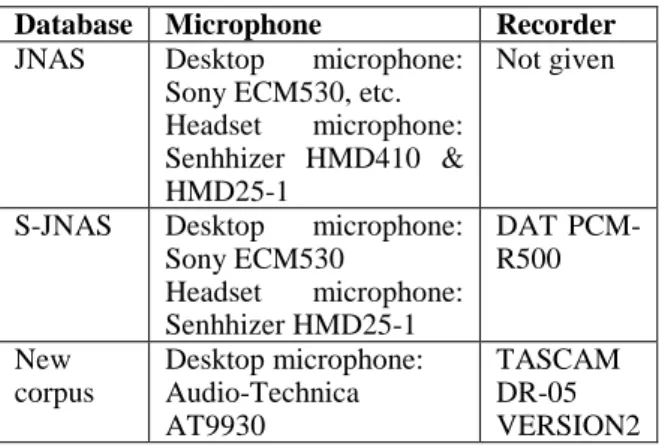
We have constructed a new speech data corpus using the utterances of 100 elderly Japanese people, in order to improve the accuracy of automatic recognition of the speech of older people. Humanoid robots are being developed for use in elder care nursing facilities because interaction with such robots is expected to help clients maintain their cognitive abilities, as well as provide them with companionship. In order for these robots to interact with the elderly through spoken dialogue, a high performance speech recognition system for the speech of elderly people is needed. To develop such a system, we recorded speech uttered by 100 elderly Japanese who had an average age of 77.2, most of them living in nursing homes. Another corpus of elderly Japanese speech called S-JNAS (Seniors-Japanese Newspaper Article Sentences) has been developed previously, but the average age of the participants was 67.6. Since the target age for nursing home care is around 75, much higher than that of most of the S-JNAS samples, we felt a more representative corpus was needed. In this study we compare the performance of our new corpus with both the Japanese read speech corpus JNAS (Japanese Newspaper Article Speech), which consists of adult speech, and with the S-JNAS, the senior version of JNAS, by conducting speech recognition experiments. Data from the JNAS, S-JNAS and CSJ (Corpus of Spontaneous Japanese) was used as training data for the acoustic models, respectively. We then used our new corpus to adapt the acoustic models to elderly speech, but we were unable to achieve sufficient performance when attempting to recognize elderly speech. Based on our experimental results, we believe that development of a corpus of spontaneous elderly speech and/or special acoustic adaptation methods will likely be necessary to improve the recognition performance of dialog systems for the elderly.
Keywords: elderly speech corpus, nursing home care, speech corpus construction, speech recognition, companion robots
1. Introduction
Previous research suggests that elderly people have more difficulty using information and communication technology (ICT) than younger adults (Júdice, 2010). The main reasons for this are the complexity of existing user interfaces, lack of familiarity with ICT on the part of many elderly and the limited set of available interaction modalities, since this technology is mainly designed with younger users in mind. Hence, adapting the technology to better suit the needs of the elderly, for instance by increasing the choice of available interaction modalities, will help ensure that the elderly have access to these technologies. Previous research suggests that speech is the easiest and most natural modality for human-computer interaction (HCI) (Acartürk, 2015). Speech is also the preferred modality for interacting with mobile devices when users have permanent impairments such as arthritis, or when temporary limitations such as driving or carrying objects make it difficult to use other modalities such as touch.
It is hoped that ICT can be used to help maintain the health of the elderly. Daily verbal interaction helps them maintain their cognitive ability, reducing the risk of dementia, and may also ease loneliness. In a super-aging society such as Japan, where we face an acute shortage of care workers, spoken dialogue systems could play an important role.
However, the speech recognizers which would need to be used in interfaces such as spoken dialogue systems do not currently work well for elderly users. A mismatch between the acoustic model and the acoustic characteristics of user speech is one factor which reduces speech recognition accuracy. Some studies have found differences in the acoustic characteristics of the speech of the elderly and that of younger people (Winkler, 2003). In particular, elderly speech frequently contains inarticulate speech, which occurs when the speaker does not fully open the mouth. Additionally, acoustic models are often constructed using the speech of adults, excluding the aged. As a result, it has been reported that deterioration in speech recognition accuracy with elderly users is caused by mismatches between acoustic models and the acoustic characteristics of elderly speech (Anderson, 1999; Baba, 2001; Vipperla, 2008). Therefore, it is important to construct an acoustic model which takes into account the characteristics of elderly speech, in order to improve the speech recognition accuracy of speech applications designed for the elderly. To address this problem, we have constructed a new speech data corpus using the utterances of 100 elderly Japanese people in three age categories; the young-old, old-old and oldest-old, in order to improve recognition of the speech of the elderly. In this study we compare the characteristics of our new corpus with those of two other speech databases which have been used to construct acoustic models in Japan