Abstract
This is a quasi-experimental study of the effects of timed and repeated reading on reading fluency and TOEIC scores over one academic year. The participants ( = 38) were divided into two groups. The treatment group, which composed of first-year students, did timed reading and repeated reading twice a week for 20 weeks. The control group consisted of third-year advanced level students in the normal curriculum. The findings indicated that (a) the combination of timed and repeated reading effectively improved reading rate while comprehension levels remained high; (b) the treatment group outperformed the control group in terms of reading rate by the end of the treatment period; and (c) reading rate can be a useful predictor of both reading and listening TOEIC scores. Thus, timed and repeated readings are of great benefit to second language (L2) learners.
: Reading fluency, timed reading, repeated reading, reading rate, reading comprehension, TOEIC
Introduction
Fluency is an important aspect of second language (L2) learning and varying degrees can be manifested in the four main language skills of speaking, listening, reading, and writing for L2 learners. The ability to read fluently in both real-world and academic contexts is highly beneficial for L2 learners for a multitude of reasons. In the digital information age, where learners have access to a wealth of information in English from Internet news sites, message forums, and social media, there is a growing need for learners to process texts quickly and efficiently. Likewise, in academic settings, learners often have to read literature, reports, and research in a second language and effective L2 literacy helps them accomplish their goals and further their aims. Moreover, numerous Japanese L2 learners take standardized English tests such as the TOEIC, TOEFL, EIKEN, or university entrance exams, all of which have English reading
Torrin R. Shimono
sections with limited time to complete them. Thus, being able to read faster in the L2 promotes higher test scores and academic success.
While it is clear that reading fluency is a necessary skill, many L2 learners are not fluent readers and this problem persists among Japanese learners. One of the root causes can be attributed to the way reading in English has been taught in Japanese junior and senior high schools. While communicative language teaching has gained momentum in recent years, reading has often been taught for the purpose of grammar explanations and vocabulary building with a noticeable lack of reading materials that promote fluency (Gorsuch, 1998). In many cases, there are often too many unknown words in high school textbooks that ultimately hinder the ability for learners to read smoothly (Browne, 1998). The net result is an unorthodox, unnatural, and inefficient way of reading as Takase (2003) noted some learners read English sentences backwards to make the syntax more compatible with Japanese. As a result, even advanced L2 students might only read 100 words per minute (wpm) or less after a reading course (Jensen, 1986). It has also been found that reading speeds of less than 100 wpm can negatively affect comprehension as too slow of speeds hinder memory retention and concentration (Nation, 2005). To break this unorthodox style of reading, Nation (2005) also noted in promoting fluency, it is important to give learners the chance to make best use of known vocabulary and grammatical structures at every level of the learning process. Therefore, Grabe (2010) has recommended activities such as timed reading and repeated reading in class. The purpose of this study, then, is to examine the effects of timed and repeated reading on reading fluency among Japanese university learners of English and how reading fluency could be predictive of TOEIC scores.
Literature Review
Reading fluency has been defined as the ability to read rapidly with ease and accuracy.... It involves a long incremental process, and text comprehension is an expected outcome of fluent reading (Grabe, 2009, p. 291). In other words, fluent readers can comprehend a text s meaning smoothly and effortlessly at an appropriate rate. (Yamashita & Ishikawa, 2010, p. 264). By reading faster, L2 learners can actually comprehend more because of an increased focus. Reading too slowly, in contrast,
increases the likelihood of being distracted which can have adverse effects on concentration and short-term memory (Breznitz, 1988). Thus, fluent reading reflects the automaticity of word recognition which has been described as fast, effortless, spontaneous, and errorless (DeKeyser, 2007).
Timed reading is one type of activity designed to promote reading fluency. Learners read relatively short passages that use predominantly highly frequent English words. The passages are approximately equal in length and difficulty and are practiced regularly over weeks or months for the primary purpose of increasing reading fluency (Champeau de López, 1993). Learners monitor their reading rate by timing how long it takes to complete a given passage. The reading is usually followed by comprehension questions. The time pressure placed on the learners to perform faster promotes reading fluency and fosters the development of automatic of word recognition. Nation (2007) described this pressure as the encouragement to perform at a faster than usual speed (p. 7).
Moreover, when using timed reading to develop fluency, Nation (2009) emphasized that there should be little or no unknown vocabulary or grammatical features (p. 2). Hu and Nation (2000) clarified this idea and proposed that knowledge of at least 98% of the vocabulary in a text is necessary for unassisted comprehension. As for comprehension, a minimum of a 70% level of understanding should be the target in L2/FL reading (Quinn, Nation, & Millett, 2007). While reading speeds vary with the difficulty of texts and under various conditions, a good careful silent reading speed is around 250 words per minute, and this is a reasonable [goal] for foreign and second language learners who are reading material that contains no unknown vocabulary and grammar (Nation, 2009, p. 72).
Just as the name suggests, repeated reading is where students read a passage repeatedly as a way to practice and speed up their word recognition skills while improving their accuracy or reducing the number of errors. The method was devised by L1 researcher Samuels (1979) as a way to put the theory of automatic information processing in reading (LaBerge & Samuels, 1974) into real-world practice. Consistent
repetition of the same words would induce word recognition, so struggling readers could then direct their attention and cognitive energy to the text s meaning. Thus, reading fluency is developed because of a transfer of practice effect to new texts (Dowhower, 1987).
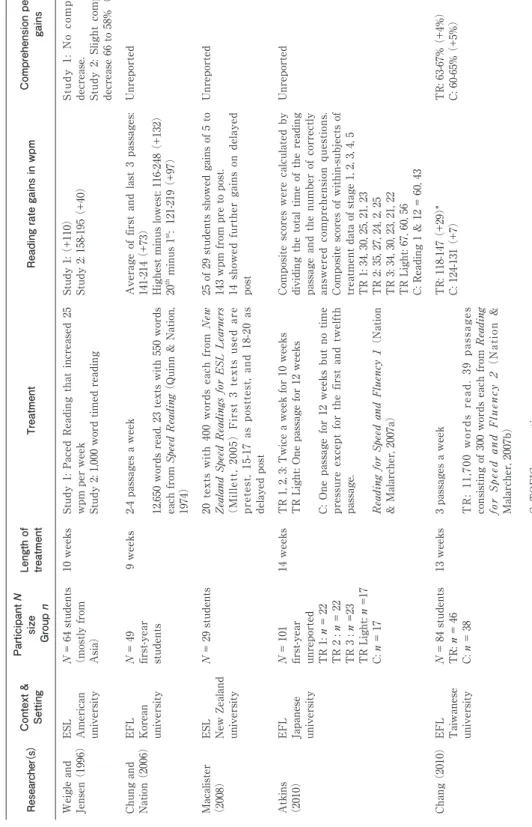
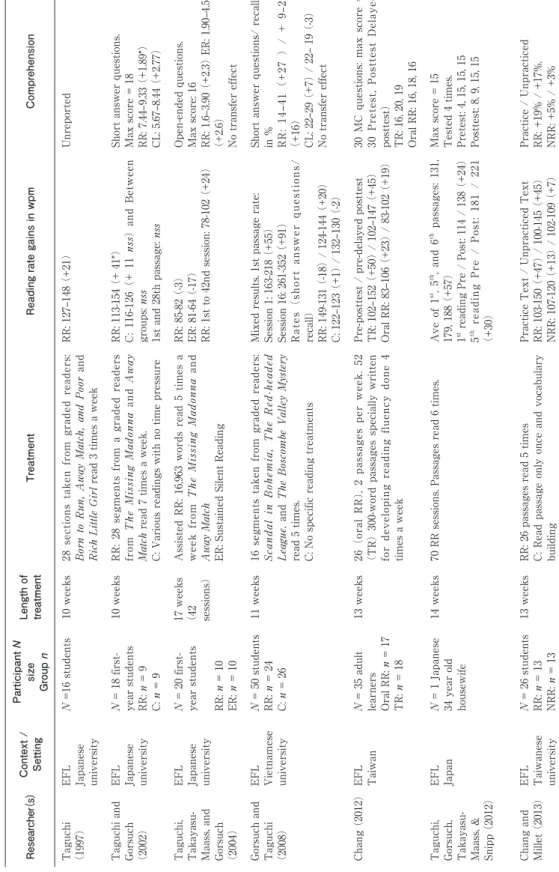
L2 reading fluency has been a growing area of research in the last 20 years in the field of second language acquisition. Table 1 shows studies that have used timed reading and reported reading fluency gains. Table 2 depicts studies repeated reading studies that have reported fluency gains. An overview of these studies indicates that longitudinal reading fluency treatments utilizing timed and repeated reading is conducive to fluency growth. Most noticeably, reading rate gains ranging from 21 to 132 wpm have been observed in a relatively short period of time. Unfortunately, numerous studies do not report comprehension (e.g., Atkins, 2010; Chung & Nation, 2006; Macalister, 2008, 2010; Taguchi, 1997) or participants scored below the 70% comprehension threshold (e.g., Chang, 2010; 2012; Chang & Millet, 2013; Underwood et al., 2012). Also, many of these studies have reporting problems where information about the participants proficiency is lacking (e.g., Atkins, 2010; Chung & Nation, 2006; Tran, 2012). Nearly all studies do not report the exact time on task or explicitly state the amount of words read during the treatment, thereby obscuring key independent variables.
Table 1. Res
ear
ch
er(
s)
Context & Setting
Participant
size
Group
Length of treatment
Treatment
Reading rate gains in wpm
Comprehension percentage
gains
Weigle and Jensen
(
1996
)
ESL American university = 64 students (mostly from Asia
) 10 weeks Study 1: Paced Reading that increased 25
wpm per week Study 2: 1,000 word timed reading
Study 1: ( +110 ) Study 2: 158-195 ( +40 ) Stu dy 1: No com prehe nsi on decrease. Study 2: Slight comprehension decrease 66 to 58% ( -8% )
Chung and Nation
(
2006
)
EFL Korean university = 49 first-year students 9 weeks 2-4 passages a week 12,650 words read. 23 texts with 550 words each from ( Quinn & Nation, 1974 ) Average of first and last 3 passages: 141-214 ( +73 )
Highest minus lowest: 116-248
( +132 ) 20 th minus 1 st: 121-219 ( +97 ) Unreported Macalister (2008 )
ESL New Zealand university
= 29 students 20 texts with 400 words each from ( Millett, 2005 ) First 3 texts used are pretest, 15-17 as posttest, and 18-20 as delayed post 25 of 29 students showed gains of 5 to
143 wpm from pre to post. 14
showed further gains on delayed post Unreported Atkins (2010 )
EFL Japanese university
= 101 first-year unreported TR 1: = 22 TR 2 : = 22 TR 3 : =23 TR Light: =17 C: = 17
14 weeks
TR 1, 2, 3: Twice a week for 10 weeks TR Light: One passage for 12 weeks C: O
ne pas sa ge f or 1 2 we eks bu t no t im e pressure except for the first and twelfth passage. ( Nation
& Malarcher, 2007a
) Composite scores were calculated by dividing the total time of the reading passage and the number of correctly answered comprehension questions. Composite scores of within-subjects of
treatment data of stage 1, 2, 3, 4, 5 TR 1: 34, 30, 25, 21, 23 TR 2: 35, 27, 24, 2, 25 TR 3: 34, 30, 23, 21, 22 TR Light: 67, 60, 56 C: Reading 1 & 12 = 60, 43
Unreported
Chang
(
2010
)
EFL Taiwanese university = 84 students TR: = 46 C: = 38 13 weeks 3 passages a week TR: 11,700 words read. 39 passages consisting of 300 words each from (Na tio n & Malarcher, 2007b ) C: TOEIC preparation TR: 118-147 ( +29 )* C: 124-131 ( +7 ) TR: 63-67% ( +4% ) C: 60-65% ( +5% )
Macalister (2010
)
ESL New Zealand university = 36 students TR: = 24 ER: = 12 5 weeks TR: 20 texts from New Zealand Speed Readings for ESL Learners ( First and last 3 texts used are pre and posttests ), Book Two ( Millett, 2005 ) ; ER: Extensive Reading Authentic texts time 1, 2, 3: TR: 113, 141, 134 ( +28, +20 ) ; ER: 162, 147, 157 ( -14.2, -5.1 ) Unreported Tran ( 2012 )
EFL Vietnamese university
= 116 first-year students TR 1: = 31 TR 2 : = 30 C 1: = 26 C 2: = 29 3 months TR 1 & 2: 20 texts from by Quinn et al. ( 2007 ) over 20 sessions
C 1 & C 2: Standard language course
Average scoring method, 20th minus 1st method, extreme method, and three extremes method of treatment
passages TR 1: +57, 61, 98, 80 TR 2: +51, 51, 88, 73 Pretest/ Posttest: TR 1: 119 -165
( + 46 ) TR 2: 119-170 ( +50 ) C 1: 119-129 ( +10 ) C 2: 114-133 ( +20 )
Increase, decrease, consistent: TR 1: 87%, 6%, 6% TR 2: 87%; 7%; 7% C 1: 39%, 42%, 19%; C 2: 31%, 31%, 38%
Underwood, Myskow, and Hattori
(
2012
)
EFL Japanese high school
= 105 10
th
graders TR: = 51 C: = 54
6 months
2 passages a week TR: (Nation & Malarcher, 2007a
) C: Supplementary activities focused on
high-frequency vocabulary development
First 3 readings / Last 3 readings TR: 104-144
( +40 ) TR: 40-47% ( +7% ) C: 36-47 ( +9% ) : EFL = English as a foreign language. ESL = English as a second language. TR = Timed Reading. ER = Extensive Reading. C = Control group.
Table 2. Res ear ch er( s) Context / Setting Participant size Group Length of treatment Treatment
Reading rate gains in wpm
Comprehension
Taguchi (1997
)
EFL Japanese university
=16 students 10 weeks 28 sections taken from graded readers: and
read 3 times a week
RR: 127‒148
(
+21
)
Unreported
Taguchi and Gorsuch (2002
)
EFL Japanese university = 18 first- year students RR: = 9 C: = 9
10 weeks R R : 28 s eg m en ts f ro m a g ra de d re ad er s from and
read 7 times a week. C: Various readings with no time pressure
RR: 113-154 ( + 41* ) C : 116 -12 6 ( + 1 1 ) and Be twe en
groups: 1st and 28th passage: Short answer questions. Max score = 18 RR: 7.44‒9.33
( +1.89* ) CL: 5.67‒8.44 ( +2.77 )
Taguchi, Takayasu- Maass, and Gorsuch (2004
)
EFL Japanese university = 20 first- year students RR: = 10 ER: = 10 17 weeks (42 sessions ) Assisted RR: 16,963 words read 5 times a week from and
ER: Sustained Silent Reading
RR: 85-82 ( -3 ) ER: 81-64 ( -17 ) RR: 1st to 42nd session: 78-102 ( +24 )
Open-ended questions. Max score: 16 RR:
1.6‒3.90 ( +2.3 ) ER: 1.90‒4.50 ( +2.6 ) No transfer effect
Gorsuch and Taguchi (2008
)
EFL Vietnamese university = 50 students RR: = 24 C: = 26 11 weeks 16 segments taken from graded readers: , and
read 5 times. C: No specific reading treatments Mixed results. 1st passage rate: Session 1: 163-218
( +55 ) Session 16: 261-352 ( +91 ) Rates ( short answer questions/ recall ) RR: 149-131 ( -18 ) / 124-144 ( +20 ) C: 122‒123 ( +1 ) / 132‒130 ( -2 ) Short answer questions/ recall ) in % RR: 14‒41 ( +27 ) / + 9‒26 ( +16 ) CL: 22‒29 ( +7 ) / 22‒ 19 ( -3 ) No transfer effect Chang ( 2012 ) EFL Taiwan = 35 adult learners Oral RR: = 17 TR: = 18
13 weeks 26 ( oral RR ), 2 passages per week. 52 ( TR ) 300-word passages specially written for developing reading fluency done 4 times a week
Pre-posttest / pre-delayed posttest TR: 102‒152
( +50 ) / 102‒147 ( +45 ) Oral RR: 83‒106 ( +23 ) / 83-102 ( +19 ) 30 MC questions: max score = 30 Pretest, Posttest Delayed posttest ) TR: 16, 20, 19 Oral RR: 16, 18, 16
Taguchi, Gorsuch, Takayasu- Maass, & Snipp
(
2012
)
EFL Japan = 1 Japanese 34 year old housewife
14 weeks
70 RR sessions. Passages read 6 times.
Ave of 1 st, 5 th, and 6 th passages: 131, 179, 188 ( +57 ) 1
st reading Pre / Post: 114 / 138
( +24 ) 5 th reading Pre / Post: 181 / 221 ( +30 )
Max score = 15 Tested 4 times. Pretest: 4, 15, 15, 15 Posttest: 8, 9, 15, 15
Chang and Millet
(
2013
)
EFL Taiwanese university = 26 students RR: = 13 NRR: = 13
13 weeks
RR: 26 passages read 5 times C: Read
passage only once and vocabulary building
Practice Text / Unpracticed Text RR: 103-150
( +47 ) / 100-145 ( +45 ) NRR: 107-120 ( +13 ) / 102-109 ( +7 ) Practice / Unpracticed RR: +19% / +17%. NRR: +5% / +3%
Ellis
(
2016
)
EFL Japanese High School
= 38 10 th graders 24 weeks Timed repeated reading twice a week
using (Nation and Malarcher, 2007a
) Term 1: 170 Term 2: 219 ( +49 ) Term 3: 231 ( +12 )
Term 1: 85% Term 2: 85% Term 3: 78%
: EFL = English as a foreign language. ESL = English as a second language. RR = Repeated Reading. TR = Timed Reading.
ER = Extensive Reading. C = Control; NRR = Non-repeated reading; * = statistically significant; = not statistical
The studies mentioned above also have issues with their methodology and needs to be improved. First, all timed and repeated reading studies have measured rate in simple words per minute. Because English words vary in length, using standard words per minute as suggested by Beglar and Hunt (2014) would improve measurement accuracy. A standard word is made up of six letter spaces of text, which include letters, punctuation, and spacing (Carver, 1990). This standardization of measurement will make reading rate results comparable across contexts. Furthermore, Flesch-Kincaid readability statistics are not often reported, and this makes the level of the texts difficult compare across studies. Additionally, the treatment period for most past studies have been shorter than one academic year. Lastly, while it has been taken for granted that reading faster promotes test scores, no studies to the researcher s knowledge has shown empirical evidence for this claim. Therefore, this study will examine the effects of timed and repeated reading over one academic year on reading fluency and TOEIC scores.
This study addresses three research questions:
RQ1. Is a treatment of timed and repeated reading for one academic year effective in promoting reading fluency?
RQ2. Does the treatment group significantly outperform a control group on reading rate measures?
RQ3. Is reading rate predictive of TOEIC scores? Methodology
Thirty-eight law majors participated in this study from a middle tier university in Japan; however, two students were removed from the data. One student had extended absences and the other had a different nationality compared to the rest of the participants. Thus, a total of 36 Japanese students contributed to the data of this study.
Twenty-five first-year participants (13 males; 12 females) from one intact class that met twice a week for 90 minutes formed the quasi-experimental treatment group. Participant ages ranged from 18 to 19 years old. These members were enrolled in a
four skills class with an emphasis on building vocabulary as well as learning strategies for the TOEIC test. This class was taught by the researcher and was one of the highest first-year classes in the department as determined by TOEIC Bridge scores. Members of this class were also enrolled in another communicative English class that met once a week which was not taught by the researcher. Thus, these participants had three 90-minute English classes per week.
Ten third-year students and one fourth-year student (7 males; 4 females) from one intact class met once a week for 90 minutes and this formed the control group. Their ages ranged from 21 to 22 years old. These learners were members of an advanced communication class. While the class had some intensive reading, it predominantly focused on speaking, listening, and presentation skills. In addition, these members belonged to one of the highest-level class in the department. All but one of the members studied abroad in an English-speaking country for one semester. Participants from this group had two additional English classes during the week that focused on current issues and other content-based topics. These classes were not taught by the researcher. Thus, these participants also had three 90-minute English classes per week.
. Prior to the start of the treatment, Nation and Beglar s (2007) Vocabulary Size Test (14,000 monolingual version) was administered to all the participants in order to estimate the written receptive vocabulary size of the two groups. This test was given to show that the participants had sufficient vocabulary knowledge for the reading materials used in this study. In an effort to avoid test fatigue, only the first six levels of the test were given. The approximate vocabulary size for the treatment group was 3,916.00 words while the comparison group s estimated size was 3,690.91 words. A one-way ANOVA was conducted and indicated there was no significant difference between the groups with regards to vocabulary size, (1, 34) = 0.79, = .38.
. Three sets of passages (Sets A, B, and C) that consisted of two passages each were used as the benchmarks of the participants reading rate and comprehension over one academic year. Each set was randomly distributed to the all the participants three times during the year̶once at the
beginning of April, once at the end of July, and once in the middle of January of the following year. Therefore, if a participant received Set A at the beginning of the spring semester, he/she would subsequently receive Set B, and then followed by Set C.
These passages were adapted and modified from a reading test created by Burrows (2012). Set A consisted of passages on the topics of using email in the workplace and America s use of nuclear weapons. The passages from Set B were about the Coca-Cola Company and the Mayans. Finally, Set C covered topics about health and NASA s space program. Each set was modified to be approximately equal in length and difficulty and no significant differences were found between them. Each passage contained almost exactly 250 standard words with eight comprehension questions. Readability statistics indicated a Flesch Reading Ease of 65.1, and a Flesch-Kincaid Grade Level of 7.1 with 6% passive sentences. As determined from a vocabulary profiler (lextutor.ca) using the British National Corpus and the Corpus of Contemporary American English, approximately 96% of the running words were from the first 2,000 most frequent words including proper nouns. With the exception of loan words, lexical items outside the first 2,000 words were glossed in the text.
. One of the
course textbooks for the treatment group was (Nation
& Malarcher, 2007c) which was designed to promote reading fluency. This book contains 40 passages in total divided into eight chapters. Each chapter consisted of five readings on relatable topics such as animals, books, computers, music, places, health, plants, and learning. Each passage contained approximately 400 words accompanied by eight multiple-choice comprehension questions. There were a total of 16,027 words (14,621 standard words) in the book. Because the treatment group did repeated readings of all the passages, a total of 32,054 (29,242 standard words) were read. In addition, any lower frequency words were taught prior to the readings through vocabulary exercises. Readability statistics indicated a Flesch Reading Ease of 71.4, and a Flesch-Kincaid Grade Level of 6.9 with 11% passive sentences. Approximately 97% of these words were from the first 2,000 high frequency words in English plus proper nouns.
Participation in the study was voluntary. In the first week, the Vocabulary Size Test was administered to all the participants. Also during the first week, one practice timed reading passage was given to the participants in order to accustom them to the task of timed reading. The data from this practice passage was not used in this study. In the second week, the first timed reading pretest was given to all participants in order to establish a baseline of reading rate and comprehension.
Before the commencement of the reading treatment for the experimental group, students were told about reading fluency strategies. They were instructed to move their eyes steadily and continuously from left to right over the print, trying not to translate or write markings on the paper. They were also told to simply skip any unknown vocabulary words and encouraged to read in terms of meaningful chunks. That is, instead of reading individual words at the same speed, they were told to try to read in phrases or thought groups. However, they were also told to maintain a good level of comprehension and it would sometimes be necessary to slow down or reread certain parts of the texts. Good levels of comprehension were defined as answering at least six out of eight comprehension questions correctly. When students achieved perfect comprehension scores, they were encouraged to read faster. In addition to trying to read faster than previous trial times, participants were also encouraged to set a goal of 250 words per minute as suggested by the authors of the textbook.
Over the next 10 consecutive weeks, members of the treatment group were
instructed to do repeated and timed reading from . In
the first session, participants were instructed to prepare a stopwatch application on their smartphones. At the instructor s command, they then pressed the start button of the digital stopwatch and began a timed reading activity of the first treatment passage. After finishing the passage, they pushed the stop button and recorded their reading time at the bottom of the page and went on to complete the comprehension questions. After everyone finished the comprehension questions, students exchanged books with a partner and graded the questions. The participants then recorded their reading speeds and comprehension scores on their graphic organizers in the back of the textbook.
Starting from the second session, participants were instructed to review their previous reading time and try to read faster than before. Participants then reread the same passage they read from the first session, trying to read it faster than the initial attempt. Comprehension questions of the first passage were not answered because they
were completed in the previous session. Directly following, they would go on to time themselves reading the next new passage, and the comprehension questions were answered and graded in class. This procedure continued for 10 weeks.
Timed reading posttest 1 was given to all participants in the 13th week of the spring semester when the treatment group finished 20 readings. The last two weeks of the semester were reserved for other tests and presentations. The timed and repeated reading treatment was continued for the first ten weeks of the second semester as well. In the middle of November, the treatment group took the institutional TOEIC test. In January, timed reading posttest 2 was administered to all participants
Because the treatment group met twice a week, a total of four passages were read per week̶two new passages and two repeated readings of previous passages. Each session took approximately 10 minutes. With a total of 40 sessions, the total time on task was approximately 400 minutes.
Analyses
In analyzing the data from the pretest and posttests, reading fluency gain was operationalized by two factors: (a) reading rate gain and (b) comprehension levels of 70% or above. To calculate the participants reading rates in terms of standard words per minute, first, the number of all characters and spaces were counted for each reading passage. Next, this sum was divided by six to get the total number of standard words. After that, the total number of standard words of each passage was divided by the total time each participant took to complete the passage in seconds. Then, this value was multiplied by 60 and the resulting value indicated the participants reading rates in terms of standard words per minute (swpm). Comprehension scores were calculated into percentages out of 100. Because there were two passages in each set, the reading rates and comprehension percentages were averaged from the two passages.
Data was analyzed quantitatively through SPSS (version 24). To answer research question 1, repeated measures ANOVAs were carried out for the two groups to see if there were any changes in the reading rates from the pre- to posttest 1, and posttest 2. Descriptive statistics of comprehension scores were also reported. For research question 2, one-way ANOVAs were performed between the reading rates of the treatment and control groups of the pretest, posttest 1, and posttest 2. Finally, to assess whether or not reading rate could be a useful predictor of TOEIC scores, linear
regressions were carried out for with TOEIC reading and TOEIC listening scores as the dependent variable. All the assumptions of the statistical analyses were checked and met.
Results
For research question 1, a one-way within-subjects repeated measures ANOVA was conducted for the treatment group with the factor being time throughout the treatment period (i.e. pretest, posttest 1, and posttest 2) and the dependent variable being reading rate. The means and standard deviations for reading rate are presented in Table 3. The results for the ANOVA indicated a significant time effect, Wilks s Λ = .60, (2, 23) = 7.84, = .003, multivariateη2 = .41. Follow-up pairwise comparisons
using a Bonferroni adjustment for multiple comparisons indicated a significant effect between the pretest and posttest 1, = .013, and between the pretest and posttest 2, = .001, with reading rate means increasing over time. While an increase in the mean was observed between posttest 1 and posttest 2, the difference was not significant, = .376. These results suggest that most participants made significant gains in reading speed during the first semester compared to the second semester even though reading rate had a linear increase over the whole treatment period. Acceptable levels of comprehension were also achieved as all scores were above the 70% threshold.
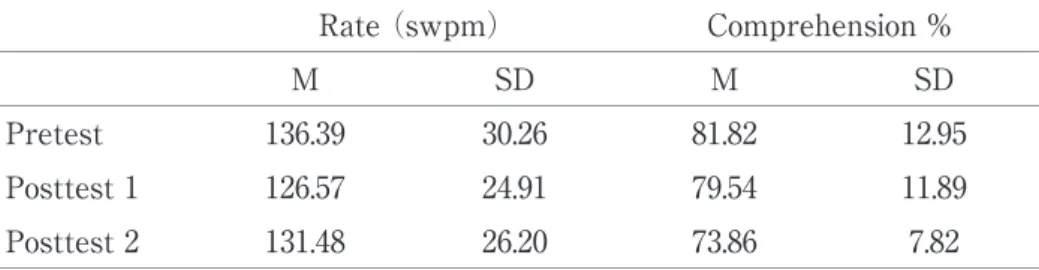
A one-way within-subjects repeated measures ANOVA was also conducted for the comparison group and the means and standard deviations for reading rate are presented in Table 4. The results for the ANOVA indicated no significant time effect, Wilks s Λ = .76, (1, 10) = 3.25, = .102, multivariateη2 = .25. While all comprehension scores for
this group were above 70%, the trend was downward for this group. Table 3. Rate (swpm) Comprehension % M SD M SD Pretest 133.51 30.42 70.50 13.87 Posttest 1 153.74 42.05 75.00 11.59 Posttest 2 161.97 39.73 72.75 12.48
Table 4. Rate (swpm) Comprehension % M SD M SD Pretest 136.39 30.26 81.82 12.95 Posttest 1 126.57 24.91 79.54 11.89 Posttest 2 131.48 26.20 73.86 7.82
To answer research question 2, a one-way between-subjects ANOVA was conducted to evaluate any differences between the treatment group and control group on pretest reading rates. The independent variable was the group and the dependent variable was reading rate. The ANOVA was not significant, (1, 34) = 0.07, = .795, indicating no initial differences between the groups in terms of reading rates. In comparing posttest 1 reading rates, another one-way ANOVA narrowly missed reaching significance, (1, 34) = 3.94, = .055. A final one-way ANOVA of posttest 2 reading rates revealed significant differences between the two groups, (1, 34) = 5.40, = .026 with a partialη2 = .14, which accounts for 14% of the variance of the dependent
variable.
For research question 3, a linear regression analysis was conducted to predict TOEIC reading scores based on reading rate in standard words per minute of posttest 2. Means and standard deviations are presented in Table 5. A significant linear relationship was found, (1, 23) = 5.97, = .023 with a moderate correlation of .454 between the variables. The adjusted R2 was .172 indicating that about 17% of the
variance in the TOEIC reading scores can be accounted for by reading rate. Beta coefficients showed that participants TOEIC reading score increased 0.58 points for every 1 standard word per minute faster they read.
Another linear regression analysis was carried out to see if reading rate could predict TOEIC listening scores. The results indicated a significant linear regression equation, (1, 23) = 6.99, = .015 with a moderate correlation of .483. The adjusted R2
was .199 indicating that about 20% of the variance in the TOEIC listening scores can be accounted for by reading rate. Beta coefficients showed that participants TOEIC
reading score increased 0.57 points for every 1 standard word per minute faster they read. Table 5. M SD TOEIC Reading 238.00 50.52 TOEIC Listening 294.80 47.05 Discussion
Research question 1 asked essentially if the reading fluency treatment was effective in promoting reading fluency growth. For the treatment group, there was a linear upward trend in reading rate throughout the measures while all comprehension percentages were above 70%. From the pretest to posttest 1, the participants gained 20.23 swpm in reading speed which was also accompanied by a five percent increase in comprehension scores. From posttest 1 to posttest 2, there was an additional group gain of 8.23 swpm, however, comprehension dropped slightly. Overall, the treatment group gained 28.46 swpm over the entire treatment period. While this gain in speed is modest compared to past studies (e.g. Chung & Nation, 2006), the treatment group maintained high levels of comprehension, above the 70% threshold. The final group reading rate was 162 swpm which fell short of yearly reading rate goal of 250 words per minute, which calls into question how much time it takes to reach this goal.
For the control group, although the participants comprehended adequately, reading speed did not change significantly. There was actually a decrease of about 10 swpm from pretest to posttest 1 accompanied by a comprehension decrease. Although speed increased from posttest 1 to posttest 2, the group mean was still below the initial rate. Comprehension also declined on the final measure. This suggests that learners fluency will not change unless explicitly practiced.
Research question 2 asked if the treatment group significantly outperformed the control group in terms of reading rate on the pretest, posttest 1, and posttest 2. The results showed that there was no significant difference between the two groups at the
beginning of the study in terms of reading rate. After one semester, posttest 1 narrowly missed significance at the .05 alpha level. However, by posttest 2, the difference between the groups reached significance showing the effectiveness of the treatment. These results suggest that reading fluency is a skill that needs long, sustained periods of practice to come to fruition. After one academic year, the treatment group was reading approximately 30 swpm faster than the control group.
Research question 3 asked if reading rate could be used as a significant predictor of both TOEIC reading and listening scores. It was found that reading rate predicted both reading and listening TOEIC scores to a statistically significant degree, explaining about 17 to 20% of the variance, respectively, with moderate correlations between the variables. While it is far from explaining all the variance of TOEIC scores, it was an important piece of the puzzle in explaining the scores for this group of students. Surprisingly, reading rate was a more highly significant predictor of listening scores. It is speculated that because the vocabulary of the listening sections generally uses higher frequency vocabulary words than the reading section, the overlap of the treatment materials and listening section in terms of vocabulary was greater. Moreover, through reading fluency training, participants reading speed became slightly faster than average speaking speed, which has been estimated to be from about 100 to 160 words per minute (Williams, 1998; Wong, 2014). This might have been a key to understanding the listening scripts. Cutler and Clifton (2000, p. 144) have commented, For most people, reading is, after all, developmentally parasitic on listening. All in all, this evidence adds credence to the value of reading rate build-up activities such as timed and repeated reading in that they are not only helpful in promoting reading skills, but also listening skills as well.
Conclusion
This study has provided supporting evidence that timed and repeated reading is a useful way to build reading fluency over one academic year. Learners who receive such a treatment can become faster readers than more experienced and proficient learners as was evident in this study. However, a limitation of the study was the sizes between the groups were not equal, and thus the results should be interpreted cautiously. This study has also shown a significant relationship between reading rate and scores on the TOEIC which underscores the idea that fluency is a necessary
component of academic success in English. Further research is needed to examine reading fluency growth beyond one academic year to better understand the full potential and upper limits of L2 learners reading fluency.
References
Atkins, A. (2010). Timed reading: Increasing reading speed and fluency. In A. M. Stoke
(Ed.), (pp. 662‒671). Tokyo: JALT.
Beglar, D., & Hunt, A. (2014). Pleasure reading and reading rate gains. , 29‒48.
Breznitz, Z. (2006). . Mahwah, NJ: Erlbaum.
Browne, C. (1998). Japanese high school textbooks: How readable are they? Retrieved from: http://www.wordengine.jp/research/pdf/Japanese_high_school_textbook.pdf Burrows, L. (2012). The effects of extensive reading and reading strategies on reading
self-efficacy. Unpublished doctoral dissertation, Temple University, Philadelphia, Pennsylvania.
Carver, R. (1990). . San Diego, CA:
Academic Press.
Champeau de López, C. L. (1993). Developing reading speed. (1), 50-51.
Chang, A. C-S. (2010). The effect of a timed reading activity on EFL learners: Speed,
comprehension, and perceptions. (2), 43-62.
Retrieved from: http://nflrc.hawaii.edu/rfl/October2010/articles/chang.pdf
Chang, A. C-S. (2012). Improving reading rate activities for EFL students: Timed
reading and repeated oral reading. (1), 56-83.
Retrieved from: http://nflrc.hawaii.edu/rfl/April2012/articles/chang.pdf
Chang, A. C-S., & Millet, S. (2013). Improving reading rates and comprehension through
timed repeated reading. (2), 126-148.
Chung, M., & Nation, P. (2006). The effect of a speed reading course. (4), 181-204.
Cutler, A., & Clifton, Jr., C. (2000). Comprehending spoken language: A blueprint of the listener. In C. M. Brown & P. Hagoort (Eds.), . Oxford: Oxford University Press.
DeKeyser, R. M. (2007). Introduction: Situating the concept of practice. In R. M. DeKeyser (Ed.), Practice in a second language: Perspectives from applied linguistics and cognitive psychology (pp. 1-18). Cambridge: Cambridge University Press.
Dowhower, S. L. (1987). Effects of repeated reading on second-grade transitional
readers fluency and comprehension. , 389-406.
doi:10.2307/747699
Ellis, M. (2016). Reading for speed and breadth: TR and ER. In P. Clements, A. Krause, & H. Brown (Eds.), . Tokyo: JALT.
Gorsuch, G. J. (1998). Yakudoku EFL instruction in two Japanese high school classrooms: An exploratory study. , 6-32.
Gorsuch, G., & Taguchi, E. (2008). Repeated reading for developing reading fluency and reading comprehension: The case of EFL learners in Vietnam. , 253-278. doi:10.1016/j.system.2007.09.009
Gorsuch G., & Taguchi, E. (2010). Developing reading fluency and comprehension using repeated reading: Evidence from longitudinal student reports.
(1), 27-59. doi:10.1177/1362168809346494
Grabe, W. (2009). . New
York, NY: Cambridge University Press.
Grabe, W. (2010). Fluency in reading‒Thirty-five years later. (1), 71‒83. Retrieved from:
http://nflrc.hawaii.edu/rfl/April2010/articles/grabe.pdf
Hu, M., & Nation, I. S. P. (2000). Vocabulary density and reading comprehension. (1), 403-430.
Jensen, L. (1986). Advanced reading skills in a comprehensive course. In
. Eds. F. Dubin, D. Eskey, and W. Grabe. Reading, MA: Addison-Wesley Publishing.
LaBerge, D., Samuels, S. J. (1974). Toward a theory of automatic information processing in reading. , 293‒323. doi:10.1016/0010-0285(74)90015-2 Macalister, J. (2008). Effect of a speed reading course in an English as a second
language environment. , 23-32.
Macalister, J. (2010). Speed reading courses and their effect on reading authentic texts:
Retrieved from: http://nflrc.hawaii.edu/rfl/April2010/articles/macalister.pdf
Millett, S. (2005). New Zealand speed readings for ESL learners, Book Two. Wellington: School of Linguistics and Applied Language Studies, Victoria University of Wellington.
Nation, I. S. P. (2005). Reading faster. , , 21-35. Nation, I. S. P. (2007). The four strands.
(1), 1-12. doi:10.2167/illt039.0
Nation, I. S. P. (2009). . New York, NY:
Routledge.
Nation, I. S. P., & Beglar, D. (2007). A vocabulary size test. (7), 9-13.
Nation, I. S. P., & Malarcher, C. (2007a). . Seoul: Compass.
Nation, I. S. P., & Malarcher, C. (2007b). . Seoul: Compass.
Nation, I. S. P., & Malarcher, C. (2007c). . Seoul: Compass.
Quinn, E., & Nation, P. (1974). . Wellington, New Zealand: Victoria University Bookcentre.
Quinn, E., Nation, P., & Millet, S. (2007).
. Wellington: English Language Institute Occasional Publication.
Samuels, S. J. (1979). The method of repeated readings. , 403-408.
Takase, A. (2003). Effects of eliminating some demotivating factors in reading English
extensively. , 95-103.
Taguchi, E. (1997). The effects of repeated readings on the development of lower
identification skills of FL readers. , 97-119.
Taguchi, E., & Gorsuch, G. J. (2002). Transfer effects of repeated EFL reading on reading new passages: A preliminary investigation.
, 43-65. Retrieved from http://www.nflrc.hawaii.edu/rfl
Taguchi, E., Gorsuch, G., Lems, K., & Rosszell, R. (2016). Scaffolding in L2 reading: How repetition and an auditory model help readers.
Taguchi, E., Gorsuch, G., Takayasu-Maass, M., & Snipp, K. (2012). Assisted repeated reading with an advanced-level Japanese EFL reader: A longitudinal diary study.
(1), 30-55.
Taguchi, E., Takayasu-Maass, M., & Gorsuch, G. (2004). Developing reading fluency in EFL: How assisted repeated reading and extensive reading affect fluency
development. , 70-96.
Taguchi, E. Gorsuch, G. Takayasu-Maass, M., & Snipp, K. (2012). Assisted repeated reading with an advanced-level Japanese EFL reader: A longitudinal diary study.
(1), 30-55.
Tran, T. N. Y. (2012). The effects of a speed reading course and speed transfer to other types of texts. , 23‒37. doi:10.1177/0033688212439996
Underwood, P., Myskow, G., & Hattori, T. (2012). The effect of speed reading instruction on Japanese high school students English reading comprehension and vocabulary
development. (1), 27-40.
doi:10.19030/jier.v8i1.6693
Weigle, S., & Jensen, L. (1996). Reading rate improvement in university ESL classes. , 55-71.
Williams, J. R. (1998). Guidelines for the use of multimedia in instruction. , 1447-1451. Wong, L. (2014). . Boston, MA: Cengage.
Yamashita, J., & Ichikawa, S. (2010). Examining reading fluency in a foreign language:
Effects of text segmentation on L2 readers. (2),