Design and evaluation of solid waste management
courses for sustainable development in elementary
schools: A case study in Da Nang city, Vietnam.
A Thesis for Acquirement of the Degree of Doctor of Philosophy
Course of Environment and Resources Systems
Graduate Programs in Environmental Systems
Graduate School of Environmental Engineering
The University of Kitakyushu, Japan
By
Phan Hoang Thu Thao
Supervisor: Professor Takaaki Kato
ABSTRACT
Environmental problems are of concern to citizens and governments of both developed and developing countries. To solve existing and emerging environmental problems, education is important. This study aimed to design solid waste management courses for elementary school students in Da Nang city, Vietnam, and to measure its effects on student’s knowledge and behavioural intention to correctly manage waste. The study was carried out in elementary schools that had an average demographic and socio-economic level.
This study evaluated student’s knowledge of environmental issues and problems to the level of their attitude and intention. The environment education was identified, and the effects of some factors such as family, school and communities on their environmental knowledge, attitude and behaviour intention were investigated.
The effectiveness of environmental education activities using a one-time environmental education and 6-month workshop approach, created by the author, on fourth grade student’s environmental knowledge was examined. The study used a treatment – control design to measure the impact of environmental education. The sample set included students from two elementary schools. Evaluation questionnaires were administered to all students before and after environmental education activities, where the treatment group participated in a workshop created by the author and school. In contrast, the control group was only exposed to environmental education that was an existing part of the school curriculum.
The study was successful at increasing student’s knowledge, attitude and intention on solid waste management through workshop activities.
Acknowledgements
Firstly, I would like to express my sincere gratitude to my advisor Prof. Kato Takaaki name order for the continuous support during my PhD studies and related research, and for his patience, motivation, and immense knowledge. His guidance helped me in all aspects of research and writing of this thesis. I could not have imagined having a better advisor and mentor for my PhD studies.
Many thanks also to Dr. Hoang Hai who provided me with the opportunity to join the ESD program in Kobe College, Kobe, Japan, preparing me from the pursuit of my master and doctoral degrees. He made it possible for me to obtain a scholarship from the Japan Student Services Organization (JASSO) enabling me to come to Japan.
My sincere thanks also goes to 古澤律子 先生 from 北九州市教育委員 会 and Principal 池町真一 先生, and 清田 渚 先生 from あやめが丘小学校 whom facilitated the opportunity to attend EE at Kitakyushu elementary, and provided support when I studied at あやめが丘小学校. Without their precious support it would not have been possible to conduct this research.
My sincere thanks also goes to Principal Phan Thị Thu Ba and all the teachers of Ong Ich Khiem elementary school, Principal Bùi Can and all the teachers of Dung Si Thanh Khe elementary school, and Principal Ha and all the teachers of Le Dinh Ly elementary school, Da Nang, Vietnam who provided me an opportunity to evaluate EE at elementary school. Without their precious support it would not have been possible to conduct this research.
I thank my fellow lab mates for the stimulating discussions, and for all the fun we had in the last four years. In particular, I am grateful to Mr. Phan Hoang Hai for collaborating with me in executing the EE activities in Da Nang, Vietnam.
Last but not the least; I would like to thank my family: my parents, my brothers and my husband for supporting me spiritually throughout the writing of this thesis and my life in general.
1
CONTENT
List of Figures ... 5 List of Table ... 7 List of Abbreviations ... 8 List of Appendix ... 9 Chapter 1 INTRODUCTION ... 10 1.1 Background ... 101.1.1 History of environmental education ... 10
1.1.2 Education in Vietnam ... 14
1.1.3 Waste management problems in Vietnam ... 18
1.2 Problem statement... 21
1.3 Research site selection ... 22
1.4 Objective of Study ... 25
1.5 Chapter plan ... 26
Chapter 2 LITERATURE REVIEW OF ENVIRONMENTAL EDUCATION ... 28
2.1. Introduction ... 28
2.2 Characteristics of childhood development ... 29
2.3 The theories of reasoned action and planned behavior ... 32
2.4 Theory on environmental education ... 34
2.5 Expansion of education methods for elementary students ... 37
2.5.1 Workshop ... 37
2.5.2 Drawing activities ... 38
2.6 Environmental education practice ... 39
2.6.1 Environmental education in Japan ... 39
2.6.2 Environmental education in Southeast Asia ... 41
2.6.3 Environmental education for elementary students in Vietnam ... 45
2.7 Lessons learned ... 48
Chapter 3 ONE-TIME ENVIRONMENTAL EDUCATION ... 50
3.1 Introduction ... 50
3.2 Methodology ... 51
3.2.1 School selection ... 51
3.2.2 EE activities and questionnaire survey design ... 52
2
3.3.1 Student’s basic environmental knowledge and their environmental protection
behaviour: ... 58
3.3.2 Effect of environmental lesson by school: ... 62
3.3.3 Effect of environmental activities by the author ... 66
3.3.4 Student’s thinking about authors environmental activities ... 71
3.4 Limitation ... 74
3.5 Conclusion ... 74
Chapter 4 OBSERVED ENVIRONMENTAL EDUCATION IN JAPAN AND DEVELOP ENVIRONMENTAL EDUCATION IN VIETNAM ... 76
4.1 Introduction ... 76
4.2 Methodology ... 76
4.3 Background of environmental education in two countries ... 77
4.3.1 Characteristics of elementary education ... 77
4.3.2 National environmental education policy ... 78
4.3.3 Difference between school in Kitakyushu city and Da Nang city ... 80
4.3.4 Environmental policy in Kitakyushu and Da Nang ... 80
4.3.5 Source separation practice in Kitakyushu and Da Nang ... 82
Kitakyushu ... 82
Da Nang ... 84
4.4 Observed elementary environmental education example in Kitakyushu ... 85
4.4.1 Goals of this environmental education ... 85
4.4.2 Evaluation criteria ... 85
4.4.3 Course outline ... 86
4.4.4 Contents of each lesson ... 86
4.4.5 Observation survey of students ... 89
4.4.6 Questionnaire survey ... 89
4.5 Development of an environmental education program for Da Nang city ... 93
4.5.1 Goals of this environmental education ... 93
4.5.2 Course outline ... 93
Contents of each lesson ... 93
4.6 Discussion ... 98
4.7 Conclusion ... 99
Chapter 5 6-MONTH ENVIRONMENTAL EDUCATION ... 101
3
5.2 Methodology ... 102
5.2.1 The study subject selection ... 102
5.2.2 Survey 1 (2016/10/11 – 2016/11/01) ... 105
5.2.3 Environmental education activities during 6 months and survey 2 ... 111
5.2.4 Survey 3 (2017/03/07 – 2017/04/01) ... 116
5.2.5 Analysis of student newspaper ... 116
5.3 Results ... 117
5.3.1 The impact to the student knowledge ... 117
5.3.2 Student newspaper results ... 127
5.3.3 Factors of intentions to participate in solid waste management ... 131
5.3.3.1 Estimation of original model for survey 1 (Model 1) ... 131
5.5.3.2 Modification of model structure for survey 1 (Model 2) ... 133
5.5.3.3 Model 2 applied to the treatment school of survey 3 (Model 3) ... 137
5.5.3.4 Model 3 modified for the treatment school of survey 3 (Model 4) ... 138
5.5.3.5 Model 5: Model 2 applied to the control school of survey 3 ... 142
5.5.3.6 Effects of EE on student intention to participate in waste management .... 143
5.3.5 Comparison between one-time EE and 6-month EE... 144
5.4. Limitation ... 144
5.5 Conclusions ... 145
Chapter 6 IMPACT OF ENVIRONMENTAL EDUCATION AFTER 14 MONTHS ... 147
6.1 Introduction ... 147
6.2 Methodology ... 147
6.2.1 Education procedure and survey ... 147
6.2.2 Follow-up survey at 14 months ... 150
6.2.3 Environmental education control school ... 152
6.3 Research hypothesis ... 152 6.4 Results ... 155 6.4.1 Hypothesis 1 ... 155 6.4.2 Hypothesis 2 ... 158 6.4.3 Hypothesis 3 ... 158 6.4.4 Hypothesis 4 and 5 ... 161
6.4.5 Measurements student performance through their answers selected at surveys 1, 3 and 4 ... 167
4
6.4.6 Short discussion about student knowledge when they join one-time EE and
6-month EE. ... 182
6.5 Limitation ... 183
6.6 Conclusions ... 183
Chapter 7 CONCLUSION AND RECOMMENDATION ... 185
7.1 Contribution to knowledge ... 185
7.2 Recommendations ... 188
5
List of Figures
Figure 1-1 Education system in Vietnam (NUFFIC, 2015) ... 17
Figure 1-2 Outline of Dissertation ... 27
Figure 2-1 Theories of reasoned action and planned behaviour (Ajzen & Fishbein, The Influence of Behavior on Attitudes, 2005). ... 33
Figure 2-2 Curriculum development and the instructional process (Hungerford, Peyton, Bluhm, & Volk, 1994) ... 36
Figure 3-1 Location of school surveyed ... 51
Figure 3-2 Research structure ... 53
Figure 3-3 Content of our environmental education ... 55
Figure 3-4 Environmental education schedule ... 56
Figure 3-5 Result from game activities ... 57
Figure 3-6 Result from non - game activities ... 58
Figure 3-7 Student basic knowledge about environment ... 61
Figure 3-8 Student thinking how they can protect environment ... 62
Figure 3-9 Study time of student ... 63
Figure 3-10 Environmental knowledge assessment questions for students ... 64
Figure 3-11 Student knowledge about the environment before and after environmental lesson in school ... 65
Figure 3-12 shows changes of student knowledge from environment lesson after 1 year ... 66
Figure 3-13 Changing of student knowledge during 1 year of our survey ... 67
Figure 3-14 Student knowledge about solid waste management after our environmental activities in school ... 68
Figure 3-15 Comparison in student knowledge ... 69
Figure 3-16 Students’ answers from survey 2, 3 and 4 one-time EE ... 70
Figure 3-17 Student checklist ... 72
Figure 3-18 Result from student checklist ... 73
Figure 4-1 Municipal solid waste management systems in Kitakyushu City ... 82
Figure 4-2 Waste Separation Types in Kitakyushu City ... 83
Figure 4-3 Questionnaire survey ... 90
Figure 4-4 Student knowledge before the environmental education lesson from the teacher ... 91
Figure 4-5 Student knowledge after environmental education lessons from the teacher ... 92
Figure 5-1 Locations of the schools surveyed ... 103
Figure 5-2 Research structure ... 104
Figure 5-3 Modified model for Da Nang elementary ... 107
Figure 5-4 Examples of questions from the CHEAKS attitude scale ... 109
Figure 5-5 Questions about solid waste management. ... 110
Figure 5-6 Questionnaire survey 2 ... 114
Figure 5-7 Treatment and control student’s knowledge about solid waste management at survey 1 ... 118
Figure 5-8 Treatment school student knowledge about solid waste management ... 119
Figure 5-9 Control school student knowledge about solid waste management ... 121
Figure 5-10 Control and treatment schools student knowledge about solid waste management ... 123
6 Figure 5-12 Changing of student answers between survey 1-survey 2 and survey 2-survey 3 . 126
Figure 5-13 Student newspaper contents summary ... 128
Figure 5-14 Frequency of keywords appearing in student’s newspapers ... 129
Figure 5-15 standardised results of structural equation model 1 ... 132
Figure 5-16 standardised results of structural equation model 2 ... 135
Figure 5-17 Standardised results of structural equation model 3 ... 137
Figure 5-18 standardised results of structural equation model 4 ... 140
Figure 5-19 Standardised results of structural equation model 5 ... 142
Figure 6-1 Structure follow up questionnaire survey ... 148
Figure 6-2 Shows question 16 to question 21 ... 151
Figure 6-3 Comparison between treatment and control schools ... 155
Figure 6-4 Difference of student answer in survey 3 and 4 ... 158
Figure 6-5 Difference between students who had good scores between survey 3 and 4 - treatment school ... 159
Figure 6-6 Change in students who had a good score between surveys 3 and 4 - treatment school ... 160
Figure 6-7 Student’s daily life behaviour - treatment school ... 161
Figure 6-8 Student’s daily life behaviour - control school ... 162
Figure 6-9 Student’s memory about EE ... 164
Figure 6-10 Environmental activities that students from 2017 to 2018 ... 165
Figure 6-11 Treatment student answers in recycle for profit question ... 171
Figure 6-12 Treatment student answers for 3Rs question ... 172
Figure 6-13 Treatment student answers in waste treatment method question ... 173
Figure 6-14 Control students’ answers to waste treatment method question ... 175
Figure 6-15 Treatment student answers in Eco-bag question ... 176
Figure 6-16 Control student answers in Eco-bag question ... 177
Figure 6-17 Treatment school student’s answers for the 3Rs question ... 178
Figure 6-18 Control student answers in 3Rs question ... 179
Figure 6-19 Treatment student answers for reason for recycling question ... 180
Figure 6-20 Control student’s answers for reason for recycling question ... 181
Figure 6-21 Nearest meaning question in 6-month and one-time EE questionnaire survey. .... 182
7
List of Table
Table 1-1 Competence of each ministry in waste management ... 20
Table 2-1 Stages of teaching method according to Piaget ... 31
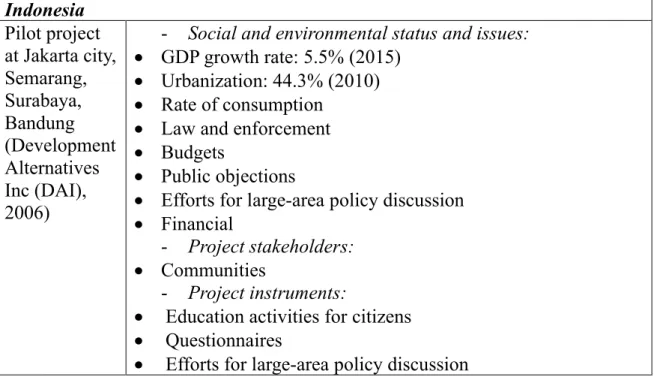
Table 2-2 Summary of EE pilot project in Southeast Asia ... 42
Table 2-3 Primary education: weekly lesson timetable (national guide lines) ... 46
Table 2-4 Vietnamese elementary guide book curriculum ... 47
Table 3-1 Information about Hai Chau and Thanh Khe district in Da Nang city, Vietnam ... 52
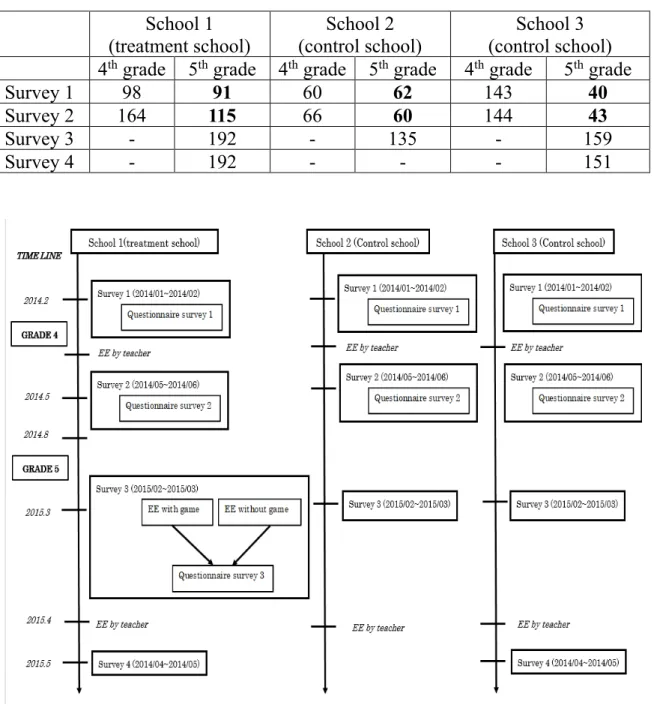
Table 3-2 Number of student engaged in one-time EE ... 53
Table 3-3 Number of student attend our survey from 2014 to 2015 ... 59
Table 3-4 Behaviour of student when they throw away garbage ... 60
Table 3-5 Comparison of results between with/out game ... 69
Table 4-1 Characteristics of elementary education in Japan and Vietnam ... 78
Table 4-2 Environmental education objectives in Japan and Vietnam ... 79
Table 4-3 Difference in characteristics of elementary school in Kitakyushu and Da Nang city 80 Table 4-4 city policy from Kitakyushu and Da Nang ... 81
Table 4-5 Evaluation criteria of students ... 86
Table 4-6 Course outline of Da Nang application ... 93
Table 4-7 Questions to go over material learned in the last lesson ... 95
Table 4-8 Difference between this study and Kitakyushu model... 98
Table 5-1 Treatment and control school... 103
Table 5-2 Summary of survey questions ... 106
Table 5-3 Adoption questions from CHEAKS scale ... 108
Table 5-4 Environmental activities guideline ... 112
Table 5-5 Number of students involved in the study ... 117
Table 5-6 Chi-square test for Figure 5-7 (before environmental workshop) ... 118
Table 5-7 T-test results for Figure 5-8 ... 119
Table 5-9 T-test results for the control school in Figure 5-9 ... 122
Table 5-10 Chi-square test for after environmental workshop of Figure 5-10 ... 123
Table 5-11 T-test results between survey 1 and survey 2 from treatment school ... 124
Table 5-12 T-test results between survey 2 and survey 3 from treatment school ... 124
Table 5-13 Elements included in their drawings by students participating in the study ... 130
Table 5-14 Model fit of alternative models tested. ... 132
Table 5-15 Factor Loading from Maximum Likelihood with Varimax Rotation for a Four-Factors Solution for environmental education attitude questions ... 134
Table 5-16 Standardised model 2 regression weights for VC, ATB, SN and PBC... 136
Table 5-17 Related model 1items ... 137
Table 5-18 Factor loading in the treatment school at survey 3 ... 139
Table 5-19 Standardised regression weights for the VC, ATB, SN and PBC model 4 ... 141
Table 5-20 Standardised regression weights for the VC, ATB, SN and PBC for Model 5 ... 143
Table 6-1 Shows question 9 to 14 ... 149
Table 6-2 Number of schools and students that joined surveys 3 and 4 ... 150
Table 6-3 Comparison of students’ knowledge after one year ... 156
Table 6-4 Comparison of student knowledge in the treatment school ... 158
8
List of Abbreviations
EE
Environmental education
ESD
Education for sustainable development
UNESCO
United Nations Educational, Scientific and Cultural
Organization
UIS
UNESCO Institute for Statistics
SDGs
Sustainable Development Goals
MSW
Municipal solid waste
PE
Pollution education
PIS
The period for integrated study
ECCE
Early childhood care and education
MOET
the Ministry of Education and Training
MONRE
the Ministry of Environment and Natural Resources
MOC
the Ministry of Construction
MARD
the Ministry of Agriculture and Rural Development
MOH
the Ministry of Health
MPI
the Ministry of Planning and Investment
MF
the Ministry of Finance
VC
Verbal commitment
SN
Subjective norm
PBC
Perceived behavioral control
ATB
Attitude toward behavior
GAP-ESD
Global Action Programme on Education for Sustainable
Development
URENCO
Urban Environment Company
JICA
Japan International Cooperation Agency
SWM
Solid waste management
9 List of Appendix
Appendix A: Questionnaire survey 1 for one-time EE ... 198
Appendix B: Questionnaire survey 3 for one-time EE ... 205
Appendix C: Questionnaire survey for 6-month workshop EE ... 210
Appendix D: Questionnaire survey for 14 months after 6-month EE ... 213
Appendix E: Pictures of one-time EE from 2014-2015 ... 216
10 Chapter 1 INTRODUCTION
1.1 Background
1.1.1 History of environmental education
The world is facing serious global environmental problems every day, such as: climate change, air pollution, water pollution, solid waste issues. Countermeasures against the environmental issues have been examined in the natural sciences, social sciences and humanities, as well as through interdisciplinary approaches. Naturally, education has been one of these countermeasures. Environmental education (EE) has been expected to play a vital role in seeking solutions to environmental problems (Imamura, 2017).
The field of EE has a history of over forty years and much longer if fore runners such as nature studies, outdoor and conservation educations are included. It has received considerably more attention in recent years as contested notions of environment and sustainability have become common topics of conversation among the public, the subject of media interest, and the focus of much political debate and legislation (Stevenson, Brody, Dillon, & Wals, 2013). Perhaps EE has its roots in the nature studies movement of the early 1900s or the public awakening to pollution and general environmental problems in the first Earth Day in 1970 (McCrea, 2006).
However, as more people began to fear the fallout from radiation, the chemical pesticides mentioned in Rachel Carson’s Silent Spring, and the significant amounts of air pollution, water pollution and waste, the public’s concern more about their health and the environment (Eneji & Akpo, 2017). EE has been defined and redefined over the last twenty-five years. Definitional issues are inherent in a field this broad and encompassing. It is generally agreed that EE is a process that creates awareness and understanding of the relationship between humans and their many environments – natural, man-made, cultural, and technological. EE is concerned with knowledge, values, and attitudes, and has as its aim responsible environmental behaviour (Binstock, 2006).
11 Since the 1970s there is a consensus that EE is crucial for achieving the goals of sustainable development, by creating an environmentally literate citizenry capable and motivated towards environmentally responsible lifestyles (UNESCO, 1997; UNESCO-UNEP, 1978; UNESCO-UNEP, 1992) (Goldman, Yavetz, & Pe'er, 2014). The magnitude of this challenge is such that in 2005, UNESCO launched the Decade of Education for Sustainable Development. Underlying this endeavour is the understanding that education is the driving force for the change needed (UNESCO, The 2005 convention on the Protection and Promotion of the Diversity of Cultural Expressions, 2005). EE and education for sustainable development (ESD) have become a growing priority at the local, national and international levels in recent years (Binstock, 2006).While there is often overlap between concepts of EE and ESD, however the importance of EE and ESD is achieving sustainable development goals for the environment.
The public became concerned over our effects on the environment around the world. Events that both celebrated the environment as well as attention to the issues affecting it became increasingly popular. Earth Day was born. Those that taught about the environment called for a new type of curriculum that included an examination of the values and attitudes people used to make decisions regarding the environment (Einstein, 1995). Environmental educators began work towards a common definition for EE. Much of the work on EE within the last quarter century has been guided by the Belgrade Charter (UNESCO, Activities of the UNESCO-UNEP International Environmental Education Programme: 1975-1983, 1984) and the Tbilisi Declaration (UNESCO & UNEP, The Tbilisi Declaration, 1977). These two documents furnish an internationally accepted foundation for EE.
Belgrade Charter, 1975 - The Belgrade Charter was developed in 1975 at the United Nations Educational, Scientific, and Cultural Organization Conference in Measuring the Success of EE Programs. Yugoslavia, and provides a widely accepted goal statement for EE: The goal of EE is to develop a world
12 population that is aware of, and concerned about, the environment and its associated problems, including the knowledge, skills, attitudes, motivations, and commitment to work individually and collectively toward solutions of current problems and the prevention of new ones (UNESCO, Intergovernmental Conference on Environmental Education: Final Report, 1975).
Tbilisi Declaration, 1977 - Following Belgrade, the world's first Intergovernmental Conference on EE was held in Tbilisi, Georgia. Building on the Belgrade Charter, representatives at the Tbilisi Conference adopted the Tbilisi Declaration, which challenged EE to create awareness and values amongst humankind in order to improve the qualities of life and the environment. A major outcome of Tbilisi was detailed descriptions of the objectives of EE. Most EE has since universally adopted these objectives. Awareness – to help social groups and individuals acquire an awareness and sensitivity to the total environment and its allied problems (UNESCO, Intergovernmental Committee for the Protection of the World Cultural and Natural Heritage, 1978).
Knowledge – to help social groups and individuals gain a variety of experience in, and acquire a basic understanding of, the environment and its associated problems.
Attitudes – to help social groups and individuals acquire a set of values and feelings of concern for the environment and the motivation for actively participating in environmental improvement and protection.
Skills – to help social groups and individuals acquire the skills for identifying and solving environmental problems.
Participation – to provide social groups and individuals with an opportunity to be actively involved at all levels in working toward resolution of environmental problems (UNESCO, Intergovernmental Committee for the Protection of the World Cultural and Natural Heritage, 1978).
Measuring the Success of EE Programs and Characteristics of EE. The outcomes of Tbilisi and Belgrade have, in many ways, provided the basis for
13 many EE programs. Certainly, having both a commonly accepted goal statement and associated set of objectives has allowed many educators to better address the desired outcomes of their programs (UNESCO & UNEP, The Tbilisi Declaration, 1977). Equal to the need to identify both a common goal and set of objectives, is the need to consider the characteristics of EE. EE is a process of recognizing values and clarifying concepts in order to develop skills and attitudes necessary to understand and appreciate the interrelatedness of man, his culture and his biophysical surroundings. EE also entails practice in decision – making and self – formulating of a code of behaviour about issues concerning environmental quality (Martin, 1975). To develop a world population that is aware of, and concerned about, the environment and it’s associated problems, and commitment to work individually and collectively toward solutions of current problems and prevention of new ones (UNESCO & UNEP, The Belgrade chapter: A Framework for Environmental Education, 1975).
EE is increasingly a prominent part of primary, secondary and tertiary education in many developing countries. The formal education sector plays a vital role in EE and awareness by exposing the younger generation to the information, issues, analyses and interpretations on environment and development. A number of factors have influenced the development of EE in the region. EE should be a part of the school curriculum because student knowledge of environmental concepts establishes a foundation for their future understandings and actions as citizens (UNESCO. Director-General, 2014).
The UN Decade on Education for Sustainable Development 2005-2014 envisioned a world “where everybody has the opportunity to benefit from education and learn the values, behaviour and lifestyles required for a sustainable future and for positive societal transformation” (UNESCO, UN Decade of Education forSustainable Development 2005 - 2014 The DESD at a glance, 2005). ESD is recognized as a key element EE and a crucial enabler for sustainable development which is at the heart of the 2030 Agenda for Sustainable
14 Development. Target 4.7 of Sustainable Development Goal 4 (SDG 4): “By 2030, ensure that all learners acquire the knowledge and skills needed to promote sustainable development, including, among others, through education for sustainable development and sustainable lifestyles, human rights, gender equality, promotion of a culture of peace and non-violence, global citizenship and appreciation of cultural diversity and of culture’s contribution to sustainable development” (UNESCO & UIS, Quick Guide to Education Indicators for SDG 4, 2018).
The UNECE (United Nations Economic Commission for Europe) affirms that “education must play a role in enabling people to live together sustainably” and that this will require working with learners across all levels and types of education, formal, non-formal and informal (Chandran & Gunawardena, 2017). The three modes of education are defined as below:
• Formal education is carried out in school systems and is based on established curriculum methods.
• Non-formal education occurs outside the formal system, in other organized learning settings.
• Informal education results from daily life activities related to work, family or leisure, and is provided within families, religious organizations, and community groups, as well as by news organizations, social media and various forms of entertainment (UNFPA, 2017).
1.1.2 Education in Vietnam
Vietnam is a country in Southeast Asia of 331,211.6 square kilometers in area. In 2018, Vietnam’s GDP growth rate hit a 10-year record high of 7.08%, making it one of the top growth performers in the region and the world (Pwc Vietnam & Vietnam Chamber of Commerce and Industry, 2019). Vietnam’s population reached 97 million in 2018 (up from about 60 million in 1986), 70% of the population is under 35 years of age, with a life expectancy of 76 years, the highest among countries in the region at similar income levels (The World Bank
15 in Vietnam, 2019). Urbanization and strong economic and population growth are causing rapidly increasing waste management and pollution challenges. Waste generation in Vietnam is expected to double in less than 15 years (The World Bank in Vietnam, 2019).
Vietnam has seen many changes in the long history of its educational development. During the feudal period (from the tenth century to the nineteenth century), the education system was mainly accessible to selected classes and intellectual elites, to maintain and develop contemporary feudalism (Ministry of Education and Training, 2014).
For one thousand years, Vietnamese people used Chinese characters in their language system, but pronounced it in a Vietnamese way (Nguyen & Nguyen, 2008). At the end of 19th and first half of 20th centuries, the French forcibly colonized Vietnam and the entire Indochina. The traditional education was replaced by French-Vietnamese education aimed mainly at training people to serve the colonial apparatus. Under the French-Vietnamese education system, French was the dominant language (Nguyen & Nguyen, 2008).
In 1975, the communist north and the country's south that was supported by the US were reunited, and the Socialist Republic of Vietnam was declared. The Government focused on two tasks: (1) removal of leftover influences from the old education system; (2) implementation of anti-illiteracy activities for people 12-50 years old. The Ministry of Education quickly developed and issued a new 12-year curriculum, and developed and printed 20 million copies of new textbooks to replace the old ones used in the South (Nguyen & Nguyen, 2008).
The biggest challenge faced by Vietnamese education in the early 1980s was that the State was not able to provide financial resources that made education to face a serious shortage of resources. To solve the financial problem, in 1986, the Vietnamese Government made major national reforms throughout the whole country. Some solutions used in the reform of general education were as follows.
16 The Government allowed the collection of tuition fees at all levels; permission was given to open private kindergartens and semi-public and people-founded classes/schools at all levels.
Since 1990, the Ministry of Education and Training (MOET; Bo Giao Duc va Dao Tao) has been responsible for all forms of education in Vietnam. The duties of the MOET include submitting proposals to the National Assembly (the government) for the founding of new schools or merging of existing education institutions, creating and publishing new textbooks and curricula, drawing up guidelines for the admission of students, and issuing certificates and diplomas (NUFFIC, 2015). To establish more educational institutions, MOET permitted the creation of private institutions for higher education. In 2006, the Hoa Sen University, a private university was founded, and in 2008 the Van Xuan University of Technology. Higher education will also become more international, and Vietnamese higher education institutions entered into partnerships with foreign partners (e.g. joint ventures, sandwich programmers) (NUFFIC, 2015).
After 10 years of this reform in the education sector, in the 1993-1994 school-year the dropout rate decreased from 12.7% in 1989-1990 to 6.58% and repetition rate fell from 10.6% in 1989-1990 to 6.18% (Nguyen & Nguyen, 2008).
A new school curriculum and textbooks were introduced in the 2002-2003 school-year and should become universal by the 2008-2009 school year, thus laying the preconditions for improved educational quality (Nguyen & Nguyen, 2008). Figure 1-1 shows the education system in Vietnam.
17 Figure 1-1 Education system in Vietnam (NUFFIC, 2015)
18 1.1.3 Waste management problems in Vietnam
In developing countries, it is common that 30-60 % of urban solid waste is uncollected and that open dumping in addition to open burning is the norm (Garg, 2013). Increasing waste generation due to rising population and waste generation rate has become a challenge for many developing countries including Vietnam, as government fights to establish proper municipal solid waste (MSW) management protocols. Poor waste management is a common growing problem facing developing countries. Recently, Vietnam has faced great challenges in solid waste management including not only the collection, transfer, and final disposal of waste, but also a lack of public awareness of the solid waste system, haphazard urbanization, introduction of environmentally unfriendly materials, and changing consumption patterns. Therefore solid waste is a growing problem for Vietnam, especial in big cities with rapidly increasing populations. The country is producing more than 15 million tons of waste each year, and this volume is expected to grow rapidly over the next decade. Urban areas produce more than 80% or 12.8 million ton/year of the country’s MSW. Solid waste in Vietnam’s urban areas is mainly composed of food waste, paper, plastic, wood, metal, and glass, with some hazardous household waste such as fluorescent lights, and batteries (Leroy & Vuong, 2015). Currently there is not an effective mechanism of publicly organized recycling in Vietnam. The government has been trying to implement a waste separation and recycling policy throughout the country, but Vietnamese Government has not yet succeeded mainly due to a lack of funding and human resources in the public sector (Nguyen & Matsui, 2011).
Seventy-five percent of globally exported waste ends up in Asia. Since July 2017, when China began to ban imports of plastic waste, Southeast Asia in particular has become a dumping ground for wealthier countries’ waste (Marks, 2019). Waste generation in Asian urban areas is around 450,000–760,000 tonnes/day and this is expected to reach about 1.8 million tonnes/day by 2025 (Curea, 2017). With rapid industrialization, urbanization, economic growth, and
19 special export waste from developed countries, the quantity of municipal solid waste and the associated problems are becoming a serious issue in Southeast Asia. Many Southeast Asian countries have policies in place to solve the aforementioned problems. Nevertheless, the primary focus is on the downstream solutions for which local governments allocate significant funds for waste collection and recycling/disposal, but without adequate consideration for EE of the young generation.
Urbanization has now become one of the most important issues and challenges for Vietnam in efforts to pursue sustainable development. Hence, Vietnam is faced with a solid waste management problem too. Urbanization has led to the migration of people from villages to big cities with a dream of making a lot of money to improve their living standards. In Vietnam, municipal solid waste has become an increasingly complex issue attributed to reasons such as increasing quantity, changing composition, and a lack of rising public awareness and municipal administration policies among different cities and surrounding communities (Nguyen & Matsui, 2011).
Waste institutional governance in Vietnam is plural: each department handles waste issued from their activity field. At both national and local levels, there is no entity in charge of coordinating the waste management system. The Ministry of Environment and Natural Resources (MONRE) is responsible for the management of hazardous waste, the Ministry of Agriculture and Rural Development (MARD) takes care of waste from agriculture, the Ministry of Planning and Investment (MPI) and the Ministry of Finance (MF) are not directly involved in the waste management system, but they plan and elaborate strategies relating to waste treatment projects and control the public finances of the sector. (Leroy & Vuong, 2015). In fact, the organizational structure is likely to cause overlapping of responsibilities between many ministries (MONRE 2011). For the same type of waste, such as healthcare waste, three ministries are competent: the Ministry of Health (MOH), which implements regulations on waste management
20 in health facilities, the Ministry of Construction (MOC), which controls waste treatment facilities and MONRE, which regulates and controls the management of hazardous hospital waste (Leroy & Vuong, 2015).
Table 1-1 Competence of each ministry in waste management
MONRE - Gives guidelines, plans, controls the waste management in the context of environmental policy.
- Provides reference standards
- Handles domestic waste with MOC - Responsible for hazardous waste
- Responsible for health and industrial waste
MOC - Gives directives in management, investment and construction of waste treatment sites.
- Manages the construction waste with MONRE
- Handles domestic waste with MONRE
- Handles waste from the Craft villages
MARD - Plans and manages waste from agriculture with MONRE
MOH - Manages waste from health facilities with MONRE
- Gives guidelines for healthy waste management, supervises their implementation.
MPI - Plans investment projects
- Develops investment strategies - Attracts domestic and foreign funding
MF - Implements and controls the budget for waste management
projects
* (Leroy & Vuong, 2015)
Vietnam produces more than 27.8 mil tons/year waste from various sources where municipal, agricultural and industrial wastes are main sources. More than 46% (12.8 mil tons/year) are from municipal sources including
21 households, restaurants, markets, and businesses (Schneider, Le, Wagner, Reichenbach, & Hebner, 2017).
Hanoi, Ho Chi Minh City (HCMC), Haiphong, Da Nang and Can Tho are the five biggest cities in Vietnam, and are hotspots contribution 70% to the total waste generation.In 2018, the average MSW of big urban areas increased to 0.9– 1.10 kg/person/day which general is 1.31 kg/cap/day in urban areas and 0.86 kg/cap/day in rural areas (Berg, et al., 2018).
Numbers from Vietnam’s Association of Plastic illustrate the scale of the problem. In 1990, each Vietnamese consumed 3.8kg of plastic per year, but 25 years later, the figure hit 41kg (Vietnam News, 2019). SWM (solid waste management) is one of the most important environmental problems of Vietnam. 1.2 Problem statement
There are a limited number of researches in Vietnam about EE activities for students from different grades. Most of the studies have been carried out at the university level. It should be taken into account that the every student is not able to complete university education. Having said that, elementary level education appears to be essential in raising environmental awareness of students as Vietnam achieved universal primary education in 2000 throughout the entire country. During the period between 2001 and 2010, net enrolment rates in Vietnam increased from 94 per cent to 97 percent in primary education, which was 12 % higher than the secondary level (Ministry of Education and Training, 2014).
Up-to-date EE may be the key to tackling environmental issues. In Vietnam, EE became one of the significant policies in addressing serious environmental problems caused by its tremendous economic growth. Vietnam has been trying to implement a garbage separation and recycling policy throughout the country, but had not yet succeeded mainly due to lack of funding and human resources in the public sector. Though various activities have been conducted, most approaches are still limited in providing children with sufficient
22 knowledge about environmental issues at their schools. In addition, education for solid waste treatment is not systematically done in Vietnam.
The quantities of MSW in Vietnam have been increasing significantly making the expenses used for collection, transportation, treatment and disposal increase (Nguyen, Hoang, Bui, & Nguyen, 2013). With current MSW management practices and challenges, the different methods for the disposal and treatment of MSW being applied in Vietnam are as follows: Open dumping and landfill, composting, incineration and recycling. For these solutions to be successful, solid waste education is an important component educating on the practice of wastes separation at the sources. Recently, solid waste education is not spoken about in Vietnam, special in elementary school.
From the problem statement, these research questions are considered in the thesis:
1. What are the characteristics of EE in Vietnam? 2. How to create and develop EE in Vietnam?
3. How to evaluate the impact of environmental activities for elementary student in Vietnam?
To answers these questions, the study chose Da Nang city – one of the 4 biggest cities in Vietnam, to start the research.
1.3 Research site selection
Vietnam has set national targets on emissions reduction, and Da Nang is in the process of developing targets locally (APEC, 2014). The Da Nang People's Committee committed to and promulgated a comprehensive environmental plan for Da Nang City in August 2008 called 'Building Da Nang City as An Environmental City (No.41 / 2008 / QD-UBND). It set a 2020 vision for many different environmental issues such as: air pollution reduction, waste treatment and recycling, energy conservation, and renewable energy. The plan is based on Agenda 21 of the Vietnamese government (Prime Ministerial Decision, No.
23 153/2004) and Vietnamese environmental standards 2, where 2020 was set as the target year. The general goals for the Environmental City Plan are to:
- Provide a safe and healthy environment for people, assuring land, and water - air quality.
- Prevent environmental pollution and degradation (APEC, 2014).
Da Nang is one of the four biggest cities in Vietnam where the gross domestic product (GDP) growth rate has been higher than the country’s national average. Between 2017 and 2018, Da Nang’s regional GDP grew 7.9 percent annually whereas the national GDP was 7.1%, totalling US$1.655 billion in 2018. Da Nang is located in the middle of Vietnam, having a population of 1,064 million in 2018 according to the statistical yearbook of the city. The economy has historically been dominated by the industrial and construction sectors but is slowly changing. In 2006, the services sector became the largest economic sector in the city as measured by gross output. This shift is in keeping with local policy targets, which seek to develop the city as a rail, road, and seaport hub, in addition to other services-oriented industries like financing, banking, insurance, telecommunications, and consulting to name a few. The tourism sector is also expected to grow, as the city strives to become a major national tourist sector that capitalizes on the city’s beaches and proximity to the old capital, Hue; Hoi An Ancient Town; and the ruins at My Son (Ostojic, Bose and Krambeck 2013). After more than 20 years of development, Da Nang has gained much prosperity: tourism products are more diversified and enriched, with a high tourist growth rate of 21.93% between 2007-2016. The average revenue from tourism reached 29.6% of Da Nang GDP. However, the process of exploiting and developing tourism has led to environmental pollution, the loss of biodiversity, and destruction of the ecological environment of the city. In 2017, Da Nang was chosen as the venue for the APEC 2017 Economic Leaders Week 05-11 November. This coastal city and major economic centre of Vietnam, is distinct for its vibrant development in line with being environmentally sustainable. It is
24 noteworthy to have a look at Da Nang’s efforts and future plan in accomplishing environmental sustainability which is part of the reason why it is considered as Vietnam’s “worth-living” and smart city. The EE materials used in Da Nang are merely translations and improvements of Japan’s version of sustainability, applied in Vietnam.
The city of Da Nang is one of the major port cities in Vietnam (in addition to Ho Chi Minh City and Haiphong) and the biggest city on the South Central Coast of Vietnam. Da Nang is listed as a first class city, and has a higher urbanization ratio than any centrally governed city. The administrative area of the city is composed of 6 districts and 2 suburb districts; one of these is an island suburb with an area of 305 km2. The total area of Da Nang is 1285.43 km2. Da Nang is located in the middle of Vietnam, having a population of 1.064 million in 2018 with a large number of people traveling in from other municipalities to work according to the statistical yearbook of the city. The economy has historically been dominated by the industrial and construction sectors but is slowly changing. In 2006, the services sector became the largest economic sector in the city as measured by gross output.
According to the survey data of URENCO (Urban Environment Company), Da Nang City collected about 268 thousand tons of municipal solid waste in 2013, and the collection rate for 2012 was 92%. Per capita waste generation in Da Nang City is 0.675 kg per day in 2010 (Japan International Cooperation Agency (JICA) data) (JICA, The Preparatory Survey on Wastewater Management and Solid Waste Management for Da Nang City The Socialist Republic of Viet Nam, 2014). MSW in Da Nang composed of 68.47% food waste, 5.07% paper, 2.89% cloth, 2.79% wood, 11.36% plastic, 0.14% glass, 1.45% metal, 0.02% hazardous waste and 3.15% other waste (Nguyen D. H., 2018). With its designed capacity, the Khanh Son Landfill will be closed by 2020. Operating since 2007, the Khanh Son landfill site has been an urban solid waste treatment facility with sanitary landfill technology in Hoa Khanh Nam Ward,
25 Lien Chieu District, Da Nang. There is an urgent need for reduction, reuse and recycling measures for MSW. Recently, there are some projects in Da Nang for sustainable solid waste management, such as: eco-city project at Cam Le district, and composting of agricultural waste at Hoa Vang suburban district (Nguyen D. H., 2018). However, EE is not formal education at elementary school in Da Nang, Vietnam, and students do not have basic knowledge about solid waste management.
1.4 Objective of Study
A. The aims of this study to solve problem statement: What are characteristics of EE in Vietnam?
A.1 Review literature
A.2 Summarize Vietnamese textbook and EE contents from elementary textbook B. How to create and develop EE in Vietnam?
B.1 Develop one-time education course B.2 Develop 6-month workshop course
C. How to evaluate the impact of environmental activities for elementary student in Vietnam?
C.1 Develop evaluation method
C.2 Measurement of the impacts of EE from textbook. C.3 Evaluation of one-time education
C.4 Evaluation of 6-month education
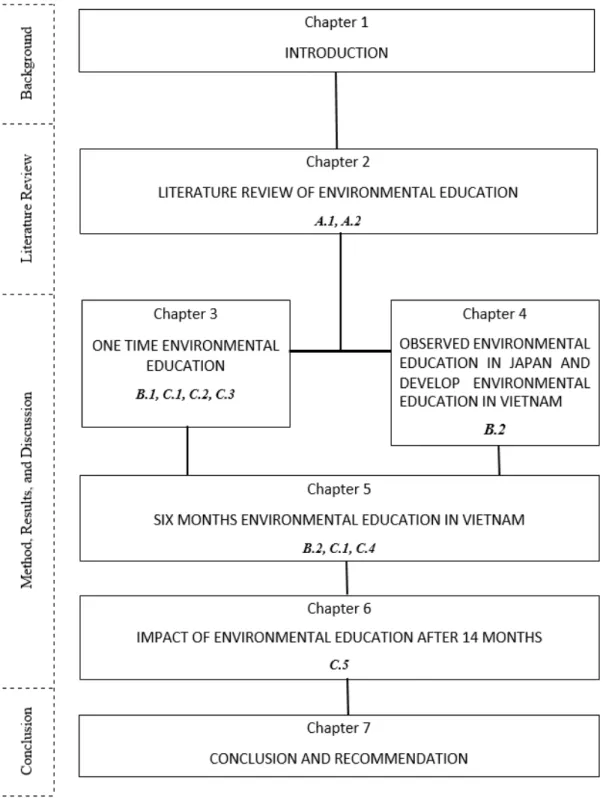
26 1.5 Chapter plan
This dissertation is divided into 7 chapters:
Chapter 1 contains a description of the background research topic and issues. The main content of this chapter: the research problem and research objectives.
Chapter 2 describes the literature review of EE for elementary students with theoretical descriptions of relevant theories that can be used to explain the methodology that was used in the study. Also contains state of the similar research that had been done.
Chapter 3 is one-time EE that was done for the study in elementary schools of Da Nang, Vietnam.
Chapter 4 is observation activities at Japanese elementary school (Kitakyushu, Japan)
Chapter 5 create workshop activities for student in Vietnam base on education in Japan.
Chapter 6 evaluation the impacts of workshop activities after 14 months and
Chapter 7 contains details of the discussion, conclusion and future plan. The outline diagram of the dissertation is shown in Figure 1-2. In the outline diagram, you can find a short summary of chapters 3, 4, 5 and 6.
27 Figure 1-2 Outline of Dissertation
28 Chapter 2 LITERATURE REVIEW OF ENVIRONMENTAL
EDUCATION 2.1. Introduction
It is necessary to understand the characteristics of environmental education and the situation in Vietnam before creating EE programs. The grade-level differences in the relationships of students' perceived academic support (from parents, teachers and peers) to academic achievement directly and indirectly, through their perceived academic engagement (Chen, 2008). The lack of research in EE, especially with regards to children in elementary schools, is not only a Vietnam specific phenomenon. Most international studies have focused on environmental knowledge and education of high school students, leaving the elementary level untouched (Harold, 1982). However, the significance of EE is highlighted by research findings suggesting that students at the elementary and secondary levels acquire most of their knowledge about the environment from classes in school (Fatma & Semra, 2013). There are several reasons to carry out EE activities geared towards elementary students. A major benefit is the impact it can have on their knowledge and behaviour. The definitive aim of environmental educators is to change individual behaviour toward the environment by producing environmentally literate and responsible citizens (Knapp, 2000). Varela-Losada, Vega-Marcote, Perez-Rodríguez, and Alvarez-Lires pointed out the compulsory character of EE, whose contents showed human communality and was different from general scientific education, skill education, or general knowledge education (Varela-Losada, Vega-Marcote, Pérez-Rodríguez, & Álvarez-Lires, 2016).
The main aims of this chapter are to find research subjects and understand the characteristics of the chosen subject. In addition, this chapter may be summarized as:
29 - The theories of reasoned action and planned behavior
- Theory on environmental education
- Expansion of education methods for elementary students including workshop method and drawing analysis method
- Environmental education in Japan
2.2 Characteristics of childhood development
Jean Piaget’s work on children’s cognitive development, specifically with quantitative concepts, has garnered much attention within the field of education. Piaget explored children’s cognitive development to study his primary interest in genetic epistemology. Upon completion of his doctorate, he became intrigued with the processes by which children achieved their answers; he used conversation as a means to probe children’s thinking based on experimental procedures used in psychiatric questioning (Ojose, 2008).
Piaget believed that the development of a child occurs through a continuous transformation of thought processes. The developmental stage consists of a period of months or years when certain development takes place. Although students are usually grouped by chronological age, their development levels may differ significantly (Weinerta & Helmke, 1998), as well as the rate at which individual children pass through each stage. This difference may depend on maturity, experience, culture, and the ability of the child (Papalia & Olds, 1996). According to Berk (1997), Piaget believed that children develop steadily and gradually throughout the varying stages and that the experiences in one stage form the foundations for movement to the next (Berk, 1997). All people pass through each stage before starting the next one; no one skips any stage. This implies that older children, and even adults, who have not passed through the later stages process information in ways that are characteristic of young children at the same developmental stage (Eggen & Kauchak, 2013).
30 From his observation of children, Piaget understood that children were creating ideas. They were not limited to receiving knowledge from parents or teachers; they actively constructed their own knowledge. Piaget's work provides the foundation on which constructionist theories are based (Wood, Smith, & Grossnoklaus, 2011).
Constructionists believe that knowledge is constructed and learning occurs when children create products or artifacts. They assert that learners are more likely to be engaged in learning when these artifacts are personally relevant and meaningful. In studying the cognitive development of children and adolescents, Piaget identified four major stages: sensorimotor, preoperational, concrete operational and formal operational. Piaget believed all children pass through these phases to advance to the next level of cognitive development. In each stage, children demonstrate new intellectual abilities and an increasingly complex understanding of the world. Stages cannot be "skipped"; intellectual development always follows this sequence. The ages at which children progress through the stages are averages -- they vary with the environment and background of individual children. At any given time a child may exhibit behaviors characteristic of more than one stage.
The years between 6 and 14 — middle childhood and early adolescence — are a time of important developmental advances that establish children’s sense of identity. Children make strides toward adulthood by becoming competent, independent, self-aware, and involved in the world beyond their families (Eccles, 1999).
Environmental education programs aiming to enhance children’s environmental attitudes in a pro-environmental direction require background information, such as age and sex differences, to ensure appropriate design. Liefländer (2014) showed in a test design that students 9-10 years of age revealed to be more responsive concerning positive attitude shifts than older students
11-31 13 years of age, where the genders were equally influenced (Liefländer & Bogner, 2014).
Table 2-1 Stages of teaching method according to Piaget
Ages Method
Early childhood learners (2-7 years)
- At this stage intuition and language develop.
- Examples of instructional tools Piaget would recommend to describe objects they are experiencing include: concrete props, symbols, and visual aids such as drawings, usage of models or examples, lessons about the children’s world and their experiences, less paper-and-pencil tasks and more “hands on” learning, back-and-forth conversations with peers to develop skills for the next stage, and field trips.
Children in the elementary school years (7-11 years)
- A child’s thinking becomes less rigid and more dynamic during this stage.
- Huitt (1997) mentions these instructional tools that follow this theory: concrete props such as three dimensional science models, lab work with minimal steps, brief and well organized lectures, relate existing instruction into previously learned material, word problems in math, and problems which require logic and analysis to solve (Huitt & Hummel, 2003).
- The Math Forum at Drexel University (2006) explained math education using a Piagetian theory: Students need to construct their own understanding of each mathematical concept, so that the primary role of teaching is not to lecture, explain, or otherwise attempt to 'transfer' mathematical knowledge, but to create situations for students that will foster their making the necessary mental constructions. A critical aspect of the approach is a decomposition of each mathematical concept into developmental steps following a Piagetian theory of knowledge based on observation of, and interviews with, students as they attempt to learn a concept (Ojose, 2008). The 12
year old and up group
- This stage is called the formal operations stage.
- Huitt (1997) suggests classroom practices such as these to best use Piaget’s theory: concrete operations stage type graphs on a more complicated scale, ask students to explore hypotheticals as they explore other worlds or complicated issues, encourage students to describe opposing viewpoints, have students describe how they solved the problem, teach broad but curriculum related concepts, and use materials and ideas relevant to the students to broaden their perspectives (Huitt & Hummel, 2003).
32 2.3 The theories of reasoned action and planned behavior
In the early days of attitude research, most investigators accepted as a given that human behavior is guided by social attitudes. In fact, the field of social psychology was originally defined as the scientific study of attitudes (Thomas & Znaniecki, 1918), (Watson, 1925) because it was assumed that attitude was the key to understanding human behavior.
Whereas this first systematic investigation of the attitude–behavior relation started with the assumption that behavior has little to do with attitudes, the second study to examine this issue accepted the proposition that attitudes guide behavior and tried to use a measure of attitude toward cheating to predict actual cheating in the classroom (Corey, 1937).
By the late 1960s, at least 45 separate studies had been reported in which investigators assessed verbal attitudes and observed actual behavior that they expected to be related to the attitudes. Investigators attempted to predict job performance, absenteeism, and turnover from job satisfaction attitudes (e.g., Bernberg, 1952; Vroom, 1964); they looked at attitudes toward African Americans in relation to conformity with the judgments made by African Americans (Himelstein & Moore, 1963), or in relation to willingness to have a picture taken with an African American (De Fleur & Westie, 1958; Linn, 1965); they used attitudes toward cheating in attempts to predict cheating behavior (Corey, 1937; Freeman & Ataoev,1960), attitudes toward labor unions to predict attendance at labor union meetings (Dean,1958), attitudes toward participating as a subject in psychological research to predict actual participation (Wicker & Pomazal, 1971), and so forth (Ajzen & Fishbein, The Influence of Behavior on Attitudes, 2005).
After conducting his review of relevant studies, Wicker (1969) reached the following conclusion regarding the strength of the attitude–behavior relation: Taken as a whole, these studies suggest that it is considerably more likely that
33 attitude will be unrelated, or only slightly related to overt behaviors as opposed to being closely related to actions (Ajzen & Fishbein, The Influence of Behavior on Attitudes, 2005).
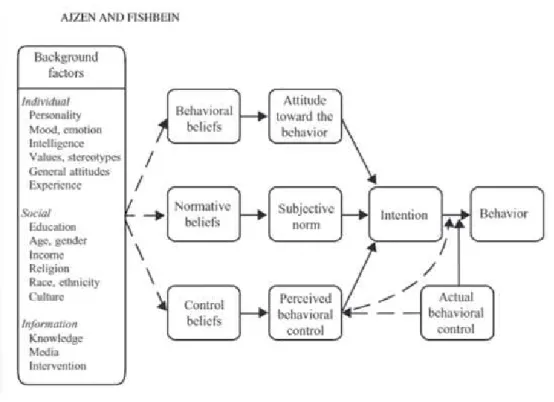
Figure 2-1 Theories of reasoned action and planned behaviour (Ajzen & Fishbein, The Influence of Behavior on Attitudes, 2005).
Figure 2-1 depicts one way how the antecedents of intentions and behavior can be represented (Ajzen, The theory of planned behavior, 1991), (Fishbein, 2000).
Implicit in this model are several fundamental assumptions: 1. Intention is the immediate antecedent of actual behavior.
2. Intention, in turn, is determined by attitude toward the behavior, subjective norm, and perceived behavioral control.
34 3. These determinants are themselves a function, respectively, of underlying behavioral, normative, and control beliefs.
4. Behavioral, normative, and control beliefs can vary as a function of a wide range of background factors.
2.4 Theory on environmental education
Legislation requiring instruction in the conservation of natural resources at both the elementary and secondary level, and requiring science and social studies teachers to have "adequate preparation" in the conservation of natural resources was passed during the 1930s. Historically, the lack of a comprehensive in curriculum planning which has resulted in a series of rather inconsistent and unrelated environmental experiences that focus on limited and incomplete program objectives (Engleson & Yockers, 1994). Wisconsin’s historical commitment to education advancing environmental literacy and sustainability is well known. Since 1935, teacher preparation programs must include environmental education. In 1985, Wisconsin adopted a requirement for every school district to develop and implement a kindergarten through grade 12 sequential curriculum plan (Wisconsin State Legislature, Wisconsin State Legislature, 2019), with implementation intended as an interdisciplinary approach, stating that “environmental education objectives and activities shall be integrated into K-12 curriculum plans, with the greatest emphasis in art, health, science and social studies education” (PI 8.01(2)(k)6.b) (Wisconsin State Legislature, Wisconsin State Legislature, 2019) (Evers, 2018).
Education can be improved if we design instruction and education research on the basis of a coherent theory that combines newer concepts from epistemology, psychology, and curriculum theory (Novak, 1980).
Sustainable development can be observed and be impacted by most of the major environmental issues facing human beings on the face of the earth. At the same time, in education, one is beset with numerous statements about and pleas
35 for the development of an environmentally literate global citizenry (Hungerford, Peyton, Bluhm, & Volk, 1994).
If educators want to develop learners who are both capable of and willing to respond to environmental issues in their communities and nations in ethically responsible ways, two things must happen: (1) The students must feel an ownership of the issue in question, and (2) the students must feel empowered to some-how effect change with respect to that issue (Hungerford, Peyton, Bluhm, & Volk, 1994).
“The Goal of EE: To aid citizens in becoming environmentally knowledgeable and, above all, skilled and dedicated human beings who are willing to work, individually and collectively, toward achieving and/or maintaining a dynamic equilibrium between development and the quality of life and quality of the environment” (Hungerford, Peyton, Bluhm, & Volk, 1994).
This definition suggests two important implications: - Firstly, the EE must develop skilled problem solvers and,
- Secondly, the EE must be concerned with development and, more importantly, a quality of human life and a quality environment (Hungerford, Peyton, Bluhm, & Volk, 1994).
Goals for Curriculum Development in EE” (and focused on an investigation approach to EE) move hierarchically from science foundations to issue awareness through issue investigation and evaluation to citizenship action (Hungerford, Peyton, Bluhm, & Volk, 1994).
There are still gaps and shortcomings in EE programs both inside and outside the school system, such as: less seems to have been achieved at the secondary level than at the primary level in schools both quantitatively and in terms of innovation. Little has been done for training out-of-school educators or in-service teachers in environmental matters. There are still far too few trained
36 for the teaching of ecology, or capable of effective participation in a multidisciplinary approach. Last, but most important, there still appears to be a considerable need for developing or refining overall EE strategies in all forms and at all levels of education (Hungerford, Peyton, Bluhm, & Volk, 1994).
The process outlined by Tbilisi (1977) has been prepared primarily to serve as a basis for curriculum development in EE. It does not propose a specific curriculum for EE but, instead, establishes a set of guidelines which are valid for curriculum decision-making in any school, community, region, or nation (Gillett, 1977).
Figure 2-2 Curriculum development and the instructional process (Hungerford, Peyton, Bluhm, & Volk, 1994)
A flow chart of the entire curriculum/implementation/evaluation process is presented in Figure 2-2. This diagram reflects the components of the instructional process plus original curriculum goals and curriculum evaluation. These relationships must be constantly respected in any curriculum development effort in order to guarantee validity (Hungerford, Peyton, Bluhm, & Volk, 1994).
37 2.5 Expansion of education methods for elementary students
2.5.1 Workshop
Today, EE is playing an important role toward sustainability. EE for young generations has an important impact on training and preparing the future generation for a green society. Children will become the biggest stake in the future, while the world is getting worse with environmental damage, social injustice and appalling ill-health. The society should equip children with the attitudes, values, knowledge and skills necessary to rethink and change current patterns of action and to secure healthy, just and sustainable futures for all (Davis & Cooke, 1998). However, for children in the early childhood years, with the biggest stake in the future, there has been a major absence from curriculum theory, policy and practice of approaches that stress environmental perspectives (Davis J. M., 1998).
In the middle 1980s, many studies confirmed that the application of informal methods of teaching led to better results in the process of learning (Dimitrijević, Filipović, & Stanisavljević, 2016). The theory and background supporting the workshop/presentation approach to professional development is well documented in the K-12 research literature (CALPRO, 2017). Workshops/presentations are one of the few professional development approaches whose impact has been best documented (CALPRO, 2017). Research by Joyce and Showers (1988) show that when the five components theory, demonstration, practice, feedback and coaching are incorporated into training, instructors make gains in their level of knowledge and skills, and transfer what they have learned in the workshop through their own classroom environment.
There are a number of ways to get students involved in EE activities. Participation can be as simple as a class lessons, or as complex as outdoor activities. A workshop is one of the simple techniques to evaluate student knowledge and intention in the classroom. In education, on the one hand it is