STUDIES ON THE HOMOGENEOUS LIQUID-LIQUID
EXTRACTION OF METAL IONS USING THE MIXTURES
OF 2-PROPANOL WITH WATER
By
NGUYEN HUU CHUNG
A Dissertation Submitted to
Department of Energy and Material Science Graduate School of Science and Engineering
Saga University, Japan
In Partial Fulfillment of the Requirements for the Degree of
Doctor of Science
THIS DISSERTATION IS DEDICATED TO MY WIFE BBUUIITTHHAANNHHHHUUOONNGG, DAUGHTER NNGGUUYYEENNTTHHUUYYTTRRAANNG, AND TO MY PARENTS G
N
Abstract
This thesis studies systematically the phase separation of mixtures of 2-propanol and
water induced by addition of NaCl and CaCl2. We have utilized the unique
physicochemical properties of the salting-out phase separation for the selective extraction of gold(III), thallium(III) and cobalt(II) in the presence of several precious metals, other triply charged ions and transition metals into the 2-propanol phase without using any extracting reagents. The results obtained are as follows:
The mixture of 2-propanol with water has been employed to extract Au(III) along with other precious metals such as Pd(II) and Pt(IV) by using NaCl in the concentration
range of 2.5-4.0 mol dm-3. Upon the addition of NaCl within this concentration range
(2.5-4.0 mol dm-3) phase separation was attained. Gold(III), which was originally
present in the aqueous phase, at different concentrations of NaCl, was quantitatively extracted into the 2-propanol-rich phase. The extraction efficiencies of the other metals such as Pd(II) and Pt(IV) were much lower than for Au(III). Thus a maximal selective separation of Au(III) from these metals could be attained using the mixture of
2-propanol with water. A reaction mechanism involving the ion-pair of Na+ and [AuCl4]
-has been proposed to explain this extraction.
Thallium(III) that is present with other trivalent metals such as gallium, indium, bismuth and antimony in aqueous solution was quantitatively and selectively extracted into 2-propanol phase of a mixture of 2-propanol and water by addition of NaCl ranging
at 2.5-4.0 mol dm-3. The extraction efficiencies of gallium, indium, bismuth and
antimony were much lower than that of thallium(III). Thus a maximal selective separation of thallium(III) from these metals could be attained using the mixture of 2-propanol with water. Thallium(III) was extracted into 2-2-propanol phase as [TlCl4]- with
Na+. The detailed extraction mechanism involving the chemical species of the metal
ions in the presence of chloride, water content in the organic phase and counter ions is discussed.
Selective separation of cobalt(II) in the presence of manganese(II), nickel(II) and copper(II) was studied by using the mixture of 2-propanol with water by addition of
CaCl2 in the concentrations range of 3.0-6.5 mol dm-3. Cobalt(II) was extracted to
the other metal ions such as Mn(II), Ni(II) and Cu(II) were much lower than that of Co(II), but they were completely stripped to the aqueous phase by using an aqueous
solution containing of CaCl2. Thus, selective separation of cobalt(II) from these
elements was attained using the mixture of 2-propanol with water. Cobalt(II) was
extracted as CoCl42- with Ca2+ from aqueous solution into the organic phase. The
detailed extraction mechanism involving the ion-pair of Ca2+ and CoCl42- has been
proposed to explain this extraction.
Cobalt(II) was extracted into 2-propanol phase after the phase separation from the
mixture of water and 2-propanol by addition of CaCl2. In order to elucidate the
chemical species of cobalt(II) in both organic and aqueous phases, spectrophotometric
titration of cobalt(II) with CaCl2 was carried out in the mixture solvents of 2-propanol
and water. The absorption spectra indicate that only the tetrahedral chloro cobalt(II) is
formed under the experimental conditions. Formation constants of β(CoCl4) were
determined for the mixed solvents at different mole fraction of 2-propanol through non-liner regression of the spectrophotometric titration data by computer program SPECFIT/32TM .
Acknowledgements
I would like to express my sincere thanks and gratitude to Professor Masaaki Tabata, supervisor, Department of Chemistry, Faculty of Science and Engineering, Saga University, Japan for his guidance, supervision and useful suggestions, which enabled me to complete this doctoral program.
I am indebted to Dr Toshiyuki Takamuku and Dr Jun Nishimoto for their kind cooperation, encouragements, advices and suggestions which also contributed a great deal to the success of my research work in Saga University. I also express my sincere appreciation to Prof. Tohru Miyajima, laboratory of Environmental Chemistry for his encouragement. I am grateful to all the members of the Department of Chemistry, Saga University for their cooperation and friendship.
I am grateful to Asian Youth Fellowship program for providing me scholarship award to pursue a 14 months preparatory study in Malaysia. My sincere gratitude also goes to Ministry of Education, Science and Culture of Japan for providing me with the Monbusho scholarship that enabled me to pursue this doctor program to a successful end.
Last but not the least, I am very thankful to Faculty of Chemistry, Ha Noi University of Education, Viet Nam, where I am working for last fourteenth years, for granting me study leave to pursue doctoral studies at Saga University. Finally, I am particularly indebted to my dearest parents, brothers and sisters, and loving wife and daughter for encouraging me to achieve this great academic objective.
God richly bless you all. Saga University, September 2004 NGUYEN HUU CHUNG
Table of Contents
Abstract i Acknowledgements iii Table of Contents iv List of Figures vi List of Tables x Chapter 1. Introduction 11. 1. Overview of Solvent Extraction 2
1. 2. Literature Review 2
References 7
Chapter 2.
Fundamental Principles of Solvent Extraction 11
2.1. Introduction 12
2. 2. Solvation Effects and Nature of Solute-Solvent Interactions 12
2. 3. Basic Principles for the Solvent Extraction 17
2. 4. Salting-out Phase Separation 23
2. 5. Formation Complexes of Metal Ions 26
References 29
Chapter 3. Phase Separation Occurs by the Addition of NaCl 31
to a Mixture of 2-Propanol and Water 3. 1. Introduction 32
3. 2. Experimental 33
3. 3. Results and Discussion 35
3. 4. Conclusions 41
References 43
Chapter 4. Selective Extraction of Gold(III) in the presence of 44
Palladium(II) and Platinum(IV) by Salting-out of the Mixture of 2-propanol and Water 4. 1. Introduction 45
4. 2. Experimental 46
4. 3. Results and Discussion 49
4. 4. Conclusions 56
References 57
Chapter 5. Selective Extraction of Thallium(III) in the Presence of 59
Gallium(III), Indium(III), Bismuth(III) and Antimony(III) 5. 1. Introduction 60
5. 2. Experimental 61
5. 3. Results and Discussion 62
5. 4. Conclusions 70
References 71
Chapter 6. Phase Separation Occurs by the Addition of CaCl2 72
to a Mixture of 2-propanol and Water 6. 1. Introduction 73
6. 2. Experimental 73
6. 3. Results and Discussion 74
6. 4. Conclusions 78
References 80
Chapter 7. Selective Extraction of Cobalt(II) in the Presence of
81
Manganese(II), Nickel(II) and Copper(II) 6. 1. Introduction 82
6. 2. Experimental 83
6. 3. Results and Discussion 84
6. 4. Conclusions 94
References 95
Chapter 8. Determination of Formation Constants of Chloro Complexes 97
of Cobalt(II) in the Mixture of 2-propanol and Water by Spectrophotometric Titration Method 7. 1. Introduction 98
7. 2. Experimental 98
7. 3. Results and Discussion 100
References 105
Chapter 9. General Conclusions
106
List of Publications 109
List of Figures 16 14 Page Figure 2 Figure 10 Figure 14 Figure 13 Figure 12 Figure 11 Figure 9 Figure 7 Figure 8 Figure 6 Figure 5 Figure 4 Figure 3
Figure 1 Dipole and hydrogen bond interactions.
Major reactions in solution, classified according to the nature of the interaction.
Major reaction in solution, classified according to the nature of the products.
A schematic representation of solvent extraction.
Liquid-liquid distribution plots. The distribution ratio D for two different substances X and Y, plotted against the variable Z of the aqueous phase. D and Z are both on the logarithmic scale. Solvent requirement for countercurrent extraction.
The procedure of phase separation experiment.
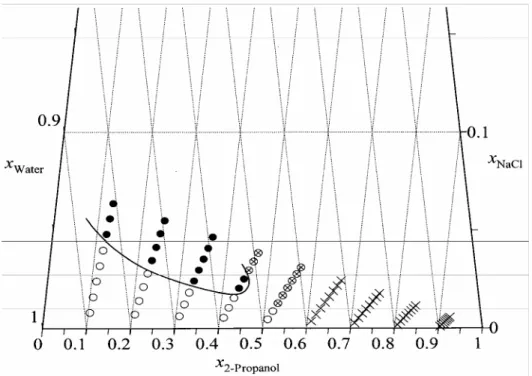
Phase diagram of the 2-propanol-water-NaCl ternary mixtures as a function of mole fraction of 2-propanol, water and sodium chloride.
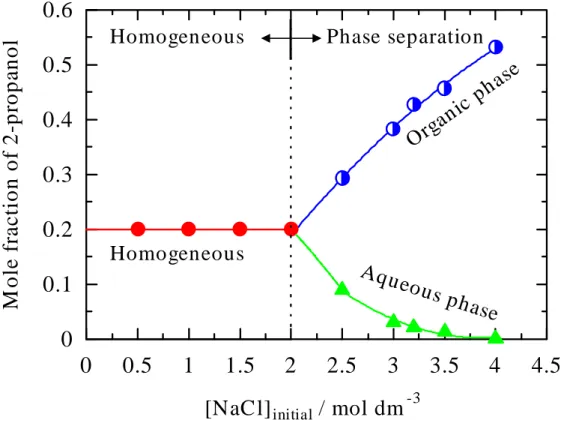
Phase separation of 2-propanol-water-NaCl ternary mixture (x
2-propanol = 0.2 ) as a function of initial concentrations of NaCl in
aqueous solution.
Changing the density of two phases after phase separation. Changing the volume of two phases after phase separation. Distribution of Cl- after phase separation by salting-out of NaCl. Distribution of H2O after separated by salting-out of NaCl.
The procedure of extraction of precious metal ions.
17 19 18 34 36 23 37 48 40 40 39 38
50 Page Figure 23 Figure 22 Figure 21 Figure 20 Figure 19 Figure 18 Figure 17 Figure 16
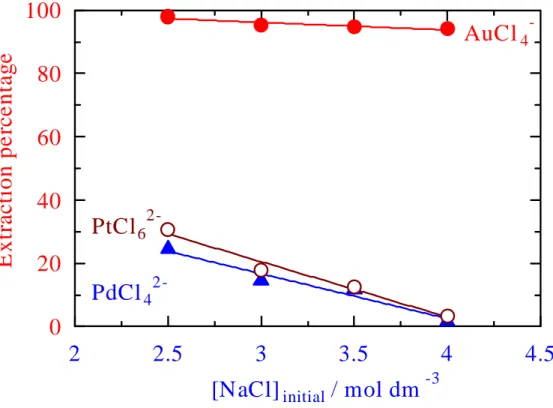
Figure 15 Effect of initial concentrations of sodium chloride on the extraction of Au(III) (
●
), Pd(II) ( ▲) and Pt(IV) (○
) from 1:1 (vol / vol) mixture of 2-propanol and aqueous solutioncontaining the precious metal ions and 0.1 mol dm-3 HCl at
different concentrations of NaCl.
Gold(III) chloro complexes at various chloride concentration.
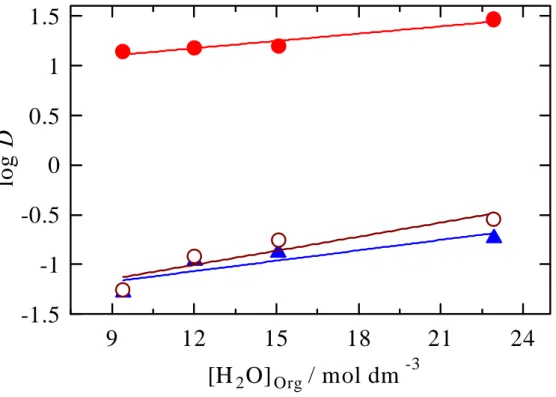
Effect of H2O concentrations in organic phase on the extraction
of precious metal ions Au(III) (
●
), Pd(II) ( ▲) and Pt(IV) (○
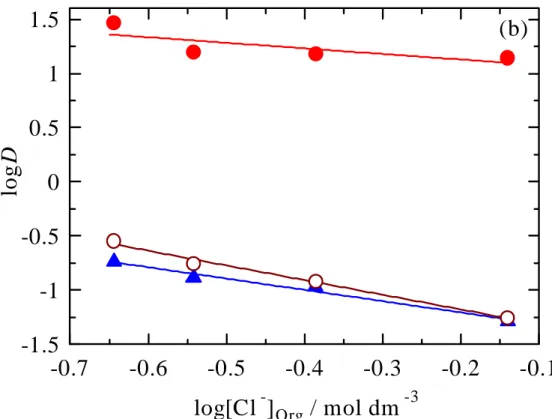
). Effect of chloride concentrations in aqueous (a) and organicphases (b) on the extraction of precious metal ions Au(III) (
●
),Pd(II) ( ▲) and Pt(IV) (
○
).Reaction scheme for the extraction of gold(III) in the presence of sodium chloride.
Distribution of water between aqueous and 2-propanol phases separated by salting out with sodium chloride.
Effect of sodium chloride concentrations on the extraction of Tl(III) (
●
), Ga(III) (▲), In(III) (■
), Bi(III) (○
) and Sb(III) (□
) from a 1:1 (v / v) mixture of water with 2-propanol in 0.1 mol dm-3 HCl.Distribution of metal chloro complexes at various concentration of chloride.
Effect of hydrochloric acid concentrations on the extraction of metal ions at 2.5 mol dm-3 NaCl.
53 52 55 54 56 63 64 66 67
Page 69 Figure 33 Figure 32 Figure 31 Figure 30 Figure 29 Figure 28 Figure 27 Figure 26 Figure 25
Figure 24 Effect of water concentrations on the extraction of Tl(III) (
●
),Ga(III) (▲), In(III) (
■
), Bi(III) (○
) and Sb(III) .Effect of sodium chloride concentrations in the organic solution on the extraction of Tl(III) (
●
), Ga(III) (▲), In(III) (■
), Bi(III) (○
) and Sb(III) (□
).Reaction scheme for the extraction of thallium(III) in the presence of sodium chloride.
Phase diagram of the 2-propanol-water-CaCl2 ternary mixtures as
a function of mole fractions of 2-propanol, water and CaCl2. The
symbols of (●) and (○) denote the phase separation and homogeneous solution, respectively.
Changing the volume of two phases after phase separation.
Distribution of H2O between two phases after phase separation
Changing the [Ca]2+ of two phases after phase separation
Changing the density of two phases after phase separation
Effect of initial concentrations of sodium chloride (a) and calcium chloride (b) on the extraction of Mn(II) (
○
), Co(II) (■), Ni(II) (●
), Cu(II) (▲ ).Absorption spectra of cobalt(II) in aqueous solution without
2-propanol in the presence of different concentrations of CaCl2 of
(1) 0.0, (2) 0.1, (3) 0.5, (4) 1.0, (5) 1.5, (6) 2.0, (7) 2.5, (8) 3.0, (9) 3.5, (10) 4.0, (11) 4.5, (12) 5.0, (13) 5.5, (14) 6.0, (15) 6.5 mol dm-3. 69 70 75 86 78 77 77 76 88
Page 90
Figure 37
Figure 40
Absorption spectra of cobalt(II) in the lower phase after the phase separation. Arrows indicate the change in absorbance with
increasing initial concentrations of CaCl2 in the aqueous
solutions: (1) 3.0, (2) 3.5, (3) 4.0, (4) 4.5 mol dm-3.
Absorption spectra of cobalt(II) in the organic phase. Arrows indicate the change in absorbance with increasing the initial
concentrations of CaCl2 in the aqueous solution: (1) 3.0, (2) 3.5,
(3) 4.0, (4) 4.5, (5) 5.0, (6) 5.5, (7) 6.0, (8) 6.5 mol dm-3.
[Co2+]initial = 332.2 ppm for (1)-(4) and 66 ppm for (5)-(8).
Effects of water concentration in the 2-propanol separated from the mixture of 2-propanol and aqueous solution containing NaCl (a) and CaCl2 (b), on the extraction of Mn(II) (
○
), Co(II) (■ ),Ni(II) (
●
) and Cu(II) (▲) into 2-propanol.Reaction scheme for the extraction of cobalt(II) in the presence of calcium chloride
Changes in absorption spectrum of cobalt(II) (6.976x10⁻³ mol dm
-3) upon titration of CaCl
2 (1.165 mol dm-3) in 2-propanol-water
mixtures of x2pr = 0.494 at 25oC. The ionic strength was kept at I
= 3.5. Concentration of HCl is 0.032 mol dm-3.
Calculated electronic spectra of cobalt(II) complexes in aqueous and 2-propanol phase: (1), [Co(H2O)6]2+ and (2), [CoCl4]2-.
The extraction (%) and (KD) of Co(II) as a function of CaCl2 for
the salting-out extraction using 2-PrOH and water mixed solvents Figure 39 Figure 38 Figure 36 Figure 35 Figure 34 91 92 93 94 100 102 104
List of Tables Page 42 Table 8 Table 7 Table 6 Table 5 Table 4 Table 3 Table 2
Table 1 Composition of the organic and aqueous phases separated in the presence of NaCl.
Extraction constants of precious metals, water and NaCl by salting-out NaCl at 4.0 mol dm-3.
Composition of the organic and aqueous phases after salting-out. Distribution ratios of triply charged ions, water and NaCl into 2-propanol after salting-out using NaCl at 4.0 mol dm-3.
Composition of the organic and aqueous phases separated in the presence of calcium chloride.
Separation factors for the extraction of Co2+ from other transition
metal ions and CaCl2 into 2-propanol after salting-out using CaCl2
at 6.5 mol dm-3.
Compositions in mole fraction of tritrant solutions for the tritration. Formation constants for the cobalt(II) chloro complexes in the mixture of 2-propanol with water.
49 64 62 79 87 99 103
CHAPTER ONE
INTRODUCTION1. 1. Overview of Solvent Extraction
Traditional solvent extraction is one of the most useful techniques that are being used for selective removal and recovery of metal ions from aqueous solutions and it is largely applied in the purification processes in numerous chemical and metallurgical industries [1-3].
In liquid-liquid extraction system, water immiscible and miscible solvents are employed. Cationic or anionic forms of metals are complexed into an organophilic compounds or an ion-pairs by chelation or using ion-pairing agents. If the water immiscible solvent and an aqueous solution containing a hydrophobic species are brought into contact, the chelate or an ion-pair is transferred into the organic phase. Advantages of this technique are simplicity and rapidity. The solvents are not highly flammable and easily recoverable. They are stable, transparent to UV, not emulsifying during extraction and as selective as possible.
Disadvantages of liquid-liquid extraction methods are emulsion formation, different extraction efficiencies for various compounds with various extracting agents, and low sensitivity. In these processes, metal ion containing solution contacts with a large amount of selective solvent. After extraction, stripping follows this process. Solvent extraction is very difficult for the separation of quantitatively of metal ions because of low driving force, and then a large amount of solvent is required. These make the extraction and stripping of desired species very expensive.
1. 2. Literature Review 1. 2. 1. Extraction of Gold(III)
Gold is widely used in jewelry, dentistry, coinage, electrical contact and plating materials, as well as in various other kinds of materials [4]. In the medical field, gold is used as the immunogold-silver staining agent in history [5] as well as in nuclear
medicine where 195mAu is employed for angiocardiography [6]. Gold is found in lode
and placer deposits, and occurs chiefly in the metallic state in numerous alloys, usually associated with quartz. It is also present sometimes as a component of various telluride ores [7].
Gold is usually separated from alkaline cyanide solution by carbon adsorption, ion exchange, co precipitation, solvent extraction, or cation exchange after dissolution of
the samples with acid mixtures such as HNO3, HCl, HClO4 and H2SO4 [8]. Traditional
solvent extraction has been proven to be a useful technology for selective removal and recovery of metal ions from aqueous solutions with organic solvent and aqueous solution as two immiscible phases.
The solvent extraction technique for the recovery of gold(III) from chloride solutions has received a strong attention from researchers. Gold can be recovered from different solutions by well-defined techniques such as cementation, carbon adsorption, solvent extraction, etc. In the case of conventional solvent extraction technique for the recovery of gold from several studies have been performed using various types of extractants such as basic extractants like amines, solvating extractants such as neutral organophosphorus compounds and other extractants containing S as the donor atom [9]. Few studies have been done on the separation of gold ions by solvation reagents, amines and quaternary ammonium salts [10-17]. The effectiveness of the operation is demonstrated by its implementation in various industrial processes to recover this precious metal. In particular case of gold extraction in chloride media and using amines as extractants, the observed extraction order is: quaternary ammonium salt > tertiary amine > secondary amine > primary amine [18].
Recently there has been a renewed interest in the application of solvent extraction to the recovery of gold using various extractants [19-26], it has unique advantages such as nontoxic, nonflammable and inexpensive components of systems. It seems that little attention has been paid to the partition of inorganic compounds in aqueous biphasic systems [27-31]. However, liquid membranes containing a carrier have been emerging as a potential alternative method to conventional solvent extraction and have different applications in the field of separation science [32].
1. 2. 2. Extraction of Thallium(III)
Thallium is a ubiquitous element with an abundance of approximately 1 ppm in the
earth’s crust [33]. Thallium does not occur naturally in its elemental form but is found in trace quantities in a variety of metal ores, coal, and commercial sources of potassium
such as sylvite (KCl) and carnallite (KCl. MgCl2. 6H2O) [34]. Thallium is also used in
various types of cements. Because of the element’s high refractive index it is utilized in the manufacturing of optical lenses and imitation jewelry.
Thallium is very important because of a possibility to apply its mineral lorandite (Sb-As-Tl) in obtaining knowledge in fundamental investigations. Thus, in 1976, Freedman
et al. [35] proposed applying of the reaction between 205Tl and solar neutrinos to study
the neutrino flux from the sun. It is also known that some thallium minerals are present in lead and zinc mines, also in the metallurgical processes of lead and zinc production thallium because a very important pollution problem concerning the environment [36]. Thallium metal and its compounds are highly toxic materials and are strictly controlled to prevent a threat to humans and environment. Thallium and its compound can be absorbed into human body by skin contact, ingestion, or inhalation of dust or fumes. In recent years, there has been growing concern about the toxic effects of thallium in the aquatic environment. Many countries, including Viet Nam, are facing serious ecological and toxicological problems resulting from the discharge of complex effluents and toxic chemical substances into watersheds. Thallium metal pollutants are among the most toxic and persistent pollutants in wastewater discharges and receiving waters [37]. Therefore, it is important to know the distribution of toxic thallium in pollution sources and receiving waters in order.
The number of laboratory and industrial applications of membrane-assisted separations is ever growing. Recently, a new radiochemical process for production of
the radio pharmaceutical 201 TlCl, based on non-depressive solvent extraction, has been
developed [38-40]. One of the most suitable techniques for separation of thallium(III) from lead is solvent extraction using butyl acetate (BuAc). From this solution Tl(III)
will be extracted in the form of HTlCl4 complex [41,42]. A chelating polycalixarene
has been synthesized by introducing the hydroxamate chelating group into the calixarene is used for the chromatographic separation of Ga(III), In(III) and Tl(III) [43]. In the extraction of thallium from aqueous solution into organic phase by using various extractants also has been investigated. Such as, the extraction of thallium (III) by carboxylic acids in kerosene [44], aqueous solution containing hydrochloric by using tributyl phosphate (TBP) and triotylamine (TOA) in benzene [45], crown-6 or 18-crown-6 ethers [46], and complexes of thallium(III) with ethylenediamine (en) [47].
Cobalt is rare but widely distributed in nature. Its content is usually low in drinking
water (0.1-5µg / litter) and in ambient air (0.3-2.3 nm / m3). Plants are generally low in
Co but they are the main source for animal. Animals are able to synthesize vitamin B12,
which is the main source of cobalt in animal foods [48]. Cobalt is used in the manufacture of alloys with a high melting point, and resistance to oxidation, in nuclear technology, and in the manufacture of hard metal alloys for grinding wheels [49].
The role of cobalt metal in animal and plant biological systems is very important, but very complex. A lack of these microelements in an organism can cause many diseases and illnesses. However, their sufficient quantities can induce many harmful consequences, also. The major source for the production of nickel and cobalt appears to be from certain raw materials such as oxidic and sulphide ores wastes, dusts, catalysts, etc [50]. Cobalt also is one of the metal of high economic and strategic importance, because of its wide range of applications and dwindling supplies.
Several hydrometallurgical processes have been developed and used to extract cobalt from various sources. A number of monodentate and chelating agents in organic media have been utilized as extractants of base metals from aqueous solutions [51-54]. Recently, it was reported that extraction of cobalt ions with di(2-ethylhexyl)phosphoric acid (D2EHPA) from an aqueous medium into kerosene [55], using the sodium salt of Cyanex 272 as extractant diluted with kerosene with tri-n-butyl phosphate (TBP) [56]. However, hydrometallurgical methods of leaching or dissolution of such materials under pressure or atmospheric conditions employing chloride, sulphate and chloride– sulphate systems result in leach liquors containing nickel and cobalt along with some impurities. It is extremely difficult to obtain pure cobalt from these leach liquors because of the difficulties in separating cobalt from nickel, which have similar physico-chemical properties [50].
Solvent extraction of cobalt has been studied by using Cyanex 301 in the presence of nickel from sulfate solutions by using Cyanex 301 [57-61]. Separation of Ni and Co from solutions in the presence of metals such as Cu, Zn and Mn has also been reported [62,63]. Several papers have reported the cobalt-nickel separation factors from sulphate media using phosphoric, phosphonic and phosphinic acids [64-70]. The separation ability of cobalt and nickel increases in the order phosphinic > phosphonic > phosphoric acid due to the increasing stabilisation of tetrahedral coordination compound of cobalt
with the extractant in the organic phase, because the tetrahedral compound is more lipophilic than the octahedral one.
There is a literature review in current research about extractions of gold(III), thallium(III) and cobalt(II) have been done by common extraction technique using conventional organic solvents such as chloroform, benzene with various extractant. However, these solvents have a low dielectric constant and are difficult for the extraction of highly charged chemical species. Furthermore, these methods cannot separate quantitatively gold(III), thallium(III) and cobalt(II) from the mixture of number of other metal ions, where are using purification of gold(III), thallium(III) and cobalt(III) in chemistry and industry.
In the present study, we have investigated the phase separation that occurs by the
addition of NaCl and CaCl2 to mixtures of 2-propanol and water. We have utilized the
phase separation processes for selective extraction of gold(III), thallium(III) and cobalt(II). An extraction method based on salting-out upon addition of electrolyte to mixed solvent of water and water-miscible organic solvent is attractive. The separated organic solvents always contains a lot of water and salt, resulting in a highly polar solvents compared to the corresponding pure organic solvent. Thus, the separated organic solvents can easily extract ion-pairs and highly charged species such as
metalloporphyrins4+, which normally cannot be extracted using conventional organic
solvents such as chloroform [71]. Therefore, the aims of my research are as follows: (a) Studies on the phase separation that occurs by addition of sodium chloride and calcium chloride to mixtures of 2-propanol and water.
(b) Selective extraction of gold(III) in the presence of palladium (II) and platinum (IV) by salting-out phase separation of the mixtures of 2-propanol and water by addition of NaCl.
( c) Selective extraction of thallium(III) in the presence of gallium(III), indium(III), bismuth(III) and antimony(III) by salting-out of NaCl.
( d) Selective extraction of cobalt(II) in the presence of manganese(II), nickel(II) and copper(II) by salting-out phase separation of the mixtures of 2-propanol and water by addition of CaCl2 .
Reference
[1] J. R. Dean, Extraction Method for environmental Analysis, John Wiley & Sons, Chichester 1998.
[2] E. M. Thurman, M. S. Mills, Solid-Phase Extraction, Principle and Practice. John Wiley & Sons, New York, 1998.
[3] P. Triangle, Method for chemical analysis of water and waste, 1983.
[4] B. M. Sutton, M. J. Dimartino, in Handbook on Toxicity of Inorganic Compounds, Marcel Dekker, New York, 1988.
[5] C. S. Holgate, P. Jackson, P. N. Cowen, C. C. Bird, J. Histochem. Cytochem 31 (1983) 938.
[6] F. J. Wacker, R. W. Giles, P. B. Hoffer, R. C. Lange, H. J. Berger, B. L. Zaret, Am. J. Cardiol 50 (1982) 89.
[7] J. C. Van Loon and R. R. Barefoot, Determination of the Precious Metals: Selected Instrumental Methods, John Wiley ad Sons, New York, (1991) 45-59.
[8] T. Zhang, W. Li, W. Zhou, H. Gao, J. Wu, G. Xu, H. Liu, J. Chen, Hydrometallurgy 62 (2001) 41.
[9] J. Zhao, Z. Wu, J. Chen, Hydrometallurgy 48 (1998) 133.
[10] G. M. Ritcey, A. W. Ashbrook, Solvent Extraction, Part II, Elsevier, Amsterdam, 1979.
[11] R. I. Edwards, W. A. M. te Riele, Handbook of Solvent Extraction, in: T. C. Lo, M. H. I. Baird, C. Hanson (Eds.), Wiley, New York, 1983.
[12] D. Maljkovic and M. Maljkovic, Proc. ISEC 3 (1988) 206.
[13] V.A. Drake, R.A. Grant, Innovations in Precious Metals Recovery and Refining, SCI, London, 1991.
[14] I. Villaescusa, N. Miralles, J. de Pablo, V. Salvadó and A. M. Sastre, Solvent Extr. Ion Exch. 11 4 (1993) 613.
[15] F .J. Alguacil, C. Caravaca, Hydrometallurgy 34 (1993) 91.
[16] S. Martínez, A. M. Sastre, N. Miralles and F. J. Alguacil, Hydrometallurgy 40 (1996) 77.
[17] I. Villaescusa, V. Salvadó and J. de Pablo, Hydrometallurgy 41 (1996) 303.
G. R. Choppin (Eds.), Marcel Dekker, New York, 1992.
[19] M. B. Mooiman and J. D. Miller, Hydrometallurgy 16 (1986) 245.
[20] J. D. Miller, R.Y. Wan, M. B. Mooiman and P. L. Sibrell, Sep. Sci. Technol. 22 (1987) 487.
[21] P. A. Riveros, Hydrometallurgy 24 (1990) 135.
[22] M. B. Mooiman, J. D. Miller, Hydrometallurgy 27 (1991) 29. [23] G. A. Kordosky, J. M. Sierakoski, M. J. Virnig, P. L. Mattison, Hydrometallurgy 30 (1992) 291.
[24] C. Caravaca, F. J. Alguacil, Hydrometallurgy 31 (1992) 257.
[25] F. J. Alguacil, C. Caravaca, A. Cobo, S. Martínez, Hydrometallurgy 35 (1993)41. [26] M. I. Martín, F. J. Alguacil, Hydrometallurgy 48 (1998) 309.
[27] R. D. Rogers, J. H. Zhang, Ion Exchange and Solvent Extraction, Marcel Dekker, New York, 13 (1997) 141-193.
[28] R. D. Rogers, A. H. Bond, C. B. Bauer, Sep. Sci. Technol. 28 (1993) 1091. [29] R. D. Rogers, J. H. Zhang, A. H. Bond, C. B. Bauer, M. L. Jezl, D. M. Roden, Solvent Extr. Ion Exch. 13 (1995) 665.
[30] R. D. Rogers, A. H. Bond, C. B. Bauer, J. H. Zhang, S. T. Griffin, J. Chromatogr. 680 ( 1996) 221.
[31] R. D. Rogers, A. H. Bond, J. H. Zhang, E. P. Horwitz, Sep. Sci. Technol. 32 (1997) 867.
[32] L. L. Tavlarides, J. H. Bae, C. K. Lee, Sep. Sci. Technol. 22 (1987) 581.
[33] C. Smith, B. L. Carson, in Trace Metals in the Environment, Vol. 1, Ann Arbor Science, Ann Arbor, Michigan, 1977.
[34] H. Toots, R. B. Parker, Environ. Res. 14 (1977) 327.
[35] M. S. Freedman, C. M. Stevens, E. P. Honwitz, L. H. Fuchs, J. Sherner, L. S. Goodman , W. J. Childs, Science 193 (1976) 1117.
[36] D. Zendelovska, T. Stafilov, Analytical Science 17(2001) 425.
[37] J. C. Codina, A. Perez-Garcia, P. Romero, A. de Vicente, Arch Environ Contam Toxicol 25 (1993) 250.
[38] T. M. Trtic, G.T. Vladisavljevic, J. J. Comor, Sep. Sci. Technol. 35 (2000) 1587. [39] T. M. Trtic, G.T. Vladisavljevic, J. J. Como, Sep. Sci. Technol. 36 (2001) 295. [40] T. M. Trtic, G. T. Vladisavljevic, S. C. Archimandritis, A. Varvarigou, J. J. Comor,
J. Sep. Sci. 7 (2001) 519.
[41] T. M. Trtic, J. J. Commor, Sep. Sci. Technol. 34 (1999) 771.
[42] T. M. Trtic, G. T. Vladisavljevic, J. J. Commor, Sep. Sci. 36 (2001) 295. [43] M. S. Gidwani, S. K. Menon, Y. K. Agrawal, Reactive & Functional Polymer 53 (2002 ) 143.
[44] X. Zhang, G. Yin, Z. Hu, Talanta 59 (2003) 905. [45] T. Sato, Shigen-to-Sozai, 123 (1996) 123.
[46] T. Sato, K. Sato, Y. Noguchi, I. Ishikawa, Shigen-to-Tozai, 113 (1997) 185. [47] G. Ma, A. Hyukhin, J. Glaser, I. Toth, L. Zekany, Inor. Chim. Acta 320 (2001) 92. [48] D. L. Tsalev, Z. K. Zaprianov, in Atomic Absorption Spectrometry in
Occupational and Environmental Health Practice, CRC Press, Boca raton, 1984. [49] J. M. Haguenoer, D. Furon, Technique Documentation, Paris, 1982.
[50] J. E. Brady, General Chemistry Principle and Structure. Wiley, New York, 1990. [51] H. Watanabe, K. Akatsuka, Analytica Chimica Acta 38 (1967) 547.
[52] G. K. Schweitzer, L. H. Howe, Analytica Chimica Acta 37 (1967) 316. [53] M. Lee, D. C. Burrell, Analytica Chimica Acta 62 (1972) 153.
[54] J. P. Brunette, M. Lakkis, G. Goetz-Grandmont, M. J. F. Leroy, Polyhedron 15 (1982) 461.
[55] T. Huang, T. Tsai, Polyhedron 99 (1990) 1147.
[56] K. Sarangi, B. R. Reddy, R. P. Das, Hydrometallurgy 52 (199) 253.
[57] W. A. Rickelton, D. S. Flett, D. W. West, Solv. Extr. Ion Exch. 2 (1984) 815. [58] J. S. Preston, Hydrometallurgy 9 (1982) 115.
[59] B. K. Tait, Hydrometallurgy 32 (1993) 365.
[60] B. K. Tait, Solvent Extraction in the Process Industries Elsevier Science, Amsterdam, 1993.
[61] J. S. Preston, A. C. Du Preez, MINTEK Johannesburg 378 (1988). [62] Z. Hubicki, H. Hubicka, Hydrometallurgy 40 (1990) 65.
[63] G. Owusu, Hydrometallurgy 47 (1998) 205.
[64] W. A. Rickelton, D. S. Flett, D.W. West, Solvent Extraction Ion Exchange 2 (1984) 815.
[65] P. R. Danesi, Y. L. Reichley, G. Mason, L. Kaplan, E. P. Horwitz, H. Diamond, Solvent Extraction Ion Exchange 3 (1985) 435.
[66] J. S. Preston, Hydrometallurgy 9 (1982) 115.
[67] I. Komasawa, T. Otake, I. Hattori, J. Chem. Eng. Jpn. 16 5 (1983) 384.
[68] N. B. Devi, K. C. Nathsarma, V. Chakravortty, Hydrometallurgy 49 (1998) 47. [69] D. I. Brandt, J. Chem. Technol. Biotechnol. 334 (1983) 33.
[70] I. Komasawa, T. Otake, J. Chem. Eng. Jpn. 17 (1984) 417.
[71] M. Tabata, M. Kumamoto, J. Nishimoto, J. Anal. Chem. 68 (1996) 758.
CHAPTER TWO
2. 1. Introduction
In its simplest form, extraction refers to the transfer of a solute from one liquid phase to another. The most common case is the extraction of an aqueous solution with an organic solvent. Diethyl ether, benzene, and other hydrocarbons are common solvent that are less dense than water and form a phase that sits on top of the aqueous phase. Chloroform, dichloromethane, and carbon tetrachloride are common solvents that are immiscible with and denser than water [1]. In a two phases mixture, some of each solvent is found in both phases, but one phase is predominantly water and the other phase is predominantly organic. The volumes of each phase after mixing are not exactly equal to the volumes that were mixed.
Solvent extraction is another name for liquid-liquid distribution, that is distribution of a solute between two liquids that must not be completely mutually miscible. This method makes use of an organic compound capable of extracting the metal ion of interest, or a complex of it, from the aqueous phase into an immiscible organic solution. It is a mature technique in that extensive experience has led to a good understanding of the fundamental chemical reaction. Solvent extractions commonly take place with an aqueous solution as one liquid and an organic solvent as the other. It consists in separation of one or several substances (solute) present in a solid or a liquid phase by contact with another liquid phase (solvent) [2]. The theory of liquid-liquid distribution for solvent extraction contains three essential elements [3]:
(i) Principles of solute-solvent interaction, which gives a neutral species certain solubility in an organic solvent.
(ii) Interactions in water between metal cations and anions by which neutral complexes, either hydrophilic or hydrophobic, are formed.
(iii) Equations that explain the extraction data, that is, relate the measured solvent distribution ratio (D) of a compound to the concentration of the species in the two phases. The modeling chemical of solvent extraction processes, particularly for metal complexes, and how these models can be tested and used to obtain complex formation and distribution constant.
2. 2. 1. Definition of Solvation
In the bulk of a solution (diluted), every solute (molecule or ion) is surrounded by a very large number of solvent molecules (designated by S). Solvation corresponds to the energetic interactions that take place between the solute and the whole of the solvent molecules that surround it (solute-solvent interactions). One defines the solvation energy as the energy required by the operation of transfer of a molecule of a solute ion, from an isolated state in vacuum to the bulk of the solvent. This energy can take on the basis of thermodynamics, notably the Gibbs free energy G, which will characterize solvation [4].
2. 2. 2. Classification of Solvents
The properties of solvents have obviously a strong bearing on their applicability for various purposes. These aspects of the behaviors can be achieved by the proper blend of the chemical properties of structured ness of solvents, polarity, electron pair and hydrogen bond donation and acceptance ability, softness, acidity and basicity, hydrophilicity, and redox properties. Thus, numerous solvents are used in solvent extraction can be divided into different classes [5,6].
Class 1: Solvent capable of forming three-dimensional networks of strong hydrogen
bond (e.g., water, poly and amino alcohol acid).
Class 2: Other solvent that have both active hydrogen atoms and donor atom (O, N, F),
but that do not form three-dimensional network (e.g., primary alcohol, acids, primary and secondary amines, nitro compounds with α-positioned hydrogen, ammoniac.
Class 3: Solvent composed of molecules containing donor atoms, but no active
hydrogen atoms (e.g., ethers, ketones, aldehydes, esters, tertial amines, nitro compounds without α –hydrogen, phosphoryls.
Class 4: Solvents composed of molecules containing active hydrogen atoms, but no
donor atoms (e.g., CHCl3 and other aliphatic halides.
Class 5: Solvent with no hydrogen bond-forming capability and no donor atom (e.g.,
pure hydrocarbons, CS2, CCl4).
This diversity in solvent properties results in large differences in distribution ratios of extracted solutes. Some solvents, particularly those of class 3, easily react directly with inorganic compounds and extract them without need for any additional extractant,
whereas others (classes 4 and 5) do not dissolve salts without the aid of other extractants. The class 1 solvent is very soluble in water and is useless for extraction of metal species, although they find use in separations in biochemical.
2. 2. 3. Cohesive Forces and Electrostatic Interactions in Solvents
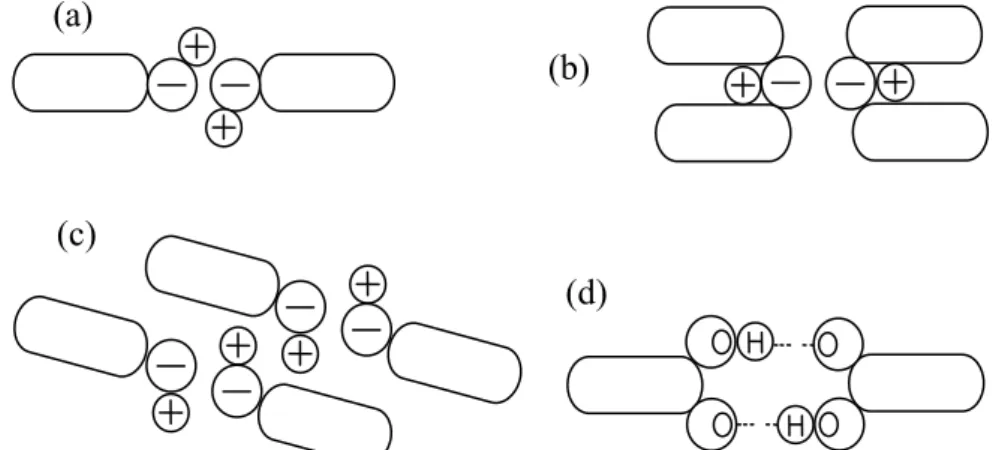
When in polar liquids the electric dipoles are able to arrange themselves in a “head-to-tail” configuration, that is, when their positive end is on the average more in the vicinity of the negative ends of neighboring molecules (Figs. 1a, c), attractive forces result. However, the structure of the molecules may be such that they prevent a head-to-tail configuration (Fig. 1b), and the resulting head-to-head configuration cause repulsion between the polar molecules [7,8]. Some of the liquids that are used in solvent extraction, especially water, interact by mean of hydrogen bonding. Their molecules have a hydrogen atom attached to a very electronegative element (mainly oxygen and, less effectively, nitrogen), and this hydrogen atom can be bound to the electronegative atom (O, N, or F) of a neighboring molecule, forming a hydrogen bridge. This bond is of considerably greater strength than dispersion and dipole-dipole interactions. If the molecules of a substance can both donate and accept a hydrogen bond, a cyclic dimmer may result that is considerably less polar than the monomers of this substance (Fig. 1d) [9].
Figure 1. Dipole and hydrogen bond interactions. A schematic representation of (a) “head-to-tail” dipole-dipole attractive interactions; (b) “head-to-head” dipole-dipole repulsive interactions, caused by steric hindrance; (c) chainlike dipole-dipole interactions; (d) a cyclic, hydrogen-bonded, dimmer.
(a)
(d) (b)
Many liquids used in solvent extraction are polarity. Their polarity is manifested by a permanent electric dipole in their molecular, since their atoms have differing electronegative. Oxygen and nitrogen atoms, for instance, generally confer such dipolarity on a molecule, acting as the negative pole relative to carbon or hydrogen atoms bonded to them [10,11]. The dipole moment µ characterized such polar
molecules and ranges from 1.15 D (debye unit = 3.336 * 10-30 C.m) for diethyl ether or
chloroform, to 4.03 D for nitrobenzene, and 5.54 D for hexamethyl phosphoric triamide. Substances that do not have a permanent dipole moment (i.e., µ =o) are called nonpolar. When nonpolar liquids are placed in an electric force, resulting in some atomic polarization [12,13].
2. 2. 4. Specific Interactions
Other interactions, not taken account of in the electrostatic model and playing a part in the case of ionic solutes as well as in the case of non-ionic solutes, are called specific interaction. They are related to the particular chemical nature of the solutes and of the solvent in order to distinguish them. These interactions can be considered as chemical bonds established between the solute and molecules S [14]. They are contact interaction of primary at short distance, different from electrostatic interactions, which are interactions at long distance.
In this category are included hydrogen bonds, which are formed between protic solvent molecules (water, alcohols, amines, non-N-disubstituted amides, carboxylic acids) and solutes that are electron pair donors, anions notably. The halide anions, for example, are more strongly solvated in protic dipolar solvents than cations of unit charge of the same size, whilst this difference does not exist in protic dipolar solvents (THF, DMSO, propylene carbonate, acetone, ect.). More than hydrogen bonds are encountered interactions of the electron pair donor-acceptor type (Lewis acid-base), corresponding to the formation of coordination bonds between donor solvent molecules and acceptor solutes (metallic cations notably), or between acceptor solvent molecules and donor solute (anions notably) [15].
2. 2. 5. Solvent-Solute Interactions
When a solute particle is introduced into a liquid, it interacts with the solvent particle in its environment. The totality of these interactions is called the solvation of the solute in the particular solvent. When the solvent happens to be water, the term used is hydration. The apparent molar properties of the solute ascribe to the solute itself the entire change in the properties of the system that occur when 1 mol of solute is added to an infinite amount of solution of specified composition. In an aqueous solution the solute is often ionized and refer it as being an electrolyte solution [16]. However, the solute ions are generally not “bare” ions, but exit as the products of specific interaction, which according to their physical nature may be classified as ion-ion, ion-dipole, or covalent interactions (Fig. 2). Another distinction is based on the chemical nature of the interactions, and classifies them as ion association, hydration or solvation, and complexation (Fig. 3). The two classifications are not synonymous. A complex is generally not the product of a purely covalent interaction. Indeed, complex of ionic contribution may be significant or even exceed the covalent contribution [17].
Ion-Dipole Interaction Solute Ion-Ion Interaction Covalent Interaction
Hydration or Solvation Solute Ion Association Complex Formation
Figure 3. Major reaction in solution, classified according to the nature of the products.
2. 3. Basic Principles for the Solvent Extraction 2. 3. 1. General of Principles
Solvent extraction is used for the separation of organic as well as inorganic compounds. Organic compounds are usually lipophilic (i.e., they dissolve easily in organic solvents) and hydrophobic (i.e., they dislike water). For inorganic substances, and particularly for metals, typically the situation is the opposite. They are lipophobic and hydrophilic [18].
The solvent extraction procedure utilizes non-uniform distribution of substances between two immiscible liquid phases. Enrichment of the substance in one of the phases is dependent on many factors, such as pH, metal concentration, salt concentration, reagent concentration, time and temperature. Under suitable conditions a substance of interest can be transferred to the one phase while unwanted substances are retained in the other. The development and optimization of a solvent extraction process involves considerable experimental effort in determining the most suitable conditions. The principle of the solvent extraction procedure is illustrated in Figures 4 and 5. In an extraction step two substances are furnished at the concentration X and Y, and distribute themselves in different ways between an organic solution containing a reagent (the light phase) and a water solution (the heavy phase) [19].
D
(A): Heavy phase (aqueous solution) (B): Feed containing X and Y
(C): Light phase (organic solution) (D): Light phase containing X1and Y1
(E): Heavy phase containing X2 and Y2
Distribution of X: Dx = X1/X2
Distribution of Y: Dy = Y1/Y2
Separation factor X from Y: F = Dx / Dy
The percentage: %E = 100D / (1+D)
Shaking
B
C
A
E
Figure 4. A schematic representation of solvent extraction.
This is because the substances have different propensities to enter into chemical combination with the reagent in the organic solution. The distribution of a substance between the two liquid phases is described by a distribution factor, which is the quotient
of the concentration of the substance in the organic phase (X1 and Y1) and the
concentration of the sub-stance in the aqueous phase (X2 and Y2). The distribution
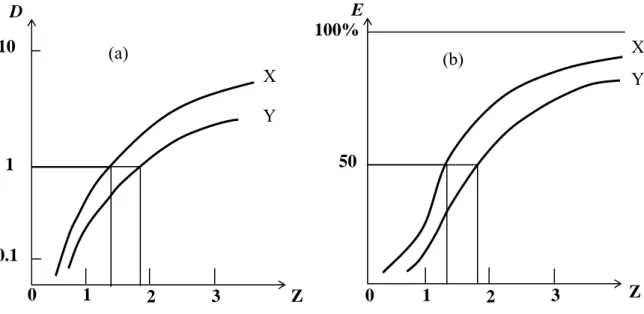
factors and thus the separation factors, which are defined in figure 4, depend on the physical and chemical conditions represented in figure 5 by the variable Z.
E 0 1 2 3 (b) 50 100% D X Y 0 (a) 3 2 1 10 X Y 1 0.1 Z Z
Figure 5. Liquid-liquid distribution plots. (a) The distribution ratio D for two different substances X and Y, plotted against the variable Z of the aqueous phase. D and Z are both on the logarithmic scale. Z may represent pH, concentration of extractant in organic phase, free ligand ion concentration in the aqueous phase, aqueous salt concentration. (b) Same systems showing percentage extraction % E as a function of Z.
2. 3. 2. Parameter Characterizing of the Solute
The transfer of solute from one liquid phase to another involves extraction reactions, which permit the establishment of liquid-liquid distribution equilibria. The distribution of a solute A, equilibrated between an aqueous phase and an organic solvent may be described by an equilibrium equation [20]:
A(aq) ⇔ A(org) (1)
Thus, when this distribution reaches equilibrium, the distribution ratio (D) of the solute concentrations between the two phases is:
D = [A]org / [A]aq (2)
For a metal species M, it can be written
[M]t, org
[M]t, aq DM
Conc. of all species containing M in organic phase
The percentage (% E) of metal extraction was therefore calculated with Eq. (4).
where M may be present the total complexed forms in the aqueous phase, as well as in
different forms in the organic phase, [M]t refers to the sum of the concentrations of all
M species in a given phase (index t for “total”). An important extraction (transfer of the major part of the substance into the organic phase) is characterized by a high value of (D >> 1), whilst a very small value of this distribution ratio (D<< 1) on the contrary characterizes a very feeble extraction. The extraction yield is between 0 for zero extraction and 100 for total extraction. In order to influence the extraction yield, one has available two sorts of factors:
% E 100 D
(1 + D) (4)
(i). Chemical factors modifying the distribution equilibria, thus modifying the values of the distribution coefficients.
(ii). A physical factor, the ratio V = Vorg / Vaq of the volumes of the two phases brought
into contact.
2. 3. 3. System for the Extraction of Ions
The extraction of an ionic species involves systems that are more complex and more varied than in the case of a molecule. In effect, for the reasons of electrical charge-each phase have to remain electrically neutral an ion cannot be transferred alone from one phase to another. Systems involving the coextraction of a cation and an anion, both present initially in the aqueous solution and transferred together into organic phase [21]. A+aq + B-aq ⇔ A+org + B+org (5) (5)
The solvent used for the extraction possesses a low dielectric constant, the extracted ions are associate in order to form electrically neutral ion pairs, when two ions of the same absolute charge. It has been shown that this phenomenon is related to the low dielectric constant (ε) of the solvent. Thus, two ions of opposite charge find themselves subjected, in a medium of low value of the dielectric constant. The predominant extraction system is:
A+aq + B-aq ⇔ (A+B-)org (6)
[A+B-]org
[A+]aq[B-]aq
(7)
Kex
The distribution coefficient of the ion A+ was calculated by the formula (8). It is related to the concentration of the counter-ion in aqueous solution, distribution coefficient (D)
increase with increasing concentration of the counter-ion in aqueous solution (CB+).
DA = Kex [B-]aq (8)
2. 3. 4. Extraction With Chelating Reagents
The term chelate effect refers to the enhanced stability of a complex system containing chelate rings as compared to the stability of a system that is as similar as possible but contains none or fewer rings. From the analytical viewpoint the most
important type of extraction is that of uncharged molecules of chelate MLn, which
undergo no polymerization in the organic phase. The separations of metal ions from each other is to selectively complex one ion using an organic ligand and extract it into an organic solvent. Each ligand can be represented as a weak acid, HL, which loses one proton when it binds to a metal ion through the atom. These ligands can react with many different metal ions, but some selectivity is achieved by controlling the pH. Most complexes that can be extracted into organic solvents must be neutral [22].
[H+]aq [L-]aq
[HL]aq KA
L-(aq) + H+(aq) ⇔ HL(aq) ; (9) (9)
It is assumed that the predominant form of the metal in the aqueous phase is Mn+ and
the predominant form of the metal in the organic phase is MLn. We define the partition
coefficient for ligand and complex as follows: [MLn]aq
[Mn+]aq[L-]aq β
nL
-(aq) + Mn+(aq) ⇔ MLn (aq) ; (10)(10)
HL(aq) ⇔ HL(org) ; KL = [HL]org / [HL]aq (11)
MLn(aq) ⇔ MLn(org) ; KM = [MLn]org / [MLn]aq (12)
From (Eqs. 10 and 12), we can write
Using the value of [L-]org from (Eq.9) given
[MLn]org = KM β [Mn+]aq KnA [HL]naq / [H+]naq (14) D ≈ [MLn]org / [Mn+]aq ≈ KM β KnA [HL]naq / [H+]naq (15)
Since most of the HL is usually in the organic phase, we can use (Eq.11) to rearrange (Eq.15) to its most useful form:
KM β KAn [HL]norg
KLn [H+]naq
D ≈ (16) (16)
(Eq. 16) says that the distribution coefficient for metal ion extraction depends on the pH and the ligand concentration. Since the various equilibrium constant are different for each metal, it is often possible to select a pH where D is large for one metal and small for another.
2. 3. 5. Countercurrent Extractions
By the simple expedient of equilibration of a separated aqueous phase with fresh portions of organic phase, a powerful technique for selective separations is available. The method for carrying out such multiple liquid-liquid extractions is countercurrent extraction, which permits the separation of substances with different distribution coefficient. Countercurrent distribution is a serial extraction process devised by L.C. Craig in 1949 [23]. The object of countercurrent distribution is to separate two or more solute from each other by series of partition between two liquid phases. A necessary condition for separation is that the distribution coefficient for the two solutes be different. The scheme is shown the countercurrent operation in Figure 6. It consists of a series of glass tubes so arrange that the lighter liquid is transferred from one tube to the next. After each extraction, transfer the upper phase to the next tube and add fresh lighter solvent to the original one.
In the beginning the tube 0 contains the mixture of substances to be separated in the heavier solvent and all the other tubes contain equal volumes of the same solvent. The lighter solvent is added to tube 0, extraction equilibrium takes place and the phases are allowed to separate. The upper phase of tube 0 is then transferred to tube 1 and fresh solvent is added to tube 0, and equilibrium is reached again. The upper layers of tubes 0
and 1 are simultaneously transferred to tubes 1 and 2 respectively, and the cycle is repeated and so on [24]. Obviously, substances with higher distribution ratio move faster than those with a lower distribution ratio. The greater difference of the distribution ratio of various substances is the better for separation between each other.
n 1 Y3 2 X2 X1 Y2 Y1 F, Xf
Figure 6. Solvent requirement for countercurrent extraction.
2. 4. Salting-Out Phase Separation 2. 4. 1. Effect of Salts
The problem of the influence of salts on the activity coefficient of nonelctrolytes in aqueous solutions is of both fundamental and applied interest. Salt effect studies can provide considerable information of theoretical importance as to the complex interactions of ions and neutral molecules and as to the unique nature of water as a solvent. The data also have application to such related problems as kinetic salt effects and mechanism of reactions, and they have a practical bearing on the separation of nonelectrolytes from water solutions by salting-out processes.
The effect of salts on solution of nonelectrolytes is a very complex phenomenon. For example, the decidedly varying influence of different salts on the activity coefficient of benzene in water. Most electrolytes salt out benzene, although in markedly varying degrees, but there are some which actually salt in this inert solute [25,26]. The phrases “salting-out” and “salting-in” are now generally used to denote, respective, an increase and a decrease in the activity coefficient of the nonelectrolyte with increasing concentration of electrolyte.
It was suggested by Kruyt and Robinson [27] that the variations in the specific effect of salts on different nonelectrolytes might arise from the fact that the water dipoles are oriented in the hydration shell around an ion. These author pointed out that if there is
also a preferred orientation of water molecules toward a polar nonelectrolyte, ions of one sign should have a tendency to promote its solubility while those of opposite sign, which orient water molecules unfavorably, should have an increased salting-out effect. It pointed out that local solvent structure should play a significant role [28-30].
The salting-out results from the effective removal of water molecules from their solvent role due to hydration of the ions were discussed by Eucken and Hertzberg [31]. Although salting-out must largely be due to a preferential attraction between ions and water molecules, which can loosely be referred to as “hydration” [32]. The variation with salts concentration of the distribution of a nonelctrolyte between aqueous solutions
and an immiscible nonaqueous reference phase gives a simple method for determining fi
(fi is molar activity coefficient of i in salt solution). If for two experiments, one
involving pure water and the other a salt solution, the concentration of nonelectrolyte in the reference phase is constant.
The chief advantages of this method are: it is simple experimentally, equilibrium is established rapidly, one can always arrange the experiment to have a low concentration of nonelectrolyte in the aqueous phase, and it can be used with nonelectrolytes which are miscible with water.
The chief disadvantage is that it is frequently difficult to find a reference solvent, which is sufficiently immiscible with water, and the distribution ratio of the nonelectrolyte is such as to give adequate accuracy in the determination of fi.
2. 4. 1. Phase Separation by Salting-Out Agents
Phase separation of homogeneous mixed solvents can be achieved by addition of salts or application of changing temperatures to organic solvents. For example, phase
separation occurs by addition of (NH4)2SO4 to polyethylene glycol [33], or by raising
the temperature to 30oC in the diethyl ether-water system [20]. The salt-induced phase
separation between acetonitrile and aqueous solution was observed by addition of a variety of inorganic and organic electrolytes [34]. When inorganic salt is added to a mixture of water with organic solvent, phase separation occurs. This phenomenon is referred to a salting-out and can be explained by the following mechanism: Electrolytes are hydrated but the organic solvent molecules are hard to be hydrated. Thus, the solubility of organic solvent molecular decreases in the aqueous solution [35].
A theoretical investigation on salting-out phase separation in aqueous solution by using Kirkwoo-Buff solution theory was suggested that micro heterogeneities in local structure of the mixture are in favor of salting-out phase separation. The mechanism of salting-out phase separation based on preferential solvation of the salt ions by water and the inherent micro heterogeneities in the mixed solvent. It was found that beyond large differences in affinities of the salt ions to the organic components and water molecules, micro heterogeneities in local structures of the mixed solvent are also in favor of salting-out phase separation in a hydro-organic mixed solvent [36].
Preferential solvation is observed in almost every chemical process taken place in mixed solvent and it is an additive result of solute-solvent and solvent-solvent interactions. The solvation in aqueous solution of several water-miscible organic solvents including methanol, ethanol, 1-propanol, 2-propanol, acetone, and acetonitrile have been studied by using 4-(N,N-dimethylamino) benzonitrile (DMABN);
2,6-diphenyl-4-(2,4,6-triphenylpyridium)-1-phenolate (ET-30); and pyrene(Py) as
solvatochromic indicators [37].
2. 4. 2. Salting-out Extraction
Phase separation occurs in aqueous solution of some water-miscible organic solvents by addition of electrolytes. This phenomenon, known as salting-out phase separation, is useful for extraction or concentrations of metal-chelates, ion-pairs, and organic materials, which cannot be extracted by conventional oil-water extraction method [38,39]. The salting-out effects have been interpreted on the basis of changes in the activity coefficient of the uranyl nitrate [40]. Groenewald [41] recently illustrated the influence of these effects on the liquid-liquid extractions, using ethyl ether and benzene as organic solvents. The complications due to salt activity coefficients are generally assumed to be unity.
A phase separation occurs from a mixed solvent of water and water-miscible organic solvent like acetonitrile upon addition of electrolyte to the mixed solvents, i.e., salting-out, due to decreased solubility of the organic solvent in aqueous solution [42]. The separated organic solvent contains water and salts, resulting in large donor and acceptor abilities compared to those of the corresponding pure organic solvent [43]. Thus, the solvent can easily extract ion-pair complexes such as tris (2,2’-bipyridine) cobalt(II)
chloride [44] and cadmium(II) iodide [45]. A further advantage is a possibility of high polarity, leading to extract hydrophilic ions that are not extracted into conventional organic solvents like chloroform [35 ].
The salting-out technique has long been used for extraction of metal-chelates, ion-pair, or organic material, high-performance liquid chromatography [46,47], polarography [45], and absorption spectrophotometry [48]. Application of the salting-out to solvent extraction of ionic species will become easier when we understand the chemical properties of the phase separated solvent, because the solvents will have high polarity resulting from dissolution of water and electrolyte into the solvents by salting-out, in addition to water-miscible solvents themselves.
2. 5. Formation Complexes of Metal Ions in Aqueous Solution
Metal ion complexation in the aqueous phase is an essential factor in solvent extraction of metals. Such complexation can provide a sufficient difference in extractability to permit separation of the metals. An understanding of how these factor work for different metals and different ligands can be major value in choosing new extraction systems for possible improvement in the separation of metals. The extent of metal ion complexation for any metal-ligand system is defined by the equilibrium constant, which is termed the formation constant for metal-ligand interaction. Since most ligand bind to the metal ion in a regular sequence, equilibria are established for the formation difference ratio between metal and ligand. The simple complexes can serve to illustrate the principles and correlations of metal ion complexation [49]. Defining M as the metal and L as the ligand (without indication of charge for simplicity). In only considering complexes that are mononuclear, a single central metallic cation associated with one or several ions or molecules of a ligand L, the successive complexation reaction can be written as:
M + L ⇔ ML (17) ML + L ⇔ ML2 (18)
or, generally
The equilibrium constants for these stepwise reactions are expressed by successive formation constant as Ki. In this way, the number n, relating to the highest complex that
can be formed, depends on the coordination number of the metallic ion and the number of the ligand can give, either by series of constants Ki or by that of the constants βi.
(with 1 ≤ i ≤ n). The cumulative combination of those equilibrium and that of their
constant leads to a consideration also of the overall formation constants.
[M Li] [Mli-1] [L] (12) Ki (20) [M Li] [M] [L]i = K1 K2…..Ki βi = (13) (21)
Sometimes the complexation reaction (Eq.9) is written as occurring between M and an acidic ligand HL.
M + HL ⇔ ML + H (22) In which case the protonated stepwise formation constant is:
[M L] [H]
[M] [HL] (15)
Ki (23)
For more complicated complexes, it is common to use an overall stability constant. According to international rule (IUPAC 1987) [50], such constants may be written in several ways, the important thing being that it is always defined in the text. Thus, the formation of the complexes MmLn(OH)p is actually written in three ways in the present:
mM + nL + pOH ⇔ MmLn(OH)p ; βmnp (24)
Because hydrolysis reactions often occur in acidic solutions, the protonated overall formation constant may be preferred.
mM + nL + pH2O ⇔ MmLn(OH)p + pH ; βmnp (25)
A quite general and simplified way of writing a reaction is
pM + qH + rL ⇔ MpHqLr ; βpqr (26)
For hydrolysis, a negative q is used to refer to the hydroxo species. This symbolism for the reaction to form ML.
However, the formation of multiligand complexes is more complicated. For example: M + 3L ⇔ ML3 ; β103 = [ML3] / [M] [L]3 = K1.K2.K3 (28)
This can be generalized as:
n
∏
i=1 Ki
M + nL ⇔ MLn ; β10n = [MLn] / [M] [L]n = (29)
Some ligands retain an ionizable proton. For example, depending on the pH of the
solution, metals complex with HSO4-, SO42- or both. In the formation of MHSO4, the
stability constant may be written as:
M + HSO4 ⇔ MHSO4 ; K1 = [MHSO4] / [M] [HSO4] (30)
or M + H + SO4 ⇔ MHSO4 ; β111 = [MHSO4] / [M] [H] [SO4] (31)
Here β111 = K1 / Ka2
where Ka2 is the dissociation acid constant for HSO4-. Alternately, some complexes are
References
[1] Y. Marcus, The Properties of Solvents, John Wiley & Sons, New York. 1998. [2] Proceeding to be published through the Chemical Society of Japan, Kyoto. 1990. [3] T. Sekine, Y. Hasegawa, Solvent Extraction Chemistry, Marcel Dekker,
New York. 1997.
[4] A. Ben-Naim, Y. Marcus, J. Chem. Phys. 70 (1984) 2016.
[5] E. Hecker, Verteilungsverfahren in Laboratorium, Verlag Chemie, Weinheim Bergstrasse, 1955.
[6] R. E. Treybal, Liquid Extraction, McGraw-Hill, New York, 1963. [7] Y. Marcus, J. Solution Chem. 21 (1992) 1217.
[8] Y. Marcus, J. Solution Chem. 20 (1991) 929. [9] Y. Marcus, J. Solution Chem. 25 (1996) 455.
[10] M. J. Kamlet, J. L. Abboud, R. W. Taft, J. Am. Chem. Soc. 99 (1977) 6027. [11] J. L. Abboud, M. J. Kamlet, R. W. Taft, J. Am. Chem. Soc. 99 (1977) 8325. [12] Ch. Reichardt, Solvents and Solvent Effects in Organic Chemistry,
VCH, Weinheim, 2nd ed. 1988.
[13] M. Chastrette, Tetrahedron 35 (1979) 1441.
[14] L. S. Lias, J. E. Bartmess, J. F. Liebman, J. L. Holmes, R. D. Levin, W. G. Mallard, J. Phys. Chem. Ref. Data 17, Suppl. 1 (1988).
[15] J. A. Riddick, W. B. Bunger, T. K. Sakano, Organic Solvents, Wiley-Interscience, New York, 4th ed. 1986.
[16] Y. Marcus, J. Solution Chem. 13 (1984) 599.
[17] Y. Marcus, Ion Solvation, John Wiley & Son, Chichester. 1985.
[18] H. Stephen, T. Stephen (eds.), Solubilities of Inorganic and Oganic Compounds. Pergamon Press, London, 1963.
[19] J. Wisniak, A. Tamir, Liquid-Liquid Equilibrium and Extraction. Elsevier, Amserdam. 1980.
[20] J. Rydberg, C. Musikas, G. R. Choppin, (Eds.), Principle and Practices of Solvent Extraction. Marcel Dekker, New York. 1992.
[21] B. Trémillon, Reactions in Solution, John Wiley & Sons, New York. 1993. [22] J. Stary, The Solvent Extraction of Metal Chelates, Pergamon. 1964. [23] L. C. Craig, O. Post, Anal. Chem. 21 (1949) 500.
[24] G. M. Ritcey, A. W. Ashbrook, Solvent Extraction-Principles and Applications to Process Metallurgy, Elsrvier, Amsterdam. 1979.
[25] J. H. Saylor, A. I. Whitten, I. Claiborne, P. M. Gross, J. Am. Chem. Soc. 74 (1952) 1778.
[26] W. F. McDevit, F. A. Long, J. Am. Chem. Soc. 74 (1952) 1090.
[27] H. R. Kruyt, C. Robinson, Proc. Acard. Sci. Amsterdam 29 (1926) 1244. [28] D. Eley, Trans. Faraday Soc. 35 (1939) 1281.
[29] D. Eley, M. G. Evans, Trans. Faraday Soc. 34 (1938) 1093. [30] H. S. Frank, M. W. Evans, J. Chem. Phys. 13 (1954) 507. [31] A. Eucken, G. Z. Hertzberg, Physik. Chem. 195 (1950) 1. [32] O.Ya. Samoilov, V. I. Tikhomirov, Ekstraksiya 2 (1962) 34. [33] W.J. Ray, C. E. Bracker, Cryst. Growth 76 (1986) 562. [34] Y. Nagaosa, K. Sakata, Talanta 46 (1998) 647.
[35] M. Tabata, M. Kumamoto, J. Nishimoto, Anal. Chem. 68 (1996) 758. [36] W. F. Furter, R. A. Cokk, Int. J. Heat Transfer 10 (1967) 23.
[37] Y. G. WU, M. Tabata, T. Takamuku, A. Yamaguchi, T. Kawaguchi, N. H. Chung, Fluid Phase Equilibria 192 (2001) 1.
[38] C. E. Matkovich, G.D. Christian, Anal. Chem. 45 (1973) 1915. [39] B. J. Mueller, R. J. Lovett, Anal. Chem. 59 (1987) 1405.
[40] I. L. Jenkins, H. A. C. Mckay, Trans. Faraday Soc. 50 (1954) 107. [41] T. Groenewald, Anal. Chem. 43 (1971) 1678.
[42] J. Z. Setchenov, Phys. Chem. 4 (1889) 117.
[43] M. Tabata, M. Kumamoto, J. Nishimoto, Anal. Sci. 10 (1994) 383. [44] Y. Nagosa, Anal. Chim. Acta 120 (1980) 279.
[45] T. Fujinaga, Y. Nagosa, Bull. Chem. Soc. Jpn. 53 (1980) 416. [46] B. J. Mueller, R. J. Lovett, Anal. Chem. 59 (1987) 1405.
[47] D. C. Leggett, T. F. Jenkins, P. H. Miyares, Anal. Chem. 62 (1990) 1355. [48] H. Kawamoto, H. Akaiwa, Chem. Lett. 21 (1973) 259.
[49] F. A. Cotton, G. Wilkinson, Advanced Inorganic Chemistry, Wiley, New York. 1976.
[50] H. Freiser, G. H. Nancollas, Compendium of Analytical Nomenclature. Definitive Rules. IUPAC. Blackwell Scientific Publications, Oxford. 1987.
CHAPTER THREE
PHASE SEPARATION OCCURS BY THE ADDITION OF SODIUM CHLORIDE TO A MIXTURE OF 2-PROPANOL AND WATER