Rumination in Posttraumatic Growth Among
Parents of Children With Cancer: Comparisons
With Parents of Children With Chronic Disease.
著者
Wataru Irie, Hitoshi Shiwaku, Kanako Taku,
Yuko Suzuki, Yukiko Inoue
journal or
publication title
Cancer Nursing
volume
2019
year
2019-06-28
URL
http://hdl.handle.net/10097/00128030
doi: 10.1097/NCC.0000000000000731Title:
Roles of Re-Examination of Core Beliefs and Rumination in Post-traumatic Growth among
Parents of Children with Cancer: Comparisons with Parents of Children with Chronic Disease
Authors:
Wataru IRIE RN, PhD; Hitoshi SHIWAKU RN, PhD; Kanako TAKU PhD; Yuko SUZUKI RN,
MSN; Yukiko INOUE RN, PhD
Affiliations:
Tohoku University Graduate School of medicine, Sendai, Miyagi, JAPAN (Irie, Shiwaku,
Suzuki, Inoue)
Department of Psychology, Oakland University, Rochester, Michigan, USA (Taku)
Sendai Akamon College, Sendai, Miyagi, JAPAN (Inoue)
Correspondence: Wataru Irie, RN, MSN
Department of Child Health Nursing, Division of Family Nursing, Postgraduate Course of Health
Sciences, Tohoku University Graduate School of medicine,
2-1, Seiryou-machi, Aoba-ku, Sendai, Miyagi, 980-8575 Japan
This work was supported by JSPS KAKENHI Grant Number JP15H06561. The authors would
like to thank all of the families who participated and the research collaborators who contributed
to this study.
Conflict of interest
can provide the opportunity to experience psychological growth, known as post-traumatic growth (PTG).
Objective: To evaluate the role of cognitive processing in PTG among parents of childhood cancer
survivors (CCS) based on the PTG theoretical model. We compared the model between parents of CCS and parents of children with chronic disease (CCD) to determine how the role of cognitive processing in PTG is different depending on the children’s illness.
Methods: Final sample consisted of 78 parents of CCS and 44 parents of CCD. The survey included
standardized measurements assessing re-examination of core beliefs, intrusive and deliberate rumination, post-traumatic stress symptoms, and PTG. The hypothetical relationships among the variables were tested by covariance structure analysis.
Results: PTG among parents of CCS had significantly strong association with re-examination of
core beliefs, but not with deliberate rumination. Re-examination of core beliefs was significantly more likely to foster PTG among parents of CCS, whereas deliberate rumination was significantly more likely to be associated with PTG among parents of CCD.
Conclusions: For parents of CCS, re-examination of core beliefs had a greater impact on PTG than
deliberate rumination. Our results suggest that support should focus on the process of re-examining core beliefs in facilitating PTG among parents of CCS.
Implication for Practice: Nurses should provide parents of CCS with reassurance regarding their
Introduction
Having a child with a severe illness is a highly stressful experience for parents. Since such an experience has a long-term negative impact, the literature has focused on alleviating negative symptoms (e.g., mental anguish) and preventing the development of mental disorders1-3.
Psychological reactions sometimes observed in parents whose children are affected by cancer have been classified as post-traumatic stress symptoms (PTSS) or post-traumatic stress disorder
4-6. Children with cancer and their parents and family members are reportedly at a high risk of
developing PTSS during cancer treatment, additionally this risk could last throughout the long-term follow-up after the treatment7-10.
Studies have indicated, however, that the impact of a traumatic experience is not always negative and can provide the opportunity to experience psychological growth. This phenomenon, known as post-traumatic growth11 (PTG), is defined as “a positive change that individuals experience as
a result of the psychological struggle with a traumatic event12.” PTG is comprised of five different domains: (1) relating to others, (2) new possibilities, (3) personal strength, (4)
appreciation of life, and (5) spiritual change13. Experiencing PTG increases mental preparedness for future stress and leads to an improved sense of well-being14, thus it is important to investigate the mechanisms of PTG experiences. Quantitative and qualitative studies indicate that the
parents of childhood cancer survivors also experience PTG15,16.
The PTG theoretical model integrates several existing theories, known concepts, and
literature11,12,17 to depict how PTG can affect positive life changes. According to the model, the PTG process begins with an experience of a traumatic event (e.g., having a child with cancer). The experience impacts an individual’s established belief system (e.g., belief that my child is perfectly healthy), contributing to a psychological struggle that leads to cognitive and emotional
responses. The period of confusion and struggle can contribute to a strengthened, even new psychological perspective among parents following their child’s diagnosis. Parents review and examine their fundamental beliefs including about self and this process can be the catalyst for the possibility of PTG. According to the PTG model, this cognitive processing is essential for
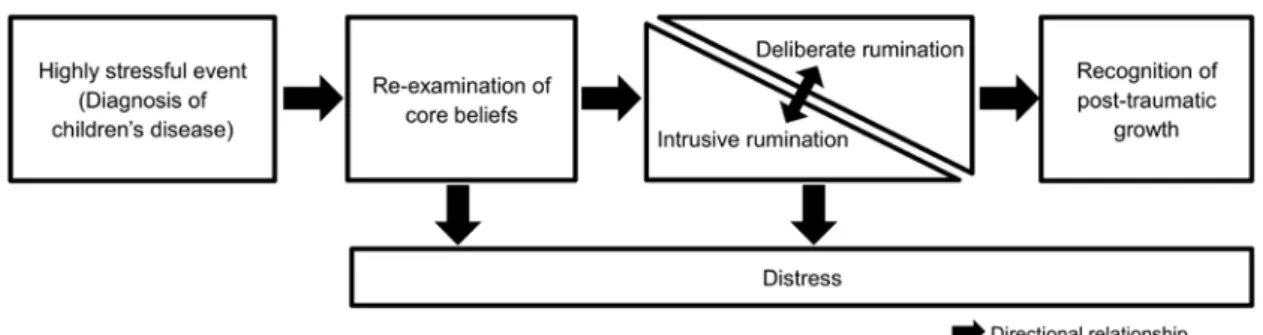
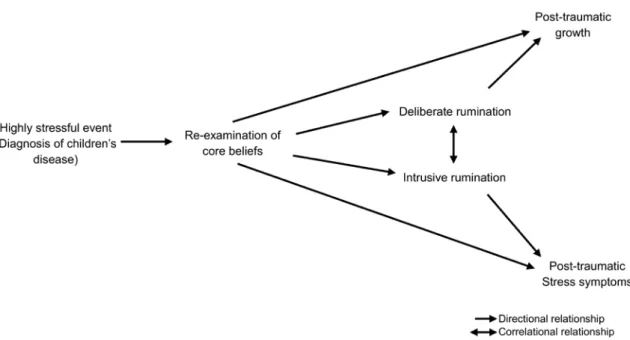
growth,12 and involves three major elements: 1) re-examination of core beliefs that were shaken and challenged by experiencing a trauma; 2) intrusive, often automatic and negative, rumination that is likely to occur as a result of experiencing a trauma; and 3) more deliberate constructive rumination that involves making meaning out of a traumatic experience. Re-examination of core beliefs and deliberate rumination are the two major factors promoting PTG18 (Figure 1).
The concept of “re-examination of core beliefs” involves dismantling personal assumptions,19 including how a person plans and predicts, and contributes to how humans and events are
understood17. Traumatic experiences make people re-examine their fundamental beliefs about the
world and their place in it18.
Ruminations are repetitive thoughts, and a pondering on what happened20 that are often
fostered by the disruption of core beliefs. The early phase of rumination is mainly intrusive, occurring when people think about the disruptive side of a traumatic experience, even when such thoughts are not desired. Intrusive rumination occasionally makes the shift to deliberate
rumination, which is more controlled and focused on making sense of the experience, problem-solving, reminiscence, and anticipation21. This deliberate quality of rumination appears important
for the subsequent recognition of PTG12.
Understanding the cognitive process of PTG among parents of a childhood cancer survivor (CCS) will help clinicians to provide support that fosters PTG among these parents. The literature about parents of CCS is focused on factors that facilitate PTG such as hope22 and
illness perceptions following treatment23. Studies have not achieved consistent results regarding which cognitive factors explain PTG. Therefore, it remains unclear whether effective support for PTG in parents of CCS should focus on the re-examination of core beliefs, deliberate rumination, or both equally. In addition, although PTSS and PTG can co-occur after a traumatic event24,
these outcomes may be predicted via different pathways25. Thus, it is important to clarify the potentially different roles of the cognitive processing in PTG and PTSS, as it leads to effective clinical practice that may focus on these factors. We also examine whether relationships among cognitive factors, PTSS, and PTG are specific to parents of CCS. Having a child with cancer may evoke higher severe initial shock than having a child with chronic disease (CCD) because it is well-known that childhood cancer is the highest cause of death by a childhood illness,
especially in Japan26, which in turn, may lead to a differential cognitive processing by parents. In the current study, we compared the parents of CCD with those of CCS to examine the different roles of cognitive processing, such as challenged core beliefs and two types of rumination in PTG and PTSS.
This study had two primary aims, to: 1) clarify how PTG and PTSS among parents of CCS are associated with the extent to which core beliefs were re-examined after the child was diagnosed with cancer and subsequent intrusive and deliberate rumination; and 2) determine whether the relationships among re-examination of core beliefs, rumination, PTG, and PTSS are equivalent between the parents of CCS and parents of CCD.
Overall, five hypotheses were derived based on the PTG theoretical model18 and
literature19,20,25 (Figure 2): 1) re-examination of core beliefs will lead to intrusive rumination and deliberate rumination; 2) re-examination of core beliefs will increase PTG and PTSS; 3)
intrusive and deliberate rumination will be correlated with each other; and 5) PTSS and PTG will be unrelated.
Methods Participants
We approached 199 parents of CCS and 120 parents of CCD during a five-month period in 2015 who met the following criteria: 1) a child diagnosed with cancer or chronic disease at 6 months to 15 years of age; 2) at least six months had passed since the completion of inpatient hospital treatment; 3) follow-up treatment was ongoing on an outpatient basis; 4) parent speaks Japanese; and 5) the child did not have congenital abnormalities (i.e., Down’s syndrome) because the parents’ reaction may be additionally affected by such.
Using the Japanese definition of medical aid for chronic pediatric diseases of specified categories, “chronic disease” is defined as a disease causing long-term limitations to daily life and/or requiring long-term management because of illness (e.g., type 1 diabetes, juvenile
idiopathic arthritis, and inflammatory bowel disease). Surveys were conducted at three hospitals in Eastern Japan (Tokyo and Miyagi). At each hospital, more than 20 patients with cancer had been treated during the year before the survey. Consent for study participation was obtained from 86 parents of CCS and 47 parents of CCD. Responses with missing data were excluded, and the analyzed data were obtained from 78 parents of CCS (39.2%) and 44 parents (36.7%) of CCD.
Measures
Japanese version of the Post-traumatic Growth Inventory (PTGI-J)
The PTGI is widely used to assess PTG resulting from a psychological struggle with a traumatic event13. The original PTGI included five factors with 21 items: Relating to Others (7
Appreciation of Life (3 items). We used the PTGI-J developed by Taku et al.27 Due to different cultural backgrounds, the PTGI-J includes four factors with 18 items: Relating to Others (6 items); New Possibilities (4 items); Personal Strength (4 items); and Spiritual Change and Appreciation of Life (4 items). The participants rated the items using a 6-point Likert scale ranging from 0 (I did not experience this change as a result of this crisis) to 5 (I experienced this change to a very great degree as a result of this crisis) based on how the degree of each change had been experienced in their current way of living as a result of their child’s diagnosis. The PTGI-J has adequate validity and internal consistency (Cronbach’s α = 0.90) for use in university students in Japan. The Cronbach’s α for the current study among parents of CCS and parents of CCD were 0.95 and 0.94, respectively.
Japanese version of the Impact of Event Scale-Revised (IES-R-J)
The IES-R-J is a 22-item self-report questionnaire used to examine PTSS within the past week related to a specific traumatic event28. The original version was developed by Weiss in the
USA29. The scale includes three factors: Avoidance (8 items); Intrusion (8 items); and
Hyperarousal (6 items). Since health insurance applications include a psychological examination in Japan, the IES-R-J is the most widely-used scale for measuring PTSS in parents of CCS. Participants rate the items on a 5-point Likert scale ranging from 0 (not at all) to 4 (a very great degree) based on how frequently each symptom was experienced within the past week at the survey point. Greater than 24 points is considered a severe level of PTSS. The Cronbach’s α of the total score for the current study was 0.95 among the parents of CCS and 0.96 among parents of CCD.
Japanese version of the Core Beliefs Inventory (CBI-J)
include a broad range of beliefs that are thought to comprise the assumptive world that may be challenged by experiencing a potentially traumatic life event19. The CBI and CBI-J included nine
items; however, with the approval of the original authors, we slightly modified three items to make them easier to understand. The participants were instructed to reflect upon the “diagnosis of disease in your child” and to indicate the extent to which it led them to seriously examine each core belief. The participants rated the items on a 6-point Likert scale ranging from 0 (not at all) to 5 (a very great degree). The Cronbach’s α for the total score in the current sample was 0.89 for both parents of children with cancer and chronic disease.
Japanese version of the Event-related Rumination Inventory (ERRI-J)
The ERRI-J was used to assess two different types of rumination (i.e., intrusive and deliberate rumination) related to a child’s disease30. The original version of the ERRI20 as well as the Japanese translated version has 20 items: intrusive rumination (10 items) and deliberate rumination (10 items). Although the original version of the ERRI involves two different time points (“during the weeks immediately after the event” and “in the last few weeks”), we asked only “in the last few weeks after the diagnosis of disease in your child” in the present study. Parents responded on a 4-point Likert scale ranging from 0 (not at all) to 3 (often). The
Cronbach’s α among parents of CCS and CCD were 0.94 and 0.95 for intrusive rumination and 0.95 and 0.97 for deliberate rumination, respectively.
Study procedures
The present study was conducted with the approval of the ethical review organization of Tohoku University, Faculty of Medicine (2015-1-1), St. Luke’s International Hospital (15-R023), and Miyagi Children’s Hospital (247). After identifying the target candidates who met the
when they visited the hospital as an outpatient. The researchers explained the purpose of the study in detail using an information form and questionnaire in a private room only after the candidates provided consent to listen to a detailed explanation of the study. The participants were asked to complete the survey packet at home if they agreed to participate. Returning the survey was then considered confirmation of consent. Survey responses were later returned by mail.
Data analysis
Analyses were performed using SPSS Statistics for Windows Ver. 23 (IBM, Inc., Armonk, NY, USA). A bilateral P value was considered significant. Initially, descriptive statistics were
calculated; they were then compared between the parents of CCS and parents of CCD. Ages of the parents and their children and the time since diagnosis were compared using t-tests. Parent’s sex, education, religious faith, child’s sex, presence or absence of siblings, presence or absence of treatment, and activities of daily living were examined using chi-square tests. Pearson’s correlation coefficients were examined to assess relationships among variables.
Next, the hypotheses were tested using Amos for Windows ver.23 (IBM, Inc., Armonk, NY, USA). We first examined whether the two groups of parents conformed to the hypothesis model. Conformity was evaluated using a chi-square test, goodness-of-fit index (GFI), adjusted
goodness-of-fit index (AGFI), root mean square error of approximation (RMSEA), and Akaike information criteria (AIC)31. The differences in the degree of impact of each parameter between the parents of CCS and parents of CCD were examined by multiple group simultaneous analysis. When evaluating the model, we set equality constraints for some paths in reference to the
correlation coefficient of each variable. Results were considered significant for a P value of 5% in the multiple group simultaneous analysis with a standard normal distribution, when the absolute value of the test statistic for a difference between parameters was > 1.96 or ≤ 1.96.
Results Participants
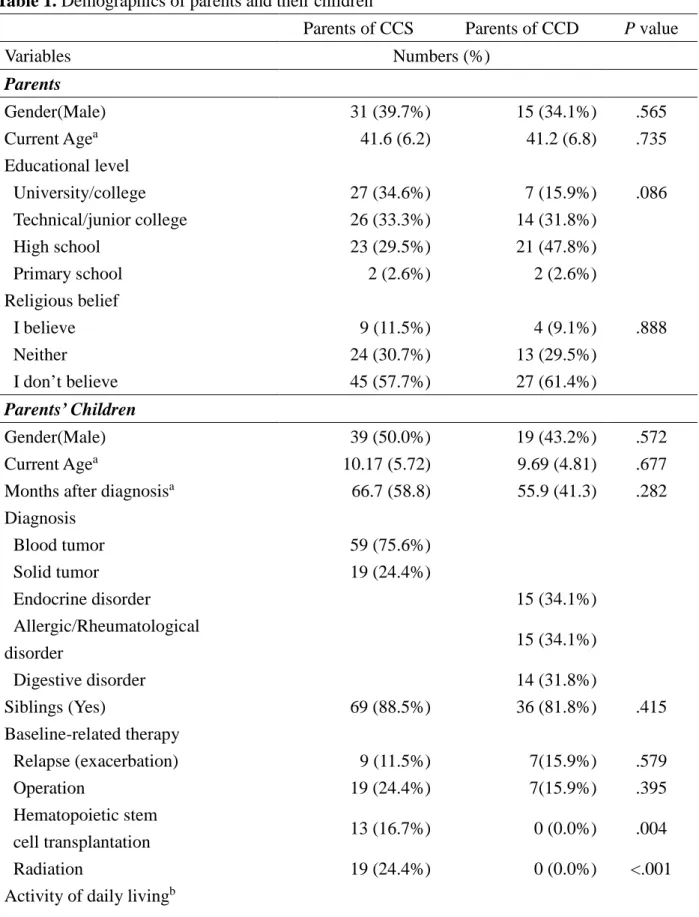
The participant characteristics are summarized in Table 1. In both groups, responses were obtained from more mothers than fathers. There were no significant differences between the parents of CCS and parents of CCD for other demographic variables. The power in an unpaired t-test was 0.75 in the following setting: the α error was 0.05 and effect size was moderate (0.50).
Comparisons of cognitive processing, PTG, and PTSS between the two groups
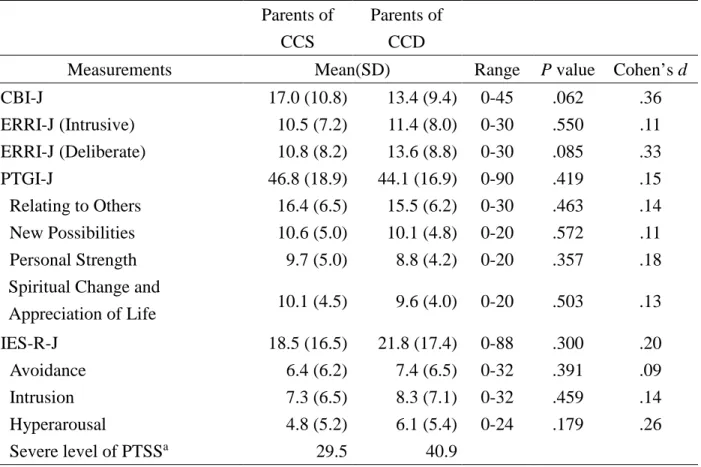
There were no differences in the mean total score of the PTGI-J between the parents of CCS and parents of CCD (Table 2). No differences were obtained in the IES-R-J scores, suggesting that the PTSS level was similar between the two groups. The average total score for the CBI-J was slightly higher among the parents of CCS than among parents of CCD. For the ERRI-J, no differences were found for either intrusive or deliberate rumination between the two groups.
Correlation analyses
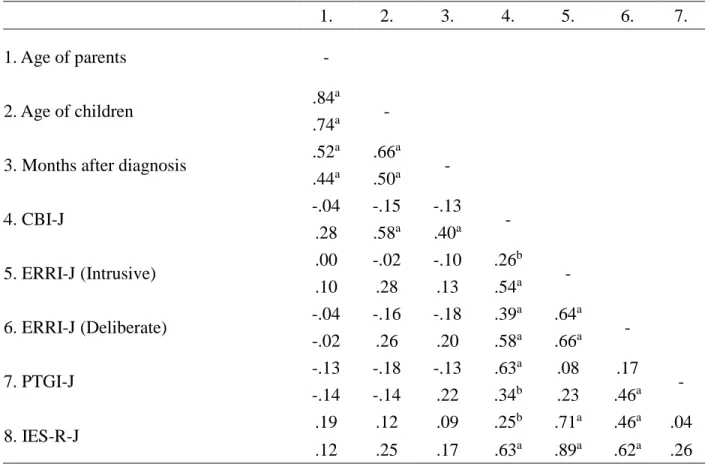
The CBI showed significant positive correlations with regards to all variables for parents of CCS and parents of CCD. Intrusive rumination showed no significant relationship with PTG in both groups, whereas deliberate rumination exhibited a significant positive relationship with PTG but only with the parents of CCD. No significant correlation between deliberate rumination and PTG was obtained for the parents of CCS. Additionally, no significant relationship was observed between PTG and PTSS among the parents of CCS and parents of CCD (Table 3).
Multiple Group Structural Equation Modeling
First, the hypothesized model was tested using structural equation modeling. The model showed excellent fit to the data: χ2 = 1.32, df = 3, P = 0.724, GFI = 0.993, AGFI = 0.966,
0.990, AGFI = 0.949, RMSEA = 0.000, and AIC = 25.15 for parents of CCD.
Second, we compared the path coefficients in the model to determine the equivalence between the two groups. Model 1 involves no constraints. Model 2 constrains the path coefficients from re-examination of core beliefs to deliberate and intrusive rumination, from intrusive rumination to PTSS, and the covariance between intrusive and deliberate rumination in the two groups. Model 3 constrains the path from intrusive rumination to PTSS and covariance between intrusive rumination and deliberate rumination. Finally, Model 4 constrains all path coefficients. By comparing the four models, Model 3 demonstrated the best fit to the data by demonstrating the lowest score on the AIC. The AIC score for all four models were as follows: 52.80 for Model 1, 50.16 for Model 2, 49.37 for Model 3, and 56.05 for Model 4.
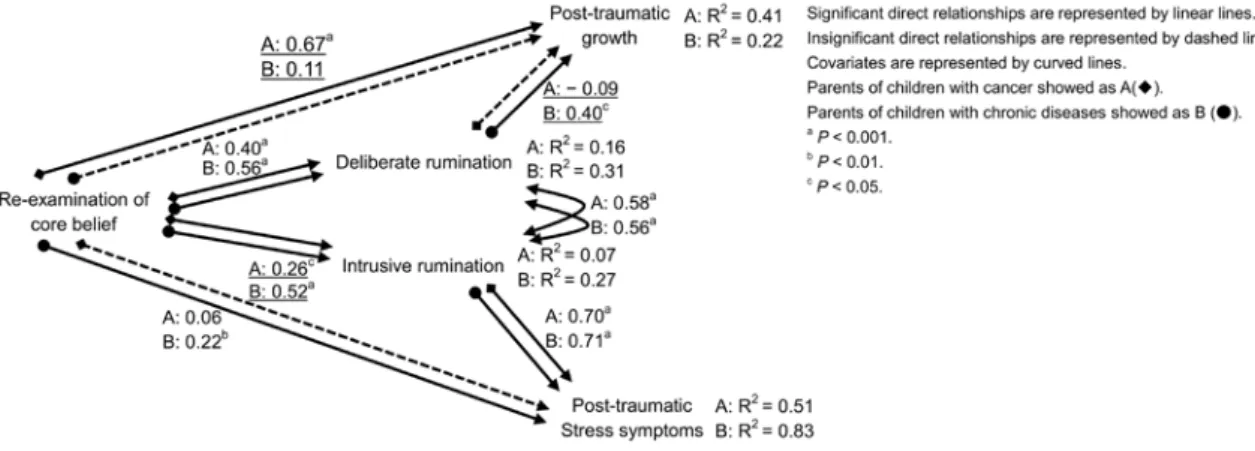
Third, we used a multiple group simultaneous analysis to assess the differences between the parents of CCS and parents of CCD. Significant differences were observed in a path from CBI to intrusive rumination, from CBI to PTG, and from deliberate rumination to PTG, as shown in Figure 3. The test statistics for the parameter differences were −2.25 from CBI to intrusive rumination, 3.02 from CBI to PTG, and −2.59 from deliberate rumination to PTG.
Discussion
We examined how PTG among parents of CCS is associated with the extent to which core beliefs are re-examined after the child was diagnosed with cancer and the subsequent intrusive and deliberate rumination. As a result of the covariance structure analysis, re-examination of core beliefs had a stronger impact on PTG than deliberate rumination among parents of CCS, but not among parents of CCD. Moreover, parents of CCS experienced PTG to the same degree as parents of CCD. However, the degree to which the perceived re-examination of core beliefs influenced intrusive rumination and to which deliberate rumination influenced PTG were
significantly lower in parents of CCS than in parents of CCD.
Firstly, PTG among parents of CCS was more strongly associated with the perceived re-examination of core beliefs than with deliberate rumination. Based on the PTG theoretical model, we hypothesized that PTG would be associated with a greater extent by the disruption of core beliefs than deliberate rumination, which was supported by the current study. The results are consistent with the findings of earlier studies of cancer patients19,32. Furthermore, in Japanese earthquake victims, PTG was influenced to a greater extent by re-examination of core beliefs than by deliberate rumination33, indicating that the impact of triggering event plays a major role in determining PTG. However, it is noteworthy that deliberate rumination did not have a direct impact on PTG among parents of CCS in the current study. This may be because having a child with cancer is so shocking that it disrupts parents’ core beliefs, and thus, the impact of disrupted core beliefs on PTG surpasses the impact of cognitive efforts that may subsequently occur. Although one previous study also indicated that deliberate rumination had no relevance to PTG among cancer survivors34, that survey was conducted after approximately five years or longer
since the diagnosis of cancer. Thus, the time since the event may be another reason for the results obtained in the present study. In addition, PTG among parents of CCS has been suggested to occur by both cognitive processes (e.g., meaning making)35, and affective processes36 (e.g.,
depression [Lindwall et al.37] and anxiety [Nakayama et al.38]). Although we did not focus on the role of affective processes in PTSS and PTG in the current study, examining both processes will help develop more effective support for parents of CCS. However, it should be noted that rumination was induced by putting only the focus on “during the last few weeks” in the current research. Studies assessing rumination “soon after the traumatic experience” showed positive correlations between deliberate rumination and PTG33. Thus, the degree of deliberate rumination
soon after a traumatic experience, rather than at a later point, might serve as a stronger predictor of PTG.
Second, the parents of CCS experienced PTG to the same extent as those of CCD. Re-examination of core beliefs produced intrusive rumination for both groups of parents as hypothesized. However, the relationships were weaker in parents of CCS. Re-examination of core beliefs also led to deliberate rumination regardless of children’s type of illness, supporting the PTG theoretical model. PTSS among parents of CCS could have been lower if more time had passed since the diagnosis39. Compared with the parents of CCD, parents of CCS might have completed treatment, leading to less intrusive rumination, however, the current study revealed no differences in the PTSS level between the two groups of parents. For the parents of CCS, re-examination of core beliefs only indirectly affected PTSS through intrusive rumination, whereas for the parents of CCD, re-examination of core beliefs directly affected PTSS. The sample in the present study included a high proportion of parents of CCD who showed severe PTSS. Thus, a significant direct effect from deliberate rumination to PTG must have been observed only among parents of CCD. Deliberate rumination is a cognitive process used to try to identify meaning from experiences and can directly trigger PTG40. On the other hand, deliberate rumination after some time has passed since the child’s diagnosis may not have the same positive impact on PTG41. Thus, future studies should consider the timing of rumination. Early deliberate
rumination seems more adaptable, whereas prolonged deliberate rumination seems to indicate ongoing cognitive efforts that have not yet led to PTG.
Limitations
This was a retrospective cross-sectional survey. The respondents answered while reflecting on their perturbation at the time of diagnosis; thus, their reports may not reflect what they actually
experienced right after their child’s diagnosis. In addition, the study inclusion criteria make it possible for a broad range of time to have elapsed between the child's diagnosis and the parent being asked to complete the instruments. Thus, a longitudinal design would be more preferable. Second, the sample size was rather small. Although these participants are not easy to access, a large-scale survey is needed in the future. Third, our sample includes a high proportion of parents of children with hematological malignancies. This may have reflected the state of the hospitals where the survey was conducted. Fourth, PTSS and PTG might be affected by medical services that are specific to Japan, in which most of the treatment is continued in an inpatient
environment. Further studies are needed to determine whether similar results would be achieved in other countries. Another limitation is that the response rate was as low as 38 % in the current study. However, the ratio of fathers’ responses (approximately 40%) is well-balanced to that of other studiese.g.)22,23,39.
Implications for clinical practice and future research
Based on the present study, PTG among parents of CCS is strongly associated with the re-examination of core beliefs, rather than deliberate rumination. Our results suggest that among parents of CCS, support should focus on the process of re-examining core beliefs. Since the greater the initial impact or shattered beliefs is often associated with higher emotional pain, parents of CCS can be overwhelmed by their situation. Therefore, clinical nurses take on the role as facilitators rather than creators of growth in helping the parents of CCS cope with trauma early during the aftermath of their child’s diagnosis. In accordance with previous studies9, clinicians should realize that the timing for the re-examination of core beliefs is a key phase required to experience PTG in parents, which will occur early in the hospitalization or soon after their child’s diagnosis. Management of initial shock seems to be critical. The provision of information
regarding the knowledge of disease, the treatment strategy and prospect of life and side effects associated with the therapy, enable the parents to review and reflectively question their core beliefs. Thus, clinicians must listen and try to understand the parents’ worldview and fundamental beliefs when they recount the story in the form of reassurance rather than to gather information.
In future studies, the content of the core beliefs should be examined. In fact, there is a report that shows a relatively low PTG among parents of CCS in whom the diagnosis had a strong impact after treatment was completed42. Therefore, it may be worth examining the individual differences
in parents’ PTG and the content of core beliefs that were challenged by their child’s diagnosis. Furthermore, PTG is a perceived change in a fundamental philosophy, which may change behaviors and perspectives concurrently. Parental support, reassurance, and distraction may also promote children’s PTG43. Thus, parental PTG may bring positive psychosocial effects to children even after the therapy ends through their parenting, including attitudes toward children. Future studies should focus on the interactive relationships between parental PTG and the children’s psychosocial influence.
Conclusions
The re-examination of core beliefs had a stronger impact on PTG than deliberate rumination among parents of CCS, but not among parents of CCD. Parents of CCS experienced PTG to the same degree as parents of CCD. However, the degree by which the perceived re-examination of core beliefs influenced intrusive rumination and by which deliberate rumination influenced PTG was significantly lower in parents of CCS than in parents of CCD. These findings indicated that the mechanism in PTG was different between parents of CCS and parents with CCD. Thus, re-examination of core beliefs, rather than deliberate rumination, would have a major role to foster
PTG among parents of CCS. Nurses should provide parents with reassurance regarding their experiences of the re-examination of core beliefs, which will lead to PTG.
References
1. Malpert AV, Kimberg C, Luxton J, et al. Emotional distress in parents of long-term survivors of childhood acute lymphoblastic leukemia. Psychooncology. 2015;24:1116-1123. doi: 10.1002/pon.3732
2. Norberg AL, Boman KK. Parent distress in cancer: a comparative evaluation of posttraumatic stress symptoms, depression and anxiety. Acta Oncol. 2008;47:267-274. 3. Sawyer M, Antoniou G, Toogood L, Rice M, Baghurst P. Childhood cancer: a 4-year
prospective study of the psychological adjustment of children and parents. J Pediatr
Hematol Oncol. 2000;22:214-220.
4. Stuber ML, Christakis DA, Houskamp B, Kazak AE. Posttrauma Symptoms in Childhood Leukemia Survivors and Their Parents. Psychosomatics. 1996;37:254-261.
5. Barakat LP, Kazak AE, Meadows AT, et al. Families surviving cancer: A comparison of posttraumatic stress symptoms with families of healthy children. J Pediatr Psychol. 1998;22:843-859.
6. Kazak AE, Stuber ML, Barakat LP, et al. Predicting posttraumatic stress symptoms in mothers and fathers of survivors of cancers. J Am Acad Child Adolesc Psychiatry. 1998;37:823-831.
7. Ljungman L, Hovén E, Ljungman G, Cernvall M, von Essen L. Does time heal all wounds? A longitudinal study of the development of posttraumatic stress symptoms in parents of survivors of cancer and bereaved parents. Psychooncology. 2016;24:1792-1798. doi: 10.1002/pon.3856
8. Ozono S, Saeki T, Mantani T, et al. Factors related to posttraumatic stress in adolescent survivors of cancer and their parents. Support Care Cancer. 2007;15:309-317.
9. McCarthy MC, Ashley DM, Lee KJ, Anderson VA. Predictors of acute and posttraumatic stress symptoms in parents following their child's cancer diagnosis. J Trauma Stress. 2012;25:558-566. doi: 10.1002/jts.21745
10. Landolt MA, Ystrom E, Sennhauser FH, Gnehm HE, Vollrath ME. The mutual prospective influence of child and parental post-traumatic stress symptoms in pediatric patients. J Child
Psychol Psychiatry. 2012;53:767-774. doi: 10.1111/j.1469-7610.2011.02520.x
11. Tedeschi RG, Calhoun L. Trauma and transformation: Growing in the aftermath of
suffering. Sage Publications, Thousand Oaks, CA; 1995.
12. Tedeschi RG, Calhoun LG. Posttraumatic growth: Conceptual foundations and empirical evidence. Psychol Inq. 2004;15:1-18.
13. Tedeschi RG, Calhoun LG. The posttraumatic growth inventory: measuring the positive legacy of trauma. J Trauma Stress. 1996;9:455-471.
14. Calhoun LG, Tedeschi RG. Facilitating posttraumatic growth: A clinician’s guide. Lawrence Erlbaum Associates, Mahwah, NJ; 1999.
15. Duran B. Posttraumatic growth as experiences by cancer survivors and their families: a narrative synthesis of qualitative research. J Pediatr Oncol Nurs. 2013;30:179-197. doi: 10.1177/1043454213487433
16. Barakat LP, Alderfer MA, Kazak AE. Posttraumatic growth in adolescent survivors of cancer and their mothers and fathers. J Pediatr Psychol. 2006;31:413-439.
17. Janoff-Bullman R. Shattered assumptions. Free Press, New York, NY; 1992.
18. Calhoun LG, Tedeschi RG. Posttraumatic growth in clinical practice. Routledge, New York, NY; 2013.
disruption in the assumptive world. Anxiety Stress Coping. 2010;23:19-34. doi: 10.1080/10615800802573013
20. Cann A, Calhoun LG, Tedeschi RG, et al. Assessing posttraumatic cognitive process: The Event Related Rumination Inventory. Anxiety Stress Coping. 2011;24:137-156. doi: 10.1080/10615806.2010.529901
21. Joseph S, Linley PA. Trauma, recovery, and growth: Positive psychological perspectives on
traumatic stress. John Wiley, Hoboken, NJ; 2008.
22. Hullmann SE, Fedele DA, Molzon ES, Mayes S, Mullins LL. Posttraumatic growth and hope in parents of children with cancer. J Psychosoc Oncol. 2014;32:696-707. doi: 10.1080/07347332.2014.955241
23. Michel G, Taylor N, Absolom K, Eiser C. Benefit finding in survivors of cancer and their parents: further empirical support for the benefit finding scale for children. Child Care
Health Dev. 2010;36:123-129. doi: 10.1111/j.1365-2214.2009.01034.x
24. Shakespeare-Finch J, Lurie-Beck J. A meta-analytic clarification of the relationship between posttraumatic growth and symptoms of posttraumatic distress disorder. J Anxiety Disord. 2014;28:223-229. doi: 10.1016/j.janxdis.2013.10.005
25. Lancaster SL, Keith KR, Nadia C, Szabo L, Mogerman B. An integrated model of posttraumatic stress and growth. J Trauma Dissociation. 2015;16:99-418. doi: 10.1080/15299732.2015.1009225
26. Vital Statistics of Japan [homepage on the Internet]. Tokyo:Statistics and Information Department, Ministry of Health, Labor and Welfare.; 5-15 [updated 2018 September 7, 2018]. Available from
27. Taku K, Calhoun LG, Tedeschi RG, et al. Examining posttraumatic growth among Japanese university students. Anxiety Stress Coping. 2007;20:353-367.
28. Asukai N, Kato H, Kawamura N, et al. Reliability and validity of the Japanese-language version of the impact of event scale-revised (IES-R-J): four studies on different traumatic events. J Nerv Ment Dis. 2002;90:175-182.
29. Weiss DS. The impact of event scale-revised. In: Wilson JP, Keane TM (ed) Assessing psychological trauma and PTSD, 2nd edn. The Guilford Press, New York, 2004:168–189. 30. Taku K, Cann A, Tedeschi RG, Calhoun LG. Core beliefs shaken by an earthquake correlate
with posttraumatic growth. Psychol Trauma. 2015;7:563-569. doi: 10.1037/tra0000054 31. Oshio A. Hajimeteno kyoubunsan kouzou bunseki. Amos niyoru path kaiseki Tokyo tosho,
Tokyo; 2014. [in Japanese]
32. Danhauer SC, Russell GB, Tedeschi RG, et al. A longitudinal investigation of posttraumatic growth in adult patients undergoing treatment for acute leukemia. J Clin Psychol Med
Settings. 2013;20:13-24. doi: 10.1007/s10880-012-9304-5
33. Taku K, Oshio A. An item-level analysis of the posttraumatic growth inventory:
relationships with an examination of core beliefs and deliberate rumination. Pers Individ Dif. 2015;86:156-160.
34. Wilson B, Morris BA, Chambers S. A structural equation model of posttraumatic growth after prostate cancer. Psychooncology. 2014;23:1212-1219. doi: 10.1002/pon.3546
35. Cadell S, Hemsworth D, Quosai TS, et al. Posttraumatic growth in parents caring for a child with a life-limiting illness: a structural equation model. Am J Orthopsychiatry. 2014;84:123-133. doi: 10.1037/h0099384
pediatric patients. J Palliat Med. 2014;17:209-218. doi: 10.1089/jpm.2013.0280.
37. Lindwall JJ, Russell K, Huang Q, et al. Adjustment in parents of children undergoing stem cell transplantation. Biol Blood Marrow Transplant. 2014;20: 543-548. doi:
10.1016/j.bbmt.2014.01.007
38. Nakayama N, Mori N, Ishimaru S, et al. Factors associated with posttraumatic growth among parents of children with cancer. Psychooncology. 2016. doi: 10.1002/pon.4307. Accessed October 31, 2017.
39. Phipps S, Long A, Willard VW, et al. Parents of children with cancer: at-risk or resilient? J
Pediatr Psychol. 2015;40:914-925. doi: 10.1093/jpepsy/jsv047
40. Stockton H, Hunt N, Joseph S. Cognitive processing, rumination, and posttraumatic growth.
J Trauma Stress. 2011;24:85-92. doi: 10.1002/jts.20606
41. Zhou X, Wu X. The relationship between rumination, posttraumatic stress disorder, and posttraumatic growth among Chinese adolescents after earthquake: a longitudinal study. J
Affect Disord. 2016;193:242-248. doi: 10.1016/j.jad.2015.12.076
42. Gardner MH, Mrug S, Schwebel DC, et al. Demographic, medical, and psychosocial predictors of benefit finding among caregivers of cancer survivors. Psychooncology. 2017;26:125-132. doi: 10.1002/pon.4014
43. Howard Sharp KM, Willard VW, Barnes S, et al. Emotion Socialization in the context of childhood cancer: perceptions of parental support promotes posttraumatic growth. J Pediatr
Psychol. 2017;42:95-103. doi: 10.1093/jpepsy/jsw062.
Table Legends
Abbreviations: CCS, Childhood Cancer Survivors; CCD, Children with Chronic Disease.
a Reported mean (SD); a t-test was used for continuous variables; χ2 tests were used for other
categorical variables.
b Evaluated by ECOG Performance Status
Table 2. Descriptive statistics of study variables
There was a statistically significant difference if p < 0.05.
Abbreviations: CCS, Childhood Cancer Survivors; CCD, Children with Chronic Disease; CBI-J,
Japanese version of the Core Beliefs Inventory; ERRI-J, Japanese version of the Event-related
Rumination Inventory; PTG-I-J, Posttraumatic Growth Inventory Japanese version; IES-R-J,
Japanese-language version of Impact of Event Scale-Revised.
a Evaluatedwhen the total score of the IES-R-J was over 24 points and reported by percentage.
Table 3. Correlations between study variables
Pearson’s correlation coefficients were examined to assess the relationships among variables.
Correlations of the parents of childhood cancer survivors are upper range and correlations of the
parents of children with chronic disease are under range in each row.
Abbreviations: CCS, Childhood Cancer Survivors; CCD, Children with Chronic Disease; CBI-J,
Japanese version of the Core Beliefs Inventory; ERRI-J, Japanese version of the Event-related
Japanese-language version of Impact of Event Scale-Revised.
a p < 0.01.
b p < 0.05.
Figure Legends
Figure 1. Cognitive processing of the PTG theoretical model
Figure 2. Hypothetical model based on the PTG theoretical model
Figure 3. Significant differences in paths from re-examination of core beliefs to intrusive
rumination, from re-examination of core beliefs to PTG, and from deliberate rumination to
PTG
Multiple group simultaneous analysis was tested on the best fit model by structural equation
modeling.
Equality constraint was set only from intrusive rumination to post-traumatic stress symptoms.
Significant direct relationships are represented by linear lines.
Insignificant direct relationships are represented by dashed lines.
Covariates are represented by curved lines.
Parents of childhood cancer survivors are shown as A(◆). Parents of children with chronic diseases are shown as B (●).
a p < 0.001.
b p < 0.01.
Tables
Table 1. Demographics of parents and their children
Parents of CCS Parents of CCD P value
Variables Numbers (%) Parents Gender(Male) 31 (39.7%) 15 (34.1%) .565 Current Agea 41.6 (6.2) 41.2 (6.8) .735 Educational level University/college 27 (34.6%) 7 (15.9%) .086 Technical/junior college 26 (33.3%) 14 (31.8%) High school 23 (29.5%) 21 (47.8%) Primary school 2 (2.6%) 2 (2.6%) Religious belief I believe 9 (11.5%) 4 (9.1%) .888 Neither 24 (30.7%) 13 (29.5%) I don’t believe 45 (57.7%) 27 (61.4%) Parents’ Children Gender(Male) 39 (50.0%) 19 (43.2%) .572 Current Agea 10.17 (5.72) 9.69 (4.81) .677 Months after diagnosisa 66.7 (58.8) 55.9 (41.3) .282
Diagnosis Blood tumor 59 (75.6%) Solid tumor 19 (24.4%) Endocrine disorder 15 (34.1%) Allergic/Rheumatological disorder 15 (34.1%) Digestive disorder 14 (31.8%) Siblings (Yes) 69 (88.5%) 36 (81.8%) .415 Baseline-related therapy Relapse (exacerbation) 9 (11.5%) 7(15.9%) .579 Operation 19 (24.4%) 7(15.9%) .395 Hematopoietic stem cell transplantation 13 (16.7%) 0 (0.0%) .004 Radiation 19 (24.4%) 0 (0.0%) <.001 Activity of daily livingb
Grade 0 66 (84.6%) 37 (84.1%) 1.000 Grade 1 11 (14.1%) 7 (15.9%)
Grade 2 0 (0.0%) 0 (0.0%) Grade 3 1 (1.3%) 0 (0.0%) There was a statistically significant difference if p < .05.
Abbreviations: CCS, Childhood Cancer Survivors; CCD, Children with Chronic Disease.
a Reported mean (SD), a t-test was used for continuous variables; χ2 tests were used for the other
categorical variables.
Table 2. Descriptive statistics of study variables
Parents of CCS
Parents of CCD
Measurements Mean(SD) Range P value Cohen’s d CBI-J 17.0 (10.8) 13.4 (9.4) 0-45 .062 .36 ERRI-J (Intrusive) 10.5 (7.2) 11.4 (8.0) 0-30 .550 .11 ERRI-J (Deliberate) 10.8 (8.2) 13.6 (8.8) 0-30 .085 .33 PTGI-J 46.8 (18.9) 44.1 (16.9) 0-90 .419 .15 Relating to Others New Possibilities Personal Strength 16.4 (6.5) 10.6 (5.0) 9.7 (5.0) 15.5 (6.2) 10.1 (4.8) 8.8 (4.2) 0-30 0-20 0-20 .463 .572 .357 .14 .11 .18 Spiritual Change and
Appreciation of Life 10.1 (4.5) 9.6 (4.0) 0-20 .503 .13 IES-R-J 18.5 (16.5) 21.8 (17.4) 0-88 .300 .20 Avoidance Intrusion Hyperarousal Severe level of PTSSa 6.4 (6.2) 7.3 (6.5) 4.8 (5.2) 29.5 7.4 (6.5) 8.3 (7.1) 6.1 (5.4) 40.9 0-32 0-32 0-24 .391 .459 .179 .09 .14 .26
There was a statistically significant difference if p < .05.
Abbreviations: CCS, Childhood Cancer Survivors; CCD, Children with Chronic Disease; CBI-J, Japanese version of the Core Beliefs Inventory; ERRI-J, Japanese version of the Event-related Rumination Inventory; PTGI-J, Posttraumatic Growth Inventory Japanese version; IES-R-J, Japanese-language version of Impact of Event Scale-Revised.
Table 3. Correlations between study variables 1. 2. 3. 4. 5. 6. 7. 1. Age of parents - 2 2. Age of children .84 a - .74a
3 3. Months after diagnosis .52
a .66a - .44a .50a 4 4. CBI-J -.04 -.15 -.13 - .28 .58a .40a 5. ERRI-J (Intrusive) .00 -.02 -.10 .26 b - .10 .28 .13 .54a 6. ERRI-J (Deliberate) -.04 -.16 -.18 .39 a .64a - -.02 .26 .20 .58a .66a 7 7. PTGI-J -.13 -.18 -.13 .63 a .08 .17 - -.14 -.14 .22 .34b .23 .46a 8. IES-R-J .19 .12 .09 .25 b .71a .46a .04 .12 .25 .17 .63a .89a .62a .26 Pearson’s correlation coefficients were examined to assess relationships among variables. Correlations of the parents of childhood cancer survivors are upper range and correlations of the parents of children with chronic disease are under range in each row.
Abbreviations: CBI-J, Japanese version of the Core Beliefs Inventory; ERRI-J, Japanese version of the Event-related Rumination Inventory; PTGI-J, Posttraumatic Growth Inventory Japanese version; IES-R-J, Japanese-language version of Impact of Event Scale-Revised.
a p < .01. b p < .05.
Figure 3. Significant differences in paths from re-examination of core beliefs to
intrusive rumination, from re-examination of core beliefs to PTG, and from