• 検索結果がありません。

福島県立医科大学 学術機関リポジトリ

N/A
N/A
Protected

Academic year: 2021

シェア "福島県立医科大学 学術機関リポジトリ"

Copied!
26
0
0

読み込み中.... (全文を見る)

全文

(1)

Fukushima Medical University

福島県立医科大学 学術機関リポジトリ

This document is downloaded at: 2021-11-07T23:15:28Z

Title Associations between diabetes mellitus and pulmonary hypertension in chronic respiratory disease patients( 本文 )

Author(s) 髙橋, 智子

Citation

Issue Date 2020-03-24

URL http://ir.fmu.ac.jp/dspace/handle/123456789/1068

Rights © The Author(s)

DOI

Text Version ETD

(2)

1

Associations between Diabetes Mellitus and Pulmonary Hypertension in Chronic Respiratory Disease Patients

Tomoko Takahashi

Department of Cardiovascular Medicine, Fukushima Medical University

(3)

Abstract

Background:

Pulmonary hypertension (PH) is a common complication of chronic respiratory disease. Recent studies have reported diabetes mellitus (DM) to be a poor prognostic factor in patients with chronic respiratory disease, including chronic obstructive pulmonary disease or interstitial pneumoniae. However, the association between DM and PH in chronic respiratory disease remains unclear. In this study, we aimed to investigate whether DM is a predictor of PH in patients with chronic respiratory disease.

Methods:

We prospectively analyzed 386 patients in our hospital with chronic respiratory disease. An echocardiographic pressure gradient between the right atrium and the right ventricle of ≥ 40 mmHg was defined as PH. We compared the clinical characteristics and impact of DM between chronic respiratory disease patients with and those without PH.

Results:

Of the 386 patients, 42 (10.9%) were diagnosed as having PH. The PH group had higher modified medical research council (mMRC) grade and complication rate of DM, but not hypertension and hyperlipidemia, when compared to the non-PH group.

Multivariable logistic regression analysis revealed that mMRC scale (odds ratio 1.702, 95% confidence interval, 1.297 to 2.232, P < 0.001) and presence of DM (odd ratio 2.935, 95% confidence interval, 1.505 to 5.725, P = 0.002) were associated with PH in chronic respiratory disease patients.

Conclusion:

DM is potentially associated with PH and is an independent factor for prediction

of PH in patients with chronic respiratory disease.

(4)

Introduction

Pulmonary hypertension (PH) due to chronic respiratory disease, such as chronic obstructive pulmonary disease (COPD) and/or interstitial pneumonia, is classified as group 3 PH by the World Health Organization and has been reported to be a common form of PH cases [1].

Various degrees of PH occur in severe respiratory disease. The destruction, occlusion, and narrowing of the pulmonary vascular bed due to respiratory disease decrease the total cross-sectional area of the pulmonary vascular bed and increase pulmonary vascular resistance [2, 3]. In addition, hypoxemia and hypercapnia due to impaired gas exchange readily cause pulmonary vasoconstriction [3], and further, compensatory polycythemia due to hypoxemia leads to increased blood viscosity and increases pulmonary vascular resistance [4]. While increases in pulmonary arterial pressure are typically relatively mild to moderate, the prognosis of group 3 PH is poor compared to that of PH due to other causes [2, 5].

The PH and right heart failure symptoms are non-specific [3], and it is important

to consider PH when a patient shows symptoms, such as shortness of breath, unexplained

by respiratory function tests. Measurement of the tricuspid regurgitation pressure gradient

(TR-PG) by transthoracic echocardiography is the most useful method among

noninvasive examinations to check for PH [1]. In addition, right heart catheterization

(RHC), which is essential for a definite diagnosis of PH (defined as mean pulmonary

arterial pressure > 20 mmHg and pulmonary vascular resistance (PVR) ≥ 3 WoodU), is

invasive and thus difficult to perform on all patients with respiratory disease. According

to the European Society of Cardiology (ESC) and the European Respiratory Society

(ERS) guidelines of 2015, RHC is not recommended for suspected PH with lung disease

(5)

unless therapeutic consequences are expected [1]. Therefore, it is important to determine the clinical factors that predict PH, so that high-risk patients can be identified.

Recently, associations between metabolic disorders and PH have been reported [6, 7]. In addition, Ho et al. have reported that diabetes mellitus (DM) is a vital factor in the prognosis of patients with COPD [8].

In this study, we examined the associations between DM and PH in patients with chronic respiratory disease.

Methods

Subjects

This was a prospective study, which included 386 consecutive patients who had interstitial pneumonia or COPD diagnosed by expert pulmonologists and who underwent transthoracic echocardiography performed by expert cardiologists in our hospital between 2006 and 2016. COPD was diagnosed when patients met forced expiratory volume in 1 s (FEV

1

)/forced vital capacity (FVC) < 70% by spirometry as Global Initiative for Chronic Obstructive Lung Disease criteria [9]. On the basis of the patient’s clinical history;

computed tomography scans of the chest; and surfactant protein-A, protein-D, and KL-6

levels, diagnoses of interstitial pneumoniae was comprehensively made by expert

pulmonologists in our hospital according to the American Thoracic Society and ERS

guidelines [10]. Interstitial pneumoniae included (i) idiopathic, (ii) connective-tissue-

disease-associated, and (iii) unclassified interstitial pneumoniae. Hypertension was

defined as the recent use of antihypertensive drugs, systolic blood pressure of ≥ 140

mmHg, and/or diastolic blood pressure of ≥ 90 mmHg [11]. DM was defined as the recent

use of antidiabetic dugs, a fasting glucose ≥ 126 mg/dL, a casual glucose ≥ 200 mg/dL,

(6)

and/or HbA1c ≥ 6.5% (National Glycohemoglobin Standardization Program) [12].

Dyslipidemia was defined as the recent use of cholesterol-lowering drugs, triglycerides ≥ 150 mg/dL, low-density lipoprotein cholesterol ≥ 140 mg/dL, and/or high-density lipoprotein cholesterol < 40 mg/dL [13]. A smoker was defined as a person who had smoked any cigarette in the past 3 months. Patients with acute heart failure or acute respiratory failure were excluded. Echocardiographic parameters and laboratory data were obtained from medical records. Dyspnea was assessed using modified Medical Research Council (mMRC) scale because of its simplicity and versatility [14]. The clinical research protocol was approved by the ethical review board of Fukushima Medical University in accordance with the Declaration of Helsinki.

Pulmonary function test

The pulmonary function test was performed using a spirometer (CHESTAC- 8900, Chest, Tokyo, Japan) when the patients were in a relatively stable phase or during euvolumic phase. Spirometry was defined using standard indices: FEV

1

, FVC, FEV

1

/FVC, vital capacity, and percentage vital capacity [15].

Echocardiography

Transthoracic echocardiography was performed by experienced

echocardiographers using standard techniques [16]. TR-PG, right ventricular fractional

area change (RV-FAC), left ventricular ejection fraction (LVEF), and ratio of mitral peak

early filling velocity (E) to early mitral annular velocity (e’) (E/e’) were measured as

indices of echocardiography [15]. Since no clear TR-PG cut-off values are available for

diagnosing PH in respiratory disease patients [17], we defined PH as TR-PG ≥ 40 mmHg

(7)

according to a previous report [18]. Receiver operating characteristic (ROC) curve demonstrated that sensitivity and specificity to detect PH based on RHC were 58.3% and 87.5%, respectively, with the above mentioned cut-off value, TR-PG 40 mmHg (Fig 1).

All recordings were done using an ultrasound system (ACUSON Sequoia, Siemens Medical Solutions, Mountain View, CA, USA).

Hemodynamics measurements

Right heart catheterizations were performed for the diagnosis of pulmonary arterial hypertension, PH due to left heart disease, or group 3 PH as well as the chronic respiratory disease with cardiovascular disease.

All catheterizations were performed within 7 days after echocardiography in a resting supine position under fluoroscopic guidance. Pulmonary arterial pressure, pulmonary capillary wedge pressure, and cardiac output were measured using a 7F Swan- Ganz catheter (Edwards Lifesciences, Irvine, CA, USA). We mainly used the thermo dilution method for the measurement of cardiac output, however, for cases of advanced tricuspid regurgitation, we used the Fick method. PVR was calculated using the conventional formula.

Statistical analysis

Normally distributed data are presented as mean ± SD, and categorical variables

are expressed as numbers and percentages. The data were compared using the Student t-

test, and the chi-square test was used for categorical variables. We performed multiple

logistic regression analysis allowing for interaction between the presence of PH and the

following clinical confounding factors: age, sex, body mass index, mMRC scale,

(8)

hypertension, DM, dyslipidemia and smoking. These analyses were performed using a statistical software package (SPSS ver. 24.0, IBM, Armonk, NY, USA).

Results

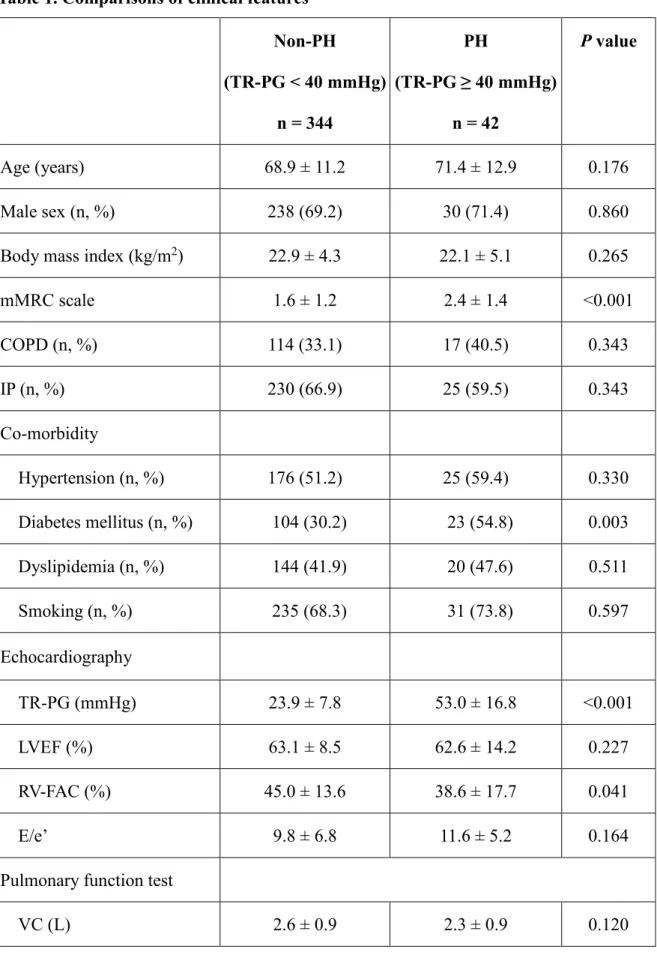
Patient characteristics are shown in Table 1. Of the 386 patients with respiratory disease (131 in COPD and 255 in interstitial pneumoniae), 42 (10.9%) had PH. In addition, 127 of the patients (32.9%) had concomitant DM.

The subjects in the PH group had higher scores on the mMRC scale than those in the non-PH group. Furthermore, the prevalence of DM in the PH group was significantly higher than that in the non-PH group (54.8% vs. 30.2%, P = 0.003). In contrast, the prevalence of hypertension and dyslipidemia did not significantly differ between the two groups. Regarding echocardiographic parameters, RV-FAC was significantly lower in the PH group than in the non-PH group (38.6 ± 17.7% vs. 45.0 ± 13.6%, P = 0.041). In contrast, LVEF and E/e’ did not differ between the two groups.

Additionally, there were no significant differences between the pulmonary function tests results and laboratory data of the two groups.

In the univariate logistic regression analysis, higher mMRC scale and presence of DM were found to be associated with PH complication (odds ratio 1.680, 95%

confidence interval, 1.286 to 2.195 [mMRC scale], P < 0.001; odds ratio 2.794, 95%

confidence interval, 1.459 to 5.350 [DM], P = 0.002). In the multivariate logistic

regression analysis, DM and mMRC scale were shown to be independent predictors of

PH complication (odds ratio 1.702, 95% confidence interval, 1.297 to 2.232 [mMRC

scale], P < 0.001; odds ratio 2.935, 95% confidence interval, 1.505 to 5.725 [DM], P =

0.002). (Table 2)

(9)

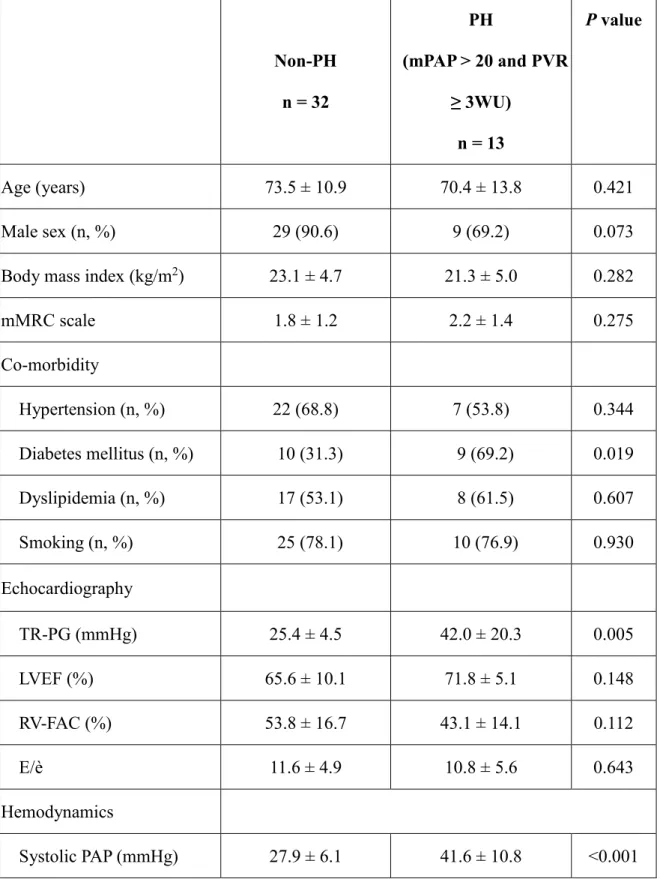
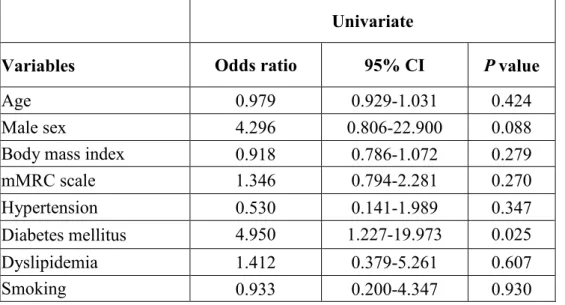
We verified that DM predicts PH in patients who underwent RHC. In our study, of the 45 patients on whom we performed RHC, 13 had PH. The number of patients with DM was significantly higher in the PH group than in the non-PH group (69.2% vs. 31.3%, P = 0.019; Table 3). Univariate analysis revealed that only DM is associated with PH in chronic respiratory disease (odds ratio 4.950, 95% confidence interval, 1.227 to 19.973;

P = 0.025; Table 4).

Discussion

In the current study, DM was demonstrated to be an independent factor for predicting PH complication in patients with respiratory diseases, such as COPD and interstitial pneumonia.

Pan et al. reported that elevation of right ventricular pressure due to hypoxia

exposure was more pronounced in DM model mice than in their control group, and that

increased production of reactive oxygen species and decreased superoxide dismutase

were found in the pulmonary arterial endothelial cells of DM mice exposed to hypoxia

[19]. Moral-Sanz et al. also reported that hypoxia and DM independently induce

pulmonary arterial remodeling and downregulate bone morphogenic protein receptor type

2 [20]. These results provided a basis for DM to predict PH in chronic respiratory disease

patients with DM. A few other studies demonstrated that PH is associated with

peroxisome proliferator–activated receptor-γ signaling, which is involved in insulin

resistance [21, 22], suggesting a possible mechanism by which DM predicts PH. Insulin

resistance induces hyperglycemia leading to oxidative stress. Reactive oxygen species

impair an activity of endothelium derived relaxing factor and cause pulmonary

vasoconstriction. Apart from insulin resistance, an attenuated PPAR-γ signaling also

(10)

brings an upregulation of transrforming growth factor-β1 which promotes pulmonary arterial smooth muscle cell proliferation [19, 21, 22].

Several studies on humans have demonstrated the association of PH with metabolic syndrome, insulin resistance, and dyslipidemia. For example, Zamanian et al.

published the first clinical report of an association between insulin resistance and PH [23].

Pugh et al. reported that unrecognized glucose intolerance, as assessed by HbA1c, is common in pulmonary arterial hypertension [24]. In addition, Abernethy et al. showed that DM is an independent predictor for the prognosis of PH patients [25]. Furthermore, Grinnan et al. described that DM is an independent predictor for PH development, even when the other components of metabolic syndrome are controlled (odds ratio = 1.53; P <

0.001) [26]. However, most of the patients in these studies were in group 1 (pulmonary arterial hypertension) and patients in group 3 were rarely included, whereas all our study subjects had chronic respiratory disease patients.

Although several studies have shown that DM affects the prognosis of both COPD and interstitial pneumoniae, the involvement of PH is still unclear. Makarevich et al. showed that PH is more severe in patients with COPD with type 2 DM, but not type 1 DM, compared to patients with only COPD [27]. Since patients with type 1 DM did not exist unexpectedly in our study, the difference between type 1 and type 2 DM with regard to the occurrence of PH in chronic respiratory disease remained unclear.

In addition, it has been reported that, of patients with COPD, 16% already had

DM at the time of enrollment, and an additional 19% developed DM during the follow-

up period [8]. Abernethy et al. reported a rate of DM occurrence in patients with group 3

PH of 29.8% [25]. The findings of those studies, taken together with the results of the

current study, indicate that DM is also a common disease in respiratory disease patients.

(11)

Further hormonal study into insulin, glucagon and corticoid in chronic respiratory disease with DM is required to confirm this finding.

Study limitations

This study has several limitations. First, the study involved a relatively small number of samples, all of which were from a single institution. Although we performed multiple logistic regression analyses to adjust possible confounding factors as much as possible, we could not rule out residual confounding factors from unknown or unmeasured variables. Second, we were unable to show the association between PH and sleep-disordered breathing because few patients underwent sleep examinations. Third, the PH and non-PH groups were classified on the basis of TR-PG values using echocardiography. RHC is a more desirable method of defining PH; however, we could perform RHC on only 45 patients. Although overestimation and underestimation are both possibilities with echocardiography, it still seems to be the most appropriate method for screening PH in respiratory disease.

Thus, future studies involving multiple institutions and research results of right heart catheterization are needed to validate our findings in this study.

Conclusion

We reported here the potential of DM as an independent predictor of PH in chronic respiratory disease patients. The presence of DM indicates increased risk of PH in these patients.

Acknowledgments

(12)

I thank Drs. Akiomi Yoshihisa, Koichi Sugimoto, Tetsuro Yokokawa,

Tomofumi Misaka, Takashi Kaneshiro, Masayoshi Oikawa, Atsushi Kobayashi,

Kazuhiko Nakazato, Takafumi Ishida and Yasuchika Takeishi for their kind supports and

supervision.

(13)

References

1. Galiè N, Humbert M, Vachiery JL, Gibbs S, Lang I, Torbicki A, et al. 2015 ESC/ERS Guidelines for the diagnosis and treatment of pulmonary hypertension: The Joint Task Force for the Diagnosis and Treatment of Pulmonary Hypertension of the European Society of Cardiology (ESC) and the European Respiratory Society (ERS): Endorsed by: Association for European Paediatric and Congenital Cardiology (AEPC), International Society for Heart and Lung Transplantation (ISHLT). Eur Heart J. 2016;37(1):67-119.

2. Weitzenblum E, Chaouat A, Canuet M, Kessler R. Pulmonary Hypertension in Chronic Obstructive Pulmonary Disease and Interstitial Lung Diseases. Semin Respir Crit Care Med 2009; 30(4): 458-70

3. Zangiabadi A, De Pasquale CG, Sajkov D. Pulmonary hypertension and right heart dysfunction in chronic lung disease. Biomed Res Int. 2014; 2014:739674.

4. Nakamura A, Kasamatsu N, Hashizume I, Shirai T, Hanzawa S, Momiki S, et al.

Effects of hemoglobin on pulmonary arterial pressure and pulmonary vascular resistance in patients with chronic emphysema. Respiration. 2000; 67(5):502-6.

5. Hurdman J, Condliffe R, Elliot CA, Davies C, Hill C, Wild JM, et al. ASPIRE registry: assessing the Spectrum of Pulmonary hypertension Identified at a REferral centre. Eur Respir J. 2012; 39(4):945-55.

6. Hansmann G, de Jesus Perez VA, Alastalo TP, Alvira CM, Guignabert C, Bekker JM, et al. An antiproliferative BMP-2/PPARgamma/apoE axis in human and murine SMCs and its role in pulmonary hypertension. J Clin Invest. 2008;

118(5):1846-57.

7. West J, Niswender KD, Johnson JA, Pugh ME, Gleaves L, Fessel JP, et al. A

(14)

potential role for insulin resistance in experimental pulmonary hypertension. Eur Respir J. 2013; 41(4):861-71.

8. Ho TW, Huang CT, Ruan SY, Tsai YJ, Lai F, Yu CJ. Diabetes mellitus in patients with chronic obstructive pulmonary disease-The impact on mortality. PLoS One.

2017; 12(4):e0175794.

9. Pauwels RA, Buist AS, Calverley PM, Jenkins CR, Hurd SS; GOLD Scientific Committee. Global strategy for the diagnosis, management, and prevention of chronic obstructive pulmonary disease. NHLBI/WHO Global Initiative for Chronic Obstructive Lung Disease (GOLD) Workshop summary. m J Respir Crit Care Med. 2001; 163(5):1256-76.

10. American Thoracic Society; European Respiratory Society. American Thoracic Society/European Respiratory Society International Multidisciplinary Consensus Classification of the Idiopathic Interstitial Pneumonias. This joint statement of the American Thoracic Society (ATS), and the European Respiratory Society (ERS) was adopted by the ATS board of directors, June 2001 and by the ERS Executive Committee, June 2001. Am J Respir Crit Care Med.

2002; 165(2):277-304.

11. Mancia G, Fagard R, Narkiewicz K, Redon J, Zanchetti A, Bohm M, et al. 2013 ESH/ESC guidelines for the management of arterial hypertension: the Task Force for the Management of Arterial Hypertension of the European Society of Hypertension (ESH) and of the European Society of Cardiology (ESC) Eur Heart J. 2013 ;34(28):2159-2219.

12. American Diabetes Association. Diagnosis and classification of diabetes mellitus.

Diabetes Care 2014; 37(Suppl 1):S81-S90.

(15)

13. Teramoto T, Sasaki J, Ishibashi S, Birou S, Daida H, Dohi S, et al. Executive summary of the Japan Atherosclerosis Society (JAS) guidelines for the diagnosis and prevention of atherosclerotic cardiovascular diseases in Japan -2012 version.

J Atheroscler Thromb. 2013; 20(6):517-23.

14. Perez T, Burgel PR, Paillasseur JL, Caillaud D, Deslée G, Chanez P, et al.

Modified Medical Research Council scale vs Baseline Dyspnea Index to evaluate dyspnea in chronic obstructive pulmonary disease. Int J Chron Obstruct Pulmon Dis. 2015; 18(10):1663-72.

15. Yoshihisa A, Takiguchi M, Shimizu T, Nakamura Y, Yamauchi H, Iwaya S, et al.

Cardiovascular function and prognosis of patients with heart failure coexistent with chronic obstructive pulmonary disease. J Cardiol. 2014; 64(4):256-64.

16. Rudski LG, Lai WW, Afilalo J, Hua L, Handschumacher MD, Chandrasekaran K, et al. Guidelines for the echocardiographic assessment of the right heart in adults: a report from the American Society of Echocardiography endorsed by the European Association of Echocardiography, a registered branch of the European Society of Cardiology, and the Canadian Society of Echocardiography. J Am Soc Echocardiogr. 2010; 23:685-713.

17. Jo YS, Park JH, Lee JK, Heo EY, Chung HS, Kim DK. Risk factors for pulmonary arterial hypertension in patients with tuberculosis-destroyed lungs and their clinical characteristics compared with patients with chronic obstructive pulmonary disease. Int J Chron Obstruct Pulmon Dis. 2017; 12:2433-43.

18. Hyldgaard C, Hilberg O, Bendstrup E. How does comorbidity influence survival in idiopathic pulmonary fibrosis? Respir Med. 2014; 108(4):647-53.

19. Pan M, Han Y, Si R, Guo R, Desai A, Makino A. Hypoxia-induced pulmonary

(16)

hypertension in type 2 diabetic mice. Pulm Circ. 2017;7(1):175-85.

20. Moral-Sanz J, Lopez-Lopez JG, Menendez C, Moreno E, Barreira B, Morales- Cano D, et al. Different patterns of pulmonary vascular disease induced by type 1 diabetes and moderate hypoxia in rats. Exp Physiol. 2012; 97(5):676-86.

21. Hansmann G, Wagner RA, Schellong S, Perez VA, Urashima T, Wang L, et al.

Pulmonary arterial hypertension is linked to insulin resistance and reversed by peroxisome proliferator-activated receptor-gamma activation. Circulation. 2007;

115(10):1275-84.

22. Green DE, Murphy TC, Kang BY, Searles CD, Hart CM. PPARγ ligands attenuate hypoxia-induced proliferation in human pulmonary artery smooth muscle cells through modulation of microRNA-21. PLoS One. 2015;

10(7):e0133391.

23. Zamanian RT, Hansmann G, Snook S, Lilienfeld D, Rappaport KM, Reaven GM, et al. Insulin resistance in pulmonary arterial hypertension. Eur Respir J. 2009;

33(2):318-24.

24. Pugh ME, Robbins IM, Rice TW, West J, Newman JH, Hemnes AR.

Unrecognized glucose intolerance is common in pulmonary arterial hypertension.

J Heart Lung Transplant. 2011; 30(8):904-11.

25. Abernethy AD, Stackhouse K, Hart S, Devendra G, Bashore TM, Dweik R, et al.

Impact of diabetes in patients with pulmonary hypertension. Pulm Circ. 2015;

5(1):117-23.

26. Grinnan D, Farr G, Fox A, Sweeney L. The Role of Hyperglycemia and Insulin

Resistance in the Development and Progression of Pulmonary Arterial

Hypertension. J Diabetes Res. 2016; 2016:2481659.

(17)

27. Makarevich AE, Valevich VE, Pochtavtsev AU. Evaluation of pulmonary

hypertension in COPD patients with diabetes. Adv Med Sci. 2007; 52:265-72.

(18)

Figure legends

Fig 1.

Receiver operating characteristic (ROC) curve for tricuspid regurgitation pressure

gradient (TR-PG) for prediction of pulmonary hypertension (PH) in patients with chronic

respiratory disease. As per the ROC curve, the sensitivity and specificity to detect PH

defined by right heart catheterization were 58.3% and 87.5%, respectively, using the cut-

off value as TR-PG = 40 mmHg. AUC, area under the curve; CI, confidence interval.

(19)

Table 1. Comparisons of clinical features Non-PH (TR-PG < 40 mmHg)

n = 344

PH

(TR-PG ≥ 40 mmHg) n = 42

P value

Age (years) 68.9 ± 11.2 71.4 ± 12.9 0.176

Male sex (n, %) 238 (69.2) 30 (71.4) 0.860

Body mass index (kg/m

2

) 22.9 ± 4.3 22.1 ± 5.1 0.265

mMRC scale 1.6 ± 1.2 2.4 ± 1.4 <0.001

COPD (n, %) 114 (33.1) 17 (40.5) 0.343

IP (n, %) 230 (66.9) 25 (59.5) 0.343

Co-morbidity

Hypertension (n, %) 176 (51.2) 25 (59.4) 0.330

Diabetes mellitus (n, %) 104 (30.2) 23 (54.8) 0.003

Dyslipidemia (n, %) 144 (41.9) 20 (47.6) 0.511

Smoking (n, %) 235 (68.3) 31 (73.8) 0.597

Echocardiography

TR-PG (mmHg) 23.9 ± 7.8 53.0 ± 16.8 <0.001

LVEF (%) 63.1 ± 8.5 62.6 ± 14.2 0.227

RV-FAC (%) 45.0 ± 13.6 38.6 ± 17.7 0.041

E/e’ 9.8 ± 6.8 11.6 ± 5.2 0.164

Pulmonary function test

VC (L) 2.6 ± 0.9 2.3 ± 0.9 0.120

(20)

%VC (%) 81.1 ± 21.9 77.4 ± 23.5 0.309

FVC (L) 2.5 ± 0.9 2.3 ± 0.9 0.069

FEV

1

(L) 1.9 ± 0.7 1.7 ± 0.7 0.075

FEV

1

/FVC (%) 75.1 ± 15.8 75.0 ± 17.1 0.977

%FEV

1

(%) 79.8 ± 26.5 77.0 ± 30.0 0.533

Laboratory data

KL-6 (U/mL) 1799.8 ± 1511.4 1450.0 ± 1105.1 0.227

SP-D (ng/mL) 306.4 ± 248.1 259.5 ± 205.6 0.328

SP-A (ng/mL) 100.0 ± 62.8 95.2 ± 65.3 0.700

HbA1c (%) 5.9 ± 0.8 5.9 ± 0.7 0.685

E/e’, ratio of mitral peak early filling velocity to early mitral annular velocity; FEV

1

,

forced expiratory volume in 1 s; FVC, forced vital capacity; LVEF, left ventricular

ejection fraction; mMRC, modified Medical Research Council; RV-FAC, right ventricular

fractional area change; SP-A, surfactant protein-A; SP-D, surfactant protein-D;.TR-PG,

tricuspid regurgitation pressure gradient; VC, vital capacity.

(21)

Table 2. Logistic analysis for potential predictors of PH

Univariate Multivariate

Variables Odds ratio 95% CI P value Odds ratio 95% CI P value

Age 1.023 0.990-1.056 0.177

Male sex 0.898 0.443-1.822 0.766 Body mass index 0.956 0.885-1.034 0.264

mMRC scale 1.680 1.286-2.195 <0.001 1.702 1.297-2.232 <0.001 Hypertension 1.404 0.732-2.693 0.308

Diabetes mellitus 2.794 1.459-5.350 0.002 2.935 1.505-5.725 0.002 Dyslipidemia 1.263 0.664-2.400 0.477

Smoking 1.307 0.633-2.697 0.469

mMRC, modified Medical Research Council

(22)

Table 3. Comparison of clinical features of patients who underwent right heart catheterization

Non-PH n = 32

PH

(mPAP > 20 and PVR

≥ 3WU) n = 13

P value

Age (years) 73.5 ± 10.9 70.4 ± 13.8 0.421

Male sex (n, %) 29 (90.6) 9 (69.2) 0.073

Body mass index (kg/m

2

) 23.1 ± 4.7 21.3 ± 5.0 0.282

mMRC scale 1.8 ± 1.2 2.2 ± 1.4 0.275

Co-morbidity

Hypertension (n, %) 22 (68.8) 7 (53.8) 0.344

Diabetes mellitus (n, %) 10 (31.3) 9 (69.2) 0.019

Dyslipidemia (n, %) 17 (53.1) 8 (61.5) 0.607

Smoking (n, %) 25 (78.1) 10 (76.9) 0.930

Echocardiography

TR-PG (mmHg) 25.4 ± 4.5 42.0 ± 20.3 0.005

LVEF (%) 65.6 ± 10.1 71.8 ± 5.1 0.148

RV-FAC (%) 53.8 ± 16.7 43.1 ± 14.1 0.112

E/è 11.6 ± 4.9 10.8 ± 5.6 0.643

Hemodynamics

Systolic PAP (mmHg) 27.9 ± 6.1 41.6 ± 10.8 <0.001

(23)

Diastolic PAP (mmHg) 12.1 ± 4.0 17.8 ± 7.4 0.002

Mean PAP (mmHg) 18.1 ± 4.3 26.8 ± 7.6 <0.001

Mean PcwP (mmHg) 8.8 ± 3.4 8.2 ± 4.2 0.594

Cardiac output (L/min) 4.7 ± 1.4 3.7 ± 1.1 0.028

PVR (Wood unit) 2.1 ± 0.8 5.2 ± 2.1 <0.001

Pulmonary function test

VC (L) 2.5 ± 0.8 2.1 ± 0.8 0.122

%VC (%) 77.8 ± 19.7 67.4 ± 21.5 0.131

FVC (L) 2.4 ± 0.8 2.0 ± 0.9 0.094

FEV

1

(L) 1.7 ± 0.6 1.6 ± 0.8 0.525

FEV

1

/FVC (%) 70.1 ± 14.8 78.0 ± 19.1 0.150

%FEV

1

(%) 72.6 ± 22.7 66.7 ± 30.4 0.485

Laboratory data

KL-6 (U/mL) 1305.3 ± 1006.8 1277.8 ± 958.5 0.945

SP-D (ng/mL) 284.9 ± 238.8 285.0 ± 244.0 1.000

SP-A (ng/mL) 99.2 ± 73.7 104.0 ± 75.7 0.876

HbA1c (%) 5.9 ± 1.2 6.3 ± 1.0 0.289

E/e’, ratio of mitral peak early filling velocity to early mitral annular velocity; FEV

1

,

forced expiratory volume in 1 s; FVC, forced vital capacity; LVEF, left ventricular

ejection fraction; mMRC, modified Medical Research Council; PAP, pulmonary arterial

pressure; P

CW

P, pulmonary capillary wedge pressure; PVR, pulmonary vascular

resistance; RV-FAC, right ventricular fractional area change; SP-A, surfactant protein-A;

(24)

SP-D, surfactant protein-D;.TR-PG, tricuspid regurgitation pressure gradient; VC, vital

capacity.

(25)

Table 4. Logistic analysis of potential predictors of PH in patients who underwent right heart catheterization

Univariate

Variables Odds ratio 95% CI P value

Age 0.979 0.929-1.031 0.424

Male sex 4.296 0.806-22.900 0.088

Body mass index 0.918 0.786-1.072 0.279

mMRC scale 1.346 0.794-2.281 0.270

Hypertension 0.530 0.141-1.989 0.347

Diabetes mellitus 4.950 1.227-19.973 0.025

Dyslipidemia 1.412 0.379-5.261 0.607

Smoking 0.933 0.200-4.347 0.930

mMRC, modified Medical Research Council

(26)

Figure 1.

Receiver operating characteristic (ROC) curve for tricuspid regurgitation pressure gradient (TR-PG) for prediction of pulmonary hypertension (PH) in patients with chronic respiratory disease.

As per the ROC curve, the sensitivity and specificity to detect PH defined by right heart

catheterization were 58.3% and 87.5%, respectively, using the cut-off value as TR-PG =

40 mmHg. AUC, area under the curve; CI, confidence interval.

Table 1. Comparisons of clinical features  Non-PH    (TR-PG &lt; 40 mmHg)  n = 344  PH    (TR-PG ≥ 40 mmHg)n = 42  P value  Age (years)  68.9 ± 11.2  71.4 ± 12.9  0.176  Male sex (n, %)  238 (69.2)  30 (71.4)  0.860
Table 2. Logistic analysis for potential predictors of PH
Table  3.  Comparison  of  clinical  features  of  patients  who  underwent  right  heart  catheterization  Non-PH  n = 32  PH    (mPAP &gt; 20 and PVR ≥ 3WU)  n = 13  P value  Age (years)  73.5 ± 10.9  70.4 ± 13.8  0.421  Male sex (n, %)  29 (90.6)  9 (69
Table 4. Logistic analysis of potential predictors of PH in patients who underwent  right heart catheterization

参照

関連したドキュメント

静岡大学 静岡キャンパス 静岡大学 浜松キャンパス 静岡県立大学 静岡県立大学短期大学部 東海大学 清水キャンパス

[r]