empirical studies
著者(英) Mitsuhiko Satake
journal or
publication title
Keizaigaku‑Ronso (The Doshisha University economic review)
volume 62
number 4
page range 423‑481
year 2011‑03‑20
権利(英) The Doshisha Economic Association
URL http://doi.org/10.14988/pa.2017.0000013616
【論 説】
Testing the Fisher Hypothesis:
A Survey of Empirical Studies
*Mitsuhiko Satake
**1. Introduction
In its simplest form, the Fisher hypothesis postulates a one-for-one relationship between the nominal interest rate and the expected inflation rate, i.e. that the nominal interest rate increases by 1% for every 1% increase in the expected inflation rate. If the Fisher hypothesis holds true, then it has important practical implications for the monetary policy, the super-neutrality of monetary policy, the usefulness of interest rates as monetary policy targets and the predictability of inflation rates using nominal interest rates. However, as is often the case with applied economics, robust results on the empirical validity of the Fisher hypothesis are difficult to find. There is a huge volume of both empirical and theoretical work, starting with the original paper by Irving Fisher (1930), which found a one- for-one relationship between nominal interest rates and inflation rates. Attempts to replicate such results have led to a wide variety of studies using varying techniques, time periods and data from a wide range of countries1). This paper
* I would like to thank Garry MacDonald at Curtin University of Technology, Ken Hirayama at Kwansei Gakuin University and the members of Monetary Economics Workshop for helpful and insightful comments. However, the remaining errors are entirely the author s responsibility.
** Faculty of Economics, Doshisha University, Karasuma-Imadegawa, Kamigyo-ku, 602-8580.
E-mail: [email protected]
1) There are few surveys on testing the Fisher hypothesis, including Cooray (2003), a brief but excellent survey.
attempts to summarize some of the results from this body of literature by focusing on empirical testing methods, which have changed over time as econometric techniques have changed and developed.
The structure of this paper is as follows. Section 2 briefly discusses the meaning and importance of the Fisher hypothesis. Sections 3 to 5 provide an overview of testing the Fisher hypothesis according to the development of techniques. Section 3 looks at the original work of Fisher (1930) and various others who attempted to extend and replicate his tests. Section 4 proceeds with the seminal work of Fama (1975), which placed the testing of the Fisher hypothesis in the context of efficient markets and rational expectations and marked a significant shift in the methodology used to test the hypothesis. Section 5 focuses on more recent attempts to test the hypothesis using modern time series techniques, in particular those associated with the development of tests for nonstationarity (unit root) and long-run relationships (cointegration). Section 6 discusses the results from a large body of work (empirical and theoretical) that found no support for the Fisher hypothesis and attempted to explain why the Fisher hypothesis was not supported.
The empirical literature reviewed in Sections 2 to 6 focuses largely on studies based on US data; therefore, the final three sections of this chapter review briefly the literature from Japan (Section 7), Australia (Section 8) and other countries (Section 9). Section 10 attempts to summarize the results discussed and puts them into perspective.
2. The Meaning of the Fisher Hypothesis
The Fisher hypothesis is based on the following identity, which simply states that the nominal interest rate is the sum of the ex ante real interest rate and the expected inflation rate.
Rt≡Et rt+Etπt+1 , (1)
where Rt is the nominal interest from t to (t+1) and Et is the expectation operator for period t ; therefore, Et rt is the real interest rate expected to hold from period t to (t+1) and Etπt+1 is the expected inflation rate from period t to (t+1). This identity is called the Fisher equation after Irving Fisher, who originally discussed the idea that, when the interest rate is considered, it is important to distinguish between nominal and real rates. If we then suppose that the real interest rate is constant (as determined by the rate of return on capital), equation (1) clearly demonstrates a one-for-one relationship between nominal interest rates and expected inflation rates. This concept is the Fisher hypothesis, or as it is sometimes referred to, the Fisher effect. Economists typically use the phrase Fisher effect as shorthand for the potential effects of monetary policy on interest rates in the context of equation (1). Thus, the Fisher effect tells us that when a loose monetary policy causes an increase in the money supply, an increase in the expected inflation rate due to this increase in the money supply will lead to an increase in nominal interest rates, as suggested by the Fisher equation (1). Whilst the implications of equation (1) are that, with constant real rates of return, any increase in expected inflation will lead to a one-for-one increase in nominal interest rates, this strict interpretation is sometimes dropped when economists refer to the Fisher effect. Often, the Fisher effect is more loosely interpreted as the effect of a 1% increase in expected inflation rates on nominal interest rates that increase by α
%, where 0<α≤ 1.
Before moving on to review at the empirical testing of the Fisher hypothesis, it is worth briefly noting the importance of the hypothesis.
First, as suggested by the discussion above, empirical support for the Fisher hypothesis suggests the super-neutrality of money. As equation (1) suggests, the
real rate of interest equals the nominal rate minus the expected inflation rate.
These move one for one; therefore, monetary policy changes to the money supply affect nominal variables but not real variables. This is the key statement for classical economics: support for the Fisher hypothesis implies the impotence of monetary policy.
The second implication is associated with the problem of the monetary policy target, i.e. whether interest rates or a monetary aggregate are more adequate as an instrument of monetary policy. The original theoretical discussion of this problem was put forward by Poole (1970) in the context of a stochastic version of the IS-LM model. Poole’s analysis clarified the choice to be made between interest rates and quantity instruments and that the incorrect choice would lead to greater output volatility. Gibson (1970b, 1970c) classified three effects of monetary policy on nominal interest rates. For example, when a loose monetary policy increases the supply of money, this increase in the money supply induces a decrease in interest rates in the short run as a result of the liquidity effect. In the controversy for the monetary policy target, economists thought that a loose monetary policy decreases interest rates. Actually, a loose monetary policy increases interest rates because of the income effect and the expected inflation effect (the Fisher effect) as inflation occurs. In particular, the Fisher effect matters greatly during a period of high inflation. A decrease in interest rates stimulates demand for investments and so on, encouraging interest rates to increase through the income effect. Moreover, an increase in expected inflation rates increases nominal interest rates more than their original level in the long run. As a result, a loose monetary policy increases, not decreases, interest rates. Consequently, the monetary authority cannot control interest rates as an intermediate target for monetary policy2). During the 1970s in Japan and other OECD countries, with the above controversy, research for
2) See Friedman (1968) and Sargent and Wallace (1975).
monetary economics produced literature on testing the Fisher effect to assess the adequacy of interest rates as a policy target. In the 1970s, policy management has switched to making monetary aggregate more important than interest rates when inflation accelerated. Therefore, with respect to controlling monetary policy, it matters whether the Fisher effect holds or not, as do the size and adjustment rate for the Fisher effect.
Finally, an increase in money supply as a result of monetary policy does not affect real interest rates, assuming that real interest rates are determined only by the real sector. Therefore, in accordance with the Fisher hypothesis, a change in future inflation rates, i.e. a change in expected inflation rates, causes the same change in nominal interest rates. The one-for-one relationship between nominal interest rates and expected inflation rates means that we can forecast future inflation rates by observing movements in nominal interest rates because information on future inflation is fully contained in such nominal interest rate movements.
As the above suggests, the Fisher hypothesis embodies important implications for macroeconomic policy. Thus, its empirical validity or otherwise has been the subject of a large body of empirical work. The following sections provide a brief survey of some of this evidence.
3. Initial Tests of the Fisher Hypothesis
A. H. Gibson found evidence to suggest that a positive relationship exists between nominal interest rates and price levels. John M. Keynes named the relationship the Gibson Paradox3). He referred to the finding as a paradox because there should be a negative relationship between nominal interest rates and price levels from the perspective of the theory at the time. According to Knut Wicksell4),
3) On the Gibson Paradox, J.M. Keynes referred to Gibson s series of articles in Banker’s Magazine, in particular January 1923 and November 1926. See Keynes (1930, pp. 177-186).
4) See Wicksell (1965).
to attain the equilibrium that equates investment with saving in the real sector, the ex ante interest rate is called the natural interest rate and is considered stable over time. However, the actual rate, i.e. the market interest rate, tends to fluctuate in the short run. If the market interest rate rises and becomes higher (lower) than the natural rate, savings exceed (lag) investments. This leads to the development of a deflationary (inflationary) gap and price levels fall (rise). Therefore, ‘Classical Theory’ suggests a negative relationship between nominal interest rates and price levels.
Fisher (1930, Ch. 19, pp. 399-451) explained the Gibson Paradox by noting the distinction between real interest rates and nominal interest rates; at equilibrium, the nominal interest rate is the sum of the returns on real assets (the equilibrium real interest rate) and the expected inflation rate. When the purchasing power of money is stable, the real and nominal interest rates are constant. However, the value of money changes over time. If fluctuations in the value of money are perfectly foreseen and the purchasing power of money decreases by 1%, then nominal interest rates become 1% higher than real interest rates. Therefore, the inverse one-for-one relationship between the change in the purchasing power of money and that of the nominal interest rate is clear and implies a positive one- for-one relationship between nominal interest rates and inflation rates, since an increase in inflation implies a decline in the value of money. However, in practice, it is frequently the case that changes in the value of money are not perfectly foreseen and agents make forecasts of expected changes. Expected inflation rates forecast a change in the purchasing power of money, and Fisher argued that expected inflation rates could be deduced from a distributed lag of prior inflation rates. This suggests that a positive relationship exists between nominal interest rates and price levels that are explained by the accumulation of lags in prior inflation rates.
This idea formed the basis of the initial empirical work that was carried out by
Fisher, who estimated the correlation coefficient between the return on the long- term bond and the expected inflation rate (proxied using a linear distributed lag of actual inflation). His initial results showed that:
• Using quarterly US data for the period 1890-1927, the maximum correlation coefficient was 0.857 and used a lag length on inflation rates for the past 20 years.
• Using quarterly UK data for the period 1898-1924, the maximum correlation coefficient was 0.98, with a lag length of 28 years.
Therefore, the Gibson Paradox, which is the positive relationship between long- term bond returns and price levels, is interpreted as a response of the long-term bond return to expected inflation rates. However, Fisher’s results suggested that actual inflation rates affect expected inflation rates for a surprisingly long time, with lags of 20 to 30 years, thus leading to the highest positive correlations in the data.
In summarizing his ideas in the final part of chapter 19 of Fisher’s (1930), The Relation of Interest on Money and Price, he indicated that there is a remarkably high correlation between inflation rates and interest rates. However, he also indicated that changes in interest rates lag inflation rates for a long time and sometime for a surprisingly long time. He concluded that interest rates change according to changes in the real sector when the purchasing power of money is stable. On the other hand, interest rates change according to a change in the purchasing power of money when the purchasing power of money is unstable. It is perhaps worth quoting some of his comments from the summary of chapter 19:
‘We have found evidence general and specific, from correlating P’5) with both bond yields 5) Note that P’ means the inflation rate.
and short term interest rates, that price changes do, generally and perceptibly, affect the interest rate in the direction indicated by a priori theory. But since forethought is imperfect, the effects are smaller than the theory requires and lag behind price movements, in some periods, very greatly. When the effects of price changes upon interest rate are distributed over several years, we have found remarkably high coefficients of correlation, thus indicating that interest rates follow price changes closely in degree, though rather distantly in time.
The final result, partly due to foresight and partly to the lack of it, is that price changes do after several years and with the intermediation of change in profits and business activity affect interest very profoundly. In fact, while the main object of this book is to show how the rate of interest would behave if the purchasing power of money were stable, there have never been any long period of time during which this condition has been even approximately fulfilled. When it is not fulfilled, the money rate of interest, and still more the real rate of interest, is more affected by the instability of money than by those more fundamental and more normal causes connected with income impatience, and opportunity, to which this book is chiefly devoted.’(Fisher, 1930, p. 451, Chapter 19, Section 13 Summary)
Thus, Fisher (1930) found surprisingly long distributed lags in estimating expected inflation rates. Although he argued that the cause of the longer lags was potentially the result of the incompleteness of both expectations and the adjustment in the determination of expected inflation rates, the lag length of the expected inflation rate in the empirical work was seen as troublesome and difficult to justify in reality. Fisher (1930) did not test the size of the Fisher effect, but simply estimated the correlation coefficient between nominal interest rates and expected inflation rates and postulated that a 1% increase in expected inflation rates leads to a 1% increase in nominal interest rates.
Since the 1970s, when the major economies of the world started to experience both higher and more volatile inflation rates, the literature on testing the Fisher
effect focused on two key issues: the length of the lag and the size of the Fisher effect. To confirm the results of Fisher (1930), papers such as Meiselman (1963), Sargent (1969), Gibson (1970a), Yohe and Karnosky (1969) and Lahiri (1976) forecasted expected inflation rates using a range of distributed lag models, tested the Fisher hypothesis and estimated the size of the Fisher effect using the following basic model structure.
Rt=Et rt+Etπt+1 (2)
Rt=α+βEtπt+1+ε (3)
Equation (2) simply recalls the original Fisher equation as denoted in Section 2.
Assuming that the ex ante real interest rate is a constant α, the Fisher hypothesis is that β=1 can be tested using equation (3).
Etπt+1=∑
i wiπt−i (4)
Rt=r¯+∑
i
wiπt−i+εt (5)
Expected inflation is estimated using the distributed lag model in (4). Putting the estimated value of expected inflation rate from the regression model (4) into the second term on the right-hand side of (3) can test whether the hypothesis that β
=1 in (3) is supported or not. Most literature substitute equation (4) in equation (3) and estimate model (5) to test whether the sum of the values of the coefficients in the distributed lags is equal to or less than one. Note that the test using model (5) could not identify the difference between the hypothesis β=1 and the size of the effect of the expected inflation rate from the distributed lag model. Basically, we should test the Fisher hypothesis using model (3) with the expected inflation rate derived from (4). However, we also summarize the testing in the literature based on model (5).
We first review some of the results in the context of the required length of the distributed lags. Meiselman (1963), Sargent (1969) and Gibson (1970a), who employed
several distributed lags, i.e. Koyck, geometric decreasing and unconditional distributed lags respectively, found that by using data before World War II the estimated length of distributed lag models was enough to support Fisher (1930). Meiselman (1963), using annual US data on returns on corporate bonds and WPI for the period 1873-1960, applied the adaptive expectations and found a mean lag of 13 years, which supported the long lag length although the size of the Fisher effect was very small before World War II. Sargent (1969), using annual US data for the period 1902-1940, determined the effect on nominal interest rates of surprisingly long distributed lags for price change variables, even while taking into account the other monetary and real variables. Gibson (1970a) used annual short- and long- term interest rate data for the period 1869-1963 and quarterly data for the period 1948-1963 and found the long-run effect of the expected inflation rate on nominal interest rates, although the size of the effect is less than one.
In another aspect of the literature, Yohe and Karnosky (1969), Feldstein and Eckstein (1970), Carr and Smith (1972) and Lahiri (1976) showed that the length of the lag required to capture the formation of the expected inflation rate was shortened in the 1960s. Using monthly data from the US for the period 1952-1969, Yohe and Karnosky (1969) analysed the relationship between nominal interest rates and inflation. The yield on 3A corporate bonds was used as long-term rates, the four to six month CP (Commercial Paper) rate was used as a short-term rate and the inflation rate was measured using the CPI. Yohe and Karnosky (1969) conducted regression analyses, in which the regressand was the nominal interest rate and the distributed lags of prior inflation rates were regressors. Almon distributed lag models6) were adopted and three types of lag lengths, 24, 36 and 48 months, were used to estimate the regression models. The results are summarized by
6) The Almon distributed lag model is one of the distributed lag models and assumes that the shape of the distribution is polynomial, meaning that we can flexibly determine the shape.
two points. First, the maximum of the determination coefficients was 0.771, using short-term interest rates in the case of the three-year lag length and 0.549, using the long-term interest rates in the case of the four-year lag length. The determination coefficients were rather large, although not as large as in the case of Fisher (1930). Second, the duration of the effect of expected inflation on the nominal interest rate is within two years and the latest period has the maximum effect. Therefore, Yohe and Karnosky (1969) showed that the distribution lags were not as long as Fisher (1930) insisted. This tendency appeared in Feldstein and Eckstein (1970) and Carr and Smith (1972), which employed the Almon distributed lag model. Polynomial distributed lag models are considered to have shorter lags than monotonic decreasing distributed lags. Moreover, Lahiri (1976) found that the some formations expect the inflation to adjust much faster.
The reduction in the lag length of the distributed lags model depends not only on the type of the model but also on the period during which the study was undertaken. Dividing the sample periods between the 1950s and the 1960s, Yohe and Karnosky (1969) and Gibson (1972) found that the adjustment rate accelerated and the lag length shortened in the 1960s compared with the 1950s. Gibson (1972) indicated that the expected inflation rate obtained from the Livingstone survey data, which contain forecasts of future inflation rates for six or 12 month in the future and could explain most of the variation in actual inflation during the 1960s. This suggests that the adjustment rate of the expected inflation effect on nominal interest rates accelerated in the 1960s more than in the 1950s. Feldstein and Eckstein (1970) and Carr and Smith (1972) conducted the analyses using data mainly from the 1960s. It is believed that the adjustment rate of the effects of expected inflation on the nominal interest rate accelerated. The reason might be because agents needed to incorporate inflation expectations into the determination of nominal variables more rapidly to insulate themselves from losses, considering
that inflation was insistent in the 1960s.
When researchers turned to analyse the size or magnitude of the Fisher effect, they found evidence that it became larger in the 1960s than in the 1950s at the same time that the lag length shortened. Thus far, the studies used the expected inflation rate formulated by distributed lag models. However, we have a problem in selecting distributed lag models because of the arbitrariness in selecting the shape and lag length of such models. We need directly observed data, i.e. survey data to make us escape from fear to determine whether we have a wrong price formation.
Although the frequency of such data is limited, the Livingstone survey data7) is available in the US since 1946. Using survey data, we can examine, without doubting whether the price formation is correct, the magnitude of the Fisher effect. We briefly summarize the literature using the survey data, i.e. Gibson (1972), Pyle (1972), Cargill (1976), Lahiri (1976) and Cargill and Meyer (1980).
Gibson (1972) used the Livingstone survey data as expected inflation rate instead of the distributed lag model. Using US data between 1952 and 1970 and dividing the entire period into two periods, i.e. the 1950s and 1960s, Gibson (1972) found that the estimated coefficient of the expected inflation rate in the 1950s was less than 0.5, while that estimated coefficient during the 1960s was nearly one. Yohe and Karnosky (1969) indicated the same results. Using the Livingstone Survey data, Cargill (1976) also tested the Fisher effect by dividing the sample period into two periods, i.e. the 1950s and 1960s. He found that most of the results of the estimation coefficients for the expected inflation rate were not significant in the 1950s, while the coefficients were almost significant and their size was supported to be one in the 1960s. Therefore, the faster the inflation rate grew in the 1960s,
7) The Livingstone Survey is produced by Joseph Livingstone, who was a nationally syndicated financial columnist. It has surveyed twice a year since 1946 from a group of business, government, labor and academic economists on their expectations of future values of macroeconomic variables including the consumer price index. See Gibson (1972).
the larger the effect on nominal interest rates. However, Cargill and Meyer (1980) examined the Fisher effect, dividing the period into three subperiods, i.e. 1954-59, 1960-69 and 1970-75. As a result, the relationship between the nominal interest rate and inflation is fairly unstable, which is inconsistent with the other two studies.
Although they did not divide the sample period, Pyle (1972) and Lahiri (1976) examined the Fisher effect using the Livingstone survey data. Pyle (1972), using US data for 1954-1969, obtained the results that the coefficient was nearly 1.0 when using 12-month forward data, while the result using six-month forward data was less than one. For the 1952-1970 samples, Lahiri (1976) incorporated the Livingstone survey data into four expectation formations and found that the size of the effect was 0.7-0.9. The coefficient increased because both studies contained data from the entire 1960s.
As described above, the length of the distributed lags was shorten in the 1960s and the result was accepted by researchers. Moreover, the magnitude of the Fisher effect grew. However, this magnitude had been by and large less than one since Yohe and Karnosky (1969). Therefore, it is conceivable that the Fisher hypothesis is not fully supported in empirical studies.
Since the seminal work of Fisher (1930), a large volume of literature has been devoted to empirical work to test the Fisher effect. Research following Fisher had two questions related to the results in Fisher (1930), i.e. far longer length of distributed lags and the one-for-one relationship between the nominal interest rate and inflation. Up to today, whilst the adjustment rate of the effect of the expected inflation rate on nominal interest rates was very slow when inflation was stable before the 1950s, it accelerated in the 1960s. Moreover, Fisher (1930) believed in the one-for-one relationship. However, many studies following Fisher found that the size of the Fisher effect was less than one, although it grew in the 1960s. We
will follow the literature using new approaches from here on.
4. The Influence of Fama (1975) on Tests of the Fisher Hypothesis
A major change in the way in which applied studies approached the testing of the Fisher hypothesis occurred with the publication of Fama’s seminal paper in 1975. Since Fisher (1930), regression models used to test the Fisher hypothesis assumed that current nominal interest rates could be explained by the expected inflation rate, which was estimated by some form of distributed lag model of past inflation rates. Therefore, the implicit assumption was that causality flowed from the inflation rate to nominal interest rates and that expectations were formed adaptively, i.e. that agents were backward looking when forming expectations.
Fama (1975) assumed that the market was forward looking and could correctly forecast future inflation as a stochastic expected value. If the short-term financial market is an ‘efficient market’, in the sense that it uses all available information in the determination of the equilibrium short-term nominal interest rate, the current nominal interest rate contains all of the information contained in the lags of the actual inflation rate, making distributed lag models redundant. In this model, current interest rates should therefore be good predictors of future inflation rates and the causation runs from nominal interest rate to inflation rate. Fama (1975) therefore incorporates two assumptions in the testing framework: that the market is efficient (see Fama (1970)) and that agents are rational (see Muth (1960)).
Fama (1975) estimated regression models in the form of equation (6), in which the regressand is the one-period-ahead inflation rate and the regressor is the current nominal interest rate.
πt+1=α+βRt+ut, (6)
where π is the inflation rate, R the nominal interest rate, α is a constant term and equal to the minus real interest rate and ut is the error term. Whether or not
the market is efficient can be examined 1) by testing the hypothesis that β=
1, which derives the constancy of the ex ante real interest rate and 2) by testing the hypothesis that there is no serial correlation in the error term, which is interpretable as reflecting market efficiency. When these hypotheses hold, the Fisher hypothesis is completely supported and the nominal interest rate contains complete information about past inflation under rational expectations and the constant ex ante real interest rate.
Using monthly US data between 1953 and 1971, with the reciprocal of the rate of one-period changes in CPI as the change in purchasing power of money and using one- to six-month Treasury Bills as the nominal interest rate, Fama’s (1975) results suggested that the hypothesis that the coefficient of the nominal interest rate is one could not be rejected. He calculated the autocorrelations of inflation rates and real interest rates from one to twelve months and found a high autocorrelation of inflation rates, showing that past inflation rates have information on expected inflation rates. Moreover, he found no autocorrelation of real interest rates, indicating that real interest rates are constant. Fama (1975) also estimated the regression model in (6) augmented with the addition of a one-period lag of the inflation rate as a regressor and found that the coefficient of the one-period lag inflation rate was not significant. Fama (1975) argued that the current nominal interest rate contains all of the information to predict one-period-ahead inflation.
Overall, Fama (1975) interpreted the results as supporting the notion that the market was efficient, with the short-term interest rate fully incorporating all past information on inflation, and that real rates were constant.
Fama’s (1975) overwhelming empirical result induced a series of comments in the American Economic Review in 1977, i.e. the comments by Carlson (1977), Joines (1977) and Nelson and Schwert (1977) and the reply by Fama (1977). Essentially, these papers attempted to find flaws in Fama’s analysis, usually by including other
variables to test whether they had significant predictive power for inflation, thus invalidating the idea that the current short-term interest rate fully incorporated all information on past inflation.
For example, Joines (1977) added the Wholesale Price Index and Hess and Bricksler (1975) and Nelson and Schwert (1977) added the forecasting value of inflation into Fama’s regression model. The coefficients of these variables turned out to be significant. Carlson (1977) questioned Fama’s (1975) result that all information in future expected inflation rate falls within the nominal interest rate given that his finding of the addition of a variable measuring business cycle factors into the Fama’s model is significant. Moreover, Carlson (1977) found that the real interest rate is not constant using results based on his analysis of the Livingstone survey data on the expected inflation rate.
On the other hand, significant research (e.g. Shiller, Campbell, Schoenholtz and Weiss (1982), Campbell and Shiller (1987) and so on) focused on the information in the term structure of interest rates whether or not the relationship between interest rates for different maturities can predict the future movement of the short-term interest rate. Combining this idea with Fama’s (1975) approach, Mishkin (1990a) proposed a method to examine the predictability of the term structure of nominal interest rates on the future inflation rate. Mishkin (1990a) examined whether the term structure of interest rates can predict the inflation rate and estimated the relationship between the term structure of interest rates and the inflation spread in the following model:
πtm−πtn=α+β[Rmt−Rtn]+et, (7)
where Rtm is the nominal interest rate of the m period matured, Rtn is that of the n period matured; therefore [Rtm−Rtn] is the nominal interest spread matured between the m period and the n period and [πtm−πtn] is the inflation spread according to the nominal interest spread.
If β=1 in equation (7), the nominal interest rate spread can completely forecast the inflation spread in the sense that the change in the nominal interest rate between different maturities, i.e. the term structure of nominal interest rates, is fully reflected in the change in inflation at different periods; therefore, the complete Fisher hypothesis holds. If 0<β<1, the nominal interest spread partly forecasts the Fisher effect and the nominal interest spread contains the future inflation rate. Equation (7) means the difference of the two equations in (6) with respect to different maturities. Accordingly, the complete Fisher hypothesis is supported if coefficient β in equation (7) is one. On the other hand, if β is less than one and greater than zero, the Fisher effect is partly considered to be found.
Mishkin (1990a) examined equation (7) for short-term TB rates in the US and found that the coefficients of the nominal interest rates spreads were 0<β<
1, concluding that the nominal interest rates have the ability to predict future inflation. Mishkin (1990b) also examined equation (7) for the longer terms in the US, between one and five years. As a result, Mishkin (1990b) found that the nominal interest rates spreads for longer terms contained information on future inflation rates. Moreover, Jorion and Mishkin (1991) analysed data in the UK, West Germany and Switzerland for the nominal interest rate maturing in one to five years. The coefficients of the nominal interest rate spread were 0<β<1, indicating that the nominal interest spread partly contained information on future inflation rates. Moreover, the longer the maturity, the more information on inflation was contained.
Fama (1975) indicated the overwhelming result that the full Fisher effect was supported by data in the US on one- to twelve-month TB rates and the CPI for 1953-1971, i.e. that nominal interest rates contain all information for one-period- ahead inflation rate. Since Fama (1975), many studies have been conducted as described above and studies examined the constancy of real interest rates, such
as Mishkin (1981), Fama and Gibbons (1982) and Huzinga and Mishkin (1986). Moreover, a series of Mishkin’s studies were conducted to examine whether the term structure of nominal interest rates contain information on future inflation. In general, the results in this section also indicate that the size of the coefficient β in both (6) and (7) is 0<β<1, indicating that the partial Fisher effect is obtained.
5. The Use of Modern Time Series Techniques to test the Fisher Hypothesis
The next key development in testing the Fisher hypothesis was the utilization of the framework of modern time series analysis, most particularly the unit root/
cointegration framework. The finding that most macroeconomic time series are nonstationary I(1) processes and the development of techniques to deal with the issues that arise from this have had implications for all applied work using time series data. The literature on unit root and cointegration is very large and the intent is not to survey this here. Equally, the literature on testing the Fisher hypothesis using some variant of the techniques proposed in this literature is also large and once again a full survey is not intended here. Rather, this section aims to simply outline the nature of the tests used, the variants and problems that have arisen and to summarize briefly the results for the US, with Sections 7 and 8 doing the same for Japan and Australia.
The Fisher hypothesis, as has been made clear, implies a one-for-one relationship between the nominal interest rate and the inflation rate. In the context of recent time series literature, this suggests that the applied researcher should first carry out unit root tests on the nominal interest rate and the inflation rate. If the two series are (as might be expected) nonstationary I(1) processes, then cointegration tests are implemented. If the cointegrating vector is (1, −1)(evidence of cointegration between the two series), then it is regarded that the one-for-one relationship between the nominal interest rate and inflation rate, i.e. the Fisher hypothesis, is supported.
On the other hand, literature exists that simply tests the stationarity of the real interest rate, arguing that support of the Fisher hypothesis is found in the case in which the real interest rate is stationary.
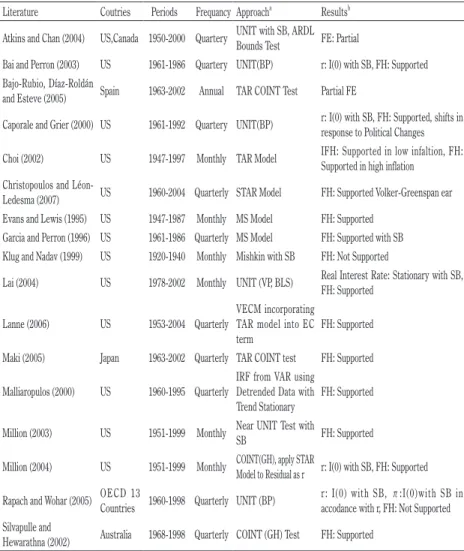
Table 1 below provides a perspective on a selection of studies between 1988 and 2008 that used some form of ‘modern’ time series approach to test the Fisher hypothesis. As noted above, there are now a large number of variants of the basic unit root and cointegration tests and the footnotes to the table provide a brief key to the various methods used in these papers.
Table 1 reveals a wide range of results, with some authors finding evidence in favour of the Fisher hypothesis and others failing to do so. Two general points can be made about the papers reported in Table 1.
First, most studies using Johansen’s (1988) approach to test the relation between the two variables support the Fisher hypothesis more than using Engle and Granger’s (1987) approach. Some others approaches also tend to support the Fisher hypothesis, for example, Lee, Clark and Ahn (1998), who applied methods suggested by Ahn and Reinsel (1998), and Westerlund (2008), who applied the panel cointegration test to 20 OECD countries.
Second, all of the three studies, Lanne (2001), Mehra (1998) and Mishkin (1992), divided their sample at the start of financial deregulation in 1979 and found that the Fisher hypothesis holds true before, but not after, 1979. Referring to the existing literature8) , Mishkin indicated evidence of a lack of support for the Fisher hypothesis in the pre-World War II data and the period after October 1979 until 1982, although the Fisher hypothesis is widely supported for the period between 1951 and 1979. Mishkin (1992) observed that there are unit root in both
8) Mishkin (1992) referred, for example, to Fama (1975), Mishkin (1981, 1988) and Fama and Gibbons (1982) as supporting evidence for the Fisher effect after the Fed-Treasury Accord in 1951 until the monetary regime shift in October 1979 and referred, for example, to Barsky (1987) and Huzinga and Mishkin (1986) as no supportive evidence existed before World War II and between 1979 and 1982.
Table 1 The Literature on Testing the Fisher Hypothesis Using Time Series Analyses without Consideration of Structural Break in the United States
Literaturea Period Frequency Approachb Resultc Atkins (1989)* 1965-1981 Quarterly COINT(JOH), ECM FH: Supported
Atkins and Coe (2002)* 1953-1999 Monthly ARDL Bounds Test FH: Supported before-tax rate, Not after-tax rate Atkins and Serletis (2003)* 1880-1985 Annual ARDL Bounds Test FH: Not Supported Bekdache (1999) 1961-1991 Monthly MS Model, Time Varying
Parameter Model r: Shifted Twice, FH: Not Supported Bonham (1991) 1955-1990 Monthly COINT(EG) FH: Supported in consideration for r Choudhry (1996) 1879-1913 Annual COINT(JOH) FH: Supported
Crowder and Hoffman (1996) 1952-1991 Quarterly COINT(JOH), ECM FH: Supported in the longrun, considering tax
Crowder and Wohar(1999) 1950-1995 Annual COINT(Several) FH: Supported Daniels, Nourzad, and
Toukoushian (1996) 1952-1992 Quarterly COINT(JOH), ECM FH: Supported Engsted (1995)* 1962-1993 Quarterly VAR with PVM Constraint FH: Not Supported Ghazali and Ramlee (2003)* 1974-1996 Monthly ARFIMA Models,
Fractional COINT Test FH: not Supported Kasman, Kasman, and
Turgutlu (2006)* 1964-2004 Monthly Fractional COINT Test FH:Supported Koustas and Serletis (1999)* 1957-1995 Quarterly VAR with King=
Watson's (1997) Method FH: Not Supported Lai (1997) 1965-1994 Monthly UNIT(DF-GLS) r: Stationary, FH: Supported Lanne (2001) 1953-1990 Monthly Near UNIT(CES) Technique FH: Supported until 1979, Not after
1979 Lee, Clark and Ahn (1998) 1953-1990 Monthly COINT, ECM FH: Supported MacDonald and Murphy
(1989)* 1955-1986 Quarterly COINT(EG) FH: Not Supported, except Fixed Exchange Rate Sytem Mehra (1998) 1961-1996 Quarterly COINT(JOH), ECM FH: Supported until 1979, Not after
1979
Mishkin (1992) 1953-1990 Monthly COINT(EG) FH: Supported until 1979, Not after 1979
Moazzami (1991)* 1953-1978 Quarterly UNIT, ECM FE: Partial Peláez (1995) 1959-1993 Quarterly COINT(EG, JOH) FH: Not Supported Peng (1995)* 1957-1994 Quarterly COINT(JOH) FH: Not Supported
Rapach and Weber (2004)* 1957-2000 Monthly UNIT, COINT(Several) π~I(0), R~ I(1), FH:Not Supported
the nominal interest rate and the inflation rate for the monthly US data during the periods between 1953 and 1979 and between 1953 and 1990. He also observed a cointegrating relationship between them, making it clear that the there is a Fisher effect in the long run in these periods and not in other periods. Therefore, Mishkin (1992) argued that the Fisher effect occurred only when a stochastic trend in both the nominal interest rate and the inflation rate was present. As Mishkin (1992) indicated, nominal interest rates and inflation rates have had a common trend since World War II and until 1979. Therefore, it could be credible that the cointegration relationship between such variables can be found and they have a common trend.
Mishkin’s findings were echoed by a number of other papers that found evidence of support for the Fisher hypothesis over certain spans of data but not others.
Some papers, such as Bonham (1991), attempted to relate these sorts of findings to factors influencing the economy and to determine whether the nature of the exchange rate affected the results of the Fisher equation by dividing the sample into periods of fixed and floating exchange rate regimes in the US. As a result,
Rose (1988)* Annual:1892-1970,1901-
1950, Monthly: 1947-1986 UNIT π~I(0), R~ I(1), r~I(1), FH: Not Supported Strauss and Terrell (1995) 1973-1989 Quarterly COINT (JOH) FH: Supported Wallece and Warner (1993) 1948-1990 Quarterly COINT(JOH) FH: Supported Westerlund (2008)* 1980-2004 Quarterly Panel COINT Test FH: Supported Yuhn (1996)* 1979-1993 Quarterly COINT( JOH) FH: Supported in the lon run (Notes)
a Literature attached * tests in multiple countries including the US. The result is shown in the US only.
b UNIT is Unit Root Test, COINT is Cointegration test, EG is Engle and Granger Test, JOH is Johansen test, ECM is Error Correction Model. MS model means Markov Switching Model. ARDL Bound Test is Autoregressive Distributed Lag Bound test, that does not require the standard univariate time series of the data. The ARFIMA model is Autoregressive Fractional Moving Average model. CES is Cavanagh, Elliot and Stock's (1995) method, which has the advantage to be asymptotically valid whether the variable is I(1) or I(0), or near unit root based on ECM.
c R is nominal interest rate, r is real interest and π is infaltion rate. FH is the Fisher Hypothesis, which is a one-for-one long-run relationship between R and π. FE is the Fisher effect, whose size is classified into full, partial and non. 'full' means the support for the Fisher hypothesis.
there is evidence supporting the Fisher effect in consideration of ex ante real interest rates regardless of sample periods.
The results in Table 1 suggest the potential for structural breaks and changes to impact the results of the Fisher hypothesis tests. The finding that structural breaks can impact the results of unit root and cointegration tests is now well known. The results in Table 1 are limited to papers that tested the Fisher hypothesis using time series analysis without consideration for structural breaks in the US.
Clearly, Fisher hypothesis tests should consider the possibility of structural breaks in the series and the relationship between nominal interest rates and inflation. Table 2 provides a selection of papers that have re-tested the Fisher hypothesis, allowing for breaks.
We can classify the literature into the following three groups with respect to the different techniques used:
• unit root and cointegration tests that have been modified to allow for the consideration of structural breaks;
• threshold models such as the Threshold Autoregressive (TAR) models and Smooth Transition Autoregressive (STAR) models; and
•Markov Switching (MS) models.
First, the Fisher hypothesis test was conducted mainly using the unit root test for the real interest rate, with consideration for structural breaks. The stationarity of the real interest rate with break shifts is found in the US by Bai and Perron (2003), Caporale and Grier (2000), Lai (2004) and Million (2003), supporting the Fisher hypothesis. While Rapach and Wohar (2005) found the stationarity of real interest rates with structural breaks in 13 OECD countries, they also found that breaks in the inflation rate negatively corresponded to those in the real interest rate, indicating less support for the Fisher hypothesis. The study by Klug and
Nadav (1999) is the only one to reject the Fisher hypothesis and they applied Mishkin’s (1990) formula in constructing the structural break. Silvapulle and Hewarathna (2002) applied Gregory and Hansen’s (1996) cointegration test, with one structural break in the nominal interest rate and inflation rate in Australia and found cointegration supportive of the Fisher effect. Atkins and Chan (2004) and Malliaropulos (2000) found a trend-stationarity in the nominal interest rate and inflation rate with a break shift in the US. They applied the VAR approach to the detrended data and found evidence supportive of the Fisher effect. As a result of the unit root and cointegration tests with break shifts, we find that every study except for Klug and Nadav (1999), whose formulation is different from others, supported the Fisher hypothesis when considering structural breaks, while Atkins and Chan (2004) only obtained a partial Fisher effect.
Second, Bajo-Rubio, Díaz-Roldán and Esteve (2005), Lanne (2006), Maki (2005) and Million (2004) all use nonlinear threshold models mainly applied to cointegration tests, which used threshold models to examine the residuals derived from cointegrating regression. All of these studies found supportive evidence for the Fisher hypothesis, except that Bajo-Rubio, Diaz-Roldan and Esteve (2005) found the partial Fisher effect. Another approach using nonlinear models was conducted by Choi (2002) and Christopoulos and León-Ledesma (2007). They constructed nonlinear models to take two regimes into account and found evidence supportive of the Fisher hypothesis. The literature using nonlinear models indicated strong evidence that supports the Fisher hypothesis by allowing for the existence of nonlinearities in the Fisher relation.
Finally, the Markov switching model, another approach to considering multiple regimes instead of threshold models, was adopted by Evans and Lewis (1995) and Garcia and Perron (1996). Evans and Lewis (1995) applied the Markov switching model to obtain the expected inflation rate to test the relationship between nominal
Table 2 The Literature on Testing the Fisher Hypothesis Using Time Series Analyses Allowing for Structural Breaks
Literature Coutries Periods Frequancy Approacha Resultsb Atkins and Chan (2004) US,Canada 1950-2000 Quartery UNIT with SB, ARDL
Bounds Test FE: Partial
Bai and Perron (2003) US 1961-1986 Quartery UNIT(BP) r: I(0) with SB, FH: Supported Bajo-Rubio, Díaz-Roldán
and Esteve (2005) Spain 1963-2002 Annual TAR COINT Test Partial FE
Caporale and Grier (2000) US 1961-1992 Quartery UNIT(BP) r: I(0) with SB, FH: Supported, shifts in response to Political Changes Choi (2002) US 1947-1997 Monthly TAR Model IFH: Supported in low infaltion, FH:
Supported in high inflation Christopoulos and Léon-
Ledesma (2007) US 1960-2004 Quarterly STAR Model FH: Supported Volker-Greenspan ear Evans and Lewis (1995) US 1947-1987 Monthly MS Model FH: Supported
Garcia and Perron (1996) US 1961-1986 Quarterly MS Model FH: Supported with SB Klug and Nadav (1999) US 1920-1940 Monthly Mishkin with SB FH: Not Supported
Lai (2004) US 1978-2002 Monthly UNIT (VP, BLS) Real Interest Rate: Stationary with SB, FH: Supported
Lanne (2006) US 1953-2004 Quarterly
VECM incorporating TAR model into EC term
FH: Supported Maki (2005) Japan 1963-2002 Quarterly TAR COINT test FH: Supported Malliaropulos (2000) US 1960-1995 Quarterly
IRF from VAR using Detrended Data with Trend Stationary
FH: Supported
Million (2003) US 1951-1999 Monthly Near UNIT Test with
SB FH: Supported
Million (2004) US 1951-1999 Monthly COINT(GH), apply STAR
Model to Residual as r r: I(0) with SB, FH: Supported Rapach and Wohar (2005) OECD 13
Countries 1960-1998 Quarterly UNIT (BP) r: I(0) with SB, π:I(0)with SB in accodance with r, FH: Not Supported Silvapulle and
Hewarathna (2002) Australia 1968-1998 Quarterly COINT (GH) Test FH: Supported (Notes)
a SB is structural break. UNIT is unit root test including Bai and Perron (1998) (BP), Vogelsang and Perron (1998)(VP) and Barnejee, Lamsdane and Stock (1992)(BLS). COINT is cointegration test. GH is Garegory and Hansen (1996) coitegration test. MS model is Markov Switching model. TAR and STAR models means Threshold Autoregressive and Smooting Trasition Autoregressive models. IRF is Impulse Response Function. VECM is Vector Erroe Correction Model. ARDL Bound test is the same as Table 1.
b R is nominal interest rate, r is real interest and π is infaltion rate. FE is the Fisher effect, FH is the Fisher hypothesis, and SB is structural break. IFH is the Inverted Fisher Hypothesis.
interest rates and inflation rates. Garcia and Perron (1996) applied the Markov switching model directly to ex post real interest rates. Both of the two studies supported the Fisher hypothesis.
Mishkin (1992) indicates that the Fisher effect appears only when both the nominal interest rate and the inflation rate have stochastic trends. Therefore, many studies that have applied linear models to the analysis, do not support the Fisher hypothesis in long-term samples. However, once the nonlinear models, that considers multiple regimes and the unit root test and cointegration tests with the consideration of the structural breaks, applies, i.e. once breaks are allowed for in the test procedure, the literature gets more supportive for the Fisher hypothesis.
6. Explanations for Non-Support of the Fisher Hypothesis
Before reviewing the empirical literature on the Fisher hypothesis in Japan, Australia and other countries, it is worth briefly considering the impact on the literature of the large number of studies that found no support for the Fisher hypothesis. Justifications for the empirical failure of the Fisher hypothesis generally fall into three categories:
•the inverted Fisher hypothesis.
•asset effects (the Mundell–Tobin effect). •tax effects (the Darby–Feldstein effect).
Carmichael and Stebbing (1983) turned the Fisher hypothesis on its head by arguing that the nominal interest rate is constant and that the real interest rate responds inversely one-for-one to the inflation rate. This hypothesis became known in the literature as, for obvious reasons, ‘the inverted Fisher hypothesis’.
According to Carmichael and Stebbing (1983), people hold money because it has implicit returns like liquidity, although the nominal interest rate on money is
zero. The implicit return is almost constant and equal to the nominal return on financial assets when there is high substitutability between monetary assets and money. Therefore, the real interest rate inversely responds one-for-one to the inflation rate. Carmichael and Stebbing (1983) found initial support for an inverted Fisher effect with their results that showed a negative one-for-one relationship between the real interest rate and the inflation rate using data from 1953–1978 in the US and from 1965-1981 in Australia. Barth and Bradley (1988) re-examined the inverted Fisher hypothesis, extending the period used by Carmichael and Stebbing (1983). They found that the inverted Fisher hypothesis was not supported and that the value of the coefficient used to test the hypothesis decreased to much less than one in the sample from 1953 to 1984. In interpreting their results, they argued that a structural break in the Fisher relationship occurred after 1979. After the 1990s, the inverted Fisher hypothesis was tested by Inder and Silvapulle (1993) in Australia and Choudhry (1997) in Belgium, France and Germany. They found that the inverted Fisher hypothesis was rejected. However, Choi (2002) found that the inverted Fisher hypothesis was supported when inflation is low and stable and that the Fisher hypothesis was supported when inflation persists, using the threshold autoregressive model (TAR model) with two regimes. Similar to the original Fisher hypothesis, it appears that evidence on its inverted version is mixed.
The second variation on this theme is the so-called Mundell-Tobin effect (see Mundell (1963) and Tobin (1965)), which argues that real money balances decrease with increases in inflation, resulting in a fall in the real asset holding of agents.
Therefore, agents increase their savings and the real interest rate decreases. As a result, a 1% increase in the inflation rate leads to a less than 1% increase in the nominal interest rate. Many authors used the idea of the Mundell–Tobin effect to justify the finding that the Fisher effect is less than one-for-one. For example, see Woodward (1992), Crowder and Hoffman (1996) and Coppock and Poitras (2000).
Finally, as originally formulated in the Fisher equation, the nominal interest rate that agents consider as the signal for deciding the level of their investment is the after-tax rate. Therefore, the effect of a change in the expected inflation rate on the before-tax nominal interest rate, which is frequently used in applied studies, could be greater than one. This theoretical argument was first suggested by Darby (1975) and Feldstein (1976). Following their theoretical argument, empirical studies were conducted. Although Peek (1981) strongly supported the Darby-Feldstein effect, most empirical studies, for example Tanzi (1980), Cargill (1977) and Carr, Pesando and Smith (1976), found that the Fisher effect was equal to or less than one, rejecting the Darby-Feldstein effect. Yun (1984) and Crowder and Wohar (1999), using both taxable and tax-exempt bond rates, found that the coefficient for the former rate was greater than that for the latter, supporting the Darby-Feldstein effect. As it is hard to distinguish one effect, such as the Darby-Feldstein effect, from others, such as the Mundell-Tobin effect, the evidence is mixed.
7. The Fisher Hypothesis in Japan
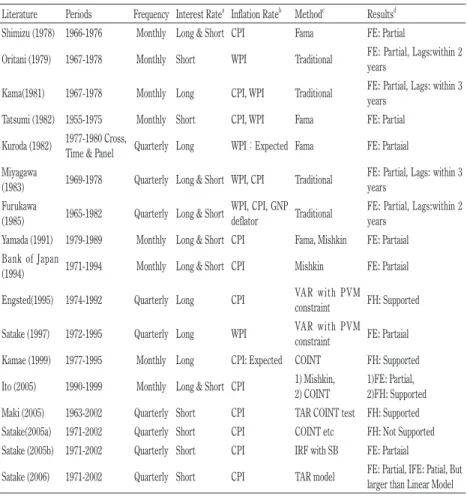
This section reviews the literature on testing the Fisher hypothesis in Japan in more detail. The literature on testing the Fisher hypothesis in Japan has grown rapidly since the late 1970s, when the inflation rate rose substantially and became quite volatile. Table 3 lists some of the key papers in the area and, once again, it seems sensible to divide these papers into three categories.
1. Papers that use the traditional methods of analysis to calculate the expected inflation rate using distributed lag models.
2. Papers that apply the testing methods suggested by Fama (1975) and Mishkin (1990a).
3. Papers that use ‘modern’ time series methods.
Table 3 The Results in the Tests on the Fisher Hypothesis in Japan Literature Periods Frequency Interest Ratea Inflation Rateb Methodc Resultsd Shimizu (1978) 1966-1976 Monthly Long & Short CPI Fama FE: Partial
Oritani (1979) 1967-1978 Monthly Short WPI Traditional FE: Partial, Lags:within 2 years
Kama(1981) 1967-1978 Monthly Long CPI, WPI Traditional FE: Partial, Lags: within 3 years
Tatsumi (1982) 1955-1975 Monthly Short CPI, WPI Fama FE: Partial Kuroda (1982) 1977-1980 Cross,
Time & Panel Quarterly Long WPI:Expected Fama FE: Partaial Miyagawa
(1983) 1969-1978 Quarterly Long & Short WPI, CPI Traditional FE: Partial, Lags: within 3 years
Furukawa
(1985) 1965-1982 Quarterly Long & Short WPI, CPI, GNP
deflator Traditional FE: Partial, Lags:within 2 years
Yamada (1991) 1979-1989 Monthly Long & Short CPI Fama, Mishkin FE: Partaial Bank of Japan
(1994) 1971-1994 Monthly Long & Short CPI Mishkin FE: Partaial Engsted(1995) 1974-1992 Quarterly Long CPI VAR with PVM
constraint FH: Supported Satake (1997) 1972-1995 Quarterly Long WPI VAR with PVM
constraint FE: Partaial Kamae (1999) 1977-1995 Monthly Long CPI: Expected COINT FH: Supported Ito (2005) 1990-1999 Monthly Long & Short CPI 1) Mishkin,
2) COINT
1)FE: Partial, 2)FH: Supported Maki (2005) 1963-2002 Quarterly Short CPI TAR COINT test FH: Supported Satake(2005a) 1971-2002 Quarterly Short CPI COINT etc FH: Not Supported Satake (2005b) 1971-2002 Quarterly Short CPI IRF with SB FE: Partaial
Satake (2006) 1971-2002 Quarterly Short CPI TAR model FE: Partial, IFE: Patial, But larger than Linear Model (Notes)
a Interest rate is classified into two categories, i.e. Short and Long. 'Long' contains NTT coupon and Government bonds, and Short does Call , Gensaki and CD Rate.
b Expected means to use expected infaltion rate derived from ARMA or Kalman filter model.
c Traditional is the approach using Distributed Lag Models. Fama and Mishkin is the approach using (6) and (7) respectively. COINT is Cointegration analysis. PVM is Present Value Model. SB is Structural Break.
IRF is Impuls Respense Function. TAR is Thoreshold Autoregresion.
d FE is Fisher Effect, FH is the Fisher Hypothesis, and IFE is the inverted Fisher Effect. Lags is the lags of distributed lag models.
7.1 Literature Related to Monetary Policy Target: Traditional Testing Methods Oritani (1979), Kama (1981), Miyagawa (1983) and Furukawa (1985) conducted Fisher hypothesis tests to discuss the potential role of an interest-rate target as a monetary policy objective and all use some variant of the ‘traditional’ method of testing the Fisher effect with some form of distributed lag to proxy for expected inflation. Oritani (1979) examines the magnitude of the Fisher effect to calculate the expected inflation rate using time series models as well as distributed lag models. The empirical work in this paper uses the three-month Gensaki9) rate as the nominal interest rate and the wholesale price index (WPI) as the price level for monthly Japanese data from February 1967 to December 1978. An Almon lag model with three degrees and 24-month lags is adopted. It was found that inflation fluctuation lags two years earlier affect current nominal interest rates.
The estimation by the Koyck lag model indicates that the coefficient of the one- period nominal interest rate is 0.85 and that of the inflation rate is 0.17, therefore finding that the effect continues about two years and its size is less than one as same as the case of Almon lag model, so that the lag length of the effect is not as long as the result of Fisher (1930). In the analysis using ARMA models to estimate the expected inflation rate, Oritani (1979) found that the coefficient of the expected inflation rate was significant but less than 0.25, contrary to the result of 1.0 (for US data) in Feldstein, Summers et al. (1978).
Kama (1981), Miyagawa (1983) and Furukawa (1985) conducted the traditional approach of deriving the expected inflation rate from Almon lag models for almost the same period as Oritani (1979). They found that the lag length of the Almon lag models is less than three years, quite shorter than the evidence in Fisher (1930) and that the size of the Fisher effect is far less than one.
To test the Fisher effect, Kama (1981) estimated the Almon lag models using
9) Gensaki means repurchase agreements.
the return on NTT coupon bonds as the long-term interest rate, the call rate as the short-term interest rate and the WPI and CPI to calculate the inflation rate during the period from October 1967 to December 1978. The lag lengths of 18, 24 and 30 months and three or six polynomial degrees are adopted. The results are as follows: 1) as the significance of the coefficients of the lagged inflation rates disappeared by the thirtieth lag, it is considered that the inflation rate three years prior does not affect the nominal interest rate. Therefore, the effect from the long lag length as in Fisher (1930) could not be found. 2) The sum of the coefficients of lagged variables is far less than one, converted at the annual rate, indicating that the Fisher effect is partial. Moreover, 3) the lag length and the size of the Fisher effect in the case of WPI are larger than in the case of CPI and the lag length of the long-term interest rate is shorter than that of the short-term interest rate. As the serial correlation in the residual term is substantially high, Kama (1981) indicates the possibility of missing explanatory variables. Therefore, Kama (1981) conducted the estimation adding real income (to test the income effect) and real money supply (to test the liquidity effect) as regressors into the equations. It is found that 1) the coefficient of the real money supply is only significant in the case of the long-term interest rate and that 2) there is no difference in the effect of the expected inflation rate both with and without adding two other regressors.
Miyagawa (1983) conducted a test of the Fisher effect, estimating the Almon lag models with three polynomial degrees and thirty months of lag for monthly Japanese data. The monthly change rates of WPI and CPI were adopted as the inflation rate, the return on NTT coupon bonds were used as the long-term interest rate and the call rate was used as the short-term interest rate, similar to Kama (1981), between January 1969 and December 1978. Finding that the signs of the coefficients were all significantly positive and the coefficient of the determination was more than 0.9, Miyagawa (1983) insisted that the results show
evidence to support the Fisher hypothesis while not mentioning that the size of the effect, which considers the sum of the coefficients of the distributed lags converted at the annual rate, was far less than one. Although the coefficients of lag lengths up to thirty months are significant, a lagged inflation rate longer than thirty months does not affect the nominal interest rate. As described above, the result of Miyagawa (1981) was very similar to that of Kama (1981).
Furukawa (1985) conducted an estimation of the Fisher effect for quarterly Japanese data from 1965 to 1982 using the return on NTT coupon bonds as the long-term interest rate, the call rate and the Gensaki rate as short-term interest rates and the WPI, the CPI and the GNP deflator as price indices. The results are as follows. 1) The effect of the lags continues for one year in the case of the GNP deflator and for two years in the case of the WPI. It is shorter than that of Fisher (1930). 2) The sum of the lag coefficients is far less than one, indicating that the Fisher effect is incomplete. 3) The size of the sum of the coefficients is larger than the Gensaki rate, the call rate and the return on the NTT Bond, in that order. The effect of long-term interest rates is less than that of short-term interest rates.
This result is consistent with Yohe and Karnosky (1969), Gibson (1970a, 1972) and Cargill and Meyer (1980). Furukawa (1985) , as well as Kama (1981), conducted an estimation of the equation with real money supply and real income as additional regressors. He found that, compared with the estimation of the model without additional explanatory variables, 1) the sign conditions were both satisfied and the coefficient of determination rose, 2) the liquidity effect disappeared over a short period while the income effect was persistent and 3) the results with additional explanatory variables were not different from those without them, similar to Kama (1981).
Essentially then, the results in this section suggest that the size of the Fisher effect is less than one and that lag lengths of up to three years are required to
capture the impact of inflation.
7.2 Empirical Studies of the Fisher Hypothesis Using the Methods of Fama and Mishkin
Fama’s (1975) approach was adopted by Shimizu (1978), Tatsumi (1982), Kuroda (1982) and Yamada (1991). Fama (1975) estimated the regression of the nominal interest rate on the inflation rate in equation (6) and tested whether or not the coefficient β is one.
Shimizu (1978) was the first to apply Fama’s (1975) approach to Japanese data.
Using the call rate as the short-term interest rate and the CPI as the price index, he found that 1) there is a serial correlation in the residual term, while the hypothesis β=1 in equation (6) was not rejected and 2) the coefficient of the one- period lagged inflation rate was significant. Therefore, the efficiency in the call market was rejected.
Tatsumi (1982) also tested Fama’s (1975) efficient market hypothesis for whether the coefficient β in equation (6) is one by estimating the regression model of the nominal interest rate on the inflation rate using monthly Japanese data for the full and sub samples during the period from 1955 to 1975, with the call rate and the Gensaki rate as the short-term interest rate and the CPI and WPI as the inflation rate. The efficient market hypothesis was basically rejected and supported for the only period when interest rates moved freely. This did not support the Fisher hypothesis. However, as there are many cases in which the hypothesis β=0 is rejected, we could construe that the nominal interest rate has partial information on future inflations.
Kuroda (1982) used quarterly Japanese data from 1977 to 1980, with government bond (listed, compounded, yield to maturity) returns as the long-term interest rate and the WPI as the inflation rate. Kuroda (1982) calculates the expected inflation
rate at each maturity according to the government bond return from forecasting values estimated by ARMA models. The examinations are grouped into three categories: 1) the time series data at each maturity, 2) the cross-sectional data at each forecasting period of the inflation rate and 3) the panel data congregating the time series and the cross section data. The results were as follows: 1) the size of the Fisher effect was between 0.3 and 0.4 in the panel data set and 2) in the case of the time series data, the results of the longer maturity show a larger Fisher effect, although the size at maturity during year nine was the largest at 0.77.
As described above, an examination of the hypothesis based on Fama’s (1975) approach suggests that the Fisher hypothesis and the efficient market hypothesis are not supported by short-term financial markets in Japan, contrary to most of the results for the US. The size of the Fisher effect in Japan is smaller than that in the US. Evidence shows that the efficient market hypothesis is supported for the period during which the interest rate was deregulated, but not supported for regulated periods. Therefore, the assertion that the short-term financial market in Japan was inefficient is basically true.
The interest rate, described above, was regulated for most of the period of the empirical studies in Japan. Yamada (1991) applied Fama’s (1975) approach to recent data when the interest rate was deregulated from May 1979 to January 1989, using the one- to twelve-month matured interest rate. He found that 1) the hypothesis β
=0 in equation (6) was rejected for one- to twelve-month interest rate maturities, indicating that the nominal interest rate contains information on the future inflation rate and 2) the hypothesis β=1 was not rejected for shorter maturities, e.g. one month and three months, but was rejected for six and twelve month maturities. It is generally considered that the interest rate partially contains information on the future inflation rate, implying that the partial Fisher effect was detected in Japan.
Studies applying Mishkin’s (1990a) approach can be found in Japan in Yamada