at √s N
N
=2. 76TeVat t he LH
C
著者
. ALI CE Col l abor at i on, Bus c h O
. , Chuj o T. ,
M
i ake Y. , Sakai S.
j our nal or
publ i c at i on t i t l e
N
uc l ear phys i c s . A
vol um
e
971
page r ange
1- 20
year
2017- 12
権利
( C) 2018 Publ i s hed by El s evi er B. V.
Thi s i s an open ac c es s ar t i c l e under t he CC BY
l i c ens e
( ht t p: / / c r eat i vec om
m
ons . or g/ l i c ens es / by/ 4. 0/ ) .
U
RL
ht t p: / / hdl . handl e. net / 2241/ 00151494
doi: 10.1016/j.nuclphysa.2017.12.004
ScienceDirect
Nuclear Physics A 971 (2018) 1–20
www.elsevier.com/locate/nuclphysa
Production
of
4
He
and
4
He in
Pb–Pb
collisions
at
√
s
NN
=
2
.
76 TeV at
the
LHC
.
ALICE
Collaboration
⋆Received 26October2017;receivedinrevisedform 20December2017;accepted 21December2017 Availableonline 27December2017
Abstract
Resultsontheproductionof4Heand4He nucleiinPb–Pbcollisionsat√sNN=2.76 TeV intherapidity range|y|<1,usingtheALICEdetector,arepresentedinthispaper.Therapiditydensitiescorrespondingto 0–10%centraleventsarefoundtobedN/dy4He=(0.8±0.4(stat)±0.3(syst))×10−6anddN/dy4He=
(1.1±0.4(stat)±0.2(syst))×10−6,respectively.Thisisinagreementwiththestatisticalthermalmodel expectationassumingthesamechemicalfreeze-outtemperature(Tchem=156 MeV)asforlighthadrons. Themeasuredratioof4He/4He is1.4±0.8(stat)±0.5(syst).
2018PublishedbyElsevierB.V.ThisisanopenaccessarticleundertheCCBYlicense
(http://creativecommons.org/licenses/by/4.0/).
Keywords:Pb–Pbcollisions;ALICEdetector;LHC;Anti-nuclei
1. Introduction
Theproductionof light (hyper-)nuclei,up toamassnumberA=3, hasbeen reported al-ready in Pb–Pb collisions at √sNN =2.76 TeV at the Large Hadron Collider (LHC). This includesdeuterons,3Heandthehypertritonaswellastheircorrespondinganti-particles[1,2]. Theobservedtotalyieldscanbedescribedwellbyequilibriumthermalmodels[3–9],withonly threefreeparameters:thechemicalfreeze-outtemperatureTchem,thevolumeV andthe baryo-chemicalpotentialμB.ThecurrentbestfittothemeasuredyieldsattheLHC,includingresults
ranginginmassfrompionsupto3He,resultsinaTchem=156 MeV[10].Themeasurementof theproductionyieldsof4Heand4He (A=4)willputadditionalconstraintsonTchem.Sincethe baryo-chemicalpotentialisconsistentwithzero(μB=0.7±3.8 MeV[11])atLHCenergies,
⋆ E-mailaddress:[email protected].
https://doi.org/10.1016/j.nuclphysa.2017.12.004
0375-9474/2018PublishedbyElsevierB.V.ThisisanopenaccessarticleundertheCCBYlicense
theexpectedanti-baryontobaryonratioisunity.Therefore,alsotheratioisexpectedtobeclose tounityforparticlescomposedof(anti-)baryons,namelytheanti-nucleiandnuclei[6].
Furthermore,4He istheheaviestanti-nucleuseverobserved.ItwasdiscoveredinAu–Au col-lisionsatRHICbytheSTARCollaboration[12].Outof109Au–Aucollisionsatcentre-of-mass energiespernucleonpair(√sNN)of 200 GeVand62.4 GeV,184He havebeendetected.The correspondingyieldatagiventransverse momentumpT iscomparedtothe predictionofthe thermalmodel[13]andthecoalescencenucleosynthesismodel[14]andfoundtobeconsistent withboth.Aconfirmationofthisobservationisstillpendingasnootherexperimenthasbeen abletodetectthe4He particlesincethen.
Coalescencemodelshavebeensuccessfullyusedtodescribethegeneraltrendsofdeuteron production[15–25]inrelativisticnuclearcollisions,albeitwithanumberofexternalparameters. Thesemodelsareclearlychallengedwiththeregularpatternobservedintheproduction proba-bilityforlightnucleimeasuredbytheSTAR[12]andALICE[1]Collaborations.Toextendthe studiestoA=4themeasurementatLHCenergiesisobviouslyofgreatinterest.
In thispaper,themeasurementofthe productionyieldof the4Heand4He nuclei withthe ALICEapparatusispresented.Besidestheincreaseincollisionenergy,themaindifferencewith respecttothemeasurementbytheSTARCollaborationistheusageofasixlayersiliconvertex detectorinALICE.Togetherwiththeotherbarreldetectorsthisprovidesprecisioninformation onvertexposition,particleidentificationandmomentum.Thedeterminedyieldsarecompared tothermalmodelexpectations.
2. Detectorsetupanddata sample
Thetwomaindetectorsinvolvedintheidentificationofthe4Heand4He particlesaretheTime ProjectionChamber(TPC)[26]andtheTimeofFlight(TOF)detector[27],combinedwiththe starttimedetectorT0.Inaddition,V0detectors([28,29])areusedforcentralitydetermination andtheInnerTracking System(ITS)[30]isemployedfortrackingandthediscrimination be-tweenprimaryandsecondaryparticles[1,31].AfulldescriptionoftheALICEdetectorcanbe foundin[32],whereastheperformanceoftheALICEsub-detectorsisreportedin[33].
Themeasurementofthe4Heand4He particlesisperformedonthe2011datasetofPb–Pb collisionsat√sNN=2.76 TeV.Fromthiscampaign,38.7×106eventsinatriggermixofcentral, semi-centralandminimum-biaseventsareusedinthisanalysis.Thisleadsto20.7×106eventsin the0–10%centralityinterval,17.4×106eventsinthe10–50%centralityintervaland0.6×106 eventsinthe 50–80%centrality interval.The combinedyieldsare extrapolatedtothe0–10% centralityclasswiththeprocedurediscussedinsection4.
3. Analysis
Table 1
Selectioncriteriaappliedforthe4Heand4He analyses.
Track selection criteria value
Number of clusters in TPC ncl>80
Number of hits in ITS nhits>2
TPC track quality χ2/cluster<4 Acceptance in pseudo-rapidity |η|<0.8 Acceptance in rapidity |y|<1 DCAz DCAz<1cm
DCAxy DCAxy<0.1 cm
PID selection value
TPC PID cut ±3σ
TOF mass window ±3σ
ThedE/dxismeasuredintheTPCasafunctionoftherigidityp/z,wherepisthemomentum andzistheelectricchargeinunitsoftheelementarychargee.Thisdistributionofreconstructed chargedparticlesiswelldescribedbytheBethe–Blochformula[34,35]andisuniqueforeach particlespecies.
Primarily,alleventswithatleastoneparticlewithadE/dxcorrespondingtoa3Heand3He orahighermassareselected.ToensureagoodtrackmatchingbetweentheTPCandtheTOF detectors,onlycandidateswithin3standarddeviations(σ)aroundthemeaninthedE/dx(TPC) vs. βγ (TOF)plane are accepted.Here, β denotesthe relativisticvelocityβ =v/candγ is theLorentzfactor.Inordertoselect4Heor 4He particles,candidateswithina3σ bandofthe Bethe–Blochparametrisationinthe dE/dx versusp/z distributionare takenintoaccount. At highermomenta,thetwoBethe–Blochcurvesof4Heor4He andof3Heor3He approacheach other.Tostudyapossiblecontaminationfrom3Heand3He particles,differentnarrowercutsfor theTPCdE/dx selectionbandareinvestigated:whiletheuppercutof theband(3σ)isfixed, thelowercutisrestrictedprogressivelygoinginstepsof0.5unitsfrom−3σ upto0σ.Forall thesesevencuts theproceduredescribed inthefollowingiscarried outandayielddN/dy is determined.
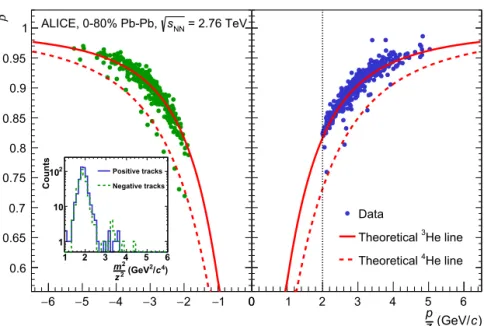
In Fig. 1,the velocity (β) distributions of He candidates are plotted versus rigidity. One can clearly see the separation of 3He and 4He. From these data, the m2/z2 (m=mass of the particle) distributions are calculatedand displayed in the insert of this figure. From the insert, the separation of 3He and 4He can be quantitatively asserted. The m2/z2 is differ-ent for 3He (2.00 GeV2/c4) and4He (3.48 GeV2/c4).Candidates lying within awindowof 2.86 GeV2/c4< m2/z2<4.87 GeV2/c4areidentifiedas4Heor4He particles.Thiswindowis determinedbyafittothepeakinthem2/z2distributionoftheselectedtracks.Becauseof the lowstatistics,thefittingisdonesimultaneouslybothforparticlesandforanti-particles,including secondary4Heknockedoutfromthematerial.AGaussianwithanexponentialtailontheright sideisusedasthefitfunction.Forthebackground,thesumofafirst-orderpolynomialandan exponentialshapeisassumed.Thisisnecessarytodescribethetime-signalshapeof theTOF detector[27].Thepolynomialshapeisneededtocopewithmismatchedcandidatetracksinthe signalregion.Asimilarprocedureisusedin[1].
Fig. 1.VelocityβmeasuredwiththeTOFdetectorasafunctionoftherigidityp/z.Forthisfigureaselectionbandof
−1.5 to3σ aroundthemeanoftheTPCspecificenergy-lossdistributionisrequired.Negatively(positively)charged particlesareshownontheleft(right)side,withpositivetracksinblueandnegativetracksingreen.Thedashedvertical linerepresentsthecutontherigidityp/z=2 GeV/c(appliedonlyforpositivelychargedparticles).Theinsertshows them2/z2distributionsobtainedfromthedatapointsshowninthemainfigure.(Forinterpretationofthereferencesto colourinthisfigurelegend,thereaderisreferredtothewebversionofthisarticle.)
abackground.Notethat thebackgroundduetoknockoutprocessesissteeplyfallingwith mo-mentumandthesignalisrisinginthismomentumrange.Therefore,only4Hecandidateswitha
p/zgreaterthan2GeV/careaccepted.Thecontaminationathighermomentaisestimatedtobe amaximumof0.13countsoutofatotalcountoftheorderof10,whichisaddedasasystematic uncertainty.
ThesmallnumberofclearsignalcountsobservedbycombiningtheTPCandTOFinformation doesnotgiveanyindicationofbackground.Inordertoestimateanupperlimitonthebackground countsfrommismatchedtracksintheTOFdetectorunderneaththe4Heor4He peakintheTOF mass window,alikelihoodfit under theassumption of aflat backgroundisperformed inthe dE/dxversusβγ planeoutsidethe±3σ matchingband.Inthisway,backgroundcandidatesare identifiedasmismatchedparticles.(Theseareusuallyrejectedandonlyusedforthispurpose.) Duetolimitedstatistics,thisprocedurecannotbeusedifastrongerselectioncriterionisapplied for theTPCdE/dx selection,sinceno4Heor 4He candidatesarelefttoapplythistechnique. Fortheseparticularcases,weassumeaconstantratioof3Hetobackgroundcountsandusethis toestimatethenumberof4Hebackground.
Thebackgroundstemmingfrommisidentificationof(anti-)3Heas(anti-)4Heisestimatedto be morethanoneorderofmagnitude smallerthanthe onefrom themismatch ofTPC tracks when extrapolatedtothe TOFdetectorandistherefore consideredtobe negligible.The esti-matedbackgrounddecreaseswithmorestringentTPC dE/dx cuts.The signal-to-background ratioimprovesdependingonthetightnessofthedE/dxcutfrom1.7to8.4for4Heandfrom1.7 to17.6for4He.
y andintransversemomentumpT.TheshapeofpTspectrainheavy-ioncollisionsistypically describedbyablast-wavemodel[36].Thismodelassumesanaverageradial-flowvelocityβ
andakineticfreeze-outtemperatureTkinasdescribedin[37].Generally,mosthadronpTspectra measuredinheavy-ioncollisionscanbedescribedwellbyonecommonsetofparameters[38]. Surprisingly,thisalsoworkswellforthedescriptionofdeuteronand3Hep
Tspectra[1].Hence thesameprescriptionisusedhereforthepTshapeof4Heand4He particles,namelythesame setofparametersisused,onlythemassischangedtothe4Hemass.
Sinceonlyasmallnumberof4Heand4He particles(144He and94HeforthewidestTPC dE/dxcut)areobserved,apTspectrumcannotbemeasured.Itisestimatedusingtheblast-wave parametersofdeuteronsand3He spectra[1].Thefinalacceptance×efficienciesareobtainedas describedin[39]andareoftheorderof15%for4Heand20%for4He.Thedifferenceoriginates fromthe2GeV/crigiditycutappliedto4Hecandidates.
Forthe4He analysis,theabsorptioninthedetectormaterialistakenintoaccountusingtwo differenttransportcodes,namelyGEANT3[40]andGEANT4[41].Thesetwocodesuse differ-entmodelsfortheestimationoftheabsorptioncrosssection.InGEANT4,aGlaubermodelbased onthewellknownhadronicinteractioncrosssectionsfor(anti-)protonsisimplemented[42].The versionof GEANT3usedinthisanalysisismodified[1]such thatitcalculatestheabsorption basedonanempiricalparameterisation[43],basedonthemeasurementsofanti-deuterons car-riedoutatSerpukhov[44].ThebaselineisgivenbytheabsorptioncalculatedwithGEANT4, whiletheGEANT3basedcorrectionisusedinthesystematicuncertaintyevaluation.The maxi-mumabsorptionprobabilitytowardslowp/zisabout20%.IncontrasttoGEANT4,whichstill showsanabsorptionofabout5%atpT=10 GeV/c,GEANT3exhibitsbasicallynoabsorption above3.5GeV/c.
Themaincontributionstothesystematicuncertaintyonthedeterminedproductionyieldsare:
– TheuncertaintyduetotheunknownshapeofthepTdistributions,whichisdeterminedby usingtheblast-wavemodelbasedonthemeasureddeuteronand3He spectra[1].Thisleads toasystematicuncertaintycontributionofaround13%.
– Only for 4He: The rigidity cut on p/z greaterthan 2 GeV/c itselfhas a systematic un-certainty of 4 to 13% depending on the TPC PID cut. As mentioned before, the sec-ondarycontamination abovethis cutis estimated tobe amaximumof 0.13 counts. This leads to a systematic uncertainty of at minimum 20% and at maximum 49% grow-ing with stricter TPC PID cut. As the number of observed candidates shrinks with stricterTPC dE/dx selection,the systematicuncertainty onthesecondarycontamination grows.
– Onlyfor4He:Theabsorptioncorrectionhasanuncertaintyof7%,estimatedfromthe dif-ferenceofthetwoGEANTimplementations.
Othersystematicuncertaintiesareestimatedbyvaryingthecutsinthelimitsconsistentwith thedetectorresolution.Thecontributionsof thesesystematicuncertainties aretypicallyfound tobebelow thepercentrange. Thesystematic uncertaintyon thechosenTPC PIDcut varies between1%for themostloosecutsand19% for strictercuts.Thisiscausedbythe stronger sensitivityofthestrictercuts,namelytheevenfurtherreducedlownumberofcandidates,which isnotreflectedintheMonteCarlosimulation.
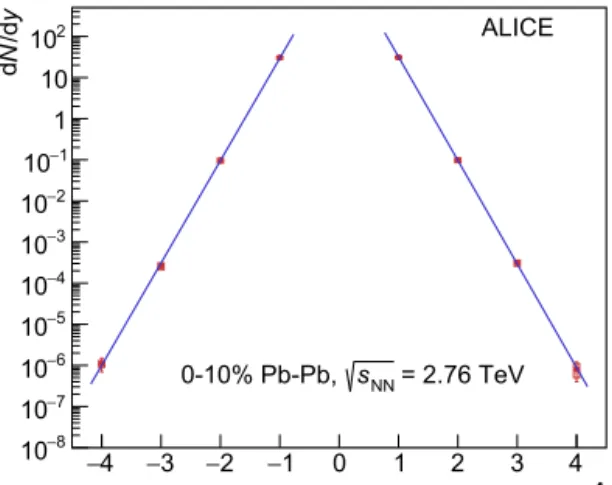
Fig. 2.dN/dyforprotons(A=1)upto4He(A=4)andthecorrespondinganti-particlesincentral(0–10%)Pb–Pb collisionsat√sNN=2.76 TeV.Thebluelinesarefitswithanexponentialfunction.Statisticaluncertaintiesareshown
aslines,whereasthesystematicuncertaintiesarerepresentedbyboxes.
4. Results
Themeasurementisperformedonadatasetincludingcentral,semi-centralandminimum-bias triggeredevents.Tomakeuseofallthedataanalysed,thesemi-centralandminimum-biasevents havebeenextrapolatedto0–10%centralityintervalassumingthattheparticleandanti-particle yieldsscalelinearlywiththecharged-particlemultiplicitydNch/dη.Thisprocedurehasalready been testedto workwellfor the(anti-)hypertritonproduction[2].In addition,d/p and3He/p ratiosaremeasuredtobeapproximatelyflatversusmultiplicitywithinuncertainties[1].Thus,for eachcentralityclass,thenumberofanalysedeventsismultipliedbythecorrespondingmeasured charged-particle densitydNch/dη [28].Ifthisisaddedupanddividedby thetotalnumberof measured eventsit leads to aweighting factor of 1034.To get the final yieldin the 0–10% centralityclassthemeasuredyieldismultipliedwiththedNch/dηfor0–10%centrality(1447.5) anddividedbytheweightingfactor,asdN/dy0−10%=dN/dymeasured×1447.5/1034.
ThisleadstofinalvaluesofdN/dy4He=(0.8±0.4(stat)±0.3(syst))×10−6for4Heand dN/dy4He=(1.1±0.4(stat)±0.2(syst))×10−6for4He.Fortheratio4He/4He weobtain1.4± 0.8(stat)±0.5(syst)(“stat”and“syst”indicatethestatisticalandthesystematicuncertainty).
Themeasuredyieldsinthe0–10%centralityintervalareshowninFig. 2togetherwiththose of (anti-)protons,(anti-)deuteronsand(anti-)3He[1,38](detailsontheextrapolationto0–10% centrality canbefoundin[10]).Thebluelinesareexponentialfitswiththefit functionKeBA
resultinginB= −5.8±0.2,whichcorrespondstoapenaltyfactor(suppressionfactorof pro-ductionyieldfornucleiwithoneadditionalbaryon)ofaround300.Thesamepenaltyfactoris alsoobtainedifthefitisdoneupto3Heonly[1].
The obtainedpenalty factor of around 300 for each additional nucleon is consistent with
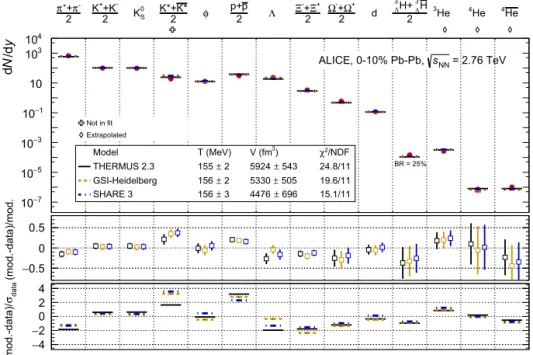
Tchem≈160 MeV in the equilibrium thermal models. The measured yields for 4He and 4He nucleiareconsistent withthepredictions from thevarious(equilibrium) thermalmodels
(THERMUS [45], GSI[5,46,47] andSHARE [48–50])with Tchem=156 MeV,as shown in
Fig. 3.Thermalmodelfits,withthreedifferentimplementations,tothelightflavourhadronyieldsincentral(0–10%) Pb–Pbcollisionsat√sNN=2.76 TeV.Thedatapointsaretakenfrom[1,2,38,51–54]anddetailsofthefitscanbefound
in[10,11].Theupperpanelshowsthefitresultstogetherwiththedata,whereasthemiddlepanelshowsthedifference betweenmodelanddatanormalisedtothemodelvalueandthelowerpanelthedifferencebetweenmodelanddata normalisedtotheexperimentaluncertainties.
particlesonlynuclei(deuterons,3Heand4Heand4He)areconsideredforthefit,theresulting temperaturesare154±4MeV.Thepuremeasuredyieldsfor4Heand4He nucleiagree, depend-ingonthemodelimplementation,withinthedetermineduncertaintieswithtemperaturesfrom 135 MeVto177 MeV.Takentogethertheseobservationssuggestthattherelativelyheavy4He and4He nucleiarealsoproducedstatisticallyatthesametemperatureasthelighterparticles.
5. Summaryandconclusion
The ALICE Collaboration has measured the production yieldsof 4He and 4He in central (0–10%)Pb–Pbcollisionsat√sNN=2.76 TeV.Theratio ofthetwoyieldsisconsistentwith unityandtheresultsareingoodagreementwiththepredictionofthestatisticalthermalmodel assumingthesametemperatureof156 MeVasisobtainedfromthefittotheotherlightflavour hadrons.
theratioof4He/4He willbesignificantlyimproved.Inaddition,amassdifferencemeasurement similartowhatwasdonein[56]willbepossible.
Acknowledgements
MinistryofEducation,Science,ResearchandSportoftheSlovakRepublic,Slovakia;National ResearchFoundationofSouthAfrica,SouthAfrica;CentrodeAplicacionesTecnológicasy De-sarrolloNuclear(CEADEN),Cubaenergía,Cuba,MinisteriodeCienciaeInnovacionandCentro deInvestigacionesEnergéticas,Medioambientales yTecnológicas(CIEMAT),Spain;Swedish ResearchCouncil(VR)andKnutandAliceWallenbergFoundation (KAW),Sweden;European OrganizationforNuclearResearch,Switzerland;NationalScienceandTechnologyDevelopment Agency(NSDTA),SuranareeUniversityofTechnology(SUT)andOfficeoftheHigher Educa-tion Commissionunder NRUprojectof Thailand,Thailand; Turkish AtomicEnergy Agency (TAEK),Turkey;NationalAcademyofSciencesofUkraine,Ukraine;ScienceandTechnology FacilitiesCouncil(STFC),UnitedKingdom;NationalScienceFoundationoftheUnitedStates ofAmerica(NSF)andU.S.DepartmentofEnergy,OfficeofNuclearPhysics(DOENP),United StatesofAmerica.
References
[1] ALICECollaboration,J.Adam,etal.,Productionoflightnucleiandanti-nucleiinppandPb–PbcollisionsatLHC energies,Phys.Rev.C93(2016)024917,https://arxiv.org/abs/1506.08951v3.
[2] ALICECollaboration,J.Adam,etal.,3Hand3¯
H productioninPb–Pbcollisionsat √s
NN=2.76 TeV,Phys.Lett.
B754(2016)360,https://arxiv.org/abs/1506.08453v2.
[3] P.Braun-Munzinger,J.Stachel,Productionofstrangeclustersandstrangematterinnucleus–nucleuscollisionsat theAGS,J.Phys.G21(1995)L17,https://arxiv.org/abs/nucl-th/9412035v1.
[4] P.Braun-Munzinger,J.Stachel,Particleratios,equilibrationandtheQCDphaseboundary,J.Phys.G28(2002) 1971,https://arxiv.org/abs/nucl-th/0112051v1.
[5] A.Andronic,P.Braun-Munzinger,J.Stachel,H.Stöcker,Productionoflightnuclei,hypernucleiandtheir antipar-ticlesinrelativisticnuclearcollisions,Phys.Lett.B697(2011)203,https://arxiv.org/abs/1010.2995v2.
[6] J.Cleymans,S.Kabana,I.Kraus,H.Oeschler,K.Redlich,N.Sharma,Antimatterproductioninproton–protonand heavy-ioncollisionsatultrarelativisticenergies,Phys.Rev.C84(2011)054916,https://arxiv.org/abs/1105.3719v1. [7] A.Andronic,P.Braun-Munzinger,K.Redlich,J.Stachel,ThestatisticalmodelinPb–PbcollisionsattheLHC,
Nucl.Phys.A904(2013)535c,https://arxiv.org/abs/1210.7724v1.
[8] J.Stachel,A.Andronic,P.Braun-Munzinger,K.Redlich,ConfrontingLHCdatawiththestatisticalhadronization model,J.Phys.Conf.Ser.509(2014)012019,https://arxiv.org/abs/1311.4662v1.
[9] J.Steinheimer,K.Gudima,A.Botvina,I.Mishustin,M.Bleicher,H.Stöcker,Hypernuclei,dibaryonandantinuclei productioninhighenergyheavyioncollisions:thermalproductionvs.coalescence,Phys.Lett.B714(2012)85,
https://arxiv.org/abs/1203.2547v2.
[10] M.Floris,Hadronyieldsandthephasediagramofstronglyinteractingmatter,Nucl.Phys.A931(2014)103,https:// arxiv.org/abs/1408.6403v3.
[11] A.Andronic,P.Braun-Munzinger,K.Redlich,J.Stachel,Hadronyields,thechemicalfreeze-outandtheQCD phasediagram,J.Phys.Conf.Ser.779(2017)012012,https://arxiv.org/abs/1611.01347v2.
[12] STARCollaboration,H.Agakishiev,etal.,Observationoftheantimatterhelium-4nucleus,Nature473(2011)353,
https://arxiv.org/abs/1103.3312v2,Erratum:Nature475(2011)412.
[13]P.Braun-Munzinger,J.Stachel,Thequestforthequark–gluonplasma,Nature448(2007)302.
[14]H.Sato,K.Yazaki,Onthecoalescencemodelforhighenergynuclearreactions,Phys.Lett.B98(1981)153.
[15]R.Hagedorn,Deuteronproductioninhigh-energycollisions,Phys.Rev.Lett.5(1960)276–277.
[16] S.T.Butler,C.A.Pearson,Deuteronsfromhigh-energyprotonbombardmentofmatter,Phys.Rev.Lett.7(Jul1961) 69–71,https://doi.org/10.1103/PhysRevLett.7.69.
[17] S.T.Butler,C.A.Pearson,Deuteronsfromhigh-energyprotonbombardmentofmatter,Phys.Rev.129(Jan1963) 836–842,https://doi.org/10.1103/PhysRev.129.836.
[18]J.L.Nagle,B.S.Kumar,D.Kusnezov,H.Sorge,R.Mattiello,Coalescenceofdeuteronsinrelativisticheavyion collisions,Phys.Rev.C53(1996)367–376.
[19]R.Scheibl,U.W.Heinz,Coalescenceandflowinultrarelativisticheavyioncollisions,Phys.Rev.C59(1999) 1585–1602,arXiv:nucl-th/9809092.
[21]L.Zhu,C.M.Ko,X.Yin,Light(anti-)nucleiproductionandflowinrelativisticheavy-ioncollisions,Phys.Rev.C 92 (6)(2015)064911,arXiv:1510.03568[nucl-th].
[22]X.Yin,C.M.Ko,Y.Sun,L.Zhu,Ellipticflowoflightnuclei,Phys.Rev.C95 (5)(2017)054913,arXiv:1703.09383 [nucl-th].
[23]L. Zhu, H. Zheng,C.M. Ko, Y. Sun, Light nuclei production in Pb+Pbcollisions at √sN N =2.76 TeV,
arXiv:1710.05139[nucl-th].
[24]A.S.Botvina,J.Steinheimer,M.Bleicher,Formationofexoticbaryonclustersinultra-relativisticheavy-ion colli-sions,Phys.Rev.C96 (1)(2017)014913,arXiv:1706.08335[nucl-th].
[25]K.-J.Sun,L.-W.Chen,Ananalyticalcoalescenceformulaforparticleproductioninrelativisticheavy-ioncollisions, arXiv:1701.01935[nucl-th].
[26] J.Alme,etal.,TheALICETPC,alarge3-dimensionaltrackingdevicewithfastreadoutforultra-highmultiplicity events,Nucl.Instrum.MethodsA622(2010)316,https://arxiv.org/abs/1001.1950v1.
[27]A.Akindinov,etal.,PerformanceoftheALICETime-Of-FlightdetectorattheLHC,Eur.Phys.J.Plus128(2013) 44.
[28] ALICECollaboration,K.Aamodt, etal.,Centralitydependence ofthecharged-particlemultiplicitydensityat midrapidityinPb–Pbcollisionsat√sNN=2.76 TeV,Phys.Rev.Lett.106(2011)032301,https://arxiv.org/abs/
1012.1657v2.
[29] ALICECollaboration,B.Abelev,etal.,CentralitydeterminationofPb–Pbcollisionsat√sNN=2.76 TeVwith
ALICE,Phys.Rev.C88(2013)044909,https://arxiv.org/abs/1301.4361v3.
[30] ALICECollaboration,K.Aamodt,etal.,AlignmentoftheALICEInnerTrackingSystemwithcosmic-raytracks, J.Instrum.5(2010)P03003,https://arxiv.org/abs/1001.0502v3.
[31] ALICECollaboration,TheALICEdefinitionofprimaryparticles,https://cds.cern.ch/record/2270008.
[32]ALICECollaboration,K.Aamodt,etal.,TheALICEexperimentattheCERNLHC,J.Instrum.3(2008)S08002.
[33] ALICECollaboration,B.Abelev,etal.,PerformanceoftheALICEexperimentattheCERNLHC,Int.J.Mod. Phys.A29(2014)1430044,https://arxiv.org/abs/1402.4476v4.
[34]H.Bethe,BremsformelfürElektronenrelativistischerGeschwindigkeit,Z.Phys.76(1932)293.
[35]F.Bloch,ZurBremsungraschbewegterTeilchenbeimDurchgangdurchMaterie,Ann.Phys.408(1933)285.
[36] E.Schnedermann,J.Sollfrank,U.W.Heinz,Thermalphenomenologyofhadronsfrom200-A/GeVS+Scollisions, Phys.Rev.C48(1993)2462,https://arxiv.org/abs/nucl-th/9307020v1.
[37] ALICECollaboration,B.Abelev,etal.,Pion,kaon,andprotonproductionincentralPb–Pbcollisionsat√sNN=
2.76 TeV,Phys.Rev.Lett.109(2012)252301,https://arxiv.org/abs/1208.1974v3.
[38] ALICECollaboration,B.Abelev,etal.,Centralitydependenceofπ,K,pproductioninPb–Pbcollisionsat√sNN=
2.76 TeV,Phys.Rev.C88(2013)044910,https://arxiv.org/abs/1303.0737v3.
[39] ALICECollaboration,J.Adam,etal.,Searchforweaklydecayingn andexoticboundstatesincentralPb–Pb collisionsat√sNN=2.76 TeV,Phys.Lett.B752(2016)267,https://arxiv.org/abs/1506.07499v2.
[40]R.Brun,F.Carminati,S.Giani,GEANTDetectorDescriptionandSimulationTool,CERN-W5013,CERN-W-5013, 1994.
[41]S.Agostinelli,etal.,GEANT4:asimulationtoolkit,Nucl.Instrum.MethodsA506(2003)250.
[42]V.Uzhinsky,etal.,Antinucleus–nucleuscrosssectionsimplementedingeant4,Phys.Lett.B705(2011)235.
[43]A.A.Moiseev,J.F.Ormes,Inelasticcrosssectionforantiheliumonnuclei:anempiricalformulaforuseinthe experimentstosearchforcosmicantimatter,Astropart.Phys.6(1997)379.
[44]V.V.Abramov,etal.,ProductionofdeuteronsandantideuteronswithlargeptinppandpAcollisionsat70GeV, Yad.Fiz.45(1987)1362.
[45] S.Wheaton,J.Cleymans,M.Hauer,THERMUS–athermalmodelpackageforROOT,Comput.Phys.Commun. 180(2009)84,https://arxiv.org/abs/hep-ph/0407174v2.
[46] A. Andronic, P. Braun-Munzinger, J. Stachel, Thermal hadron production in relativistic nuclear collisions: thehadron mass spectrum, thehorn, and theQCD phase transition, Phys. Lett. B 673 (2009)142, https:// arxiv.org/abs/0812.1186v3,Erratum:Phys.Lett.B678(2009)516.
[47]A.Andronic,P.Braun-Munzinger,K.Redlich,J.Stachel,DecodingthephasestructureofQCDviaparticle pro-ductionathighenergy,arXiv:1710.09425[nucl-th].
[48] G.Torrieri,S.Steinke,W.Broniowski,W.Florkowski,J.Letessier,J.Rafelski,SHARE:statisticalhadronization withresonances,Comput.Phys.Commun.167(2005)229,https://arxiv.org/abs/nucl-th/0404083v2.
[49] G.Torrieri,S.Jeon,J.Letessier,J.Rafelski,SHAREv2:fluctuationsandacomprehensivetreatmentofdecay feed-down,Comput.Phys.Commun.175(2006)635,https://arxiv.org/abs/nucl-th/0603026v2.
[50] M.Petran,J.Letessier,J.Rafelski,G.Torrieri,SHAREwithCHARM,Comput.Phys.Commun.185(2014)2056,
[51] ALICECollaboration,B.Abelev,etal.,K0sandproductioninPb–Pbcollisionsat√sNN=2.76 TeV,Phys.Rev. Lett.111(2013)222301,https://arxiv.org/abs/1307.5530v2.
[52] ALICECollaboration,B.Abelev,etal.,Multi-strangebaryonproductionatmid-rapidityinPb–Pbcollisionsat
√s
NN=2.76 TeV,Phys.Lett.B728(2014)216,https://arxiv.org/abs/1307.5543v3.
[53] ALICECollaboration,B. Abelev, etal., K∗(892)0 and φ (1020) production in Pb–Pbcollisions at√sNN=
2.76 TeV,Phys.Rev.C91(2015)024609,https://arxiv.org/abs/1404.0495v3.
[54]ALICECollaboration,J.Adam,etal.,K∗(892)0andφ (1020)mesonproductionathightransversemomentumin ppandPb–Pbcollisionsat√sNN=2.76 TeV,Phys.Rev.C95(2017)064606,arXiv:1702.00555[nucl-ex].
[55]ALICECollaboration,B.Abelev,etal.,UpgradeoftheALICEexperiment:letterofintent,J.Phys.G,Nucl.Part. Phys.41(2014)087001.
[56] ALICECollaboration,J.Adam,etal.,Precisionmeasurementofthemassdifferencebetweenlightnucleiand anti-nuclei,Nat.Phys.11(2015)811,https://arxiv.org/abs/1508.03986v1.
ALICECollaboration