Research on Chinese Social Media
Censorship as Contemporary Archaeology
Notes on Time-Sensitivity
Joshua Cader*
This essay considers a selection of English- language work examining censorship on Sina Weibo at peak platform vitality. The goal is to see how Chinese social media censorship and the research examining it evolved in tandem, this evolution being largely determined by shifts in usage patterns sped up by network effects and the increasing
sophistication of censorship technology and strategy. We will see that when the platform became moribund, research consequently shifted away from political topics towards use of the platform as mere corpus. I then end by suggesting uses for such a platform as the subject of political research.
The first article of note on Sina Weibo was Bamman et al.,1 appearing in early 2012.
Work before the study’s appearance largely concentrated on the prevention of access to information, “including IP blocking of foreign websites or search engine filtering”, and it represents the “first large-scale analysis of political content censorship in social media”.
While IP filtering2 is useful to the state when the target of censorship is beyond its jurisdiction or the state does not have the resources to set up a more costly system, the censorship performed by IP filtering is rather
“hard”. That is, it relies on fear rather than
friction,3 and the literature indicates that when applied to the general population, this is a suboptimal strategy.4 For example, in an experimental setting, Chinese undergraduate- age subjects responded to overt censorship of blog posts by choosing to read similar posts next rather than avoiding a sensitive topic altogether.5 Conversely, censorship of blog posts on a sensitive topic (here, Tibetan self-immolations) that simply erases the post with no trace makes posts from others less likely.6 As an objection to such arguments, one could say that reading is a low-risk activity, while posting is high-risk. However,
The Rise of Sina Weibo and Soft Censorship
in a study of bloggers cited in the same manuscript,7 being censored does not make it either more or less likely that they will post again on the same topic. So, fear is inert, at least at the “typical” producer and consumer level examined, whereas friction works. Of course the relative importance of the typical user for setting the agenda of discussion is up for debate, and it is likely that the study’s findings do not hold for power- users. This will be discussed later. For now, I note that the use of particularly “hard”
censorship, such as IP filtering, has become a less important part of the censorship equation in China, while remaining the solution of choice, if not the only solution, in countries with less inclination or ability to spend scarce resources on making censorship
“soft”, with mixed results.8
This is not to say that websites are no longer blocked in China, but that to use the mere fact as a subject of research i s u n i n t e r e s t i n g f o r t w o r e a s o n s : i t isn’t new, and understanding of it is fairly transparent. Any visitor to Greatfire.org can find out which websites have been blocked and when, with archives of tests of DNS blocks (as well as URL redirections9) dating back, in many cases, to 2011. This is accompanied by extensive test data, which is particularly useful when the website in question is blocked in a different form than the standard DNS block. Although the
reasons for the block are not described, in most cases they are somewhat boring and, perhaps more importantly, idiosyncratic.
This means that less obvious trends cannot really be established by means of automated analysis, which is the weapon of choice of Internet researchers. Some popular pornography portals are blocked, some are not, and some are blocked part of the time.
If a news website speaks ill of a Chinese leader loudly enough, they will be blocked – Bloomberg.com being a particularly stark example, blocked consistently since June 2012 when it ran a major story exposing the property holdings of Xi Jinping’s family. The New York Times is always blocked. Thus the academic action on the Chinese censorship front is elsewhere – at the user level, which can be researched by looking at the patterns visible in the massive number of traces left by users on social media. At the height of the “big data”10 hype in 2012, the platform of choice was indisputably Sina Weibo. Earlier microblog services had been shut down at the time of the 2009 Urumqi riots (which also led to the DNS blocks of Facebook and Twitter). Sina Weibo was the outlet of choice among the new microblogs that took their place, which were in turn the method of expression most likely to have collective action potential.11
Bamman et al. seeks to uncover “the terms whose presence in a message leads
to anomalously higher rates of deletion”
by using Chinese-language Twitter (which consists of both mainland-resident VPN users as well as overseas Chinese) as “an uncensored stream for contrast”. The blocking of search terms is also examined – an example of a more primitive, “hard”
censorship in action. This can be seen as a transitional piece. The term searched for by Bamman et al. –
刘晓波 (Liu Xiaobo) –
is of course said by them to be blocked, or more specifically “self-censored” (that is, by Sina themselves: searching yields a message explaining that results cannot be shown due to “relevant laws”), and my own tests years later yield the same result. However a cursory look on Greatfire.org indicates that a search for Liu Xiaobo on Weibo had been sporadically possible from late 2013 to late 2014 (this conveniently right after the end of the government campaign that would bring about the end of Weibo as cutting edge, see below). Thus Roberts’ pointing towards the greater usefulness of “soft”censorship (“friction”) over hard (“fear”) can be said to be understood by those in charge of Chinese social media censorship implementation, as softness temporarily increased. It should be specified that while sometimes a sensitive search is possible, the results are manipulated. Roberts writes that search filtering is now producing a list of unobjectionable websites, instead
of producing an error indicating that the search term is objectionable.12 I have seen this in progress – after finding an interesting situation where no results were returned in a keyword search modified by the imposition of a twenty-four-hour window and performing this exact search multiple times, the search ended up being altered three days later to display ten posts rather than zero, or the thousands that would have been returned if unmanipulated.13 For the user not desperate to see something in particular, such manipulated searches do not elicit the same fear as being told in stark terms that one is searching for something illegal, but does create the desired information-slowing friction.
Some of Bamman et al.’s findings are obvious: some keywords are sensitive all the time; some are sensitive due to a current event. However, the finding that a post’s being rebroadcast or the poster having a large number of followers does not make it more likely that a comment will be deleted is surprising, although there may be multiple internal variables working at cross-purposes here: deleting such tweets may make censorship more obvious, and thus “hard”, making deletion less likely. Also, those with many followers may be more circumspect in their usage of offending terms (with power comes responsibility), and therefore their posts may be less incendiary. On the other
hand, the ability of such posts to spread outward from a trusted source may make the censors more likely to want to nip such activity in the bud. Perhaps the most interesting finding of Bamman et al. is that sentiment is not important in determining deletion. This presages the work of King et al. which, by setting up a message board in China and making use of the necessary censorship tools, finds that, if anything, “it is that submissions in favor of the government are reviewed more often than those against the government!”14 – perhaps censors are on the lookout for sarcasm.
Zhu et al. looks at users who have a high rate of post deletions15 with deletion r e s o l u t i o n d o w n t o m i n u t e i n t e r v a l s . T h e y w a n t t o s e e “ h o w u s e r s w h o discuss sensitive topics will experience Weibo’s censorship”.16 Unsurprisingly, deletion speeds are found to be fastest for hot topics.17 This concurs with King et al.’s
work, which found censorship concentration at the time of “volume bursts”, hypothesized to be for collective action prevention.18 Zhu et al. also asserts that there is a filtering system for incoming posts as they are made, with some simply not allowed to be made, while others are implicitly filtered until they can be manually checked.19 The latter involves a situation where the user is asked to wait for a few minutes for the post to be “synchronized by the data server”; this sometimes takes many hours.20 Though the existence of such a system is unsurprising, its implications are interesting, as it shows that Sina does not mind lying to create an environment where censorship is less visible – softer – providing further evidence for the assertion that the glitches in keyword search mentioned above are not mere glitches. The existence of “camouflaged posts”, where other users cannot see your posts (though you can),21 is another example.
Since the time of the work examined above, Sina Weibo’s golden age has passed, and therefore research into its current mobilization potential is no longer sensible.
Three of the most recent noteworthy articles (Huang and Sun22, Tong and Zuo23, and Bondes and Schucher24) were all submitted for publication in mid-2012. The twilight
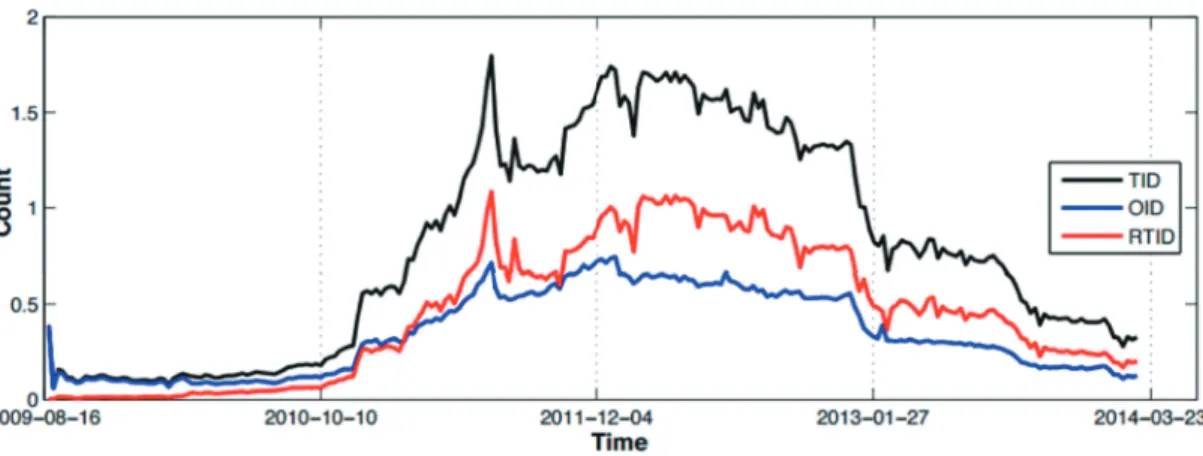
of Weibo as a leading space is captured in Rauchfleisch and Schäfer, with material covering 2013.25 Newer articles tend to concentrate on everyday platform use: how it has become commodified,26 how it shapes collective memory,27 or, in one case, helpfully plotting its relative demise complete with various time-series graphs (see Fig. 1 below
Weibo’ s Death by Engineered Boredom
for an example).28 Browsing Google Scholar one is struck by the proliferation of articles by public health researchers and computer scientists using the utterances as a linguistic corpus.29 By early 2014, WeChat, a service similar to Japan’s Line, was seen as the new cutting edge information sharing system, with Sina Weibo’s user-base having slid 9% in 2013.30 This is assumed to be largely due to the August-October 2013 crackdown confronting Weibo power-users31 and their potential for “online rumor-mongering”,32 with interpretations of laws indicating that
“any online post containing defamatory information would be considered a ‘serious off ense’ under the Criminal Law if it received more than 5,000 views or was reposted more than 500 times.”33
R o b e r t s , t h o u g h s h e f a l l s s q u a r e l y
on the side of “friction” being more important, readily admits that “the Chinese government focuses its intimidation efforts on high-profile bloggers”,34 while declaring this to be consistent with a friction strategy as it has downstream friction eff ects on the spread of information. Fu and Chau provide statistics to back up the assertion that the power-users were key to Weibo’s appeal, indicating that 60% of Weibo accounts have never posted, with 90% of the ones who have posted not making an “original post in a 7-day study period”, and only 0.45% posting more than 40 times within this timeframe.
Thus, a small group of users created a majority of the content, with only about 2%
of all accounts managing to create posts that were reposted or received comments at least once.35
Figure 1: Average posts per day per account (black: all; blue: original; red: forwarded)36
At least in China, then, the future of social media research wishing to understand today's politics by means of contemporary artifacts would seem to belong to investigations into the cat-and-mouse game being played out on instant messaging services, concentrating on the relatively prosaic keyword lists, technical details of the software’s censorship implementation, as well as the potentially fascinating and very real presence of pervasive surveillance on such services as the former TOM-Skype37 and WeChat.38 The problem with such work lies in the nature of surveillance. Censorship involves interference, which can be measured;
surveillance does not. However, while WeChat is cited as the destination to which Weibo users migrated,39 the crackdown has extended to this new space as well,40 with foreign services such as KakaoTalk and Line blocked.41 Thus perhaps an emerging line of research belongs to those who look into the effects of particularly constrained, though lively, social media environments on public discourse.
Some, such as Mo Zhixu, see in this i n c r e a s i n g l y c o n s t r i c t i v e p a t t e r n t h e inevitability of the Great Firewall morphing into a “National LAN”42 as soon as Chinese applications are able to handle
the functions that are currently served by foreign companies, such as VPNs43 and Amazon Web Services. The latter is a particularly tricky problem for the censors as dissident websites such as Greatfire.org and technology companies like Xiaomi use the same encrypted servers.44 Blocking one means blocking both. With a national LAN, such problems would be solved, though the solution is extreme. Would this push the (typically VPN-using) intellectuals to the street?
C h i n e s e s o c i a l m e d i a c e n s o r s h i p i s theorized as preventing those who would rise up in opposition from having the information required to do so, being: how many people will join me? It allows dissent to simmer while suppressing any display of the peaks of discontent that could trigger an overthrow.45 Volume bursts are specifically squelched when related to collective action and criticism of censors,46 while general policy criticism is seen as unproblematic.
Thus maybe, no matter how “hard” the censorship, as it will certainly appear if an Internet-savvy populace is placed in a national-LAN cage, squelching the ability to calculate a cost-benefit analysis of showing up in the street may be more important than keeping up appearances.
Effects of Platform Migration on Censorship Tactics and Research
Thereon
It should be clear by now that doing research on current Sina Weibo censorship architecture is not particularly useful to understand how collective action is suppressed in the present. Those interested in forming a politically engaged community have migrated to other platforms that are less public, which are in turn consistently being purged. There remains, however, potential in the study of Weibo as a historical artifact during its approximately three-year period of particular cultural relevance (2010 to mid-2013) in order to better understand the goals (and the degree to which they are realized) of the censors at both the company and government level. Such efforts
can be used to draw parallels with the goals of censors attempting to cleanse other platforms that, as they are less public, may be impossible to study in the same depth.
It would also be useful in studying Chinese government reaction to events that occurred during the three-year timeframe, particularly by examining relationships between social and traditional media. We must be good archaeologists and remember that though our subject is less than a decade old, rapid shifts in tool use demand attention to strata context. The persistence of a platform’s existence does not mean it has the same collective uses or is used by the same people at similar rates in similar ways.
Internet Archaeology
1 Bamman, O’Connor, and Smith, “Censorship and Deletion Practices in Chinese Social Media.”
2 The blocking of a website by means of targeting its numerical address.
3 Fear being a naked warning against accessing illicit content; friction being making the content more annoying to access, making it more likely that the casual user will no longer choose to access such content.
4 As opposed to a population of opinion leaders or “sensitive” users.
5 Roberts, “Fear or Friction?,” 17–23.
6 Ibid., 23–28.
7 Ibid., 6–17.
8 See Hassanpour, “Media Disruption and Revolutionary Unrest” for a look at the protest-widening mistake the Egyptian state made in shutting down the internet during the 2011 “Arab Spring” as well as Gohdes, “Pulling the Plug” for the idea of Internet blackouts being useful in a civil war scenario as opposition coordination can be disrupted allowing for military offensives.
Civil war would seem to be a special case – where blocking the Internet is mainly an update or extension of the radar jamming tactic. In civil war, convincing the populace of the state’s benevolence is a secondary goal.
9 Whereby a URL does not resolve to the IP address desired by the user. This may cloak the block in friction, by causing the user to believe it is the desired website's fault rather than that of the authorities.
10 The use of large amounts of digital footprints in order to understand social phenomena by means of aggregation.
11 Through cross-province networking; see Huang and Sun, “Weibo Network, Information Diffusion and Implications for Collective Action in China.”
12 Roberts, “Fear or Friction?,” 29.
13 This unmanipulated, or at least relatively unmanipulated, state was revealed by expanding the requested timeframe and then focusing on the posts that were missing from the more stringent search.
14 King, Pan, and Roberts, “Reverse Engineering Chinese Censorship through Randomized Experimentation and Participant Observation,” 19.
15 Zhu et al., “The Velocity of Censorship,” 2.
16 Ibid., 3.
17 Ibid., 2; ibid., 5.
18 King, Pan, and Roberts, “How Censorship in China Allows Government Criticism but Silences Collective Expression.”
19 Zhu et al., “The Velocity of Censorship,” 6.
20 Ibid.
21 Ibid.
22 Huang and Sun, “Weibo Network, Information Diffusion and Implications for Collective Action in China.”
23 Tong and Zuo, “Weibo Communication and Government Legitimacy in China.”
24 Bondes and Schucher, “Derailed Emotions.”
25 Rauchfleisch and Schäfer, “Multiple Public Spheres of Weibo.”
26 Fuchs, “Baidu, Weibo and Renren.”
27 Zhao and Liu, “Social Media and Collective Remembrance.”
28 Xia et al., “On the Rise and Fall of Sina Weibo.”
29 Another reason for this trend: the increasing numbers of Chinese scholars publishing in English.
30 Wade, “Weibo User Numbers Slide as Rivals Grow.”
31 Custer, “The Demise of Sina Weibo: Censorship Or Evolution?”
32 Though this extended even to children if the rumor they started was considered problematic enough.
33 “A Chronicle of China’s Social Media Crackdown.”
34 Roberts, “Fear or Friction?,” 29.
35 Fu and Chau, “Reality Check for the Chinese Microblog Space.”
36 Xia et al., “On the Rise and Fall of Sina Weibo.”
37 A Chinese version of Skype. Until November 2013, if one attempted to reach Skype.com in China, a URL redirect would send the user to tom.skype.com, the homepage of TOM-Skype, a partnership between Microsoft and a Chinese firm. For more information, see “Small Step for Microsoft - Huge Improvement for Chinese Users.”
38 Henochowicz, “Beware the WeChat Spy.”
39 Rudolph, “Censorship and Innovation in China’s Social Media.”
40 Rajagopalan, “China Renews Crackdown on Tencent’s Messaging App WeChat.”
41 Lee, “China Tells South Korea It Blocked KakaoTalk, Line to Fight Terrorism.”
42 Mo,“The Advent of a National LAN in China.”
43 Used by businesses for security as well as those wishing to climb the Great Firewall.
44 Ornell, “Who’s Behind Greatfire.org?”
45 Lorentzen, “China’s Strategic Censorship.”
46 King, Pan, and Roberts, “How Censorship in China Allows Government Criticism but Silences Collective Expression.”
Bibliography
“2013 Year in Review: A Chronicle of China’s Social Media Crackdown.” Fei Chang Dao, January 1, 2014.
http://blog.feichangdao.com/2014/01/2013-year-in-review-chronicle-of-chinas.html.
Bamman, David, Brendan O’Connor, and Noah Smith. “Censorship and Deletion Practices in Chinese Social Media.” First Monday 17, no. 3 (March 4, 2012).
http://firstmonday.org/ojs/index.php/fm/article/view/3943.
Bondes, Maria, and Günter Schucher. “Derailed Emotions: The Transformation of Claims and Targets during the Wenzhou Online Incident.” Information, Communication & Society 17, no. 1 (January 2, 2014): 45–65. doi:10.1080/1369118X.2013.853819.
Custer, Charles. “The Demise of Sina Weibo: Censorship Or Evolution?” Forbes, February 4, 2014.
http://www.forbes.com/sites/ccuster/2014/02/04/the-demise-of-sina-weibo-censorship-or-evolution/.
Fu, King-wa, and Michael Chau. “Reality Check for the Chinese Microblog Space: A Random Sampling Approach.” PLoS ONE 8, no. 3 (March 8, 2013): e58356. doi:10.1371/journal.pone.0058356.
Fuchs, Christian. “Baidu, Weibo and Renren: The Global Political Economy of Social Media in China.” Asian Journal of Communication, July 3, 2015, 1–28. doi:10.1080/01292986.2015.1041537.
Gohdes, Anita R. “Pulling the Plug: Network Disruptions and Violence in the Syrian Conflict.” Journal of Peace Research 9, no. 10 (January 31, 2014). http://web.isanet.org/Web/Conferences/Toronto%202014/Archive/6a10bba8-83b0-48cc-bc55-2e7585a2d890.pdf.
Hassanpour, Navid. “Media Disruption and Revolutionary Unrest: Evidence From Mubarak's Quasi-Experiment.” Political Communication 31, no. 1 (2014): 1–24. doi:10.1080/10584609.2012.737439.
Henochowicz, Anne. “Beware the WeChat Spy.” China Digital Times, August 12, 2013.
http://chinadigitaltimes.net/2013/08/beware-the-wechat-spy/.
Huang, Ronggui, and Xiaoyi Sun. “Weibo Network, Information Diffusion and Implications for Collective Action in China.”
Information, Communication & Society 17, no. 1 (2014): 86–104. doi:10.1080/1369118X.2013.853817.
King, Gary, Jennifer Pan, and Margaret E. Roberts. “How Censorship in China Allows Government Criticism but Silences Collective Expression.” American Political Science Review 107, no. 02 (May 2013): 326–43. doi:10.1017/S0003055413000014.
———. “Reverse Engineering Chinese Censorship through Randomized Experimentation and Participant Observation,” 2014.
http://gking.harvard.edu/publications/export/bibtex?f%5Btype%5D=working-paper.
Lee, Se Young.“China Tells South Korea It Blocked KakaoTalk, Line to Fight Terrorism.” Reuters. August 7, 2014.
http://www.reuters.com/article/2014/08/07/us-southkorea-china-apps-idUSKBN0G709E20140807.
Lorentzen, Peter. “China’s Strategic Censorship.” American Journal of Political Science 58, no. 2 (April 1, 2014): 402–14. doi:10.1111/
ajps.12065.
Mo, Zhixu. “The Advent of a National LAN in China.” China Change, July 3, 2014.
http://chinachange.org/2014/07/03/the-advent-of-a-national-lan-in-china/.
Ornell, Natalie. “Who’s Behind Greatfire.org?” China Digital Times, March 21, 2014.
http://chinadigitaltimes.net/2014/03/whos-behind-greatfire-org/.
Rajagopalan, Megha. “China Renews Crackdown on Tencent’s Messaging App WeChat.” Reuters, May 27, 2014.
http://ca.reuters.com/article/technologyNews/idCAKBN0E71AK20140527.
Rauchfleisch, Adrian, and Mike S. Schäfer. “Multiple Public Spheres of Weibo: A Typology of Forms and Potentials of Online Public Spheres in China.” Information, Communication & Society 18, no. 2 (February 2015): 139–55. doi:10.1080/1369118X.2014.940364.
Roberts, Margaret E. “Fear or Friction? How Censorship Slows the Spread of Information in the Digital Age,” March 20, 2014.
http://scholar.harvard.edu/files/mroberts/files/fearfriction_0.pdf.
Rudolph, Josh. “Censorship and Innovation in China’s Social Media.” China Digital Times, February 5, 2014.
http://chinadigitaltimes.net/2014/02/censorship-innovation-chinas-changing-social-media/.
“Small Step for Microsoft - Huge Improvement for Chinese Users.” Greatfire.org, November 27, 2013.
https://en.greatfire.org/blog/2013/nov/small-step-microsoft-huge-improvement-chinese-users.
CADER Joshua (ケイダ・ジョシュア)
[生年月] 1986 年 4 月生まれ
[出身大学または最終学歴] 早稲田大学大学院アジア太平洋研究科修士課程終了
[専攻領域] 社会運動論、政治学、メディア研究
[所属] 東京大学大学院学際情報学府博士課程
[所属学会] Association of Internet Researchers, International Studies Association
Tong, Jingrong, and Landong Zuo. “Weibo Communication and Government Legitimacy in China: A Computer-Assisted Analysis of Weibo Messages on Two ’Mass Incidents’. ”Information, Communication & Society 17, no. 1 (January 2, 2014): 66–85. doi:10.1080 /1369118X.2013.839730.
Wade, Samuel. “Weibo User Numbers Slide as Rivals Grow.” China Digital Times, January 17, 2014.
http://chinadigitaltimes.net/2014/01/weibo-user-numbers-slide-rivals-grow/.
Xia, Fan, Qunyan Zhang, Chengyu Wang, Weining Qian, and Aoying Zhou. “On the Rise and Fall of Sina Weibo: Analysis Based on a Fixed User Group.” Data Engineering Workshops (ICDEW), 2015 31st IEEE International Conference on, 224–31. IEEE, 2015.
http://ieeexplore.ieee.org/xpls/abs_all.jsp?arnumber=7129580.
Zhao, Hui, and Jun Liu. “Social Media and Collective Remembrance: The Debate over China’s Great Famine on Weibo.” China Perspectives, no. 1 (2015): 41–48.
Zhu, Tao, David Phipps, Adam Pridgen, Jedidiah R. Crandall, and Dan S. Wallach. “The Velocity of Censorship: High-Fidelity Detection of Microblog Post Deletions.” arXiv Preprint arXiv 1303.0597 (July 10, 2013).
http://arxiv.org/abs/1303.0597.
As social media use has become ubiquitous and increasingly an inseparable component of everyday actions rather than operating in a separate sphere, research projects using the large amounts of data generated by social media use have correspondingly increased in number. Such projects do not merely mean to understand social media use, but make assumptions based on this use, extrapolating the userbase or material present on the platform the data is drawn from to the larger society. While sampling issues have forever been a problem in social research, the types of problems presented by the extrapolation of a platform's userbase differ due to the speed not only at which this userbase changes, but of usage type shifts.
This essay uses as example of the necessity of shifts in research agenda tracking shifts in usage a selection of work examining censorship on China's Sina Weibo microblog platform at peak platform vitality. The goal is to see how Chinese social media censorship and the research examining it evolved in tandem, this evolution being largely determined by shifts in usage patterns sped up by network effects and the increasing sophistication of censorship technology and strategy. When the platform became moribund, research consequently shifted away from political topics towards use of the platform as mere corpus. Uses for a platform that is no longer politically vital as the subject of political research are also suggested.
Research on Chinese Social Media Censorship as Contemporary Archaeology
Joshua Cader*