An Examination of Primary Education Music Lesson Planning Based on a Workshop Case Study
TOKIE Lisa
(Tokyo Gakugei University, Graduate Student)
Keywords: Primary Education, Creative Music Activities, ICT, Workshop
1. Introduction
(1) New Trends in School Education and Music Education in Japan
Following worldwide trends in school education, similar new changes can be seen in Japan. That is, teacher-trainees and teachers change their teaching methods from
content-based to competency-based lessons as required in Japan’s new Course of Study.
The draft of new courses of study for Japan's primary education, which calls for lessons that foster deep, conversational and self-activated learning, was formally released for comment by the Ministry of Education, Culture, Sports, Science and Technology (hereafter MEXT) in February 2017 and will replace the current one soon. This study aims to show that collaborative and cooperative learning helps meet these requirements.
Music education in Japanese schools is currently undergoing many changes. Up until now, the main focus of music lessons have been the acquisition of singing skills and instrumental music performances, in other words mastering a skillful performance using a choir as well as musical instruments. In contrast, current education is attempting to develop into a process where they let the children pursue and learn musical expression together.
The concept of music as we are taught in school is broadening. Not only western classical music and Japanese song are studied, but also Japanese traditional music, ethnic music from all over the world, pop music and music using computer media etc.
In addition to looking at music from such a broad viewpoint, the recently revised Guidelines for the Course of Study has in its opening statement “To encourage students
to cultivate their sentiments, fundamental abilities for musical activities, a love for music as well as a sensitivity toward it, through music-making and appraising.” The result of this is that teachers are now also expected to cultivate abilities and qualities concerning daily life and social music culture (MEXT 2018).
(2) The Importance of “Creative Music Activities” and its Utilization
The author has had the opportunity to take part in music lesson planning workshops aimed at teachers during her third and fourth year as an undergraduate student. For example, at a workshop called “Creative Music Making” (Takakura 2019) held by a teacher from the Elementary School attached to University of Tsukuba, she learned about “continuous activity” (Nakajima, Takakura, Hirano, Kojima 2017) , where you aim at establishing musical acquisition in schoolchildren through repeated practice during every music lesson.
Additionally, at a workshop organized by Yamaha, the author learned about lessons adopting the use of ICT, bodily expression, piano-accompaniments arranged in a jazz style as tools to instruct singing for a diverse lesson planning.
The common denominator for these workshops is “creative music activities”. It is not merely about skills to reproduce existing songs, but the base activity where students collaborate to create sounds and music.
Music Education in Japan contains four major fields: Singing, playing instruments, music appreciation and utilizing creative activities. The classes seeks to help music educators in Japan utilize more creative activities in their music classes as opposed, for example, to music recitation activities, as required by the educational standards of the government. The author believes that one advantage of teaching creative music
activities is that it allows students, even those without classical music training, to work together in groups to achieve a set goal. It also provides chances for students to
communicate both verbally and physically, brainstorm to create solutions to common problems and practice to improve individual skills.
2. Research Reported
From this perspective, the author picked up activities considered to be effective for Japanese elementary school music classes from the workshops she attended during her teacher training sessions. The author believes that the described methods and activities below by the English composer Trevor Wishart and Swiss composer E.J. Dalcroze can be easily incorporated into Japanese elementary school music classes. Furthermore, the author believes that the Creative Music Making activities will nurture cooperating skills in the students and enable them to understand the basic elements of music from play.
(1) Music Activity Examples Based on the Methods of Trevor Wishart 1) “The Hello Game”:Based on a concept created by the English composer, this
game uses rhythm with spoken words. This game has variations that include using the student’s names, favorite foods, and names of countries or famous places students want to visit.
2) “Rhythmic Clapping Activity”:During this activity, for which there are multiple variations, students stand in a circle and clap in turn using a specific rhythm. As a basic example, while clapping in turn in a clockwise manner, the students
simultaneously stomp on the floor in turn going counterclockwise.
3) “Sound Parking”:This activity requires students to concentrate and try to read the other group members’ disposition. In pairs or groups, students attempt to use short and sharp claps, but not at the same time as the others. If two students clap
simultaneously, an event that is called “double parking”, the students are “out.” As an alternative, students can use their voices instead of clapping.
4) “The Music Conductor Game”:One student will act as a conductor and the other students will be required to make certain sounds using their bodies or voice. They will play according to the conductor’s improvisation. An alternative activity uses
“Voice Ensemble”.
(2) Music Activity Examples Based on the Methods of E. J. Dalcroze The “activities to move” described in the elementary and junior high school curriculum guidelines are closely related to music education methods in Europe,
including eurhythmics founders E.J. Dalcroze, Carl Orff and Zoltan Kodaly. For example, in practice based on the philosophy of E.J. Dalcroze’s eurhythmics, the emphasis is on learning while experiencing various elements of music such as “beat”
and “phrase” by actually moving the body (Abramson et al., 1986).
As shown in Table 1, this practice is an example of physical expression activities that students repeatedly engaged in in order to “break the ice” during the introductions of the various music activities. Through experiencing these activities during workshops, the author analyzed that the activities could have the following effects on children:
1) Students were able to easily understand canons through physical expression.
2) Students were able to align beats and maintain tempo together.
3) By carefully imitating each other, students were able to cultivate collaboration and communication skills.
4) They were able to connect to music expression while feeling the rhythm of words and music.
Table 1. Activities Utilizing Dalcroze Eurhythmics Name of
Activitiy Action by whole class Action by the leader Face Canon
Imitate the leader’s action, 3 beats behind while pointing out the part of the face
Movement example Eyes, Mouth, Mouth Nose, Nose, Ears
Body Canon
Imitate the leader’s action, 3 beats behind while pointing out the part of the body
Movement example
Head, Shoulders, Shoulders
3. Method 1 ― Utilizing ICT and Creative Music Making
As mentioned before, music classes are roughly categorized as "Instrumental Music",
"Singing", "Appreciation", and "Creation" in Japan. In these categories, "Creation" is known as the most difficult category to approach for teachers and children. Especially
for elementary children who are not familiar with music scores and in the way
to acquire both melody instrumental performances and singing performances. The level of difficulty of creating the melody is high. Also, it is difficult to establish an effective teaching method for teachers.
Makabe (2016) states that the current situation, where music lessons are limited to once a week, means that thanks to practical use of ICT, Information & Communications Technology classes, reading music and musical grammar knowledge can be skipped.
This would also mean that even more time can be spent on creative activities. This way of thinking is a valid utilization of ICT corresponding to the reality of education
facilities.
In many education facilities in Japan, there is a disparity in access to ICT equipment, between schools and areas. Also in music classes, there is a reluctance to use ICT in lessons, which is currently delaying its introduction. In such educational settings, all kinds of lesson models and creative activities in which the children can make full use of the benefits of the ICT equipment, is strongly desired.
The author had a opportunity to participate at the ICT workshop for school teachers.
As part of the workshop, there was an opportunity to visit an ICT lesson at T elementary school in I prefecture.
(1) Observation at “T” Elementary School
In 2018, the author observed a class at public elementary school “T” that practiced advanced music classes incorporating ICT. In this elementary school they used
YAMAHA’s VOCALOID Education Edition, and in groups they created songs through collaborative activities.
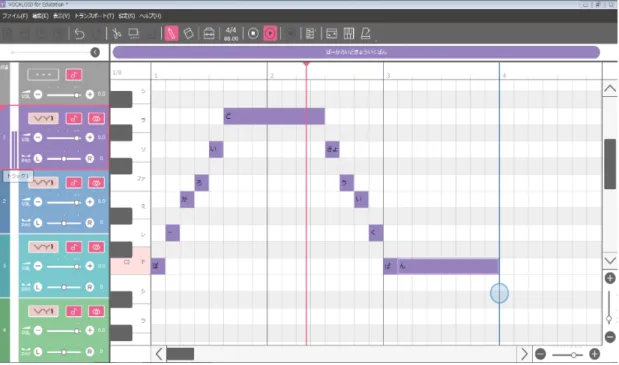
"VOCALOID Education Edition" is a teaching material which enables students to intuitively "create songs・create music" by using a tablet. (See Figure 1)
According to YAMAHA, which developed the material, "By trial and error, Elementary, Junior High, and High School students can have fun creating music. Of course, it is not only in music classes, but also in classroom activities, Integrated Study, special support classes, and other subjects where we are able to use it as cross- curriculum support."The
main content, as observed by the author, are contained in the following steps.
1) Lyrics・Rhythm Making
In four groups of 3~4 students, each group made a song of 16 measures. They followed the instructions from the VOCALOID Education Edition, which they were using for the first time.
(a) Students learned how to input sound and fix the sound.
(b) Students learned that one measure is separated into 8 squares. 1 square is 1 note, and a lyric can be input on that note. Therefore 1 measure can have a maximum of 8 syllables. (See Figure 1)
(c) Students practiced how to input lyrics, and rhythm making. By stretching the words, and inputting rest notes to make the rhythm, students made a pattern of 7 syllables + 5 syllables ; "Ya-sa-shi, se-n-se-i, A-ri-ga-to-u", which means "Thank you kind teacher".
(d) Students learned, that on the 2nd measure, stretching the syllables and inputting rest notes changed the sound by putting it in different positions. Using the "Rhythm Entry Sheet", which was in the Lesson Model Pack, included in the VOCALOID Education Edition, they then discussed how they wanted the rhythm to be.
(e) In the VOCALOID Education Edition, students posted the same notes they had written in the “Rhythm Entry Sheet”. Just a single practice was enough for the students.
2) Creating a Mental Picture
After getting used to operating the VOCALOID Education Edition and rhythm making, it was time to actually make their original song.
(a) The students made their lyrics within the rules of 8 words per measure, just as they had learned.
(b) Students researched and discussed what they wanted the listeners to know about the history of “T” Elementary School and their memories.
(c) When the lyrics were done, they then discussed what kind of song they want to make, the mental picture of their song. Students wrote arrows on Post-It Notes to get an
image of the melody and how they wanted the important words to swell, and how they could give quiet impressions by silencing the sounds.
(d) When they had an image of their song, the whole class listened and discussed the kind of accompaniment that they thought would be appropriate for their mental picture image.
3) Making the First Half of the Song (a) After choosing the accompaniment, they finally got in to construction, using the
VOCALOID Education Edition. For an easier visualization of the song, the students input the first 8 measures and the last 8 measures separately.
(b) In the VOCALOID Education Edition, there is a section called "Code Guide"
which shows the code constitution (=Chord sound), used in the accompaniment in yellow. By using this section, finding the matching sound based on its accompaniment, is easily possible. (See Figure 2)
(c) Knowing the melody's movement by its visualization, input the melody, play the song, discuss and fix. This was done repeatedly.
4) Making the Second Half of the Song
(a) The last half of the song must not break the atmosphere of the first half, so the students had to work carefully. By singing, children tried to match the melody. Each and every group devised and moved on step by step.
(b) Once the melody, was done, the children learned to "repeat" as a song making skill from the teacher. By these procedures, a neatly put together melody was made.
5) Performing at the "Thank you, “T” Elementary School"Ceremony
At the School Closing Ceremony, the songs were performed as part of a "Thank you Assembly" to thank the neighborhood. In class right before the presentation, the
students brushed up some points, such as the smoothness of the singing and the pitch of the melody. Also, they made a manuscript to explain to the other students and their guardians, about their songs. This also helped the students to really think about the
meaning of their songs.
6) Chorus at the "School Closing Ceremony"
The song “Thank you “T” Elementary School", was sung by the whole school. It is hard to imagine that the wonderful arrangement was made by Elementary School children. The students love and memories encompassed in the song, resonated with guardians, teachers and the authors.
7) The Song Making Process
The reason to create music this time was to evince their special memories and love of their school. In class, children had an opportunity to deeply learn the elements of music.
By trial and error they could match the chords to the accompaniment, and they could make the lyrics match smoothly to their melody.
It became a lesson to themselves about the sense of accomplishment, the meaning of having a goal, and the reason to reach the goal. Moreover, from their impressions after the event, the experience of presenting a song that they had made in front of the people who supported them, became a meaningful one.
(2) Summary of the Main Ideas
By observing these creative activities, children shared their thoughts and positivity by repeatedly challenging themselves. Creative activities encouraged initiative by sharing thoughts and using their friends’ ideas, which made children's sense of value expand by communicating through the use of ICT.
The use of VOCALOID Education Edition in creative lessons made children's logical points such as, knowledge and skills, improve, and also improved their sensitivity such as, expression, thoughts, and judgment abilities. Unlike a class in which the student passively learns from a teacher, students independently try and the experience of creation they make with their friends makes their consciousness stronger as a learner.
Surrounding a tablet and deepening their learning by communicating, is related to increasing motivation and confidence (Tokie 2019).
Figure 1. Main Interface of VOCALOID Education Edition Students can put sounds as blocks.
Figure 2. Image of "Chord Guide"
Show the main sound of the current position chord in yellow.
It became clear that the use of VOCALOID Education Edition for creative activities enables equal participation in music activities regardless of differences in reading and performance skills. For example, by utilizing the “Chord Guide” function provided, the student can select a sound that makes a good melody and matches the accompaniment.
Thus, even students without reading or performance skills were observed to have been helped by technology while creating their songs.
4. Method 2 ― Integrated Study and Creative Music Making
When the author attended the Creative Music Making workshop, an opportunity to watch the following lesson on video was presented. This is an excellent practice example of the integration of the subjects Music, Integrated Study and Visual Arts, which was highly recommended in the workshop. The outline of this practice example is described below.
(1) Integration of Music, Visual Arts and Integrated Study
The class title was “Onomatopoeia with Japan Sea as Motif”. It was a Group Voice Ensemble undertaken by a 4th-grade class of 30 students, during the Integrated Study period encompassing Music and Visual Arts.
The class was split into five groups of six. In the Visual Arts class, students took a walk during the spring to the nearby Sea of Japan, which they then drew. The sea is only five minutes from the school, and so forms an integral part of the children’s school life.
In the summer, the students swam in the sea, played in the sand on the beach, and experienced the area using all of their five senses and were able to deepen their understanding of the sea and to create a clearer mental image of it.
In order to do an onomatopoeia-based music activity, the class listened several times to “Miniwannka”, by Canadian composer R. M. Schafer. Afterward, in their groups, the students used varying pitch and strength in their voices to create simple onomatopoeic expressions of the sea.
(2) Summary of the Main Ideas
In order for the students to be able to repeatedly rewrite and share their scores, they used laminated sheet music paper. Even students who were not familiar with musical notation were able to freely use symbols and curves to show their compositions.
In the questionnaire given to the students after the class, students gave such feedback as “Just repeating the same thing over and over makes for a boring performance, so we worked together to make both quiet, calm wave sounds and loud, violent ones.”
Today in Japan, classes often contain a number of children who either have a learning disability or have problems with truancy. This lesson plan was created at the request of a teacher whose class contained four such children. The teacher wished to have a class in which every student, even those without the ability or knowledge to write musical notation, could still participate in composing music.
Creating songs using VOCALOID Education Edition is an activity that involves trial and error when it comes to combining sound length, pitch and rhythm. It is thought that through this process logical thinking abilities and programming thinking abilities were fostered. With the current allocated time for music lessons only being 1.3 hours a week, great expectations are being placed on the development of learning methods that
effectively use ICT.
5. Implications for Music Education
As mentioned at the beginning of this paper, the teaching method of school education today has changed significantly with the revision of the new curriculum guidelines.
Therefore it is important for teachers involved in music education to share information promptly. In that sense, the participation of relevant faculty and students in workshops and open classes will be more strongly sought.
For example, global trends are encouraging cross-disciplinary learning. In this paper, a music class where music, visual arts and integrated studies were linked was featured, and it was easy to see that the expansion of field allowed children to demonstrate their strengths in respective fields. As described above, in order to enable flexible guidance according to the individuality of each child, it is necessary for teachers to become familiar with more fields than just music.
In conclusion, with the newly revised guidelines from MEXT, new approaches and skills are required from teachers, yet neither of the above mentioned type of lessons has been taught at the author’s university. Through visiting open classes, the author has come to the conclusion that student’s can learn musical expression together through physical practice in order to create excellent results.
Due to the newly revised Guidelines for the Course of Study, there is a demand for a new kind of lesson planning. Alongside this, the cultivation of creativity and problem- solving skills is more highly anticipated, as is the area of “Music Creation”, rather than the area of instruments and singing. Hereafter, the author would like to continue
researching the validity of lesson planning based on “Music Creation”.
Acknowledgement
The author would like to express special thanks to “T” elementary school teachers, and Mr. Tomosada from Yamaha Corporation for their assistance with this research.
References
・Chosky, L., Abramson, R.M., Gillespie, A.E., Woods, D., York, F. (1986). Teaching Music in the Twenty-First Century (2nd Edition), New Jersey:Prentice-Hall, Inc.
・Makabe, Y. (2016). The point of contact between education and music and ICT, Journal for Chijoh , Vol.120, Children’s Future and Education of Information Studies, Global Communication Center, International University, Tokyo:pp.82-91
・Ministry of Education, Culture, Sports, Science and Technology (MEXT) (2018).
Teaching Guide for Junior High School Study of Music, Tokyo: Kyouiku Geijutsu Sha Co., Ltd.
・Nakajima, T., Takakura, H., Hirano, J., Kojima, A. (2017). Important Aspects in Music Lessons, Tokyo:Tohyoh Press.
・Takakura, H. (2019). Music Lessons’ “Viewpoint and Way of Thinking” Successful Guidance Skills and Ideas for Teaching Material, Music Lesson Support Book, Tokyo:
Meiji Tosyo Press.
・Tokie, L. (2019). The Application of ICT (Information & Communications
Technology) on Creative Music Making in Elementary Schools, Abstract of the 12th Asia Pacific Symposium for Music Education Research (APSMER) 2019 / ISME Regional Conference, Macao:p.88
Abstract
The purpose of this research is to analyze the validity and implications of the activities presented in music lesson plans targeted for schoolchildren while
communicating with their peers. The cornerstone of the research is the use of concrete and specific examples. The author also aims to create a proposal for expected future implementation in regards to lesson planning.
This research will be based on the author’s experiences at workshops, and the author will extract especially notable practical examples, and examine their validity and their possible improvements.
This research features case studies of actual elementary school music lessons which the author had the opportunity to attend and observe in person or view a recording of said lesson. Then, by carefully describing the latest contents of the lesson practice, the author aimed to clarify the teachers' intention and approach to the children.