鉛 LEAD (Pb) 水銀 MERCURY (Hg) カドミウム CADMIUM (Cd) 六価クロム HEXAVALENT CHROMIUM (Cr6+) ポリ臭化ビフェニル
POLY BROMINATED BIPHENYL (PBB) 物質名
MATERIAL
最大許容値 ppm MAXIMUM ALLOWABLE VALUE RoHS 指令
RoHS DIRECTIVE ELV DIRECTIVEELV 指令 1,000 1,000 100 1,000 1,000 1,000 1,000 100 1,000 −
環境負荷物質対応について
SUPPLEMENTARY DATA
環境負荷物質対応について
CONTROLS ON SUBSTANCE OF CONCERN
持続的経済発展のためには、地球環境に配慮した製品開発、提供 が不可欠です。 このため、当社では ISO14001 に準拠した環境マネジメントシス テムを運用し、RoHS 指令や ELV 指令などの環境規制や、顧客 要求に基づき、環境負荷物質の製品への含有の削減、禁止に積極 的に取り組んでいます。
For sustainable economic growth, it is essential to develop and provide products with awareness of the global environment. For this purpose, we have been operating an environment management system conforming to ISO 14001 and actively addressing to reduce or prohibit substance of concern to be contained in the products based on the environmental standards such as the RoHS Directive and the ELV Directive as well as customers' requests.
「RoHS 指令」は電子・電気機器に使用される危険物質に関する 制限(Restriction of Hazardous Substances)のため欧州連合(EU) により 2003 年 2 月に公布されました。
この指令に基づき、2006 年 7 月 1 日以降は、EU 加盟国内におい て、RoHS 指令の禁止物質の含まれる電子・電気機器を上市する ことはできなくなりました。
The Restriction of Hazardous Substances Directive came into effects in February 2003 by the European Union (EU) to restrict hazardous substances used in electronic and electric appliances. According to the Directive, from 1 July 2006 and onward in the EU countries, it has been made impossible to market electronic and electric appliances that contain substances prohibited by the RoHS Directive.
The End-of-Life Vehicle Directive, aiming to reduce impacts of end-of-life vehicles to the environment, was passed in May 2000 by the European Union (EU) and came into effects on 21 October 2000.
The Directive is intended to promote recycling of parts in vehicles and control containment of hazardous substances in parts.
It has been mandatory for vehicle manufacturers to conform to the applicable regulations concerning new vehicles sold from 1 July 2003 onward.
1. RoHS 指令とは
「ELV 指令」は、使用済み自動車(End of Life Vehicles)が及ぼ す環境への影響を軽減することを目的として、EU(欧州連合) により 2000 年 5 月に成立、2000 年 10 月 21 日に公布されました。 この指令は自動車に使用される部品のリサイクルを促進し、部品 に使われる有害物質の含有規制を行うものです。 自動車メーカーは 2003 年 7 月 1 日以降に販売されている新車に ついて、当該規制を遵守することが義務化されております。
2. ELV 指令とは
ELV 指令の含有禁止物質は、鉛、カドミウム、六価クロム、水 銀の 4 物質です。 RoHS 指令では上記4物質にさらに、ポリ臭化ビフェニル(PBB)、 ポリ臭化ジフェニルエーテル(PBDE)が加わります。 用途によっては除外となるものもありますが、電線では意図的な 使用に加えて、基準値以上の混入も禁止されています。 含有禁止物質に対して RoHS 指令および ELV 指令が求める規制 数値基準は下表のとおりです(2010 年 7 月現在)。3. 含有禁止物質の最大許容値
1. RoHS Directive
2. ELV Directive
The containment-prohibited substances of the ELV Directive are four substances: lead, cadmium, hexavalent chromium, and mercury.
Besides the above four substances, the RoHS Directive adds two substances: poly brominated biphenyl (PBB) and poly brominated diphenyl ether (PBDE).
Some uses are exempted; however, in addition to intentional use, it is also prohibited for the wires to contain more than the standard value.
The regulation numerical standards for the containment-prohibited substances required by the RoHS Directive and the ELV Directive are as follows (as of July 2010).
※本カタログの仕様・構成等は性能改善の為、お断り無く変更する場合がございます。 ※ This specification is subject to change without a prior announcement.
(2014.02) 項目 ITEM エネルギー分散型 蛍光 X 線分析 ENERGY DISPERSIVE X-RAY FLUORESCENSE SPECTROMETRY プラズマ発光 分光分析(ICP) INDUCTIVITY COUPLED PLASMA ATOMIC EMISSION
SPECTROMETRY (ICP) ジフェニルカルバジド 吸光光度分析 DIPHENYLCARBAZIDE ABSORPTION SPECTROPHOTOMETRY ガスクロマトグラフ 質量分析 GAS CHROMATOGRAPH MASS SPECTROMETRY 分析対象 SUBJECT OF ANALYSIS 検出限界 DETECTION LIMIT 用途 USE 備考 REMARKS Cd, Pb, Hg, 総 Cr, 総 Br Cd, Pb, Hg, total Cr, total Br 50 ppm 定性スクリーニング分析 Qualitative screening analysis
非破壊検査が可能 簡便、前処理不要 Non-destructive inspection possible,
simple, no pretreatment required
Cd, Pb, Hg 10 ppm
定量精密分析 Quantitative precision analysis 前処理が必要 時間がかかる Pretreatment required, time-consuming Cr6+ 2 ppm 前処理が必要 時間がかかる Pretreatment required, time-consuming PBB, PBDE 5 ppm ソックスレー管での抽出 時間がかかる Extraction with soxlet tube,
time-consuming ■補足:有害物質の測定方法について
ELV 指令、RoHS 指令(PBB、PBDE といった特定臭素系物質 を規制に含む)での規制物質の実測評価には、次の代表的な方法 があります。 蛍光 X 線分析は、検査所要時間が短く、非破壊での検査も可能で あるため、定性分析ではあるものの、一定の基準値を決めてスク リーニングとして広く日常的に運用されております。このスクリ ーニング分析で仮に一定基準を超過した場合は、各種の定量分析 を行うことになります。 なお蛍光 X 線分析では、下記の制約があります。 (1) 総クロムとしては検出できるが、六価クロム(Cr6+)含有を個 別に検出できない。このため一般的には総クロムの検出値が 基準値を超過しないことを確認することになる。 (2) 臭素系物質(RoHS 規制対象の PBB、PBDE でなくても)を 含有する物質では、臭素(Br)の検出波形が他環境負荷物質 の波形を覆い隠す場合もあるため、他の定量分析方法を必要と することがある。
The fluorescent X-ray analysis, which requires a short time for inspection and allows a non-destructive inspection, although being qualitative analysis, is widely used commonly as a screening with a certain standard value specified. If such a standard is exceeded in a screening analysis, various quantitative analyses shall be conducted.
The fluorescent X-ray analysis has the following restrictions. (1) The amount of total chromium can be detected, but the
hexavalent chromium (Cr6+) content can not be detected separately; therefore, it shall be confirmed as a rule that the detected amount of total chromium dose not exceed the standard value.
(2) For substances that contain brominated substances (not limited to PBB or PBDE, the RoHS control subjects), the detection waveform of bromine (Br) may cover over the waveforms of other environmental load substances; therefore, other quantitative analysis methods may be required. ■ Supplement: Measurement method for hazardous substances The actual measurement evaluations of controlled substances in the ELV Directive and the RoHS Directive (which includes the controls on the specific brominated substances such as PBB and PBDE) include the following representative methods.
REACH 規 則 と は Registration, Evaluation, and Authorization of Chemicals の略で、化学物資の登録および評価と認可のことです。 これは EU での新しい化学物質規制であり 2007 年 6 月 1 日から 施行されています。EU 域内で化学物質を年間 1t 以上製造または 輸入する場合は化学物質を登録することが義務付けられており、 安全性に関する評価が必要となります。また、EU が定める有害 物質(高懸念物質 :SVHC)を製品中に重量比 0.1% 以上含む場合、 2009 年 6 月以降、物質名の公開の義務が生じます。さらに含有量 が年間 1 トン以上の場合には届け出の義務が生じます。初回の SVHC 候補リストは 2008 年 10 月に発行されその後、2010 年 1 月以降は、概ね半年毎に物質の追加が行われています。
4. REACH 規則とは
REACH stands for Registration, Evaluation, and Authorization of Chemicals. This regulation is new chemical substance control in EU. It was forced from June 1 in 2007.A chemical substance should be registered and the evaluation of its safety is necessary if the chemical substance more than 1 ton is manufactured or imported in EU. A chemical substance name should be disclosed if more than 0.1 weight % of hazardous substance (SVHC: Substance of Very High Concern) that is determined by EU is contained in the products after June 2009. Furthermore a notification should be done if the amount of SVHC is more than 1 ton per year. The first SVHC candidate list was issued in October 2008 and since January 2010 the list added per approximately every half a year.
(1) フタル酸エステル 欧州では、玩具用途において 6 種類のフタル酸エステルの使用 規 制が 2007 年 1 月 16 日から施行されています(DIRECTIVE 2005/84/EC)。さらに DEHP(フタル酸エチルヘキシル)など 4 種類のフタル酸エステルが REACH の SVHC 候補となっています。 フタル酸エステルは PVC の可塑剤として非常に一般的に使用さ れているもので、従来の PVC 電線ではフタル酸エステルの混入 や汚染を防止するのが困難でした。当社のハロゲンフリー電線は フタル酸エステルの汚染を排除した工程にて製造されており、フ タル酸エステルフリーの電線としてお使い頂けます。 (2)PFOS(パーフルオロオクタンスルホン酸) DIRECTIVE 2006/122/EC より 2008 年 6 月 27 日以降、指定 含有量を超える PFOS(パーフルオロオクタンスルホン酸)およ びその類縁化合物を含む製品の EU 域内への上市が禁止されまし た。PFOS は撥水剤などの用途に使用されていましたが、高い難 分解性、高蓄積性があり、有毒性も疑われています。電子ワイヤ ー製品には PFOS および類縁化合物の使用はございませんので、 安心してお使い頂けます。 (3) 特定ベンゾトリアゾール 2007 年 11 月 10 日に 2-(2H-1,2,3- ベンゾトリアゾール -2- イ ル )-4,6- ジ -tert- ブチルフェノール(特定ベンゾトリアゾール) が化審法の第一種特定化学物質 ( 実質的に製造・輸入が禁止され る物質 ) に指定されました。この物質は紫外線吸収剤として樹脂 に添加されていましたが、電子ワイヤー製品には特定ベンゾトリ アゾールの使用はございませんので、安心してお使い頂けます。 (4) フマル酸ジメチル(DMF) DIRECTIVE 2009/251/EC により 2009 年 5 月 1 日以降、フ マル酸ジメチルを含む製品の EU 域内への上市が禁止されまし た。フマル酸ジメチルは防カビ剤として、家具などの中に小袋に 入れて使用されているものですが、人体に触れるとアレルギー反 応を起こすことが問題となり、禁止されました。電子ワイヤー製 品にはフマル酸ジメチルを含む製品および梱包仕様はございませ んので、安心してお使い頂けます。
5. お問い合わせの多い化学物質について
(1)PhthalatesRegulation of 6 kind of phthalate has been carried out for toy application by DIRECTIVE 2005/84/EC since January 16, 2007. 4 kinds of phthalate, ex. DEHP(Di-ethyl Hexyl phthalate), are in the candidate list of REACH SVHC. The phthalate is generally used as plasticizer for PVC. Therefore it is difficult to prevent from mixing or contamination of the phthalate with conventional PVC wire. Our halogen free wires are manufactured in phthalate free process, you can use it as the phthalate free wire.
(2)PFOS(perfluorooctane sulfonate)
It has been banned that the product which contains
PFOS(perfluorooctane sulfonate) or relates of PFOS exceeding certain amount is placed on the market by DIRECTIVE 2006/122/EC after June 27,2008. PFOS was used as water proof agent. It is very persistent, accumulative and also suspected of toxic. The PFOS and relates of it are not used in our Electronic Wire products. Therefore you can use our products without care of these chemical substances. (3)Specific benzotriazole
2-(2H-1,2,3-benzotriazole-il)-4,6-di-tert-butylphenol(specific benzotriazole) has been designated as Class I Specified Chemical Substance of Japanese Law concerning the Evaluation of Chemical Substances and Regulation of Their Manufacture, etc, which is banned to manufacture and import actually November 10,2007. This substance was added to plastic resin as UV-absorbance. However this substance is not used in our Electronic Wire products. Therefore you can use our products without care of this chemical substance.
(4)Di-methyl fumarate(DMF)
After 1 May 2009, products containing Di-methyl fumarate (DMF) were prohibited from being placed on and sold on the market in EU by DIRECTIVE 2009/251/EC. Di-methyl fumarate is packaged in the small bags in furniture to prevent the products from getting moldy. However, it causes allergic reaction when it touches human skin and it is prohibited. The DMF is not used in our Electronic Wire products and its packing. Therefore you can use our products without care of this chemical substance.
※本カタログの仕様・構成等は性能改善の為、お断り無く変更する場合がございます。 ※ This specification is subject to change without a prior announcement.
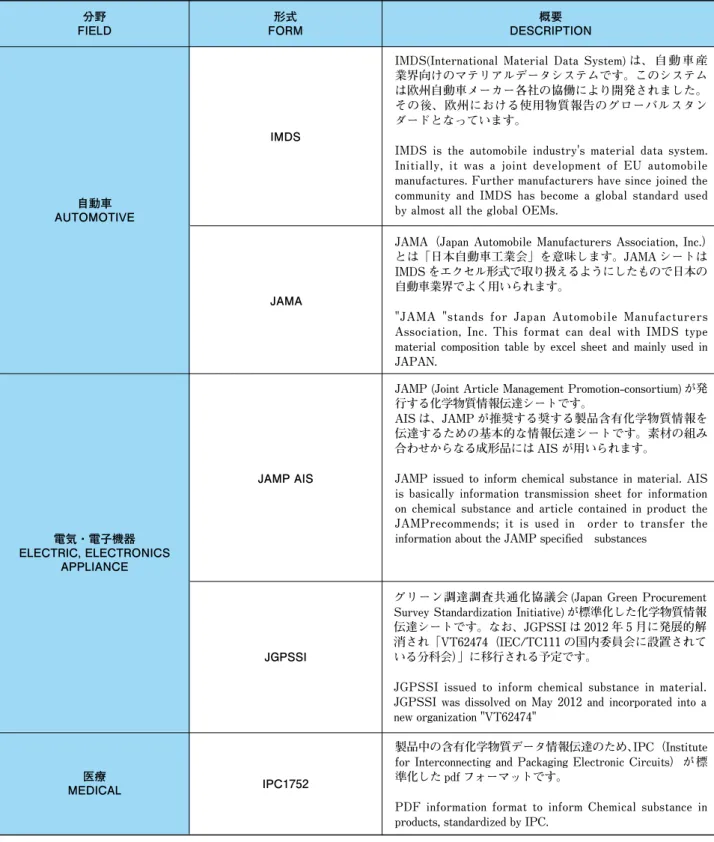
(2011.04) JGPSSI 形式 FORM 自動車 AUTOMOTIVE IMDS 電気・電子機器 ELECTRIC, ELECTRONICS APPLIANCE 医療 MEDICAL JAMP AIS IPC1752 概要 DESCRIPTION 分野 FIELD
IMDS(International Material Data System) は、 自 動 車 産 業界向けのマテリアルデータシステムです。このシステム は欧州自動車メーカー各社の協働により開発されました。 その後、欧州における使用物質報告のグローバルスタン ダードとなっています。
IMDS is the automobile industry's material data system. Initially, it was a joint development of EU automobile manufactures. Further manufacturers have since joined the community and IMDS has become a global standard used by almost all the global OEMs.
JAMP (Joint Article Management Promotion-consortium) が発 行する化学物質情報伝達シートです。
AIS は、JAMP が推奨する奨する製品含有化学物質情報を 伝達するための基本的な情報伝達シートです。素材の組み 合わせからなる成形品には AIS が用いられます。
JAMP issued to inform chemical substance in material. AIS is basically information transmission sheet for information on chemical substance and article contained in product the JAMPrecommends; it is used in order to transfer the information about the JAMP specified substances
JAMA
JAMA(Japan Automobile Manufacturers Association, Inc.) とは「日本自動車工業会」を意味します。JAMA シートは IMDS をエクセル形式で取り扱えるようにしたもので日本の 自動車業界でよく用いられます。
"JAMA "stands for Japan Automobile Manufacturers Association, Inc. This format can deal with IMDS type material composition table by excel sheet and mainly used in JAPAN.
グリーン調達調査共通化協議会 (Japan Green Procurement Survey Standardization Initiative) が標準化した化学物質情報 伝達シートです。なお、JGPSSI は 2012 年 5 月に発展的解 消され「VT62474(IEC/TC111 の国内委員会に設置されて いる分科会)」に移行される予定です。
JGPSSI issued to inform chemical substance in material. JGPSSI was dissolved on May 2012 and incorporated into a new organization "VT62474"
製品中の含有化学物質データ情報伝達のため、IPC(Institute for Interconnecting and Packaging Electronic Circuits)が標 準化した pdf フォーマットです。
PDF information format to inform Chemical substance in products, standardized by IPC.
6.環境関連回答フォーム
汎用的に使用される環境負荷物質調査フォームを示します。いずれのフォームでも提出対応が可能です。
形式
FORM DESCRIPTION概要
対象 ITEM
紛争鉱物
CONFLICT MINERALS EICC/GESI
EICC/GeSI が発行する紛争鉱物調査フォーム。紛争鉱物 と定義される 4 金属の使用有無とその精錬所を情報伝達す る為に策定されました。 これは、米国金融規制改革法第 1502 条において、米国に 上場している企業に紛争鉱物の使用について米国証券取引 委員会への報告が義務付けられたことによります。 EICC/GeSI issued to declare usage of 4 metals defined as conflict metal and its smelters
This stands for US Dodd-Frank Wall Street Reform and Consumer Protection Act Sec.1502 to disclose of usage conflict minerals. また、紛争鉱物と定義される金属(金、スズ、タングステン、タンタル)について由来を明確にするための調査フォーマットがあります .