Architectural Institute of Japan
NII-Electronic Library Service Arohiteotural エnstitute of Japan
【
論 文】
日本建築学 会 構 造 系論 文 報 告 集 第 451 号・
1993 年9 月Journal
of Struct,
Constr.
Engng,
A正J
,
No.
45t,
Sep.
,
1993EFFECTS
OF
COARSE
AGGR
.
EGATE
CHARACTERISTICS
.
ON
MECHANICAL
PROPERTIES
’
OF
ULTRA
HIGH
−
STRENGTH
CONCRETE
粗
骨材
の特 性
が超 高強 度
コ ン クリ
ー
ト
の力学 的性 質
に及
ぼす
影 響
’
Masa
ツosノ匠 」【ン11
(IZAKI
* andHidetoshi
EDAHfRO
* *柿 崎
正
義 ,枝 広 英 俊
This
report made a test study abQut effects of quality andkinds
of coarse aggregate and400
kN
crushing value and maximum size on compressive strength ahd crushing condition anCl compress
.
ive
deformation
of ultrahigh・
strength concrete (about90
−
130
MPa
).
The
results are shown asfol−
lows,
(
a)
,
When
400
kN
crushing value of aggregateis
11−
23
% and water−
to−
cementitious ratiois
less
thanO
,
25
,
this
strengthis
concludedfor
.
material and mixingproportions
…of ultrahigh・
strength concrete
.
(
b
)
.
Compressive
strength of concreteincrease
withdecrease
in
maximum size of coarse aggregate,
Compressive
strength of concrete made withlimestone
andhard
sandstone(
A
)graded
at10
−
5mm
is
aboutlO6
MPa
and aboutll7MPa
,
whichis
2
−
6
%higher
than that of concrete made with agrading
of20−5
mm,
(
c)
.
Co
皿pressive
strainincrease
withdecrease
in
grading
of coarse aggregate.
When
compressive strength of rock reduces,
we can’
tfind
anydiffer
・
ence
in
grading
,
(d
).
In
orderto
get
compressive strength of ultrahigh−
sfrength concrete,
it
is
necessary to raise compressive
.
strength of rock and crushing strength.
andgrading
(maximum size)
of coarse aggregate andbonding
between
coarse aggregate and mortar and atthe
sametime
しobring strength and
deformation
of aggregate close to strength of aggregatetind
deformation
of matriX mOrtar OrinCreaSe
it
.
Ke
∬roon [lk
:ultra−high
strength
concrete
,
400
k
V
crushing
uatue
,
kind
Of
aggregate
,
water
−
t7cententitious 厂atio
,
comPressive S’rain超 萵 強 度コ ンク リ
ー
ト,
400kN
破 砕 率,
粗
骨 材の種 類,
水結
合 材 比,
圧 縮ひずみ度1
1
.
lntroduction
Recent
progress
in
止edevelopment
ofhigh
.
range water−
reducing admixturehas
madeit
easyto
ptoduce
high
strength concrete.
High
strength cast−in−place
concrete of41
−
48
MPa
degree
specifieddesign
strengthis
now commonly usedin
the
construction ofhigh
・
rise reinfQrced coIlcretebuildingsi
)’
3〕.
Furthermore
,
the
use of mixtures such as silicafume
,
fly
ash andground
granulat
俘
d
blast
−
furnace
slagmakes
is
possible
to
produce
ultra−
high
strength concrete of over100
MPa
degree
strength,
and manystudies on
the
use ofthese
mixtureshave
been
conductedin
thepast
壬ewYears4
)−
6 〕・
24 ]・
32)−
34},
Ahigh
compressive strengthin
concre’
te
is
thought
to
depend
primarily
onthe
water.
to
−
cdmentitious ratiq,but
compressive strengthls
alsoinfluenced
by
the
types
of coarse aggregates used ,the
400
KN
crushing strength ofthe
coarse aggregate,
andthe
aggregate/
mortarbbnd ..
Detailed
analysis ofthe
existing studies on
this
、
.
subject revealedthe
following
:・
a
)
The
compressive.
.
1strength
of concreteis
greatly
influenced
by
the
cornpres串
ive
strengthproperties
ofthe
rock usedin
the
concrete , and may vary considerablydepending
onthe
brittleness
ofthe
rock7 ].
』
b
)
The
compressive.
strength of concrete,
where the water−
to
−
cementitious ratiois
constant ,has
been
reported asincreasing
with a reductionin
the maximum coarsetiggregate
sizein
the compounds }・
9 },
* Kajima
Technical
Research
Institute
,
Dr
.
Eng
.
#Shibaura
Institute
of Technology,
鹿 島 技 術 研 究 所 専門 部 長・
工博 芝 浦 工 業 大学建 築 学 科 助 教 授一
19
一
whereas other studies report
the
opposite,that
compressive strengthdecreases
with smaller maximum coarse aggregate sizeiO].c)
When
coarse aggregateis
addedto
the
mortar,the
compressive strength of concrete eitherdecreases
in
proportion
to
the
ratio of aggregateto
mortarby
volumeg', or shows noproportional
decrease9).
d)
The
influence
onthe
compressive strength of concrete resultingfro'm
different
kinds
of aggregateis
seento
be
small when concrete strengthis
Iow,
but
increase
as concrete strengthbecomes
higheri2).
e)
The
larger
the
maximum size and unit volume of coarse aggregate,the
less
the
strainin
proportion
to
cornpressiye strength]Z),As
wehave
pointed
out,the
kind
of coarse aggregate used,・ as well asits
quality,
crushing value, shape, maximum size and absolute volume can allhave
significant effects on the strength characteristics ofhigh-strength
concrete, which manyprevious
studieshave
demonstrated.
However,
in
the
90--13o
MPa
degree
range of ultrahigh-strength
concrete, the specific effectshave
notbeen
made adequately clear.The
purpose
ofthis
study wasto
gather
basic
data
onthe
selections of aggregate and concrete mixingproportions
fer
ultrahigh-strength
cencrete.This
researchinvolvecl
consideration of the effectsthat
suchproperties
of coarse aggregate(including
kinds,
crushing vatue,grading)
wouldhave
onthe
compressive strength of concrete, and on
the
cornpressivedeformation
characteristicsin
90-l30
MPa
degree
strength concrete.Table1
Factors
andLevels
KindsofRock
Speeimen
ll'wattti",'l'..i.'i/i"','\tti.,.ttil'.i'iiS'i'''i...rm..'''i''i"''''''""'.',ss..'g'ltpa'
ttttttt/t
.trrc
±.I.'/・./.#'・./mm'.
IlardSandstoneAHardSandstoneBQuartzS ¢histLirnestonex.1..'1sc..・AndesiteWaoer-totCernetttitiousRatioe
O.2S
O.S5
m
-
-KindsofCoarse Aggregate HhrdSandstoneAHhrdSandstoneBQiartzSehistLimestoneAr:desite
CaerseAggregateGradingofCoarse
Aggregate(mm)
20--S
20-15ls--le10-55-2.5
kindsofFine AggregateHtSand
HhrdSandstoneAIinestone- -FineAggregateGradingofFine Aggregate(mm)2.5
-
-
-
-Note:
'
'Water-to-{ceiTient +Sraca
Fume)iatioTab[e2
Physical
Propeities
of Coarse AggregatesHardSanttsrone(A>
l..g.i..,,,l.-ms-uai.,..
,X/.ii.I・i・.,,..., " 2.62O.671,56 ssg-'is'・ee'ie・as+,l,,.,ii..l/l ' .i...:・'}rr"ts.rrIffi.maurer,II'ge:''/:
" S9,S 20.1 145xs"ee'.fi.,"l'S'3,iSIg'・
lj$・/S'・tlSXL"/inL/j'"・f'ew"'.tag'/Li'
IS-10mm14.6 e,6Si1ct 10 2,GlO,5S1.565S:S 17,2 Liptstore ee 2.69O.35;,6160.0 . 104 IS-10mm23.1 O.SSx1or 10 2.68e.3s1.6360.S 23.eQuartzSahist10
2.S8O.9fi1,56S9.6 t4,2 tS3 IS-IOmmILa O.7tr1ct HatdSandstoneP}10 2.tiSo,ssIA354.2
21,2 133 IS-10mm20,7 O,67i1ctAntesite 10 2,57o.as1," 55,S 192 104 IS-10mm11 O.4611cr
-20-Architectural Institute of Japan
NII-Electronic Library Service ArchitecturalInstitute of Japan
-Table3
Physical
Properties of FineAggTegates
Note: '
Pit
Sand
Table4
Mixing Propertionsl Sand. SSI
i,l
'iE.l,ttt'tt.,,i.t,o,ee,S/-,l.gets:・.I/tti,$//:,,me/.',$'//ew,
er-" , en,・"oi
'"t.
'-//:'ssii3V'gtt'qx・l..eeX///,ee.as,tew,wwklkisc/;/\,.i{,,,,g,X,i, " E60610974 2HLrdS#ndttone(A)o,oseruIhedtandM'1esstit7gGeo61g974 IS,S6 o.es
3 o.ssSendIS171313
'
Sl!eso9S6 O.7S'
4 Sand SSI79 amSSI1026
sLimatone'o."Cruthedsand14lasSSI" amG031016 IS,Sfi
o,"
6 o.sfSend'IStn311
.
313S42.9S6- P.7S7HtrdSrmdstonoCB) ,O.15SnndM16SSSIT9 amGsSm LS,es
・o."
eQuatuschli; e.2st/,Sand241essel" 660S97gse IS,as O.66
9Andeskoo.asSEndu16Ssgl7Pan664m IS.SG o."
(MaximumSiteofCos"cAggrcsetc: 10mm)
2.
Experimental
Factors
and
Criteria
Using
the'experimental
factors
and criteriadescribed
in
Table
1.
3.
Materials
,
In
the
・experiments,
ordinaryportland
cement andfive
kincls
of coarse aggregate were used.Aggregates
¢onsisted of twokinds
ofhard
sandstones,limestone,
quartz
schist, and andesite.The
physical
properties
ofthe
coarseaggregates
are shownin
Table
2.
Regarding
the
maximum aggregate sizesIisited
in
Table
2
in
th.e20
to
5
mm range,the
aggregates were classified accordingto
the
JASS
s,
and were
in
the
center ofthe
standardgrading
rangesfor
・their
sizedesignations.
The
physical
preperties
ofthe
fine
aggregate are shownin
Table
3.
The
principal
ingredient
ofthe
high-range
water-reducing admixture waspolycarbonate-ether,
and an air-controlling agent was also used.Granular
silicafume
(specific
gravity
2.
23,
approximate specific surface are a23.
2
m21g) was used as a mineral admixture, at an accretion rate of12
%
of cement・by
weight33',The
clternical compQs-ition ofthe
silicafume
was97
%
Si02,
O.
09
%
A1203,
O.
09
%
Fe20s
anclO,
11
%
CaO.
Potable
city water was usedfor
all concretemixtures.
,.
'
'
,+/
4.
Mixing
Proportions
Table
4
shows mixingpropertions
for
various'types
of concrete usedin
the
experiments,The
mortarsample used
for
the
concrete mixtures shownin
Table4
wasfirst
passed
through
a5mm
sieve,5.
Preparation
of
Specimens
aDdTest
Methods
5'.
1
Preparation
ofSpecimens
Rock
specimensfor
the
compressive strengthtests
on variouskinds
of rock were cut out ofquarries
in
-21-the
form
of40
cm3blocks,
then
eore-boredfrom
three
directions
(x,
y
and z) withdue
regardto
joints,
and
finally
shapedinto
cylinders5
cmin
diameter
and10cm
in
length.
Seven
to
nine such cylinderswere
prepared
frorn
variouskind
of rock specimens.The
concrete specimens were madein
accordance withthe
JIS
A
1132
standardsfor
preparing
concretefor
compressive strengthtests,
using3
cylinder specirnens of eachtype,
10
crnin
diameter
and20
cmin
length,
and curedin
standard water7
days,
2s
days
and91
days
respectively.We
made cosiderationfor
results of specimensbased
on standard watercuring.
The
surfaces ofthe
specimens on whichloads
wereto
be
applied were machinepolished.
For
the
compressive strengthtests
of mortar, concrete was used whichhad
been
passed
through
as
mmstandard sieve, according
to
the
JIS
A1132
standards.The
5cm
diameterXIOcm
length
mortar cylinders wereprepared
and curedin
the
same way asthe
concretefor
the
$amepeiiocls
oitime
before
being
usedin
the
experiment.5.2
Experimental
Methods
Comprehensive
strengthtests
of rock specimens wereperformed
in
accerdance withJIS
A
11os,
JIS
B
7733,
andJIS
M
0302,
andthen
tested
afterbeing
cut and curedin
standard waterfor
24
hours.
The
400
kN
crushingtests
wereperformed
in
accordance withBS
812
Standard'3',
using a standard aggregategrading
ef10-15
mm.Abrasion
tests
wereperferrned
in
accordance withJIS
A
1121,
with an aggregategrading
ofIO-5mm
and20-5
mm.For
both
concrete and mortar, compressive strengthtests
wereconducted at
the
ages of7
days,
28
clays
and91
days,
in
accerdance withJIS
A!108,
using ahigh-rigidity
compression machine with a eapacity of4,OOOkN.
Strain
was measured upto
the
maximum stress of concrete using strain
gauges
of60
mmlength
(three
times
the
maximum size ofthe
coarse aggregate).
Gauge
readings were recorded untilthe
maximum stress was reached, after whichfurther
deformations
were measuredbetween
the
pressure
plate
andthe
specimen, using a straingauge-type
displacement
gauge.
Photograph
1
showsthe
results ofthe
compressive strengthtests
and strain measurements.The
staticmodulus of elasticity of rock specimens was
determined
by
monitoringtwo
straingauges
of30
mmgauge
length
sirnultaneously, while stressingthe
specimensto
33
%
oftheir
failure
stress alongthe
stress-strain curve.
The
test
rnethodfor
mortar samples was as outlined above, andthe
test
methodfor
concrete was similar, exceptthat
a30
mm and a60
mmgauge
length
wereboth
used,Specimens
ofmortar and concrete were
tested
at an age of7
and28
days
usingformula(1)
below.
Ev,=(S,-S,)!e,-50
×10-fi)・・・・・・---・--・--・・・--・---・-・・-・・・・・・・・・---・・・・----・・・・----・・・--・・・(1)
where
:
E=static
elastic modulus(NlmmZ)
S,==stress
when strain=50 ×10-E
S,=::stress
l!3
maximumload
(Nlmm2)
E,==strain causedby
stressS,
6.
Analysis
andDiscussion
ofTest
Results
6.1
Effect
ofCoarse
Aggregate
9uality
onCompres$ive
Strength
ofConcrete
(1)
Quality
of eoarse aggregateEvaluation
oftest
results obtainedfrom
testsperformed
by
the
Cement
Associatien
ofJapan
onthe
correlations
between
variousproperties
of cearse aggregatehas
revealedthat
the
degree
of significance coarse aggregatehas
in
concreteis
influenced
by
the
crushingstrength
andabraded
quantity
andthe
percentage
of solid volume and specificphysical
properties
ofthe
aggregateiS).The
tests
determinecl
the
principal
physical
properties.
Table2,
Figure
1
showsthe
resultsin
the
present
study(grading
10-5mm,
with somein
the
20-5mm
grading
range) andin
previous
studies(grading
20-s
mm)s}・']・is)-ig]・Zi)for
the
relationshipbetwebn
the
400
kN
crushing values of coarse aggregate andthe
quantity
of aggregate abraded, and thepercentage
of solid volome.In
the
10-5mm
gradine
range,the
quantity
of abraded aggregate, which showed atendency
to
increase
with anincrease
ofthe
400
kN
crushing values, was about14
%
for
quartz
schist, about17
%
for
hard
sandstone(A),
about19
%
for
andesite, about21
%
for
hard
sandstone(B),
and about23
%
-22-Architectural Institute of Japan
NII-Electronic Library Service ArchitecturalInstitute ofJapan
Photographl
Compfessive
Testing
O
AndesiteS}Disuii)-nno-
Lime$toneS)is)iabn)me
Hard
sandstonefi)T]iSMoptvm},a
RivergravelPiniOm)n)
"Sand
stonenmTou>a
Cobble
stonenrms)iom)N
Cru$hed stoneinmY
Crystalline schisttS)*
-'FFzq=qawoq=m<
292T25.2321191715131197
Figure1
//1111
AQuartz
schistOBasaltTe)ie}
APit
gravelnn)
@
ChertiP
VSguare
stonelS"Amphiboleistan]
±Quart2item)u)
S+S :Herd sandstone{A)+Plt sand, S+K:Harq sandston?{A)+Crushed
sandstenesand
St+S:Hard sandstone(e)+Pit sand, Q+S:auerti schlst+Plt sand,
A+S:Andeslte+Pit sand
L+S:Limes ±one+Pltsand, L+K:Llmestone+Crushed 11mestonesand
ca160aE
.140I120og
loooL80o;
60edi 40E 2o:oUl S+KS+SSI+SL+S S+k S+S・Sl
-S
L.S S+K S.S SI+S
L+S S+K$.SSI+$ L.s"or1 L.+K atS A,S L-K a+S A+S L+K Q+s A+s L+K a+s A.s za
・
KINDS OF COARSE AGGREGATE5Figure
2
Relationship
betvveen
Kinds
ofCoarse
Aggregate
afid
Compressive
Strength
ofConcrete
2006f 180gEEii6ots
i'
!
g.:4o8::
M120kgooo=100 eo MaximumVtilueOMeanValue
・
Ee ENumber ot testspeclmens
'
E7""ss
ii
---・-li
ex.
,, Mtnimumvaiue Xsli--.-ss 510
15 20 25 30AGGREGATE CRUSHtNG VALUE OF 4eekN ,%
Relatienship
between
AbrF,decl
Qvantity
andAggre-gate
Crushing
ValueFigure
3
QUAFrrZ HAHDSAND- HARO SAND.ANDESrrE LIMESTONE SCHIST'STONEfA} STeNE(B}
KINDs oF
'HOCK.
spEclMEkRelationship
between
Kinds of Rock Specimen andCompressive
Strength
ofRock
Specimen
tt
for
limestone.
Ttie
abradedquantity
ofharcl
sandstone(A)
of10-5
mmgrading
decreased
-about
14
%
in
comparison with
those
of20-5
mmgiading.
As
reportedby
M.
Hisaka
andH,
Numazawa
(
7
),
onthe
quantity
of abraded aggregateforhard
sandstone,the
abradedquantity
ofthe
basalt
(grading
20--s
mm)was
the
lowest
at13
%,
while natural coarse aggregate andpit
coarse aggregate(grading
25-5mm),
andcrushed stone were
16
%,
and sandstone andlimestone
were20-22
%.
The
abradedquantity
in
the
present
experiment was alarger
quantity
of abraded stonethan
found
in
previous
studies,however
it
was still smallerthan
the
regulation of within25
%
whichqualified
as "highquality"
crushed stone22).Furethermore,
comparingthe
percentage
of solid volume andthe
400
kN
crushing ratio ,there
,was
no'
apparent correlation.
(2)
Kind
ofCoarse
Aggregate
・
''
Figure2
showsthe
relationshipbetween
kind
of coarse,aggregate(grading
10-5mm)'and
compressive strength of concrete.
It
indicates
thatthe
compressive strength of concretefor
agiven
c6ncretetype
atthe
age of28
days
(standard
water curing),in
decreasing
erder accordingto
type
of
.
1408E:
1305gi2di
i611oiEm100!8E
gok8
80
eMean
Value Hard Sendstone(A) +Crushed Sandstone SandCA}olCr"sedLimestene+Limestenei-VeaQuartz---"a----Schlst+PIt'g
Sand Snd e-ae-p-"O"-diopoI:-eV("----e
::ee
tL---e)-m-e"ediio
HardSand$tene{ANPitsee
Grading IO.v5mrn WIC+SF=O.25e
Hard Sandstone(B) +Pit 5and Andesite+PitSand Llmestene+Pit Sand80
100
I20
l4e
160
180
200
COMPRES$SVE STRENGTH OF ROCK SPECIMEN , MPa
Figure
4
Relationship
between
CempTessive
Strength
oferete and
Compressive
Strength
ofRock
Specimen
O.T5
'e.-o.7oLXpt:2 e.6sBio= -Ee・6o82
o.ssomrve:
oseJOwc OA5 100 110 120 130 140 150 160COwrPRESStVE STRENGTH OF ROCK SpECIMEN,MPa
Figure5
Relationship
between
Cempressive
Strength
ancl
Etastic
Modulus
ofRock
Specimen
concrete are
:
from
the
highest,
quartz
schist andpit
sand atabout118
MPa,
hard
sandstone(A)
andpit
sand at about114
MPa,
andesite andpit
sand at about104
MPa,
hard
sandstone(B)
andpit
sand at about102
MPa,
andlimestone
andpit
sand at about98
MPa.
The
order ofthis
list
is
almostidentical
to
that
ofthe
rock specirnentsof
Figure
3
(from
7
to
9
specimens) rankedby
average compressive strengthin
decreasing
orcter.The
discrepancy
observedin
part
efthese
two
ranking orders seemsto
have
been
caused
by
differences
in
the
internal
structure or composition ofthe
rock specimens.This
suggeststhat
the
average compressive strength of rock specimens may vary withthe
diTection
(x,
y,
andz)
andjoint
in
whichthe
rockis
cut, andis
thought
to
occurin
the
way expressedin
Figure3.
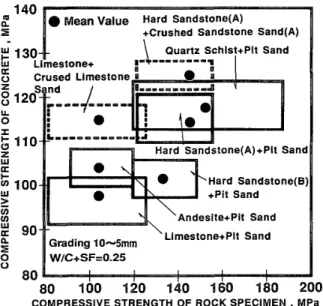
Figure
4
showsthe
relationshipbetween
the
compressive strength of concrete ancl compressivestrength of rock specimens
for
variouskinds
of aggregate.Compressive
strength of concretefor
limestone
andpit
sand and andesite andpit
sand showed results nearingthe
average compressivestrength of Tock specimens.
On
comparison,the
compressive strength of mortartuTned
outto
be
either nearlythe
same asthe
average cornpressive strength of rock specimens, or even slightly
greater,
maintaining abalance.
In
contrast,
the
compressive strength of concrete made withquartz
schist,hard
sandstone(A),
hlard
sandstone
(B)
andpit
sand wasless
than
that
of rock specimens.From
this we caninfer
that
the
compressive strength ofthe
coarse aggregate/mortarbond
or mortaritself
was srnall comparedto
the
average compressive stTength of
the
rock specimens,When
varyingthe
kinds
of aggregate usedin
agiven concretetype
atthe
age of28
days
(standard
water curing)to
determine
its
compressive strength, concrete made withquartz
schist andpit
sand[hard
sandstone(A)
and sandstone sand,limestone
andlime
sand]clemonstrated
thelargest
compressive strength.When
increasing
the
agingfrom
28
to
91
days
to
increase
the
compressive strength, concretemade
from
quartz
schist,hard
sandstone(A)
andpit
sand[hard
sandstone(A)
and sandstone sand]had
the
Iargest
compressive strength, while concrete made with andesite,limestone
andpit
sand[linestone
and
lime
sand]had
the
smallest.This
showsthat
the
compressive strength of concreteis
clearly affectedby
the
con}pressive strength ofits
composite rock specimens, as shownin
Figure
5.
Rock
specimens made with andesite andlimestone
demonstrated
and average compressive strength of onlylo4
MPa,
while rock specimens made
frorn
quartz
schist and sandstone(A)
showed a compressive strength of153
MPa
and145
MPa
respectively.However,
the
compressive strength of concrete made withlimestone
and
lirne
sand not onlyincreases
withthe
static modulus of elasticity ofthe
rock specimen,but
is
alsothought
to
increase
withthe
chemicalbond
formed
between
the
limestene
andthe
cementpaste.
-24-Architectural Institute of Japan
NII-Electronic Library Service ArchitecturalInstitute of Japan
s
15o:[ 130Ez 110ooLg go!
70e
,,dimW
30ie=' toe20$S
Q22%",
o2sxS)ii)
v3o$E)
l31kiop
i4oxn]
Asoxts)an)a')icssxm
D60$IS)n}
ltr6stsIS)ll)S 10 12 14 16 18 20 22 24 26 28
AGGREGATECRUSHtNGVALUEOF40ekN,%
Figure6
Relatibnship
be.tweenCompressive
Strength
andAggregate
Crushing
Value
(WateT-to-Cementltlous
Ratio)
O
AndesiteS}T):E}ts)-mto-
LimestoneS}iilie)imi)e
Hard sandstones)nis)ie)m)m・O
River graveli):SM)nni)"Sand
stonenTs]Tsn"al
Cobble
stenenivie]:sn"ew
Cru.Shed stoneiS)dT)E
YCrystalline
schlseg) E 150AQuartz
schistOB'asalt:t)is]
APit
gravelnn)@
Chertie)VSquare
stene,S)trllinpbiboleds)n]
)i(QUartzitett)ii]
ur-taggx2g:g-:8
130ltO9070503010Largemark :Resultsofthis study Age:28 days
.e.S.S'.q
ee:g
WtC+SFgre.-:)r
ow.za ¢ e.es) 8
Figure7
10 t2 14 16 1820
22
24 26 2S AGGREGATECRU$HINGVALUEOF400kN,%Relationship
between
Cempresslve
Strength
and Aggregate CrushingYalue
(Kinds
of Aggregate>(3)
400kN
crushing valueFigure
6
showsthe
relationshipsbetween
the
cornpressive strength of concrete andthe
400
kN
crushing values of coarse aggregatefor
various water-to-cementitious ratios obtainedin
the
present
study(gTading
10-5
mm,large
marks),together
withthe
results ofprevious
studies(grading
20-5
mm, with somein
the
25-5
mmgrading
range)S)・i5]・i6LiS)・20)・Ei)・i4}.The
compressive strength of concrete with a・water-to-cementitious
ratio ofO.
25,
whenthe
400
kN
crushing value rangedfrom
17
%-23
%,
wasless
than90-110
MPa.
When
the400
kN
crushing valve of coarse aggregate rangedfrom
U--ls
%,
the
compressive strength of cbncrete was110-130
MPa.
In
contrast, with a water-to-cementitious ratio ofO.
55,
whenthe
4oo
kN
crushing valve of coarse aggregate rangedfrom
14-23
%,
the
com'pressive strength of concrete wasless
than
35
MPa.
Among
the
results of,theprevious
studies, a compressive strength ofless
than
50
MPa
degrees
was observedin
concrete with a water-to-cementitious ratio ofO.
40-O.
65
and a400
kN
crushifig value rangingfrom
10
%
to
27
%.
This
is
because
the
compressive
strength of mortar
is
tess
than
the
crushing strength of aggiegate,Th.at
is,
.as
in
llltrahigh-strength
concrete,it
is
notinfluenced
by
the
crushing strength ofthe
coarse aggregate,Figure
7
shows・the
relationshipbetween
the
compressive strength of concrete andthe
400
kN
aggregate crushing value of coase, and
presents
the
results ofFigure
6
by
kind
of aggregate.The
compressive strength of concrete with a water-to-cementitious ratio ofO,
25
rangedfrom
90-130
MPa
degr'ee,
andthe
400
kN
crushing value ofthe
aggregate rangedfrom
11-23
%
for
quartz
schist,hard
sandstone, andesite, and
limestone
coase aggregate materials.With
a compressive strength of only3s
'abie5
ll
,Lat8".lh,;p.,be.t::f,:e.",ligm,?Le,ss:,e.S.t:?;.gtllk,f)g,gg:,llli.l:,S.e,gge,e,,f."cl.fa,
W,a,lel'"2
,C,e6
・
kN
brushing
value wasin
the
14'23
%
rangefoe
hard
sandstone(A)
and1imestone
coarse
gate.
From
the
test
results ofFiglires
6
and7,
the
relationshipsbetween
the
compressive strength of cencrete, water-to-cementlotlous ratlo,
-25-'
ll・l.i'・k-eeff"・S・"Ftetag.eE.kff・aFee",
'g.e.rn.e[itrbovst.Rlltrew..kI・--.galEst,geEl.,
eewleeveM...,..X..-,.,gge.;vaige..ee"g'sEi""i"'tewaliew..ps,ta'ii
lee1ww.iilzaii.,les.,.,/iwa.lgfftwy"tk'a'X'me.ee
s35 s5S 14SA.S,23Limestone,
Ha:dsandstone(A) 90Sac<110 sas usA.s23Hardsandstone(Axu),iindesite,
Quarzschist,Limestone・
11osacs13o ses 11SA.S15Hardsandstene{N,
and
400
kN
crushing valuetogether
are shownin
Table
5,
Therefore,
the
compressive strength of ultrahigh-strength
concreteis
greatly
influenced
by
the
compressive strength of
the
rock specimen, as well asby
the
crushing strength andkinds
of coarse aggregate usedin
the
mixture.(
4
)
Grading
ofCoarse
Aggregate
Figure
8
showsthe
relationshipbetween
one-$ized coarse aggregate andthe
compressive strength ofconcrete
with a water-to-cementitious ratio ofO.25.
Here,
the
compressive strength ofthe
concrete shows atendency
to
increase
with adecrease
in
the
maximum size ofthe
coarse aggregate, as well asin
the
case of one-sized coarse aggregate.This
tendency wasthe
samefer
eachkind
of coarse aggregate, and alsoheld
true
for
concretein
the
present
study, as well asin
previous
studiesS)'g"2S"2`' with awater-to-cementitious ratio of
O.55,
as shownin
Figure9.
The
compressive strength of concrete rnade withhard
sandstone(A)
graded
at10-5
mmis
about117
MPa,
whichis
2-6
%
higher
than
that
of concrete made with agrading
of20-5
mm.On
the
otherhand,
the
compressive strength of concrete madefrorn
limestone
made with agrading
of10'5
mmis
only about106
MPa,
whichis
1'2
%
higher
than
that
of concrete made withgrading
of20J5
mm.Concrete
made withlimestone
graded
at10'5
mmhas
a compressive strength about4
%
Iess
than
that
grade
at5'2.5mm.
8
13oEti5
12oz85r 1108imts 100!zaE goEMOR-
5-2.5 10-5 15-10 20-15 20-5 eTAR
e
COARSE
AGGREGATE
OF
ONE-SIZED,
mm
Figure8
ReLationship
betweenCoarse
Aggregate ef
Sized
andCompressive
Strength
ofConcrete
QHardsandstoneCA)
aLlmestone
Mxe;-'
se
/1::.s!
WIC+SF:O.25a
Age:2Bdeys
OHard
sandstene{A),nLTmestone,
-Tutt'T)
OCrushed
stenesu,eHard
sandstoneN)eQuartz schlst') , ARiver gravela)
iLRIvergravetiD 1.22Elg1.ozatsyS
O・8
g
E・,.,
MORTAR510
15
20
2530
35
40(5-2.5)(10-5N15-10X20-15)
MAXIMUM SIZE OF COAnSE AGGREGATE ,mm
(ONE-SIZED
COARSE AGGREGATE}Flgure9
Relationship
between
Maximum
Size
efCoarse
Aggregate and
Compressive
Strength
ofConcrete
Strength
Ratio
In
this
way, when a smallergrading
of one-sized coarse aggregateincreases
the
compressive strength ofthe
concrete,This
is
thought
to
be
because
the
boundary
surface of cementpaste
(mortar)
and coarse aggregatebecomes
$maller, makingit
difficult
for
defects
to
forrn,
andleaving
fewer
gaps
between
the
coarse aggregates.The
size of one-sized coarse aggregate atthe
maximumcompressive strength of
hard
standstone(A)
-aggregate
(pit
sand) concreteis
larger
than
that
for
limestone-aggregate
(pit
sand) concrete,This
is
thought
to
be
due
to
the
incfeased
bond
strengthbetween
the
boundary
surfaces ofthe
coarseaggregate and mortor, which arises
from
differ-encesbetween
the
surface structure andthe
percentage
of solid volume ef coarse aggregate,There
was considerably morefracturing
of coarse aggregate noticeablein
broken
specirnens o{Gra
'2'o-smm
le--52o-s.m
10-5Mtx.W/C+SF
O.2S,.Age:2S
days
Architectural Institute of Japan
NII-Electronic Library Service ArchitecturalInstitute of Japan
,
limest6ne-aggregate
(pit
sand) concretebecause
the
400
kN
crushing value oflimestone
is
larger
than
that
ofhard
sandstone(A)
(see
Photograph
2).
Here,
under stress, cracksinside
the
'
,
aggregate concretegrew
withincreased
load
on'tbe
specimen.'It
wasthought
that
the
cracking speedwas
higher
after reachingthe
aggregate surface,than
in
the
matrix mortar.Further,
Johnston's2"'
experiments on
the
relation of nettensile
strength and aggregategrading
have
shownthat
the
bond
strength
.be,tween
coarse aggregate and mortar.decreases with aningrease
in
the
maximum size andgrading/.of
the
coarse aggregate.・
',
Frorn
the
results shownin
Figure
8,
to
increase
the
compressive strength of concrete madefrom
hard
.sandstone
(A)
andlimestone,
it
is
adviaableto
increase
the
cementitious-to-water ratio sothat
the
concrete compressive,stre.ngth
does
notfall
below
that
ofthe
mortaritself
by
using one-slzed coarseaggregate, or
by
using a-one-sized coarse aggregate withinthe
range thathas
a smaller strengthreduction
than
the,compressive
strength ofthe'mortar,
Therefore,
in
orderto
produce
concrete with a' compressive strength of110-120
MPa
and awater-to-c'ementitious ratio of
O.
2s,
it
is
recommendedto
us'e・hard sandstone(・A)
with agrading
of10-5
mm, orlimestone
ulith
agrading
of'5-2.5mm.
.
6.2
・
Effect
ofAggregate
Quahtity
onCompressive
Deformation
ofConcrete
(
1
)
,Relation'ship
Between
Stress
'and
Strain
1)
Kind
of rbck s'pecimens,
・
Figure
10
shows'the stress-strain curvesfor
the
compressivetests
andtensite
tests
of rock specimens.,'The
stress-strain.curvesfor
rock specimens are approximatelylinear,
up tothe
p6int
where stressis
the
highe$t.
This
different
from
the
tendency
of such curvesfor
concrete.When
the
compressive stress ofrock specimens
is
100
MPa,
the
conipressive strainis
about27
×10"`
for
andesite,the
largest,
followed
by
about20
×10-`
for
for
limestone
and about14
×1.0-`
for
quartz
schist andhard
sandstone(A
orB>,
showing variety among
the
kinds
of rock specilnens.However,
the
compressive strain ofthe
rockspecimen
generally
decreases
with anincrease
in
the
compressives stress ofthe
rock specimen.The
same
tepdency
is
seenfor
the
tensile
strain ofthe
rock specimen, whichis
aboutO.
5
ofthe
compressivestrqin
for
each ofthe
rock specimens, exceptfor
andesite..
,
'
t
t
'
2)
Kind
ofCoarse
Aggregate
'
'
Figure
11
showsthe
stress-strain curvesin
the
high-stress
range,including
the
regionfrQm
maximumr
'
t
:
'160a'
t
E.
zy8i2o.thg2.6so8zatsy
dem:E.
o.20Figure
lO
10
O 10STRAIN,xte-`
SLress-Stfain
Curyes
fgr
Rock
20
30Specimen
t50a"・E.:::8ioots$:zaw)
508:l8oo
10
Figurell
Stress-Strain
Concrete)
20
30
40
STRAtN,xlo-4
CuTves・
for
ConcTete
50
(Types
of-27-stress
to
declining
stress,forvarious
concretes
that
containdifferent
coarse aggregates.As
seenin
the
figure,
whilethe
stress-strain curves of concrete containinglimestone
andpit
sand, andesite andpit
sand
inereases
en a curvein
the
increasing
stress region.In
centrast,that
for
concrete which cQntainshard
sandstone(A
orB)
andpit
sanddoes
solinearly
in
the
increasing
stress Tegion.However,
both
concretes show non-lineardeformation
characteristics.Also,
the
stre$s strain curves showirregularity
in
the
declining
region after maximum stress.This
is
due
te
the
repeated re-distribution of stress.On
the
other
hand,
the
curvefor
concrete containinglirnestone,
andesite andpit
sandfalls
sharplyin
the
declining
region after maximum stress,indicating
ductile
properties.
This
behavior
occursbecause
ofthe
low
level
of compressive strength ofthe
rock specimen.Therefore
the
coarse aggregatebecomes-unable
to
withstandthe
cTushing energy ofthe
concreteimmediately
after maximum stress, and suddenlyfractures,
resultingin
weakness ofthe
bond
strengthbetween
the
mortar andthe
coarse aggregate.The
slopes ofthe
curvesin
the
region subsequentto
maximum stresstend
to
differ
greatly,
depending
on thekind
of coarse aggregate, andparticularly
onits
crushing strength.Photograph
3
shows examples ofthe
compressivefracture
oflimestone-aggregate
concrete.This
seemsto
indicate
that
the
nature ofthe
breakage
was very similarto
brittle
stressfracture,
due
to
the
influence
ofthe
smalldifference
between
the
elastic modulus ofthe
rock specimens andthat
ofthe
mortar,
the
lesser
mechanical non-uniformity withinthe
specimens, anddifferences
in
bond
strengths3]).At
a stress ofO.9a,
and above, surfacedelaminatidn
phenomena
started,followed
by
mortar cracking,in
everytype
of concrete.3)
Grading
ofCoarse
Aggregate
Figure
12
showsthe
stress-strain curvesfor
concretes with various of one-sized coaTse aggregates.The
slopefalls
more sharplyfor
ultrahigh-strength
concrete containinghard
sandstone(A),
limestone
andpit
sand withgrading
of20-15
mm, subsequentto'
maximum stress, comparedto
the
same concrete withgrading
of10-5
mm.This
indicates
that
coarse aggregatebecomes
unableto
withstandthe
crushingenergy of
the
concreteimmediately
afterrnax-S80
150ca"swFwmozoe・L100ococataorHquilmgeE
sogo
oo
Figure12
10
Stress-Strain
Aggregate)20STRASNCurves
30
40
,X10-4forConerete
50{One-Sized
imum
stress, and suddenlyfractures,
resultingin
weakness ofthe
bond
strengthbetween
the
mortar andthe
coarse aggregate.The
maximurn strains of concretesthat
con-tained
hard
sandstone(A)
of10-5rnm
and20-15
mmgrading
whenthe
water-to-cementitious ratio wasO.25,
were33
×10+`
and29
×10-`
re-spectively.The
maximum strain was12
%
higher
for
the
10-smm
grading
than
for
the
20-15
mmgrading.
In
contrast,the
maximum strain ofGra
Photograph3
Limestone-Aggregate
Specirnens
Fractured
by
Compression
-28-Architectural Institute of Japan
NII-Electronic Library Service ArchitecturalInstitute of Japan
'
concrete
that
containslimestone
in
grading
of10-5
mm as wellas
in
gracling
of20-15
mm wereboth
aboutthe
same, at25
×10-4.
It
also appearsthat
there
were no・differencesin
maximum strainfor
concrete made withhard
sandstone.On
the
otherhand,
whenthe
water-to-cementitious ratio was
O.
55,
the
maximum stiain ofthe
concretes containing'hard sandstone'ingrading
of10-5
mm・was about17
%
gTeateT
than
that
withgrading
of20-15mm.
Futhermore,
limestone
withgrading
10-5mm
showed about28・%
greater
strain at maximum compressive stressthan
concrete with agrading
of20-'5
mm ofthe
same
coarse
aggregate.cbarse aggregate and
the
rnortar,Qr
the
greater
influence
than
the
fracturing
ofthe
concrete
'
-(
2
1
Strain
'for
maximum c6mpressive stress'
These
10-'
for
andesite andpit
sand,29
×・10-4
for
for
sand, and
26
×10+-
for・hard
'sandStone
CB)
and'
This
tendency
agrees withthe-results
ofthe
compressive strain of concrete
is
influenced
to
a'speclmen.
'
・
pit
sandfine
aggregateproduced
higher
values when stress wasthe
same,bond
strengths of coarse aggregate and mortarspeclmens.
・
,
'
'
'
'
'
,7.
conchusioh
A
summary ofthe
resultsis
listed
below,
I.
On
Compressive
Strength
1)effect
on
the
compr,essive strength ofthe
2)
With
a water-to-cementitious ratio ofO.
25,
sand,
the
compTe$sive'strengthis
onthe
average strength of rock specimens.In
contrast,sand,
the
compressive strengthis
lewer
than
specimens.The
compress・ive strength of u corppressive' strength ofthe
eriginal rock used3)
The
range of our research covered coarsehigh-strength
concretes centainingll-23
%
'
limestone
with a water-to-cementitious ratioincreases
with adecrease
'in'the
maximum size observed equallyin
eachkin
/
/t
wtmcowmi:ootq!(crFm
40
30TpXrco-208Em
10
When
the
water-to-cementitious ratiois'large
compresslve
coarse
Figure
13
shows the compressive strains of concretesfor
compressive stress of100
.curves
showthat
the
strain of concrete.increaseslinearly
with anincrease
in
compressive stressThe
stTains of concretes at compressive stress of110
MPa
degrees
werelimestonei
quartz
schistpit
test
on
great
As
for
the
compressive strain ofconcretes accordingto
the
kincls
offine
aggregate used
than
This
difference
is
thought
to
have
been
an'effect
ofthe
differences
between
r
90
tOO
110
120 130 140COMPRESS:VE STRESS
OF
CONCRETE,MPa
Figure13
Relationship
6etween
Compressive
Stress
andStrain
ofConcrete
,
the
bond
strengthbetween
the
strength of
the
mortaritself,
seemsto
have
a aggregate onthe
maxjmum compressive strain of-13o
MPa
degree.
,
in
declining
orther, about33 ×,・ ancl
hard
sandstone(A)
andpit
sand, which was
the
lowest
value.the
compressive strain of rock specimens.The
extent
by
the
compressive strain ofthe
reckconcrete with
'
concretes with crushed sand,
by
about6
×10-`,
ancl
differences'
in,
the
eiastic moclulus of ToCk'
'
A
reduption ofthe
abradedquantity
and400
kN
crushing value of coarse aggregateh.as
a ¢ontrollingconcrete.
・
for
concrete containinglimestone,
andesite- andpit
about
the
same asthat
ofthe
average copapressivefor
concrete containingquartz
schist,hard
sandstone andpit
that
ofthe
average compressive strength of rockItra
high-strength
concreteis
strongly affectedby
the
kind
andfor
coarse aggregate.,
'
'
aggregates with a crushing value of
400
kN,
with ultramixtures
quartz
schist,hard
sandstone, andesite andof
less
than
O.
25.
The
compressive strength of concreteof
the
coarse aggregate used.This.tendency,
wqsds
of coarse aggregate we examined,The
compressive strength of concrete'
'
r29-containing aggregate
graded
at10-5
mm wasfrem
2-6
%
higher
than
that
of concrete with20-5
mmgraded
aggregate.The
mest effectivegrading
size varied acoordingto
the
kind
of aggregate used, with10-5
mrngrading
being
the
best
for
hard
sandstone, and5-2.5mm
being
thebest
for
limestone.
ll.
On
Compressive
Deformation
1)
The
stress-strain curve ofthe
rock specimens was almostlinear,
withthe
degree
of straindropping
with anincrease
in
the
cornpressive strength ofthe
rock specimens.The
tensile
strain wasapproximately
1!2
ofthe
compressive strain.2)
Depending
onthe
kinds
of coarse aggregate used,the
stress-strain curve ofthe
concrete,including
the
region of maximum stress,in
some cases showed a curvedincrease
withgreater
compressive strength of ro.ck specimens, andin
other cases alinear
increase.
When
the
degree
ofcompressive stress ofthe
concrete washigh,
the
hysterisis
curve also showed alarge
increase.
The
slopes ofthe
curvesin
the
declining
region subsequentto
maximum stressdropped,
particularly
sharply whenthe
cempressivestrength of
the
rock was small, whenthe
maximum size ofthe
coarse aggregate waslarge,
and whenthe,
compTessive strength ofthe
concreteincreased,
leading
to
suddenfracture
ofthe
concrete.The
compressive strength ofthe
reck specimens andthe
maximum size ofthe
coarse aggregate, andof
the
bond
strengthbetween
the
aggregate andthe
mortarhad
adetermining
influence
on whentherthe
concrete was subject
to
suddenfracture
failure.
After
the
point
of maxirnum'stress,the
characteTistics ofthe
curvein
decline
differed
with thetypes
of concrete,in
some cases showing a redistribution of stress, andin
other cases exhibitingductile
properties.
The
pToportional
limit
stress, withthe
kinds
andgrading
of coars'e aggregate, and compressivestrength set at a
degree
of90-130
MPa,
changedfrom
O.
7-O.
8
ab,3)
Compressive
strainincreased
withdecreases
in
the
maximum size ofthe
coarse aggregate.No
differences
were observedthrough
changesin
the
maximum size whenthe
compressive strength ofthe
rock specimens was small.
Compressive
strain of concreteincTeased
withincreases
in
the
absolute volume of coarse aggregate, withincrease$
uniformly occurring on a curve.4)
The
maximum compressive strainincreases
linearly
withincreases
in
compressive stressin・the
concrete.The
compressive strain of concrete accordingto
kinds
of coarse aggregateincreased
withdecrea$es
in
the
compressive strength ofthe
rock specimens.The
maximum compressiyestrain
ofconcrete, with
the
kinds
andgrading
of coarse aggregate, and at adegree
of90-130
MPa,
changeclfrom
O.23-O.33
%
in
compressive strength,In
orderte
increase
the
compressive strength of ultrahigh-strength
concrete,it
is
advisableto
strengthenthe
compressive strength ofthe
rock specimens,the
crushing strength ofthe
coarseaggregate, and reduce the maximum size of
the
grading,
afid strengthenthe
bond
strengthbetween
coarse aggregate and mortar.
At
the
sametime
it
is
necessaryto
bring
the
value ofthe
strength orthe
deformation
ofthe
rnatrix mortar closeto
that
ofthe
coarse aggregate, orto
ensurethat
the
value ofthe
matrix rnortaris
somewhat strongerthan
that
ofthe
coarse aggregate.Acknowledgements
The
authorgratefully
acknowledgesthe
advice and suggestionsprovided
by
Masami
Murata,
Shibaura
FactoTy
chief,Hiroyuki
Kataoka,
section chief ofKeihin
Ryoko
Concrete
Company,
Ltd.
,and
Kazuomi
Okamura,
group
leader,
andToru
Kanda,
researcher, ofFujita
Gijutsu
Kenkyusho.
We
also extend our
thanks
to
Yasuhara
Matsuura
andTakushi
Kamiya,
both
of whom are constructiong[aduates
in
the
class of1990
ofthe
shibauraInstitute
ofTechnology,
for
their
assistancein
preparing
this
paper.
References
1)
Kaneko,
H,
andOkamoto,
K.,
et al. :High-Rise
RC
Buildings
Constructed
withHigh-Strength
(Fc420
kgVcmZ}
Cencrete,
for
Community
Dwelling
in
Park
City,
Shin-Kawasaki,
Architectural
Product
Engineering,
No.
263, pp.23-32,September