The Japanese Psychonomic Society
NII-Electronic Library Service
The JapanesePsychonomic Society
ThE
.tapanese
fournalof Ps),chonotnic Science2005,Vol.24,No,1,113-l14
Summaryof
Awarded
PresentationIPI3
Change
detection
from
motion
parallax
Kenchi
HosoKAwA*,
Satoko
OHTsuKA**,
andTakao
SATo*
The bbeiversity
of
TOleyo*
andSaitama
instituteof
7kechnolog),*'We
investigated
thc temporal-charactcristicsofdepth
perceptionfrom
motion parallaxby
presenting stimuli with an abrupt change
in
motion parallax. In thefirst
experiment theparticipantscompared the depth perceived from two stimuli. one ef which changed itsmotion
paraLlax abruptly. The results indicated thatthe same
depth
was perceived when the averagedparallax was
the
samc. In thesecond experiment, theparticipants reported the changein
depth
perceived
from
a stimulus with a variety of motion parallaxchanges. The reaction time of thesubjects was reversely proportionaltotheamount of parallaxchange. These results imply thatthe
depth
perception evoked by motion paral]axis
averagedin
a periodof time merethan
one second.Key words: motion para]]ax,motion indepth
Rogers and Graham
<1979)
have
reported thatreti-nal relative motion synchronizing toan observer's
head
movement can provide efficient cues forper-ceiving depth,
The
studies on the structure fromrnotion without head mevement suggest that an
ac-cumulation of motion information isnecessary
for
the reconstruction of three-dimensional
(3-D)
sur-facesfrom retinal motion
(Ullman,
1984).
Inthis study we investigatedthctemporat
charac-teristicsof
depth
perception from motion parallaxby
presenting
stimuli with changes inmotion parailax(Le,,
relative velocities tohead
movernent).
Experiment
1
The basicsettings were
based
on the way ofRo-gcrs and Graham
(1979).
Inthe present studyhow-ever, rnotions of
the
stimuli wcre intermittent,andthemotions stopped and restarted suddenly during a
presentation.
Method
Eachofthefourparticipant$reciprocallymoved theirhead sideways. The participants
ob-served two stirnuli: a constant and an intermittent
stimulus which were presented side
by
side. Theparticipantswere required tornatch the perceived
* Department of
Psychology,
Faculty of Letters,The University of
Tokyo,
7-3-1Hongo,
ku,
Tokyo 113-O033**
Saitama
Institute
of Technolog}', 1553-1Fusaiji,
Okabe,
Saitama
369-0203Copyright2005
depth of both stimuli by adjusting thevelocity of the
constant stimulus by a staircase rnethod. When the
percieved
depth
ofboth
stimulus was equaL theve-locityof the constant stimulus was
defined
as thepointof $ubjective equality
(PSE).
Both
of the stimu}i consisted of random dots.Thedots
in
the constant stimulus were synchrenizedwith allof the head movement
but
thedots
in
inter-mittent stimulus were only partially synchronized.When
a participant'shead
waslocated
in
the
"mov-ingpart" of the reciprocation, the
dots
weresynchro-nized but in the remaining
part
thedots
did
notmove,
The
ratios of the `'movingpart"tothe tetal
length of the reciprocation, were from 1/6 to 5/6.
The
location
of the "moving part" was defined as eitherthe
"center"or "periphery''.
In
the "center" condition, the "movingpart"was located at the
cen-ter of the rcciprocation and the non-moving parts
were at each periphery,
The
"periphery"
condition was opposite. The velocities of theintermittent stim-uliin
the "movingparts"were 40, 60, and 80 arc
seconds,
in
equivalent parallax.The head movement was measured
from
theloca-tion of chin rest which was mounted on a rail20
centimetres long. The reciprocation Nv'as performed at
least
three times,and cuedby
u tone. Eachone-way movement occurred
in
a period of1
second(Le.
reciprocated at O.5Hz). The velocity gradient of the
dot
motion was sinusoidal.The Japanese Psychonomic Society
NII-Electronic Library Service
TheJapanesePsychonomic Society
114 The
Japanesc
Journalof
Psych(a)
s
`D velocity:4o""I.1'
L,nt
Fg
i
g,,
...・P
]'
t
a'..,・,"
1 e "'・---T--Lr'rlfs 21e 31e 4I6 srs alG 11ey6 4reSrS
Moving-part
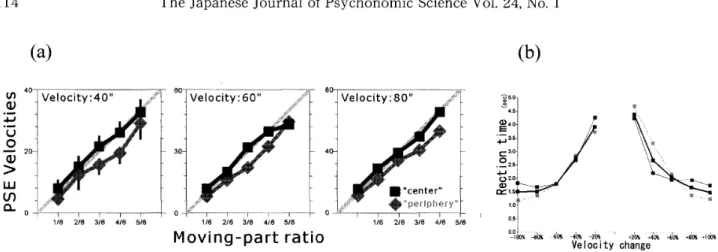
ratioResults A noticeable change in depth was not
reported by any of
the
participants,In
addition,the
PSE
wcre clearly proportional to the ratio of the"rnoving
part",as shown
in
Figure
la.
In otherwords, the perceived
depths
were equal when theaveraged velocity between both stimuli was equaL
The
correlation coefficients of the "movingpart"
ra-tioand thc
PSE
velocity wcre allaboveO.72,
for
all ofthe individualdata sets
Cnot
the avcraged data}.
Experiment
2
Experiment 1suggested thatpercieued depth from
motion parallax isaveraged over a tirneperiod. To
examine thispossibilitythe amount of the velocity
changes were manipulated.
It
was proposed thatif
the motion parallax was averaged temporally, the
amount of the velocity change would beina reversc
proportion to the time to exceed the threshold
to
noticc thc change indepth,
Methods
Thebasic
settings were similar to thosein
expcriment1,
but
only one stimulus waspre-sented
in
thisexperiment.The
ve]ocity of thestimu-luswas suddenly changed after some cycles of
head
reciprocation. This velocity change was varied in11
steps
frem
-100%
to+100% of the velocitybefore
the change, The times of thevelocity changes were
at 2,4,6,and 2.25,4.25,and 6.25cycles of
reciproca-tion.
The
first
three conditionsdid
notinclude
anabrupt change because the velocity change occurred
at a point where
the
stimulus djd not have anymotion. The other conditions however, included an
abrupt change ofvelocity. The participantsreported a change of the depth which was perceived
by
press-ing
kcy, andtheir
reaction time after the changeonomic Sclence Vol.24,No. 1
(b)
Ti.o--・・1
4S F.,..
84n
t' '・,'gl: "'' 'x,,,,'s,.
:.s
',
tt
p L.' 020Ei.,III
i-・'・i.'li'{
US 716 3te 4V6 5fe / {'t' M.P/tai'za des -bk
-!ca.
'
.2os
.4'es'
i'os .e'os,Edm
VeloGityeltange
occurred was recorded,
Results
The
reaction times of the subjects werealmost constant
for
all of the times of velocitychange and the reaction time was inreverse
propor-tionto theamount of velocity change, as shown in
Figure lb. This result agreed with the expectation
that the reaction time would
be
reverselypropor-tionaltethe amount of velocity change. Moreovcr, a
differencebetween the abrupt and non-abrupt
cha-nges was not reflected
in
the
reaction time.The
resu!ts indicatedthattheternporalcharacteristics of
thechange of motion parallaxhad a weak cffect on
the perccption of a
depth
change.
Discussion
The proportionality found inthe two experiments suggests that the fluctuatingvelocity signal
is
aver-aged over a presentation period,
The
lack
ofdetec-tion of abrupt motion changes found in thesecond
experirnent also supports
this
proposaLThe
integra-tion time should
be
one second orlonger,
becausethere was one switch inthe motion velocity within
each periodof head movement. However. the
pre-sent experiments were not able to
determin
which ofboth,
motion anddepth
system,lead
tothe response characteristics.References
Rogers,
B.&
Graham,
M. 1979Motion
paral]ax as anindependent cue for depth.
perception.
Ilerception,
8,
125-139.
Ullman,
S.
1984 The incremental recovery of3-D
structure from rigid and nonrigid motion.